


Community hub
Recent from talks
Contribute something
Nothing was collected or created yet.
Engelberg
View on Wikipedia
 | This article may incorporate text from a large language model. (October 2025) |

Key Information


Engelberg (lit.: mountain of angel(s)) is a village resort and a municipality in the canton of Obwalden in Switzerland. Alongside the central village of Engelberg, the municipality encompasses additional settlements, including Grafenort, Oberberg and Schwand.
The municipality of Engelberg is an exclave, entirely encircled by the neighboring cantons of Bern, Nidwalden and Uri.
Engelberg is a mountain resort in Central Switzerland. In the Middle Ages, the area garnered recognition for its Benedictine monastery, known as Engelberg Abbey. As time progressed, particularly from the 19th century onwards, Engelberg became a well-known mountain resort.[citation needed] The city of Lucerne serves as the nearest major urban center.
While the official language of Engelberg is German, the predominant spoken language is the local variation of the Alemannic Swiss German dialect.
History
[edit]Engelberg's earliest mention dates to 1122, denoted as Engilperc, concurrent with the founding of the Abbey. Prior to this, the Alpine pasture of Trüebsee was already collectively utilized by the locals.[1]
In August 1815, as Nidwalden hesitated in accepting the Federal Treaty, Engelberg promptly expressed its support. Federal troops entered Nidwalden, ultimately prompting their acceptance of the treaty on 18 August 1815. Consequently, Engelberg was incorporated into the canton of Obwalden.[2]
The mid-19th century ushered in Engelberg's emergence as a vacation destination, known for its therapeutic mineral water, milk serum and fresh air. The efforts of families such as Cattani, Hess, and Odermatt led to the establishment of a number of hotels, cementing the region's status as a tourist destination. Related developments included the construction of a broader road between 1872 and 1874, as well as the inauguration of the Stansstad-Engelberg electric railway in 1898.[1]
Engelberg's reputation as a hub for hiking and other mountain activities grew toward the end of the 19th century.[citation needed] The winter season made its debut in 1903-1904. The Gerschnialpbahn, a funicular railway (unveiled in 1913), connected Engelberg to Gerschni with a subsequent cable car (inaugurated in 1927) extending the journey to Ober Trüebsee. The pre-World War I era was characterized by robust growth, as indicated by a substantial influx of visitors (165,922 visitor-nights in 1911). The expansion of roadways and the extension of the railway to Lucerne (achieved in 1964) enhanced the accessibility of Engelberg. Further advancements were marked by the opening of the higher segment of the Titlis cable car in 1967. Over time, Engelberg's appeal extended beyond tourism, hosting regular conferences. By the turn of the millennium, the tertiary sector, particularly tourism, contributed significantly to employment in Engelberg.[1]
Geography
[edit]
Engelberg is situated within the Uri Alps mountain range.
Engelberg is surrounded by several mountain summits, such as Titlis in the south (3,238 metres (10,623 ft)) above sea level), the Walenstöcke (2,572 metres (8,438 ft)) and Ruchstock (2,813 metres (9,229 ft)) to the north, Hahnen (2,606 metres (8,550 ft)) and Wissberg (2,627 metres (8,619 ft)) to the east, the Engelberger Rotstock (2,819 metres (9,249 ft)) and the Wissigstock (2,887 metres (9,472 ft)) to the northeast, and the upper valley of the Engelberger Aa leading to the Surenen Pass (2,291 metres (7,516 ft)) leading to the Urner Reusstal.[3]
Engelberg has an area (as of the 2004/09 survey) of 74.87 km2 (28.91 sq mi).[4] Of this area, about 27.1% is used for agricultural purposes, while 25.8% is forested. Of the rest of the land, 3.7% is settled (buildings or roads) and 43.5% is unproductive land. In the 2013/18 survey a total of 146 ha (360 acres) or about 1.9% of the total area was covered with buildings, an increase of 35 ha (86 acres) over the 1980/81 amount. Over the same time period, the amount of recreational space in the municipality increased by 34 ha (84 acres) and is now about 0.61% of the total area. Of the agricultural land, 685 ha (1,690 acres) is fields and grasslands and 1,424 ha (3,520 acres) consists of alpine grazing areas. Since 1980/81 the amount of agricultural land has decreased by 156 ha (390 acres). Over the same time period the amount of forested land has increased by 103 ha (250 acres). Rivers and lakes cover 78 ha (190 acres) in the municipality.[5][6]
The average altitude of Engelberg is 1,020 m (3,350 ft). However the village is surrounded by the Alps, creating very steep terrain. The highest point in the borders of the municipality is the Titlis. The Engelberg Valley (German: Engelbergertal) is drained by the Engelberger Aa, a tributary of Lake Lucerne. The valley is located southwards from the lake.[3]
Transport
[edit]The municipality of Engelberg is served by two stations on the Luzern–Stans–Engelberg line. Engelberg railway station is located in the village and is the terminus of the line. Grafenort station is to the north, one station away. Both stations are served by hourly InterRegio trains from the city of Lucerne.[7]
A free bus system provides daytime transport within the village, with a network of seven routes during the winter season (from December through to April) and a single route during the summer season (from April until October).[8]
Drahtseilbahn Engelberg–Hotel Terrasse, a funicular from the village to Hotel Terrace operated from 1905 to 2008, with some interruptions. Gerschnialpbahn opened in 1913.
Tourism
[edit]The tourist activities in the village and surrounding area include skiing and other snow sports in the winter season, and hiking and mountain activities during the summer.
In the village itself the main sights are the Benedictine monastery Engelberg Abbey which incorporates a cheese factory and demonstration shop, the Talmuseum showing the history of the area and Swiss rural life, and a number of old chapels.
The winter sports season generally lasts from December until April, although the high altitude glacier areas on the Titlis can sometimes be used (by advanced skiers) from October until May.[9] Snow coverage is generally reliable, although in recent years artificial snow machines have been installed on some of the lower altitude runs in order to improve snow cover.

Engelberg hosts a round of the ski jumping World Cup at the Gross-Titlis-Schanze jump.

In common with the rest of Switzerland, there is a village celebration for Swiss National Day on 1 August, with parades and events throughout the day.
On the last Saturday in September the Alpabzug takes place, when the cattle are brought from the mountain pastures back to their winter barns in the village and valley.
There are three main mountain areas, accessible from the village, offering various activities in winter and summer. The cable cars generally run all year round, providing access for hikers and mountain bikers as well as skiers.
Titlis
[edit]The Titlis in the south of Engelberg at 3,238 metres (10,623 ft) above sea level is the highest summit of the range north of the Susten Pass, between the Bernese Oberland and Central Switzerland.
The Titlis mountain massif is accessible by cable cars of the Titlis Bergbahnen. The cable car bottom station is also the central terminus of the village bus services. A funicular railway (dating from 1913) runs up to station Gerschnialp (1,267 m (4,157 ft)) and a wide Alpine pasture called Gerschni, with easy snow areas suitable for beginners and cross country ski trails, and a toboggan run leading back down to the valley station. In the summer there are two cheese dairies, with walking trails leading up to Ober Trüebsee and back down to the village, or level trails leading to Unter Trüebsee to the west.
The "Titlis Xpress" gondola lift, opened in 2015 to replace an older one dating from the 1970s, runs from the valley station (996 m (3,268 ft)) up to the middle station Trübsee (1,788 m (5,866 ft)) and on to Stand (2,428 m (7,966 ft)). This area provides more challenging skiing, on the lower slopes of the Titlis and via further chair lifts to the Jochpass (2,207 m (7,241 ft)) and below the Jochstock at 2,508 m (8,228 ft). A continuous ski piste leads down to Unter Trüebsee and back to the cable car valley station. In summer the lake is a destination for walkers, with rowing boats available on the lake and picnic places around it.[citation needed] Walking routes lead over the Jochpass to Engstlenalp and Melchsee-Frutt, or directly from Engleberg over the Juchli Pass (2,171 m (7,123 ft)) or Storegg Pass (1,742 m (5,715 ft))) into the Melchtal.
The "Rotair" cable car ("the world's first rotating cable car") runs up to the Kleintitlis mountain station (3,028 m (9,934 ft)) where there is a restaurant and shops, an observation terrace and access to the glacier and summit. The high altitude glacier runs down from the peak are suitable for advanced skiers, with off-piste routes leading down to Trüebsee and the Laubersgrat ridge.
Brunni
[edit]The Brunni mountain area, to the north of the village, is accessible from the cable car station which runs up to Ristis (1,600 m (5,200 ft)), with a further chair lift up to Brunnihütte (1,860 m (6,100 ft)). The ski runs here are of a beginner to medium standard, although sometimes not having so much snow cover as the Titlis side due to the south facing aspect. There is another toboggan run from Brunnihütte back down to Ristis. In summer there are a number of walking trails starting from here, including the Walenpfad leading to Bannalp and the Rot Grätli ridge across the mountains to the north and northeast. There are also a number of prepared rock climbing routes (German: Klettersteig).
Fürenalp
[edit]At the eastern end of the Engelberg valley, there is a cable car up to Fürenalp (1,840 m (6,040 ft)), passing over the Fürenwand rock climbing area. From the top station or from the valley, summer walking routes with views of the Chli Spannort (3,140 m (10,300 ft)) and Gross Spannort (3,198 m (10,492 ft)) mountain peaks lead to the Surenenpass (2,291 m (7,516 ft)) in the east.
Heritage sites
[edit]Engelberg is home to three sites that are Swiss heritage sites of national significance; Engelberg Abbey with its library, archives and music collection, the mansion (Herrenhaus) in Grafenort and the Holy Cross chapel in Grafenort.[10]
-
-
 Mansion in Grafenort with Garden Pavillon
 -
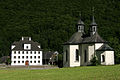 Holy Cross Chapel


Demographics
[edit]The historical population is given in the following table:[1]
| Year | Population |
|---|---|
| 1709 | 678 |
| 1799 | 1,468 |
| 1850 | 1,737 |
| 1900 | 1,973 |
| 1950 | 2,544 |
| 2000 | 3,544 |
| 2010 | 3,859[11] |
- Roman Catholic (66.0%)
- Swiss Reformed Church (13.0%)
- Other Christian/religion (12.0%)
- Undeclared/unaffiliated (9.00%)
Engelberg has a population (as of December 2020[update]) of 4,194.[12] As of 2016[update], 26.2% of the population are resident foreign nationals. In 2015 a small minority (259 or 6.3% of the population) was born in Germany.[13] Over the last 6 years (2010-2016) the population has changed at a rate of 5.92%. The birth rate in the municipality, in 2016, was 8.3, while the death rate was 5.8 per thousand residents.[6]
As of 2016[update], children and teenagers (0–19 years old) make up 17.7% of the population, while adults (20–64 years old) are 61.4% of the population and seniors (over 64 years old) make up 20.9%.[6] In 2015 there were 1,762 single residents, 1,808 people who were married or in a civil partnership, 230 widows or widowers and 297 divorced residents.[14]
In 2016 there were 1,925 private households in Engelberg with an average household size of 2.10 persons. In 2015 about 43% of all buildings in the municipality were single family homes, which is about the same as the percentage in the canton (44.4%) and less than the percentage nationally (57.4%).[15] Of the 1,302 inhabited buildings in the municipality, in 2000, about 48.5% were single family homes and 34.4% were multiple family buildings. Additionally, about 17.1% of the buildings were built before 1919, while 9.4% were built between 1991 and 2000.[16] In 2015 the rate of construction of new housing units per 1000 residents was 8.3. The vacancy rate for the municipality, in 2017[update], was 0.92%.[6]
Most of the population (as of 2000[update]) speaks German as their mother tongue (88.2%), with Serbo-Croatian being second most common (2.5%) and English being third (2.2%).[17] As of 2000[update] the gender distribution of the population was 49.9% male and 50.1% female.
Politics
[edit] | This section needs to be updated. (July 2019) |
In the 2015 federal election small, local parties received 53.5% of the vote and the SVP received the remainder (46.5%). In the federal election, a total of 1,476 votes were cast, and the voter turnout was 56.4%.[18]
In the 2007 election the most popular party was the SVP which received 37.4% of the vote. The next three most popular parties were a variety of other parties (not major) (28.6%), the CVP (22.7%) and the SPS (11.3%).
Education
[edit]In Engelberg about 65.5% of the population (between age 25–64) have completed either non-mandatory upper secondary education or additional higher education (either university or a Fachhochschule).[17]
Business and industry
[edit]Engelberg is classed as a tourist community.[19]
As of 2014[update], there were a total of 2,547 people employed in the municipality. Of these, a total of 143 people worked in 56 businesses in the primary economic sector. The secondary sector employed 267 workers in 54 separate businesses, of which 6 businesses employed a total of 117 employees. Finally, the tertiary sector provided 2,137 jobs in 372 businesses.[20]
In 2016 a total of 8.3% of the population received social assistance.[6] In 2011 the unemployment rate in the municipality was 1.1%.[21]
In 2015 local hotels had a total of 354,960 overnight stays, of which 67.1% were international visitors.[22]
In 2015 the average cantonal, municipal and church tax rate in the municipality for a couple with two children making SFr 80,000 was 5.5% while the rate for a single person making SFr 150,000 was 11.1%, both of which are much lower than the average for the canton. The canton has a slightly higher than average tax rate for those making SFr 80,000 and one of the lowest for those making SFr 150,000. In 2013 the average income in the municipality per tax payer was SFr 88,070 and the per person average was SFr 45,328, which is greater than the cantonal averages of SFr 87,563 and SFr 38,842 respectively It is also greater than the national per tax payer average of SFr 82,682 and the per person average of SFr 35,825.[23]
Due to the risks of filming in the disputed region of Kashmir, many Indian films requiring a Kashmir snowy mountain setting have been filmed in Engelberg in the recent past.[24][25]
Cultural references
[edit]Engelberg is mentioned in chapter XXIV of Henry James's 1875 novel Roderick Hudson.
Climate
[edit]Between 1991 and 2020 Engelberg had an average of 151 days of rain or snow per year and on average received 1,568 mm (61.7 in) of precipitation. The wettest month was July with 198 mm (7.8 in) of precipitation over 15.7 days. However June had the most precipitation days (15.9) but only 179 mm (7.0 in). The driest months of the year was February with 81 mm (3.2 in) of precipitation over 10.0 days.[26]
This area has a long winter season, with little precipitation mostly in the form of snow, and low humidity. The Köppen Climate System classifies the climate in Engelberg as Oceanic.[27] MeteoSwiss's classification is Central Alpine northslope.[26]
| Climate data for Engelberg, elevation 1,036 m (3,399 ft), (1991–2020 normals, extremes 1973–present) | |||||||||||||
|---|---|---|---|---|---|---|---|---|---|---|---|---|---|
| Month | Jan | Feb | Mar | Apr | May | Jun | Jul | Aug | Sep | Oct | Nov | Dec | Year |
| Record high °C (°F) | 16.1 (61.0) |
16.5 (61.7) |
20.9 (69.6) |
24.0 (75.2) |
28.2 (82.8) |
31.5 (88.7) |
33.1 (91.6) |
32.4 (90.3) |
29.5 (85.1) |
24.9 (76.8) |
20.5 (68.9) |
18.4 (65.1) |
33.1 (91.6) |
| Mean daily maximum °C (°F) | 2.0 (35.6) |
3.0 (37.4) |
7.3 (45.1) |
11.7 (53.1) |
16.0 (60.8) |
19.3 (66.7) |
21.0 (69.8) |
20.6 (69.1) |
16.3 (61.3) |
12.2 (54.0) |
6.4 (43.5) |
2.8 (37.0) |
11.6 (52.9) |
| Daily mean °C (°F) | −1.7 (28.9) |
−1.1 (30.0) |
2.5 (36.5) |
6.3 (43.3) |
10.4 (50.7) |
13.8 (56.8) |
15.4 (59.7) |
15.2 (59.4) |
11.4 (52.5) |
7.6 (45.7) |
2.5 (36.5) |
−0.8 (30.6) |
6.8 (44.2) |
| Mean daily minimum °C (°F) | −5.3 (22.5) |
−5.1 (22.8) |
−1.7 (28.9) |
1.5 (34.7) |
5.4 (41.7) |
8.9 (48.0) |
10.7 (51.3) |
10.7 (51.3) |
7.2 (45.0) |
3.8 (38.8) |
−0.9 (30.4) |
−4.2 (24.4) |
2.6 (36.7) |
| Record low °C (°F) | −27.3 (−17.1) |
−23.8 (−10.8) |
−21.3 (−6.3) |
−12.7 (9.1) |
−5.6 (21.9) |
−0.5 (31.1) |
0.9 (33.6) |
1.7 (35.1) |
−1.8 (28.8) |
−12.0 (10.4) |
−16.4 (2.5) |
−21.7 (−7.1) |
−27.3 (−17.1) |
| Average precipitation mm (inches) | 89.4 (3.52) |
81.3 (3.20) |
98.5 (3.88) |
112.1 (4.41) |
165.7 (6.52) |
178.6 (7.03) |
198.2 (7.80) |
196.2 (7.72) |
128.0 (5.04) |
109.8 (4.32) |
102.5 (4.04) |
107.2 (4.22) |
1,567.5 (61.71) |
| Average snowfall cm (inches) | 78.5 (30.9) |
82.1 (32.3) |
75.4 (29.7) |
43.2 (17.0) |
3.6 (1.4) |
0.0 (0.0) |
0.0 (0.0) |
0.0 (0.0) |
0.0 (0.0) |
7.1 (2.8) |
52.5 (20.7) |
72.4 (28.5) |
414.8 (163.3) |
| Average precipitation days (≥ 1.0 mm) | 11.4 | 10.0 | 12.2 | 12.0 | 14.5 | 15.9 | 15.7 | 14.7 | 11.7 | 10.3 | 10.9 | 11.7 | 151.0 |
| Average snowy days (≥ 1.0 cm) | 8.4 | 8.1 | 7.8 | 5.4 | 0.8 | 0.0 | 0.0 | 0.0 | 0.0 | 0.7 | 5.2 | 8.3 | 44.7 |
| Average relative humidity (%) | 79 | 77 | 74 | 72 | 76 | 78 | 79 | 81 | 84 | 82 | 81 | 80 | 79 |
| Mean monthly sunshine hours | 51.1 | 91.8 | 128.2 | 146.4 | 147.4 | 158.1 | 164.0 | 156.5 | 131.5 | 112.0 | 61.5 | 31.3 | 1,379.8 |
| Percentage possible sunshine | 46 | 47 | 46 | 47 | 42 | 42 | 45 | 48 | 46 | 47 | 44 | 42 | 45 |
| Source 1: NOAA[28] | |||||||||||||
| Source 2: MeteoSwiss (snow 1981–2010)[26][29]Infoclimat (extremes)[30] | |||||||||||||
Notable people
[edit]
- Baroness Felicitas von Reznicek, (1904-1997 in Engelberg), German writer, a British agent during WWII
- Herbert Matter (1907–1984) an American photographer and graphic designer, used photomontage
- Giuseppe Piazzi (1907–1963 in Engelberg), bishop of Bergamo
- Hermann Hess Helfenstein (1916-2008) a Swiss naturalist, explorer, climber and engineer.
Sport
[edit]- Rolf Olinger (1924–2006) a Swiss alpine skier and bronze medallist at the 1948 Winter Olympics
- Erika Hess (born 1962), bronze medallist at the Alpine skiing at the 1980 Winter Olympics
- Dominique Gisin (born 1985), gold medallist at the Alpine skiing at the 2014 Winter Olympics
- Denise Feierabend (born 1989) a Swiss former World Cup alpine ski racer.
- Michelle Gisin (born 1993) alpine ski racer, gold medallist at the 2018 & 2022 Winter Olympics.
- Lena Häcki (born 1995), Junior Biathlon silver medallist.[31]
- Fabian Bösch (born 1997), Olympic freestyle skier and 2015 slopestyle gold medallist
- Fabio Scherer (born 1999), racing driver
References
[edit]- ^ a b c d Engelberg in German, French and Italian in the online Historical Dictionary of Switzerland.
- ^ Canton of Nidwalden in German, French and Italian in the online Historical Dictionary of Switzerland.
- ^ a b "Swiss Topo Map, Municipal Boundaries". map.geo.admin.ch. Retrieved 2 October 2019.
- ^ Arealstatistik Standard - Gemeindedaten nach 4 Hauptbereichen
- ^ "Arealstatistik Land Use – Gemeinden nach 10 Klassen". landuse-stat.admin.ch. Swiss Federal Statistical Office. 24 November 2016. Retrieved 14 February 2018.
- ^ a b c d e Regionalporträts 2018: Swiss Federal Statistical Office (in German) accessed 17 September 2018
- ^ "Luzern–Stans–Engelberg" (PDF). Bundesamt für Verkehr. Retrieved 14 January 2013.
- ^ "Engelberg Transportmittel". Engelberg-Titlis Tourismus AG. Retrieved 18 January 2017.
- ^ "Titlis Snowsport". Engelberg Titlis. Titlis Bergbahnen AG. Retrieved 28 January 2017.
- ^ "Swiss inventory of cultural property of national and regional significance". A-Objects. Federal Office for Cultural Protection (BABS). 1 January 2018. Archived from the original on 28 June 2010. Retrieved 2 October 2019.
- ^ a b "Bevölkerungsstatistik 2010" (PDF). Gemeinde Engelberg (German). Archived from the original (PDF) on 5 February 2016. Retrieved 12 January 2016.
- ^ "Ständige und nichtständige Wohnbevölkerung nach institutionellen Gliederungen, Geburtsort und Staatsangehörigkeit". bfs.admin.ch (in German). Swiss Federal Statistical Office - STAT-TAB. 31 December 2020. Retrieved 21 September 2021.
- ^ Federal Statistical Office – Ständige und nichtständige Wohnbevölkerung nach institutionellen Gliederungen, Geburtsort und Staatsangehörigkeit (Land) accessed 31 October 2016
- ^ Swiss Federal Statistical Office – Ständige und nichtständige Wohnbevölkerung nach institutionellen Gliederungen, Geschlecht, Zivilstand und Geburtsort (in German) accessed 8 September 2016
- ^ Statistical Atlas of Switzerland – Anteil Einfamilienhäuser am gesamten Gebäudebestand, 2015 accessed 18 May 2017
- ^ Swiss Federal Statistical Office STAT-TAB – Thema 09 – Bau- und Wohnungswesen (in German) accessed 5 May 2016
- ^ a b Swiss Federal Statistical Office Archived 5 January 2016 at the Wayback Machine accessed 03-Sep-2009
- ^ "Nationalratswahlen 2015: Stärke der Parteien und Wahlbeteiligung nach Gemeinden" [National council elections 2015: strength of the parties and voter turnout by municipality] (in German). Swiss Federal Statistical Office. Archived from the original on 2 August 2016. Retrieved 18 July 2016.
- ^ "Die Raumgliederungen der Schweiz 2016" (in German, French, Italian, and English). Neuchâtel, Switzerland: Swiss Federal Statistical Office. 17 February 2016. Retrieved 14 December 2016.
- ^ Federal Statistical Office -Arbeitsstätten und Beschäftigte nach Gemeinde, Wirtschaftssektor und Grössenklasse accessed 31 October 2016
- ^ "Arbeitslosenquote 2011". Statistical Atlas of Switzerland. Swiss Federal Statistical Office. Retrieved 4 May 2017.
- ^ Federal Statistical Office – Hotellerie: Ankünfte und Logiernächte der geöffneten Betriebe accessed 31 October 2016
- ^ "18 – Öffentliche Finanzen > Steuern". Swiss Atlas. Swiss Federal Statistical Office. Retrieved 26 April 2017.
- ^ "Bollywood in Switzerland". Der Arbeitsmarkt (in German) (6/2007). Zurich, Switzerland. June 2007. Retrieved 9 May 2018.
- ^ JOHN TAGLIABUE (11 July 2010). "A Beloved Bollywood Extra Draws Indians". The New York Times. New York, USA. Retrieved 9 May 2018.
- ^ a b c "Climate Normals Engelberg (Reference period 1991−2020)" (PDF). Swiss Federal Office of Meteorology and Climatology, MeteoSwiss. Archived from the original (PDF) on 26 January 2022. Retrieved 26 January 2022.
- ^ Climate Summary for Engelberg
- ^ "World Meteorological Organization Climate Normals for 1991–2020". World Meteorological Organization Climatological Standard Normals (1991–2020). National Oceanic and Atmospheric Administration. Archived from the original on 11 December 2024. Retrieved 11 December 2024.
- ^ "Climate Normals Engelberg (Reference period 1981−2010)" (PDF). Swiss Federal Office of Meteorology and Climatology, MeteoSwiss. Archived from the original (PDF) on 26 December 2019. Retrieved 26 January 2022.
- ^ "Normales et records pour la période 1991-2020 ENGELBERG". Infoclimat. Retrieved 14 September 2025.
- ^ Andrea Hurschler. "Engelberg-Magazin". No. Sommer 2016. Engelberg-Titlis Tourismus AG. p. 6.
External links
[edit]

- Municipality Engelberg
- Engelberg Tourism website
- Coolidge, William Augustus Brevoort (1911). . Encyclopædia Britannica. Vol. 9 (11th ed.). p. 405.
- Titlis website
- Brunni website
Municipalities in the Canton of Obwalden, Switzerland | ||
|---|---|---|
 | ||
| International | |
|---|---|
| National | |
| Geographic | |
| Other | |


Engelberg
View on GrokipediaGeography
Location and Topography
Engelberg is a municipality in the canton of Obwalden, central Switzerland, positioned at approximately 46°49′N 8°24′E. It occupies an area of 74.84 km² and serves as the endpoint of a narrow alpine valley branching from the larger Lucerne region. The village center lies at an elevation of about 1,000 meters above sea level, within a landscape dominated by forested slopes and glacial features.[8][9] The topography of Engelberg features steep, rugged terrain characteristic of the Urner Alps, with the municipality surrounded by high summits that create a dramatic vertical relief. Mount Titlis, the dominant peak to the south, reaches 3,238 meters, while the average local altitude hovers around 1,020 meters, escalating rapidly into alpine meadows, rock faces, and permanent snowfields above the treeline. This configuration results in a compact valley floor—primarily used for settlement and agriculture—flanked by inaccessible cliffs and cirques, fostering a microclimate influenced by orographic precipitation.[10][11][7] Prominent surrounding features include the Hahnen at 2,606 meters overlooking the valley and the Walenstöcke range exceeding 2,500 meters, contributing to the area's isolation until modern infrastructure development. The relief map of Obwalden highlights Engelberg's position amid these elevations, where glacial erosion has shaped U-shaped valleys and moraine deposits, supporting year-round tourism via cableways accessing higher altitudes up to 3,020 meters.[12][13]Climate and Environment
Engelberg, situated at an elevation of 1,020 meters in a valley flanked by peaks over 3,000 meters high, exhibits a Central Alpine north slope climate as classified by MeteoSwiss, marked by pronounced seasonal variations with long, cold winters and short, mild summers. The region receives abundant orographic precipitation, averaging approximately 2,000 mm annually, with much falling as snow from November to April, accumulating depths suitable for winter sports. Mean daily temperatures peak at around 19°C in July and drop to -1°C in January, while nighttime lows average -8°C during the coldest months, reflecting the influence of altitude and surrounding topography. Under the Köppen-Geiger system, the climate aligns with Dfc characteristics, indicating subarctic conditions with cool summers and severe winters, though local data from the Engelberg station records an annual mean minimum temperature near 4°C based on historical observations.[14][15] The environment encompasses diverse alpine ecosystems, including coniferous forests dominated by spruce and fir up to the treeline, subalpine meadows rich in endemic flora such as edelweiss and alpine roses, and higher glacial zones with perpetual snow preserving unique minerals.[16] Fauna includes chamois, Alpine ibex, marmots, red deer, and avian species like golden eagles, supported by the rugged terrain and proximity to the Titlis glacier.[17] Conservation measures feature designated protected game areas restricting access to minimize disturbance to wildlife habitats, alongside local initiatives for sustainable land use amid tourism pressures.[18] These efforts aim to balance ecological preservation with economic activities, though empirical monitoring indicates ongoing challenges from climate-driven shifts in species distribution and glacier retreat observed in the broader Swiss Alps.[19]History
Founding of the Abbey and Early Settlement
The Benedictine Abbey of Engelberg was founded in 1120 by Count Konrad von Sellenbüren, a nobleman who donated lands in the remote Engelberg Valley for the purpose of establishing a monastic community.[3][20] This foundation occurred under the auspices of the Benedictine order, with the first abbot being Blessed Adelhelm, a monk transferred from St. Blasien Abbey in the Black Forest.[21] The abbey's establishment on April 1, 1120, marked a pivotal moment, transforming the valley from a sparsely used alpine pasturage into a center of religious and communal activity.[22] The name "Engelberg," translating to "mountain of angels" in German, reflects the site's perceived spiritual significance, likely inspired by the founder's devotion or early monastic traditions associating the location with divine presence.[20] Initial inhabitants included monks from existing Benedictine houses, such as Muri Abbey, who formed the core community and began cultivating the surrounding lands for sustenance and self-sufficiency.[3] These early residents engaged in agriculture, herding, and manuscript production, laying the groundwork for economic activities that supported both the monastery and emerging lay settlements. Settlement expanded gradually as the abbey attracted serfs, artisans, and pilgrims, fostering the development of villages under monastic oversight. By the mid-12th century, the valley's population had grown, with the abbey exercising temporal authority over lands and dependents, which facilitated organized habitation and resource management in the challenging mountainous terrain.[3] This early phase established Engelberg as a self-contained ecclesiastical territory, insulated from broader feudal conflicts due to its isolated geography and papal protections granted soon after founding.[21]Medieval and Early Modern Periods
Following its founding, the Engelberg Abbey consolidated its authority in the medieval period, with abbots wielding both ecclesiastical and secular power over the surrounding valley and its inhabitants.[3] Under the second abbot, Frowin, the monastery achieved status as an independent entity under imperial protection, establishing a scriptorium that supported manuscript production and a growing library.[20] A devastating fire in 1305 damaged the complex, prompting the construction of a new church consecrated in 1325.[20] By the late Middle Ages, the abbey sought and received protection from the Swiss Confederation's estates amid regional conflicts, though retaining significant local jurisdiction.[20] [21] In the early modern era, successive abbots pursued reforms to enhance monastic discipline and valley administration. Abbot Barnabas Burcky, serving from 1506 to 1546, elevated standards of observance and promoted agricultural improvements, efforts partially offset by recurrent plagues.[20] Later, Abbot Jakob Benedikt Sigerist reorganized internal structures and reaffirmed the abbey's legal privileges.[20] A catastrophic fire on August 29, 1729, destroyed the church and much of the monastery, leading to reconstruction in early Baroque style completed by 1737 under Abbot Emmanuel Crivelli (1731–1749).[20] The abbey's temporal rule endured until 1798, when French revolutionary forces invaded Switzerland, establishing the Helvetic Republic and dissolving monastic jurisdictions, thereby granting the Engelberg valley political autonomy.[3]Industrialization, Tourism Development, and Modern Era
Engelberg's economy exhibited minimal industrialization, constrained by its remote alpine topography, which preserved a focus on agriculture, dairy farming, and pastoral activities rather than manufacturing or heavy industry.[23] Tourism emerged in the mid-19th century as a health resort, spearheaded by physician Carl Cattani, who transformed the Engel Inn—operated by his family since 1823—into Switzerland's first spa hotel by the 1840s, promoting cures based on fresh mountain air, mineral springs, and milk serum for respiratory ailments like tuberculosis.[24] A surge in hotel construction occurred from the 1860s through World War I, with landmarks such as the Grand Hotel Kuranstalt opening in 1898 to accommodate affluent international guests.[24] The completion of the Stansstad-Engelberg electric cogwheel railway in 1898 dramatically improved access from Lucerne, facilitating a boom in summer and nascent winter visitors.[25] Early 20th-century infrastructure advancements included the Engelberg-Gerschnialp cableway in 1913 and Switzerland's inaugural aerial cableway from Gerschnialp to Trübsee in 1927, enabling reliable mountain excursions and supporting emerging ski activities.[4] Engelberg gained prominence by hosting the FIS Alpine Ski World Championships in 1938.[4] Postwar expansion featured the Stand-Titlis cable car opening on May 9, 1967, extending access to high-altitude skiing, followed by the Titlis Rotair—the world's first rotating cableway—inaugurated on December 20, 1992, which enhanced panoramic views and visitor capacity.[4] Corporate consolidation, including the 1982-1983 merger into BEGT AG and the 1992 formation of Bergbahnen Engelberg-Trübsee-Titlis AG, streamlined operations amid rising demand.[4] In the modern era, tourism has become the dominant economic driver, propelling sustained population growth and infrastructure investments while emphasizing sustainability to balance environmental pressures from year-round activities like skiing and hiking.[26][27]Monastery and Religious Heritage
Engelberg Abbey: Architecture and History
The Engelberg Abbey, a Benedictine monastery, was founded in 1120 by Count Conrad von Sellenbüren, with its initial community established by monks dispatched from Muri Abbey.[3][28] The abbey's early history involved rapid expansion, as it acquired lands and privileges, becoming a significant ecclesiastical and territorial power in the Engelberg Valley; by the medieval period, abbots exercised both spiritual authority and secular lordship over the region until the French Revolutionary invasions of 1798 curtailed their temporal powers.[3] The monastery endured multiple catastrophes, including three major fires—the most devastating occurring on August 29, 1729, which razed much of the complex—prompting successive reconstructions that preserved its centrality in local religious and cultural life.[29] Despite secularization pressures in the 19th century, the abbey maintained continuity, with approximately 30 monks residing and operating it as of the early 21st century.[28] Architecturally, the current abbey ensemble reflects Baroque reconstruction efforts following the 1729 fire, completed by 1737 under the direction of architect Johann Rüeff, who adapted earlier concepts by Caspar Moosbrugger dating to 1704.[30][20] The complex forms a substantial, enclosed quadrangle with an inner courtyard, dominated on its northern flank by the monastery church, characterized by early Baroque elements including pilasters, gables, and a prominent tower on the facade.[30] Internally, the church features a spacious nave adorned with elaborate stuccowork, frescoes, and high decorative quality, aligning with Central Swiss Baroque traditions that emphasize grandeur and monastical symbolism.[20] The overall structures, among the largest Baroque monastic layouts in central Switzerland, integrate functional monastic spaces such as libraries and workshops while prioritizing aesthetic harmony with the alpine surroundings.[30]Role in Local Society and Economy
The Engelberg Abbey serves as a cornerstone of local society, providing pastoral care to the Engelberg valley parish since its founding in 1120 and maintaining spiritual guidance for the community through daily monastic practices centered on the Benedictine Rule of prayer and work. With a community of 17 monks supported by secular employees, the abbey fosters close ties with the population via shared faith activities, cultural events, and education, while extending partnerships to 13 surrounding municipalities for regional cooperation. Historically, until 1798, abbots exercised both spiritual and secular authority over the valley, influencing settlement and governance; today, it continues as a hub for reflection, hosting pilgrims, organizations, and universities.[31][32][3] In education, the abbey operates the Stiftsschule Engelberg, one of Switzerland's oldest institutions, where monks teach across subjects in its gymnasium and secondary programs, offering the Swiss Matura since 1909 and emphasizing holistic development rooted in Benedictine values of stability and inquiry into life's essentials. The school integrates vocational training and natural sciences, adapting to modern needs while preserving cultural heritage like historical manuscripts from the abbey's scriptorium, thereby shaping generations in the community.[33] Economically, the abbey ranks as the second-largest employer in Engelberg, after the Titlis mountain railways, managing diverse businesses including cheese dairies producing regional specialties like Engelberger cheese, carpentry for custom woodwork, a florist cultivating flowers and herbs, restaurants offering local delicacies, and guesthouses for visitors. These operations, largely staffed by salaried employees, generate revenue to sustain the monastery, school, parish, and external missions, such as in Cameroon, while contributing to tourism through product sales and events that draw visitors to the valley. The abbey's agricultural, forestry, and hospitality activities further support local sustainability and economic vitality.[32][3][34][33]
Spiritual and Cultural Significance
The Engelberg Abbey embodies profound spiritual significance as a Benedictine stronghold dedicated to Our Lady of the Angels, where monastic life revolves around the Rule of St. Benedict's principles of prayer (ora) and work (labora). Founded in 1120, it has served as a haven for contemplation, drawing pilgrims and dignitaries alike for renewal of body, mind, and soul amid the serene Alpine setting.[35][3] The community's daily rhythm centers on communal choir prayers, including the Liturgy of the Hours, alongside labors that sustain the monastery and support pastoral care for the Engelberg parish, reinforcing its role as the valley's spiritual anchor with about 30 monks residing as of recent records.[31][36][28] Historically, the abbey's abbots wielded quasi-episcopal jurisdiction over vassals and the burgeoning town, extending spiritual oversight that intertwined monastic authority with regional governance until secular reforms diminished such powers in the late 18th century.[21] This legacy underscores a causal link between the monastery's autonomy and the preservation of Catholic orthodoxy in a Protestant-influenced Switzerland, where it maintained educational and charitable functions amid Reformation pressures.[37] Culturally, the abbey has profoundly shaped Engelberg's heritage for over 900 years, from pioneering agriculture and hospitality to fostering artistic traditions like sacred music compositions by monks such as Fathers Benedikt Deuring (1690–1768) and Wolfgang Iten (1712–1769).[3][38] Housing Switzerland's largest church organ, it hosts events that bridge medieval liturgy with contemporary expressions, ensuring the continuity of customs like annual festivals while adapting to tourism without diluting core Benedictine values.[28][6]Economy
Tourism Industry
Tourism dominates Engelberg's economy, serving as the primary source of income and employment for the community. The sector leverages the valley's alpine terrain and proximity to Lucerne, drawing visitors for outdoor pursuits and cultural heritage year-round, with a pronounced emphasis on winter operations.[39] Central to this industry is Titlis Bergbahnen AG, which operates the cableway system ascending to the Titlis glacier at 3,020 meters. In the 2023/24 financial year, the facility accommodated 1,114,729 guests, marking a 3.7% rise from the previous period and yielding an operating income increase of 13 million Swiss francs. This infrastructure not only facilitates access to high-altitude attractions but also underscores tourism's revenue-generating capacity.[40] Public authorities recognize the operator's economic centrality; in July 2024, Engelberg municipality expanded its equity in Titlis Bergbahnen, enhancing local control over a key asset vital to the valley's prosperity.[41] The sector's vulnerability surfaced during the COVID-19 crisis, with hotel overnight stays halving in 2020 relative to prior norms, highlighting reliance on inbound travel and prompting adaptations toward diversified markets and sustainable practices.[42]Skiing and Winter Sports
The Engelberg-Titlis ski area encompasses 82 kilometers of pistes ranging from beginner-friendly blues to demanding blacks, accessible via 24 lifts including eight gondolas and cable cars plus seven chairlifts, with elevations from 1,003 meters in the valley to 3,020 meters at the Titlis glacier summit, yielding a vertical drop of up to 2,017 meters.[43][44][5] Snow reliability is exceptional due to the glacier terrain above 2,000 meters, north-facing slopes, and average upper-mountain snowfall exceeding 10 meters annually, supporting a prolonged season from early October to late May.[45][44][46] Skiing and snowboarding predominate, with a signature 12-kilometer valley descent from the Titlis summit station overcoming 2,000 meters of altitude to reach Engelberg village, offering continuous skiing back to accommodations.[47][48] The area suits intermediates and advanced riders particularly well, featuring steep off-piste freeride zones below the Stand and on the glacier, alongside family-oriented sectors like the Brunni area with additional novice terrain.[44][49] Beyond alpine skiing, winter sports include ski jumping at the Gross-Titlis-Schanze, a floodlit hill hosting FIS Continental Cup events, such as the December 27–28, 2024, competition that drew international athletes.[50] Toboggan runs and winter hiking trails complement the offerings, with cross-country skiing available on groomed loops near the village.[51] Modern infrastructure, including high-capacity cableways, ensures efficient access and minimal queuing.[47]Summer Activities and Hiking
![Engelberg-Titlis cableway wallpaper.JPG][float-right] Engelberg features over 500 kilometers of marked hiking trails during summer, encompassing routes from gentle valley paths to demanding high-alpine paths accessible via cable cars to areas like Brunni, Trübsee, and Mount Titlis.[52][53] The Four Lakes Hike stands out as a prominent panoramic trail linking Trübsee, Tannensee, Storrensee, and Engstlensee, offering views of alpine lakes and peaks with a total length of approximately 21 kilometers and moderate difficulty requiring about seven hours for the full traverse, though sections can be shortened using public transport.[27][54] Other notable themed trails include the Walenpfad, a multi-stage panoramic route incorporating farmers' cableways for access to remote alpine areas, and the Alpine Cheese Trail, which combines hiking with visits to cheese-making sites.[52][55] On Mount Titlis, summer hikers utilize a seasonal pass valid from June to October, granting access to glacier-adjacent paths and adventure trails at elevations up to 3,020 meters, where perpetual snow persists despite warmer months.[56][53] Additional summer pursuits integrated with hiking infrastructure encompass via ferrata climbs and mountain biking on designated paths, supporting Engelberg's role as a year-round alpine destination beyond winter sports.[57][58]Other Sectors and Sustainability
Agriculture and forestry constitute minor but traditional components of Engelberg's economy, reflecting broader patterns in the canton of Obwalden where approximately 10% of employment is in these primary sectors, exceeding the national Swiss average.[59] Local farming families maintain livestock rearing and dairy production on alpine pastures, utilizing cable cars not only for tourism but also for transporting hay and goods to remote meadows, thereby integrating agricultural needs with infrastructural developments.[60] Secondary sector activities, such as small-scale manufacturing and construction, support tourism infrastructure but remain limited in scope, with no large industrial operations dominating the local economy. Engelberg emphasizes sustainability across its operations, earning the #swisstainable label from Switzerland Tourism as one of the country's leading destinations for environmentally conscious practices.[19] Key initiatives include commitments to energy efficiency, climate protection, and the promotion of renewable energy sources, alongside efforts to foster environmentally friendly mobility options like public transport to reduce reliance on private vehicles.[19] The Titlis cableways operator has entered a target agreement with act Cleantech Switzerland to enhance energy optimization and lower CO2 emissions, aligning infrastructural growth with ecological goals.[61] These measures aim to preserve the region's natural assets, including its flora, clean air, and glacial water resources, while guiding visitors toward sustainable holiday choices.[16]Infrastructure and Transport
Road and Rail Access
Engelberg is served by Engelberg railway station, the terminus of the Luzern–Stans–Engelberg line, a 1,000 mm narrow-gauge rack railway operated by Zentralbahn that connects the municipality to Lucerne via Hergiswil and Stans over a distance of approximately 21 kilometers.[62] Trains, including the Luzern–Engelberg Express, depart from Lucerne every hour and cover the route in 43 to 45 minutes, with services extending to Zurich Airport via Lucerne in about 1 hour 45 minutes total.[63] The station provides access to ticket sales, shops, and onward connections for tourists and residents, facilitating frequent travel without the need for transfers within the line.[64] Road access to Engelberg is limited to a single route entering the Engelberg Valley from the north via Stans on the southern shore of Lake Lucerne, as the municipality lies at the end of a cul-de-sac valley without alternative paved connections.[65] Motorists approach from the A2 motorway by exiting at Stans Süd and following cantonal road 393 southeast for about 12 kilometers through the valley, a drive typically taking 20 to 30 minutes from Lucerne depending on traffic and conditions.[66] The road remains drivable in most weather, though winter tires or chains may be required during snow, and parking in Engelberg is managed through designated lots to handle seasonal influxes from tourism.[66] No direct highway extension reaches the village, preserving its relative isolation while ensuring reliable access from central Switzerland.[63]Cable Cars and Mountain Transport
The primary mountain transport systems in Engelberg facilitate access to alpine areas for skiing, hiking, and sightseeing, with the Titlis cableways and Brunni cable car serving as the main infrastructure. These systems connect the valley floor at approximately 1,000 meters above sea level to elevations exceeding 3,000 meters, supporting year-round tourism.[67][68] The Titlis cableways, managed by Titlis Bahnen AG, provide a multi-stage ascent from Engelberg to the Titlis summit at 3,020 meters, completed in about 30 minutes. The system originated with the Engelberg–Gerschnialp cableway, which opened on January 21, 1913, marking the first such transport in the area. Subsequent developments included the aerial cableway from Gerschnialp to Trübsee on December 23, 1927—the first in Switzerland with federal concession—and the Stand–Titlis section on May 9, 1967. The modern route features the Titlis Xpress, an 8-person gondola lift in two sections from Engelberg to the Stand intermediate station, followed by the Titlis Rotair, the world's first revolving aerial cableway inaugurated on December 20, 1992, offering panoramic views during its five-minute summit leg.[4][69][70] The Brunni cable car system, operated by Brunni-Bahnen AG, transports passengers from Engelberg to Ristis at 1,600 meters and onward to Brunni at 1,850 meters via a 3-person chairlift. Initially opened on February 23, 1952, with a 12-seat cabin and capacity of 480 persons per hour over 1,694 meters, it was upgraded to a 65-person cabin in 2008, increasing capacity to 640 persons per hour and reducing travel time to under five minutes to Ristis. Supporting lifts include a 3-seater chairlift from Ristis to Brunnihut commissioned in 1993 with 1,200 persons per hour capacity.[71][68][72] Supplementary transport includes smaller agricultural and residential cableways, such as the Bord Bahn, a private cable car connecting remote farms to Engelberg since 2005, and the year-round Fell-Spis inclined railway for local access. These systems enhance connectivity in the rugged terrain but primarily serve utilitarian purposes rather than mass tourism. Farmers' cableways, often manually operated, provide essential links to isolated alpine pastures and trails.[73][74][55]Recent Infrastructure Projects
In 2021, construction began on the TITLIS Project, a comprehensive modernization initiative by Bergbahnen Engelberg-Trübsee-Titlis AG aimed at enhancing capacity, safety, and visitor experience on Mount Titlis at elevations up to 3,000 meters.[75] The project includes the development of a new single-track aerial tramway, dubbed "Titlis Connect," linking the Stand intermediate station to the summit area, with initial commissioning for material transport in 2025 and passenger operations starting in 2026.[76] This cableway, constructed under extreme alpine conditions, incorporates specialized underload transport systems for efficient freight delivery, minimizing environmental impact during the build phase.[77] A key component is the replacement of the existing summit station with a new, expanded facility designed by architects Herzog & de Meuron, scheduled for completion in 2029 and featuring increased interior space, improved energy efficiency, and panoramic views.[78] The design integrates an underground connecting passageway for passengers and goods, alongside refurbishments to the adjacent viewing tower and snowcat depot, all executed at one of Europe's highest construction sites.[79] Delays due to the COVID-19 pandemic shifted the original timeline, with full operations expected to boost annual capacity from 1.5 million passengers while prioritizing sustainability through reduced material transport emissions.[80] Additional phases involve a new railway line and infrastructure upgrades to support year-round tourism, including enhanced snow management facilities.[81] These developments, costing hundreds of millions of Swiss francs, are funded primarily through operator revenues and align with Switzerland's broader alpine transport resilience goals, though they have faced local scrutiny over construction disruptions.[82] No major road or rail expansions specific to Engelberg valley access have been reported in the 2020-2025 period, with focus remaining on vertical mountain infrastructure.[75]Government and Politics
Municipal Administration
The municipal administration of Engelberg operates under the executive authority of the Einwohnergemeinderat, a five-member council responsible for implementing policies, managing departments, and overseeing daily governance in areas such as education, infrastructure, finance, and public services.[83] [84] Elected by popular vote for four-year terms, the council's composition reflects a mix of independent and party-affiliated members, with elections held as part of Obwalden canton's communal renewal process; the most recent occurred on March 3, 2024, with a second round on April 7, 2024, determining the full slate for the 2024–2028 term.[85] [86] Mike Bacher serves as Talammann (council chairman, equivalent to municipal president), elected in 2024 following the resignation of predecessor Alex Höchli; other members include Cornelia Amstutz (department head for education and sports), Martin Zumbühl (department head for construction and infrastructure), Claudia Christen, and Martin Mahler (Statthalter, or deputy roles assigned as needed).[86] [87] [83] On May 7, 2024, the council allocated departmental responsibilities, with deputies designated for continuity: Bacher deputizes Amstutz in education and sports, while Christen supports Zumbühl in infrastructure.[88] [87] Administrative operations are supported by the Gemeindekanzlei (municipal chancellery) at Dorfstrasse 1, led by Gemeindeschreiber Roman Schleiss, who handles secretarial duties, resident registration, and coordination with the council.[89] [90] Since July 1, 2016, Engelberg has employed a Geschäftsführermodell (management model), where department heads under Geschäftsführer Bendicht Oggier execute council directives, enhancing professional oversight of tourism-dependent services, environmental management, and fiscal planning amid the municipality's 4,200-plus residents and seasonal population influx.[84] [88] The Bürgergemeinde, a separate entity for citizens holding local Heimatrecht, manages communal assets like forests and alpine pastures, distinct from the Einwohnergemeinde's broader administrative purview.[91]Political Landscape and Elections
Engelberg's municipal governance features an Einwohnergemeinderat, a council of five members that functions as both legislative and executive authority, elected every four years through proportional representation by eligible residents aged 18 and older.[83] The council handles local policy on tourism infrastructure, environmental management, and fiscal matters, reflecting the community's emphasis on sustainable development amid heavy reliance on visitor economies. Active political groups include Die Mitte (center-right, successor to CVP), FDP.The Liberals (liberal-conservative), Grünliberale Partei (green-liberal), and occasional independent candidacies, with limited presence from the Swiss People's Party (SVP) or Social Democrats (SP) at the local level.[92] The most recent elections occurred on March 3, 2024 (first round), with a second round on April 7, 2024, yielding a council comprising Cornelia Amstutz and Mike Bacher (Die Mitte), Martin Mahler (FDP), and independents Martin Zumbühl (incumbent) and Claudia Christen (newly elected with 821 votes, edging out Josef Infanger's 679).[86] This resulted in two seats for Die Mitte, one for FDP, and two independents, maintaining a stable center-right majority without representation from progressive or populist national parties. Voter participation details were not publicly detailed, but outcomes underscore preferences for experienced incumbents and non-partisan figures aligned with tourism and conservation priorities.[93] Historically, Engelberg's politics exhibit conservatism influenced by its Catholic heritage and the Benedictine abbey's longstanding role, though federal voting patterns show support split between local lists and SVP, with minimal left-wing traction.[85] Key issues in recent cycles include balancing expansion of ski facilities against ecological concerns, as evidenced by council delegations to regional bodies like the Obwalden Tourism Commission.[94] The absence of major shifts in 2024 indicates continuity in pragmatic, pro-business governance suited to a resort municipality of approximately 4,200 residents.[91]Relations with Canton and Federation
Engelberg was incorporated into the canton of Obwalden in 1815, following Nidwalden's initial refusal to accept the Swiss federal constitution of that year, which prompted federal intervention and the transfer of Engelberg's abbey lands and municipality to Obwalden as compensation. This accession marked the end of Engelberg's prior administrative ties to Nidwalden, where it had been loosely associated amid historical abbey influences, and established it as a distinct exclave of Obwalden, geographically bordered by the cantons of Bern, Nidwalden, and Uri.[33] As one of Obwalden's seven municipalities, Engelberg maintains standard municipal autonomy under Swiss cantonal law, managing local matters such as zoning, communal taxes, and infrastructure while adhering to cantonal oversight in domains including education, public health, and law enforcement.[3] Cantonal relations emphasize fiscal cooperation, with Engelberg contributing significantly to Obwalden's economy through tourism revenues that support shared services like regional transport and emergency response; no notable disputes have arisen since integration, reflecting alignment in the canton's conservative, Catholic political culture.[59] At the federal level, Engelberg's interactions occur primarily through Obwalden's representation in the Swiss Confederation, with municipal residents exercising direct democracy via national referendums and elections for the Federal Assembly. Federal funding for projects, such as alpine infrastructure and environmental protection, flows through cantonal allocations, underscoring Switzerland's decentralized federalism where cantons act as intermediaries between municipalities and the national government.[95] This structure preserves local influence while ensuring compliance with federal standards in areas like immigration and defense.Demographics
Population Statistics and Trends
As of 1 January 2023, Engelberg had a resident population of 4,297.[96] In that year, the municipality recorded 31 births and 38 deaths, yielding a natural balance of -7, while net migration contributed positively with 473 inflows against 383 outflows.[96] These figures reflect a birth rate of 7.1 per 1,000 inhabitants, a death rate of 8.8 per 1,000, and a migration rate of 20.7 per 1,000.[96] The population has exhibited consistent growth over recent decades, increasing by 66% between 1975 and 2015.[97] Estimates place the 2024 population at 4,416, with an annual growth rate of 1.3% from 2020 onward.[1] This results in a low density of approximately 59 inhabitants per square kilometer across the municipality's 74.85 km² area, predominantly shaped by alpine geography.[1]Linguistic and Cultural Composition
The linguistic composition of Engelberg reflects its position within the German-speaking heartland of central Switzerland, where German serves as the official language of administration, education, and public life. The resident population primarily speaks local variants of Alemannic Swiss German dialects, characteristic of the canton of Obwalden, with Standard German used in formal contexts such as signage and media. Foreign residents and tourists introduce multilingual elements, including English and other European languages, but these do not alter the dominant monolingual German framework of the community. Culturally, Engelberg embodies traditional Central Swiss Alpine heritage, profoundly shaped by the Benedictine monastery established in 1120, which has anchored the valley's identity through monastic discipline, liturgical practices, and communal governance for over 900 years.[6] The populace maintains Roman Catholic traditions, including parish feasts, processions, and adherence to Benedictine values of prayer, work, and hospitality, with the abbey functioning as both spiritual center and cultural preserver.[98] Seasonal customs such as Almabtrieb (cattle descents from pastures) and local folk music events underscore agrarian roots, while tourism has integrated modern expressions like international festivals without displacing core conservative, faith-oriented norms.Migration and Social Structure
Engelberg's resident population reached 4,380 in 2023, reflecting an average annual growth of 1.46% from 2020 to 2023.[99] This expansion persists amid a negative natural balance, characterized by a birth rate of 7.1 per 1,000 inhabitants and a death rate of 8.8 per 1,000, underscoring net positive migration as the dominant factor in demographic change.[96] Foreign nationals accounted for 29.7% of the population in 2023, exceeding the 16.4% cantonal average in Obwalden and indicative of sustained inflows tied to the local tourism economy.[99] [100] Predominantly from European countries, these migrants—often in hospitality and service roles—contribute to a younger demographic profile, offsetting the municipality's overall average age of 45.9 years.[99] The social structure features 2,160 families supporting the populace, corresponding to an average household size of about 2.0 persons, consistent with nuclear family norms prevalent in rural Swiss settings.[99] This framework, bolstered by a 52% male to 48% female ratio, integrates migrant labor into a stable community fabric historically shaped by the Benedictine Abbey's emphasis on communal discipline and Catholic traditions, which canton-wide integration efforts further support through language and civic programs.[99] [101]Education and Culture
Educational Institutions
The primary educational institution in Engelberg is the Stiftsschule Engelberg, also known as the Abbey School, operated under the trusteeship of the Benedictine Monastery of Engelberg.[102][103] Established by the monastery with roots tracing to its founding in 1120, the school originally provided instruction by monks but transitioned to primarily lay staff in the 1970s while maintaining a Christian Benedictine framework guided by the abbot.[33] It serves as a coeducational boarding and day school for students aged 11 to 19, enrolling approximately 120 pupils in small classes averaging 12 to 23 students.[104][102] The curriculum encompasses secondary education through an integrative orientation school, followed by four-year or six-year gymnasium programs culminating in a bilingual Swiss Matura certificate in German and English, as well as the International Baccalaureate Diploma Programme, authorized since October 28, 2013.[105][106] Instruction emphasizes bilingualism, with select subjects taught in English, alongside extracurriculars such as sports, music, theater, and reading clubs to foster holistic development.[103] Boarding facilities accommodate students during the week in a communal setting that promotes responsibility and social skills within the monastery's historic environment.[107] Engelberg also hosts the Schweizerische Sportmittelschule Engelberg, a specialized sports middle school founded in 1995 to nurture young talents in winter sports disciplines like alpine skiing, freestyle, and snowboarding.[108] Located at Wydenstrasse 10, it integrates compulsory secondary education with intensive athletic training, supported by Swiss Ski certification, and has produced elite athletes including Olympic champion Marco Odermatt.[109][110] The program balances academic requirements with sport-specific development, enabling participants to pursue professional careers while completing Swiss educational standards.[108]Cultural Events and Traditions
Engelberg's cultural events and traditions are rooted in its Benedictine monastic legacy and alpine pastoral practices. The Abbey of Engelberg, founded in 1120, preserves over 900 years of monastic customs, including liturgical observances, cheese production, and cultural conservation efforts that integrate spiritual life with community education and craftsmanship.[3][6] Guided tours of the abbey provide access to its historical treasures, such as baroque architecture and manuscripts, while occasional recitals and name-day celebrations highlight ongoing musical and communal traditions.[98] Alpine heritage manifests in the annual Alpabzug, or cattle descent, occurring in late September or early October, where herds return from summer pastures decorated with flowers, bells, and ribbons, led by farmers in traditional attire and accompanied by alphorn performances and yodeling.[111][112] This event, part of broader Obwalden customs, underscores seasonal agricultural cycles and communal gatherings, often featuring local markets with homemade goods.[111] Modern cultural programming includes the Zwischentöne Chamber Music Festival, established in 2015 and held annually in September and October, which brings international artists to perform classical and contemporary works in intimate alpine settings, organized by the Merel Quartet.[113] The Valley Museum complements these activities with rotating exhibitions on regional history, preserving artifacts that contextualize Engelberg's evolution from monastic settlement to tourist destination.[98]Notable Cultural References
Engelberg has gained prominence in Indian cinema as a surrogate for restricted filming sites in Kashmir, with its snow-capped peaks and Mount Titlis cable car appearing in over 200 Bollywood productions since the 1990s, boosting tourism from India. The 1995 blockbuster Dilwale Dulhania Le Jayenge, directed by Aditya Chopra and starring Shah Rukh Khan and Kajol, prominently features Titlis sequences, including a preserved cutout of the leads at the summit that draws fans annually.[114][115] Other films, such as Yash Chopra's works from the 1980s onward, popularized the locale for romantic song-and-dance numbers amid alpine vistas, embedding Engelberg in South Asian popular imagination.[116] In Swiss literature, Conrad Ferdinand Meyer (1825–1898) composed the narrative poem Engelberg: Eine Dichtung in 1872, drawing on the Benedictine monastery's medieval lore and the valley's ethereal landscape to explore themes of faith and nature.[117] Meyer's work, part of his realist poetic oeuvre, reflects the site's historical role as a spiritual haven founded in 1120.[118] Contemporary freeride skiing documentaries, like Freeride Symphony (2023) directed by Anton Thorin, showcase Engelberg's off-piste terrain and local rider community, highlighting its status in extreme sports media.[119]Notable People
Sports Personalities
Engelberg has nurtured numerous elite winter sports athletes, leveraging its alpine terrain and facilities like the Titlis ski area for training and competition.[120] Denise Feierabend, born on April 15, 1989, in Engelberg, specialized in alpine skiing, competing for Switzerland at the 2014 Winter Olympics in Sochi and the 2018 Winter Olympics in Pyeongchang, with career highlights including top-10 finishes in World Cup slalom and giant slalom events.[121] Erika Hess, born March 6, 1962, in Grafenort (a district of Engelberg), dominated women's alpine skiing in the 1980s, securing 31 World Cup victories, six world championship gold medals—including three in 1982—and Olympic bronzes in slalom at the 1980 Games in Lake Placid and giant slalom at the 1984 Games in Sarajevo.[122] Lena Häcki-Groß, born July 1, 1995, in Engelberg, is a biathlete who represented Switzerland at the 2018 and 2022 Winter Olympics, achieving World Cup podiums in pursuit and individual events, with two victories in the 2023-24 season and consistent top-15 finishes in overall standings.[123][120] Fabian Bösch, raised in Engelberg and affiliated with SC Engelberg, excels in freestyle skiing, winning world championships in slopestyle (2015) and big air (2017), an X Games gold in big air (2016), and Olympic appearances in 2018 and 2022, known for technical innovations like switch double cork 1080s.[124][125] Other figures include Rolf Olinger (1924–2006), an alpine skier who earned bronze in combined at the 1948 Winter Olympics in St. Moritz.[126]Other Figures in Arts, Science, and Public Life
Herbert Matter (April 25, 1907 – May 8, 1984), born in Engelberg, was a Swiss-American photographer, graphic designer, and filmmaker renowned for pioneering photomontage in commercial art and typography.[127] After early training under engraver Max von Moos in Switzerland and studies at the École des Arts Appliqués in La Chaux-de-Fonds, Matter moved to Paris in 1927, where he apprenticed with Adolphe Mouron (A.M. Cassandre) and collaborated with modernists like Le Corbusier and Fernand Léger.[128] His 1930s posters for Swiss tourism, including promotions for Engelberg and other Alpine destinations, integrated dynamic photographic elements with sans-serif typography, influencing mid-20th-century advertising aesthetics.[129] In 1936, Matter emigrated to the United States, working with Alexey Brodovitch on layouts for Harper's Bazaar and Vogue, and later producing documentary films such as Impressions of Switzerland (1939) for the Swiss Tourist Office.[130] His experimental films and abstract photographs, often exploring light and motion, earned recognition from institutions like the Museum of Modern Art, though he balanced commercial success with fine art pursuits until his death in Southampton, New York.[131] Abbots of Engelberg Abbey have historically shaped regional public life, wielding temporal authority as prince-abbots until the Helvetic Republic's secularization in 1798. Frowin of Engelberg (c. 1082–1132), the abbey's second abbot, expanded its scriptorium and library, fostering medieval scholarship through manuscript production and attracting scholars, which bolstered the monastery's cultural influence amid feudal Switzerland.[21] Modern abbots, such as Christian Meyer (elected 2008), continue as public figures, engaging in community discourse on environmental and infrastructural issues, including the regulation of the Engelberger Aa river initiated by earlier abbots like Barnabas Bürki in 1515.[32]References
- https://commons.wikimedia.org/wiki/File:00_4279_Luftseilbahn_Engelberg_-_Ristis_%28Brunni%29.jpg