Hubbry Logo
ErasmusbrugErasmusbrugMain
Open search
Erasmusbrug
Community hub
Erasmusbrug
logo
8 pages, 0 posts
0 subscribers
Be the first to start a discussion here.
Erasmusbrug
Erasmusbrug
from Wikipedia

The Erasmusbrug (English: "Erasmus Bridge") is a combined cable-stayed and bascule bridge. Construction began in 1986 and was completed in 1996. It crosses the Nieuwe Maas in the centre of Rotterdam, connecting the north and south parts of this city, second largest in the Netherlands. The bridge was named in 1992 after Desiderius Erasmus, a prominent Christian Renaissance humanist also known as Erasmus of Rotterdam. The Erasmus Bridge is Rotterdam's most important landmark and is even part of the city's official logo.[4]

Key Information

History

[edit]

The 802-metre-long (2,631 ft) bridge across the New Meuse was designed by Ben van Berkel and completed in 1996. The cable-stayed bridge section has a single 139-metre-high (456 ft) asymmetrical pale blue pylon with a prominent horizontal base, earning the bridge its nickname "The Swan".[1]

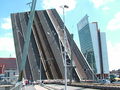
The southernmost span of the bridge has an 89-metre-long (292 ft) bascule bridge for ships that cannot pass under the bridge. The bascule bridge is the largest and heaviest in Western Europe and has the largest panel of its type in the world.

After costing more than 165 million Euros to construct, the bridge was officially opened by Queen Beatrix on September 6, 1996.[5] Shortly after the bridge opened to traffic in October 1996, it was discovered the bridge would swing under particularly strong wind conditions. To reduce the trembling, stronger shock dampers were installed.[6]

Design

[edit]
The bent pylon of the Erasmus Bridge with 16 pairs of front stay cables and 2 sets of back stay cables; back stay cables attached at the minimal height of the third front stay, limiting the cantilever of the upper front cables at the top of the pylon.[7]

During the preliminary design process, many alternative designs were developed. In 1990, one of the review architects, Ben van Berkel, revealed his own design, which was similar to the one Santiago Calatrava used for the Alamillo Bridge in Sevilla, Spain: a single pylon positioned on one side of the river with a backward lean. Because the initially designed 150-m-high concrete bent pylon was to act as a counterweight for the 284-m span, the pylon had no back stays.[1][7]

In the subsequent engineering feasibility study, a number of significant design changes were made. Most importantly, live loads, like 60-ton trucks, would introduce tremendous bending forces into the backward leaning pylon; therefore back stays were added to minimize bending forces. The 150-m-high concrete pylon was changed to a 139-m-high steel pylon. The overall appearance of the bridge design remained intact, however, which proved to be the decisive factor for its selection. In November 1991, the city council chose the highly ambitious backward leaning bent pylon shape and made available the necessary additional funds for the asymmetric bridge.[1][7]

The Erasmus Bridge is the result of an unusual design process in which architects and engineers interacted as equals. In the end this resulted in a bridge that evidences a full commitment to both technical and aesthetic standards.[7]

Two box girder spines & transverse sections under the deck of the Erasmus bridge. The three tall buildings to the right that have views of the bridge are the KPN Tower, De Rotterdam, and the New Orleans.

The thin deck profile was not only aesthetically motivated, but also dictated by a number of technical conditions, e.g., there needed to be a clear shipping height in the centre of the span of 12.5m for at least 200m. The deck was thus designed with two box girder spines, 2.25m high by 1.25m wide, where the cables were attached to support a deck with 4 traffic lanes and 2 tram tracks in between the two spines. The two spines were joined every 4.9m by transverse sections, which were cantilevered out 6.7m either side for the pedestrian and cycle ways.[8]

On the concrete piers, the engineers designed the steel tubes within the concrete piers to support the bridge and the architects designed the concrete form around these inner steel tubes as a sculptural form.[8]

Use in events

[edit]

The bridge featured in the 1998 Jackie Chan film Who Am I?. In 2005, several planes flew underneath the bridge as part of the "Red Bull Air Race". The bridge is also part of The World Port Days in Rotterdam.

In 2005, the bridge served as the backdrop for a performance by DJ Tiësto titled "Tiësto @ The Bridge, Rotterdam". The performance featured fire-fighting ships spraying jets of water into the air in front of the bridge, a fireworks barge launching fireworks beside the bridge, and multi colored spot/search lights attached to the bridge itself.

The bridge was crossed during the prologue and the opening stage of the 2010 Tour de France and during the second stage of the 2015 edition of the Tour. The bridge was also crossed during the 2024 Tour de France Femmes.

The bridge features during an interval act at the Eurovision Song Contest 2021 in the grand final by Dutch DJ Afrojack called “Music Binds Us”.

[edit]

References

[edit]
[edit]
Revisions and contributorsEdit on WikipediaRead on Wikipedia
from Grokipedia
The Erasmus Bridge (Dutch: Erasmusbrug), commonly known as "The " for its elegant, curved , is a cable-stayed in , , that spans the river to connect the city's northern and southern districts. Designed by architects and Caroline Bos of , the bridge measures 802 meters in length, 34 meters in width, and features a distinctive asymmetrical pylon rising 139 meters high, supporting the structure with 40 stay cables. Completed in 1996 after construction from 1990 to 1996, it accommodates four road lanes, a line, paths, and walkways, weighing 6,800 tons in total. Named after the renowned Renaissance humanist Desiderius Erasmus, who was born in in 1466 (or 1469 by some accounts), the bridge honors the city's intellectual heritage while serving as a vital link for urban mobility and redevelopment. Officially opened on September 6, 1996, by Queen Beatrix, it cost approximately 365 million Dutch guilders (equivalent to about 165 million euros) to build and quickly became an iconic symbol of Rotterdam's modern resilience following destruction. The bridge's innovative design not only facilitates the bascule section's rapid two-minute opening for river traffic but also integrates seamlessly into the skyline, acting as a gateway to the Kop van Zuid neighborhood and enhancing the city's identity as a hub of . As Rotterdam's official logo, it represents unity between historic and expanding areas, drawing millions of visitors annually and underscoring the ' engineering prowess in infrastructure.

Location and Context

Geographic Position

The Erasmusbrug spans the river in , , serving as a vital link between the city's northern and southern banks. It connects the Centrum district, encompassing the historic city center on the northern side, to the Kop van Zuid neighborhood on the southern bank, facilitating seamless pedestrian, vehicular, and tram traffic across the waterway. Positioned at geographic coordinates 51°54′32″N 4°29′14″E, the bridge's structure measures 802 meters in total length, with the primary cable-stayed span extending 280 meters over the river. The asymmetrical pylon, a defining feature, reaches a of 139 meters, providing both structural support and a prominent visual landmark. The bridge integrates closely with Rotterdam's waterfront infrastructure, anchoring the northern end near the central boulevards and the southern end within the redeveloped Kop van Zuid area, adjacent to the Wilhelminapier peninsula and the historic Leuvehaven harbor basin. This positioning enhances connectivity to nearby maritime and urban zones, supporting the flow of traffic into surrounding port and residential developments.

Urban and Symbolic Role

The Erasmusbrug serves as a crucial transportation artery in Rotterdam, accommodating pedestrians, cyclists, trams, and vehicular traffic across the river to connect the city's northern and southern . By providing a direct 800-meter span, it significantly streamlines north-south mobility, alleviating congestion on alternative routes and fostering efficient urban flow. Symbolically, the bridge stands as Rotterdam's preeminent , prominently featured in the city's and recognized for its elegant, swan-like that embodies the municipality's modern identity. It attracts countless tourists each year as a must-see , highlighting the city's architectural prowess and drawing visitors to its vantage points for panoramic views of the . The structure also represents Rotterdam's post-World War II reconstruction efforts, emerging as a bold emblem of resilience and innovative ambition in a city largely rebuilt from wartime devastation. In the urban landscape, the Erasmusbrug has been instrumental in the redevelopment of the Kop van Zuid district, converting a derelict former zone into a vibrant mixed-use area with residential, commercial, and office spaces. This transformation, supported by the bridge's connectivity, has integrated the southern waterfront with the , spurring economic growth through enhanced accessibility and attracting around 11,000 residents as of (projected 15,000 by 2010) and supporting significant in the area. By facilitating linkages and private investment, it has bolstered Rotterdam's economy, contributing to a decline in citywide from 17% in 1991 to 6% in 2005 while repositioning the area as a hub for knowledge-based industries.

History and Development

Planning and Design Process

The planning for the Erasmusbrug originated in the late 1980s amid increasing traffic demands across the , as sought to better integrate its northern and southern districts while revitalizing the underdeveloped Kop van Zuid area on the southern bank. Initial conceptualization focused on creating a new north-south axis to alleviate congestion on existing crossings like the De Verrotonde tunnel and Willemsbrug, accommodating growing vehicular, , cycling, and pedestrian flows in a city still recovering from post-war reconstruction. In 1987, Maarten Struijs, an with the Rotterdam Municipal Public Works Department, led the preliminary efforts, proposing a conventional four-mast estimated to cost 325 million Dutch guilders (approximately €147 million). This emphasized structural efficiency for the 800-meter span but prioritized engineering functionality over bold aesthetics. By 1990, as part of an invited review process involving multiple s, of the then newly formed Van Berkel & Bos Architecten (later ) was brought on as a consultant alongside Wim Quist; van Berkel's submission of initial sketches for an asymmetrical single-pylon structure ultimately won selection, marking a shift toward innovative architectural expression. Van Berkel's concept, developed through on-site studies including cycling routes and vantage sketches, symbolized unity between 's divided halves, earning early public affection as "De Zwaan" (The Swan). The design phase entailed close collaboration among architects from Van Berkel & Bos, structural engineers specializing in bridge dynamics, and municipal planners to refine the hybrid form integrating cable-stayed and bascule elements. This interdisciplinary approach transformed traditional engineering-led bridge projects into architecture-driven ones, ensuring the structure met navigational clearances for river traffic while enhancing urban visibility and flow. The cable-stayed bascule hybrid was favored over purely fixed or multi-pylon alternatives for its aesthetic slenderness, which minimized visual obstruction against Rotterdam's , and its functional adaptability, allowing the 89-meter southern span to lift for vessels up to 150 meters long without compromising the main 280-meter cable-stayed section's stability. Budget planning commenced in , setting an initial allocation of 365 million Dutch guilders (equivalent to about €165 million at the time), covering , , and preparatory works. was secured primarily through the of , supplemented by national Dutch government contributions via infrastructure programs, reflecting the bridge's role in regional economic regeneration. This financial framework supported the project's progression to without major overruns, underscoring effective pre-build coordination.

Construction and Opening

The construction of the Erasmusbrug commenced on September 1, 1993, following extensive planning that dated back to 1986, and culminated in its completion in 1996. The project, overseen by the City of Rotterdam's department, involved significant to span the river while accommodating the bustling waterway traffic. Key contractors included Grootint, responsible for fabricating and transporting the 139-meter-tall asymmetrical pylon. Major milestones marked the build's progress amid the dynamic river environment. Foundation and preparatory works laid the groundwork for stability in the shifting riverbed, a critical challenge given the need to anchor deep piles into the sediment-prone soil without disrupting . On April 13, 1995, the pylon was floated into position across the river, a complex operation requiring precise coordination to integrate with existing shipping lanes. Cable installation followed in late 1995, supporting the 280-meter main span, before the bascule section—the largest of its kind in —was installed on January 26, 1996, enabling the bridge to lift for vessels up to 40 meters high. The bridge faced notable hurdles during , particularly in securing riverbed stability through advanced piling techniques to counter scour and movement, and ensuring seamless integration with the via the bascule mechanism that allows over 20,000 ship passages annually. These efforts totaled approximately 365 million Dutch guilders (equivalent to about €165 million), with significant national . Officially opened on September 4, 1996, by Queen Beatrix, the Erasmusbrug's inauguration featured a ceremonial ride across the structure, shows, , and public festivities broadcast live, symbolizing Rotterdam's . Shortly after, in October 1996, the bridge was temporarily closed when its stay cables exhibited large-amplitude vibrations under rain and moderate wind conditions—a phenomenon known as rain-wind-induced vibration—prompting safety concerns. Engineers resolved this by installing tuned hydraulic dampers on the cables in 1997, reducing amplitudes by over 90% and restoring full operations.

Design and Engineering

Architectural Features

The Erasmusbrug features a distinctive asymmetrical white pylon that rises to 139 meters, its harp-like or swan-neck shape contributing to the bridge's popular nickname, "The Swan." This single, inclined pylon, angled at 85 degrees, supports the structure through 40 steel cables arranged in a fan pattern, creating a visually dynamic silhouette that evokes both grace and tension. Designed by under , the pylon's form draws inspiration from the city's industrial heritage while serving as a sculptural . The bridge's deck is a sleek, curved coated in a sky-blue tone that appears white from a distance, spanning the with a main cable-stayed section complemented by a bascule lift for maritime passage. The deck enhances and cyclist experiences by providing unobstructed panoramic views of Rotterdam's and waterfront. These railings not only add an artistic flourish but also integrate safety with aesthetic appeal, allowing light to filter through in subtle patterns. In 2024, the bridge was repainted in its original color as part of efforts. Lighting plays a key role in the bridge's nighttime presence, with an LED system installed in 2017 replacing earlier fixtures to enable energy-efficient, dynamic illumination. Comprising 68 LED fixtures—34 white and 34 multicolored—controlled via DALI protocol, the setup allows for 20 pre-programmed color sequences, transforming the pylon and cables into a for events and seasonal displays. This upgrade reduced energy use by up to 70% compared to the previous system while amplifying the bridge's role as a visual . Embodying a modernist style that blends functionality with sculptural expression, the Erasmusbrug's prioritizes fluid lines and innovative form over rigid symmetry, reflecting UNStudio's parametric approach to as . Separate walkways, elevated slightly from vehicular lanes, incorporate artistic details such as textured surfaces and integrated seating, offering dedicated viewpoints toward landmarks like the nearby Erasmus Tower and the evolving Kop van Zuid district. These elements encourage leisurely traversal, turning the crossing into an experiential journey.

Technical Specifications

The Erasmusbrug employs a hybrid structural design combining a cable-stayed main span of 284 meters supported by 40 stay cables in a fan arrangement from a single asymmetric pylon, with an adjoining 89-meter bascule section that is the largest of its kind in . The deck and pylon are constructed from high-strength , including S460 grade for the pylon and orthotropic steel plating for the deck, while forms the foundations; the pylon is coated in white for protection. The total structural is approximately 6,800 tons. The bridge supports with two vehicular lanes in each direction, dedicated tracks, separate paths, and sidewalks on both sides, facilitating high-volume urban . To counter aerodynamic effects such as rain-wind-induced s, tuned hydraulic dampers were installed in , enhancing stability against gusts up to Beaufort force 6 (approximately 10-13 m/s sustained, with higher peaks). The design incorporates provisions for wind loads up to 30 m/s. Maintenance efforts since the 1996 opening have included routine inspections of cables, deck, and mechanisms, with early remediation of vibration issues in ; as of 2025, no major structural incidents have been reported.

Usage and Events

Transportation Function

The Erasmusbrug functions as a critical in Rotterdam's urban mobility network, facilitating the daily movement of vehicles, , cyclists, and pedestrians between the city's northern districts, such as Centrum, and southern areas like Kop van Zuid. It accommodates mixed on its 802-meter span, including cars traveling along key inner-city routes and operated by the Rotterdamse Elektrische Tram (RET) on lines 7, 23, and 25, which provide essential connectivity across the river. Bicycles and pedestrians share dedicated lanes on the bridge, supporting Rotterdam's emphasis on sustainable short-distance travel to replace car usage and reduce urban emissions. By offering an additional crossing option, the bridge helps alleviate congestion on nearby alternatives like the Willemsbrug, distributing flows more evenly across the city's river crossings. The design allows for efficient passage, with average vehicle crossing times under 2 minutes under normal conditions, enhancing overall network reliability. The structure's integration with Rotterdam's broader system, including nearby metro and bus connections, further supports seamless multimodal journeys for commuters. The bridge's bascule mechanism enables periodic openings for maritime traffic on the busy waterway, occurring several times daily with advance acoustic and visual warnings to minimize disruptions for road and rail users. Accessibility features include widened lanes for cyclists and pedestrians on both sides, promoting safe and inclusive use while aligning with goals to lower carbon emissions through increased in the urban core. Daily usage includes thousands of pedestrians and cyclists, contributing to reduced reliance on motorized transport for local trips.

Cultural and Sporting Events

The Erasmusbrug has served as a prominent venue for high-profile sporting events, particularly in the realm of and . In 2005, 2006, 2008, 2009, and 2010, it hosted the Red Bull Air Race World Championship, where pilots navigated tight courses around the bridge's structure, drawing thousands of spectators to witness the high-speed maneuvers over the river. The bridge's iconic pylon and span provided a dramatic backdrop for these races, with pilots flying under and around it during qualifying and final rounds. In cycling, the Erasmusbrug has been a key feature in major international races. It formed part of the prologue and Stage 1 route for the , serving as the starting point for the race's Dutch leg and allowing riders to cross its length amid cheering crowds. The bridge reappeared in Stage 2 of the , where the traversed it during the 166 km stage from to . More recently, in 2024, it was crossed during Stage 1 of the , contributing to the event's scenic urban route through . The bridge also hosts musical performances and festivals that leverage its architectural prominence. In 2005, Dutch DJ delivered a landmark live set on the Erasmusbrug as part of the TMF Awards, transforming the structure into an open-air stage for electronic music with a massive audience gathered along the riverbanks. For the , held in , the bridge was featured in pre-event recordings and the opening montage "Eurovision: Europe Shine a Light," with special illuminations and closures to capture its silhouette against the city skyline. Annually, the Erasmusbrug anchors Rotterdam's celebrations with a major display, Het Nationale Vuurwerk, launched from its vicinity to light up the harbor and skyline at midnight. This event includes live music, countdown projections, and has become a national broadcast highlight, attracting large crowds despite temporary road and bridge closures starting in the evening for safety. Other recurring events include the , where runners cross the bridge early in the race, starting from its base and heading south, emphasizing its role in the city's endurance sports culture. Additionally, the structure hosts occasional art installations, such as dynamic light projections during festivals, utilizing its LED system to create colorful patterns and thematic displays that enhance evening views. Event organization on the Erasmusbrug involves strict logistics for public safety, including full or partial closures to vehicular and pedestrian traffic hours before major gatherings. Capacities can reach up to 70,000 spectators for spectacles like the New Year's fireworks, with viewing zones along the quaysides and alternative transport encouraged to manage flow.

Cultural Impact and Legacy

The Erasmus Bridge has appeared in several films, notably serving as a key location in the 1998 action thriller Who Am I?, directed by Benny Chan and starring , where a climactic chase scene unfolds on and around the structure as the protagonist evades pursuers. In the 2023 Dutch family film Kung Fu Leeuw, directed by Froukje Tan, the bridge features prominently in exterior shots, highlighting Rotterdam's urban landscape during the young protagonist's adventures. These cinematic depictions have helped cement the bridge's status as a visually striking backdrop for action and coming-of-age narratives. In television and , the bridge has been showcased in promotional content for tourism, such as videos produced by the city's official tourism board that emphasize its role in the skyline and encourage visitors to explore by foot or . While specific BBC documentaries on have not centered on the Erasmus Bridge, it appears in broader segments, like a 2012 BBC guide to destinations, illustrating Rotterdam's post-war architectural revival. The bridge's distinctive swan-like form has made it a staple in , appearing in experiences such as the 2018 online murder mystery game The Bridge by Digital Rocks, where players investigate a set directly on the structure. On platforms, it garners widespread attention under hashtags like #SwanBridge, with often capturing its illuminated nighttime profile against the cityscape, contributing to its viral appeal among travelers and photographers. Literary references portray the Erasmus Bridge as a postmodern of Rotterdam's transformation, featured in architecture texts like / Erasmus Bridge (2004) by Todd Gannon, which analyzes its as a of late-20th-century urban innovation. Travel guides, such as those from , similarly highlight it as an emblem of the city's bold, forward-looking identity, often recommending crossings for panoramic views. Globally, the bridge has achieved recognition through photography in articles on Dutch design, such as a 2015 feature on as the "design capital," where it is praised for its elegant, avian silhouette amid modernist landmarks. It has also been exhibited in design shows, including UNStudio's 2016 20th-anniversary installation at the New Institute in , which showcased models and drawings to underscore its influence on international bridge architecture.

Recognition and Iconic Status

The Erasmusbrug stands as one of Rotterdam's most prominent landmarks, embodying the city's commitment to innovative architecture and . Completed in 1996, its distinctive asymmetrical pylon and sweeping cable-stayed form—often compared to a swan's —have transformed it into a symbol of progress, frequently featured in promotional materials and visual representations of Rotterdam's modern identity. As noted by its designers at , the bridge has "reshaped the city," serving not only as a vital transportation link but also as a cultural beacon that draws global attention to the port city's post-World War II resurgence. The structure's prowess has been recognized for its pioneering use of a single inclined pylon supporting a 320-meter main span combined with a bascule section for maritime clearance. This underscores the bridge's role in advancing cable-stayed principles, influencing subsequent projects by demonstrating how aesthetic ambition can align with functional demands in dense urban environments. Architects and engineers worldwide have cited the Erasmusbrug as a for integrating bold forms with practical considerations, such as wind resistance and navigational efficiency. Preservation efforts highlight the bridge's enduring value amid Rotterdam's evolving skyline. Ongoing maintenance aims to adapt the structure to climate challenges while maintaining its iconic silhouette. As the bridge approaches its 30th anniversary in 2026, city officials are exploring commemorative events to celebrate its legacy, potentially including exhibitions on its design impact and role in urban connectivity. The landmark attracts significant annual foot, vehicular, and tourist traffic, reinforcing its status as a global draw.

References

Add your contribution
Related Hubs
User Avatar
No comments yet.