Hubbry Logo
Erika MannErika MannMain
Open search
Erika Mann
Community hub
Erika Mann
logo
8 pages, 0 posts
0 subscribers
Be the first to start a discussion here.
Erika Mann
Erika Mann
from Wikipedia

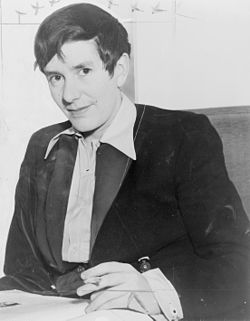
Erika Julia Hedwig Mann (9 November 1905 – 27 August 1969) was a German actress and writer, daughter of the novelist Thomas Mann.

Key Information

Erika lived a bohemian lifestyle in Berlin and became a critic of National Socialism. After Hitler came to power in 1933, she moved to Switzerland, and married the poet W. H. Auden, purely to obtain a British passport and so avoid becoming stateless when the Germans cancelled her citizenship. She continued to attack Nazism, most notably with her 1938 book School for Barbarians, a critique of the Nazi education system.

During World War II, Mann worked for the BBC and became a war correspondent attached to the Allied forces after D-Day. She attended the Nuremberg trials before moving to America to support her exiled parents. Her criticisms of American foreign policy led to her being considered for deportation. After her parents moved to Switzerland in 1952, she also settled there. She wrote a biography of her father and died in Zürich in 1969.

Biography

[edit]

Early life

[edit]

Erika Mann was born in Munich, the first-born daughter of German writer and later Nobel Prize winner Thomas Mann and his wife, Katia (née Pringsheim), the daughter of an intellectual German family of Jewish heritage.[1][2] Due to her being the granddaughter of Júlia da Silva Bruhns, she was also of Portuguese-Indigenous Brazilian partial descent.[3] She was named after Katia Mann's brother Erik, who died early, Thomas Mann's sister Julia [de] and her great-grandmother Hedwig Dohm. She was baptized Protestant, just as her mother had been. Thomas Mann expressed in a letter to his brother Heinrich Mann his disappointment about the birth of his first child:

It is a girl; a disappointment for me, as I want to admit between us, because I had greatly desired a son and will not stop doing so.... I feel a son is much more full of poetry [poesievoller], more than a sequel and restart for myself under new circumstances.[4]

Nevertheless, he later candidly confessed in the notes of his diary, that he "preferred, of the six, the two oldest [Erika and Klaus] and little Elisabeth with a strange decisiveness".[5]

In Erika he had a particular trust, which later showed itself when she exercised great influence on her father's important decisions.[6] Her particular role was also known by her siblings, as her brother Golo Mann remembered: "Little Erika must salt the soup".[7] This reference to the twelve-year-old Erika from the year 1917 was an often-used phrase in the Mann family.

After Erika's birth came that of her brother Klaus, with whom she was personally close her entire life. They went about "like twins" and Klaus described their closeness as follows: "our solidarity was absolute and without reservation".[8] Eventually there were four more children in total, including Golo, Monika, Elisabeth and Michael. The children grew up in Munich. On their mother's side the family belonged to the influential urban upper class and their father came from a commercial family from Lübeck and already had published the successful novel Buddenbrooks in 1901. The Mann home was a gathering-place for intellectuals and artists and Erika was hired for her first theater engagement before finishing her Abitur at the Deutsches Theater in Berlin.

Education and early theatrical work

[edit]

In 1914, the Mann family obtained a villa on 1 Poschingerstraße in Bogenhausen, which in the family would come to be known as "Poschi." From 1912 to 1914, Erika Mann attended a private school with her brother, joining for a year the Bogenhausener Volksschule, and from 1915 to 1920 she attended the Höhere Mädchenschule am St. Annaplatz. In May 1921, she transferred to the Munich-based Luisengymnasium. Together with her brother Klaus, she befriended children in the neighborhood, including Bruno Walter's daughters, Gretel and Lotte Walter, as well as Ricki Hallgarten, the son of a Jewish intellectual family.

Erika Mann founded an ambitious theater troupe, the Laienbund Deutscher Mimiker. While still a student at the Munich Luisengymnasium, Max Reinhardt engaged her to appear on the stage of the Deutsches Theater in Berlin for the first time. The partially mischievous pranks that she undertook in the so-called "Herzogpark-Bande" ("Herzogpark gang") with Klaus and her friends prompted her parents to send both her and Klaus to a progressive residential school, the Bergschule Hochwaldhausen, located in Vogelsberg in Oberhessen. This period in Erika Mann's schooling lasted from April to July 1922; subsequently she returned to the Luisengymnasium. In 1924 she passed the Abitur, albeit with poor marks, and began her theatrical studies in Berlin that were again interrupted, because of her numerous engagements in Hamburg, Munich, Berlin and elsewhere.

1920s and 1930s

[edit]

In 1924, Erika Mann began theater studies in Berlin and acted there and in Bremen. In 1925, she played in the première of her brother Klaus's play Anja und Esther. The play, about a group of four friends who were in love with each other, opened in October 1925 to considerable publicity. In 1924 the actor Gustaf Gründgens had offered to direct the production and play one of the lead male roles, alongside Klaus, with Erika and Pamela Wedekind as the female leads. During the year they worked on the play together, Klaus was engaged to Wedekind and Erika became engaged to Gründgens. Erika and Pamela were also in a relationship together, as were, for a time, Klaus and Gustaf. For their honeymoon, in July 1926, Erika and Gründgens stayed in a hotel that Erika and Wedekind had used as a couple shortly before, with the latter checking in dressed as a man.[9] Erika's marriage to Gründgens was short-lived and they were soon living apart before divorcing in 1929.

In 1936, her brother Klaus wrote the book Mephisto, whose main character was loosely based on Gründgens, posed as a man who sold his soul to the devil, (the Nazis). The book, which drew a lawsuit from Gründgens' nephew in the 1960s, was made into a film of the same name in 1981, starring Klaus Maria Brandauer.

Erika Mann would later have relationships with Therese Giehse, Annemarie Schwarzenbach and Betty Knox, with whom she served as a war correspondent during World War II.[10]

In 1927, Erika and Klaus undertook a trip around the world,[1] which they documented in their book Rundherum; Das Abenteuer einer Weltreise. The following year, she became active in journalism and politics. She was involved as an actor in the 1931 film about lesbianism, Mädchen in Uniform, directed by Leontine Sagan, but left the production before its completion. In 1932 she published Stoffel fliegt übers Meer, the first of seven children's books.

In 1932, Erika Mann was denounced by the Brownshirts after she read a pacifist poem to an anti-war meeting. She was fired from an acting role after the theatre concerned was threatened with a boycott by the Nazis. Mann successfully sued both the theatre and also a Nazi-run newspaper.[11] Also in 1932 Mann had a role, alongside Therese Giehse, in the film Peter Voss, Thief of Millions.

In January 1933, Erika, Klaus and Therese Giehse founded a cabaret in Munich called Die Pfeffermühle, for which Erika wrote most of the material, much of which was anti-Fascist. The cabaret lasted two months before the Nazis forced it to close and Mann left Germany.[11] She was the last member of the Mann family to leave Germany after the Nazi regime was elected. She saved many of Thomas Mann's papers from their Munich home when she escaped to Zürich. In 1936, Die Pfeffermühle opened again in Zürich and became a rallying point for German exiles.

In 1935, it became apparent that the Nazis were intending to strip Mann of her German citizenship; her uncle, Heinrich Mann, was the first person to be stripped of German citizenship when the Nazis took office.[12] She asked Christopher Isherwood if he would marry her so she could become a British citizen. He declined but suggested she approach the gay poet W. H. Auden, who readily agreed to a marriage of convenience in 1935.[13] Mann and Auden never lived together but remained on good terms throughout their lives and were still married when Mann died; she left him a small bequest in her will.[14][15] In 1936, Auden introduced Therese Giehse, Mann's lover, to the writer John Hampson and they too married so that Giehse could leave Germany.[14] In 1937, Mann moved to New York, where Die Pfeffermühle (as The Peppermill) opened its doors again. There Erika Mann lived with Therese Giehse, her brother Klaus and Annemarie Schwarzenbach, amid a large group of artists in exile that included Kurt Weill, Ernst Toller and Sonia Sekula.

In 1938, Mann and Klaus reported on the Spanish Civil War, and her book School for Barbarians, a critique of Nazi Germany's educational system, was published.[13] The following year, they published Escape to Life, a book about famous German exiles.

World War II

[edit]
Female war correspondents in 1944, with Erika Mann on the far right and Betty Knox third from right

During World War II, Mann worked as a journalist in London, making radio broadcasts, in German, for the BBC throughout the Blitz and the Battle of Britain. After D-Day, she became a war correspondent attached to the Allied forces advancing across Europe. She reported from recent battlefields in France, Belgium and the Netherlands.[11] She entered Germany in June 1945 and was among the first Allied personnel to enter Aachen.

As soon as it was possible, she went to Munich to register a claim for the return of the Mann family home. When she arrived in Berlin on 3 July 1945, Mann was shocked at the level of destruction, describing the city as "a sea of devastation, shoreless and infinite".[11] She was equally angry at the complete lack of guilt displayed by some of the German civilians and officials that she met. During this period, as well as wearing an American uniform, Mann adopted an Anglo-American accent.

Mann attended the Nuremberg trial each day from the opening session, on 20 November 1945, until the court adjourned a month later for Christmas. She was present on 26 November when the first film evidence from an extermination camp was shown in the court room.[11] She interviewed the defense lawyers and ridiculed their arguments in her reports and made clear that she thought the court was indulging the behaviour of the defendants, in particular Hermann Göring.[10]

When the court adjourned for Christmas, Mann went to Zürich to spend time with her brother, Betty Knox and Therese Giehse. Mann's health was poor and on 1 January 1946, she collapsed and was hospitalised. Eventually, she was diagnosed with pleurisy. After a spell recovering at a spa in Arosa, Mann returned to Nuremberg in March 1946 to continue covering the war crimes trial.[11] In May 1946, Mann left Germany for California to help look after her father who was being treated for lung cancer.[13]

Later life

[edit]
Gravestone of Erika Mann in Kilchberg

From America, Mann continued to comment on and write about the situation in Germany. She considered it a scandal that Göring had managed to commit suicide and was furious at the slow pace of the denazification process. In particular, Mann objected to what she considered the lenient treatment of cultural figures, such as the conductor Wilhelm Furtwängler, who had stayed in Germany throughout the Nazi period.[16]

Her views on Russia and on the Berlin Airlift led to her being branded a Communist in America.[11] Both Klaus and Erika came under an FBI investigation into their political views and rumored homosexuality. In 1949, becoming increasingly depressed and disillusioned over postwar Germany's occupation, Klaus Mann died by suicide. This event devastated and enraged Erika Mann.[10] In 1952, due to the anti-communist red scare and the numerous accusations from the House Committee on Un-American Activities, the Mann family left the US and she moved back to Switzerland with her parents. She had begun to help her father with his writing and had become one of his closest confidantes. After the deaths of her father and her brother Klaus, Erika Mann became responsible for their works.

Mann died in Zürich on 27 August 1969 from a brain tumour[1] and is buried at Friedhof Kilchberg in Zürich, also the site of her parents' graves.[17][18] She was 63.

Biographical films

[edit]
  • Escape to Life: The Erika & Klaus Mann Story (2000)

Published works

[edit]
  • All the Way Round: A Light-hearted Travel Book (with Klaus Mann, 1929)
  • The Book of the Riviera: Things You Won't Find in Baedekers (with Klaus Mann, 1931)
  • School for Barbarians: Education Under the Nazis (1938)
  • Escape to Life (1939)
  • The Lights go Down (1940)
  • The Other Germany (with Klaus Mann, 1940)
  • A Gang of Ten (1942)
  • The Last Year of Thomas Mann. A Revealing Memoir by His Daughter, Erika Mann (1958)

See also

[edit]

References

[edit]

Further reading

[edit]
[edit]
Revisions and contributorsEdit on WikipediaRead on Wikipedia
from Grokipedia
Erika Julia Hedwig Mann (9 November 1905 – 27 August 1969) was a German actress, writer, and anti-Nazi activist, the eldest daughter of Nobel Prize-winning novelist and his wife Katia Pringsheim Mann. Born in , she began her career in theater and founded the satirical cabaret troupe Die Pfeffermühle (Pepper Mill), which openly mocked the rising Nazi movement in the early 1930s. After fleeing in 1933 following the Nazi seizure of power, Mann became a prominent voice against , delivering lectures across the to warn of Hitler's threats and authoring works like School for Barbarians, which detailed Nazi indoctrination of youth. She collaborated with her brother on anti-Nazi publications such as Escape to Life and served as a war correspondent during , contributing to broadcasts and journalism that aimed to counter Nazi propaganda. Despite personal challenges and the shadow of her father's fame, her relentless advocacy for and human freedom defined her legacy as an early and unyielding opponent of .

Early Life and Family Influences

Birth and Childhood in Munich

Erika Julia Hedwig Mann was born on November 9, 1905, in , , as the first child and eldest daughter of author and his wife, Katia Pringsheim-Mann, who hailed from a prominent academic family; her father, , was a professor of mathematics at the University of , while her mother, Rosalie, came from a background in the . The Mann family resided in Munich's upscale district, in a household marked by intellectual rigor and cultural refinement, reflecting Thomas Mann's rising literary stature following the 1901 publication of , which drew from his own bourgeois roots but was composed amid the family's early years. Erika's early childhood unfolded in this environment of disciplined creativity, where her father's writing routine—often involving up to eight hours daily—and discussions of literature, philosophy, and politics shaped daily life; Thomas Mann later described the household as one prioritizing "work and achievement" over overt affection, a dynamic that influenced his children's development. Her younger brother Klaus arrived in 1906, forging an immediate sibling bond that would later extend to collaborative artistic endeavors, while subsequent siblings—Golo (1909), Monika (1910), Elisabeth (1918), and Michael (1919)—expanded the family amid Thomas Mann's growing fame, including his 1929 Nobel Prize in Literature. The family's Protestant milieu, despite Katia's partial Jewish ancestry through her father's converted lineage, underscored a secular, cosmopolitan upbringing in pre-World War I Munich, free from overt religious observance but immersed in European high culture. By her pre-teen years, Erika displayed early interests in performance and writing, influenced by the theatrical visits and cabaret scenes of 's vibrant cultural life, though formal education began later; the family's stability in the city persisted until economic and political shifts in the 1920s prompted travels, yet remained the anchor of her formative years.

Relationship with and Family Dynamics

Erika Mann, born on November 9, 1905, in , was the eldest of six children born to Nobel Prize-winning author and his wife, Katia Pringsheim Mann, a mathematician's who managed the household and her husband's career logistics. From an early age, Erika enjoyed a uniquely privileged rapport with her father, who harbored a special affection for her and permitted her to speak candid truths to him, setting her apart from her siblings in the intellectually rigorous but emotionally reserved Mann household. , absorbed in his daily writing routine from 9 a.m. to 12:15 p.m., remained a distant paternal figure, exerting influence more through example—his disciplined irony and cheer—than direct nurturing, while Katia handled practical family matters. Erika's bond with deepened into collaboration during the family's following the Nazi rise to power in , as she retrieved his confiscated Joseph manuscript from their home under disguise and later served as his secretary, confidante, and aide in anti-Nazi lectures and propaganda efforts across and the . She remained by his side until his death on August 12, 1955, managing aspects of his and political advocacy, though their relationship was not without tensions, such as Erika's 1936 accusations that Thomas betrayed émigré intellectuals by defending publisher Bermann and undermining brother Klaus's anti-fascist journal Die Sammlung. Family dynamics were marked by the siblings' shared rebellion against bourgeois norms—Erika and Klaus, in particular, formed an inseparable duo in youth, collaborating on performances and writings amid Thomas's repressed (evident in his diaries) and the children's own nonconformist orientations, with Erika bisexual and Klaus homosexual. Exile realigned these ties, with Erika aligning closely to her father at Klaus's expense, exacerbating Klaus's isolation and contributing to familial strains, as Thomas expressed diary concerns over Erika potentially mirroring Klaus's . Despite disputes, the Manns maintained unity in opposing , with Erika and Klaus portraying their father in a 1939 Atlantic as a formative, if aloof, influence through evening story readings and personal anecdotes that instilled ambition and cultural depth.

Education and Entry into Arts

Formal Education and Early Theatrical Training

Erika Mann attended a in with her brother from 1912 to 1914. In May 1921, she enrolled at the Luisengymnasium, a municipal for girls in , where she continued her education amid growing interest in . Although not an exceptional academic performer, Mann demonstrated early aptitude for performance by organizing an amateur theater troupe, the Laienbund Deutscher Mimiker (Lay League of German Mimics), with school friends including ; the group staged improvisational and mimetic productions, reflecting the experimental spirit of Weimar-era . Her formal schooling effectively ended around 1924, as she prioritized theatrical pursuits over completing traditional qualifications. Mann relocated to , where she trained under , the influential director known for innovative staging and ensemble work at his theaters, including the Deutsches Theater. This apprenticeship provided rigorous exposure to acting techniques, voice training, and dramatic interpretation, building on her self-taught foundations from the Munich troupe. By late 1924, at age 19, she secured her first professional acting role at the Bremen Playhouse, marking the transition from informal experimentation to stage work.

Debut in Cabaret and Performing Arts

Erika Mann entered the through theater in the mid-1920s, beginning with studies in in 1924 followed by acting roles in productions there and in . In 1925, she appeared in the premiere of her brother Klaus Mann's play Anja und Esther and toured with a cast that included Pamela Wedekind and , marking her initial professional exposure to stage performance amid the Weimar Republic's vibrant cultural scene. Her debut in occurred in early 1933, when she co-founded the political ensemble Die Pfeffermühle (The Peppermill) in alongside and actress . The opened on January 1, 1933, at the Bonbonnière venue next to the Hofbräuhaus, presenting satirical revues that critiqued and social hypocrisies through , songs, and sketches. Erika Mann authored most of the material for Die Pfeffermühle, drawing on her writing skills to craft anti-fascist content that indirectly targeted the National Socialist movement without overt confrontation, which allowed initial success with sold-out shows in . The ensemble's performances, featuring Mann as a performer and director, expanded beyond via tours, but Nazi pressure led to its closure by March 1933 after the regime's consolidation of power. This brief but influential run established Mann's reputation as a artist committed to .

Career in Writing and Performance

Key Works and Publications Pre-Exile

Erika Mann's earliest notable publication was the collaborative travelogue Rundherum: Abenteuer einer Weltreise (All the Way Round: The Adventure of a Journey), co-authored with her brother and published in 1929 by Rowohlt Verlag. The book chronicles their 1927–1928 journey around the world, funded in part by their parents, offering humorous and observational accounts of encounters in locations from to , emphasizing cultural contrasts and personal escapades without deeper political analysis. This light-hearted work reflected the siblings' bohemian lifestyle and marked Erika's entry into print as a , though it received mixed reviews for its anecdotal style rather than literary depth. Prior to the cabaret phase, Mann contributed witty feature articles to newspapers in the late 1920s, capturing the vibrancy of Weimar-era urban life, theater scandals, and social trends as an embodiment of the "New Woman." These pieces, often unsigned or under pseudonyms, showcased her sharp observational humor but were ephemeral, with no comprehensive collection published pre-exile. In theater, Mann debuted professionally in 1922 at Munich's Münchner Schauspielhaus, taking roles in plays such as Pension Schaller and later appearing in productions across Germany, including Berlin, where she honed her satirical performance style. Her stage work emphasized comedic and cabaret-like elements, blending acting with improvised commentary on contemporary mores. Mann's most prominent pre-exile endeavor was co-founding the Die Pfeffermühle (The Pepper Mill) on January 1, 1933, in Munich's Bonbonnière theater, alongside , , and others. As principal writer and performer, she crafted biting satirical sketches, songs, and monologues targeting political hypocrisy, militarism, and bourgeois conventions, often performing in a signature and as her "Pepita Matador." The troupe's 20 programs drew large crowds—up to 300 nightly—before Nazi pressure forced relocation to Zurich in March 1933 following the regime's ascent on January 30. These unpublished scripts represented Mann's pinnacle of Weimar-era creativity, fusing journalism, theater, and anti-authoritarian wit, though their ephemerality limited lasting publication.

Collaborative Projects with Siblings

Erika Mann collaborated closely with her brother on theatrical and literary projects during the era. In 1925, she toured Germany performing in Klaus's play Anja und Esther alongside actors Pamela Wedekind and , marking an early joint venture into dramatic production. Their most prominent collaboration was the founding of the satirical cabaret troupe Die Pfeffermühle (The Pepper Mill), which debuted on January 1, 1933, in with programs critiquing authoritarian tendencies and the Nazi rise to power. Erika contributed texts and direction, while Klaus participated in performances; the ensemble included actress and musician Magnus Henning, with their father suggesting the name and authoring a supporting essay. The achieved rapid success, staging multiple programs before Nazi authorities banned it in March 1933, prompting . Erika and revived Die Pfeffermühle in starting October 30, 1933, where it ran for nearly two years across German-speaking areas, performing anti-fascist sketches amid and restrictions until disbanding in 1936. In , other Mann siblings occasionally joined efforts to sustain the troupe, reflecting family-wide opposition to , though Erika and led creatively. Beyond performance, the siblings co-authored drawing from shared experiences. Their 1929 book Rundherum: Abenteuer einer Weltreise recounted a 1927 global journey, blending humorous anecdotes with observations on foreign cultures. Later, in 1939 , they jointly edited Escape to Life, a collection of essays by European intellectuals warning against . These works underscored their intertwined artistic output, often infused with political undertones, though primarily executed as a duo rather than involving additional siblings extensively.

Anti-Nazi Activism and Exile

Initial Opposition and Loss of Citizenship

Erika Mann's opposition to the Nazis began in earnest during the early 1930s, manifesting through public advocacy and satirical performances that directly challenged the regime's ideology. In early 1932, she spoke at a women's rally promoting and , prompting the Nazi newspaper to call for a "war of liquidation" against the Mann family. On January 1, 1933, just weeks before Adolf Hitler's appointment as chancellor, Mann co-founded the anti-fascist cabaret Die Pfeffermühle in alongside her brother Klaus and left-wing artists, featuring sketches that lampooned Nazi leaders and doctrines. The cabaret endured initial harassment, including heckling by members at related events, but was shuttered by authorities following the on February 27, 1933, amid escalating suppression of dissent. Faced with mounting threats—including physical danger from Nazi sympathizers in —Mann and fled in mid-March 1933, shortly after the consolidated Hitler's power. They resettled in , where they revived Die Pfeffermühle as an exile troupe, debuting on October 1, 1933, in Zurich with programs explicitly critiquing National Socialism through parables and satire. This exile marked the beginning of Mann's sustained anti-Nazi activism abroad, though her prior domestic efforts had already positioned her among 's most reviled critics of the regime. Mann's German citizenship was formally revoked by the Nazi government in 1935, a consequence of her vocal opposition and the regime's broader expatriation policies targeting émigré intellectuals. This denaturalization occurred shortly after her marriage of convenience to W. H. Auden on June 15, 1935, which she had entered to secure British nationality amid fears of impending revocation; the Nazis acted within days, underscoring their determination to punish prominent exiles like the Manns. Her uncle Heinrich Mann had been among the first stripped of citizenship in 1933, setting a precedent for the family's treatment. The loss severed her legal ties to Germany, compelling reliance on foreign passports—initially British via Auden, later Czechoslovak for the family in 1937—while amplifying her role as a stateless advocate against fascism.

Lecture Tours and Propaganda Efforts in the US

Following her exile from , Erika Mann arrived in the United States in late and promptly initiated a series of lecture tours aimed at alerting Americans to the dangers of the Nazi regime. These efforts were part of a broader campaign by German exiles to counter Nazi influence and advocate for democratic intervention against Hitler. Speaking in fluent English, Mann addressed audiences at high schools, universities, and public forums, emphasizing the totalitarian indoctrination and barbarism of National Socialism. A cornerstone of her propaganda work was the 1938 publication of School for Barbarians: Education Under the Nazis, a exposé detailing how the regime systematically corrupted German youth through state-controlled schooling and programs. The book, issued by Modern Age Books, sold widely and served as a key text in her lectures, where she warned of Nazism's expansionist threats, including encroachments in , and criticized Western policies. Mann's tours, such as the 1939–1940 circuit, included speeches like "The Barbarian" at the on January 11, 1940, where she dissected Nazi educational methods to underscore the ideological war against democracy. Throughout the early 1940s, Mann continued these tours, speaking at institutions like in December 1941 to promote awareness of Nazi atrocities and rally support for the Allied cause. Her presentations often highlighted the personal stakes for exiles, positioning America as a bulwark against , though she faulted democracies for enabling Hitler's rise through inaction. In addition to lectures, she sought to organize German exile groups in the to amplify anti-Nazi voices, though these initiatives faced internal divisions among refugees. By 1944–1945, amid the war's final phases, Mann undertook another extensive tour, reflecting on the lecturer's challenges in an article titled "Lecturer's Lot" published in Liberty magazine on March 24, 1945, where she described the grueling demands of persuading skeptical audiences of Nazism's existential threat. These efforts contributed to shifting American opinion toward unconditional opposition to the Third Reich, leveraging her family's prominence and firsthand exile experience to authenticate her warnings.

World War II Reporting and Advocacy

In 1940, Erika Mann moved to , where she reported on for the Evening Standard and contributed articles to other publications documenting the aerial bombings and civilian resilience. She also began broadcasting for the BBC German Service, delivering messages in German to audiences in Nazi-controlled territories, with the aim of fostering by highlighting Allied determination to end the Hitler regime. These broadcasts numbered seven in 1940, eight in 1941, and two in 1943, often facing British censorship that required softening anti-Nazi rhetoric, such as replacing direct references to "Nazis" with broader terms. As the war progressed, Mann transitioned to frontline reporting, covering the North African campaign, the Normandy landings on June 6, 1944, and the subsequent Allied advances through France into Germany as an accredited correspondent attached to U.S. and British forces. Her dispatches, which emphasized the strategic and human costs of the conflict while underscoring the moral imperative to dismantle Nazi tyranny, appeared in outlets such as the Toronto Star Weekly, New York Herald Tribune, Chicago Daily News, Vogue, and the German-language émigré newspaper Aufbau. In 1942, she briefly consulted for the Voice of America, advising on programming targeted at German women to erode support for the regime, though she resigned that March citing insufficient impact. Mann's wartime efforts combined journalistic observation with explicit advocacy for democracy's triumph over , extending her pre-war critiques—such as her 1938 book School for Barbarians on Nazi —into real-time calls for German capitulation and post-victory reconstruction. Her broadcasts and reports, grounded in eyewitness accounts from bombed cities to advancing fronts, sought to counter Nazi propaganda by portraying the regime's inevitable collapse and the futility of continued loyalty to it. This work positioned her as a bridge between Allied military progress and against the Axis, though her émigré status occasionally limited her platform amid Allied debates over messaging authenticity.

Post-War Life and Political Engagement

Return to Europe and Criticism of American Policy

In the immediate , Erika Mann returned to in mid-1945, surveying the ruins of her homeland and expressing deep disillusionment with its populace, remarking that ", as you know, are hopeless." This brief visit underscored her ongoing commitment to confronting Germany's recent past, though she soon resumed her advocacy work in the United States, where she had resided since 1936. By the early 1950s, however, mounting political pressures in America compelled her permanent return to Europe. Harassed amid the McCarthy-era anti-communist campaigns, Mann faced deportation proceedings initiated around 1950, stemming from U.S. authorities' suspicions of her covert membership in the Communist Party of the —a perception fueled by her pre-war affiliations with groups like the American Artists' Congress, which maintained ties to the party. In 1952, following the death of her brother in 1949 and amid these investigations, she relocated to to join her parents in Kilchberg near , where had already settled after growing disenchantment with American politics. Mann's criticisms of American policy centered on its and the intensifying posture, which she assailed as overly aggressive and shortsighted in public writings and lectures—a stance that exacerbated scrutiny from U.S. officials despite her earlier cooperation as an on potentially subversive exiles during the war. These views, articulated sharply from her vantage as a democratic wary of authoritarian excesses on both sides, reflected her broader skepticism toward post-war realignments, including perceived leniency toward former Nazi collaborators in cultural spheres, though such positions aligned her with left-leaning exile networks prone to ideological overreach. Her outspokenness curtailed her viability as a political in the U.S., marking the effective end of that phase of her career upon her European repatriation.

Advocacy for Democracy and Views on German Guilt

Following , Erika Mann actively promoted the establishment of democratic institutions in , arguing that true required a fundamental reckoning with the Nazi past to prevent authoritarian resurgence. In lectures and writings during the late 1940s, she emphasized re-education programs that would instill democratic values, drawing from her pre-war experiences organizing anti-fascist cabarets and exile advocacy. Mann viewed superficial reforms as insufficient, insisting that Germans must confront their complicity in the regime's atrocities to foster genuine civic responsibility and tolerance. Mann's observations as an early Allied visitor to liberated German cities, including in 1945 and in July of that year, reinforced her conviction that many Germans exhibited a profound absence of remorse, which she saw as a barrier to democratic renewal. She reported encountering civilians and officials who deflected responsibility, portraying themselves as victims of the war's destruction rather than acknowledging active or passive support for , a stance that fueled her calls for rigorous denazification. This lack of self-reflection, in her assessment, stemmed from widespread evasion of moral accountability, making collective introspection essential for rebuilding a stable . Central to Mann's postwar perspective was the concept of collective German guilt—not as indiscriminate punishment, but as a causal prerequisite for ethical reconstruction, where societal participation in the Nazi machinery necessitated shared admission to uproot latent authoritarianism. She critiqued leniency toward former regime collaborators, particularly in cultural spheres, arguing that reintegrating unrepentant figures undermined democratic legitimacy by normalizing past crimes. Her BBC broadcasts and articles, such as those expressing categorical views on this guilt during the war's end, sparked controversy for challenging German audiences directly, though she maintained these positions into the early Cold War era despite shifting Allied priorities toward anti-communism. By the 1950s, as West Germany's rapid economic recovery prioritized stability over exhaustive moral inquiry, Mann's insistence on sustained guilt acknowledgment waned in influence, leading her to settle in Switzerland amid broader disillusionment with incomplete denazification efforts.

Personal Struggles and Relationships

Sexuality, Marriages, and Family Ties

Erika Mann was homosexual, with her romantic relationships centered on women; she had a significant partnership with actress , with whom she lived during exile in the United States starting in 1937. Other notable affairs included journalist and performer . Mann appeared as an extra in the 1931 film , which depicted same-sex attraction between schoolgirls, reflecting her own orientation. Her only marriage occurred on June 15, 1935, to British poet in , ; it was a deliberate arrangement to grant her British citizenship as prepared to strip her of her , with no or , given Auden's . The couple never divorced, and Auden occasionally referenced as his father-in-law in jest until Erika's death. Earlier plans for a sham union with her brother-in-law fell through when he married actor Emilie Charlotte Reeg instead. As the eldest of six children born to and Katia Pringsheim on November 9, 1905, Erika shared an exceptionally close bond with her brother , born January 6, 1906; the siblings collaborated on literary and theatrical projects, often masquerading as twins to emphasize their inseparability, and supported each other's anti-Nazi efforts and identities amid family pressures. She maintained ties to siblings Golo, Monika, Michael, and Elisabeth but prioritized her partnership with , who predeceased her in 1949; Erika had no children of her own.

Health Issues, Drug Use, and Death

Erika Mann experienced deteriorating health in the years following , compounded by the emotional toll of exile, family losses, and ongoing political disillusionment. Postwar records indicate she suffered from respiratory issues, including a collapse requiring hospitalization, though specific diagnoses like remain noted primarily in biographical accounts without primary medical corroboration. Her condition worsened in the , with chronic illness limiting her activities in Kilchberg, , where she had settled in the early . In her final years, Mann was diagnosed with a , which she endured for an extended period before succumbing to the illness. She died on August 27, 1969, at the age of 63 in , . No verified accounts detail significant personal drug use or addiction for Mann herself, unlike her brother , whose struggles with and are well-documented; any substance involvement appears limited to potential medical prescriptions for in her later illness, though primary sources do not specify. She was buried in Kilchberg .

Legacy, Achievements, and Criticisms

Cultural and Political Impact

Erika Mann's performances with the anti-Nazi troupe Die Pfeffermühle, founded in in 1933, blended and political commentary to mock Hitler's regime, influencing exile cultural circles by preserving German cabaret traditions as a vehicle for dissent before the troupe's disbandment in 1937 due to financial pressures. Her writings, including the 1938 book School for Barbarians, exposed the systematic indoctrination of German youth under , drawing on firsthand observations to alert Western audiences to totalitarian education methods and contributing to early critiques of fascist . Politically, Mann's lecture tours across the starting in 1936, often emphasizing the threat of to , helped galvanize anti-fascist sentiment among American intellectuals and policymakers, with her advocacy for boycotts and intervention shaping discussions in exile communities. During , her work as a war correspondent for British publications and broadcaster for the BBC's German service produced propaganda aimed at eroding Nazi support within , including reports from the front lines after D-Day that highlighted Allied advances to demoralize the enemy. Post-war, Mann's return to Germany in 1945 involved efforts to promote democratic re-education amid , where she criticized lingering authoritarian mentalities and advocated for cultural renewal, though her uncompromising stance on collective German responsibility limited her influence as reconstruction prioritized stability over radical reform. Her overall legacy reinforced the émigré intellectual tradition's role in anti-totalitarian discourse, bridging German with Anglo-American , yet her association with leftist anti-fascist networks, including groups linked to the , drew scrutiny in contexts.

Controversies and Balanced Assessments

Erika Mann's collaboration with government agencies, beginning as early as , involved providing information on fellow German exiles, including potential subversives within the community. Declassified files reveal she cooperated willingly with the FBI and other entities for over 15 years, responding to inquiries about associates' political activities and loyalties, often to distinguish between genuine anti-Nazis and those with lingering fascist or communist ties. This role has sparked debate over the ethics of intra-community surveillance, as it positioned her as an amid a group fleeing tyranny, potentially undermining trust among exiles while aiding efforts to screen for threats during wartime and tensions. Compounding this, Mann herself faced intense scrutiny from the FBI, which investigated her and her brother for suspected communist sympathies, , and even unsubstantiated rumors of an incestuous relationship between siblings. These probes, detailed in FBI files, reflected broader suspicions of leftist leanings due to her vocal criticisms of policies and post-war leniency toward former Nazis, such as slow de-Nazification and rehabilitation of collaborators in German cultural institutions. Her outspoken opposition to American , including rearmament debates and perceived softness on ex-Nazis, led to considerations of her in the late and early . Balanced assessments of Mann's legacy highlight her prescient anti-Nazi advocacy—through lectures, broadcasts, and works like School for Barbarians ()—as instrumental in alerting Western audiences to totalitarian dangers before broader recognition. Yet, her informant activities and the reciprocal suspicions against her underscore the precariousness of exile politics, where ideological purity tests fractured solidarity; some scholars argue her cooperation was pragmatic , targeting real risks like Nazi agents, while others view it as compromising the moral high ground of refugee resistance. Her post-war insistence on rigorous German accountability, though principled, appeared increasingly quixotic amid Cold War , diminishing her influence but affirming her unwavering commitment to democratic renewal over expediency. Overall, Mann's contributions remain undervalued relative to her father's, tainted by personal and political entanglements that reveal the human costs of sustained opposition to authoritarianism.

References

Add your contribution
Related Hubs
User Avatar
No comments yet.