Hubbry Logo
Escher Wyss & Cie.Escher Wyss & Cie.Main
Open search
Escher Wyss & Cie.
Community hub
Escher Wyss & Cie.
logo
8 pages, 0 posts
0 subscribers
Be the first to start a discussion here.
Escher Wyss & Cie.
Escher Wyss & Cie.
from Wikipedia
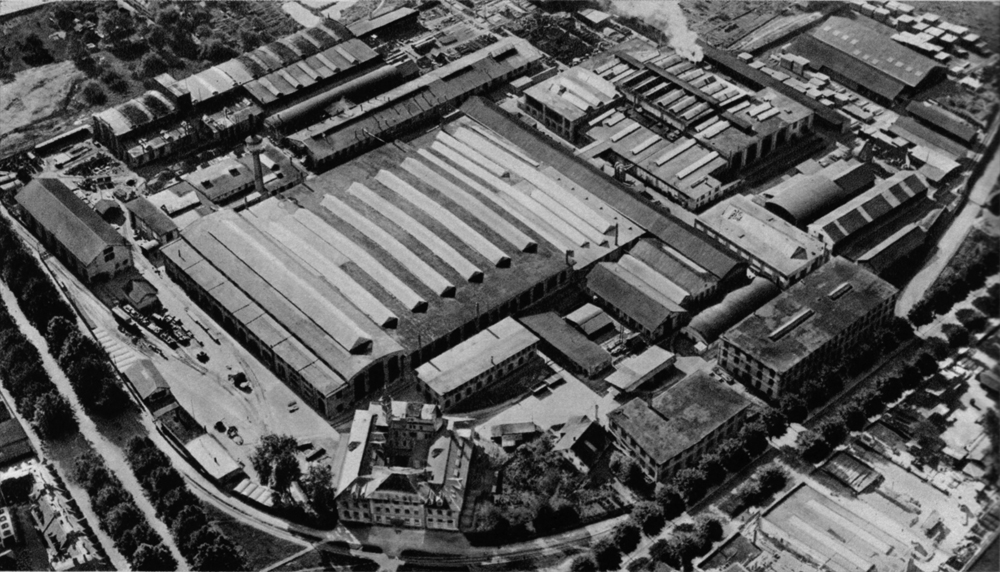
The Escher Wyss plant in Zürich in 1930

Key Information

Escher Wyss's former Schiffbau or shipbuilding hall in Zürich now functions as a cultural centre.
ZSG steamships Stadt Rapperswil and Stadt Zürich at Bürkliplatz respectively Bürkliterrasse.
Share of the AG der Maschinenfabriken Escher Wyss & Cie, issued 1. April 1912

Escher Wyss & Cie., also known as Escher Wyss AG, was a Swiss industrial company focused on engineering and turbine construction. Its headquarters were in the Zürich quarter of Escher Wyss, which takes its name from the company.

History

[edit]

The company was founded, as Escher Wyss & Cie., in 1805 by Hans Caspar Escher and Salomon von Wyss. After having originally started the company as a textile spinning business, the two expanded their enterprise to include a machine shop that manufactured textile machinery, water wheels, water turbines, power transmission equipment, and starting in 1835, ships, including boilers and steam engines.[1]

After 1860, under the direction of Hans Zoelly, the company concentrated on hydraulic systems, steam engines and cooling systems. Between 1904 and 1929 steam turbines were produced for thermal power plants, ships and locomotives. The company also manufactured hydraulic systems for hydroelectric plants. Around this time it provided equipment for Norsk Hydro.[2] During WWII, the company was a supplier for the German war effort manufacturing and supplying flamethrowers.[3] The company remained in existence until it was taken over in 1969 by Sulzer AG,[1] then inside of the group Andritz AG, and was closed in 2014.

Notable products

[edit]

See also

[edit]

References

[edit]
Revisions and contributorsEdit on WikipediaRead on Wikipedia
from Grokipedia
Escher Wyss & Cie., also known as Escher Wyss AG, was a Swiss engineering and manufacturing company founded in 1805 by Hans Caspar Escher and banker Salomon von Wyss in . Initially established as a for machinery amid the Napoleonic era's economic pressures, it pioneered mechanized spinning in and grew into a leading producer of water turbines, steam engines, pressure pipelines, and hydraulic equipment essential for early industrialization and development. The firm expanded significantly in the 19th and early 20th centuries, contributing to Switzerland's industrial base through innovations in and , including the of steamships like the DS Stadt . By the mid-20th century, it had established international offices and focused on advanced solutions, though it faced scrutiny for its German subsidiary's wartime production activities supporting the Nazi regime, including components for and potentially nuclear-related projects. In 1969, Sulzer Brothers acquired full control, leading to mergers such as the formation of Sulzer Escher Wyss AG in 1983, after which operations were restructured around hydraulic turbines and thermal turbomachines until eventual integration into larger conglomerates.

Founding and Early History

Establishment and Initial Focus (1805–1830s)

Escher Wyss & Cie. was established in 1805 in , , by architect Hans Caspar Escher (1775–1859) and banker Salomon von Wyss as a cotton-spinning mill at Neumühle along the River. The venture incorporated advanced British spinning machinery imported via , enabling mechanized production during the economic constraints of the Napoleonic , which restricted direct access to English technology. In 1810, the partners formalized the operation as Escher, Wyss & Cie., launching Switzerland's first dedicated to textile machinery production. Initial output centered on spinning equipment and related apparatus to support the expanding regional sector, drawing on Escher's prior study of French machinery and leveraging water power from nearby sources. This shift marked an early pivot from mere spinning operations to , positioning the firm as a key supplier for Switzerland's nascent industrialization. Through the 1820s, the company concentrated on refining textile production tools, including waterwheels for powering mills, amid growing demand from Zurich's cotton industry. By the , employment had reached approximately 1,200 workers, with the firm pioneering employee welfare initiatives such as , , healthcare, and support for the elderly and disabled—uncommon for the era and reflective of Escher's paternalistic management approach. These developments solidified its role in mechanizing Swiss textiles while laying groundwork for broader mechanical engineering pursuits.

Expansion into Heavy Machinery (1840s–1900)

During the 1840s, Escher Wyss & Cie. shifted from its initial emphasis on textile machinery toward heavier applications, driven by the growing demand for hydraulic power in industrializing . Ferdinand Redtenbacher, an Austrian engineer pivotal to scientific machine design, collaborated closely with the firm during this period, conducting observations and trials at their Zurich facilities to establish empirical principles for machinery construction, including ratios for component sizing and stress analysis. This marked an early adoption of systematic, data-driven methods in , distinguishing Escher Wyss from artisanal workshops. By the mid-19th century, the company had established production of water turbines, leveraging Switzerland's resources and exporting to neighboring regions. In 1839, commissioned Escher Wyss for significant machinery projects, signaling its entry into German industrial markets and underscoring the firm's growing expertise in large-scale and assembly. Key developments included turbines based on designs like those of Benoit Fourneyron and later refinements by local innovators such as Franz Zuppinger, with Escher Wyss constructing Zuppinger-type radial-flow turbines suited for medium-head applications. These machines powered mills, factories, and early , with outputs reaching hundreds of horsepower by the , reflecting advances in and precision . The firm's expansion accelerated in the 1850s–1870s through investments in factory infrastructure, including specialized workshops for turbine runners and casings, as documented in 1875 lithographs of assembly halls handling multi-ton components. By 1856, Escher Wyss established a subsidiary in , , to localize production of hydraulic equipment, facilitating exports and adapting designs for diverse site conditions like varying water heads and flows. Steam engines also entered the portfolio, with vertical condensing types produced by 1900, complementing for reliable industrial drive. This era solidified Escher Wyss's reputation for robust, custom-engineered heavy machinery, contributing to Switzerland's mechanical sector amid rapid and rail expansion.

Core Operations and Innovations

Turbine and Hydropower Engineering

Escher Wyss & Cie. became a prominent manufacturer of , focusing on designs that improved efficiency and control in applications. In the , the company developed a standardized for water turbines utilizing a high-pressure oil system, which provided reliable speed regulation and remained influential in subsequent designs. This addressed key challenges in variable water flow conditions, enabling more stable power output from early hydroelectric installations. By the early , Escher Wyss exported advanced hydraulic technology internationally. In 1887, it supplied three 250-horsepower for a cotton spinning mill at , , linked via wire cable transmission to drive machinery, marking an early example of large-scale equipment deployment in industrial settings. In 1904, the firm licensed its designs to in the United States, facilitating the construction of a 1,250-horsepower unit by and supporting massive projects such as a 70,000-horsepower installed at in 1923. These licenses underscored Escher Wyss's reputation for robust, scalable suited to high-capacity sites. A landmark achievement came in 1936 with the invention of the Bulb turbine at its facilities, adapting the Kaplan turbine's adjustable blades into a compact configuration where the generator is enclosed in a streamlined bulb housing. Optimized for low-head environments (typically under 20 meters), this design minimized hydraulic losses and space requirements, broadening viability for rivers with modest drops and influencing installations worldwide. Escher Wyss's turbines, including Francis and Kaplan variants, powered diverse European projects, emphasizing precision casting and modular assembly for durability under continuous operation.

Other Mechanical Products and Exports

In addition to turbines, Escher Wyss & Cie. manufactured high-pressure air compressors, steam engines for vessels, paper-making machines, and steam boilers as part of its diversified output. These products supported industrial applications ranging from maritime propulsion to pulp and paper processing. The company's compressor designs included axial flow turbo-compressors, patented in the late for multistage operations with intermediate cooling to enhance efficiency in high-pressure systems. Marine mechanical products featured prominently, with Escher Wyss producing steam engines for paddle steamers and other vessels, such as compound cylinder engines exhibited at the for shallow-water navigation. By the 1930s, the firm developed controllable-pitch propellers, first introduced in 1934, which provided adjustable thrust for naval vessels, coast guard ships, mega-yachts, and specialized craft, improving maneuverability and performance in variable conditions. Shipbuilding-related components, including engines and propulsion systems, were assembled at dedicated facilities like the Schiffbau division. Exports of these products extended across and to international markets, with vertical condensing engines supplied to Britain circa 1900 for industrial and maritime use. Paper-making machinery and compressors reached global buyers, while marine engines and propellers supported foreign naval and commercial fleets. The firm's international presence was bolstered by exhibitions and partnerships, enabling technology transfer to regions including the and , where components aided projects like early propulsion prototypes in the 1920s.

World War II Involvement

Wartime Expansion and Production

During , Escher Wyss & Cie., leveraging its German subsidiary in , significantly expanded production to supply components critical to the Nazi war machine, despite Switzerland's official neutrality. The facility shifted focus toward armaments manufacturing, including the assembly and supply of flamethrowers, which were dispatched from Swiss operations under disguised nomenclature to evade export restrictions. This wartime reorientation involved fulfilling large-scale orders from , such as equipment for plants, where Escher Wyss provided turbines and related machinery; production at one such facility commenced in 1941 following Swiss-sourced components. The company's engineering expertise in turbines facilitated the production of propulsion systems, compressors, and propellers for Nazi naval vessels, including submarines and battleships, enhancing Germany's underwater and surface fleet capabilities. Ravensburg operations also contributed to aircraft components, such as starters and altimeters, aligning with broader demands for precision machinery in Luftwaffe applications. This expansion was marked by the Nazi regime's recognition of the Ravensburg plant as a "National Socialist Model Company," reflecting streamlined wartime output and ideological alignment in production efficiency. Escher Wyss further supported Nazi strategic initiatives by supplying turbines for the facility in occupied , which produced essential for Germany's atomic research program under wartime control. Overall, these activities represented a pivot from pre-war and industrial machinery to high-priority military contracts, with the site emerging as a hub for such output amid escalating Axis demands from 1940 onward.

Labor Practices and Armaments Contracts

During , the branch of Escher Wyss & Cie., a Swiss-owned enterprise with operations in , relied on forced labor to sustain production amid acute workforce shortages induced by the Nazi . Historical records indicate that the facility employed 198–203 forced laborers, including prisoners of war, primarily foreign nationals such as French, , and . This practice aligned with the Third Reich's systematic deployment of coerced labor across industries, where Swiss firms operating in German territory often participated to fulfill contractual obligations without direct state compulsion. The company's armaments contracts with encompassed the manufacture of gun parts and related components at sites including and , contributing to the Axis military supply chain. In , Escher Wyss produced flamethrowers at its Zurich facility, dispatching them to under camouflaged designations to circumvent nominal neutrality restrictions; U.S. intelligence reports from 1944 documented these shipments as part of larger orders for the . Such activities underscored the pragmatic economic incentives driving Swiss industrial collaboration, prioritizing export revenues over geopolitical isolation despite public stances of impartiality. Under managing director Eugen Schwab, the Ravensburg operations were designated a "National Socialist Model Company" by Nazi authorities, an accolade bestowed for exemplary productivity and ideological conformity in wartime manufacturing. This status facilitated access to resources and labor allocations, enabling the integration of POWs and other coerced workers into assembly lines for tasks essential to armaments output. Postwar inquiries, drawing from local German archives, confirmed the scale of these practices but noted no evidence of unique brutality beyond regime-wide norms, attributing involvement to survival imperatives in a context.

Leadership Role of Eugen Schwab

Eugen Schwab, a Swiss-born engineer, joined Escher Wyss's subsidiary in around 1935–1936 and rose to become its commercial manager, later serving as managing director during . Under his oversight, the facility—part of the Swiss parent company's German operations—shifted toward intensified production of precision machinery, including hydraulic turbines, pumps, and components critical to the Nazi war machine, such as those supporting propulsion and energy systems. In 1939, the Ravensburg works under Schwab's leadership earned designation as a "National Socialist Model Company," a Nazi program recognizing firms for exemplary alignment with regime economic goals, which granted preferential access to raw materials, contracts, and labor amid wartime shortages. This status enabled expansion, with the factory employing up to several hundred foreign workers, including forced laborers from Poland, the Soviet Union, and French prisoners of war, practices widespread in German industry to sustain output despite domestic manpower deficits. Production included specialized equipment like high-pressure turbines potentially linked to armaments projects, though direct ties to specific weapons such as V-2 rocket components remain asserted in archival investigations but lack universal corroboration in mainstream records. Schwab's tenure emphasized operational efficiency and collaboration with Nazi authorities, including the Armaments Ministry, to secure orders that bolstered the subsidiary's viability within the tightly controlled German economy. Postwar questionnaires in 1946 probed his activities as commercial manager, but proceedings resulted in no classification as an ardent Nazi or party member, with mixed evidence on formal affiliations amid broader scrutiny of industrial leaders. His role exemplified Swiss firms' navigation of neutrality while their German branches integrated into Axis production networks, prioritizing survival through adaptation rather than ideological commitment.

Post-War Trajectory and Acquisition

Reconstruction and Continued Operations (1945–1960s)

Following , Escher Wyss & Cie, headquartered in with its Ravensburg branch in , faced minimal disruption due to Switzerland's neutrality, allowing a swift return to peacetime production without extensive physical reconstruction of facilities. The Ravensburg site, which had produced armaments during the conflict, shifted focus back to products, including turbines and pumps, amid Europe's broader economic recovery. Under continued management by Eugen Schwab, who had overseen the German operations since , the company prioritized its core expertise in equipment to support projects across neutral and Allied nations. A key area of post-war activity involved supplying water turbines for hydroelectric developments, particularly in . Escher Wyss manufactured vertical Francis turbines for Norwegian facilities, such as those in the Tokke and Midskog power plants, contributing to the country's expansion of capacity from 1945 onward as part of national electrification efforts. Concurrently, the firm advanced gas turbine technology; in 1945, engineers including Curt Keller presented foundational theories and test results on closed-cycle gas turbines (Escher Wyss-AK system) to the Swiss Hydraulic Association, marking early experimental work that continued into the with prototypes emphasizing efficiency for industrial applications. By late 1945, Escher Wyss also completed a mechanical vapor recompression system for the Aarberg sugar plant in , demonstrating sustained innovation in energy-efficient machinery. Through the 1950s and into the early 1960s, Escher Wyss maintained robust operations as a major exporter of custom and heavy machinery, focusing on high-head installations and supporting global demand for reliable power generation amid industrial growth. The company's and works produced specialized equipment for international clients, leveraging pre-war designs refined for post-war scalability, while avoiding the scrutiny faced by fully German firms due to its Swiss parentage. This period solidified Escher Wyss's reputation in , with steady output in and emerging gas technologies, setting the stage for its integration into larger conglomerates by the mid-1960s.

Merger with Sulzer (1963–1969)

In the early , Escher Wyss AG experienced a period of prosperity, employing 2,300 people in 1963 amid full order books from post-war reconstruction demands. However, recovering foreign competitors eroded its global market position, particularly in securing high-value international contracts for hydraulic turbines and heavy machinery. These pressures contributed to a strategic merger with Sulzer AG of , a fellow Swiss engineering firm specializing in engines, pumps, and . In , Sulzer acquired a 53% majority stake in Escher Wyss AG in Zurich, initiating the consolidation process. This step enhanced Sulzer's engineering and technology portfolio through complementary expertise in and rotating equipment. The integration culminated in 1969 with Sulzer's complete takeover of Escher Wyss, forming Sulzer Escher-Wyss AG. The merger expanded Sulzer's to over 30,000 employees, reflecting synergies in production and market reach within Switzerland's consolidating sector. Despite these gains, the combined entity later contended with broader industry shifts toward specialization.

Legacy and Contemporary Relevance

Industrial Contributions and Sites

Escher Wyss & Cie pioneered advancements in engineering, notably inventing the first Bulb in 1936, optimized for low-head water applications and influencing global installations. The company specialized in axial-flow turbines, including Kaplan variants, and contributed to standardized intake and outlet designs for low-head systems. These innovations stemmed from its early 19th-century focus on machinery construction, evolving from textile equipment to steam engines, pumps, and pressure pipelines by the mid-1800s. Key manufacturing sites included the headquarters, established in 1805 as Switzerland's first foundry for textile machinery, which expanded into turbine and facilities along the River. The plant's shipbuilding hall, active through the early , later repurposed into a cultural center, reflecting the site's transition from industrial production to urban mixed-use development. In , , a founded in 1856 concentrated on heavy machinery and plant construction, particularly components, continuing operations post-merger under successors like ANDRITZ Hydro. Following the 1969 full integration into Sulzer AG, Escher Wyss's technological legacy persisted in enhanced turbine production and service capabilities, with maintaining focus on European needs. The site's industrial footprint, once central to Switzerland's engineering sector, now hosts innovation hubs like Technopark, underscoring the enduring spatial impact of its operations.

Historical Assessments and Debates

The wartime activities of Escher Wyss & Cie, particularly through its subsidiary, have been assessed in the context of Switzerland's broader industrial engagement with , as detailed in post-war inquiries such as those by the Independent Commission of Experts (Bergier Commission), which documented how Swiss firms with German operations supplied machinery and components critical to the Axis war effort. The plant, under managing director Eugen Schwab, produced specialized equipment including turbines and propellers for naval applications and other military uses, contributing to German armaments production amid labor shortages. Assessments highlight the company's reliance on foreign labor, including forced laborers from occupied territories, consistent with practices at other Swiss-owned facilities in Germany that collectively employed over 11,000 such workers to sustain output. The Ravensburg operation received the "National Socialist Model Company" designation in 1943-1944 for its productivity and alignment with regime priorities, reflecting pragmatic adaptation to Nazi labor and procurement demands rather than ideological commitment. Post-war denazification proceedings cleared Eugen Schwab of formal membership or active ideological involvement, allowing the firm to resume operations without significant penalties, as prioritized economic continuity over retrospective accountability. Debates persist over the extent of complicity, with historians critiquing as enabling profiteering—evidenced by Escher Wyss's wartime expansion and post-1945 merger trajectory—while defenders argue such engagements were economically inevitable given geographic encirclement and pre-war investments in . Recent discussions, often amplified in , exaggerate personal ties (e.g., unsubstantiated claims of Schwab's proximity to Hitler) but underscore verifiable facts of industrial support for the Nazi economy, contrasting with mainstream narratives that minimize non-financial collaboration due to institutional reluctance to revisit wartime decisions. These assessments reveal systemic biases in academic and media sources, which historically underemphasized industrial roles compared to banking scandals, prioritizing national self-image over full causal of neutrality's enablers for Axis sustainment.

References

Add your contribution
Related Hubs
User Avatar
No comments yet.