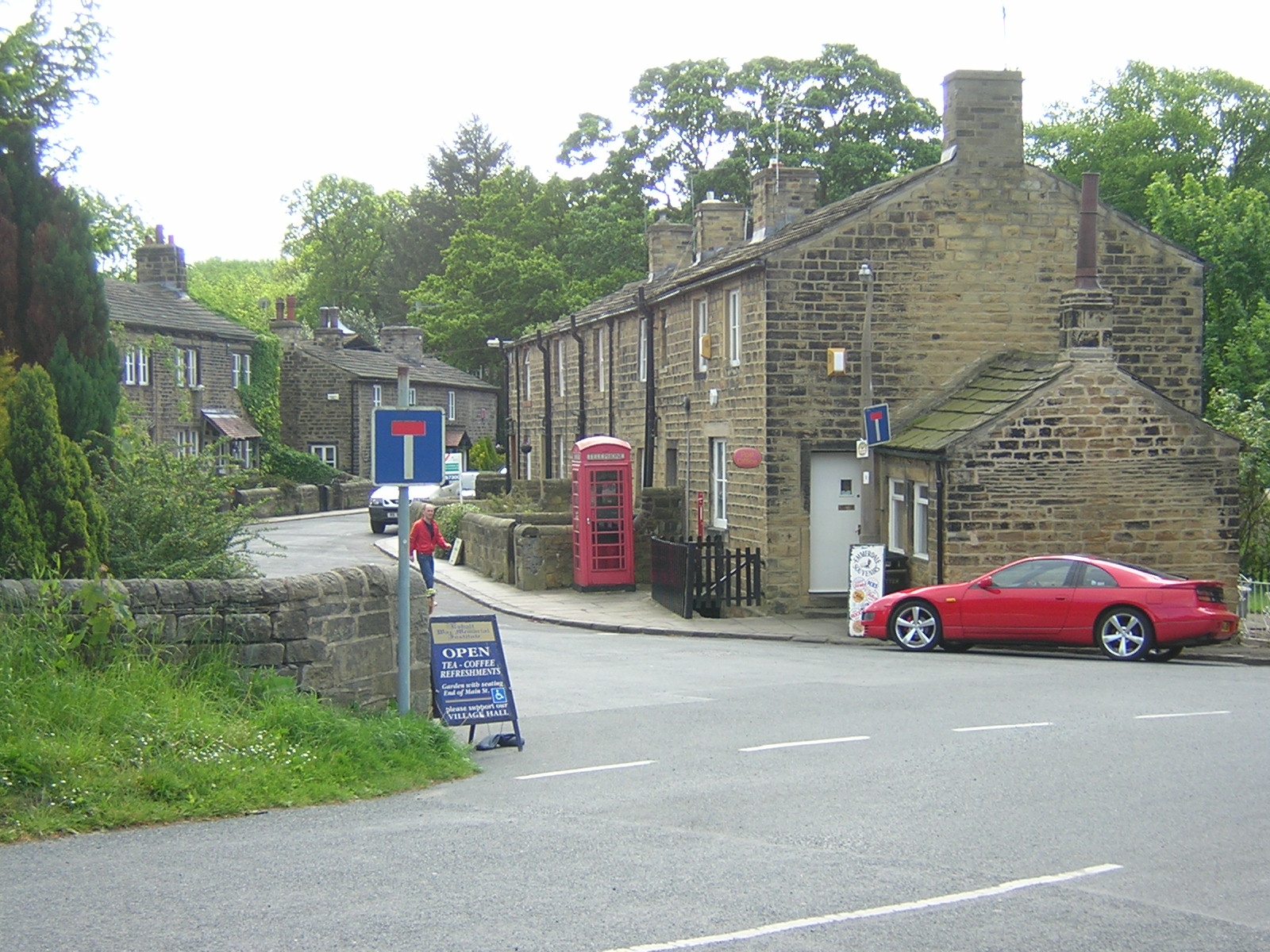
Esholt
Esholt
Main page
2263239

Esholt

logo
Community Hub0 subscribers
Read side by side
from Wikipedia

Esholt is a village and former civil parish in the metropolitan district of the City of Bradford, West Yorkshire, England. It is situated 3 miles (4.8 km) east of Shipley town centre, 1.5 miles (2.4 km) south-west of the A65 in Guiseley, 7 miles (11 km) north of Bradford City Centre, and 10 miles (16 km) north-west of Millennium Square, Leeds.

Key Information

The name "Esholt" indicates that the village was first established in a heavily wooded area of ash trees.[1]

History

[edit]

In the 12th century, the Esholt estate was owned by Syningthwaite Priory, and Esholt Priory, a Cistercian nunnery dedicated to St Mary and St Leonard was established at Lower Esholt.[2][3] When the nunnery was dissolved in about 1547, the estate was granted to Henry Thompson by Edward VI.[2] In the 17th century Frances Thompson, the heiress of Henry Thompson, married Walter Calverley (1629–1694). In 1709 their son Walter Calverley built Esholt Hall, a Queen Anne style mansion house, on the site of the old nunnery.[2] In 1775 the Calverleys sold the estate to Robert Stansfield,[2] whose family remained in possession until 1906, when it was sold to Bradford City Council.[4]

To the north of the village was Esholt railway station, which opened in 1876[5] and closed in 1940. In 1892 a rail crash occurred at Esholt Junction on the Otley and Ilkley Joint Railway.[6][7]

From 1912 to 1915 Nanson, Barker & Co manufactured the Tiny cyclecar in Esholt.[8] In 1919 after the First World War the company made larger cars under the Airedale brand but went into liquidation in 1924.

Just before the First World War land on the estate was used for Airedale Aerodrome.[9] The current owner of the estate, Yorkshire Water, operates a waste water treatment plant on what was the location of the aerodrome.[10] Home farm on the estate is used as a conference and staff learning centre and many buildings have Grade II star listed building status.[11]

Civil parish

[edit]

Esholt was formerly a township and chapelry in the parish of Otley.[12] From 1866 Esholt was a civil parish in its own right. In 1931 the parish had a population of 496.[13] On 1 April 1937 the parish was abolished, with most of the area, including the village itself, being added to the parish of Idle in the County Borough of Bradford, with smaller parts going to Aireborough and Baildon.[14] Since 1937 the village has been administratively part of Bradford, although it remains outside the built-up area of the city.

Landmarks

[edit]
Esholt Old Hall, Church Lane

The manor house, Esholt Old Hall at Upper Esholt is medieval in origin, probably 16th century, and possibly once had a moat. It is well-preserved and has Grade II* listed building status.[11]

Esholt has one public house, The Woolpack a listed building in Main Street.[15]

St. Paul's Church which is a listed building

The Church of Saint Paul was built at a cost of £800 in 1839 by William Rookes Crompton-Stansfield for use as a private family chapel.[16] Historically part of the parish of Guiseley,[17] the Church of St Paul is a successor to the private chapel in the old manor house. It was consecrated in 1853 and the chancel added in 1895.[16] Since 1983 it has been in the combined parish of Guiseley with Esholt.[18]

There are many listed buildings on Esholt Lane,[19] Cunliffe Lane,[20] Chapel Lane,[21] Church Lane,[22] Main Street,[23] St Leonard's Farm,[24] Upper Esholt,[25] The Avenue,[26] and Esholt Hall.[27]

Esholt Waste Water Treatment Works

[edit]

Esholt Waste Water Treatment Works is located on a 300 acres (120 ha) site on the former estate of Esholt Hall,[28] and serves 750,000 people in Bradford and North Leeds.[29] It is Yorkshire Water's second largest waste water treatment plant, exceeded only by Knostrop in Leeds.

History

[edit]

As Bradford's population and the textile industry grew in the early 19th century most human waste and industrial effluent drained into Bradford Beck, to the canal basin and on to the River Aire flowing past Esholt.[1]

Frizinghall ventilation shaft

In 1862 a sewage system was begun in Bradford but Bradford Beck was still polluted. In 1869 William Stansfield of Esholt Hall obtained an injunction requiring Bradford Corporation to improve the sewage system so as not to pollute the beck. Bradford Corporation built a treatment works at Frizinghall to treat sewage before the water was put in the river.[30]

Press House, Esholt

When Frizinghall works could not cope with the waste the Esholt estate was acquired for more than £239,000 as the site for a new sewage works. A three-mile long tunnel between Frizinghall and Esholt to connect the sites was completed in the 1920s. Frizinghall works closed in 1926.[4] The tunnel has ventilation shafts in Frizinghall, Wrose[31] and Idle.[32]

In the site's Sludge Disposal Building later known as the Press House, 128 steam filter presses compressed sludge to recover grease (lanolin) which could be used for a variety of applications, and the press residue was sold as fertiliser to meet the cost of operating the plant.[33] After Bradford's woollen textile industry declined, the Press House became roofless and derelict.[33]

Modernisation

[edit]

Between 2006 and 2009 the waste water treatment plant was modernised. The £44m scheme included the installation of aeration tanks, activated sludge tanks, and sludge digestion facilities.[29] The sludge digestion facility produces biogas that is used in a combined heat and power plant with two CHP engines generating 19 MWh per day which is 44% of the electrical energy requirements of the site.[29][34] Waste products from the works are reprocessed, mixed with green waste and turned into compost.[29] The old percolating filters are obsolete and there are plans to empty them and install photovoltaic panels to generate electricity to power the site, with any excess going to the National Grid.[28][34]

Hydro-electricity power generation

[edit]

The effluent emerging from the sewage tunnel passes through motorised screens, then through the 64 tonne Spaans Babcock screw generators into the primary settling tanks. The screw generators comprise two 2.6 metres (8.5 ft) diameter, 14 metres (46 ft) long Archimedes' screw hydro-turbine generators installed in series.[35] The generators operate on a head of 8.2 metres (27 ft) with a flow rate up to 2,678 litres per second, generating up to 175 kW, providing 7% of the electrical power required by equipment on the site.[28][34][35] The equipment was installed in 2009 by JN Bentley and is the first site in the UK to use untreated (screened) sewage for hydro power generation.[28]

Sport

[edit]

Esholt Cricket Club[36] is based at Upper Mill Cottages on Esholt Lane. Also on Esholt Lane is a golf driving range,[37] and near Hollins Hall Hotel an 18-hole golf course.

Transport

[edit]

The 649 bus service to Shipley starts in Esholt.[38] The A3 to Leeds Bradford Airport and Bradford Interchange stops near Esholt. The nearest railway stations are at Baildon, Shipley, Guiseley and Apperley Bridge on the Wharfedale line.

[edit]
The Woolpack, Main Street

From 1976 to 1996 Esholt was used for outside location shots for the Yorkshire Television drama series Emmerdale Farm.[39] The series relocated to a purpose built set based on the layout of Esholt on the Harewood estate in Leeds.[39]

During the time when the village was used as a location, the name of the village pub was changed from The Commercial Inn to The Woolpack when the landlord tired of the inconvenience caused by the frequent pub sign changes.

Scenes were once again filmed in Esholt, 19 years after they were last filmed, as part of the special episode following Ashley Thomas's dementia storyline in December 2016 in an attempt to show a skewed, unfamiliar view of the village as perceived by Ashley.[40]

Notable people

[edit]

Sir Walter Calverley (1670–1749) lived at Esholt Hall which he had built in 1706–7. His son Sir Walter Calverley-Blackett (1707–77) lived at Esholt Hall before his marriage and until it sale in 1755. The estate was later owned by the MP William Crompton-Stansfield (1790–1871).

The mill owner Sir Henry Mitchell (1824-1898) was born in Esholt and received a knighthood for his support and service to education in Bradford.[41]

See also

[edit]

References

[edit]
[edit]
Revisions and contributorsEdit on WikipediaRead on Wikipedia
from Grokipedia
Esholt is a small, picturesque village in the metropolitan borough of the City of Bradford, West Yorkshire, England, best known as the original outdoor filming location for the ITV soap opera Emmerdale (originally Emmerdale Farm) from 1976 to 1997.[1][2] Situated on the outskirts of Shipley between Guiseley and Baildon, the village features traditional stone cottages, scenic countryside, and a tranquil rural atmosphere that contributed to its selection as the show's fictional setting of Beckindale.[3][1] The name Esholt derives from Old English words meaning "ash wood" or "a wood where the wild garlic grows," reflecting its wooded surroundings.[4][1] Historically, the area was part of an estate owned by the Stansfield family until it was acquired in 1906 by Bradford Corporation for £239,000 to construct a major sewage treatment works, addressing the city's expanding needs after boundary extensions in 1899; this included a 3-mile tunnel from Frizinghall, completed in the 1920s, and the original Frizinghall facility closed in 1926.[4] Remnants of the early 20th-century sewage works highlight the village's industrial heritage tied to Bradford's growth during the Industrial Revolution, when the works processed effluent from the city's wool industry.[1][4] Esholt's connection to Emmerdale remains its most prominent feature, with the village's Main Street, the Woolpack Inn (formerly the Commercial pub, renamed permanently after the show), and nearby farms like Home Farm standing in for key locations such as Demdyke Row and the Sugdens' residence.[2] Filming ceased in 1997 following the 1993–1994 plane crash storyline that "demolished" parts of the set, prompting production to relocate to a purpose-built replica at Harewood Estate near Leeds.[2] The Woolpack continues to draw international visitors with Emmerdale memorabilia, local ales, and dog-friendly amenities, while the surrounding Esholt Woods—including Spring Wood, Belmont Wood, and Jerrison Wood—offer extensive footpaths, mountain bike trails, and spring bluebell displays along the River Aire and Guiseley Beck.[3][2] Other notable aspects include the Esholt Cricket Club and the annual Esholt Sprint, a timed motorcycle speed event held on the village's long estate avenue, as well as proximity to the Leeds and Liverpool Canal for additional walking and cycling routes.[1][4] The village's enduring charm and historical ties make it a popular day-trip destination from nearby cities like Bradford and Leeds, just 20–30 minutes away.[2][3]

Geography and Demographics

Location and Setting

Esholt is situated at coordinates 53°51′31″N 1°43′28″W, with an OS grid reference of SE185405.[5] The village lies within the metropolitan borough of the City of Bradford in West Yorkshire, approximately 3 miles (4.8 km) east of Shipley and 7 miles (11 km) north of Bradford city centre.[6] It occupies a position south-east of the A6038 Shipley to Guiseley Road, contributing to its secluded rural character.[7] Topographically, Esholt is positioned in the River Aire valley, where the river forms its southern boundary, with land rising to the north and south to create a sheltered setting amid open farmland and hills.[7] The area's name derives from Old English "æsc-holt," meaning "ash wood" or "shelter by ash trees," reflecting its original wooded landscape dominated by ash trees.[7] Surrounding countryside features extensive deciduous woodlands, such as St. Paul’s Wood and Jerrison Wood, which enhance the leafy, verdant environment.[7] Environmental features include the village's close proximity to the River Aire, providing scenic views from locations like the rear of the Vicarage and Chapel Lane.[7] The 300-acre Esholt Wastewater Treatment Works, located on the former Esholt Hall estate adjacent to the village, occupies a significant portion of the local landscape, with its open spaces and wooded fringes integrating into the broader valley setting.[8]

Population and Community

Esholt is a small village with an estimated population of approximately 1,500 residents, reflecting its status as a compact rural settlement.[8] This figure underscores its modest scale within the broader Baildon ward, which recorded 15,920 inhabitants in the 2021 census.[9] Demographically, the area is predominantly White, comprising 95.1% of the Baildon ward population, with local postcode sectors in Esholt showing even higher proportions at 98%.[9][10] The age distribution aligns with rural West Yorkshire patterns, featuring 16.6% of the ward's residents under 16 years old, 57.5% aged 16–64, and the remainder in older age groups.[9] Community life in Esholt is supported by active local groups, such as the "My Esholt" Facebook community, which facilitates sharing of historical and contemporary information about village residents and landmarks.[11] In 2023, the village well underwent restoration, enhancing this historic feature as part of ongoing efforts to preserve local heritage.[12]

History

Origins and Medieval Period

The name Esholt derives from the Old English terms "æsc" for ash tree and "holt" for wood or copse, translating to "ash wood," reflecting the area's wooded landscape dominated by ash trees.[13] Esholt Priory, a small Cistercian nunnery dedicated to St. Mary and St. Leonard, was established in the 12th century as an offshoot of Syningthwaite Priory. The foundation occurred when Simon Warde granted the Esholt estate to the nuns of Syningthwaite, a grant confirmed by his son in 1172 and reaffirmed in 1185, marking the priory's role in the local monastic network. By the early 13th century, the community had grown modestly, with records indicating around six to nine nuns, supported by regular priests or brethren after 1318, and the priory focused on contemplative life amid the rural Wharfe Valley setting.[7][14] The priory faced challenges in its later years, including building decay noted in 1445, but persisted until the Dissolution of the Monasteries under Henry VIII. It was suppressed in 1539, with its assets valued at approximately £13 5s 4d at the time. The estate was subsequently granted to Henry Thompson by Edward VI in 1547, ending the monastic presence and transitioning the lands to secular ownership.[15][16][17] Among medieval landmarks, Esholt Old Hall stands as a key survivor, originating as a late medieval aisled house likely from the 15th or early 16th century, possibly once moated. This stone structure, serving as the original manor house, exemplifies the period's domestic architecture and is now designated as a Grade II* listed building for its historical and architectural significance.[18][19]

Modern Era and Administrative Changes

In the early 18th century, Esholt saw significant development with the construction of Esholt Hall in 1709 by Sir Walter Calverley, a Queen Anne-style mansion built on the site of the former priory, marking a shift toward elite residential architecture in the village.[8] The estate changed hands in 1755 when it was purchased by Robert Stansfield, whose family retained ownership for over 150 years, maintaining the hall as a prominent local landmark until its compulsory sale to Bradford Corporation in 1906 for the development of sewage treatment facilities.[20][7] Administratively, Esholt gained civil parish status in 1866, allowing for localized governance amid the expanding industrial influences of the West Riding. The parish, which recorded a population of 496 in 1931, was abolished on 1 April 1937 and merged into the expanding City of Bradford Metropolitan District, reflecting broader municipal consolidations in the region. This period also witnessed key infrastructural events, including the opening of Esholt railway station in 1876 on the Midland Railway's Shipley to Guiseley line, which facilitated connectivity until its closure in 1940 due to wartime economies.[21] Tragically, on 9 June 1892, a passenger train from Ilkley overran signals at Esholt Junction and collided with another train, resulting in five fatalities and 26 injuries, as detailed in the official Board of Trade inquiry.[22] Esholt's modern economy intertwined with the regional wool trade, a dominant force in West Yorkshire's textile industry during the 19th and early 20th centuries, where local estates like Esholt Hall supported wool processing and trade networks that drove economic growth across the Aire Valley.[23] Local manufacturing diversified briefly with the production of the Tiny cyclecar by Nanson, Barker & Co from 1912 to 1915, an 8 hp air-cooled model aimed at affordable transport, followed by the transition to Airedale cars from 1919 to 1924, featuring 12 hp engines with 1,795 cc overhead-valve powerplants noted for their robust springing.[24][25]

Landmarks and Infrastructure

Historic Sites and Buildings

Esholt Old Hall, located on Church Lane in Upper Esholt, dates to the medieval period with significant 16th-century fabric, making it one of the village's oldest surviving structures. Originally possibly moated and serving as a manor house, the building now comprises numbers 3 to 11 along with an adjoining barn, all constructed in coursed squared stone with a stone slate roof. It was designated a Grade II* listed building on 4 September 1952 by Historic England due to its well-preserved architectural features, including mullioned windows and a continuous hood mould.[19] The hall's terrace and adjoining conservatory, also Grade II* listed, further enhance its historical significance, reflecting the estate's evolution from medieval roots. St. Paul’s Church, a key religious landmark in Esholt, was constructed in 1839 as a private family chapel by William Rookes Crompton-Stansfield of Esholt Hall, at a cost of £800. Initially lacking a chancel and dedicated to simple worship for the estate's residents, the church features a modest Gothic Revival style with sandstone walls, a slate roof, and an open nave without aisles or a tower. It was consecrated on 10 October 1853, after which it opened to the wider parish community, becoming the village's primary place of worship and remaining part of the Guiseley and Esholt benefice.[26] The building's architecture emphasizes functionality over ornamentation, underscoring its origins as an estate chapel rather than a grand ecclesiastical structure.[27] The Woolpack public house, situated on Main Street, is a Grade II listed building dating to circa 1830, built in coursed sandstone with a stone slate roof and multi-pane sash windows. Originally known as the Commercial Inn, it was renamed The Woolpack in 1976 and has since served as a central hub for village social life, offering traditional pub fare and accommodating events. Its listing, granted by Historic England, recognizes the structure's contribution to Esholt's vernacular architecture and its role in community gatherings.[28] Other notable historic sites include the remnants of Esholt Priory, a Cistercian nunnery founded in the late 12th century and dissolved in 1539 during the Dissolution of the Monasteries. The priory's estate was granted to secular owners post-dissolution, with surviving elements integrated into the grounds of Esholt Hall, constructed in the early 18th century on the site and later owned by the Stansfield family. These remnants, including estate boundaries and possible foundational traces, highlight the area's monastic heritage. Additionally, the village well, a traditional water source central to daily life before modern utilities, underwent restoration in 2023 to preserve its stonework and historical pump mechanism, ensuring its place as a communal landmark.[29][12]

Esholt Wastewater Treatment Works

The Esholt Wastewater Treatment Works was established in the early 20th century on part of the former 750-acre Esholt estate, originally including Strangford Farm, to address the growing sewage needs of the Bradford area.[30][31] Initially developed by Bradford Corporation, the facility marked a significant advancement in regional sanitation infrastructure, with early operations involving the transport of sewage mixed with ashes and waste via canal boats along the Leeds and Liverpool Canal.[31] The works now serves a population equivalent of around 760,000 people across Bradford and surrounding areas, processing up to 3,200 liters of wastewater per second through biological treatment methods, including an activated sludge process that promotes microbial breakdown of organic matter.[32][30][33] Between 2005 and 2009, the facility underwent major modernization in a phased £64 million program, which included the installation of new aeration tanks and activated sludge plants to enhance treatment efficiency and reduce pollutant emissions into waterways.[33] In 2024, further upgrades improved phosphorus removal to minimize contaminants and support River Aire ecosystem health.[34] Sustainability efforts at the site feature biogas production from anaerobic digestion of sewage sludge, powering a 3.2 MWe combined heat and power (CHP) plant that generates electricity and heat for on-site use while cutting carbon emissions by approximately 9,000 tonnes annually.[35] Additionally, hydroelectric generation harnesses the flow of treated wastewater to produce up to 180 kW of renewable energy, contributing to the facility's self-sufficiency goals.[36] Located along the River Aire, the works influences the local environment by discharging treated effluent, with upgrades aimed at minimizing phosphorus and other contaminants to support river ecosystem health.[30][34]

Economy and Development

Historical Industries

Esholt's economy in the 19th century was closely tied to the broader West Yorkshire wool trade, which dominated the region's industrial landscape. The village featured woollen and worsted textile production, employing the majority of its residents in mills focused on spinning, fulling, and scribbling processes essential to wool processing. By 1851, two key facilities operated: Upper Esholt Mill on Church Lane, dedicated to worsted production, and a scribbling and fulling mill located near Upper Mill Cottages. These operations reflected the area's integration into the expanding textile sector, where local labor contributed to the preparation of wool for broader manufacturing hubs like Bradford.[7] The mills' activity declined toward the century's end, with both sites disused by 1893 amid shifts in the industry, though earlier records trace fulling operations back to at least 1626. This textile heritage underscored Esholt's role in supporting the wool trade's labor-intensive demands, including dyeing and finishing, before mechanization and market changes reduced local viability.[7] In the early 20th century, Esholt briefly emerged as a center for automotive manufacturing. From 1912 to 1915, Nanson, Barker & Co produced the Tiny cyclecar, an 8 hp lightweight vehicle designed for affordability and simplicity, at their works in the village. This venture marked an innovative foray into small-scale motoring amid the cyclecar boom. Following World War I, the firm transitioned to full automobiles, assembling Airedale cars from 1919 to 1924 as a successor to the Tiny; approximately 90 units were built, featuring open tourer bodies and engines sourced from suppliers like Coventry-Simplex. The operation, led by Guy Nanson and Norman Barker, capitalized on post-war demand but ceased amid economic challenges.[24][25] The establishment of Esholt Wastewater Treatment Works in 1906 further shaped local industry, becoming a major employer after Bradford Corporation acquired the entire 1,900-acre estate for over £239,000 to address sewage from the growing urban population and textile effluent. The facility processed waste from Bradford and surrounding areas, providing steady jobs in construction, operation, and maintenance; by 1923, the corporation built 28 worker bungalows to house staff. This infrastructure project not only mitigated pollution from the wool trade but sustained employment through the interwar period, with operations including sludge processing for lanolin extraction tied to textile byproducts.[4][7][37]

Contemporary Projects and Sustainability

In 2021, the Esholt Positive Living masterplan received planning approval from Bradford City Council for a major redevelopment on 180 acres of unused land surrounding the Esholt Wastewater Treatment Works.[38][39] The project, led by Keyland Developments in partnership with Yorkshire Water, proposes 150 sustainable homes ranging from one-bedroom maisonettes to five-bedroom detached houses, alongside up to 100,000 m² of commercial space tailored for bio-tech firms, vertical farms, and industries that can leverage the site's existing resources.[38][40] This development aims to foster a diverse community through eco-friendly designs, including shared recreation areas and low-water consumption features to support Yorkshire Water's net-zero carbon target by 2038.[38] As part of the broader City of Bradford Development Framework, the masterplan is positioned as a cornerstone for regional economic growth, though as of mid-2025, it awaits final sign-off and has yet to commence construction despite the initial approval.[39] Sustainability is central, with the project integrating heat, power, and water from the adjacent wastewater facilities—sourced from biogas combined heat and power systems and a small-scale hydro-power installation generating up to 180 kW—to minimize environmental impact and promote energy efficiency.[38][36] These elements enable the commercial spaces to operate with reduced reliance on external utilities, while the residential areas emphasize green building standards to encourage low-carbon living.[41] The initiative promises significant community benefits, including the creation of approximately 2,000 jobs in sustainable sectors and enhancements to local infrastructure, such as improved green spaces that promote healthier lifestyles.[38] By repurposing brownfield land adjacent to ongoing wastewater operations, Esholt Positive Living advances circular economy principles, boosting the area's economy through innovation in bio-related industries while prioritizing environmental stewardship.[42]

Transport and Connectivity

Road and Bus Services

Esholt's road network provides primary access to the village via the A6038, the main route connecting Shipley to the east and Guiseley to the west, with a dedicated turn-off leading directly into the settlement along Station Road.[7] Local rural roads, including Esholt Lane and Springs Road, link the village to surrounding areas and facilitate connections to the nearby A65 trunk road approximately 1.5 miles (2.4 km) to the southwest, enabling onward travel toward Bradford and Leeds.[43] These roads support the rural character of the area while accommodating moderate traffic volumes from residents and visitors. The principal bus service serving Esholt is route 649, operated by TLC Travel, which provides a direct link from the village to Shipley Market Square via Baildon and Charlestown.[44] This service operates on weekdays with approximately hourly departures during morning and midday hours, typically four trips per day, starting from Esholt Cricket Club and including stops at Chapel Lane near Cunliffe Lane and Station Road at Main Street before proceeding to Shipley.[44] At Shipley Market Square, passengers can transfer to frequent connecting buses for Bradford city centre and other regional destinations, enhancing accessibility without a car.[44][45] These transport options play a key role in supporting daily commuting for Esholt residents to nearby employment hubs in Shipley and Bradford, reducing reliance on private vehicles in this semi-rural setting.[46] Additionally, the bus route's proximity to entry points for local walking paths, such as those into Esholt Woods, promotes integration with recreational activities and sustainable travel.[47]

Rail History and Access

Esholt once featured its own railway station, which opened in 1876 on the Shipley to Guiseley line operated by the Midland Railway.[48] The station served the village until its closure to passengers in 1940, after which the buildings remained in place until demolition in 1953.[48] The line at Esholt formed a key junction where routes from Leeds and Bradford converged toward Ilkley. A significant incident in the area's rail history occurred on 9 June 1892 at Esholt Junction, when two passenger trains collided, resulting in five deaths and 26 injuries.[22] The crash involved the 3:10 p.m. train from Ilkley to Bradford and the 3:07 p.m. train from Leeds to Ilkley, with one passenger killed instantly, another during transport to hospital, and three more succumbing to injuries shortly after.[22] Today, Esholt lacks a local station, with the nearest access points on the national rail network being Baildon approximately 2 miles away, Shipley 3 miles, Guiseley 3 miles, and Apperley Bridge 4 miles.[49][50][51][52] These stations lie on the Wharfedale line, providing electrified connections to major cities including Leeds and Bradford. The line, electrified with 25 kV AC overhead since 1994, supports frequent services operated by Northern Rail.

Culture and Leisure

Sport and Recreation

Esholt is home to the Tong Park Esholt Cricket Club, which traces its roots to the late 19th century through the original Esholt and Tong Park clubs, both established around the 1880s and early 1900s as part of local leagues like the Bradford Cricket League.[53][54] The clubs merged in 2008 to form the current entity, preserving community cricket traditions while expanding facilities.[55] The club's main home ground is located on Esholt Lane, featuring scenic views near the River Aire, with a second ground at Low Springs for junior and third-team matches; it supports three senior teams and seven junior sides, fostering inclusive participation across age groups.[56][53] The senior teams compete in the Airedale & Wharfedale Senior Cricket League, emphasizing local rivalries and community engagement.[56] Golf enthusiasts in Esholt have access to the Ghyll Beck Driving Range on Esholt Lane, a floodlit facility with 18 bays set amid scenic countryside, offering practice for all skill levels and drawing local and visiting players year-round.[57] Nearby, the Hollins Hall Hotel, Golf & Country Club in Baildon—approximately 2 miles from Esholt—features an 18-hole championship course spanning 200 acres with panoramic Aire Valley views, attracting golfers from across West Yorkshire for its challenging layout and hotel-integrated amenities.[58][59] Beyond organized sports, recreation in Esholt centers on the natural landscape along the River Aire, where walking trails like the Ladderbanks Lane and Esholt Circuit provide moderate hikes through woodlands and riverside paths, ideal for spotting local wildlife and enjoying elevated views over Esholt Woods.[60][61] Community events tied to sports, such as the 2024 National AMYA Cricket Tournament final hosted at the Esholt ground, enhance social ties and draw spectators to celebrate local achievements.[62] Esholt gained widespread recognition as the primary filming location for the British soap opera Emmerdale, originally titled Emmerdale Farm, from 1976 to 1996. The village served as the exterior set for the fictional Beckindale, with key landmarks such as the Woolpack Inn—filmed at the local Commercial Inn, now renamed The Woolpack—featuring prominently in episodes.[63][64] Filming returned to Esholt in 2016 for a special episode (7699, aired December 20) depicting the dementia storyline of character Ashley Thomas, marking the first use of the location in nearly two decades to convey his disorientation.[63][65] The association with Emmerdale significantly boosted tourism in Esholt, transforming the quiet village into a popular destination for fans seeking to visit sites like the pub and village streets. This influx led to the show's relocation to a purpose-built set on the Harewood estate in 1997 to accommodate growing visitor numbers and maintain production privacy.[64][66] The soap's heritage has also influenced local preservation efforts, including the restoration of the village well, a feature tied to Esholt's depiction in the series and now a restored landmark attracting heritage enthusiasts.[12] Beyond television, Esholt's Emmerdale fame is documented in local history publications, such as Peter Riley's Esholt: A Bygone Era, which illustrates the village's transformation into a cultural icon. The location also appears in discussions within dedicated online archives and community resources focused on Yorkshire television history.[67]

Notable Residents

Historical Figures

Sir Walter Calverley (1670–1749), the first baronet of his line, was a prominent English aristocrat and landowner whose family ties deeply influenced Esholt's development. Born as the only son of Walter Calverley of Calverley, Yorkshire, he inherited significant estates and expanded the family's influence through his marriage to Frances Thompson, daughter and heiress of Henry Thompson of Esholt, which shifted the primary family seat to Esholt Hall.[68][69] In 1706, Calverley commissioned the construction of Esholt Hall, a Queen Anne-style mansion built on the site of the former Esholt Priory, marking a key architectural and economic milestone for the village as a center of local gentry power.[70] Created a baronet in 1711, he served as a Member of Parliament for Shaftesbury from 1711 to 1713, reflecting his political engagement in early 18th-century England, while his diary offers insights into the Jacobite Rebellion and regional affairs.[71] Calverley's legacy as a steward of Esholt's lands endured until his death in 1749, after which the estate passed through family lines. Henry Thompson, a 16th-century gentleman-at-arms to King Henry VIII, became a pivotal figure in Esholt's post-medieval history as the recipient of the village's priory estate following its dissolution. In approximately 1547, during the reign of Edward VI, the Esholt Priory lands—previously a Cistercian nunnery founded around 1172—were granted to Thompson, transitioning the site from ecclesiastical to secular ownership and laying the groundwork for its later manorial development.[72][8] As estate holder, Thompson consolidated control over the former priory's holdings in Guiseley parish, and his daughter's marriage to Walter Calverley of Calverley ultimately transferred the property to that influential Yorkshire family, shaping Esholt's gentry lineage for centuries.[73] Thompson's acquisition exemplified the broader Tudor redistribution of monastic properties, securing his status as an early modern landowner in the region until his death, after which the estate remained in familial hands. Sir Henry Mitchell (1824–1898), born in Esholt to wool manufacturer Matthew Mitchell, rose from humble beginnings to become a leading Bradford industrialist and philanthropist whose contributions extended the village's influence into urban education and culture. Starting work at age 14 in his father's business, Mitchell built a successful career as a mill owner, amassing wealth through textile enterprises like W. Fison & Co., and later served as a governor of the Bradford School Board, advocating for public education reforms.[74][75] Knighted for his civic service, he was Bradford's first freeman and donated over £100,000 to causes including the establishment of free public libraries in the city, such as the 1882 Mitchell Library, which provided access to knowledge for working-class communities and reflected his commitment to self-improvement.[76] Mitchell's philanthropy, rooted in his Esholt upbringing, also supported technical colleges and hospitals, leaving a lasting impact on West Yorkshire's social infrastructure until his death in 1898.[77]

Modern Notables

Due to Esholt's population of approximately 1,500 residents (2011 Census), public records of modern notables are limited, with most contributions coming from local community efforts and development professionals rather than high-profile individuals.[8] In 2023, local community groups led the restoration of the historic village well, a project that preserved a key landmark and drew attention in regional media for revitalizing the area's traditional features.[12] This initiative involved collaboration among residents and parish volunteers, though specific leaders are not prominently documented in public sources, reflecting the grassroots nature of such endeavors in rural West Yorkshire communities. A prominent modern figure associated with Esholt is Luke Axe, Land and Planning Director at Keyland Developments, who has spearheaded the Esholt Positive Living project since its early planning stages in 2018.[78] This ambitious sustainable development on the former Yorkshire Water site includes 150 eco-friendly homes and over 1 million square feet of commercial space, aiming to create a low-carbon community that integrates residential, workspace, and green areas. Axe has emphasized the project's role in positioning Esholt as a model for clean growth and economic regeneration in Bradford, securing planning approval in 2021; as of mid-2025, while approved, the project awaits final agreements and has not yet begun construction.[79][80][39] Beyond development, local governance figures contribute to Esholt's modern landscape, including Councillor Debbie Davies of Bradford Council's Baildon ward, which encompasses the village and supports community initiatives on sustainability and infrastructure. While the village lacks widely recognized business leaders, the Positive Living initiative highlights emerging opportunities for sustainability-focused entrepreneurs within its expanding eco-industrial framework.[38]

References

User Avatar
No comments yet.