


Community hub
0 subscribers8 pages, 0 posts
Recent from talks
All channels
Be the first to start a discussion here.
Be the first to start a discussion here.
Be the first to start a discussion here.
Be the first to start a discussion here.
Contribute something
Welcome to the community hub built to collect knowledge and have discussions related to Palaemon (crustacean).
Nothing was collected or created yet.
Palaemon (crustacean)
View on Wikipediafrom Wikipedia
| Palaemon | |
|---|---|

| |
| Palaemon pacificus | |

| |
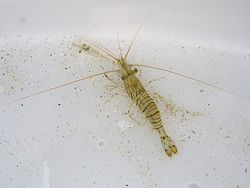
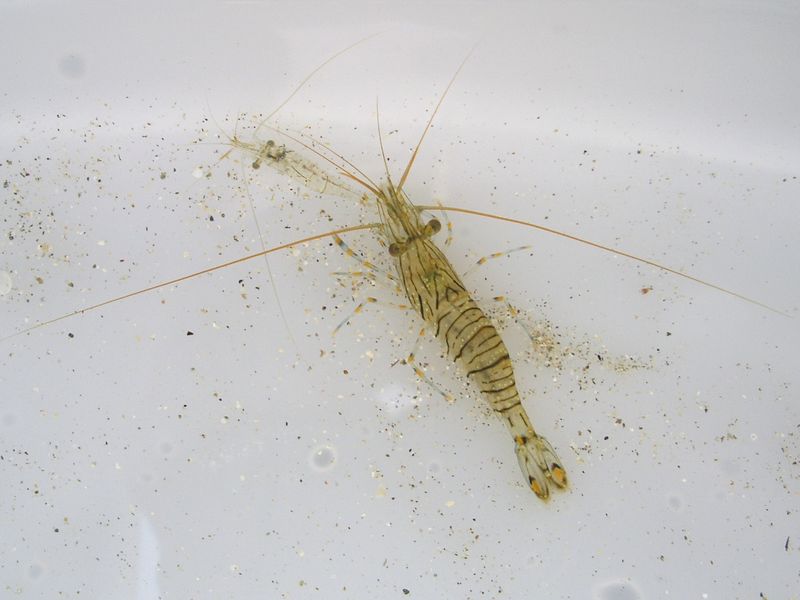
| Palaemon elegans | |
Scientific classification 
| |
| Kingdom: | Animalia |
| Phylum: | Arthropoda |
| Class: | Malacostraca |
| Order: | Decapoda |
| Suborder: | Pleocyemata |
| Infraorder: | Caridea |
| Family: | Palaemonidae |
| Genus: | Palaemon Weber, 1795 |
| Type species | |
| Palaemon adspersus | |
| Synonyms | |
|
List
| |
Palaemon is a genus of caridean shrimp in the family Palaemonidae.[2]
Some species, including Palaemon macrodactylus and Palaemon orientis, can inhabit fish ponds where they compete with fish for food and can therefore be considered pests.[3]
Species
[edit]The following species are recognised in the genus Palaemon:[2]
- Palaemon adspersus Rathke, 1836
- Palaemon affinis H. Milne Edwards, 1837
- Palaemon africanus (Balss, 1916)
- Palaemon annandalei (Kemp, 1917)
- Palaemon antennarius H. Milne Edwards, 1837
- †Palaemon antonellae Garassino & Bravi, 2003
- Palaemon antrorum (Benedict, 1896)
- Palaemon argentinus (Nobili, 1901)
- Palaemon atrinubes (Bray, 1976)
- Palaemon audouini Heller, 1861
- Palaemon australis (Dakin, 1915)
- Palaemon camranhi (Nguyên, 1997)
- Palaemon capensis (De Man in Weber, 1897)
- Palaemon carinicauda Holthuis, 1950
- Palaemon carteri (Gordon, 1935)
- Palaemon colossus Tzomos & Koukouras, 2015
- Palaemon concinnus Dana, 1852
- Palaemon cummingi (Chace, 1954)
- Palaemon curvirostris Nguyên, 1992
- Palaemon debilis Dana, 1852
- Palaemon dolospinus Walker & Poore, 2003
- Palaemon elegans Rathke, 1836
- †Palaemon exul Frič, 1872
- Palaemon floridanus Chace, 1942
- Palaemon gladiator Holthuis, 1950
- Palaemon gracilis (Smith, 1871)
- Palaemon gravieri (Yu, 1930)
- Palaemon guangdongensis Liu, Liang & Yan, 1990
- Palaemon hainanensis (Liang, 2000)
- Palaemon hancocki Holthuis, 1950
- Palaemon hiltoni (Schmitt, 1921)
- Palaemon hobbsi (Strenth, 1994)
- Palaemon intermedius (Stimpson, 1860)
- Palaemon ivonicus (Holthuis, 1950)
- Palaemon kadiakensis (Rathbun, 1902)
- Palaemon khori De Grave & Al-Maslamani, 2006
- Palaemon kwangtung De Grave & Ashelby, 2013
- Palaemon leucurus Ashelby, De Grave & Nguyen, 2018
- Palaemon lindsayi (Villalobos Figueroa & Hobbs, 1974)
- Palaemon litoreus (McCulloch, 1909)
- Palaemon longirostris H. Milne Edwards, 1837
- Palaemon macrodactylus Rathbun, 1902
- Palaemon maculatus (Thallwitz, 1891)
- Palaemon mani (Sollaud, 1914)
- Palaemon mercedae (Pereira, 1986)
- Palaemon mesogenitor (Sollaud, 1912)
- Palaemon mesopotamicus (Pesta, 1913)
- Palaemon mexicanus (Strenth, 1976)
- Palaemon migratorius (Heller, 1862)
- Palaemon minos Tzomos & Koukouras, 2015
- Palaemon miyadii (Kubo, 1938)
- Palaemon modestus (Heller, 1862)
- †Palaemon monsdamarum Pasini & Garassino, 2017
- †Palaemon mortuus Smirnov, 1929
- Palaemon mundusnovus De Grave & Ashelby, 2013
- Palaemon northropi (Rankin, 1898)
- Palaemon octaviae (Chace, 1972)
- Palaemon ogasawaraensis Kato & Takeda, 1981
- Palaemon orientis Holthuis, 1950
- Palaemon ortmanni Rathbun, 1902
- Palaemon pacificus (Stimpson, 1860)
- Palaemon paivai Fausto Filho, 1967
- Palaemon paludosus (Gibbes, 1850)
- Palaemon pandaliformis (Stimpson, 1871)
- Palaemon paucidens De Haan, 1844
- Palaemon peringueyi (Stebbing, 1915)
- Palaemon peruanus Holthuis, 1950
- Palaemon powelli Ashelby & De Grave, 2009
- Palaemon pugio (Holthuis, 1949)
- Palaemon ritteri Holmes, 1895
- Palaemon schmitti (Holthuis, 1950)
- Palaemon semmelinkii (De Man, 1881)
- Palaemon septemtrionalis Katogi, Chiba, Yokoyama, Hatakeyama, Shirai & Komai, 2019
- Palaemon serenus (Heller, 1862)
- Palaemon serratus (Pennant, 1777)
- Palaemon serrifer (Stimpson, 1860)
- Palaemon sewelli (Kemp, 1925)
- Palaemon sinensis (Sollaud, 1911)
- Palaemon styliferus H. Milne Edwards, 1840
- Palaemon suttkusi (Smalley, 1964)
- Palaemon tenuidactylus Liu, Liang & Yan, 1990
- Palaemon texanus (Strenth, 1976)
- Palaemon tonkinensis (Sollaud, 1914)
- Palaemon turcorum (Holthuis, 1961)
- Palaemon varians Leach, 1814
- †Palaemon vesolensis Bravi, Coppa, Garassino & Patricelli, 1999
- Palaemon vicinus Ashelby, 2009
- Palaemon vietnamicus (Nguyên, 1992)
- Palaemon vulgaris Say, 1818
- Palaemon xinjiangensis (Liang, 2000)
- Palaemon xiphias Risso, 1816
- Palaemon yamashitai Fujino & Miyake, 1970
- Palaemon yuna Carvalho, Magalhães & Mantelatto, 2014
- Palaemon zariquieyi (Sollaud, 1938)
References
[edit]- ^ S. De Grave & C. H. J. M. Fransen (2011). "Carideorum Catalogus: the Recent species of the dendrobranchiate, stenopodidean, procarididean and caridean shrimps (Crustacea: Decapoda)". Zoologische Mededelingen. 85 (9): 195–589, figs. 1–59. ISBN 978-90-6519-200-4. Archived from the original on 2012-12-20.
- ^ a b "Palaemon Weber, 1795". DecaNet. World Register of Marine Species. Retrieved 2023-06-17.
- ^ Chan, Tin-Yam & Yu, Hsiang-Ping (19 July 1984). "Studies on the shrimps of the genus Palaemon (Crustacea: Decapoda: Palaemonidae) from Taiwan". Journal of the Taiwan Museum. 38 (1): 119–127.
 | This Caridea-related article is a stub. You can help Wikipedia by adding missing information. |
Palaemon (crustacean)
View on Grokipediafrom Grokipedia
Taxonomy
Etymology and history
The genus name Palaemon is derived from the Greek "palaemōn" (Παλαίμων), meaning "wrestler," a reference to the mythological sea god Palaemon and evoking the agile, combative locomotion of these shrimps through water using their powerful appendages.[8] This etymology underscores the genus's association with dynamic aquatic environments, where species exhibit rapid, grappling-like movements.[9] The genus Palaemon was formally established by Friedrich Heinrich Weber in 1795 through his publication Nomenclator Entomologicus secundum Entomologiam systematicum ill. Fabricii, which provided an early systematic nomenclature for entomological and crustacean taxa.[10] The type species, Palaemon adspersus (described by Henrik Rathke in 1836), was later designated to anchor the genus's definition, reflecting its focus on caridean shrimps with specific rostral and appendage characteristics.[11] In the early 19th century, the genus rapidly expanded as naturalists like Rathke incorporated diverse shrimp forms from European waters, describing multiple species such as P. adspersus and P. elegans based on morphological observations from Baltic and North Sea collections.[12] Throughout the 19th century, over 100 species were proposed for inclusion in Palaemon as explorations revealed varied shrimp morphologies worldwide, though many descriptions lacked rigorous comparative analysis, leading to nomenclatural instability.[5] Taxonomic refinements accelerated in the 20th century, with Rathke's foundational work supplemented by later systematists who clarified distinctions within Palaemonidae. A pivotal 20th- and 21st-century contribution came from De Grave and Fransen (2011), whose Carideorum Catalogus compiled a global inventory of caridean shrimps, recognizing approximately 26 valid species in Palaemon at the time while noting numerous synonyms. Further revisions by De Grave and Ashelby (2013) integrated molecular and morphological data to synonymize Palaemonetes, Exopalaemon, and Coutierella under Palaemon, reducing overall synonymy and elevating the genus to 83 valid species by absorbing previously separate taxa.[13] As of 2024, ongoing descriptions and phylogenetic studies have increased the recognized valid species in Palaemon to 95, reflecting refined boundaries within Palaemonidae while continuing to resolve historical misclassifications from the 1800s.[1] This evolution from broad 19th-century inclusions to a more precise modern delineation highlights the genus's central role in understanding caridean diversity.Classification and phylogeny
The genus Palaemon is classified within the kingdom Animalia, phylum Arthropoda, subphylum Crustacea, class Malacostraca, order Decapoda, suborder Pleocyemata, infraorder Caridea, superfamily Palaemonoidea, family Palaemonidae, and genus Palaemon.[2] This hierarchical placement positions Palaemon among the caridean shrimps, a diverse group characterized by their pleocyemate development and adapted to a range of aquatic environments. Phylogenetically, the family Palaemonidae, which includes Palaemon, diverged during the Late Cretaceous approximately 92 million years ago in the Indo-West Pacific region, based on Bayesian relaxed clock analyses calibrated with fossil records.[14] The genus Palaemon forms a distinct clade within the Palaemoninae subfamily of Caridea, supported as monophyletic in molecular phylogenies utilizing multi-gene datasets including 18S rRNA and cytochrome c oxidase subunit I (COI) sequences from studies spanning 2011 to 2022.[14] These analyses reveal high bootstrap support for the clade, highlighting evolutionary adaptations such as ambulatory pereiopods suited for diverse habitats.[4] Close relatives of Palaemon include the genera Macrobrachium (freshwater prawns) and Exopalaemon, which form sister clades within Palaemonidae based on shared ancestral traits and phylogenetic reconstructions.[15] Distinctions among these genera are primarily morphological: Palaemon species typically exhibit a mandibular palp, a rostrum with 6–10 dorsal and 2–5 ventral teeth, and chelate second pereiopods that are subequal in males, contrasting with Macrobrachium's elongate, spiniform rostrum, absence of a mandibular palp in some species, and markedly unequal second pereiopods in males adapted for freshwater locomotion.[16] Exopalaemon differs subtly in rostral dentition (often fewer ventral teeth) and pereiopod setation, though some taxa have been synonymized with Palaemon in recent revisions.[17] Recent molecular studies have illuminated genetic diversity within Palaemon, particularly in European species like P. elegans, resolving cryptic species complexes through mitogenome phylogenetics and COI analyses.[4] For instance, P. elegans populations show divergence into distinct haplogroups dating to the Messinian Salinity Crisis (approximately 5.3–5.9 million years ago), with further splits in Atlantic-Mediterranean lineages around 0.7 million years ago linked to Pleistocene glaciations, indicating hidden biodiversity and potential taxonomic revisions.[4] These insights, drawn from mitochondrial protein-coding genes, underscore the role of historical barriers in shaping palaemonid evolution.[18]Description
Morphology
The body of species in the genus Palaemon is bilaterally symmetrical and elongated, divided into two main regions: the cephalothorax and the abdomen. The cephalothorax results from the fusion of the head and thorax, covered dorsally and laterally by a rigid carapace that extends as a branchiostegite to enclose the branchial chamber. A prominent rostrum projects anteriorly from the carapace, typically bearing 6–10 dorsal teeth (including a post-orbital tooth) and fewer ventral teeth, aiding in protection and sensory functions.[19][20][21] The appendages of Palaemon are highly specialized for locomotion, feeding, and swimming. The thorax bears five pairs of pereiopods: the first pair is chelate, forming robust pincers for grasping prey and manipulation; the second pair is also chelate but asymmetrical and more slender; and the third to fifth pairs are ambulatory, lacking chelae, for walking along substrates. The abdomen features five pairs of biramous pleopods (swimmerets), which facilitate swimming and, in females, brood protection; the sixth abdominal segment bears uropods and a telson, together forming a fan-like tail for rapid backward escape propulsion.[19][20][22] Sensory structures in Palaemon enable detection of chemical, mechanical, and gravitational stimuli. Compound eyes are mounted on movable stalks, providing wide visual fields for detecting light and motion. The antennules (first antennae) are biramous, with the inner flagellum specialized for chemoreception and the outer for mechanoreception, while the longer antennae serve primarily for tactile exploration. Statocysts, located in the precoxal segment of each antennule, function as balance organs, containing statoliths that stimulate hair cells in response to gravity and acceleration.[23][20] The exoskeleton of Palaemon is composed primarily of chitin, impregnated with calcium carbonate for rigidity, and periodically molted to allow growth. Respiration occurs via phyllobranchiate gills housed within the branchial chamber beneath the carapace, where water is circulated by the scaphognathite of the second maxilla to facilitate oxygen uptake.[24][20]Size and variation
Adult individuals in the genus Palaemon typically attain total lengths ranging from 2 to 8 cm, with considerable interspecific variation influenced by habitat and regional factors. For instance, in P. elegans, females can reach up to 6 cm, while males are generally smaller at around 4 cm maximum.[25][26] Species within Palaemon exhibit a translucent body coloration, often accented by transverse dark bands across the abdomen for camouflage in aquatic environments. Live specimens may display subtle red or green hues that intensify in vegetated or rocky habitats but fade rapidly after death, reflecting adaptive pigmentation patterns.[27][28] Sexual dimorphism is pronounced in Palaemon, with females generally achieving larger body sizes than males to support reproductive demands. Males possess elongated second pleopods bearing an appendix masculina for spermatophore transfer, whereas females feature a broader, rounded abdomen suited for brooding eggs beneath the tail.[26][29] Intraspecific variation occurs across life stages and environmental gradients in Palaemon. Juveniles often lack the full complement of rostral teeth present in adults, with dentition developing progressively with growth.[30]Habitat and distribution
Environmental preferences
Species of the genus Palaemon are predominantly euryhaline, exhibiting a broad salinity tolerance that enables them to inhabit environments ranging from freshwater (near 0 ppt) to fully marine conditions (up to 35 ppt), with many species particularly thriving in brackish estuarine waters of 5-20 ppt.[31][32] For instance, P. elegans demonstrates high survival (80-100%) across salinities from 0.6 to 35 ppt, while P. adspersus tolerates 1-35 ppt under similar conditions.[31] Optimal salinities for development and survival in species like P. serratus fall between 21-29 ppt, though juveniles show greater low-salinity resilience, with critical thresholds around 5.5-12 ppt depending on life stage.[33] Temperature preferences in Palaemon species generally center on a moderate range of 10-25°C for optimal physiological performance, though tolerances extend to extremes influenced by acclimation and habitat.[32] Both P. adspersus and P. elegans exhibit 80-100% survival across 2-22°C, with osmoregulation weakening at higher temperatures and low salinities.[31] In Baltic Sea populations, P. adspersus persists through near-freezing winters (around 2°C), reflecting adaptations to cool, brackish environments.[34] For P. serratus, larval development accelerates with rising temperatures up to 19°C, but survival declines below 10°C or above 19°C at suboptimal salinities.[33] Palaemon species favor structured microhabitats providing cover, such as vegetated substrates with algae, seagrasses, or rocks, which offer refuge from predators and support foraging.[35] They are commonly associated with dense beds of submerged aquatic vegetation or fouling communities on submerged structures, showing a strong preference for such habitats over exposed sandy or open bottoms.[36][37] This selection for vegetated areas enhances their abundance in shallow, estuarine zones.[38] These shrimps require well-oxygenated waters, with oxygen consumption remaining stable down to approximately 1.8 mg/L before increasing under hypoxia, though they perform best above 4-6 mg/L in natural settings.[39][40] Regarding pH, Palaemon species tolerate a neutral to slightly alkaline range of 7-8.5, aligning with typical estuarine conditions, with stress emerging below 7.6 or above 8.5 in acidification studies.[41][42]Global range
The genus Palaemon exhibits a native distribution primarily in the Northern Hemisphere but also including African coastal waters, with species inhabiting coastal and estuarine environments across Europe, Asia, North America, and parts of Africa. In Europe, P. elegans is widespread from the Mediterranean Sea and Black Sea northward to the Baltic Sea and along the Atlantic coast from Norway to the Iberian Peninsula. In Asia, P. paucidens occurs in freshwater and brackish systems of East Asia, including rivers and lakes in Japan, Korea, and China. In North America, P. paludosus is native to Atlantic and Gulf Coast estuaries from New Jersey southward to Florida and Texas, favoring vegetated shallows in low-salinity environments. In Africa, species such as P. concinnus are found in southern coastal estuaries. Several Palaemon species have established introduced ranges outside their native areas, often through human activities. P. macrodactylus, originating from the Northwest Pacific coasts of Asia (Russia to northern China and Japan), was first detected as invasive in San Francisco Bay, California, in 1957, likely transported via ballast water from Asian shipping routes; it has since spread to other Pacific Coast estuaries including Oregon and Washington (with first reports in the Salish Sea as of 2025), as well as to the Atlantic Coast since 2001 (e.g., New York, Connecticut, Rhode Island, Virginia, Maryland), and to South America and Australia. Similarly, P. elegans has expanded into North American waters since the early 2000s, with initial records in Salem Harbor, Massachusetts, in 2010, followed by detections in Rhode Island, Maine, and other northeastern Atlantic sites, attributed to transatlantic shipping vectors. P. adspersus, native to European waters, was introduced to northeastern North America around 2011, with established populations in coastal areas, likely via shipping. These introductions have also occurred in the southern hemisphere for species like P. macrodactylus. Biogeographically, Palaemon species are primarily confined to temperate and subtropical zones, with a concentration in coastal regions where seasonal temperature fluctuations support their euryhaline lifestyles. Their presence is limited in tropical regions, where competition from more diverse palaemonid genera, such as Macrobrachium, restricts niche availability in warm, stable waters. Dispersal in Palaemon is facilitated by a planktonic larval stage, which enables passive oceanic transport over moderate distances via currents, allowing colonization of new estuarine habitats. Human-mediated factors, including ballast water discharge from international shipping and unintentional releases from aquaculture operations, have significantly accelerated range expansions, particularly for invasive populations.Ecology and behavior
Diet and feeding habits
Species of the genus Palaemon exhibit an omnivorous diet, functioning primarily as detritivores and micropredators in aquatic ecosystems. They consume a variety of organic matter, including algae, detritus, and small invertebrates such as amphipods, copepods, ostracods, chironomid larvae, and polychaetes like Hediste diversicolor. Plant material, such as fragments of Cladophora spp., Enteromorpha spp., and other macroalgae, forms a significant portion of their intake, alongside occasional molluscs and potential fish eggs depending on availability.[43][44][45] Feeding mechanisms in Palaemon involve both scavenging and active predation, facilitated by their chelipeds (chelae) for grasping and manipulating food items. They employ antennular flicking to detect chemical cues from prey or detritus, enhancing foraging efficiency in low-visibility environments. Foraging activity peaks nocturnally, aligning with reduced predation risk and increased prey availability in many habitats.[46][47][48] As opportunistic mid-level consumers, Palaemon species occupy a flexible trophic position, with gut content analyses revealing substantial plant-derived matter; for instance, detritus and plant fragments constitute over 80% by frequency in P. elegans. Seasonal variations influence diet composition, with increased consumption of protein-rich animal matter during reproductive periods to support energy demands. In high-density environments such as aquaculture ponds, intensified competition for shared resources like algae and invertebrates can alter foraging patterns and nutritional intake.[49][43][44][50][51]Interactions with other organisms
Palaemon species serve as important prey in coastal and estuarine ecosystems, facing predation from a variety of organisms including fishes such as perch and gobies, birds like herons, and crabs.[52][53][54] For instance, gobies (Gobiidae) frequently consume Palaemon serratus, while herons and other wading birds target smaller individuals in shallow waters.[52][53] Crabs, including shore crabs (Carcinus maenas), also prey on juvenile Palaemon, contributing to high mortality rates in dense populations.[55] To evade these predators, Palaemon shrimp employ rapid tail-flip swimming, a burst escape response triggered by visual or mechanosensory stimuli that propels them backward at high speeds.[56][57] This mechanism is particularly effective against gape-limited fish predators, allowing larger individuals like Palaemon elegans to increase survival by directing escapes away from the threat.[56] Competition among Palaemon species and with other shrimp occurs primarily for food and space in shared estuarine habitats. In crowded estuaries, intraspecific aggression is common, with dominant individuals establishing linear hierarchies to secure resources, as observed in Palaemon pugio where females display aggressive behaviors to defend territories.[58][59] Interspecific competition arises with sympatric species like Crangon septemspinosa, where co-occurrence in polyhaline zones leads to overlap in foraging areas and shelter use, potentially limiting recruitment of subordinate Palaemon populations.[59][60] Symbiotic relationships involving Palaemon include commensal interactions where species like Palaemon elegans and Palaemon adspersus act as cleaners in temperate waters, removing ectoparasites from client fishes at informal stations and gaining nutritional benefits without harming the hosts.[61] Some Palaemon individuals host epibionts such as balanid barnacles, which attach to the exoskeleton in low densities, potentially providing camouflage while relying on the shrimp's mobility for dispersal.[62] Additionally, Palaemon elegans associates closely with eelgrass (Zostera marina) beds, where it interacts with algal grazers like Gammarus locusta, facilitating trophic dynamics in these seagrass systems through shared habitat use.[63] Invasive interactions are exemplified by Palaemon macrodactylus, which outcompetes native shrimp in introduced regions by exhibiting higher aggression and prolonged time at food sources, displacing species like Palaemon elegans and altering local food webs.[64] This competitive dominance can reduce native shrimp abundance, impacting higher trophic levels such as fish populations that rely on them as prey, leading to broader ecosystem disruptions in estuaries like those in the northwestern Atlantic, with new establishments reported in Washington state as of 2025.[65][66][67][68] Recent studies (as of 2024) have shown that invasive populations of P. elegans in the Baltic Sea exhibit greater risk-taking behavior than native P. adspersus, potentially enhancing their competitive success.[69]Reproduction and life cycle
Mating and reproduction
Palaemon species exhibit gonochorism, with distinct male and female sexes, and no hermaphroditism reported in the genus.[70] Sexual dimorphism is evident, particularly in the larger chelae of males, which are used in agonistic interactions.[71] Males detect receptive females primarily through contact pheromones released during the female's parturial molt, sensed via antennules; these pheromones elicit searching and mounting behaviors in males.[72] Courtship typically involves male-male combat, where dominant males use their chelae to fend off rivals and secure access to females, often leading to precopulatory mate guarding in which the male carries the female ventrally until her molt and subsequent copulation.[70] Copulation is brief, lasting 5-10 seconds, and occurs immediately after the female's molt when her exoskeleton is soft, facilitating spermatophore transfer to the ventral sternum.[72][73] Following fertilization, females extrude eggs and attach them to the pleopods on their ventral abdomen using a glue-like adhesive secreted from the oostegites, forming a brood mass that is aerated by pleopod beating.[74] Fecundity varies by species and female size, with representative clutches ranging from 200 to 3,700 eggs; for instance, Palaemon elegans females carry 222-2,628 eggs, while Palaemon adspersus produce up to 3,710.[37][75] Reproductive strategies differ across species, with some like Palaemon paucidens being largely semelparous (one breeding season) and others like Palaemon serratus iteroparous, producing multiple clutches annually.[72][76] Embryonic development within the brood mass is temperature-dependent, with hatching occurring after 36-56 days at 15-18°C in Palaemon serratus; higher temperatures accelerate development but may reduce viability if exceeding optimal ranges.[77] Recent studies indicate that climate-driven temperature increases can shorten embryonic development but lower larval survival rates in species like P. serratus.[78] Females actively brood the eggs, fanning them to maintain oxygenation and prevent fungal growth, until larvae hatch as free-swimming zoeae.[74]Development stages
The development of Palaemon species begins with the egg stage, where berried females carry fertilized embryos attached to their pleopods. Embryonic incubation typically lasts 20-60 days, depending on species and environmental conditions; for instance, in P. serratus, development lasts approximately 37 days at 18°C and 56 days at 15°C, extending to ~126 days at 10°C.[77] In some freshwater-adapted species, such as P. sinensis, direct development occurs without a free-living larval phase, allowing embryos to hatch as miniature adults directly in low-salinity habitats.[79] Following hatching, most marine and brackish Palaemon species undergo a planktonic larval phase consisting of 5-10 zoeal stages, characterized by elongated bodies and spines that aid in buoyancy and dispersal in coastal waters.[80] These zoeae feed on plankton and progress through molts, with species like P. serratus typically exhibiting 8-9 stages before transitioning.[80] The larval period culminates in metamorphosis to a post-larval stage, often termed mysis or decapodid, which resembles a scaled-down adult with developing appendages and reduced spines, enabling settlement into benthic habitats.[81] Juveniles emerge from the post-larval stage and grow through frequent molting, typically every 1-2 weeks in optimal conditions, as seen in P. varians where the molt cycle averages 8.7 days at ambient temperatures.[82] Growth involves iterative exoskeleton shedding and regeneration, with individuals reaching sexual maturity in 3-6 months; for example, P. gravieri yearlings mature and produce their first brood within the initial year post-settlement.[83] Environmental factors significantly influence these stages, particularly salinity and temperature. Larval survival in P. serratus is highest at 21-29‰ salinity, with lower levels reducing viability and development success, while freshwater species tolerate near-zero salinity due to abbreviated ontogeny.[80] Temperature accelerates development via a Q10 effect, where rates approximately double for every 10°C increase; in P. elegans, incubation shortens from 11 days at 19°C to 9 days at 27°C, and larval progression follows similar thermal acceleration.[84]Diversity and species
List of recognized species
The genus Palaemon Weber, 1795, encompasses 63 accepted species according to the World Register of Marine Species (WoRMS), reflecting ongoing taxonomic refinements that incorporate molecular and morphological data.[2] Recent revisions have synonymized several junior names and transferred certain tropical and freshwater forms to related genera, such as Macrobrachium and Nematopalaemon, to better align with phylogenetic relationships.[2] The accepted species are listed alphabetically below, with authorities and years of description.| Species | Authority | Year |
|---|---|---|
| Palaemon adspersus | Rathke | 1836 |
| Palaemon affinis | H. Milne Edwards | 1837 |
| Palaemon africanus | Balss | 1916 |
| Palaemon annandalei | Kemp | 1917 |
| Palaemon audouini | Heller | 1861 |
| Palaemon capensis | De Man in Weber | 1897 |
| Palaemon carinicauda | Holthuis | 1950 |
| Palaemon carteri | Gordon | 1935 |
| Palaemon concinnus | Dana | 1852 |
| Palaemon curvirostris | Nguyên | 1992 |
| Palaemon debilis | Dana | 1852 |
| Palaemon dolospinus | Walker & Poore | 2003 |
| Palaemon elegans | Rathke | 1836 |
| Palaemon floridanus | Chace | 1942 |
| Palaemon gladiator | Holthuis | 1950 |
| Palaemon gracilis | Smith | 1871 |
| Palaemon gravieri | Yu | 1930 |
| Palaemon guangdongensis | Liu, Liang & Yan | 1990 |
| Palaemon hainanensis | Liang | 2000 |
| Palaemon hiltoni | Schmitt | 1921 |
| Palaemon intermedius | Stimpson | 1860 |
| Palaemon khori | De Grave & Al-Maslamani | 2006 |
| Palaemon kwangtung | De Grave & Ashelby | 2013 |
| Palaemon leucurus | Ashelby, De Grave & Nguyen | 2018 |
| Palaemon litoreus | McCulloch | 1909 |
| Palaemon longirostris | H. Milne Edwards | 1837 |
| Palaemon macrodactylus | Rathbun | 1902 |
| Palaemon maculatus | Thallwitz | 1891 |
| Palaemon mani | Sollaud | 1914 |
| Palaemon mesogenitor | Sollaud | 1912 |
| Palaemon modestus | Heller | 1862 |
| Palaemon mundusnovus | De Grave & Ashelby | 2013 |
| Palaemon northropi | Rankin | 1898 |
| Palaemon octaviae | Chace | 1972 |
| Palaemon ogasawaraensis | Kato & Takeda | 1981 |
| Palaemon orientis | Holthuis | 1950 |
| Palaemon ortmanni | Rathbun | 1902 |
| Palaemon pacificus | Stimpson | 1860 |
| Palaemon paivai | Fausto Filho | 1967 |
| Palaemon parvibrachium | Komai & Hanai | 2024 |
| Palaemon paucidens | De Haan | 1844 |
| Palaemon peringueyi | Stebbing | 1915 |
| Palaemon peruanus | Holthuis | 1950 |
| Palaemon powelli | Ashelby & De Grave | 2009 |
| Palaemon pugio | Holthuis | 1949 |
| Palaemon ritteri | Holmes | 1895 |
| Palaemon schmitti | Holthuis | 1950 |
| Palaemon semmelinkii | De Man | 1881 |
| Palaemon serenus | Heller | 1862 |
| Palaemon serratus | Pennant | 1777 |
| Palaemon serrifer | Stimpson | 1860 |
| Palaemon sewelli | Kemp | 1925 |
| Palaemon styliferus | H. Milne Edwards | 1840 |
| Palaemon tenuidactylus | Liu, Liang & Yan | 1990 |
| Palaemon varians | Leach | 1814 |
| Palaemon vicinus | Ashelby | 2009 |
| Palaemon vietnamicus | Nguyên | 1992 |
| Palaemon vulgaris | Say | 1818 |
| Palaemon xinjiangensis | Liang | 2000 |
| Palaemon xiphias | Risso | 1816 |
| Palaemon yamashitai | Fujino & Miyake | 1970 |
| Palaemon zariquieyi | Sollaud | 1938 |