Hubbry Logo
Extended chordExtended chordMain
Open search
Extended chord
Community hub
Extended chord
logo
8 pages, 0 posts
0 subscribers
Be the first to start a discussion here.
Extended chord
Extended chord
from Wikipedia
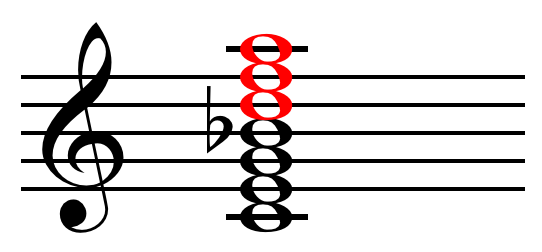
Dominant thirteenth extended chord: C–E–G–B–D–F–A play. The upper structure or extensions, i.e. notes beyond the seventh, in red.
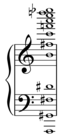
A thirteenth chord (E13) "collapsed" into one octave results in a dissonant, seemingly secundal[1] tone cluster. Play

In music, extended chords are certain chords (built from thirds) or triads with notes extended, or added, beyond the seventh. Ninth, eleventh, and thirteenth chords are extended chords.[2] The thirteenth is the farthest extension diatonically possible as, by that point, all seven tonal degrees are represented within the chord (the next extension, the fifteenth, is the same as the root of the chord). In practice however, extended chords do not typically use all the chord members; when it is not altered, the fifth is often omitted, as are notes between the seventh and the highest note (i.e., the ninth is often omitted in an eleventh chord; the ninth and eleventh are usually omitted in a thirteenth chord), unless they are altered to give a special texture.[3][4]

Chords extended beyond the seventh are rarely seen in the Baroque era, and are used more frequently in the Classical era. The Romantic era saw greatly increased use of extended harmony. Extended harmony prior to the 20th century usually has dominant function – as V9, V11, and V13, or V9/V, V13/ii etc.[5]

Examples of the extended chords used as tonic harmonies include Wild Cherry's "Play That Funky Music" (either a dominant ninth or dominant thirteenth).[6]

Common practice period

[edit]

During the common practice period of Western classical music, composers orchestrating chords that are voiced in four or fewer parts would select which notes to use so as to give the desired sonority, or effect of the intended chord. Generally, priority was given to the third, seventh and the most extended tone, as these factors most strongly influence the quality and function of the chord.[7] The root is never omitted from the texture. The third defines the chord's quality as major or minor. The extended note defines the quality of the extended pitch, which may be major, minor, perfect, or augmented. The seventh factor helps to define the chord as an extended chord (and not an added note chord), and also adds to the texture. Any notes which happen to be altered, such as a flatted fifth or ninth, should also be given priority. For example: in a thirteenth chord, one would play the root, third, seventh, and thirteenth, and be able to leave out the fifth, ninth, and eleventh without affecting the function of the chord. The eleventh chord is an exception to this voicing, in which the root, seventh, ninth, and eleventh are most commonly used.[8]

In the classical practices of western music, extended chords most often have dominant function (dominant or secondary dominant), and will resolve in circle progression (down a fifth) in much the same way that V7, V7/ii, V/IV, etc. might resolve to their respective tonics. Extended chords can also be altered dominants, and the extended pitch may be altered in several ways (such as V flat 13 in a major key).[9]

Following standard voice leading rules:

Voice leading for dominant ninth chords in the common practice period.[10] Play
V9 to I or i
  • The third, which will also be the seventh scale degree, always resolves upward to tonic.
  • The seventh resolves downwards stepwise to the third factor of the chord of resolution.
  • The extended pitch will resolve downward.
Voice leading for dominant eleventh chords in the common practice period.[10] Play
V11 to I or i
  • The seventh resolves downwards stepwise to the third factor of the chord of resolution.
  • The ninth resolves downwards stepwise to the fifth factor of the chord of resolution.
  • The eleventh doesn't move, and becomes the root of the chord of resolution.
Voice leading for dominant thirteenth chords in the common practice period.[10] Play
V13 to I or i
  • The seventh resolves downwards stepwise to the third factor of the chord of resolution.
  • The third, which will also be the seventh scale degree, always resolves upward to tonic.
  • The thirteenth, will resolve downward to the tonic, and often includes a passing tone through the ninth factor of the chord of resolution. Less often, the thirteenth may also remain the same and become the third of the chord of resolution.

An important distinction between extended and added chords must be made, since the added tones and extended tones are enharmonic, but differ in function. Extended chords always have at least one octave between their lowest pitch, and extended note, otherwise the extended factor would be considered an added pitch. Extended chords usually must be resolved when used in a dominant function, whereas added chords are most often textures added to a tonic.

History

[edit]
Fifteenth chord discussed by Marpurg as resulting from the addition of a ninth below a (dominant) seventh chord[11] Play

18th century

[edit]

In the 18th century, ninth and eleventh chords were theorized as downward extensions of seventh chords, according to theories of supposition.[12]

In 1722, Jean-Philippe Rameau first proposed the concept that ninth and eleventh chords are built from seventh chords by (the composer) placing a "supposed" bass one or two thirds below the fundamental bass or actual root of the chord.[13] With the theoretical chord F–A–C–E–G–B the fundamental bass would be considered C, while the supposed bass would be F.[13] Thus the notes F and A are added below a seventh chord on C, C–E–G–B, triadically (in thirds). This is also referred to as the "H chord".[14]

The theory of supposition was adopted and modified by Pierre-Joseph Roussier, Friedrich Wilhelm Marpurg, and other theorists. A. F. C. Kollmann, following Johann Kirnberger, adopted a simpler approach and one closer to that prevalent today, in which Rameau's "supposed" bass is considered the fundamental and the ninth and eleventh are regarded as transient notes inessential to the structure of the chord.[13] Thus F–A–C–E–G–B is considered a seventh chord on F, F–A–C–E, with G and B being nonchord tones added above triadically.[15]

19th century

[edit]
Chromaticism from voice leading and borrowed and extended chords from the end of Scriabin's Preludes, Op. 48, No. 4; "though most vertical sonorities include the seventh, ninth, eleventh, and thirteenth, the basic harmonic progressions are strongly anchored to the concept of root movement by fifths."[16] Play

In 19th-century classical music the seventh chord was generally the upper limit in "chordal consonance", with ninth and eleventh chords being used for "extra power" but invariably with one or more notes treated as appoggiaturas.[12] The thickness of complete ninth, eleventh or thirteenth chords in close position was also generally avoided through leaving out one or more tones or using wider spacing (open position).[12]

20th century

[edit]
A diatonic fifteenth chord on B opens Franz Liszt's Ossa arida (1879), in, "a striking anticipation of twentieth-century harmonic experimentation".[17] Play

In the 20th century, especially in jazz and popular music, ninth chords were used as elaborations of simpler chords, particularly as substitutes for the tonic triad at the end of a piece.[12] The "piling up" of thirds above the tonic to make seventh, ninth, eleventh, or even thirteenth chords "is one of the most important characteristics of jazz harmony".[12] Vítězslav Novák's student Jaroslav Novotný (1886–1918) used a fifteenth chord in the fourth song of his 1909 song cycle Eternal Marriage.[18]

Chord structure

[edit]
Final chord of Arnold Schoenberg's Sechs kleine Klavierstücke, 2nd movement,[19] in thirds: C–E–G–B–D–F–A–Cdouble sharp. Play

Building on each of the major scale degrees the thirteenth chord chord quality that is harmonic to such scale (i.e. with all its notes belonging to such scale), results in the following table. The numbering is relative to the scale degree numbers of the major scale that has the major scale degree in question as tonic:

Chord root Chord quality 1 3 5 7 9 11 13
I IM13
ii iim13
iii iiim7913
IV IVM1311
V V13
vi vim713
viio viiø7913

Other thirteenth chord qualities do exist but they do not belong to any mode of the major scale.

From the table it is clear that adding an eleventh or a thirteenth makes the seven chord qualities distinguishable from each other, as without an eleventh added the I and IV chord quality would be identical, and without a thirteenth added the ii and vi chord quality would be identical.

Jazz, jazz fusion and funk

[edit]

Jazz from the 1930s onward, jazz fusion from the 1970s onward and funk all have been seen to use extended chords as a key part of their sound. In these genres, chords often include added ninths, elevenths and thirteenths as well as their altered variations. In jazz and jazz fusion, compositions consist of complex chord progressions in which many of the chords are extended chords and in which many of the dominant seventh chords are altered extended chords (e.g., A7add911 or D7911). Funk also uses altered extended chords, but in this genre, pieces are usually based on a vamp on a single chord, because rhythm and groove are the key elements of the style. When extended chords are voiced in jazz or jazz fusion, the root and fifth are often omitted from the chord voicing, because the root is played by the bass player.[20]

See also

[edit]

References

[edit]

Further reading

[edit]
[edit]
Revisions and contributorsEdit on WikipediaRead on Wikipedia
from Grokipedia
In music theory, an extended chord is a formed by stacking additional thirds beyond the seventh above a chord's , incorporating scale degrees such as the , eleventh, or thirteenth to create richer, more complex sonorities than basic triads or seventh chords. These extensions add color and tension, often resolving in specific linear patterns, such as the descending by step or the thirteenth by third. Extended chords typically build upon dominant seventh chords in root position, with the root and seventh essential for identification, while extensions like the eleventh may replace the third in voicing. In theory, they represent advanced harmonic structures, such as the dominant ninth (V9), eleventh (V11), or thirteenth (V13), derived from diatonic or altered scales to enhance and reharmonization. Examples include the dominant C13 chord (C–E–G–B♭–D–F–A), which stacks thirds from the C , though voicings often omit non-essential notes like the fifth for practicality on instruments like or guitar. Extended chords have evolved from classical to modern genres, with alterations such as the ♯11 or ♭13 expanding tonal possibilities while maintaining functional resolution toward the tonic.

Fundamentals

Definition and Terminology

Extended chords are harmonies constructed by stacking additional thirds beyond those of a seventh chord, incorporating the ninth, eleventh, and thirteenth scale degrees relative to the root, and are typically founded on a major or minor triad. This construction extends the basic tertian harmony, in which chords are built by superimposing intervals of major and minor thirds. Extended chords build upon seventh chords as their starting point, adding further layers to create richer tonal colors while maintaining the underlying chord function, such as dominant or tonic. In music theory terminology, an "extension" denotes any note added above the tone, specifically the (scale degree 2 or 9), eleventh (degree 4 or 11), or thirteenth (degree 6 or 13), which can be natural, altered, or omitted depending on context. A , for example, includes the root, third, fifth, seventh, and , forming a five-note structure that implies greater complexity. These extensions often correspond to upper partials in the or series generated by the fundamental pitch, providing a perceptual foundation for their consonant yet colorful integration into . A representative example is the Cmaj9 chord, which comprises the notes C (root), E (major third), G (perfect fifth), B (major seventh), and D (major ninth), illustrating how extensions expand the major triad without altering its essential quality.

Distinction from Other Chord Types

Extended chords differ from seventh chords primarily in their inclusion of notes beyond the seventh scale degree. While seventh chords, such as the dominant seventh (e.g., : G-B-D-F), consist of the root, third, fifth, and seventh, extended chords build upon this foundation by adding ninths, elevenths, or thirteenths without replacing the core triad or seventh tones, resulting in structures like G9 (G-B-D-F-A) or G13 (G-B-D-F-A-C-E). In contrast to added tone chords, which incorporate supplementary notes like a second or directly onto a triad without a seventh (e.g., Cadd9: C-E-G-D), extended chords always presuppose the presence of the seventh as part of their stacking of thirds, ensuring a fuller density. Altered chords, often involving modifications to the , eleventh, or thirteenth (e.g., ♭9: G-B-D-F-A♭), represent a of extended rather than a distinct category; these alterations introduce chromatic tensions for heightened dissonance but retain the extended framework's reliance on the seventh and upper partials. Unlike tone clusters or quartal harmony, which construct sonorities from stacked seconds (secundal, e.g., C-D-E for dense, dissonant clusters) or fourths (quartal, e.g., C-F-B♭), extended chords adhere strictly to tertian harmony, deriving their intervals from successive thirds to maintain a traditional, scalable harmonic progression. A key characteristic of extended chords is their theoretical completeness despite frequent practical omissions, such as dropping the fifth in voicings like a C13 (C-E-G-B♭-D-F-A), with non-essential notes like the fifth (G) and eleventh (F) often omitted, for example C-E-B♭-D-A, to accommodate dense textures while implying the full structure.

Historical Development

18th and 19th Centuries

In the , extended chords emerged sparingly within the and Classical styles, primarily as implied dissonances rather than fully voiced structures. In , particularly Johann Sebastian Bach's chorales, ninth chords were occasionally suggested through suspensions and non-harmonic tones that temporarily aligned to form extended harmonies before resolving, reflecting the era's emphasis on linear over vertical sonority. These appearances remained rare, as harmony was governed by strict voice-leading rules derived from modal traditions transitioning to . Jean-Philippe Rameau's 1722 Traité de l'harmonie played a pivotal role in this development by grounding chord in the natural harmonic series—the corps sonore—which justified stacking thirds beyond the and influenced subsequent theorists to explore dissonance more systematically. During the Classical period, composers like incorporated ninth chords for added color, especially in operatic contexts where emotional expression demanded subtle harmonic enrichment, though such extensions were typically passing and resolved promptly to triads or seventh chords. By the , Romantic composers expanded these practices amid a shift from rigorous voice-leading to more expressive harmonic freedom, with extended chords appearing more frequently as vehicles for and emotional depth. In Frédéric Chopin's Preludes, Op. 28, implications of ninth and eleventh chords arise through layered dissonances in the inner voices, particularly in the earlier preludes, enhancing the music's introspective and turbulent character without a formalized theoretical framework. Richard Wagner's "Tristan chord" in Tristan und Isolde (1859) exemplifies this proto-extended approach, functioning as a half-diminished seventh with an added appoggiatura that prolongs dissonance to heighten dramatic yearning while ultimately resolving in traditional fashion. Throughout the Romantic era, such extensions often materialized transiently in passing or as suspensions, prioritizing affective impact over structural prominence, as no comprehensive theory of extended harmony existed until later developments.

20th Century

In the early 20th century, extended chords matured within impressionist music, where composers like Claude Debussy and Maurice Ravel employed them to evoke coloristic and atmospheric effects rather than structural progression. Debussy frequently used parallel ninths and other upper extensions to blur tonal boundaries and suggest dreamlike ambiguity, as seen in the opening of Prélude à l'après-midi d'un faune (1894), where the flute melody unfolds over a half-diminished seventh chord extended with chromatic tensions. Ravel similarly integrated ninths, elevenths, and thirteenths into dominant seventh structures, often with chromatic alterations, to create shimmering, non-resolving harmonies that prioritized timbre over function; for instance, in Pavane pour une infante défunte (1899), parallel-planed ninth chords support the modal melody, enhancing the piece's introspective mood. These techniques marked a departure from Romantic-era extensions, which were typically dominant-oriented, toward freer, color-driven applications./32:_Impressionism_and_Extended_Tonality) Alexander Scriabin further advanced extended chords in his mystic works, developing the "mystic chord" (or chord)—a synthetic comprising stacked fourths (e.g., C–F♯–B♭–E–A–D)—which functions as an derived from altered dominant harmonies with added ninth and thirteenth partials. This structure, inspired by acoustic and theosophical ideas, appears prominently in Prometheus: The Poem of Fire, Op. 60 (), where it serves as both harmonic foundation and melodic source, evoking mystical ecstasy without traditional resolution. Scriabin's approach expanded eleventh and thirteenth extensions beyond impressionist colorism, integrating them into a personal synthetic scale that blurred diatonic boundaries. By mid-century, neoclassical composers such as Igor Stravinsky and Béla Bartók incorporated extended chords into structured, contrapuntal frameworks, often juxtaposing them with bitonal or modal elements to evoke classical clarity amid modernist dissonance. Stravinsky's Symphony in Three Movements (1945) features extended dominant ninths and elevenths in layered textures, using chain-of-fifths progressions and tonal interferences to balance neoclassical restraint with rhythmic vitality. Bartók, in works like the Divertimento for String Orchestra (1939), employed consecutive extended harmonies—such as parallel ninth chords and altered elevenths—drawn from folk modalities, imitating Baroque progressions while introducing asymmetric tensions for expressive depth. Meanwhile, Arnold Schoenberg's atonal music implied extended chords through dense, vagrant sonorities that expanded basic tetrachords into five- or six-note aggregates, as in Five Pieces for Orchestra, Op. 16 (1909), where polychords suggest unresolved ninths and elevenths without explicit functional roots. Theoretical treatises of the era, notably Schoenberg's (1911), analyzed extended chords as natural evolutions of diatonic , discussing ninth, eleventh, and thirteenth constructions as non-diatonic yet connective elements that could substitute for modal degrees or form "vagrant" progressions. This underscored the shift to non-functional , where extensions operated independently of tonic-dominant relations, enabling impressionist parallelism and atonal aggregates to prioritize sonic texture over goal-directed motion. In late 20th-century developments, post-World War II serialism diminished the role of extended chords by prioritizing pitch-row organization over harmonic density, as in integral serialism's avoidance of traditional sonorities for parametric control. However, extended chords lingered in film scores, where integrated ninth and eleventh tensions into dramatic cues. Concurrently with these classical developments, extended chords became a cornerstone of in the . Ninth chords emerged in early and around the , often as elaborations of dominant sevenths in arrangements. By the of the 1930s, fuller voicings were common, and in the style of the 1940s, eleventh and thirteenth chords standardized, facilitating advanced and reharmonization in standards.

Theoretical Construction

Building from the Root

Extended chords are constructed theoretically by stacking successive thirds above the root note, extending the basic triad and seventh chord through additional tertian intervals. This process begins with the root, followed by a third (major or minor, depending on the chord quality), then another third to form the fifth, and continues upward. For example, a C major thirteenth chord (Cmaj13) is built as follows: C (root, 1), E (major third, 3), G (perfect fifth, 5), B (major seventh, 7), D (ninth, 9), F (eleventh, 11), and A (thirteenth, 13). Each added note represents a compound interval from the root, derived from the diatonic scale: the ninth is a major ninth (14 semitones) above the root, equivalent to a major second above the octave; the eleventh is a perfect eleventh (17 semitones); and the thirteenth is a major thirteenth (21 semitones). The core structure of an extended chord typically includes the , third, fifth, and seventh to define the fundamental quality and function of the , though in practice the fifth is often omitted in 9th and chords, and the third may be omitted in 11th chords to avoid dissonance with the eleventh. Extensions such as the , eleventh, and thirteenth are optional and added cumulatively, meaning a implies the presence of the underlying seventh but may or may not include higher extensions. This modular approach allows for flexibility in voicing while maintaining the chord's theoretical completeness when fully realized. In practice, certain notes are frequently omitted from extended chords to manage density and facilitate smoother . The fifth is often dropped because it contributes least to the chord's distinctive color and can create clutter when combined with extensions, allowing space for more tension-bearing intervals like the or thirteenth without overwhelming the texture. Similarly, the eleventh is commonly omitted, particularly in major or dominant chords, due to its dissonant minor interval with the (e.g., in Cmaj11, the F forms a minor with E), which can disrupt consonance unless intentionally used for tension. Alternatively, the is often omitted to allow inclusion of the eleventh, creating a dominant 7sus4 voicing with added if present. These omissions prioritize efficiency, enabling minimal motion between chords—such as stepwise or common-tone resolutions—while preserving the essential chord identity. Rootless voicings, where the is implied by bass or context, further emphasize these selective inclusions.

Common Extensions and Alterations

Ninth chords extend the basic seventh chord by adding the ninth scale degree, providing additional harmonic color while generally maintaining consonance. Major ninth chords (Maj9), such as Cmaj9 (C-E-G-B-D), impart a bright, dreamy quality that enhances melodic lines without introducing significant tension. Minor ninth chords (min9), like Cm9 (C-E♭-G-B♭-D), offer a smooth, melancholic texture that supports introspective jazz ballads. Dominant ninth chords (dom9), exemplified by C9 (C-E-G-B♭-D), add a rich, jazzy depth and subtle tension, often functioning as a preparatory harmony in progressions. Eleventh chords incorporate the eleventh scale degree, typically the perfect fourth above the , to heighten complexity, but they are frequently voiced in a suspended manner to imply a sus4 quality. In dominant 11th chords, is frequently omitted to incorporate the eleventh without the minor ninth dissonance, effectively creating a 7sus4 extension. This approach avoids the dissonant minor ninth interval created by the perfect eleventh clashing with the in major or dominant chords. The natural eleventh aligns naturally with the , where it serves as the unaltered fourth degree in dominant contexts. Thirteenth chords represent the fullest extension, stacking up to the thirteenth (sixth above the ), as in Cmaj13 (C-E-G-B-D-F-A), yet complete voicings of all notes remain rare due to practical limitations in performance. These chords predominantly imply a dominant function, such as V13 (e.g., G13 resolving to C), emphasizing resolution and harmonic drive in settings. Alterations to extensions, including ♭9, ♯9, ♯11, and ♭13, are primarily applied to dominant chords to generate heightened tension that resolves satisfyingly to the tonic. For instance, G7♭9 (G-B-D-F-A♭) introduces chromatic dissonance evocative of inflections, drawing from s like the flattened third and fifth for emotional intensity. Similarly, ♯9 and ♭13 alterations stem from chromatic approaches, amplifying instability in harmonies while facilitating smooth toward resolution. These modifications, unique to extended dominant structures, derive their expressive power from both heritage and broader chromaticism in modern harmony.

Notation and Voicing

Chord Symbols

Extended chords are notated using symbolic conventions that vary between jazz lead sheets and classical figured bass, allowing musicians to interpret and realize the harmony efficiently. In jazz and popular music, chord symbols provide a concise shorthand for the root, quality, and extensions, implying the presence of the seventh unless otherwise specified. For instance, the symbol "C9" denotes a C dominant ninth chord, consisting of the notes C-E-G-B♭-D, where the dominant seventh (C-E-G-B♭) is extended by the major ninth (D). Similarly, "Cmaj9" or "CΔ9" indicates a major ninth chord (C-E-G-B-D), with a major seventh and added ninth. Higher extensions follow numerical progression, with "C11" representing a dominant eleventh chord (C-E-G-B♭-D-F) and "C13" an even fuller dominant thirteenth (C-E-G-B♭-D-F-A), though the full stack is rarely voiced completely due to register limitations. Partial extensions are denoted by stacking or parenthetical additions, such as "C9(11)" to include the eleventh without implying the full thirteenth. Alterations to these extensions use accidentals, as in "G7♯9♭13" for a G dominant seventh with a raised ninth (A♯) and lowered thirteenth (E♭), creating tension common in jazz harmony. Parentheses often mark optional or implied notes, like "C(13)" to suggest adding the thirteenth if context allows, without mandating it. In contrast, employs notation, which uses stacked numerals below the bass line to indicate intervals above the bass note, focusing on vertical harmony rather than root-based symbols. For a , figures such as "7,9" indicate the seventh and above the bass, along with the third and fifth (e.g., over G bass: B third, D fifth, F seventh, A ). This system, rooted in practice, differs from the concise lead-sheet approach by emphasizing inversion and interval specifics over chord quality labels. Slash notation, prevalent in lead sheets, indicates inversions or non-root bass notes using a forward slash, such as "C9/E" for a C9 chord with E in the bass, facilitating bass lines or reharmonization. In digital production, these symbols are standardized for software recognition; for example, notation programs like Finale parse chord symbols according to conventional theory rules to generate outputs or lead sheets from textual input.

Voicings and Inversions

Voicings of extended chords refer to the specific arrangement of their notes across the range of an instrument, balancing and clarity to suit the musical . Close voicings stack the chord tones tightly, often within an , creating a compact, intense sound suitable for dense textures, while open voicings spread the notes over a wider interval, typically more than an , to produce a more airy, resonant quality that reduces perceived muddiness in lower registers. In practice, close voicings emphasize the core tensions of extensions like the 9th or 11th, whereas open voicings allow extensions to bloom without clashing, particularly in ensemble settings where multiple instruments contribute. For guitar, drop-2 voicings adapt extended chords by lowering the second-highest note an , transforming a close four-note chord into an open one that fits the instrument's fretboard. A common example is the Cmaj9 chord in drop-2 form: starting from a close voicing of C-E-G-B-D, drop the B (second from top) to the bass, yielding B-C-E-G-D, which spans the strings efficiently for comping. This technique enhances playability on guitar by avoiding awkward stretches while preserving the chord's color, and it can be inverted across positions for smooth progressions. Inversions rearrange the chord tones so a note other than the root is in the bass, with higher inversions of extended chords—such as the third inversion of a 9th chord, where the 7th becomes the lowest note—requiring careful inclusion of extensions to maintain harmonic integrity. For instance, a C9 in third inversion might place the Bb (7th) in the bass, followed by D (9th), E (3rd), and G (5th), emphasizing the dominant tension without the root. Rootless voicings, prevalent in jazz piano, omit the root entirely (often played by bass) and focus on guide tones like the 3rd, 7th, 9th, and 13th—for example, E-G-Bb-D for a C9—allowing the right hand to explore upper extensions fluidly. Practical techniques for voicing extended chords include shell voicings, which use only the and 7th (e.g., C-Bb for C7) as a foundational pair in the left hand on , leaving room for extensions in the right hand to add color without overcrowding. To avoid dissonant clusters, particularly in major chords, the natural 11th is often raised to ♯11 (e.g., F♯ instead of F in Cmaj7), preventing the from clashing with the . Adaptations differ between piano and guitar due to their structural constraints: piano allows fuller, more vertical voicings with up to ten notes across registers, facilitating rich extensions, while guitar favors horizontal, partial voicings limited to six strings, often prioritizing bass-root connections over complete stacks. The choice of register significantly influences perceived dissonance in extended chords; lower registers amplify roughness from interval beating, making tensions like the ♯11 more biting, whereas higher registers soften dissonance through reduced density, enhancing consonance. A unique application involves pedal points with extended chords, where a sustained (often the ) underpins changing harmonies, such as holding a C pedal while voicing shifting 9th and chords above to create tension in bass lines. This technique maintains continuity in the bass while allowing extensions to drive harmonic motion, common in both classical and contexts for dramatic effect.

Applications in Music

Common Practice and Classical

In common practice harmony, extended chords primarily serve functional roles within tonal progressions, enhancing tension and resolution without disrupting overall key centers. Dominant ninth chords (V⁹), for instance, intensify the pull toward the tonic in cadences by incorporating the between the third and seventh while adding the for color, creating a more urgent sense of dominant function compared to simple triads or seventh chords. Secondary extensions, such as applied ninth chords to non-dominant scale degrees during modulations, facilitate smoother shifts between keys by borrowing from parallel modes or chromatic alterations, maintaining the era's emphasis on directed harmonic motion. Voice leading in these chords prioritizes smooth connections to preserve contrapuntal flow, with the typically resolving downward by step to the (root position) and elevenths moving to the tenth for resolution, often treated as suspensions or appoggiaturas in upper . This approach is particularly evident in orchestral , where extended sonorities are distributed across instruments to avoid while supporting linear melodies. Due to the polyphonic constraints of the period, extended chords were often not fully voiced, omitting inner intervals like the fifth or eleventh to fit within four-part writing or instrumental ensembles, prioritizing clarity over density. Theoretically, Hugo Riemann's function theory provided justification by framing extensions as elaborations of tonic (T), dominant (D), or (S) roles, allowing chromatic additions to reinforce dualistic without abandoning tonal hierarchy. These elements distinguished extended chords from strict triadic by introducing greater expressivity—through dissonant tensions that resolve predictably—while preserving the era's commitment to functional tonality, a development building on 19th-century innovations. In , extended chords are frequently employed to add color and facilitate , often through upper structures that layer additional notes atop basic seventh chords. For instance, dominant chords in jazz standards are commonly voiced as 13th chords to create richer resolutions. Alterations like the ♭9 and ♯11 on dominant chords introduce tension that resolves expressively during solos, a technique rooted in the chord-scale approach where the (seventh mode of melodic ) provides the improvisational framework. The ubiquitous II-V-I progression exemplifies this, with extensions such as the 9th on the ii (e.g., Dm9) and 13th on the V (e.g., G13), enhancing the harmonic motion while allowing modal interchange to borrow chords like 11ths (min11) from parallel keys for added depth, or 13ths (maj13) for brighter resolutions. In fusion and , extended chords evolve into dense, layered stacks that integrate electric instruments and synthesizers for textural complexity. Hancock's compositions, such as "Dolphin Dance," feature 11th voicings like C-11 and E♭maj7 with added 9ths, creating suspended, impressionistic harmonies that suspend resolution and support rhythmic grooves. These dense stacks, often altered with ♯11 or ♭13, contribute to the genre's characteristic tension-release patterns in tracks emphasizing modal interchange for min11 or maj13 colors. Extended chords appear in popular genres through reharmonization, where basic progressions are enriched for emotional nuance. In rock and pop, ' "Michelle" reharmonizes its framework with a Fmaj7 in the intro , transitioning to Fm6 and implying 9th extensions that add a bittersweet French flavor to the melody. Hip-hop often implies extensions via sampled or soul loops, such as minor 11th voicings drawn from modal interchange, which producers chop and layer to evoke nostalgic depth without explicit notation. Post-2000 developments in EDM integrate extended chords into drops and pads, using synth layers to sustain maj13 or min11 structures for atmospheric builds. Tracks like those by employ i-VI-iv progressions, creating euphoric tension through digital production. This approach, enabled by software like , allows incomplete voicings to imply full extensions, bridging pop accessibility with harmonic sophistication.

References

Add your contribution
Related Hubs
User Avatar
No comments yet.