


Extinct in the wild
View on Wikipedia
| Conservation status |
|---|
| Extinct |
| Threatened |
| Lower Risk |
| Other categories |
| Related topics |
 Comparison of Red List classes above and NatureServe status below  |
A species that is extinct in the wild (EW) is one that has been categorized by the International Union for Conservation of Nature as only consisting of living members kept in captivity or as a naturalized population outside its historic range.[1][2] Classification requires exhaustive surveys conducted within the species' known habitat with consideration given to seasonality, time of day, and life cycle.[2][3] Once a species is classified as EW, the only way for it to be downgraded[3] is through reintroduction.[3][4]
Not all EW species are rare. An example is the Brugmansia genus, where all seven species are widely cultivated, but none are found in the wild.[5] Ultimately, the purpose of preserving biodiversity is to maintain ecological function to prevent ecological extinction.
Examples
[edit]


Examples of species and subspecies that are extinct in the wild include (in alphabetical order):
- Abutilon pitcairnense (last surviving plant destroyed in 2005)[6]
- Alagoas curassow (last unconfirmed sighting reported in the late 1980s, listed extinct in the wild since 1994)[7]
- Corypha taliera (last tree cut down in 1979)[8]
- Christmas Island blue-tailed skink (listed extinct in the wild since 2014)[9]
- Dabry's sturgeon (listed extinct in the wild since 2022)[10]
- Escarpment cycad (listed extinct in the wild since 2006)[11]
- Franklinia alatamaha (last seen in 1803, listed extinct in the wild since 1998)[12]
- Golden skiffia (listed extinct in the wild since 1996)[13]
- Guam kingfisher (listed extinct in the wild since 1986)[14]
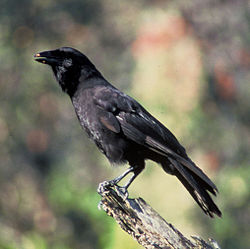
- Hawaiian crow or ʻalalā (last seen in 2002, listed as extinct in the wild since 2004)[15] Small groups have since been released in 2017[16][17] and 2018.[18]
- Kihansi spray toad (listed extinct in the wild since 2009)[19]
- La Palma pupfish (last seen in 1994, listed extinct in the wild since 1996)[20]
- Lister's gecko (listed extinct in the wild since 2014)[21]
- Oahu deceptor bush cricket (listed extinct in the wild since 1996)[22]
- Panamanian golden frog (possibly extinct in the wild)[23]
- Père David's deer (listed extinct in the wild since 2008.[24] However, reintroduction from captive populations began in 1985, with 53 wild herds of varying sizes being recorded in 2003)[25]
- Partula species (listed extinct in the wild in the 1990s):
- Simandoa conserfariam [26]
- Socorro dove (listed extinct in the wild since 1994)[27]
- Socorro isopod (last seen in 1988, listed as extinct in the wild since August 1996)[28]
- South China tiger (since 2008 IUCN Red List lists as critically endangered; possibly extinct in the wild)[29][30]
- Spix's macaw (listed extinct in the wild since June 2019)[31]
- Wyoming toad (listed extinct in the wild since 1991, although 853 have been released into the wild since 1995, leading to a population of around 1,500 in 2017)[32]
Conservation
[edit]Reintroduction
[edit]Reintroduction is the deliberate release of individuals into the wild, from captivity or from other areas where the species survives. However, it may be difficult to reintroduce EW species into the wild, even if their natural habitats were restored, because survival techniques, which are often passed from parents to offspring during parenting, may have been lost. Reintroduction efforts, also referred to as translocation, are complex and a common source of complication is how animals behave upon release.[33] Climate suitability has been shown to influence reintroduction outcomes as well.[34] Though many efforts translocate populations to historic ranges, climate change may be causing those previously inhabited areas to no longer be suitable for the species.[34]
.jpg)
The Przewalski's horse was downgraded from EW to Endangered in 2011 after decades of reintroduction efforts.[35] In China, they are still classified as EW since they are given supplemental feed over the winter to aid survival.[35] Of the 2500 living, about 1360 are in the wild, and all 2500 are descended from 12 wild-caught ancestors, causing an inbreeding depression that contributes to factors, such as shorter lifespans and high mortality, that impede conservation.[35]

Northern white rhinos have been extinct in the wild since 2007, and only two females remain in captivity.[36] The San Diego Zoo Global is planning to save the species by using living cells from 12 rhinos that have been cryopreserved, turning them into stem cell lines, using in vitro fertilization to create embryos, and then having Southern white rhinos serve as surrogates.[36] Currently, there have been no successful embryo transfers in rhinos.[36] It is estimated to take at least 40 years for the target of 25–40 northern white rhinos to be reached.[36]
Some people critique efforts to save species with such small populations due to the possibility of inbreeding as it can reduce the population growth rate.[37] Small effective population sizes are another critique. Effective population size is a measurement of the loss of genetic diversity.[38] Multiple populations have been found to have an effective population size below conservation goals.[38] Additionally, monitoring effective population size and using it to aid estimations of the success of conservation efforts has been shown to provide a better overview of determining population trends when compared to population size.[39]
IUCN Green Status of Species
[edit]The IUCN developed a system of classifying species recovery efforts in 2012 entitled the Green Status.[40] The species recovery score is a 0%–100% scale, with 0% being the species is extinct or extinct in the wild and 100% being fully recovered.[40] In addition, the Green Status also classifies previous and future conservation impacts with the Green Scores of Conservation Dependency, Conservation Gain, Conservation Legacy, and Recovery Potential.[40][41]
For a species to receive a score of 100% and be considered fully recovered, three requirements must be met: the species must be present in all areas of both its current and historical range, it is viable in all areas of the range, and performs its ecological niche across the full range.[41] Given the lofty standards, many species are not expected to meet the criteria and it is not a goal of this system. Land use changes have cumulated in many species losing habitat.[41]
Green Scores are snapshots in time to assess a species' current status and how conservation efforts have influenced their status.[41] It is also predictive as it can project how the status would change if conservation efforts ceased or continued.[41] Conservation Legacy assess how previous conservation work has changed or maintained a species' status. The score ranges from high to low with low meaning conservation efforts were ineffective or did not occur.[41] Conservation Dependency is the estimate of a species' status in 10 years if conservation efforts halted. High dependency means the species would have a lower status and low dependency equates to the status not changing.[41] Conservation Gain is the flip side. It projects a species' status in 10 years if conservation efforts continue.[41] Both dependence and gain are considered short-term measures. The long-term measure is Recovery Potential, which is how much of the range is estimated to be able to house ecologically functional populations.[41]
Flagship species
[edit]
The Pinta Island tortoise (Geochelone nigra abingdoni) had only one living individual, named Lonesome George, until his death in June 2012.[42] The tortoise was believed to be extinct in the mid-20th century, until Hungarian malacologist József Vágvölgyi spotted Lonesome George on the Galapagos island of Pinta on 1 December 1971. Since then, Lonesome George has been a powerful symbol for conservation efforts in general and for the Galapagos Islands in particular.[43] With his death on 24 June 2012, the subspecies is again believed to be extinct.[44] With the discovery of 17 hybrid Pinta tortoises located at nearby Wolf Volcano, a plan has been made to attempt to breed the subspecies back into a pure state.[45]
See also
[edit]- International Union for Conservation of Nature
- IUCN Red List
- IUCN Red List extinct in the wild species for a list by taxonomy
- Category:IUCN Red List extinct in the wild species for an alphabetical list
- Ex situ conservation
- Extinction
- Ecological extinction
- Lists of extinct species
- Local extinction
- Nature conservation
- Species reintroduction
- Wildlife conservation
References
[edit]- ^ "2001 IUCN Red List Categories and Criteria: Version 3.1" (PDF). IUCN. p. 14. Archived from the original (PDF) on 21 June 2010. Retrieved 30 May 2010.
- ^ a b "The IUCN Red List Categories and Criteria". IUCN Red List.
- ^ a b c IUCN. (2003). Guidelines for Application of IUCN Red List Criteria at Regional Levels: Version 3.0. IUCN Species Survival Commission. IUCN, Gland, Switzerland and Cambridge, UK. ii + 26 pp.
- ^ "Reasons for Changing Category". IUCN Red List.
- ^ Petruzzello, Melissa. "Extinct in the Wild but Still Around: 5 Plants and Animals Kept Alive by Humans". Encyclopædia Britannica. Retrieved 16 November 2019.
- ^ Bárrios, S.; Smyth, N. (2018). "Abutilon pitcairnense". IUCN Red List of Threatened Species. 2018 e.T122926206A122926208. Retrieved 16 December 2023.
- ^ "Alagoas Curassow (Mitu mitu)". IUCN Red List of Threatened Species. 7 August 2018. 7 August 2018. Archived from the original on 15 December 2023.
- ^ Johnson, D. (1998). "Corypha taliera". IUCN Red List of Threatened Species. 1998 e.T38493A10118302. Retrieved 16 December 2023.
- ^ "Christmas Island Blue-tailed Shinning-skink (Cryptoblepharus egeriae)". IUCN Red List of Threatened Species. 20 February 2017. 20 February 2017. Archived from the original on 15 December 2023.
- ^ Qiwei, W. (2022). "Acipenser dabryanus (Yangtze Sturgeon)". IUCN Red List of Threatened Species. 2022 e.T231A61462199. Archived from the original on 15 December 2023. Retrieved 3 September 2022.
- ^ Donaldson, J.S. (2010). "Encephalartos brevifoliolatus (Escarpment Cycad)". IUCN Red List of Threatened Species. 2010 e.T41882A10566751. doi:10.2305/IUCN.UK.2010-3.RLTS.T41882A10566751.en.
- ^ "Franklin Tree (Franklinia alatamaha)". IUCN Red List of Threatened Species. 3 February 2015. 3 February 2015. Archived from the original on 15 December 2023.
- ^ "Golden Skiffia (Skiffia francesae)". IUCN Red List of Threatened Species. 18 April 2018. 18 April 2018. Archived from the original on 15 December 2023.
- ^ "Guam Kingfisher (Todiramphus cinnamominus)". IUCN Red List of Threatened Species. October 2016. October 2016. Archived from the original on 15 December 2023.
- ^ "Hawaiian Crow (Corvus hawaiiensis)". IUCN Red List of Threatened Species. October 2016. October 2016. Archived from the original on 12 June 2023.
- ^ Keysor Espenschied, Susan (27 September 2017). "'Alalā released into natural area reserve". Aliso Laguna News. Archived from the original on 27 April 2023.
- ^ Ako, Diane (16 October 2017). "Rare Hawaiian crows released into native forests of Hawaiʻi Island". KITV4. Archived from the original on 24 October 2021. Retrieved 10 February 2020.
- ^ Brestovansky, Michael (1 October 2018). "Five more alala released into Puu Makaala Forest Reserve". West Hawaii Today. Archived from the original on 10 May 2023.
- ^ "Nectophrynoides asperginis". IUCN Red List of Threatened Species. 25 July 2014. 25 July 2014.
- ^ "La Palma Pupfish (Cyprinodon longidorsalis)". IUCN Red List of Threatened Species. 27 September 2018. 27 September 2018. Archived from the original on 15 December 2023.
- ^ "Christmas Island Chained Gecko (Lepidodactylus listeri)". IUCN Red List of Threatened Species. 20 February 2017. 20 February 2017.
- ^ "Leptogryllus deceptor". IUCN Red List of Threatened Species. August 1996. August 1996.
- ^ "'Last wave' for wild golden frog". BBC. 2 February 2008. Retrieved 22 February 2015.
- ^ "Père David's Deer (Elaphurus davidianus)". IUCN Red List of Threatened Species. 31 March 2016. 31 March 2016.
- ^ Yang, R.; Zhang, L.; Tan, B.; Zhong, Z. (2003). "Investigation on the status of Père David's deer in China". Chinese Journal of Zoology. 38: 76–81.
- ^ "Simandoa conserfarium (Simandoa Cave Roach)". arthroverts.org.
- ^ "Zenaida graysoni (Socorro Dove)". IUCN Red List of Threatened Species. 1990s. 1990s.
- ^ "Thermosphaeroma thermophilum". IUCN Red List of Threatened Species. August 1996. August 1996.
- ^ "South China Tiger". World Wide Fund for Nature.
- ^ "Panthera tigris amoyensis". IUCN Red List of Threatened Species. 30 June 2008. 30 June 2008.
- ^ "Spix's Macaw". IUCN Red List of Threatened Species. 20 June 2019. 20 June 2019.
- ^ "Wyoming Toads Begin To Recover As States Seek Endangered Species Act Overhaul". NPR.
- ^ Berger-Tal, O.; Blumstein, D. T.; Swaisgood, R. R. (April 2020). "Conservation translocations: a review of common difficulties and promising directions". Animal Conservation. 23 (2): 121–131. Bibcode:2020AnCon..23..121B. doi:10.1111/acv.12534. ISSN 1367-9430.
- ^ a b Bellis, Joe; Bourke, David; Maschinski, Joyce; Heineman, Katie; Dalrymple, Sarah (December 2020). "Climate suitability as a predictor of conservation translocation failure". Conservation Biology. 34 (6): 1473–1481. Bibcode:2020ConBi..34.1473B. doi:10.1111/cobi.13518. ISSN 0888-8892. PMID 32304113.
- ^ a b c Turghan, Mardan Aghabey; Jiang, Zhigang; Niu, Zhongze (15 November 2022). "An Update on Status and Conservation of the Przewalski's Horse (Equus ferus przewalskii): Captive Breeding and Reintroduction Projects". Animals. 12 (22): 3158. doi:10.3390/ani12223158. ISSN 2076-2615. PMC 9686875. PMID 36428386.
- ^ a b c d Ryder, Oliver A.; Friese, Carrie; Greely, Henry T.; Sandler, Ronald; Saragusty, Joseph; Durrant, Barbara S.; Redford, Kent H. (August 2020). "Exploring the limits of saving a subspecies: The ethics and social dynamics of restoring northern white rhinos (Ceratotherium simum cottoni)". Conservation Science and Practice. 2 (8). Bibcode:2020ConSP...2E.241R. doi:10.1111/csp2.241. ISSN 2578-4854.
- ^ Bozzuto, Claudio; Biebach, Iris; Muff, Stefanie; Ives, Anthony R.; Keller, Lukas F. (2 September 2019). "Inbreeding reduces long-term growth of Alpine ibex populations". Nature Ecology & Evolution. 3 (9): 1359–1364. Bibcode:2019NatEE...3.1359B. doi:10.1038/s41559-019-0968-1. hdl:11250/2637691. ISSN 2397-334X. PMID 31477848.
- ^ a b Husemann, M; Zachos, F E; Paxton, R J; Habel, J C (October 2016). "Effective population size in ecology and evolution". Heredity. 117 (4): 191–192. Bibcode:2016Hered.117..191H. doi:10.1038/hdy.2016.75. ISSN 0018-067X. PMC 5026761. PMID 27553454.
- ^ Wang, J; Santiago, E; Caballero, A (October 2016). "Prediction and estimation of effective population size". Heredity. 117 (4): 193–206. Bibcode:2016Hered.117..193W. doi:10.1038/hdy.2016.43. ISSN 0018-067X. PMC 5026755. PMID 27353047.
- ^ a b c Grace, Molly K.; Akçakaya, H. Resit; Bennett, Elizabeth L.; Brooks, Thomas M.; Heath, Anna; Hedges, Simon; Hilton-Taylor, Craig; Hoffmann, Michael; Hochkirch, Axel; Jenkins, Richard; Keith, David A.; Long, Barney; Mallon, David P.; Meijaard, Erik; Milner-Gulland, E.J. (December 2021). "Testing a global standard for quantifying species recovery and assessing conservation impact". Conservation Biology. 35 (6): 1833–1849. Bibcode:2021ConBi..35.1833G. doi:10.1111/cobi.13756. hdl:10919/108163. ISSN 0888-8892. PMID 34289517.
- ^ a b c d e f g h i "The IUCN Green Status of Species". IUCN Red List.
- ^ Gardner, Simon (6 February 2001). "Lonesome George faces own Galapagos tortoise curse". Archived from the original on 4 June 2011.
- ^ Nicholls, H. (2006). Lonesome George: The Life and Loves of a Conservation Icon. London, England: Macmillan Science. ISBN 1-4039-4576-4. Archived from the original on 14 September 2011. Retrieved 28 April 2011.
- ^ "Last Pinta giant tortoise Lonesome George dies". BBC News. 24 June 2012. Retrieved 25 June 2012.
- ^ "Scientists: Extinct Galapagos tortoise species could be resurrected". CTV News. 22 November 2012. Retrieved 25 November 2012.
External links
[edit]- List of Extinct in the Wild species as identified by the IUCN Red List of Threatened Species
| Phenomena |  | ||||
|---|---|---|---|---|---|
| Models | |||||
| Causes | |||||
| Theories and concepts | |||||
| Extinction events |
| ||||
| Extinct species | |||||
| Organizations | |||||
| See also | |||||


| IUCN Red List |
| ||||||||||||||||||
|---|---|---|---|---|---|---|---|---|---|---|---|---|---|---|---|---|---|---|---|
| By taxa | |||||||||||||||||||
| Conservation | |||||||||||||||||||
1 Pre-2001 categories and subcategories shown in italics. | |||||||||||||||||||


Extinct in the wild
View on GrokipediaDefinition and Classification
IUCN Criteria for Extinct in the Wild
The IUCN Red List classifies a taxon as Extinct in the Wild (EW) when it is known only to survive in cultivation, captivity, or as a naturalized population well outside its past range.[6] This category indicates the complete absence of self-sustaining populations in the wild, with all known individuals dependent on human intervention for persistence.[7] A taxon may be presumed EW if exhaustive surveys fail to detect any individuals in their known, expected, or past habitats, conducted at appropriate times aligned with the taxon's life cycle, behavior, and seasonal patterns.[6] Such surveys must cover the entire likely range over a timeframe sufficient to account for detection probabilities and population dynamics, ensuring no reasonable doubt remains about the absence of wild populations.[6] The criteria emphasize empirical evidence from field investigations rather than mere absence of recent records, distinguishing EW from data-deficient cases.[7] These standards, outlined in version 3.1 of the IUCN Red List Categories and Criteria adopted in 2001, require documentation of survey efforts, including methodology, coverage, and timing, to support the classification.[6] Unlike the quantitative thresholds applied to threatened categories (CR, EN, VU), EW relies on qualitative assessments of persistence in the wild, focusing on the taxon's ecological dependence on ex situ conservation.[7] Reclassification to lower risk is possible upon successful reintroduction and establishment of viable wild populations, reflecting the category's role in tracking recovery potential.[8]Distinctions from Extinct and Endangered Categories
The "Extinct in the Wild" (EW) category, as defined by the International Union for Conservation of Nature (IUCN), applies to taxa with no known individuals surviving in their natural habitats but with extant populations maintained in captivity, cultivation, or as introduced populations outside their native range, following exhaustive surveys that yield no evidence of wild persistence.[7] In contrast, the "Extinct" (EX) category denotes taxa for which there is no reasonable doubt that the last individual has died, implying total global extinction with no surviving specimens anywhere, verified through comprehensive searches confirming absence even in captivity or ex situ collections.[9] This distinction underscores EW as a transitional state where genetic material and potential for reintroduction persist, whereas EX represents irreversible loss, as seen in cases like the dodo (Raphus cucullatus), declared EX in 1662 with no captive remnants.[7] EW further diverges from the "Endangered" (EN) category, which identifies taxa still extant in the wild but facing a very high risk of extinction due to factors such as observed or projected population declines of at least 50% within 10 years or three generations, restricted geographic range with continuing decline, or small population sizes (fewer than 2,500 mature individuals) coupled with decline rates exceeding 20% over five years or two generations.[7][10] EN status requires evidence of ongoing wild presence and viability, albeit precarious, whereas EW confirms complete absence from natural ecosystems despite potential captive viability, emphasizing the loss of self-sustaining wild populations as the critical threshold.[9] For instance, the Przewalski's horse (Equus ferus przewalskii) transitioned from EW in 2008—after decades without wild survivors—to lower threat levels following reintroductions, illustrating EW's focus on habitat dependency over mere population risk metrics applied in EN assessments.[7] These categories enable targeted conservation: EX prompts historical analysis, EW prioritizes reintroduction feasibility, and EN demands in situ protection to avert progression to EW or EX.[10]Historical Context
Early Documented Cases
The Père David's deer (Elaphurus davidianus), native to the wetlands of central China, represents one of the earliest well-documented cases of a species becoming extinct in the wild while persisting in captivity. Historically confined to marshy habitats along the Yangtze River, the deer's wild populations had dwindled due to habitat loss and overhunting by the early 20th century, with the final wild individuals disappearing around 1900 amid flooding and subsequent human predation during famine.[11] A small captive herd maintained in the Chinese emperor's hunting park in Beijing survived until 1900, when it was destroyed during the Boxer Rebellion, though earlier exports to European zoos in the 1860s provided the foundation for subsequent breeding programs.[11] The European bison (Bison bonasus), or wisent, provides another early example, with its wild population vanishing by 1927 following centuries of habitat fragmentation, poaching, and disease introduction in its native forests of Eastern Europe. Last confirmed wild individuals were killed in Poland and the Caucasus around 1921, leaving only about 50-60 animals in zoos across Europe, which formed the basis for genetic recovery efforts.[12] Przewalski's horse (Equus ferus przewalskii), the last surviving wild horse species, was declared extinct in the wild by the mid-20th century, with the final confirmed sighting in Mongolia's Gobi Desert in 1969. Discovered by Western science in the late 19th century, its decline accelerated due to steppe conversion for agriculture, overgrazing by domestic livestock, and direct capture for zoos, reducing wild numbers to near zero by the 1960s while a captive population of around 800 individuals was maintained globally.[13][14] The International Union for Conservation of Nature (IUCN) formally classified it as extinct in the wild during its initial Red List assessments in 1964, predating the category's widespread adoption.[15] These cases, primarily from the early 1900s to 1960s, highlight patterns of anthropogenic pressures like habitat alteration and hunting leading to wild extirpation, with survival hinging on pre-existing captive stocks whose genetic viability was later scrutinized for inbreeding risks.[12] Reintroduction attempts for these species in subsequent decades, such as Père David's deer to China in the 1980s, demonstrated potential for recovery but underscored the challenges of restoring self-sustaining wild populations from managed lineages. ![Observation_des_chevaux_de_Przewalski_(Equus_ferus_przewalskii)][float-right]Formal Recognition and Evolution of the Category
![Przewalski's horse, classified as Extinct in the Wild in the 1964 IUCN Red List assessment][float-right]The "Extinct in the Wild" (EW) category was formally recognized in the inaugural IUCN Red List of Threatened Species, published in 1964, which inventoried global conservation statuses based primarily on expert assessments.[16] Przewalski's horse (Equus ferus przewalskii), surviving only in captivity after the last wild individuals were captured in the late 19th century, exemplifies early application of this classification, highlighting species dependent on ex situ populations without verified wild persistence.[15] Initial categorizations relied on qualitative judgments rather than standardized quantitative thresholds, allowing for EW designations when field evidence indicated absence from historic ranges despite searches, though lacking uniform criteria across taxa.[17] The category evolved significantly with the adoption of objective, quantitative IUCN Red List Categories and Criteria in 1994 (version 2.3), shifting from subjective evaluations to measurable extinction risk parameters applicable globally.[17] Under these criteria, EW status requires evidence that exhaustive surveys in known or expected habitats, conducted at appropriate times and throughout the historic range, have failed to detect any individuals, presuming survival solely in cultivation, captivity, or as non-naturalized populations.[18] This formalization addressed inconsistencies in prior lists, where threat assessments varied by specialist groups, and enabled more rigorous tracking of species like the Hawaiian crow (Corvus hawaiiensis), downlisted from EW in 2021 after reintroductions.[19] Subsequent refinements occurred with version 3.1 in 2001, incorporating clarifications for criteria application without altering core EW definitions, emphasizing verifiable absence over mere rarity to distinguish from endangered statuses.[20] These updates improved consistency and reduced bias in assessments, though critiques persist regarding under-detection of extinctions in inconspicuous taxa due to survey limitations.[5] The category's evolution reflects a progression toward evidence-based conservation, facilitating reclassification upon successful wild re-establishment, as seen in fewer than 100 EW species globally as of recent assessments.[8]