Hubbry Logo
Fafan ZoneFafan ZoneMain
Open search
Fafan Zone
Community hub
Fafan Zone
logo
8 pages, 0 posts
0 subscribers
Be the first to start a discussion here.
Fafan Zone
Fafan Zone
from Wikipedia

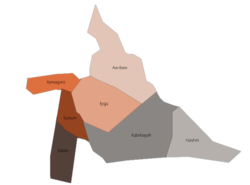
Fafan Zone (Somali: Gobolka Faafan) is a zone in Somali Region of Ethiopia. It was previously known as the Jijiga zone, so named after its largest city, Jijiga.[2] Other towns and cities in this zone include Awbare, Derwernache, Lefe Isa, Babile, Kebri Beyah, Harshin, Goljano, Tuli Gulled and Hart Sheik. Fafan is bordered on the south by Jarar, on the southwest by Nogob, on the west by the Oromia Region, on the north by Sitti, and on the east by Somaliland.

Key Information

Demographics

[edit]

Based on the 2014 Census conducted by the Central Statistical Agency of Ethiopia (CSA), this Zone has a total population of 1,190,794 of whom 616,810 are men and 541,4794 women.[3]

Based on the 2007 Census 203,588 or 21.04% are urban inhabitants, a further 72,153 or 11.59% were pastoralists. Two largest ethnic groups reported in Jijiga were the Somalis (95.6%) and Amhara (1.83%); all other ethnic groups made up 2.57% of the population. Somali language is spoken as a first language by 95.51%, Amharic by 2.1%, and Oromo by 1.05%; the remaining 1.34% spoke all other primary languages reported. 96.86% of the population said they were Muslim, and 2.11% said they practiced Orthodox Christian.[4] There are three settlements in the zone for refugees from Somalia, with 40,060 registered individuals.[5]

The 1997 national census reported a total population for this Zone of 813,200 in 138,679 households, of whom 425,581 were men and 387,619 were women; 155,891 or 19.17% of its population were urban dwellers. The three largest ethnic groups reported in Fafan were the Somali (87.51%), the Oromo (7.49%), and the Amhara (2.13%); all other ethnic groups made up the remaining 2.87% of the population. Somali was spoken by 90.23% of the inhabitants, 6.68% Oromiffa, and 2.81% spoke Amharic; the remaining 0.28% spoke all other primary languages reported. Only 61,293 or 7.54% were literate.[6]

According to a May 24, 2004 World Bank memorandum, 7% of the inhabitants of Fafan have access to electricity, this Zone has a road density of 30.5 kilometers per 1000 square kilometers, the average rural household has 1.3 hectares of land (compared to the national average of 1.01 hectares of land and an average of 2.25 for pastoral regions)[7] and the equivalent of 1.0 head of livestock. 28.2% of the population is in non-farm related jobs, compared to the national average of 25% and a regional average of 28%. 21% of all eligible children are enrolled in primary school, and 9% in secondary schools. 74% of the zone is exposed to malaria, and none to Tsetse fly. The memorandum gave this zone a drought risk rating of 386.[8] In 2006, the Fafan Zone was affected by deforestation due to charcoal production.[9]

Districts

[edit]

Based on the 2024 Census by the Federal Democratic Republic of Ethiopia's Central Statistical Agency (CSA), Awbare district has the largest district population in the Somali Region.[10]

District Name Population (2024)[11]
1. Awbare 519,044
2. Jijiga 439,505
3. Kebri Beyah 254,251
4. Harshin 122,556
5. Babile 117,167
6. Gursum 42,082

Notes

[edit]
Revisions and contributorsEdit on WikipediaRead on Wikipedia
from Grokipedia
The Fafan Zone is one of the administrative zones comprising the in eastern , bordering to the east and encompassing diverse terrain from semi-arid plains to urban centers. It serves as a key and trading hub, with a predominantly consisting of ethnic Somalis practicing nomadic alongside emerging urban economies centered around its principal , , which functions as the regional capital. According to data from the Central Statistical Agency's 2007 census, the zone's exceeded 1.3 million, with a significant portion engaged in amid challenges posed by recurrent droughts and resource scarcity. The zone's districts, including Awbare, Harshin, and Kebri Beyah, reflect a mix of rural woredas and border settlements, contributing to 's strategic eastern frontier dynamics. Geographically, Fafan features low densities averaging around 16 inhabitants per square kilometer, underscoring its vast, arid landscapes suited to rearing but vulnerable to environmental stresses. Bordered by Jarar Zone to the south, Nogob Zone to the southwest, Region to the west, and Siti Zone to the north, the area has been marked by inter-communal resource disputes and influxes of internally displaced persons from adjacent regions, straining local capacities.

Geography

Location and Borders

Fafan Zone is situated in the eastern portion of Ethiopia's Somali Regional State, approximately 450 kilometers east of the capital, , and near the borders with neighboring countries. The zone encompasses the upper catchment of the Fafan River, a seasonal originating in the surrounding highlands that flows eastward, shaping local water resource dynamics through its influence on and flood patterns in pastoral lowlands. The zone's boundaries include the Region to the west, where shared frontiers facilitate but also complicate access to grazing lands for transhumant herders due to overlapping resource claims in arid zones. Internally within the , it adjoins Nogob Zone to the southwest and Jarar Zone to the south, while lies to the north; to the east, it interfaces with the internationally unrecognized but independent , approximately 70 kilometers from , the zone's administrative center. These eastern frontiers enable cross-border livestock trade and migration corridors, though they are marked by political ambiguities stemming from Somaliland's self-declared independence since 1991. Jijiga's position enhances the zone's strategic role as a conduit for , linking inland Ethiopian markets via the Harar corridor to the westward and northward trade paths toward port, which handles over 90 percent of Ethiopia's import-export traffic. The Wajale-Jijiga route stands out as a primary for licensed goods importation, underscoring how Fafan Zone's supports regional connectivity amid the Somali Region's overall reliance on for maritime access. This configuration influences resource flows, with riverine features like the Fafan acting as natural divides that guide seasonal displacements and constrain to floodplain-adjacent areas.

Physical Features and Climate

The Fafan Zone features diverse topography, including the Amora Mountains with peaks exceeding 3,000 meters, the Jijiga Plains at approximately 1,700 meters elevation, and the Fafan Valley characterized by alluvial sediments and undulating valleys. Geologically, the area rests on a basement of granites and gneisses, overlain by limestone formations such as the Hamanlei (up to 250 meters thick) and Gabredare marly limestones, with basalt domes in the plains and alluvial deposits in the valleys. Soils primarily consist of Cambisols, Leptosols, Vertisols, Luvisols, Fluvisols, and Calcisols; in upper Fafan valley areas, luvisols (slightly fertile, about 60%) and vertisols (fertile, about 18%) predominate, though many are prone to and exhibit low overall fertility, supporting predominantly mobile pastoral herding rather than intensive . Vegetation is adapted to semi-arid conditions, featuring woodlands, , open shrublands, and grasslands, with having declined significantly due to degradation. includes sparse native such as leopards, , and historically black-maned lions in grasslands and riparian zones, though and loss pose risks; primary domesticated like camels and goats dominate the landscape. The climate is semi-arid with bimodal rainfall patterns: the Gu season (March to late May) and Deyr or Karan (mid-July to late September or October-November), averaging 380 to 756 mm annually, with higher amounts (up to 735 mm) in mountainous areas and less than 400 mm in plains and valleys. Temperatures range from 20°C to 35°C, moderated by higher elevations compared to lowland parts of the . Droughts recur periodically (every 10-20 years), often linked to failed Gu rains and extended dry spells up to five months, as seen in regional events like those in 2011 and 2016, with high rainfall variability constraining settlement and economic activities.

History

Pre-Federal Era and Ogaden War

During the late 19th and early 20th centuries, the area encompassing modern Fafan Zone, centered on , was incorporated into the through military expansion into Somali-inhabited lowlands, establishing a at around 1891 as a base for campaigns and administrative control. This outpost facilitated the collection of in livestock from local Somali nomadic herders, reflecting a system of nominal amid intermittent resistance, such as the 1900 ambush aimed at expelling Ethiopian settlers. Under Emperor , functioned as a administrative hub, where evolved into formalized taxation, though nomadic groups increasingly resisted through evasion, fostering early irredentist tensions without unified opposition, as clan-based alliances sometimes accommodated Ethiopian authority over outright rejection. The of 1977–1978 marked a direct challenge to Ethiopian sovereignty when , under , launched an invasion on July 12, 1977, deploying 35,000 troops supported by 15,000 (WSLF) militiamen primarily from clans, rapidly seizing over 60% of the by late July. Somali forces captured on September 19, 1977, gaining control of key mountain passes vital for logistics to major cities in the disputed region. Ethiopia's regime, initially weakened by internal revolution, countered with Soviet and Cuban assistance starting in late 1977, recapturing and most territory by March 1978, affirming defensive control over historically administered lands rather than mere occupation, as evidenced by prior tribute systems and lack of unanimous Somali rejection of Ethiopian rule. The war exposed intra-Somali clan fractures, particularly between dominant elements in the WSLF and rival groups like the Issa, whose divided loyalties limited unified support for the invasion and highlighted opportunistic alliances, including some clans aligning with Ethiopian forces against pan-Somali . Under Mengistu Haile Mariam's , post-war policies of collectivization and villagization imposed Soviet-style agricultural reforms ill-suited to nomadism, displacing herders through forced settlements and resource mismanagement, which exacerbated grievances and seeded insurgent precursors like the (ONLF), formed in 1984 amid repression. These failures stemmed from ideological rigidity, ignoring ecological realities of arid herding, and contributed to localized famines without addressing clan-based social structures.

Establishment Under Ethnic Federalism

The adoption of ethnic federalism in Ethiopia following the EPRDF's victory in 1991 led to the reorganization of administrative units along ethnic lines, culminating in the formal establishment of the Somali Regional State in 1992 as one of nine ethnic-based regions with delegated autonomy, including its own president and regional parliament. This structure aimed to address historical marginalization of ethnic groups like Somalis by granting self-rule over territories with majority Somali populations, formalizing claims to areas such as the Ogaden and Jijiga environs previously contested or administered centrally. However, the system's emphasis on ethnic majorities for resource allocation and political power inadvertently encouraged boundary irredentism, as regional authorities sought to expand zones by claiming adjacent districts with even nominal Somali presence, particularly from neighboring Hararghe areas in Oromia, to secure greater federal transfers and influence. Within the , the Zone—centered on the strategic town of —was redesignated as Fafan Zone during the to align administrative nomenclature with local Somali geography, specifically the Fafen River valley that supports pastoralist livelihoods in the area. This and attendant zone consolidation absorbed Somali-majority or contested from former province, enhancing the region's cohesion but exacerbating inter-ethnic tensions over land use and migration routes. The transition formalized Somali administrative control but faced immediate tests from internal divisions, as clan-based politics intersected with the new federal incentives, prompting federal intervention to delineate zones and mitigate secessionist pressures evident in early regional assemblies. The period was overshadowed by the resurgence of the (ONLF), which initiated armed insurgency in 1994 after rejecting the federal framework's limits on , launching attacks on , military outposts, and economic targets across the , including routes vital to Jijiga's stability. Ethiopian federal forces responded with measures, including troop deployments and intelligence operations, which by the late 1990s had curtailed ONLF operations in northern zones like Fafan, securing as a administrative hub despite sporadic ambushes. This stabilization enabled modest recovery, with influxes of returning pastoralists and internally displaced persons post-Derg era conflicts, though estimates for Fafan-specific growth remain imprecise amid broader regional sedentarization trends. Initial post-federal development in Fafan relied heavily on international aid for basic services and relief, a dependency pattern critiqued by observers for undermining pastoralist and fostering expectations of external provision over local revenue generation, as federal transfers prioritized security over economic diversification in the . Such aid inflows, while averting , reinforced patronage networks that complicated governance, setting precedents for the region's chronic vulnerability to humanitarian cycles rather than sustainable autonomy under .

Developments Since 2000

In the early 2000s, the (EPRDF) government pursued stabilization in the , including Fafan Zone, by integrating local -based militias into formal security structures, such as the formation of the Liyu Police in 2008 to counter insurgent threats like the (ONLF). This approach reduced overt large-scale but entrenched clan politicking within state institutions, as militias were often loyal to subclans rather than centralized . Infrastructure development advanced with the establishment of Jigjiga University in March 2007, part of Ethiopia's second-generation public universities initiative to expand higher education in peripheral regions, enrolling initial cohorts focused on local needs like and veterinary sciences. Under Prime Minister Abiy Ahmed from 2018 onward, the ONLF signed a peace agreement with the federal government on October 21, 2018, formally ending its armed campaign and enabling political participation, which aimed to foster development in zones like Fafan by shifting focus from conflict to investment in gas-rich areas. However, this period saw spikes in clan-based and inter-ethnic violence, including clashes between Somali and Oromo groups in 2017 that displaced thousands and targeted attacks on highlanders in Jigjiga on August 4, 2018, amid power struggles exacerbated by Abiy's reforms displacing regional president Abdi Mohamoud Omar. These incidents, often driven by competition over administrative control and resources, highlighted persistent clan rivalries despite reduced ONLF activity. Economic progress in Fafan Zone has been marked by urban expansion in Jigjiga, the zone's administrative center, supporting small-scale trade and services through initiatives like business programs by NGOs since the mid-2010s, though overall socio-economic indicators remain low with rates exceeding national averages. Regional GDP contributions from urban growth are limited by aid dependency and volatility, as federal transfers and international assistance fluctuate with security conditions, tempering gains from projects like development in Fafan districts. allegations in aid distribution and clan favoritism have undermined project efficacy, with reports of mismanagement in and sectors persisting into the .

Administration and Governance

Regional Context and Zone Structure

The Somali Regional State, established in 1994 as part of Ethiopia's framework under the 1995 Constitution, grants administrative to the predominantly Somali population while remaining subordinate to the federal government in defense, , and monetary policy. The region is divided into approximately 11 zones, a structure that has evolved through periodic administrative reforms to accommodate clan dynamics and local governance needs. Fafan Zone, formerly known as Zone until renamed around 2007, occupies a central position as the region's political and administrative core, encompassing the capital city of with its estimated urban population exceeding 400,000 as of 2022 projections. This urbanization distinguishes Fafan from more pastoral and remote zones, concentrating regional institutions such as the president's office, state council, and key infrastructure like Jijiga's , which maintains direct commercial flights to roughly 359 km to the west. Zonal administration in the follows Ethiopia's federal hierarchy, with zone heads appointed by the regional president, who leads the executive branch and oversees policy implementation through the state council legislature. Security governance relies on the regional for routine law enforcement, augmented by federal deployments in hotspots of violence or , reflecting the region's of internal tensions integrated into formal structures via customary elders' councils. considerations permeate bureaucratic appointments, where informal quotas aim to balance representation among major Somali groups like the and , though this practice has been linked to patronage networks that undermine merit-based efficiency. The zone's relative accessibility from has facilitated disproportionate infrastructure investments, such as roads and utilities, fueling local perceptions of favoritism toward Fafan over arid peripheral zones like those bordering . remains a systemic issue, with regional officials often implicated in resource misallocation, exacerbating inequities in service delivery across the federal setup.

Districts and Local Administration

Fafan Zone is administratively subdivided into 11 woredas, serving as the primary units for local in the . These districts handle core functions including tax and revenue collection, local development planning, and delivery of basic services such as , , and , though implementation varies due to differences in resources and levels. Jijiga woreda functions as the zonal capital and the most urbanized district, concentrating administrative offices, markets, and infrastructure like roads and utilities that support regional coordination. In contrast, Awbare woreda, positioned along the border with , emphasizes administration and cross-border trade oversight, while Gursum woreda primarily manages nomadic herding and resources. Other notable woredas include Harshin, Babile, Goljano, and Tuliguled, where local councils address agro- needs amid disparities in access to water points and veterinary services. Infrastructure gaps persist, with urban centers like benefiting from relatively better connectivity, whereas remote districts rely on mobile extension teams for service provision.

Demographics

Population and Urbanization

The 2007 national census reported a population of 968,000 residents in Fafan Zone. Population density varies significantly, with higher concentrations in riverine and agro-pastoral districts along sources, such as those near the Erer River, compared to sparse nomadic settlements in arid interiors. These patterns reflect adaptation to semi-arid conditions, where access to and supports denser human and settlement. Jijiga, the zone's administrative center, serves as the primary urban hub, with its estimated at approximately 483,000 inhabitants as of recent projections. Urban growth in has accelerated due to changes, including expansion of built-up areas amid broader regional trends. Smaller towns like Kebribeyah contribute to limited urban infrastructure, with combined urban populations in key settlements reaching around 218,000 based on earlier assessments. Since 2017, influxes of internally displaced persons (IDPs) from inter-regional clashes with Oromia have bolstered urban and peri-urban populations in Fafan Zone, particularly around Jijiga. Over half of Somali Region's IDPs traced displacements to that year, straining settlement patterns already pressured by recurrent droughts prompting pastoralist migration toward reliable water and market access. The zone exhibits a pronounced youth bulge, with demographics indicating around 60% of the population under age 25, driven by high fertility rates in pastoral communities. This age structure amplifies urbanization dynamics, as young migrants seek non-pastoral livelihoods in expanding towns.

Ethnic and Linguistic Composition

The Fafan Zone is predominantly inhabited by ethnic Somalis, who form the vast majority of the population, estimated at around 95.6% based on assessments of return areas encompassing the zone. This homogeneity reflects the broader demographic patterns of Ethiopia's , where Somali pastoralist and agro-pastoralist communities have historically predominated due to adaptation to the arid lowlands and cross-border kinship ties with Somali populations in neighboring and . Intra-ethnic divisions exist primarily along clan lines, with Somali society structured around patrilineal clan federations that regulate access to grazing lands, , and dispute resolution through customary xeer law; these federations emphasize agnatic descent and systems, fostering both cooperation and competition within the Somali group rather than external ethnic fragmentation. Key Somali clans in the zone include sub-branches of the confederation, such as the , alongside Dir-affiliated groups like the , who predominate in districts such as Awbare, and Issa communities in border areas like Harshin. These clan distributions influence local power dynamics and resource allocation, with no single achieving monopoly across the zone's 968,000 residents as of the 2007 census, though exact clan proportions remain undocumented in official tallies due to the emphasis on ethnic over sub-ethnic categorization in Ethiopian data. Non-Somali minorities are marginal, comprising small pockets of Oromo (about 2.25%) and Amhara (0.69%) concentrated in urban centers like , often as traders or civil servants, alongside negligible Gurage and other highland Ethiopian groups; these minorities stem from administrative postings and historical migrations but do not alter the zone's overarching Somali character. Linguistically, the zone is overwhelmingly Somali-speaking, with the Af-Maxaa-tiri dialect serving as the vernacular and regional working language, facilitating oral traditions, , and daily pastoral interactions in a Cushitic linguistic framework shared across Somali territories. , 's federal , appears in official administration and education, particularly in Jijiga's urban settings, while minority languages like Oromo or are spoken in isolated enclaves without broader institutional support. This linguistic uniformity reinforces clan-based social cohesion, as Somali dialects exhibit minimal variation within the zone compared to broader East Cushitic diversity elsewhere in .

Religion and Social Structure

The inhabitants of Fafan Zone are nearly universally adherents of , comprising the dominant faith in the where over 95% of the population identifies as Muslim, with practices rooted in the prevalent among eastern Ethiopian communities. Sufi orders, particularly the , exert considerable influence on religious life, fostering tariqa-based networks that blend spiritual authority with communal mediation and resilience against environmental hardships in pastoral settings. This conservative Islamic orientation emphasizes scriptural adherence and tariqa loyalty, contributing to social cohesion amid recurrent droughts and mobility demands, though it has drawn critiques for potentially reinforcing insularity over integration with state institutions. Social organization centers on patrilineal clan structures, segmentary in nature, where primary loyalties extend from nuclear families to broader clan families like the , subdivided into lineages and diya-paying groups of 50-200 adult males sharing common ancestors four to eight generations back. These groups enforce , including the diya system of blood money compensation—typically 100 camels per —to avert escalatory feuds, with elders arbitrating via integrated with Islamic principles. Extended kin networks underpin pastoral resilience, pooling resources for survival and migration, yet they perpetuate divisions wherein men dominate herding and decision-making while women handle milking, weaving, and domestic labor, often curtailing female asset control and . Literacy rates in the , encompassing Fafan Zone, lag national averages at under 40% for adults, with female rates even lower due to early norms and prioritization of household duties over schooling, though Islamic madrasas provide rudimentary Qur'anic focused on rather than secular skills. This framework bolsters cultural continuity and dispute resolution efficacy but faces scrutiny for hindering broader development amid aid inflows that some argue erode self-reliant kinship incentives.

Economy

Primary Sectors: Agriculture and Livestock

Livestock rearing dominates the economy of Fafan Zone, supporting the predominantly agropastoral livelihoods in this semi-arid area of the Somali Region. The zone sustains an estimated livestock population of over 3 million heads, comprising approximately 503,871 cattle, 1,134,856 sheep, 1,365,265 goats, and 290,649 camels, which provide milk, meat, and draft power essential for household food security and mobility. These herds adapt to aridity through nomadic grazing patterns, though veterinary challenges persist, including outbreaks of foot-and-mouth disease (FMD) and other reportable conditions like contagious caprine pleuropneumonia, which reduce productivity and necessitate community-based vaccination efforts. Crop agriculture remains marginal, confined to small irrigated enclaves along river valleys such as the Upper Fafan, where recession and support limited cultivation of , , and . Yields are typically below 1 ton per hectare for staple grains, hampered by erratic rainfall, , and acute shortages that lead to frequent crop failures during droughts. Sustainability is undermined by , with livestock densities often surpassing carrying capacities, accelerating vegetation loss and soil degradation across communal pastures. degradation rates in the , including Fafan, stem primarily from excessive stocking and breakdown of traditional mobility, reducing forage availability by up to 50% in heavily utilized areas and prompting initiatives for ecosystem restoration. These pressures highlight adaptive strategies like , though enforcement remains limited amid and climate variability.

Trade, Urban Economy, and Challenges

Jijiga serves as the primary wholesale hub in Fafan Zone, facilitating trade in , imported commodities, and local goods through enhanced road corridors that connect to cross-border routes with and . The zone's commerce relies heavily on these informal and formal exchanges, with exports forming a key component, though traders face persistent constraints including limited access to capital, inadequate market , and underdeveloped at trading sites. Urban economic activity in centers on services, retail, and transport linked to regional trade flows, bolstered by recent infrastructure expansions like widened roads and business-integrated layouts that support commercial growth. Remittances from the contribute to household incomes and urban consumption, though precise regional shares remain underdocumented amid national figures hovering below 1% of GDP; however, in displacement-affected areas like Fafan, they sustain informal sectors amid high joblessness. rates in the exceed 80% in some assessments, particularly among youth and returnees, exacerbating reliance on transient trade opportunities. Khat trading links Fafan Zone to neighboring , where production dominates eastern Ethiopia's highlands, enabling cross-regional exports that supplement local commerce despite regulatory fluctuations and export pricing disputes. Border closures and diplomatic tensions have driven in imported essentials, fostering prevalence for , forex, and goods, which undermines formal and distorts signals. Humanitarian aid inflows, while addressing acute needs in refugee-hosting areas like , distort local markets by flooding supply chains with subsidized goods, undercutting private traders, and fostering dependency that hampers endogenous commercial development. This intervention-heavy environment, compounded by institutional risks documented in broader Ethiopian systems, perpetuates inefficiencies and informal coping mechanisms over sustainable urban economic resilience.

Conflicts and Ethnic Tensions

Inter-Clan and Inter-Ethnic Clashes

Inter-clan and inter-ethnic clashes in Fafan Zone stem primarily from competition over scarce pastoral resources, such as water points and grazing lands, exacerbated by administrative boundary changes and population pressures among nomadic herders. These conflicts often involve Somali clans like the Geri (a Darood sub-clan dominant in parts of Fafan) contesting dominance with non-Ogaden groups, including Issa and Dir subclans such as in districts like Awbare and Gursum, as well as incursions from Oromo groups across the zonal border. Triggers frequently include disputes over wells and migration routes, with attempted through , the customary Somali legal system relying on clan elders, precedents, and oral agreements to enforce restitution like diya (blood money). However, xeer's effectiveness diminishes in cases intertwined with formal administrative politics, where communities increasingly favor state courts. A notable wave of violence occurred from 2017 to 2018 along the Fafan-Oromia border, involving Geri Somalis and Jarso communities (of mixed Somali-Oromo heritage) in districts like Tuli Guled and near Jijiga. Clashes were fueled by unresolved 2004 referendum outcomes assigning kebeles to either region, coupled with resource scarcity and political mobilization by regional special police (liyu). In February-March 2017, Somali militias raided Oromia areas, killing over 100 civilians, while retaliatory Oromo incursions targeted Somali settlements, contributing to broader Somali-Oromo fighting that displaced over 1 million people across the border zones by mid-2018 and resulted in hundreds of deaths. Fafan-specific incidents included skirmishes in Chinaksen (September 2017) and Tuli Guled (July 2018), where liyu forces backed Geri claims, leading to thousands displaced in the zone. Intra-clan tensions within Fafan have persisted, as seen in land disputes between Harshin woreda (primarily -affiliated pastoralists) and neighboring Yocaale communities, triggered by 2011 administrative restructurings that restricted livestock migration routes and reduced rangeland due to vegetation loss from 1984-2014. These fights over water access and new encroachments like crop farming and charcoal production highlight efforts to assert control amid arms availability lingering from the 1977-1978 , which flooded the with small arms post-withdrawal. Efforts to resolve such conflicts via often falter when clans perceive bias toward dominant groups like , prompting hybrid appeals to regional authorities. Recurrent flare-ups, such as the March 2023 clashes in Tuli Guled over village incorporation into (Makanis kebele) and a disputed in Marar, underscore ongoing ethnic friction, with at least several deaths reported from militia exchanges. Issa-Somali rivalries, though more acute in adjacent , spill into Fafan through pastoral overlaps, contesting hegemony via resource grabs. Proliferation of weapons from the era sustains lethality, as pastoralists arm for self-defense, complicating elder-led ceasefires.

Boundary Disputes with Neighboring Regions

Boundary disputes in Fafan Zone primarily arise from Ethiopia's , which assigns territories based on predominant ethnic groups, exacerbating competition over pastoral grazing lands and between Somali and Oromo communities. These tensions manifest as mutual territorial encroachments, where nomadic herders from both sides cross borders during seasonal migrations, triggering armed clashes. In Fafan Zone, located along the western frontier of the adjoining , such disputes have intensified since the early , transforming traditional resource rivalries into formalized claims over administrative boundaries. Pastoral encroachments along the frontier have repeatedly led to violence, with notable escalations in 2017–2018 resulting in significant displacements. During this period, clashes displaced over 1 million people across the Somali- areas, including substantial numbers in Fafan Zone, where one of the largest concentrations of internally displaced persons (IDPs) from inter-ethnic conflict was reported. By mid-2018, these events had uprooted approximately 857,000 individuals due to coordinated attacks and retaliatory raids, often involving militias aligned with regional ethnic lines. Urban-rural frictions with neighboring Harari and Dire Dawa administrations involve disputes over resource access at the interface of Somali pastoral zones and urban peripheries. In Dire Dawa, a chartered city bordering Fafan woredas like Babille, competing claims between Somali herders and urban dwellers—often Oromo or multi-ethnic—have sparked sporadic confrontations over land use and market access, though less documented than Oromia border violence. Harari's compact territory sees analogous pressures from adjacent Somali expansions, but Fafan-specific incidents remain tied to broader regional pastoral-urban divides rather than large-scale territorial annexations. Resolution efforts, including federal boundary commissions established under Ethiopia's , have largely failed to delimit contested areas permanently, perpetuating cycles of . These mechanisms, intended to adjudicate ethnic-based claims, often stall amid mutual accusations of , leaving disputes unresolved and enabling recurrent clashes. Economically, such instability has halted cross-border trade routes vital for Fafan Zone's markets, with border closures during flare-ups disrupting commerce and exacerbating local . Renewed violence as recently as 2025 has displaced over 288,000 along the Somali-Oromia frontier, underscoring the ongoing costs.

Insurgency and Security Dynamics

The Ogaden National Liberation Front (ONLF), a Somali nationalist insurgent group primarily drawing from the Ogaden clan, waged a low-intensity guerrilla campaign against Ethiopian federal forces in the Somali Region from the early 1990s until 2018, targeting military installations and economic assets to press for regional self-determination or secession. Operations extended to areas near Jijiga, the administrative center of Fafan Zone, including a 2011 ambush on a military convoy escorting oil workers outside the city, which underscored the group's aim to disrupt federal control and foreign investments. The insurgency relied on hit-and-run tactics, ambushes, and improvised explosive devices, exploiting the region's arid terrain and porous borders with Somalia for logistics and sanctuary, while federal counteroperations, including Ethiopian National Defense Force (ENDF) sweeps, gradually eroded militant capacities through sustained pressure. A pivotal shift occurred with the October 21, 2018, peace agreement signed in , , between the Ethiopian government and the ONLF, formally terminating armed hostilities and committing the group to , , and political engagement within Ethiopia's federal framework. Under the accord, thousands of ONLF fighters reintegrated into civilian life or joined regional security structures, with the government facilitating , vocational training, and resettlement programs that demobilized core combatants and neutralized operational threats, marking a success in converting separatist momentum into electoral participation. This outcome contrasted with ONLF demands for referendum-based independence, highlighting integration's tangible benefits such as expanded infrastructure—like roads and electrification in previously contested zones—and economic access, which bolstered local stability over protracted conflict. Security dynamics in Fafan Zone hinged on the regional Liyu police, a clan-recruited force established in 2007 to supplement ENDF efforts against ONLF incursions, proving effective in intelligence-driven operations that disrupted militant supply lines and safe houses by leveraging local knowledge. Federal interventions, including joint ENDF-Liyu raids, capitalized on this to weaken the pre-accord, though human rights groups like documented allegations of extrajudicial killings and torture by Liyu units, claims the government attributed to isolated excesses amid a broader imperative. Clan complicity complicated operations, as ONLF's ethnic Somali base fostered harboring of fighters within communities, enabling evasion until targeted defections and incentives shifted loyalties toward federal alignment. Islamist threats, while secondary to ONLF nationalism, posed cross-border risks from Somalia-based groups like al-Shabaab, prompting heightened ENDF patrols along Fafan Zone frontiers to preempt infiltration and radicalization, with no major localized uprisings recorded but ongoing vigilance against ideological spillover. Overall, post-2018 demobilization successes underscored causal factors like military attrition and political concessions in resolving clan-tied insurgencies, prioritizing empirical stabilization over separatist narratives.

Recent Developments

Administrative Restructuring and Protests

In July 2025, the Somali Regional State Council approved a major administrative , including the creation of 14 new woredas (), four additional zonal administrations, and 25 municipal offices, as part of efforts to reorganize local structures across the region, including Fafan Zone. This resolution, passed on July 27, aimed to streamline administration amid criticisms of inefficiency in the existing woreda system, though regional officials have not publicly detailed efficiency metrics or cost savings projections. The restructuring provoked immediate protests in multiple towns, with demonstrators in areas linked to Fafan Zone, such as Jijiga, expressing fears that realignments would dilute clan-based representation and favor dominant groups like the Issa clan over others, including the Gadabuursi and Gurgura. Protesters accused the regional government of unilateral decision-making without adequate clan consultations, exacerbating inter-clan tensions and risking escalation into broader ethnic conflicts, as evidenced by petitions to federal authorities highlighting governance collapse tied to these changes. Opposition groups, including the Ogaden National Liberation Front, condemned the process as lacking popular legitimacy and potentially violating border agreements with neighboring regions. Regional authorities defended the reforms as necessary for modernizing and reducing administrative redundancies, countering claims of bias by asserting broad consultations occurred, though protesters and petitioners disputed this, citing suppressed dissent and a on public discourse. Outcomes included deepened divisions, with Somali elders issuing rebuttals to petitioners and ongoing unrest reported in affected zones, alongside unverified reports of arrests targeting protest leaders, amid a regional environment where independent verification remains challenging due to restricted access for NGOs. As of August 2025, tensions persisted without formal reversals, highlighting underlying clan power imbalances in Fafan Zone's diverse ethnic makeup.

Humanitarian Crises and Displacements

The Fafan Zone has experienced recurrent from 2018 to 2025, contributing to internal displacements amid broader climate shocks in the , where an estimated 276,868 individuals were displaced primarily by and related factors as of May 2024. These events, compounded by floods in low-lying areas, have strained pastoralist livelihoods dependent on and water access, prompting movements to urban peripheries or host communities within the zone, such as sites in Qoloji hosting protracted IDPs numbering around 6,000 as of August 2024. Cross-border inflows from , including drought-affected populations, have further increased the IDP caseload in Fafan, though precise zone-level figures remain limited; nationally, accounted for 17.7% of displacements (612,250 IDPs) as of September 2023. Humanitarian responses involve UNHCR and WFP operations targeting drought-impacted areas in the , including cash assistance, food distributions, and nutrition programs to address acute food insecurity. rates among children under five in Somali Region pastoral and agropastoral zones have hovered around or exceeded 15% global acute (GAM) thresholds during peak periods, with zones like Shinile recording 15.6% GAM in recent assessments. Despite these efforts, funding shortfalls have forced ration reductions, exacerbating vulnerabilities for over 2.3 million drought-displaced across and neighboring areas by August 2023. Clan dynamics in the , including Fafan, have been critiqued for enabling gatekeeping of resources, where dominant clans prioritize kin networks, leading to , exclusion of minority groups, and inefficiencies in distribution that undermine resilience. Long-term initiatives to sedentarize nomadic pastoralists have largely faltered due to incompatible arid and cultural practices, perpetuating cycles of displacement during shocks rather than building . These gaps highlight causal factors rooted in resource competition and institutional limitations over external narratives of uniform failure.

References

Add your contribution
Related Hubs
User Avatar
No comments yet.