Hubbry Logo
FatbikeFatbikeMain
Open search
Fatbike
Community hub
Fatbike
logo
8 pages, 0 posts
0 subscribers
Be the first to start a discussion here.
Fatbike
Fatbike
from Wikipedia
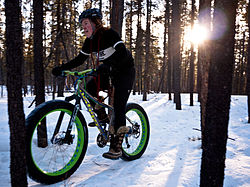
Fatbike being ridden over snow

A fatbike (also called fat bike, fat tire, fat-tire bike, or snow bike) is an off-road bicycle built to accommodate oversized tyres, typically 3.8 in (97 mm) or larger and rims 2.16 in (55 mm) or wider, designed for low ground pressure to allow riding on soft, unstable terrain, such as snow, sand, bogs and mud.[1] Fatbikes are built around frames with wide forks and stays to accommodate the space required to fit these wide rims and tires. The wide tires can be used with inflation pressures as low as 34 kPa; 0.34 bar (5 psi) to allow for a smooth ride over rough obstacles. A rating of 55–69 kPa; 0.55–0.69 bar (8–10 psi) is suitable for most riders.[2] Fatbikes were developed for use in snow or sand,[1] but are capable of traversing diverse terrain types including snow, sand, desert, bogs, mud, pavement, or traditional mountain biking trails.[3]

History

[edit]
Picture from series "Strange but True!", placed by Currys Ltd in the cycling press, before 1932

Early versions of fat-tired bikes were probably built as long ago as the early 1900s but modern versions were not developed until the 1980s. An early example is the custom three-wheeled in-line longtail-style bike with fat tires, designed by French cyclist Jean Naud in 1980 for desert travel. He rode it from Zinder in Niger to Tamanrasset in Algeria,[citation needed] and later rode a similar bike in 1986 across the Sahara using prototype fat tires from Michelin.[4]

In the late 1980s, Alaskan frame builders began experimenting with custom components and configurations designed to achieve a large contact patch of tire on snow. Steve Baker, with Icycle Bicycles in Anchorage, was welding together two rims and even three rims and built several special frames and forks that could accommodate two or three tires together. In 1989, Dan Bull, Mark Frise, Roger Cowles and Les Matz, rode the 1,000-mile (1,600 km) length of the Iditarod Trail.[5]

Simultaneously, in New Mexico, Ray Molina had commissioned Remolino 3.1 in (79 mm) rims, 3.5 in (89 mm) tires, and frames to fit them. He wanted the bikes for his guided tour business in the soft sands of the Mexican and Southwest arroyos and dunes. Mark Gronewald, owner of Wildfire Designs Bicycles in Palmer, Alaska, met Molina at the 1999 Interbike convention in Las Vegas and rode one of Molina's prototypes at demo days. In late 1999, Gronewald and another Alaskan frame builder, John Evingson, collaborated to design and build several bikes using Molina's rims and tires. Gronewald and Evingson then began producing their own separate lines of fat-tired bikes in 2000. Rims and tires were imported to Alaska where Wildfire and Evingson began making small, handmade production runs and custom-ordered frames built around Remolino 80 mm (3.1 in) rims and 3.5-inch (89 mm) tires. Gronewald coined the trademark "Fat Bike" in 2001 and used it as the model name for his bikes. Gronewald initially worked with Palmer Machinery for welding and later contracted frame building to Mike DeSalvo at DeSalvo Cycles of Ashland, Oregon. Gronewald continued to sell his original fatbikes until 2011. Gronewald's design featured an 18 mm (0.71 in) offset wheel and frame built to allow full range gearing, since he was using standard hubs and bottom brackets available at the time.

Wildfire and Evingson bikes were used in the Iditarod Trail races beginning in 2000. Also that year, Mike Curiak from Colorado set a record on the Iditarod Trail in the IditaSport Extreme race to Nome on a modified Marin bike with Remolino rims and tires. Surly Bikes released the Pugsley frame, in 2005,[6] and began producing Large Marge 65 mm (2.6 in) rims and Endomorph 3.8-inch (97 mm) tires in 2006. The Pugsley frame, rim and tire offerings made fatbikes commercially available in local bike shops worldwide.[7] The Pugsley bikes also featured the offset wheel and frame build.

Other early versions of the fatbike were normal mountain bikes equipped with SnowCat rims, created by Simon Rakower of All-Weather Sports in Fairbanks, Alaska, in the early 1990s;[8] or with multiple tires seated on two or three standard rims that had been welded or pinned together.[9] Rakower was involved with technical support aspects of the Iditabike (later IditaSport) race, which started in 1987. Since 2002 the race continued on the same trail under the name Iditarod Trail Invitational (ITI). Rakower started hand making extra wide rims for participants by welding two rims together and cutting off the middle ridge known as the snowcat rims 44 mm (1.7 in). S. Rakower produced those rims from 1991 through 1999. Many riders on the Iditarod Trail used a Geax tire with the snow cat rim. Enthusiasts would cut and sew tire-carcasses together to maximize the size of the tire and utilize all the available space between the seat stays and chain stays; this tire and rim combination would maximize the bicycle's footprint, increasing flotation on winter trails. Soon after, Rakower decided to design a 44 mm (1.7 in) rim from scratch and had it produced. SnowCats revolutionized winter cycling, as they could be fitted to nearly any commercially available mountain bike.

Mike Curiak from Colorado set a record on the Iditarod Trail in the 2000 race to Nome.[10]

Products

[edit]

Surly Bikes released the Pugsley frame in 2005 and began producing Large Marge 65 mm (2.6 in) rims and Endomorph 3.8-inch (97 mm) tires in 2006.[11] The Pugsley frame, rim, and tire offering made fatbikes commercially available in local bike shops worldwide. The Pugsley bikes also featured the offset wheel and frame build. Fatback Bikes came online in 2007 adding the carbon Corvus fatbike. Another Alaskan brand 9:zero:7 joined in 2010 also offering a carbon fatbike. Other bike manufacturers have also entered the fatbike market recently including Trek, with the Farley, Salsa with the Beargrease and Mukluk, and Specialized with the Fatboy and On=One with the Fatty. Others followed since 2014 Rocky Mountain, Felt, Kona, Pivot and many more. Since 2014, Dorel Sports has utilized their Mongoose brand to make fatbikes even more accessible to the general public, with models such as the Beast, Dolomite, Hitch, and Malus selling for around $250, considerably less than their higher-priced predecessors. Until approximately 2012, the TommiSea company of Virginia Beach built fat bikes for use on beach sand.

Events

[edit]

As the popularity of fatbikes has expanded,[12][13][14] fatbike specific events (races, race series, tours, and festivals) have emerged. Examples include the Snow Bike Festival,[15][16] the annual Global Fatbike Summit[17] (since 2012),[18] the Fatbike Birkie race[19] which is part of the Great Lakes Fatbike Series (2014–2015 season: 8 races held across 3 states),[20][21] the US Open Fatbike Beach Championships (inaugural, 2015),[22] the USA Cycling Fat Bike National Championship (inaugural, 2015),[23][24] the Ontario-based Substance Projects OnFatbikeSeries (OFBS), the 45Nrth Fatbike Triple Crown race series[25] and the UK Fatbike Championships (inaugural, 2013).[26][27]

The Iditarod Trail Invitational (formerly known as Iditabike and Iditasport Extreme and Iditasport Impossible) race in Alaska has grown into an international event offering an extreme 130-mile (210 km), 350-mile (560 km) and 1,000-mile (1,600 km) distances. The event spurred the creation of many other winter ultra events in the United States, Canada and Europe that are accepted qualifiers to get into this Invitational.

A number of extreme expeditions have also been made on fatbikes. In December 2012 Eric Larsen attempted to ride a fatbike to the South Pole, but made it only a quarter of the way before he had to turn around.[28] Maria Leijerstam became the first to cycle to the South Pole, across the South Pole Traverse road on a tricycle with fatbike tires.[29] On 21 January 2014, Daniel P. Burton became the first person to ride a bike across Antarctica to the South Pole, starting at Hercules Inlet and biking 1,247 km (775 mi) to the South Pole on a carbon fiber Borealis Yampa fatbike[30] with 4.8 in (120 mm) wide tires.[31][32]

Popular fatbiking destinations are predominantly found in the northern latitudes of the United States, Canada, and some Nordic countries.

[edit]

See also

[edit]

References

[edit]
[edit]
Revisions and contributorsEdit on WikipediaRead on Wikipedia
from Grokipedia
A fatbike, also known as a fat tire bike, is an off-road designed with oversized s typically measuring 3.8 inches (97 mm) or wider and rims at least 2.16 inches (55 mm) wide, enabling low pressures around 5-15 psi for superior flotation and traction on soft, unstable terrains like , , and . The origins of fatbikes trace back to the early 1980s in , where cyclists like Steve Baker experimented with DIY modifications, such as welding tracks or using dual rims to create wider tires for winter riding on frozen trails. This innovation was spurred by events like the inaugural Iditabike race in 1987, a 200-mile challenge along the that demanded bicycles capable of handling deep . Further developments in the 1990s included contributions from innovators like Simon Rowader, who introduced the 44 mm rim, and Ray Molina, who designed 88 mm rims and 3.5-inch Chevron tires tested in races. Commercialization accelerated in the mid-2000s with the launch of the Surly Pugsley in , featuring 3.7-inch tires and 65 mm rims, which made fatbikes accessible through major distributors and ignited widespread interest. Key features of modern fatbikes include frames made from materials like aluminum, , carbon fiber, or for durability and weight reduction; suspension options such as rigid forks, front suspension (e.g., 80-120 mm travel), or full suspension for varied ; and drivetrains often using 1x systems with wide-range cassettes (e.g., 11-50T) paired with disc brakes for reliable stopping power in harsh conditions. These bicycles have evolved beyond winter use to support year-round adventures, including beach cruising, desert trails, and groomed fatbike paths, with major manufacturers like Trek, Salsa, and Specialized offering models that cater to both recreational riders and competitive athletes.

Definition and Design

Tires and Wheels

Fatbike tires are characterized by their wide profile, with a minimum width of 3.8 inches (97 mm) to qualify as "fat," though typical sizes range from 4 to 5 inches for optimal performance on soft terrains. This width enables the tires to distribute the rider's weight over a larger surface area, providing flotation on surfaces like and . The tires are designed to operate at low pressures, typically 5 to 15 psi, which further enhances their ability to conform to uneven ground and maintain traction without sinking deeply. Rim specifications for fatbikes emphasize width to support these oversized s securely. Internal rim widths typically start from 44 mm for narrower fat tires but are commonly 65 to 80 mm to prevent at low pressures. For instance, Surly's Large Marge rims, with a 65 mm internal width, were introduced in 2006 and became a benchmark for early fatbike wheelsets. These wider rims ensure the tire's sidewall remains supported, reducing the risk of pinch flats and promoting even wear. Tire compounds in fatbikes prioritize durability and grip, often using rubber formulations that balance suppleness for low-pressure riding with resistance to cuts from rocks or . Tread patterns vary by intended use: knobby designs with aggressive lugs excel in and loose for better bite, while semi-slick options with shallower, directional chevrons provide on packed sand or groomed trails. Representative examples include the Surly Endomorph, a 3.8-inch released in 2006 with a semi-slick tread suited for versatile flotation, and the Surly Larry, featuring 4.8-inch width and knobby patterns optimized for and sand traction. Fatbike wheels are typically constructed with 26-inch diameter (ISO 559 mm) or 27.5-inch options, allowing compatibility across various frame geometries while maintaining maneuverability. To withstand the stresses of low-pressure operation, wheels incorporate reinforced components, such as double-butted spokes for enhanced resistance and robust hubs with wider flanges to handle without deformation. These features ensure during prolonged exposure to on soft surfaces. The evolution of fatbike tire and wheel standards gained momentum post-2010, influenced by the International Mountain Bicycling Association (IMBA), which in 2013 issued best practices defining fatbikes as those with tires wider than 3.7 inches at under 10 psi to minimize trail impact. This guidance helped standardize sizing for trail access and compatibility with frames designed for wide clearances.

Frame and Components

Fatbike frames are designed with geometry that prioritizes stability on loose and uneven surfaces, featuring slack head angles typically ranging from 66 to 70 degrees to enhance handling at low speeds and improve front-wheel traction. Longer wheelbases, often exceeding 1150 mm, contribute to this stability by distributing weight more evenly and reducing tippiness over obstacles. Common frame materials include chromoly steel for durability in harsh conditions, aluminum for a balance of strength and reduced weight (with frames around 3-4 kg), and carbon fiber for lighter options approaching 2.5-3.5 kg while maintaining rigidity. These materials accommodate the demands of oversized tires without excessive flex, with aluminum and carbon frames often featuring hydroformed tubing for optimized strength-to-weight ratios. Suspension options on fatbikes emphasize and , with rigid frames being the most prevalent to minimize weight and in or . However, front suspension forks with 80-120 mm of travel are available for rougher terrain, providing additional compliance without the complexity of full-suspension systems, which are less common but can offer 100-150 mm total travel in specialized models. Drivetrain adaptations focus on versatility for variable terrain, with 1x setups as the standard configuration using single chainrings paired with wide-range cassettes spanning 11-46T to 11-51T for low gearing in soft conditions. Chainstay clearance is increased, often to 170-190 mm between dropouts, to prevent interference from , , or debris buildup around wide tires. Braking systems on fatbikes rely on hydraulic disc brakes to manage the added rotational and from oversized tires, delivering consistent in wet or frozen environments. A minimum rotor size of 160 mm is standard for international mount , ensuring adequate leverage and heat dissipation during extended descents. Additional components are reinforced for robustness, including oversized bottom brackets with 100-121 mm shell widths to support wider Q-factors and maintain pedaling efficiency. Forks feature 150 mm hub spacing for enhanced stiffness and tire compatibility, often with tapered steerers for precise steering under load. Handlebar widths typically measure 720-800 mm to provide leverage for control on unpredictable surfaces, accommodating broader rider positions for stability.

History

Early Developments

The concept of fatbikes emerged from early 20th-century innovations in tire design aimed at improving traction on soft terrains like . Balloon tires, measuring approximately 2.125 inches wide, were introduced in Europe by companies such as in the late 1920s and gained popularity in the United States through Schwinn after the company encountered them during a 1932 trip to . Schwinn's models, including the B-10, featured these oversized tires to provide flotation on uneven surfaces such as dunes and poor roads, marking an early precursor to modern fatbike designs by enhancing stability and reducing sinkage in loose substrates. During the 1970s and 1980s, grassroots experiments further advanced the idea, particularly in response to challenges posed by snow and desert environments. In , riders developed initial snow prototypes by modifying standard mountain bikes to handle deep powder, with innovators like Steve Baker creating "six pack" configurations in the mid-1980s using multiple tires for increased surface area. Concurrently, French engineer Jean Naud commissioned custom 4-inch tires from in 1986 for a 3,200 km expedition across the Desert, demonstrating the potential of wide tires for arid sand riding independent of Alaskan efforts. These parallel developments highlighted the need for bicycles that could float over low-traction surfaces without commercial components available at the time. A pivotal milestone occurred in 1989 when four cyclists—Alaskans , Roger Cowles, and Les Matz, along with Minnesotan Mark Frise—completed the 1,000-mile from Knik to Nome, the first such bike traversal of the route. Cowles rode a custom "six pack" bike with welded rims supporting extra-wide tires for snow flotation, while others used similarly modified mountain bikes, proving the viability of fat tire setups for extreme winter ultra-distance travel despite harsh conditions. In the , further refinements included Simon Rakower's introduction of the 44 mm rims in the early and Ray Molina's development of 82 mm rims and 3.5-inch Chevron tires in the late , tested in races and paving the way for production models. Early fatbike development faced significant hurdles due to the absence of purpose-built rims and tires, forcing creators to improvise with custom solutions like together multiple standard rims to achieve widths up to 82 mm or repurposing tracks and components for enhanced grip. These fabrications were often handmade in small workshops, limiting scalability but enabling pioneering rides on unforgiving terrains. The innovations were predominantly propelled by tight-knit communities of winter cyclists in , where adventurers adapted bikes for challenges, alongside emerging influences from Canadian riders experimenting with similar informal modifications in snowy regions prior to 1990. These grassroots efforts in the late set the stage for broader adoption and eventual commercial production in the .

Modern Commercialization

The commercialization of fatbikes accelerated in the mid-2000s with the launch of the Surly Pugsley in 2005, marking the first mass-produced model designed for ultra-wide tires. This bike featured 3.8-inch Endomorph tires paired with 65 mm Large Marge rims, enabling greater flotation on and while maintaining compatibility with standard hubs. Expansion continued in the late 2000s through Alaskan innovators, including Fatback Bikes founded in 2007, which pioneered wider hubs and rims for improved stability. By 2009, 9:zero:7 introduced the first production aluminum fatbike frame, further broadening accessibility. During this period, tire widths evolved beyond 3.8 inches, with 4-inch and larger options emerging to enhance traction on loose terrain. The 2010s saw a boom in mainstream adoption, as major manufacturers entered the market. Trek launched the Farley in 2013, emphasizing lightweight performance for , while Specialized released the Fatboy in , incorporating a carbon fork and wider 4.6-inch tires for versatile all-terrain use. Post-2015, electric fatbikes gained traction, with models like Felt's e-fat line integrating Bosch motors to extend range in challenging conditions, aligning with the broader e-bike market's rapid expansion. Following , the fatbike sector experienced sustained growth amid a surge in winter outdoor activities, driven by pandemic-related shifts toward accessible . Advancements included widespread of carbon for reduced and increased , alongside e-fatbikes that combined electric assistance with fat tires for extended winter exploration. By 2025, continued innovations feature advanced e-fatbike integrations with higher-capacity batteries and lightweight carbon designs from brands like Trek and Specialized. The global market, valued at approximately USD 1.5 billion in 2023, is projected to reach USD 3.2 billion by 2033 (as of 2024 estimates), with notable expansion in European and Asian regions utilizing established standards like ISO 559 mm (26-inch) wheels for .

Uses and Applications

Terrain Suitability

Fatbikes are particularly suited to soft and unstable terrains where their oversized tires, typically 3.8 inches or wider, provide exceptional flotation and traction compared to standard tires measuring 2.1 to 2.6 inches. These low-pressure tires distribute weight over a larger surface area, enabling effective navigation through up to 4-6 inches deep, dunes, , and loose , where narrower tires would sink and lose momentum. The design's emphasis on wide, underinflated tires creates significantly greater on these surfaces, allowing riders to maintain progress without excessive effort. In winter conditions, fatbikes perform well on groomed trails and frozen lakes, offering to remote areas otherwise limited to snowshoes or . A notable example is Daniel P. Burton's 2014 expedition across , where he rode a Borealis Yampa fatbike for 1,247 km from Hercules Inlet to the , demonstrating their capability in extreme polar environments. For off-road versatility, they excel on beaches and desert washes, mimicking the flotation of snowshoes while providing pedal-powered mobility over shifting sands or loose substrates. Fatbikes maintain performance in sub-zero temperatures when equipped with studded options, which enhance grip on icy or hard-packed without compromising flotation. Their robust frames support a load-carrying capacity of up to 150 kg, including the rider and gear, making them suitable for loaded expeditions or practical use in challenging environments. Emerging applications include urban , with increased adoption post-2020 in cities like , where dedicated winter trails facilitate daily rides, and , where fatbikes enable forested and coastal winter exploration.

Riding Techniques

Fatbikes benefit from a lower center of gravity provided by their wide tires, which enhances stability on uneven or soft surfaces compared to narrower-tired bicycles. This design allows riders to maintain balance through subtle body movements, such as shifting weight with shoulders, hips, and legs to preserve traction during turns or inclines. For optimal handling, tire pressures should be kept low, typically between 3 and 10 PSI, to maximize the tire's contact patch and "float" effect. However, at low pressures, riders must avoid sharp cornering above 10 mph to prevent loss of grip and potential slides, instead opting for gradual leaning and smooth steering inputs. Due to the higher from wide, low-pressure tires, pedaling on fatbikes demands more consistent effort than on standard mountain bikes. Riders should aim for a steady of 60-80 rpm to distribute power evenly and minimize rear-wheel slippage, particularly in soft or y conditions. In , proactive gear shifting to lower ratios helps sustain momentum on climbs or through variable terrain, preventing sudden stops that could unbalance the bike. Safety is paramount when fatbiking, especially in winter environments with reduced and slippery conditions. Helmets are mandatory to protect against falls on or hard-packed , and riders should layer with moisture-wicking base layers, insulating mid-layers, and windproof outer shells to manage without overheating. aids, such as front and rear lights, reflective gear, and high-contrast apparel, are essential for low-light rides, ensuring detection by other users or vehicles. Skill development on fatbikes progresses from foundational practices to advanced maneuvers as riders adapt to the bike's unique dynamics. Beginners should start on flat, groomed trails to build in balance and pedaling rhythm, gradually experimenting with pressure adjustments for traction without overcommitting to technical features. Common errors include over-inflating tires above 10 , which reduces the and leads to slips on loose surfaces; instead, riders learn to "feel" the ideal pressure through practice. Advanced techniques involve positioning weight rearward during descents to maintain front-wheel control and avoid pitching forward, while standing out of the enhances responsiveness on uneven . For electric fatbikes (e-fatbikes), adaptations focus on leveraging motor assistance in challenging conditions while managing power resources. use is particularly effective in deep , providing instant to push through unrideable sections without excessive pedaling strain. In cold weather below freezing, battery range typically drops 20-30% due to reduced lithium-ion efficiency, so riders must monitor charge levels closely, store batteries indoors when possible, and use insulated covers to mitigate temperature impacts.

Products and Manufacturers

Major Brands

Surly Bikes emerged as a pioneer in the fatbike industry with the introduction of the Pugsley in 2005, recognized as the first mass-produced fatbike designed for ultra-wide tires and soft terrain. The company emphasizes durable steel frames constructed from 4130 chromoly, which provide robustness for off-road adventures while maintaining affordability, with entry-level complete models priced between $2,200 and $2,700 as of 2025. Surly's focus on versatile, no-frills designs has made it a foundational brand for riders seeking reliable fatbikes without premium costs. Trek Bicycle entered the fatbike market with the debut of its Farley series in 2013 for the 2014 , quickly establishing itself as a prominent player in through innovative material options. The Farley lineup features lightweight carbon fiber frames alongside aluminum alternatives, and includes suspension-equipped variants like the Farley EX for enhanced performance on varied terrain. Trek's broad distribution network and emphasis on high-performance components have positioned it as a leading manufacturer in the region, catering to both recreational and competitive riders. Specialized joined the fatbike segment in with the launch of its Fatboy line, integrating advanced for improved handling and compatibility. The Fatboy models incorporate features such as flip-chip dropouts, allowing adjustable rear spacing to accommodate wider tires up to 5 inches for better clearance and versatility across surfaces. Specialized's approach combines aluminum and carbon constructions with 29er-inspired , appealing to riders transitioning from standard mountain bikes. Among other notable manufacturers, debuted the Beargrease in 2013, a lightweight carbon fatbike optimized for racing and groomed trails with 27.5-inch wheels. Norco offers the series, known for its aggressive handling and compatibility with up to 4.6-inch tires on 27.5-inch rims, targeting all-season trail performance. Fatback Bikes, founded by early innovator Greg Matyas in , played a key role in advancing fatbike design in the late ; the brand changed its name to Corvus Cycles in 2021 and continues with a niche focus on high-performance fatbikes. On the global stage, European brands like Mondraker, based in , contribute with models such as the Panzer fatbike introduced around 2015, featuring lightweight aluminum frames and forward geometry for dynamic riding. In , the e-fatbike sector is experiencing rapid growth by 2025, driven by Chinese OEMs that dominate production and exports, with the e-bike market expected to reach USD 14.51 billion in 2025 and grow at a CAGR of 5.22% to USD 18.71 billion by 2030.

Notable Models and Innovations

The Surly Pugsley, introduced in 2005, marked the debut of the first mass-produced fatbike, featuring a rigid chromoly and paired with 26-inch wheels fitted for 3.7-inch wide s, establishing the foundational design for oversized tire flotation on and sand. The Trek Farley 9.6, updated in 2020, advanced this concept with an OCLV carbon frame and a Bluto RL offering 120mm of front suspension travel, enabling better handling on varied terrain while maintaining compatibility with 27.5 x 4.5-inch s for enhanced versatility. Electric fatbike variants emerged prominently with the Specialized Turbo Levo FSR 6Fattie in 2018, integrating a 460Wh M1-series battery into its carbon front and aluminum rear frame for extended capability, paired with 27.5 x 3.0-inch tires on both wheels (with option to toggle to 29-inch wheels). Post-2020 models increasingly adopted Bosch Performance Line CX mid-drive systems, delivering 85Nm of and ranges of 50-100 km depending on terrain and assist levels, as seen in various fatbike integrations that prioritize efficient power delivery for off-road . Key innovations include the adoption of 27.5+ sizes starting around 2015, which provided a bridge between traditional fat tires and standard wheels, improving rollover speed and compatibility with existing frames while retaining traction benefits. Tubeless setups became widespread in the mid-2010s, eliminating inner tubes to reduce overall bike weight by approximately 0.6-1 kg through lower rotational mass and enabling lower pressures for better grip without pinch flats. By 2023, smart pressure monitoring systems like the FOBO Bike 2 gained traction, using sensors to provide real-time alerts via for optimal inflation on dynamic surfaces. High-end examples include the 9:zero:7 Whiteout carbon frame, refined since its 2013 debut and capable of complete builds under 10 kg with 197mm rear spacing for up to 5-inch tires, emphasizing lightweight stiffness for racing. On the budget end, the State 6061 Trail+ offers accessible entry with 26-inch wheels and 4.8-inch tires on an aluminum hardtail frame, priced around $900 as of 2025 for recreational riders seeking fatbike flotation without premium costs. Recent trends as of 2025 focus on sustainable materials, such as recycled carbon fiber in select models, alongside modular frame designs that allow rider-specific customization of geometry and components for personalized fit.

Events and Community

Competitions and Races

Fatbike competitions encompass a variety of formats tailored to snow and winter conditions, including cross-country races typically featuring loops of 10 to 50 kilometers on groomed trails, ultra-distance events exceeding 200 kilometers that test endurance over multi-day journeys, and downhill races emphasizing speed on steep, snowy descents. Rules across major events prioritize stock or near-stock bicycles to maintain fairness, with minimum tire widths commonly set at 3.5 to 3.8 inches to ensure adequate flotation on snow, and maximum tire pressures often capped at 8 psi to prevent trail damage. One of the premier ultra-distance events is the Iditarod Trail Invitational (ITI), an annual race since 2000 that challenges participants to cover up to 1,000 miles along Alaska's historic from Knik Lake to Nome, with fatbikes gaining prominence in the bicycle category for their ability to navigate deep snow and remote terrain. The ITI requires self-supported travel, emphasizing navigation, gear management, and resilience in extreme cold, with the men's course record for fatbikes at 10 days, 2 hours, and 53 minutes (Jeff Oatley, 2014). The Fat Bike Birkie, held annually in Cable, , as part of the American Birkebeiner Ski Trail system, offers cross-country distances of 10 km (Fun Fat), 21 km (Half Fat), and 47 km (Big Fat), with the 2025 edition held on March 8 and attracting 542 riders on professionally groomed snow trails. Notable performances include sub-2-hour finishes for the 21 km course, such as times under 1 hour 47 minutes for elite men, highlighting the event's blend of speed and technical riding on rolling terrain. The Borealis Fat Bike Worlds, established in 2015 in , serves as an unofficial with a multi-lap cross-country format, returning to its origin site on January 25, 2025 over a challenging course that tests climbing and handling. The inaugural edition drew 260 competitors, and subsequent years have expanded categories while maintaining a festive yet competitive atmosphere. By 2025, hybrid and resumed in-person races like the Fat Bike Worlds in demonstrated continued growth, with the event incorporating an approximate total distance of 25 miles (40 km) across laps to accommodate diverse skill levels. In the , the first Fat Bike National Championships occurred in 2015 at Powder Mountain Resort, , where Ned Overend won the men's pro open category over a 30 km snow-covered course, marking the sport's formal recognition by the national governing body. The Open Fat Bike Beach Championships, launched that same year in , adapted the format to sand with short, intense loops, drawing riders from multiple states despite the non-snow venue. Following the 2020 , fatbike racing saw increased participation in virtual formats on platforms like , mirroring broader trends where e-racing surged by over 100% as in-person events were curtailed, allowing riders to simulate snow courses remotely and sustain community engagement.

Festivals and Gatherings

Global Fat Bike Day, an annual grassroots celebration held on the first Saturday in December since its in 2012, unites fatbike enthusiasts worldwide through local group rides and informal gatherings to promote winter culture. The event was founded in the by Si Matthews and Ritchie Salt, inspired by a desire for a global fatbike ride similar to vintage gatherings, with the inaugural rides occurring on December 3, 2012, in and . By 2025, it features confirmed events across multiple continents, including organized rides in Sudbury, ; various U.S. locations such as , and ; and informal European meetups in places like Frensham, UK, and , , emphasizing community participation over competition. Regional festivals further foster fatbike culture through social events and demonstrations. The MTBVT Fatbike Fest Series in , held from December 2024 to March 2025, hosted a sequence of community-focused gatherings with group rides and equipment demos at trailheads in Stowe, Woodstock, East Burke, and , drawing riders to explore snow-covered paths in a relaxed setting. In , the Fat Bike Festival serves as an annual family-friendly event highlighting coastal fatbiking, with activities centered on guided rides and social hours along Southern Oregon's beaches and trails. These gatherings have evolved to enhance inclusivity, particularly post-2020 when virtual formats emerged to maintain community connections amid restrictions, such as online fatbike racing simulations in , which later transitioned to hybrid in-person and digital meetups. Fatbiking also supports adaptive programs, like the Lasher Full Fat at the National Ability Center, designed for riders with spinal cord injuries, balance issues, or amputations to access winter trails independently. In , expansions of fatbike days in regions like Swedish Lapland in 2025 promote inclusive through guided group explorations of snow and ice terrains. Some festivals briefly overlap with race weekends to broaden attendance and shared trail experiences.

Advantages and Challenges

Benefits

Fatbikes offer superior flotation and traction on soft terrains such as and due to their wide tires, which distribute the rider's weight over a larger surface area compared to standard tires, preventing excessive sinkage and enabling smoother progress where narrower tires would bog down. This design enhances versatility for year-round use in seasonal climates, allowing riders to maintain routines through winter conditions that would otherwise halt standard travel. As a low-impact cardiovascular exercise, fatbiking in winter can burn 700 to 1,000 calories per hour, depending on terrain and effort, providing an effective fitness option with reduced joint strain relative to running. The inherent stability from low tire pressures makes fatbikes particularly accessible for beginners venturing into challenging environments like or , lowering the for off-road . They also support practical touring applications, with compatible rear racks accommodating 25-50 kg (55-110 lbs) of additional cargo for extended trips, depending on the model. Environmentally, fatbikes promote sustainable non-motorized winter travel, generating zero emissions and minimal impact. Following the 2020 , fatbiking participation surged alongside broader winter trends, with overall bicycle sales rising 57% in the United States and increasing due to heightened demand for safe, solitary activities that supported through nature engagement.

Limitations and Maintenance

Fatbikes exhibit notable performance trade-offs compared to standard s, primarily due to their wide tires and overall design. The low-pressure, oversized tires result in significantly higher , particularly on paved or firm surfaces, where they can require 30-45 watts per tire at moderate speeds, compared to 15-25 watts for typical 2.2-inch mountain bike tires. This translates to approximately 50-100% more effort for riders on non-loose terrain. Additionally, fatbikes are heavier, often weighing 12-15 kg for non-electric models, versus 10-12 kg for comparable mountain bikes, which impacts acceleration and climbing efficiency. Durability challenges arise from the demanding environments fatbikes are built for, such as abrasive sand and extreme cold. Tires experience accelerated wear on hard, gritty surfaces like sand, where friction causes faster tread degradation, potentially limiting lifespan to 1,000-2,000 miles overall, though soft sand itself is less abrasive than pavement. In cold conditions, components like derailleurs can freeze, leading to shifting failures, while exposure to road salt or de-icing chemicals promotes corrosion in unsealed parts. For electric fatbikes, which have grown popular as of 2025 for mitigating pedaling effort, batteries suffer temporary capacity loss of 10-20% at 0°C and up to 30-50% at -20°C due to thickened electrolytes, with prolonged cold exposure accelerating permanent degradation by 10-20% if charged below 5°C. Essential maintenance routines help mitigate these issues and extend fatbike longevity. Riders should check tire pressure weekly, adjusting to 5-15 psi based on to balance flotation and , as improper exacerbates wear and instability. After rides in , , or salt, thoroughly clean the frame, , and components using mild soap and a soft brush, avoiding high-pressure water near bearings to prevent ; lubricate the chain frequently in wet conditions. Annual servicing of bearings in hubs, bottom brackets, and headsets involves regreasing to combat and wear. For electric models, store batteries indoors at 40-60% charge in temperatures of 10-30°C to minimize degradation. Cost factors further highlight the premium nature of fatbikes, with high-end models starting at $2,000 and reaching $3,000 or more for quality components like reinforced frames and suspension forks. Electric variants add expense through batteries that may require replacement after 500-1,000 cycles, especially if exposed to cold without proper care. Solutions include upgrading to sealed hubs and bearings, such as those from DT Swiss or , which resist water and salt ingress for winter riding, and using thermal covers or insulated storage to protect batteries. These measures, combined with routine upkeep, can significantly enhance durability and reduce long-term costs.

References

Add your contribution
Related Hubs
User Avatar
No comments yet.