Hubbry Logo
BlockfieldBlockfieldMain
Open search
Blockfield
Community hub
Blockfield
logo
8 pages, 0 posts
0 subscribers
Be the first to start a discussion here.
Blockfield
Blockfield
from Wikipedia

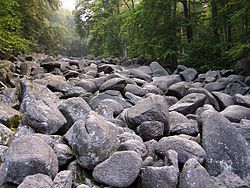
Felsenmeer in Lautertal-Reichenbach (Odenwald)
Felsenmeer on the Kalmit in the Palatine Forest
Boulder stream of the Kaser Steinstube near Triftern
A photo of a single eastern white pine in the nearly barren Boulder Field, Hickory Run State Park, PA.
Felsenmeer, painting by Egbert Schaap (1912). Rijksmuseum Amsterdam

A blockfield[1] (also spelt block field[2]), felsenmeer,[1] boulder field[1][2] or stone field[2] is a surface covered by boulder- or block-sized rocks usually associated with a history of volcanic activity, alpine and subpolar climates and periglaciation. Blockfields differ from screes and talus slope in that blockfields do not apparently originate from mass wastings. They are believed to be formed by frost weathering below the surface.[3][4] An alternative theory that modern blockfields may have originated from chemical weathering that occurred in the Neogene when the climate was relatively warmer. Following this thought the blockfields would then have been reworked by periglacial action.[4][5]

Most known blockfields are located in the northern hemisphere. Examples can be found in Abisko National Park in Sweden, Snowdonia National Park in Wales, the Great End-Scafell Pike ridge in England, and Hickory Run Boulder Field and River of Rocks in the Appalachian Mountains of the United States. All examples except the first one are outside present day subpolar climate areas, and have thus traditionally been seen as relict landforms from past times when these areas were under periglaciation.

The term "felsenmeer" comes from the German meaning "sea of rock". In a felsenmeer or blockfield, freeze-thaw weathering has broken up the top layer of the rock, covering the underlying rock formation with jagged, angular boulders. Freeze-thaw or frost weathering occurs when water that is trapped along microcracks in rock expands and contracts due to fluctuations in temperature above and below the freezing point. Felsenmeers are formed in situ, meaning that they are not transported during or after their creation.

Characteristics

[edit]

Surface

[edit]

Felsenmeers only form on slopes of 25° or lower. A steeper angle results in transport of the blocks due to gravity. This creates a talus slope, rather than a felsenmeer.[6] Crude sorting with boulder imbrication can occasionally be seen on the surface of felsenmeers.

Profile

[edit]

The depth of the boulder field depends on the slope angle, rock types, age, and erosional history. However, a reasonable average for felsenmeer depth is approximately 1 m. Ballantyne (1998)[7] defines three types of felsenmeer profiles: Type 1 consists of boulders overlying a matrix of fines at some depth below the surface. Type 2 consists of boulders supported by a cohesionless sandy matrix that continues from the surface down through the profile. Type 3 also consists of boulders supported by a matrix, but differs from Type 2 in that the matrix consists of silt and/or clay rather than sand.

Occurrence

[edit]

Due to the slope requirements they are most commonly found on plateaus.[8] Basalt and sedimentary rocks often produce larger, more numerous felsenmeers than other types of rock.[9] Blockfields are most often found in high mountain periglacial regions near the Arctic Circle, especially in Iceland, the Canadian arctic and Norway and are still active in parts of Central Europe that were not covered by ice sheets.[2] In the Southern Hemisphere inactive blockfields can be found in the Lesotho Highlands,[10] and the Prince Edward Islands.[11]

Age

[edit]

Felsenmeers are, typically, relatively young geomorphological features. Most felsenmeers formed during or since the last ice age (approximately 20,000 years ago). Others may be pre-glacial features that survived glaciation beneath cold-based glaciers.[12] Their specific age can be determined using surface exposure dating, a technique that works best on materials which have been exposed to cosmic rays with little interference from trees or soils.

See also

[edit]

References

[edit]
Revisions and contributorsEdit on WikipediaRead on Wikipedia
from Grokipedia
A blockfield, also known as a felsenmeer, is a surficial accumulation of coarse, angular to subangular rock blocks formed by on level or gently sloping upland surfaces in periglacial environments. These deposits typically consist of or nearly frost-shattered debris derived from underlying , with block sizes varying but often exceeding 25 cm in diameter, and minimal fine-grained material present. Blockfields form through mechanical processes driven by repeated freeze-thaw cycles in cold climates, where in rock fractures expands upon freezing, progressively disintegrating well-lithified such as quartzites, granites, or other resistant lithologies with pre-existing joints. This periglacial activity, which can initiate below the active layer of , has been documented in both modern and Pleistocene contexts, often on exposed plateaus that escaped full glaciation or were covered by cold-based ice. The resulting landscape is uneven and bouldery, with the blocks mantling the underlying formation after the removal of overlying ice or soil. These features are widespread in mid- and high-latitude mountainous regions, including upland areas of , (such as in Counties Mayo and Donegal), the , and parts of , where suitable and prevail. In the UK, blockfields are mapped at a 1:50,000 scale using digital terrain models and geological datasets to identify high-suitability zones on slopes under 5 degrees in unglaciated domains. Blockfields serve as important indicators of past periglacial climates and geological heritage, reflecting the influence of periglacial processes over thousands to potentially millions of years, with origins in some cases proposed to date back to the period, though this remains debated. They pose challenges for , such as development in upland areas, due to their unstable, rocky nature, and are thus valuable for geohazard assessment and .

Definition and Terminology

Definition

A blockfield is a consisting of a continuous surface cover of large, angular to subangular rock blocks derived from the of underlying , typically forming a chaotic or pavement-like expanse on relatively flat or gently sloping terrain. Unlike slopes or talus accumulations, which result from and gravitational transport down steep inclines, blockfields are autochthonous features where the clasts remain largely in place with minimal lateral movement. The blocks are typically boulder-sized, distinguishing them from thinner rock veneers. These clasts are predominantly composed of resistant lithologies such as , , or other quartz-rich rocks that weather into durable fragments. Blockfields typically exhibit an openwork structure at the surface with minimal fine-grained material, though fines may increase below the surface. Blockfields are commonly associated with periglacial environments, where such surfaces have developed under cold climate conditions. The term "blockfield" derives from the German "Blockfeld," literally translating to "field of blocks," and is synonymous with "Felsenmeer," meaning "sea of rocks." These terms describe extensive surfaces covered by angular rock blocks, with "Felsenmeer" emphasizing the undulating, sea-like appearance of such accumulations. The nomenclature originated in amid debates on the extent of past glaciations and the role of frost action in shaping high-elevation terrains. In English-language literature, "blockfield" emerged as the preferred term during the mid-20th century, particularly in periglacial studies exploring cold-climate beyond glaciated zones. Similarly, "protalus ramparts" refer to arcuate debris ridges formed below cliffs by frost shattering and limited downslope movement, sharing formation processes with blockfields but differing in morphology and confinement to steeper slopes. Blockfields represent a key periglacial , often preserved on nunataks or plateaus.

Formation Processes

Weathering Mechanisms

Mechanical dominates the formation of blockfields, primarily through frost action involving repeated freeze-thaw cycles that exploit existing fractures in the . Water infiltrates joints and pores, expands upon freezing by approximately 9%, and generates wedging forces that propagate cracking, leading to granular disaggregation at the mineral scale and eventual detachment of discrete blocks. Insolation, or from diurnal temperature fluctuations, contributes to surface cracking, particularly in exposed quartz-rich lithologies, while cryoturbation—driven by and solifluction—further disrupts and sorts the , enhancing block isolation. Chemical weathering plays a subordinate role in blockfield development, mainly through hydrolysis and oxidation processes that preferentially affect accessory minerals in quartz-rich rocks such as quartzite and granite. involves the reaction of water with , as exemplified by the breakdown of :
\ceSiO2+2H2O>H4SiO4\ce{SiO2 + 2H2O -> H4SiO4}
where (\ceH4SiO4\ce{H4SiO4}) forms, slowly widening joints by dissolving mineral edges. Oxidation targets iron-bearing phases, producing secondary oxides that further enlarge fractures, though overall chemical alteration remains minimal due to the low reactivity of dominant components.
The formation sequence begins with initial joint-controlled fracturing of the , where pre-existing tectonic or stress-relief joints (typically spaced 1–5 meters apart) serve as primary planes of weakness. This is followed by progressive exfoliation, in which parallel sheeting develops from unloading or thermal stresses, and continued frost action isolates individual blocks over millennia, creating a pavement of angular clasts up to several meters in diameter. The rate of these processes is influenced by rock type and joint spacing. , with its low and high resistance to chemical breakdown, experiences slower overall compared to more fractured granites or gneisses, preserving block integrity longer. Closer joint spacing accelerates mechanical breakdown by providing more entry points for and , whereas wider spacing in massive rocks prolongs the isolation phase. These mechanisms typically operate under periglacial conditions, where seasonal freeze-thaw is recurrent.

Environmental Influences

Blockfields form predominantly in periglacial environments, defined by cold climatic regimes with mean annual air temperatures () typically between -15°C and 2°C, which facilitate repeated seasonal freeze-thaw cycles without supporting widespread coverage. These conditions, often at the margins of glaciated regions, maintain while allowing an active layer to thaw annually, thereby enabling subsurface physical weathering processes essential for blockfield development. In such settings, ground temperatures remain below 0°C for much of the year, with annual varying widely from 300 mm in polar areas to over 2000 mm in maritime uplands, providing sufficient moisture for cryogenic activity. Topographic conditions play a crucial role in blockfield genesis, favoring accumulation on high-elevation (>1,000 m) plateaus and convex summits characterized by low-gradient slopes that inhibit downslope of weathered debris. These low-relief, stable landforms, often in the form of broad ridges or flat uplands, promote sorting and preservation of angular rock fragments by minimizing gravitational erosion and . The combination of elevation and subdued creates microclimates conducive to prolonged frost action, with reduced accumulation further exposing surfaces to fluctuations. Blockfield formation is intrinsically linked to the cold phases of the , spanning multiple glacial-interglacial cycles where periglacial processes dominated non-glaciated highlands, resulting in relict features that persist today. Many such landforms have been preserved through non-erosive mechanisms during glacial advances, including coverage by cold-based ice sheets that deposited thin layers, or by protective organic mats in post-glacial periods, which shield underlying structures from fluvial and aeolian degradation. Environmental interactions, particularly cycles of and degradation, enhance frost heave and cryogenic disturbance, driving the upward migration of blocks and deepening of fronts. Sparse , limited to lichens, mosses, and occasional grasses, maintains exposure by restricting development and root penetration, thereby amplifying the efficacy of freeze-thaw dynamics on the surface. These factors collectively sustain blockfield integrity, with presence ensuring sustained low temperatures that perpetuate the periglacial regime.

Physical Characteristics

Surface Morphology

Blockfields exhibit a distinctive surface morphology characterized by a pavement-like covering of angular, frost-shattered boulders that form an irregular, on relatively flat or gently sloping . These blocks, typically ranging from decimeter to meter scales in size, are closely packed and interlocked, creating a arrangement that lacks the sorted patterns seen in some periglacial features, though occasional stripes, nets, or circles may arise from solifluction influences on the surface. Vegetation on blockfield surfaces remains sparse, primarily consisting of lichens and mosses colonizing the exposed boulder faces, with tundra-like such as grasses occasionally establishing in the finer sediments accumulated within block interstices. Erosion processes periodically expose fresh rock surfaces, maintaining the sharpness of block edges and limiting development, which contributes to the overall barren appearance of these landscapes. The scale of blockfield coverage varies from several hectares to expansive areas spanning square kilometers, often forming continuous mantles across mountain summits and plateaus, with micro-relief featuring undulations due to differential block settling and periglacial sorting patterns like 1.5–2.0 meter circles. Diagnostic features include the predominantly angular shapes of the blocks, with sharp edges indicative of recent exposure rather than prolonged transport, distinguishing them from rounded glacial erratics. This morphology arises from underlying mechanisms that fracture in .

Subsurface Structure

The subsurface structure of blockfields typically consists of a vertically stratified profile that reflects periglacial processes and limited weathering under cold climatic conditions. The upper layer comprises a blocky regolith, often 0–1 m thick, dominated by coarse, angular to subangular clasts derived from in situ frost shattering of bedrock, forming an openwork or matrix-supported diamict. Beneath this lies a fines-rich regolith layer, characterized by increased proportions of sand, silt, and clay (typically 15–85% fines), which accumulates through granular disaggregation and sorting during cryoturbation. This fines-rich zone transitions downward into weathered bedrock, or saprolite, where fracturing and jointing facilitate deeper alteration, often extending several meters into the substrate before reaching unweathered parent rock. Soil development within blockfield profiles is minimal due to the harsh periglacial environment, resulting in weakly expressed horizons rather than mature pedogenic sequences. Cryoturbated horizons are common, featuring involutions, frost fissures, and disrupted layering from past dynamics, which impart gelic properties such as cryic temperatures and ice-cemented textures. In the interstices between blocks, a thin, organic-poor A-horizon may form, comprising sandy with low content (<5% organic matter), but true pedogenesis is inhibited by persistent cold, limiting biological activity and horizon differentiation. Geophysical investigations reveal distinct signatures of this subsurface architecture, aiding in mapping layer boundaries without invasive sampling. Electrical resistivity tomography (ERT) commonly shows high resistivity values (>1000 Ωm) in the upper block layer due to the coarse clasts and low moisture retention, contrasting with lower values in the underlying fines-rich where finer particles enhance conductivity. Seismic refraction tomography (SRT) delineates the interface with fractured through variations in P-wave velocities, typically 0.5–2.0 km/s in the versus higher velocities (>3.0 km/s) in competent , highlighting zones of fracturing at depth. These features underscore the dynamic yet episodic nature of blockfield development, with cryodisturbance contributing to the overall structure.

Geographical Occurrence

Global Distribution

Blockfields, also known as felsenmeer, exhibit a global distribution primarily concentrated in periglacial environments of high latitudes and alpine regions. In the , they are prevalent across the High , with extensive occurrences in , including southern and and the Swedish Scandes, as well as in , particularly in the of Labrador. In the , blockfields appear in sub-Antarctic settings, such as the maritime of and the North Patagonian in Patagonia. In the , they also occur in alpine zones of temperate mountain ranges like the European Alps and the in . The latitudinal range of blockfields spans approximately 30° to 80° N and S, reflecting their association with cold-climate zones conducive to . In high-latitude areas, they occur at relatively low elevations on plateaus and summits, but in mid-latitudes, their distribution is elevation-dependent, typically forming above 2,000–3,000 m in temperate mountain ranges such as the and Rockies, where periglacial conditions persist at higher altitudes. This pattern underscores the role of climatic thresholds in limiting blockfield development to regions with sufficient freeze-thaw cycles. Influencing factors for blockfield distribution include proximity to former Pleistocene ice sheets, where relict forms have survived non-erosive glacial cover or remained unglaciated, preserving pre- weathering mantles modified by periglacial processes. Current periglacial margins also sustain active blockfield formation in transitional zones between glacial and non-glacial terrains. These factors contribute to a patchy global pattern, with blockfields often marking nunataks or ice-free summits during past glaciations. Mapping efforts have documented blockfield coverage through national geological surveys, providing spatial datasets for regional analysis. For instance, the has compiled a comprehensive blockfields for the , delineating distributions in upland areas like the and based on field mapping and . Similar surveys in and support broader global inventories, aiding in the identification of periglacial landform patterns.

Specific Examples

One prominent European example is the blockfield on the Abisko plateau in northern , a feature spanning approximately 1,000 km² across the Scandes mountains near . This autochthonous mantle consists of angular cobbles and boulders up to 2 m thick, primarily formed through physical processes during late glacial-interglacial cycles, with low rates of 6.7–16.2 mm ka⁻¹ preserving it over multiple cold phases. In the , blockfields cap quartzite summits such as those in northwest , where openwork clast-supported diamicts of angular blocks indicate post-glacial exposure following preservation under cold-based ice during the . These features, with minimal fine matrix (0–6.8% clay), reflect frost-driven granular disaggregation under Pleistocene periglacial conditions rather than inherited . In , the blockfields of , , exemplify autochthonous development on the shield, where felsenmeer-like covers of in situ angular blocks mantle weathered plateaus on Cumberland Peninsula . These relict surfaces survived multiple glaciations under cold-based portions of the Laurentide Ice Sheet, highlighting minimal erosion on ancient crystalline rocks dating back to the . Further south, in the alpine zones of Colorado's , frost-dominated blockfields form thin accumulations of subangular to rounded blocks on slopes above 3,500 m, driven by intensive freeze-thaw cycles in a periglacial environment. These features, often associated with rock glaciers, exhibit active downslope movement rates of 1–6 cm yr⁻¹, underscoring ongoing frost heave and solifluction in high-elevation settings. Southern Hemisphere examples include the stone runs of the , sub-Antarctic blockfields composed of openwork quartzite boulders that exhibit wind-eroded surfaces and streamlined forms from periglacial solifluction. Cosmogenic indicates these composite landforms developed over multiple stages, with valley-axis runs up to 700–800 ka old, reflecting episodic frost-wedging and debris flows in a windy, cool maritime climate. In the Australian Alps of southeastern , Pleistocene relict blockfields and blockstreams mantle granitic and metamorphic plateaus above 1,000 m, such as on Mount William, with openwork boulder accumulations preserved from late periglacial activity. Exposure ages from 10Be cluster around 20–50 ka, confirming formation during the Last Glacial Stage under intensified freeze-thaw regimes. In , blockfields occur in periglacial environments such as on and the , where they form through on gently sloping surfaces under current cold-climate conditions. Unique variations include volcanic blockfields in , where clasts form irregular mantles on and lava plateaus, shaped by rapid physical in a hyperoceanic periglacial setting. These features, distinct for their vesicular blocks, integrate cryoturbation with volcanic terrain instability. In , blockfields on central-eastern plateaus like Sølen and Elgåhøgda are preserved under thin overburden, protecting relict from post-glacial erosion while allowing subsurface frost processes to continue. Such preservation under organic covers, up to 0.5 m thick, maintains the integrity of pre-LGM weathering profiles amid ongoing degradation.

Age and Landscape Evolution

Dating Techniques

Relative dating techniques for blockfields rely on stratigraphic relationships to establish the sequence of formation relative to other geomorphic or glacial features. For instance, the principle of superposition indicates that blockfields predating glacial advances are preserved beneath or overridden by overlying glacial till deposits. In southern Ireland, blockfields on mountain summits exhibit trimlines where lower slopes show glacial abrasion but upper surfaces lack modification, with overlying till layers dated to the Last Glacial Maximum (LGM, ~26–19 ka), implying blockfield formation prior to this event. Similarly, cosmogenic nuclide analysis of 10Be and 26Al in blockfield boulders can reveal relative exposure histories through nuclide ratios; ratios deviating from the expected production ratio (~6.75 for 26Al/10Be at sea level-high latitude) suggest inheritance from prior exposure, indicating that some boulders predate the LGM by multiple glacial cycles. Absolute dating methods provide numerical ages for blockfield development or stability. Optically stimulated luminescence (OSL) dating targets buried fine sediments (e.g., quartz grains) beneath blockfields, measuring the time since last exposure to sunlight; this yields ages typically ranging from 10–100 ka, reflecting periods of periglacial activity and sediment deposition. For example, OSL analysis of fines under stone runs (analogous blockfield features) in the produced ages of 16–54 ka, with peak activity around 32–27 ka during enhanced periglacial conditions. Lichenometry offers estimates of surface exposure duration by correlating lichen thallus diameter (e.g., Rhizocarpon spp.) with known growth rates of 0.5–2 mm/year, applied to assess blockfield stability over timescales. In mid-Norway, lichen measurements on blockfield surfaces indicated stability for at least ~12.5 ka, using a calibrated rate of ~0.45 mm/year under cold, dry conditions. Sampling blockfields for presents challenges, particularly in accounting for exhumation (uplift exposing deeper material) or reworking ( overturning or relocation), which can introduce inherited s or reset signals. In dynamic fields like those in , samples are collected from tops, bases, and subsurface clasts to capture varied exposure histories, with isolation for analysis. The basic equation for cosmogenic exposure age, assuming negligible decay and , is t=NPt = \frac{N}{P}, where tt is exposure time (years), NN is the measured concentration (atoms/g), and PP is the production rate (atoms/g/year, e.g., ~6 for 10Be at mid-latitudes). For s like 10Be ( ~1.39 Ma), decay is minor over timescales, but full models (e.g., via calculator) incorporate it as N=Pλ(1eλt)N = \frac{P}{\lambda} (1 - e^{-\lambda t}), solved iteratively for tt, with λ\lambda as the decay constant. Reliability of these dates is limited by potential erosion, which yields minimum ages by reducing nuclide accumulation or resetting OSL signals, and by post-depositional disturbances like . In blockfields, 10Be concentrations often indicate minimum exposure times of 70–600 ka, but complex histories (e.g., burial under or ) require multi-method integration—combining cosmogenic ratios, OSL on fines, and lichenometry—for robust age constraints, as single techniques may overestimate or underestimate due to inheritance.

Interpretations of Antiquity

Blockfields exhibit a diverse age profile, with some forms originating from Tertiary-era chemical processes that predate the period (>2.6 Ma), as evidenced by the presence of clay minerals like and in profiles on high plateaus in . In contrast, the majority of blockfields are in origin (2.6 Ma to present), developing primarily through physical under periglacial conditions during colder glacial intervals, including peaks in activity during 2–4. These ages highlight blockfields' role in recording extended landscape stability amid fluctuating climates. Central to interpretations of blockfield antiquity is the between autochthonous —where blockfields evolve in place over multiple glacial-interglacial cycles—and recent exhumation from glacial burial, which posits post-glacial exposure of buried . Evidence favoring includes data from Scandinavian plateau summits, such as those in southern Norway's Reinheimen National Park, indicating exposure and erosion histories spanning 1–3 Ma with minimal glacial overprinting. Low surface erosion rates (4–8 m/Myr) on these summits further support preservation through successive glaciations, often under cold-based ice conditions that limited abrasion. Evolutionary models of blockfields emphasize context-dependent dynamics: in non-eroding uplands like Scandinavian plateaus, they function as stable relicts, with rounded boulders and cover signaling prolonged subaerial exposure and resistance to modification since the . Conversely, in tectonically active areas, blockfields exhibit more dynamic behavior, with ongoing renewal via wedging and surface lowering at rates of 6.9–35 mm/ka, integrating substrates with processes. These models underscore blockfields' adaptability to tectonic and climatic forcings over timescales. The antiquity of blockfields carries significant implications for reconstructing past climates and landscape evolution, serving as proxies for periglacial environments that persisted through glacial maxima. Their survival on summits challenges conventional views of ubiquitous glacial erosion, revealing instead patchy ice-sheet dynamics where non-erosive regimes allowed relict surfaces to endure multiple Pleistocene glaciations. This persistence highlights blockfields' value in testing models of ice-sheet behavior and long-term denudation in formerly glaciated terrains.

References

Add your contribution
Related Hubs
User Avatar
No comments yet.