Hubbry Logo
Festetics familyFestetics familyMain
Open search
Festetics family
Community hub
Festetics family
logo
8 pages, 0 posts
0 subscribers
Be the first to start a discussion here.
Festetics family
Festetics family
from Wikipedia

Festetics
Feštetić
CountryHabsburg monarchy
Founded15th century
FounderPetar Feštetić
Current headGeorg Festetics

The House of Festetics (singular, not plural) or Feštetić (in Croatian) is a historic noble family of Hungarian counts and princes originating in Croatia, which dates back to the 15th century.

A prominent family during the Austro-Hungarian Empire, they are mostly known for the baroque Festetics Palace and the Viennese Prince Tasziló Festetics.

Counts Festetics of Tolna

[edit]
Original coat of arms of the Festetics family (1213)

The progenitor of the family is considered to be Peter Festetić or Petrus Ferztheschych from Roženica, Pokupsko in central Croatia, whose name was mentioned as such in the protocol from the second part of the 15th century. Born during the reign of Matthias Corvinus, he held large estates throughout Turopolje, southwest of Zagreb. Another protocol from 1570 mentions Mihovil Festetić (probably Peter's son), who served as ministerialis of the Bishop of Zagreb.

On 8 August 1746, Mihovil's descendants, Josef and Kristof Festetics (the two sons of the second marriage of Paul Festetics who moved to Hungary) added de Tolna to their surname (von Tolna in Austria).

On 5 November 1766, Josef's eldest son Pal Festetics de Tolna (1725–1782) was made a count by Queen Maria Theresa of Hungary. On 24 February 1772, Kristof's eldest son Pal Festetics de Tolna (1722–1782) was made a count by Queen Maria Theresa of Hungary, who was also Archduchess of Austria and Holy Roman Empress. The title of count was hereditary, inheritable by all legitimate male-line descendants of the family.

Princes Festetics of Tolna

[edit]

On 21 June 1911, Count Tassilo Festetics de Tolna (1850–1933) was made a prince (Fürst) with the style of Serene Highness (Durchlaucht) by King Francis Joseph I of Hungary. His grandson, Prince Georg (born 1940) is the current head of the house and third Fürst.

Dutch nobility incorporation

[edit]

In 1973, Count Dénes Festetics de Tolna (1943) was incorporated in the Dutch nobility with the title of count; the title of count(ess) is inheritable by all male-line descendants.

Notable members

[edit]

Among the other prominent members of the family are:

Festetics/Feštetić may also refer to:

See also

[edit]

References

[edit]

Further reading

[edit]

Timeline of feudal lords of Međimurje

[edit]
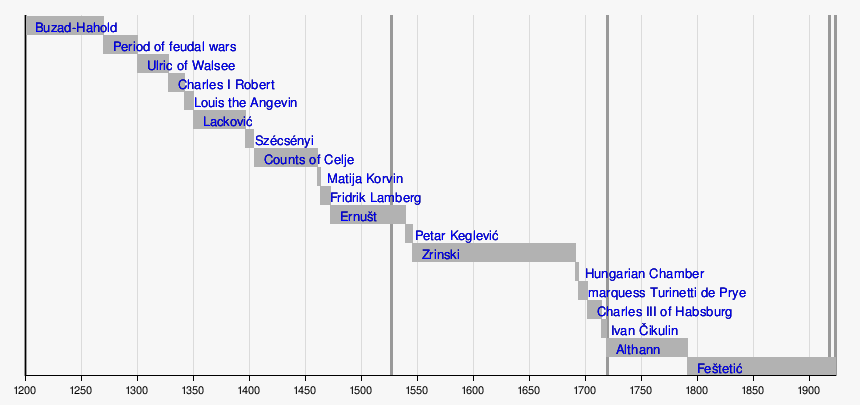
Festetics familyAlthannIvan Franjo ČikulinCharles VI, Holy Roman EmperorHercule Joseph Louis Turinetti de PryeChancery (medieval office)House of ZrinskiPetar KeglevićHouse of ErnuštLambergMatija KorvinCounts of CeljeSzécsényi familyLackovićLouis I of HungaryCharles I RobertLords of WalseeList of feudal wars 12th–14th centuryHahót (genus)


Revisions and contributorsEdit on WikipediaRead on Wikipedia
from Grokipedia
The Festetics family was a prominent Hungarian noble lineage of Croatian origin that rose to ducal status in the 18th and 19th centuries, exerting influence across , , , and through extensive landholdings and institutional foundations. Originating as in the , the family acquired key estates like Keszthely in 1736 under Kristóf Festetics, whose descendants expanded their domain and wealth via agricultural enterprises and strategic marriages. Count György Festetics I (1755–1819) epitomized the family's achievements by founding the Georgikon in Keszthely in 1797, Europe's inaugural independent institution of higher , which trained experts in farming techniques, , and estate management amid the Enlightenment's emphasis on practical sciences. He further advanced Hungarian cultural life by instituting the Helikon festivals, gatherings that promoted , , and , while developing model farms and botanical collections that underscored the family's commitment to agrarian innovation. The family's architectural legacy includes the in Keszthely, a sprawling complex with libraries housing thousands of volumes, and the neoclassical Dég Palace, featuring Central Europe's largest , both reflecting their opulent lifestyle and of Freemasonry and the sciences. Notable later members, such as Prince Tasziló Festetics, sustained this prominence into the Austro-Hungarian era, though the dynasty's estates were largely expropriated after 1945 amid postwar land reforms, prompting many to relocate to .

Origins and Rise

Croatian Ancestry and 17th-Century Migration

The Feštetić (Hungarian: Festetics) family traced its origins to Croatian gentry, with historical records indicating roots in regions such as Turopolje, where they held noble status prior to broader involvement in Hungarian affairs. The family's Croatian heritage is evidenced by their name's form in Croatian sources and associations with Croatian noble lineages, though specific early progenitors like Lukács Festetics remain tied to pre-migration activities in Croatian territories. In the mid-17th century, Pál Festetics I (c. 1640–1720), a key figure in the family's translocation, migrated from Croatian lands to Hungarian-controlled territories, initially serving the powerful family at their stronghold in Güssing (modern Németújvár, then part of the Kingdom of ). This move positioned the family as within the Hungarian system, leveraging military and administrative service amid the post-Ottoman reconquest opportunities in the region. Pál's settlement marked the family's shift from Croatian estates to integration into Hungarian feudal structures, facilitated by alliances with established magnates like the Batthyánys. The migration reflected patterns among Croatian nobles seeking advancement in the Habsburg domains, where loyalty to the crown and service in border defenses yielded land grants and titles, though the Festetics initially held modest holdings compared to their later elevations. By the late , descendants like Kristóf Festetics (1696–1768) began acquiring significant properties, such as in Keszthely by 1739, solidifying the family's Hungarian base while retaining Croatian ancestral ties.

Initial Service and Land Acquisitions in Hungary

The Festetics family, originating from Croatian gentry, initiated their integration into Hungarian nobility through service under the influential Batthyány family in the mid-17th century. Pál Festetics I settled in Németújvár (present-day Güssing, Austria) around 1634, having fled Ottoman devastation in southern regions, and entered the employ of the Batthyány lords, who controlled extensive estates in western Hungary and adjacent territories. This service likely involved administrative and military roles in a border area contested by Habsburg and Ottoman forces, providing the family initial foothold amid the reconquest efforts following the failed Wesselényi conspiracy of 1664–1670. Pál Festetics II (1639–1720), son of Pál I, advanced the family's position through active military participation in Habsburg campaigns against the Ottomans, including engagements during the reconquest of after the 1683 relief. His successes, combined with advantageous marriages into allied noble lineages, enabled the acquisition of modest landholdings in Vas and Zala counties, establishing hereditary claims in fertile western plains. These early estates, often granted as rewards for loyal service to Habsburg authorities, totaled several hundred sessio (approximately 50–100 hectares each) by the late , though precise surveys remain sparse in surviving records. By the early , under Kristóf Festetics (1696–1768), the family transitioned from service-based grants to direct purchases, acquiring the Keszthely domain and surrounding lands in in 1739 for an estimated 100,000 florins from prior owners. This purchase, leveraging accumulated wealth from prior military stipends and agrarian revenues, marked the shift toward autonomous estate management and set the stage for developments, with Keszthely encompassing over 20 villages and yielding annual incomes exceeding 10,000 florins by mid-century.

Nobility and Titles

Elevation to Counts of Tolna

Pál Festetics de Tolna (7 December 1722 – 7 April 1782), eldest son of Kristóf Festetics and a prominent administrator in Habsburg , was elevated to the rank of count by on 24 February 1772. This grant recognized his extensive service as vice-president of the Royal Hungarian Chamber, (alispán) of County, and parliamentary deputy, as well as his advisory role in economic reforms. Festetics had contributed to the formulation of Maria Theresa's Urbarial Patent of 22 April 1767, which standardized peasant labor obligations () and land use across Hungarian estates, aiming to boost and fiscal stability amid post-Rákóczi War recovery. His memoranda to the queen emphasized rationalizing feudal dues based on empirical assessments of land yields and serf capacities, influencing the patent's provisions limiting to three days weekly and promoting leaseholds. These efforts aligned with enlightened absolutist policies favoring state revenue over unchecked noble privileges, though implementation varied by locality due to noble resistance. The comital title incorporated the predicate "de Tolna," derived from family holdings in , including estates acquired through marriage and service grants since the mid-17th century. Primogeniture applied, extending the title to Pál's male heirs, thereby consolidating the family's status among Hungary's magnates. A separate elevation in 1766 may have occurred for a collateral branch under József Festetics, but the grant marked the primary ascent of the senior line, enabling further territorial expansion and institutional patronage.

Promotion to Princely Status

Count Tasziló Festetics de Tolna (1850–1933), head of the Keszthely branch of the family, was elevated from the rank of count to hereditary prince (Fürst Festetics de Tolna) on 21 June 1911 by Emperor Franz Joseph I, who also held the title of Apostolic King of Hungary. This conferral granted the style of Serene Highness (Durchlaucht) to the recipient and his legitimate descendants in the male line, marking the pinnacle of the family's ennoblement within the Austro-Hungarian nobility system. The promotion reflected the Festetics' entrenched status as major landowners and political figures in , with Tasziló serving in various capacities that aligned with Habsburg interests, including diplomatic roles and estate management centered on properties like in Keszthely. His 1880 marriage to Lady Mary Victoria Douglas-Hamilton (1850–1922), daughter of William Douglas-Hamilton, 11th , had already linked the family to prominent , potentially influencing the timing of the elevation amid Franz Joseph's late-reign recognitions of loyal houses. Following the bestowal, Tasziló assumed the role of the first Prince Festetics de Tolna, with the title passing to his son György Tasziló József (1882–1941) as the second prince upon his death in 1933. The princely dignity endured privately after the 1918 dissolution of the and the 1919 abolition of noble privileges in and , though it ceased to confer . This advancement distinguished the Keszthely line from other Festetics branches, which retained comital rank.

Incorporation into Dutch Nobility

In 1973, Count Dénes Festetics de Tolna (born 1943), a member of the Hungarian princely branch of the family, was incorporated (ingelijfd) into the by royal decree, granting him and all his legitimate descendants the title of graaf (count). This recognition by the Hoge Raad van Adel, the official body overseeing under the Wet op de adeldom, extended the family's noble status within the while preserving their original Hungarian predicate de Tolna. The incorporation reflects the Dutch legal provision for admitting foreign noble houses with established titles upon residency or significant ties to the kingdom, listing the Festetics de Tolna among northern Dutch noble families thereafter. Subsequent state publications confirmed aspects of the family's nomenclature, including a 1982 decree affirming Dénes's full names (Dénes Samuel Imre Tihamér Vilmos) and titles, and a 2004 decree permitting surname variations for descendants such as Dominique Viola gravin Festetics de Tolna. This branch's integration remains limited to administrative and titular purposes under Dutch law, without altering the family's primary Hungarian heritage or estates.

Estates and Economic Foundations

Key Properties and Developments

The Festetics family amassed extensive landholdings in Hungary, primarily in Zala, Tolna, and Fejér counties, through military service, royal grants, and strategic purchases during the 17th and 18th centuries. Their properties served as centers for agricultural production, horse breeding, and administrative control, underpinning the family's economic power. Key estates included the Festetics Palace in Keszthely, the Dég Mansion, and the Fenékpuszta estate, each developed through phased constructions and expansions reflecting Baroque and Classical influences. The in Keszthely, located on the shores of , originated as a modest U-shaped, one-storey structure with 34 rooms initiated by Kristóf Festetics in 1745. Pál Festetics oversaw a major reconstruction from 1769 to 1770, transforming it into a grander complex that expanded over the subsequent century into a 101-room edifice, the third largest palace in . This development incorporated and Neo-Baroque elements, alongside ancillary features such as an English park, a housing over 80,000 volumes (one of Europe's largest intact noble collections), and a carriage museum, solidifying its role as a cultural and residential hub for the family until the early 20th century. In Dég, , the family acquired a vast estate in the fertile Mezőföld region, exclusively held by Lajos Festetics (1732–1797), who constructed an initial single-storey manor house in the mid-18th century. His son Antal Festetics (1764–1853), dubbed "the richest petty noble in ," commissioned architect Mihály Pollack to redesign it as a Classical mansion starting around 1802, with completion by 1812 and additions shortly thereafter. The property prospered through grain exports during the , supporting further infrastructural enhancements like an and outbuildings for estate management. The Fenékpuszta estate, purchased in 1739 and initially developed under Kristóf Festetics, exemplified the family's agricultural focus. Divided into northern (for cattle and servants' quarters), central ( and barns), and southern ( stables) sections, it became a premier horse-breeding operation in by the 19th century, specializing in Arabian thoroughbreds under László Festetics (1785–1846) and English breeds under Tasziló Festetics (1813–1883), yielding competition winners alongside cattle, sheep rearing, and crop cultivation until the 1930s. In , the family's titular domain, properties like the Ság castle served as ancestral seats, reinforcing their regional influence through .

Agricultural and Economic Innovations

The Festetics family advanced Hungarian through the establishment of institutional frameworks for professional training and applied breeding practices on their estates. In 1797, György Festetics I founded the Georgikon in Keszthely, recognized as the first agricultural higher education institution in , which introduced systematic instruction in modern farming techniques, including , , and livestock improvement to replace traditional, inefficient methods prevalent in the Habsburg domains. This initiative reflected a commitment to Enlightenment-era modernization, training estate managers and farmers in evidence-based practices that boosted yields and economic viability on large holdings like those around . Practical innovations in further distinguished the family's estates, particularly under Imre Festetics, who applied to sheep and horses to enhance productivity and resist hereditary defects. At estates such as Keszthely and Fenékpuszta, Imre Festetics developed rigorous programs to combat , prioritizing traits like quality and resistance in Merino-derived sheep flocks, which informed his empirical "laws of organic functions" derived from decades of observational data starting in the late . Fenékpuszta served as a premier center, housing thoroughbreds and supporting advanced stud operations that contributed to regional equine standards by the early . Economically, these efforts shifted revenue streams on Festetics properties from dominant grain and wine production toward diversified , with outputs rising significantly between 1785 and 1807 amid expanding markets for , , and draft animals. This transition, documented in estate records, capitalized on fertile Mezőföld soils and Balaton-adjacent lands, yielding sustainable income growth despite periodic agrarian slumps, as the family's integrated approach—combining , breeding, and market-oriented farming—outpaced peer estates reliant on .

Scientific and Intellectual Contributions

Imre Festetics and Pioneering Genetics Work

Count Imre Festetics (1764–1846), a member of the , conducted empirical research on , particularly sheep, which laid foundational principles for understanding . Through systematic on his estates in , he developed the Mimush sheep breed by 1817, employing to fix desirable traits such as robustness and wool quality while mitigating risks of degeneration. This work rejected Lamarckian acquisition of traits, instead emphasizing innate transmission from parents, based on observations over more than 15 years of breeding experiments. In 1819, Festetics articulated four "genetic laws of nature" (genetische Gesetze der Natur), the earliest explicit use of "genetic" to denote hereditary processes distinct from physiological adaptation. These laws, derived from sheep breeding outcomes, stated: (1) healthy, robust animals propagate and transmit their qualities to offspring; (2) sickly or weak individuals degrade the lineage; (3) first-generation crossbreeds match parental quality but decline in later generations without selection; and (4) deliberate of inferior traits is essential to maintain superiority. He identified recessive traits and warned against unchecked inbreeding's degenerative effects, advocating controlled crosses to restore vigor, principles validated by his successful Mimush flocks exhibited publicly in . Festetics co-founded the Sheep Breeders' Society of in 1814, fostering a network of empirical breeders that emphasized quantitative records and controlled matings, influencing regional . This prefigured Mendel's later pea experiments in the same milieu, though Festetics's laws remained practitioner-oriented rather than mathematically formalized, prioritizing causal mechanisms of over blending theories prevalent in academia. His unpublished manuscripts, preserved in family archives, underscore a commitment to evidence-based deduction, predating formal by decades.

Establishment of Educational Institutions

Count Pál Festetics established the first high school in Keszthely in 1772, which evolved into the János Vajda Gymnasium and marked an early effort to provide structured in the region. He also founded primary and secondary schools in the town, reflecting the family's commitment to elevating local literacy and skills among tenants and residents on their estates. Pál's son, György Festetics I, advanced these initiatives by founding the Georgikon on July 1, 1797, Europe's first independent higher education institution dedicated to . Located in Keszthely on family lands, the academy trained students in practical farming techniques, crop management, animal husbandry, and forestry, integrating hands-on work on model farms with lectures from professors recruited from and universities. György invested heavily, constructing specialized buildings between 1799 and 1801, and allocated estate resources like vineyards and fields for student demonstrations to promote efficient, science-based amid Hungary's feudal . The Georgikon's curriculum prioritized applied knowledge over abstract theory, aiming to produce skilled estate managers capable of boosting yields and adopting innovations such as improved plowing and seed selection, which aligned with Enlightenment-era reforms under Habsburg rule. Though operations faced interruptions from and administrative challenges—closing briefly in 1804 before reopening—it set a precedent for , influencing later institutions across Europe. György's vision extended to supporting broader learning through the Helikon Library, assembled from his collections and opened to scholars, which provided resources for Georgikon students and regional intellectuals.

Cultural Patronage and Architectural Legacy

Palace Constructions and Baroque Influence

The Festetics family's palace constructions exemplified the opulent style prevalent in 18th-century Habsburg , serving as symbols of their rising noble status and cultural patronage. The flagship project was the in Keszthely, initiated by Kristóf Festetics in 1745 as a modest two-story, U-shaped Baroque edifice with 34 rooms, built on earlier foundations to replace a medieval . This initial structure featured characteristic Baroque elements such as symmetrical facades, pilasters, and pediments, aligning with the era's emphasis on dramatic scale and classical proportions influenced by Italian and Austrian architects. Pál Festetics, elevated to in 1746 for service to Empress , oversaw a major expansion between 1769 and 1770, transforming the into a larger complex with added wings and enhanced interiors, including stucco work and frescoes that evoked the grandeur of Viennese precedents. Subsequent generations, including György Festetics I, continued modifications through the late 18th and 19th centuries, incorporating flourishes and Neo-Baroque updates to the gardens and elevations, resulting in a 101-room surrounded by expansive French-style parks by 1880. These developments reflected the family's adaptation of principles—such as illusionistic ceilings and ornate detailing—to local Hungarian contexts, blending them with regional motifs amid the transition to neoclassicism. Beyond Keszthely, the family commissioned or renovated other Baroque-influenced properties, such as the Festetics-Chernel Palace in , originally two houses unified and restyled in late Baroque-Rococo form in 1766 under family oversight, featuring curved gables and interior paneling. In , their late-18th-century palace integrated Baroque massing with classical pediments, underscoring a stylistic continuity tied to imperial favor. This architectural legacy demonstrated the Festetics' role in disseminating aesthetics across Hungarian estates, prioritizing monumental forms and decorative exuberance to affirm aristocratic identity during a period of centralized Habsburg . The Festetics family maintained significant ties to , particularly through members active in 18th- and 19th-century Hungarian lodges. Count György Festetics (1755–1819) emerged as a key figure, engaging in Masonic activities from 1791 and embodying ideals of Masonic ethics, , and cultural patriotism in his intellectual pursuits. Following the 1795 ban on under Habsburg rule, Antal Festetics, a lodge master, acquired surviving Masonic documents across the empire and continued clandestine meetings at the Dég Palace, which served as a repository for Hungarian Freemason archives for over a century. These archives, preserved in the family's Dég estate, include Masonic source materials that highlight the network's influence on Enlightenment-era , though post-1945 dispersals under communist rule reduced accessible holdings to copies and fragments. In parallel, the family extended patronage to the arts, fostering cultural institutions amid their broader Enlightenment interests. György Festetics I (1758–1819) supported literature, education, and artistic endeavors, establishing the Helikon Library at Keszthely in 1797 as a hub for scholarly collections, including rare fencing treatises that reflect heritage. He initiated the annual Helikon celebrations in 1817, which evolved into regional cultural festivals promoting poetry, music, and theater, drawing artists and intellectuals to the family's estates. Later generations, including Pál Festetics, sustained this legacy by funding artistic renovations and maintaining palace galleries, though economic pressures after curtailed such support; these efforts positioned the Festetics as key enablers of Hungarian Baroque and neoclassical artistic continuity.

Political Roles and Influence

Ministers and Statesmen in Habsburg Era

Count Pál Festetics (1724–1795), a leading figure of the family during the mid-18th century, served as a trusted councilor and confidant to Empress Maria Theresa, influencing key aspects of Habsburg policy toward Hungary. He contributed to the drafting of the Urbarium of 1767, a regulatory decree that standardized peasant labor obligations, limited arbitrary feudal exactions, and sought to stabilize rural economies amid the empress's centralizing reforms. This role underscored the family's alignment with enlightened absolutism, as Festetics advocated for measures balancing monarchical authority with pragmatic improvements in agrarian relations, reflecting Maria Theresa's efforts to bolster loyalty in Hungarian provinces post-War of the Austrian Succession. In recognition of his counsel on administrative and fiscal matters, Maria Theresa elevated Pál Festetics and his male descendants to the rank of count in 1772, granting them a augmented coat of arms and affirming their status within the Habsburg nobility. His advisory functions extended to judicial and military tasks, leveraging the family's estates in western Hungary to implement court directives, though always within the constraints of noble privileges and resistance from diet assemblies. This positioned the Festetics as intermediaries between Vienna and provincial elites, aiding the monarchy's consolidation without full confrontation until Joseph II's more radical edicts. The family's political engagement persisted into the dualist phase of the after the 1867 Austro-Hungarian Compromise, with members holding roles that bridged royal oversight and Hungarian autonomy. While not occupying formal cabinet posts in the pre-1867 absolutist structure, their earlier service as high councilors exemplified statesmanlike contributions to , prioritizing empirical stabilization over ideological overhauls.

20th-Century Involvement and Ideological Shifts

Count Sándor Festetics (1882–1956), a prominent member of the family, served briefly as Minister of Defence in the liberal government of from December 30, 1918, to January 13, 1919, following the that ended Habsburg rule in . This administration, led by Sándor's brother-in-law Károlyi, pursued pacifist policies, including of the and territorial concessions, amid post-World War I chaos that facilitated a subsequent short-lived communist regime under . Sándor's early alignment with this democratic experiment reflected a temporary openness among some aristocrats to reformist governance, though the government's collapse by March 1919 underscored its instability. Disillusioned with liberal democracy's perceived failures—exacerbated by the in 1920, which stripped of two-thirds of its territory—Sándor shifted sharply rightward in the . In the early , he broke from the conservative Unitary Party and founded the , explicitly modeled on Adolf Hitler's National Socialist German Workers' Party, emphasizing , racial purity, and . The party advocated aggressive nationalism, demanding the exclusion of Jews from public life and economic roles, and attempted a failed insurrection against the Horthy regime, which suppressed it but tolerated far-right agitation amid widespread revanchist sentiments. Sándor's extremism peaked during ; after Regent Miklós Horthy's overthrow on October 15, 1944, he joined the government as Minister of Foreign Affairs in late October, aligning with Ferenc Szálasi's fascist regime that intensified collaboration with and domestic pogroms. This trajectory—from a ministerial post in a nascent republic to leadership in a Nazi-inspired movement—exemplified ideological radicalization among segments of the Hungarian aristocracy, driven by territorial losses, economic distress, and anti-communist fervor, though it diverged from the family's earlier Habsburg-era conservatism. Other Festetics branches maintained lower political profiles under Horthy's authoritarian-conservative system, focusing on estate management until wartime expropriations.

Decline, Exile, and Modern Legacy

Impact of World Wars and Communist Era

The Festetics family experienced significant upheaval during , as advancing Soviet forces and the collapsing Axis alliance prompted their departure from key estates. In September 1944, family members abandoned in Keszthely amid the chaos of German retreat and local disorder, leaving behind valuable collections that were subsequently looted by German and Hungarian soldiers as well as elements of the local population. This flight presaged broader losses, with the family's extensive landholdings—spanning tens of thousands of hectares—vulnerable to wartime destruction and postwar reprisals against the . Postwar land reforms under the provisional Hungarian government initiated the family's decline, as 2/1945 on redistributed large estates exceeding 57 hectares to peasants and smallholders, targeting noble properties like those of the Festetics without compensation. By late 1945, the state had confiscated the bulk of their remaining assets, forcing surviving family members into exile in to evade the encroaching communist regime. The consolidation of power by the after 1947 accelerated expropriations, with the Keszthely palace formally nationalized in 1948 and repurposed initially as a and agricultural , stripping the family of their cultural and economic base. Under communist rule from onward, the regime's class-war policies systematically dismantled aristocratic legacies, converting Festetics properties into state institutions such as museums and farms while prohibiting noble titles and inheritance claims. Family members faced persecution risks, with some, like politician Sándor Festetics, dying in amid the revolutionary unrest that briefly challenged Soviet control but ultimately reinforced expropriations. This era marked the effective end of the family's influence in , scattering descendants abroad and preserving their estates only as nationalized heritage sites devoid of private ownership.

Contemporary Preservation and Descendants

The Festetics family's properties, largely confiscated during the communist era, have been preserved primarily through state-managed museums and restoration projects since Hungary's in 1989. The in Keszthely, constructed in the , now operates as the Helikon Palace Museum, featuring exhibitions on the family's aristocratic lifestyle, including carriages, artifacts, and travel collections, with over half of its 101 rooms accessible to visitors. The palace park underwent a major remodel in 2015 to restore its historical , enhancing its role as a cultural site drawing significant tourism. In Dég, the , built starting in 1745, has seen recent renovations completed around 2023, including restoration of the park and structures like the Dutch-house on an artificial , transforming it into a venue for conferences and public access while highlighting the family's architectural legacy. Associated sites, such as the Georgikon Agricultural History Exhibition and Imre Festetics Experience Centre, maintain the family's contributions to and through interactive displays and preserved collections. These efforts, often funded by grants and national heritage programs, prioritize historical accuracy over commercialization, though challenges persist in funding long-term maintenance amid economic pressures. Descendants of the family, scattered by World War II displacements and communist expropriations, primarily reside abroad, particularly in Austria, with occasional returns to Hungary for heritage events. György Festetics IV, a direct descendant of the 19th-century György Festetics who founded the Georgikon college, was born around 1941, raised in Keszthely until the war's end, and lives in Vienna as a retiree; he has participated in cultural openings, such as a 2016 literary event, expressing interest in global perspectives akin to his ancestors' enlightenment ideals. László Festetics, another branch descendant, fled Hungary at age 10 during the communist takeover, lived in exile for five decades, and returned to oversee aspects of the Dég palace's revival, symbolizing reconnection with ancestral estates. While not reclaiming properties—given state ownership—such figures contribute to public awareness through visits and narratives, underscoring the family's enduring Croatian-Hungarian noble identity without formal political or economic restitution claims.

References

Add your contribution
Related Hubs
User Avatar
No comments yet.