


Community hub
0 subscribers8 pages, 0 posts
Recent from talks
All channels
Be the first to start a discussion here.
Be the first to start a discussion here.
Be the first to start a discussion here.
Be the first to start a discussion here.
Contribute something
Welcome to the community hub built to collect knowledge and have discussions related to Fielding (cricket).
Nothing was collected or created yet.
Fielding (cricket)
View on Wikipediafrom Wikipedia
Not found
Fielding (cricket)
View on Grokipediafrom Grokipedia
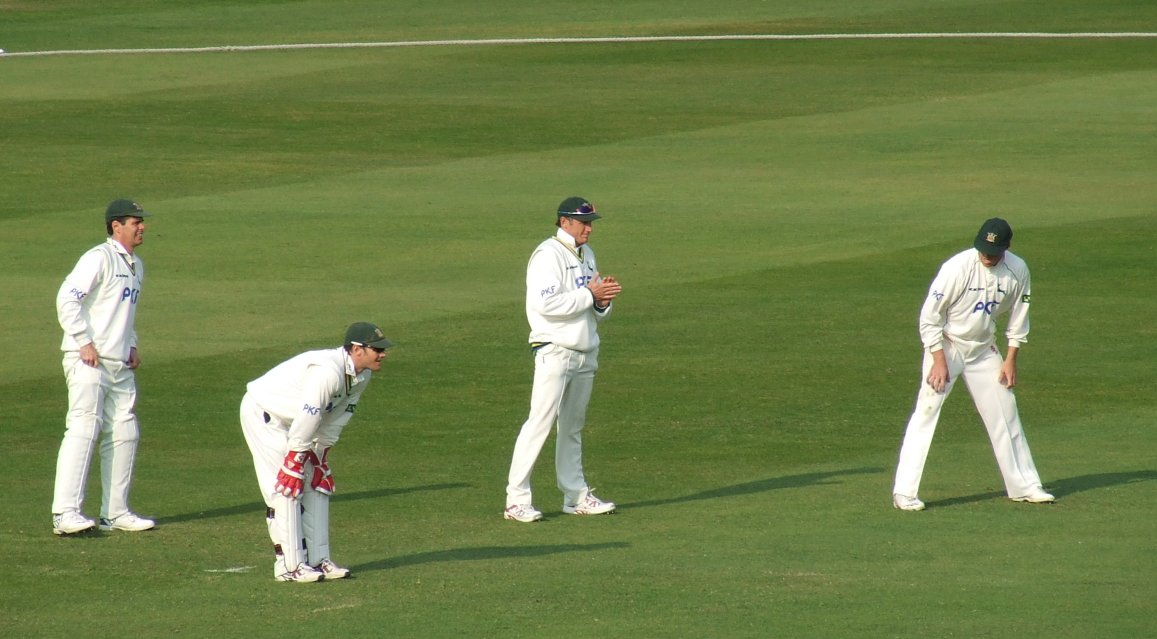
Fielding in cricket is the collective action of the fielding team's players to retrieve, stop, and return the ball after it has been struck by the batsman, with the primary objectives of limiting the scoring of runs and effecting dismissals such as catches, run-outs, or stumpings by the wicket-keeper.[1] The fielding side comprises 11 players in total, including the bowler (who delivers the ball) and the wicket-keeper (positioned behind the stumps), leaving nine other fielders responsible for covering various areas of the oval-shaped field of play.[2] This aspect of the game demands high levels of athleticism, including agility, speed, and hand-eye coordination, as fielders must react quickly to unpredictable ball trajectories while adhering to the Laws of Cricket.[3]
Fielding positions are strategically placed by the captain to counter the batsman's strengths and the bowler's style, categorized broadly into close-in catchers, infield stoppers, and outfield boundary protectors. Close positions, such as slips (behind the batsman on the off side) and gully (near slips but wider), target edges from the bat, while aggressive spots like silly point or silly mid-on position fielders perilously close to the batsman for quick reactions to mistimed shots.[4] Infield roles include point (behind square on the off side) and cover (straighter on the off side) to intercept ground shots, mid-on and mid-off (aligned with the bowler), and leg-side equivalents like square leg and mid-wicket.[4] Outfielders occupy deeper spots such as long-on, long-off, deep square leg, and fine leg to chase aerial or rolling balls toward the boundary, preventing fours or sixes.[5]
Under the Laws of Cricket governed by the Marylebone Cricket Club (MCC), fielders may use any part of their body to field the ball but cannot wilfully obstruct the batsman or use unfair means, such as throwing the ball at the batsman.[6] Only the wicket-keeper is permitted gloves or external leg guards, while other fielders may wear protective pads on fingers or hands but no gloves.[6] In limited-overs international matches regulated by the International Cricket Council (ICC), fielding restrictions limit the number of fielders outside a 30-yard circle during powerplay overs—typically no more than two in the first ten overs of an ODI—to encourage aggressive batting, with no more than five permitted on the leg side at any time.[7] These rules ensure fair play and have evolved to emphasize fielding's growing tactical importance, particularly in shorter formats where exceptional fielding can decisively influence match outcomes.[8]
A typical 11-fielder layout for a right-handed batsman might place the wicketkeeper behind the stumps, slips and gully close behind on the off side, point and cover forward on the off side, mid-off and mid-on straight ahead, mid-wicket and square leg on the leg side, with long-off, long-on, deep square leg, and third man positioned deeper toward the boundary to balance close catching and boundary protection.[5]
Many position names originated in the 18th and 19th centuries, reflecting the field's geometry or the risk involved. For instance, "slips" derives from fielders slipping in to catch glancing blows off the bat's edge, a term in use by the early 1800s. "Gully" comes from the narrow channel-like area between point and slips, historically called "short third man" before evolving in the mid-19th century. "Point" traces back to the 18th century as the "point of the bat," where the fielder stood to intercept the ball's point of contact. Terms like "silly" in positions such as silly mid-on or silly point (close-infield spots) emerged in the 19th century, denoting the perceived foolishness of standing riskily near the batsman to induce mistimed shots.[11][12]
Positions are mirrored for left-handed batsmen: the off side shifts to the batsman's left, and the leg side to the right, requiring fielders like slips and point to adjust accordingly to maintain coverage.[5] For example, what is point for a right-hander becomes a leg-side equivalent for a left-hander.[13]
Field Positions
Standard Position Names
In cricket, the standard fielding positions refer to the conventional names and locations assigned to the nine fielders (in addition to the bowler and wicketkeeper) on the oval-shaped field, which is approximately 450 feet in diameter. These positions are defined relative to the batsman facing the bowler, with the field divided into the off side (the side away from the batsman's body, to the right for a right-handed batter) and the leg side (or on side, closer to the batsman's legs, to the left for a right-handed batter).[5] The total of 11 players forms a strategic arrangement, with the wicketkeeper positioned directly behind the stumps immediately behind the batsman, and the bowler at the opposite end of the 22-yard pitch.[9] The following table outlines the core standard positions, their typical locations, and brief descriptions of their placement:| Position | Location Description |
|---|---|
| Slips | Close behind the batsman on the off side, 2-4 fielders positioned to catch edges from the bat; first slip closest to the wicketkeeper, progressing to fourth slip farther out.[10] |
| Gully | Behind the batsman on the off side, between point and slips, slightly wider and deeper than slips to intercept angled shots or deflections.[5] |
| Point | On the off side, level with the batsman or slightly behind, about 15-20 yards from the pitch, covering cuts and drives square of the wicket.[9] |
| Cover | On the off side, forward of point, around 20-25 yards from the batsman, positioned to stop straight drives and cover drives.[10] |
| Mid-off | Straight on the off side, aligned with the bowler, about 25-30 yards from the pitch, to field lofted shots or straight drives.[5] |
| Mid-on | Straight on the leg side, mirroring mid-off, about 25-30 yards from the batsman, covering on-drives and straight shots.[9] |
| Mid-wicket | On the leg side, forward of square leg, around 20-25 yards from the batsman, to stop flicks and on-drives.[10] |
| Square leg | On the leg side, perpendicular to the pitch behind the batsman, about 15-20 yards away, covering square shots and glances.[5] |
| Fine leg | On the leg side, behind square leg but closer to the fine line (near the wicket), around 20 yards deep, to catch or stop fine glances.[9] |
| Long-off | Deep on the off side, near the boundary straight of mid-off, to prevent boundaries from aerial drives.[10] |
| Long-on | Deep on the leg side, near the boundary straight of mid-on, mirroring long-off for leg-side boundaries.[5] |
| Deep square leg | Deep on the leg side, near the boundary at square leg, to field powerful square pulls or hooks.[9] |
| Third man | Behind point on the off side, near the boundary, patrolling the edge for deflections or controlled shots.[10] |