


Community hub
Recent from talks
Contribute something
Nothing was collected or created yet.
Fifth-wheel coupling
View on Wikipedia


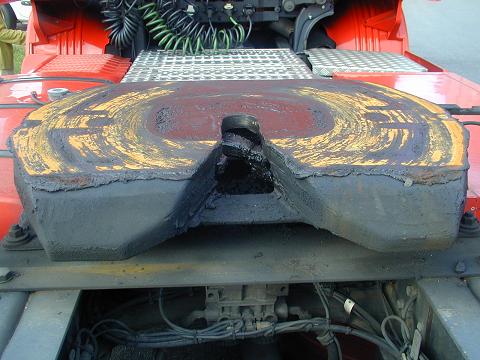
The fifth-wheel coupling provides the link between a semi-trailer and the towing truck, tractor unit, leading trailer or dolly. The coupling consists of a kingpin, a 2-or-3+1⁄2-inch-diameter (50.8 or 88.9 mm) vertical steel pin protruding from the bottom of the front of the semi-trailer, and a horseshoe-shaped coupling device called a fifth wheel on the rear of the towing vehicle. As the connected truck turns, the downward-facing surface of the semi-trailer (with the kingpin at the center) rotates against the upward-facing surface of the fixed fifth wheel, which does not rotate. To reduce friction, grease is applied to the surface of the fifth wheel. The configuration is sometimes called a turn-table in Australia and New Zealand, especially if it is a rotating ball-race-bearing type. The advantage of this type of coupling is towing stability.
Some camper trailers also use a fifth-wheel configuration, with the coupling installed in the bed of a pickup truck as a towing vehicle; "fifth wheel" is therefore sometimes used as a synonym for such campers.
Origin
[edit]The term fifth wheel comes from a similar coupling used on four-wheel horse-drawn carriages and wagons. The device allowed the front axle assembly to pivot in the horizontal plane, to facilitate turning while preventing the vehicle from tipping over, which an axle alone might permit. A wheel would be placed on the rear frame section of the truck, which at the time had only four wheels, making the additional wheel the "fifth wheel". The trailer needed to be raised so that the trailer's pin would be able to drop into the central hole of the fifth wheel.
Fifth wheels were originally not a complete circle and were hand forged. When mass production of buggy parts began in the early 19th century, fifth wheels were among the first products to be made. There were a number of patents awarded for fifth-wheel design. Edward and Charles Everett, Quincy, Illinois patented a type of fifth wheel in 1850, followed by Gutches' metallic head block and fifth wheel in 1870 and Wilcox fifth wheel in 1905.[inconsistent]
Steam tractors with fifth-wheel
[edit]A Thornycroft steam tractor with articulated trailer competed in the 1898 heavy vehicle trials in Liverpool which took place from May 24 to May 28.[1] Built by the Steam Carriage and Wagon Company of Chiswick, the trailer and tractor unit were connected by a turntable though the details of the coupling are not revealed apart from a schematic.
Another early example of the fifth wheel in a motorised vehicle was the Messrs T. Toward & Co Steam Motor Tractor that was exhibited at the Northumberland Agricultural Society Show in Newcastle upon Tyne in July 1898,[2] and described in some detail in the September issue of the Automotor Journal.[3] The tractor is shown towing a trailer (or 'lorry') "It will be observed that the fore-wheels of the latter are removed, the fore part of the body being carried on the rear end of the tractor, which is fitted with a turntable with an adjustable screwed spindle." "By this means the major portion of the load on the lorry can be transferred to the rear part of the tractor, and this increases the load on the rear wheels (the drivers) of the latter, and consequently the adhesion." They make the point that "The tractor system, of course, means in effect an articulated six-wheel vehicle". Drawing a trailer loaded with 30 passengers on 6 August 1898 it travelled the 14 miles (23 km) from Newcastle to Durham without a stop for water. After stopping at Market Place for 2 hours where it attracted a large crowd, it turned "nearly in its own length" and made the return journey without any problems on the hills between.[4] The fifth wheel, or turntable, for these vehicles was a full disk, and is pictured in the September 1898 article. The September account also includes details of the delivery and successful testing of one of these vehicles for hauling loads of coal over the hilly roads in Morpeth.
Martin Rocking Fifth Wheel
[edit]
The invention of the fifth wheel for motorized trucks is often credited to US inventor Charles H. Martin of the Martin Rocking Fifth Wheel Co. who invented the device in 1915.[5] It was submitted for patent in 1915 and finalized in 1916, with Herman Farr as inventor and Martin as assignee. When they formed the Martin Fifth Wheel company Martin was president and Farr was named secretary. It is a fair question whether the fifth wheel can be considered a milestone separate from the semi-trailer. After all, the purpose of the fifth wheel is to link the tractor and the trailer; indeed, trailers existed before Charles H. Martin introduced the Martin Rocking Fifth Wheel in 1915. At the time, the fifth wheel literally was a wheel that moved with the trailer—unlike today’s technology that secures a kingpin. What makes the fifth wheel so important is the ability it gave fleet owners to attach large trailers to tractors easily and safely and the freedom it gave them to switch out trailers. Without a fifth wheel, the modern distribution system would look quite different as drop-and-hook would not be easy. The semi-trailer increased the capacity of trucks, but it was the fifth wheel that brought the flexibility for drivers to keep moving while receivers unloaded the loads they just delivered.
The Fruehauf Trailer Corporation helped to make the Martin Rocking 5th Wheel a success by installing them on their popular new semi-trailer design. August Fruehauf invented the semi-trailer in 1914 with their own 5th wheel hitch. They adopted the Martin Rocking 5th wheel in 1916. By 1916 Fruehauf was producing semi-trailers in tandem with Federal Truck. These two Detroit companies also contracted with the military in WWI sending a convoy of supplies, men and equipment from Detroit to Norfolk, Virginia shipyards for travel to the front in Europe.[6]
Fruehauf's success with semi-trailer sales surpassed the million dollar sales mark by 1920. Opening a branch in Chicago and later in Des Moines their trailers and hence, the Martin Rocking 5th Wheel became the top selling commercial vehicle of this era. Fruehauf's slogan, "A Horse can pull more than it can carry, so can a truck" became their advertising motto. Merchants, manufacturers and businesses in every industry clamored for a semi-trailer and the shuttle concept introduced by Fruehauf using one tractor truck and 2 or more semi-trailers.[7]
Fruehauf used the Martin Rocking 5th Wheel up until at least 1919. Early that year, the manual coupler was introduced to the industry by Fruehauf and the jacks acting as front supports for the semi-trailer were supplanted by wheels, raised and lowered manually.
Fruehauf automatic semi-trailer
[edit]In 1926, Fruehauf introduced the automatic semi-trailer in which the coupling and the uncoupling of the tractor were accomplished mechanically by the motion of the tractor. Fruehauf's introduction of the automatic semi-trailer was instantly recognized by transportation experts as a major contribution to the industry.[8]
The automatic semi-trailer coupling patented by Fruehauf dominated the semi-trailer market until the Fruehauf Trailer Corporation's assets were sold in bankruptcy to Wabash National in 1997.
Another fifth wheel patent U.S. 2,053,812[9] was issued to Charles E. Bradshaw of Wellville, Virginia, filed March 18, 1936 and granted September 8, 1936. One third of that patent was assigned to Charles Martin, also of Wellville.
Modern fifth wheels allow the trailers to slide into the fifth wheel and lock into it very reliably when maintained and serviced properly. The engagement of the king pin into the fifth-wheel locking mechanism is the only means of connection between tractor and trailer; no other device or safety mechanism is used. Couplers and pintle hooks use safety chains in the event of a trailer separation while going down the road. Trailer-to-trailer connection can also be made by using fifth wheels; this creates a B-train.
See also
[edit]
References
[edit]- ^ The Liverpool Trials of Heavy Motor Vehicles, The Automotor and Horseless Vehicle Journal, 15 Jun 1898, pp317-334
- ^ Messrs. Toward & Co's Moto-Tractor, The Automotor Journal, Aug 1898, pp448-449
- ^ The Toward Steam Moto-Tractor, The Automotor Journal, Sep 1898, pp482-486
- ^ Trial trip of a Steam Motor Tractor, Newcastle Journal, 9 August 1898, p6
- ^ direct link U.S. patent 1,169,717 fifth wheel construction
- ^ New York Times, July 6, 1919
- ^ "Motor World for Jobbers, Dealers and Garagemen". 1918.
- ^ "Singing Wheels, the History of the Fruehauf Trailer Company - Singing Wheels: The History of the Fruehauf Trailer Company". Archived from the original on 23 May 2015. Retrieved 17 April 2015.
- ^ direct link: U.S. patent 2,053,812
General
[edit]- [1][permanent dead link]
- Bill Johnson, The American Truck Historical Society
- Darlene Norman, The Fruehauf Trailer Historical Society
- [2]
Fifth-wheel coupling
View on GrokipediaHistory
Origins in Horse-Drawn Vehicles
The concept of the fifth wheel emerged in the mid-19th century as a mechanical innovation for horse-drawn vehicles, specifically designed to enhance maneuverability on rough or uneven terrain. In traditional four-wheeled wagons and carriages, the front axle was rigidly fixed, limiting sharp turns and often causing the wheels to drag or bind during navigation. The fifth wheel addressed this by introducing a horizontal, ring-like pivoting structure mounted beneath the fore-axle, functioning as an additional "wheel" that allowed the front axle to swivel independently around a central king-bolt or pin. This design, lighter and more efficient than earlier European wheel-plates, reduced friction, improved stability under load, and enabled tighter turning radii essential for agricultural and transport wagons.[5] Early developments trace back to 1837, when Brown and Hicks patented a convex-plated fifth wheel to minimize vibrations and enhance ride quality in carriages. A significant advancement came in 1850 with the Everett Carriage Coupling, patented by Edward and Charles Everett of Quincy, Illinois, which refined the pivoting mechanism for better handling and load distribution in heavy-haul wagons. By 1870, Gutches introduced a metallic head block integrated with the fifth wheel, providing a more durable all-metal construction that replaced wooden components prone to wear. These innovations marked a shift toward standardized, forgeable iron designs that supported increasing wagon sizes and weights during the expansion of American roadways.[6][4] In the late 1880s, Jacob Herbrand further evolved the design with his fifth wheel patent (US244599A, filed 1881), allowing smoother articulation under dynamic loads. This Herbrand model, produced by the company he co-founded in Fremont, Ohio, emphasized enhanced turning circles and was widely adopted for multi-axle farm and freight wagons. By 1905, the Wilcox Fifth Wheel, developed by Frank E. Wilcox (building on earlier patents like US644651A from 1900), offered additional refinements in durability and ease of maintenance, solidifying the fifth wheel as a precursor to articulated vehicle couplings. These pre-automotive designs laid the foundational principles of pivoting load transfer that would later influence trailer attachments in motorized transport.[7][5][8]Early Adoption in Steam Tractors
During the late 1890s and early 1900s, engineers adapted fifth-wheel principles—originally from horse-drawn carriages—to steam-powered road vehicles, enabling the connection of detachable trailers for enhanced traction and towing on uneven terrain. British manufacturer Thornycroft pioneered this integration in steam tractors, using swivel turntables to link tractor units with trailers, which allowed for greater flexibility in off-road and agricultural applications compared to rigid drawbar systems.[9] A notable example is the 1898 Thornycroft steam tractor, which featured an articulated 5-ton trailer connected via a pivoting turntable coupling, permitting the boiler-equipped tractor unit to swivel independently of the trailing load for improved stability during turns and over rough ground. This design addressed the limitations of early steam vehicles by facilitating the towing of heavy implements, such as in road haulage trials where the vehicle demonstrated reliable performance.[10] The heavy forward weight distribution of steam boilers posed significant engineering challenges, often risking tipping or wheel slippage on irregular surfaces; to counter this, early fifth-wheel adaptations incorporated oscillating or rocking mechanisms that absorbed vertical movements and maintained contact with the ground, preventing derailment while supporting loads up to 5 tons in models like the Thornycroft. Similar swivel couplings appeared in French steam tractors, such as the 1896 De Dion-Bouton designs, where turntables above the rear axles enabled pivoting for tight maneuvers and stability under loads reaching 7.5 tons.[5] Key milestones include the 1898 Liverpool Self-Propelled Traffic Association Trials, where Thornycroft's articulated steam wagon secured top honors for heavy goods transport, marking a practical debut in powered towing applications that extended to agriculture. By the early 1900s, these principles gained traction in logging operations across Europe and North America, with steam road locomotives using fifth-wheel swivels to haul timber trailers over forested trails, boosting efficiency in resource extraction.[9]Key Innovations: Martin Rocking and Fruehauf Designs
The Martin Rocking Fifth Wheel, introduced in 1915 by Charles H. Martin, represented a significant advancement in coupling mechanisms for early motorized trucks. Invented in collaboration with Herman G. Farr, the device featured a hinged, rocking upper plate that allowed the trailer to pivot and balance dynamically over uneven terrain, reducing stress on the chassis and improving load distribution during travel. This mechanism consisted of a circular upper member attached to the trailer with a depending kingpin that engaged jaws on a lower plate mounted to the tractor, enabling the entire assembly to rock fore and aft on pivots for better articulation and shock absorption. Patented as U.S. Patent No. 1,169,717 on January 25, 1916, with Martin as assignee, the design was specifically tailored for internal combustion delivery vehicles of the era, such as those used in urban freight hauling. The Martin Rocking Fifth Wheel Company, formed that same year, marketed the invention for its ability to enhance maneuverability on unpaved roads common in the 1910s.[11][12][13] Parallel to Martin's work, August Fruehauf and Otto Neumann developed the first practical semi-trailer in 1914, initially using a simple pin-hitch fifth wheel coupling to connect a flatbed trailer to a modified Ford Model T roadster for hauling lumber and boats. This early design, built for Detroit lumber dealer Frederic M. Sibley, featured a 20-foot-long, two-wheeled trailer with sideboards, marking the transition from full trailers to semi-trailers that supported partial weight on the tractor. By 1916, Fruehauf evolved the coupling into a more secure locking fifth wheel, adopting elements of the Martin design while refining it for heavier freight loads, which allowed for quicker detachment and reattachment of trailers. In 1919, Fruehauf engineer Ernest F. Hartwick patented an improved automatic locking version (U.S. Patent No. 1,351,245, issued August 31, 1920), incorporating a floating upper jaw mechanism that self-engaged the kingpin for safer, semi-automatic operation. This innovation stemmed from Fruehauf's growing operations, leading to the formal founding of the Fruehauf Trailer Company in 1918 with $108,000 in capital, focused on producing standardized semi-trailers for commercial use.[14][15][16] These designs collectively standardized trailer detachment in the 1910s and 1920s, shifting from fully manual hitches to semi-automatic systems and enabling initial load capacities of around 20,000 pounds for freight transport. Their adoption accelerated during World War I, when Fruehauf supplied over 125 specialized trailer variants to the U.S. military, supporting logistics efforts such as a 1917 convoy of 30,000 trucks that moved 690,000 tons of supplies from Detroit. Martin's rocking mechanism, integrated into Fruehauf trailers by 1916, improved road efficiency for early trucking fleets, while Fruehauf's locking innovations laid the groundwork for scalable semi-trailer operations in post-war commerce. By the mid-1920s, these developments had transitioned the industry toward more reliable, high-volume freight hauling, with automatic features reducing coupling time from minutes to seconds.[14][4][12]Design and Components
Basic Structure and Mounting
The fifth-wheel coupling features a horseshoe-shaped top plate that serves as the primary structural component, designed to receive and secure the trailer's kingpin while enabling articulation between the tractor and trailer. This plate is typically mounted over the tractor's rear axle rails and is secured directly to the chassis frame, often using high-strength bolts or welds to withstand vertical loads up to 165,000 pounds (74,000 kg) in heavy-duty applications.[17][18][20] The pivot point at the center of the plate allows for up to 90 degrees of horizontal articulation, facilitating tight turns without decoupling.[17][18] Mounting variations include fixed installations, which are bolted or welded permanently to the frame for standard applications, and adjustable sliding mounts that allow fore-aft repositioning to optimize weight distribution and axle loading. In modern Class 8 trucks with high-tension steel frames, reinforcements such as cross-members or L-profile angles are commonly added to distribute loads and prevent frame distortion during operation. Fixed mounts use at least five bolts per side with spacing not exceeding eight inches, while sliding versions incorporate carriages with plunger mechanisms for incremental adjustments in 2- to 4-inch steps.[21][2][22] Fifth wheels are commonly constructed from cast steel or high-strength alloys for durability under extreme stress, with the top plate often featuring a ductile iron or forged steel composition to resist wear and fatigue. Standard dimensions include a throat opening of approximately 6 inches to accommodate a 2-inch kingpin, and overall plate widths ranging from 39 to 40 inches for compatibility with most semi-trailers. These units typically weigh between 50 and 150 pounds, depending on capacity and whether they include integrated slides, with height adjustments from the frame bed ranging from 4 to 6 inches via risers or baseplates to fine-tune coupling alignment.[18][23][24] Integration with the tractor requires alignment to specific height regulations, typically positioning the top of the fifth wheel 47 to 51 inches above the ground when unladen to ensure the combined vehicle height does not exceed 13 feet 6 inches, the federal maximum for interstate travel. This height accounts for tire size, suspension deflection, and trailer specifications, with adjustments made during installation to maintain level coupling and prevent overhang issues.[25][26][27]Core Mechanisms: Jaw, Lock, and Kingpin
The core of the fifth-wheel coupling lies in its interlocking components: the jaw, lock, and kingpin, which together provide a secure, high-strength connection between the tractor and trailer. The jaw, typically a robust, U-shaped steel component integrated into the fifth wheel's top plate, is designed to capture and grip the trailer's kingpin. Its geometry features a throat opening approximately 2.875 inches in diameter to accommodate initial kingpin entry, narrowing to a 2.000-inch diameter contact area for precise engagement, ensuring compatibility with standard kingpins. Anti-rotation stops on the jaw's inner surfaces prevent slippage under torque loads by distributing forces evenly across the pin.[28][29] The locking mechanism secures the jaw once the kingpin is captured, employing spring-loaded or cam-actuated locks to hold the assembly in place. These locks, often including a primary jaw lock and a secondary safety latch, engage automatically via tension springs that bias the jaw toward the closed position, with the secondary latch preventing inadvertent release. Release is facilitated by levers connected to the jaw, which can be manual, hydraulic, or pneumatic, allowing the operator to slide the jaw open for uncoupling. In designs like those using a slidable jaw connected to a top plate, a release arm pivots to move the jaw via a pin in a slot, while a trigger member interacts with the kingpin to initiate locking. Materials such as hardened steel ensure durability, with wear plates serving as indicators for maintenance.[30][29] The kingpin, mounted on the trailer's forward understructure, functions as an inverted bolt that serves as the pivot point for articulation and load transfer. Constructed from forged steel, it measures approximately 2 inches in diameter and 2 to 3 inches in length, protruding downward to mate with the fifth wheel's jaw and throat. Per SAE J700 standards, the kingpin must maintain tight tolerances, such as a jaw contact diameter of 2.000 inches ±0.005 inches and a maximum downward bow of 0.125 inches over a 10-inch radius, to ensure no-slip performance under vertical loads up to 165,000 pounds (74,000 kg). These specifications guarantee structural integrity in the unladen condition, with inspection criteria limiting wear to 0.125 inches to avoid out-of-service conditions. Standard 2-inch (50.8 mm) kingpins per SAE J700 are common, while 3.5-inch (88.9 mm) variants per SAE J848 are used for heavier loads.[28][29][31] Together, these mechanisms ensure reliable engagement: the kingpin enters the throat, the jaw closes around it via the lock's action, and anti-rotation features resist torsional forces, enabling safe towing without decoupling. Compatibility is standardized to SAE J700 for the kingpin and related interface specs, allowing interchangeability across manufacturers while mounting the fifth wheel to the tractor's frame provides the stable base for these interactions.[30]Function and Operation
Coupling and Uncoupling Process
The coupling process for a fifth-wheel hitch requires careful pre-checks to ensure safety and proper function. Drivers must inspect the fifth wheel for damage, missing parts, secure mounting to the tractor frame, and lubrication of the jaws and plate; the locking mechanism should be fully open with the safety latch in the appropriate position. The trailer's kingpin must be undamaged and properly aligned, with landing gear raised or supporting the trailer as needed, brakes applied (including spring brakes if applicable), and wheels chocked to prevent movement, especially on inclines. Cargo should be secured, and the area around the vehicles cleared of personnel and hazards. These inspections help prevent accidents during engagement.[32] To couple the tractor and trailer, the driver positions the tractor directly in front of the trailer nose on level ground, applies the tractor's parking brakes, and slowly backs up to align the fifth wheel throat with the trailer's kingpin, listening for an audible click indicating initial engagement. With the transmission in neutral and brakes set, the driver then connects the air lines using gladhand couplers for the emergency and service brake systems, followed by the electrical cable for lights and signals, ensuring no leaks, tangles, or damage. The trailer brakes are locked, and the tractor is backed further if needed to fully seat the kingpin into the fifth wheel jaws. The driver pulls the release lever to engage the lock. For SAF-Holland Simplex SE and II SE Series fifth wheels, proper coupled position requires the release handle to be fully retracted with the lock indicator in the down position above the release handle, and no gap is permissible between the trailer bolster plate and the fifth wheel. The driver verifies closure visually and by checking for no gap between the trailer bolster plate and the fifth wheel, raises the landing gear completely using the crank handle, and secures it. A final tug test—gently pulling forward with trailer brakes on—confirms the connection, along with air pressure buildup to normal levels. Safety chains are attached as required to provide backup in case of coupling failure.[32][33][34] Uncoupling follows a reverse sequence to safely detach the vehicles. On flat, level ground, the driver applies the tractor parking brakes, chocks the trailer wheels or engages spring brakes, and lowers the landing gear with the crank handle until it fully supports the trailer weight, relieving pressure on the fifth wheel jaws. Air lines are disconnected first using the gladhand couplers—emergency line before service to avoid sudden brake release—followed by the electrical cable, with all stored to prevent dragging. The fifth wheel lock is released by pulling the lever; for models equipped with a manual safety indicator, such as the SAF-Holland Simplex SE and II SE Series, it must be manually rotated out of the way before pulling the release handle. The tractor is driven forward slowly and straight to disengage the kingpin, ensuring no personnel are nearby. Post-uncoupling, the trailer is inspected for stability, and the fifth wheel is checked for damage or debris. Common errors like misalignment during backing can be avoided by using mirrors and slow speeds; in modern setups, electronic aids such as LED indicators on the fifth wheel (e.g., SAF-Holland's ELI-te system) or cab sensors (e.g., JOST's JSK sensor-equipped models) provide visual or audible confirmation of proper engagement, reducing errors.[32][33][35][36][34] The entire coupling or uncoupling procedure typically takes 2 to 5 minutes for experienced drivers under ideal conditions, emphasizing deliberate steps over haste to maintain safety and efficiency.[37]Articulation, Load Transfer, and Maneuverability
The fifth-wheel coupling enables articulation between the tractor and semi-trailer through a pivot mechanism centered on the kingpin, allowing up to 90 degrees of horizontal rotation to each side of the centerline. This range facilitates sharp turns without causing the tractor-trailer combination to jackknife, as the trailer's front end can align closely with the tractor's path during low-speed maneuvers. The pivot relies on bushings or bearings that support smooth rotational movement; however, these components are subject to wear from friction, particularly under repeated loading and turning stresses. Regular lubrication of the bushings and pivot surfaces is essential to reduce friction, prevent accelerated wear, and maintain operational efficiency, with manufacturers recommending grease application at intervals based on mileage or usage.[38][39] Load transfer via the fifth wheel occurs primarily through vertical forces at the kingpin interface, distributing 20-30% of the trailer's total weight—known as pin weight—to the tractor's drive axles, while the remainder supports the trailer axles. This percentage depends on the trailer's center of gravity position and axle configuration, ensuring balanced axle loads for compliance with weight regulations and optimal traction. The vertical force on the fifth wheel can be calculated using static equilibrium principles as , where is the trailer weight, is the horizontal distance from the kingpin to the trailer's center of gravity, and is the distance from the kingpin to the centroid of the trailer axles; this formula highlights how forward-biased loading increases pin weight and tractor axle burdens. Proper load distribution minimizes uneven tire wear and enhances braking performance by avoiding excessive rearward weight bias on the trailer.[40][41] The fifth wheel's design significantly improves maneuverability by permitting a reduced turning radius for semi-trucks, typically 45-55 feet for standard configurations, compared to longer rigid vehicles. This capability is crucial for navigating urban intersections and loading docks, where tight sweeps are common. Cornering stability is further supported by the kingpin's setback positioning, typically 36 inches (3 feet) from the trailer's forward edge, which helps counteract lateral forces and reduces offtracking—the tendency of the trailer to cut the corner sharply. During turns, the pivot manages torque from the trailer's inertia, with shear forces approximated by , where is the applied torque and is the effective pivot radius; this ensures the coupling withstands dynamic loads without excessive stress concentrations.[42][43][44][45]Types and Variations
Fixed and Semi-Oscillating Fifth Wheels
Fixed fifth wheels are rigidly bolted to the tractor frame in a single position, providing a stable and straightforward connection without provisions for sliding or positional adjustment. This design is particularly suited for operations involving consistent trailer lengths and uniform load distributions, such as regional hauling where frequent changes in configuration are not required.[46] Typical models, like those in the SAF-Holland FW2000 series, support vertical loads up to 44,000 lbs (196 kN) and D-values of 165 kN.[2] Installation involves direct bolting to mounting brackets on the chassis, eliminating the need for sliding rails and resulting in lower overall weight and simplified setup compared to adjustable variants.[1] The primary advantages of fixed fifth wheels include their robust construction, reduced maintenance requirements due to fewer moving parts, and enhanced durability, with well-maintained units often achieving lifespans exceeding 500,000 miles in commercial use.[47] However, their lack of adjustability limits compliance with varying weight distribution regulations, potentially requiring tractor-trailer combinations to be optimized specifically for fixed setups and restricting versatility for multi-trailer fleets.[46] Semi-oscillating fifth wheels build on the fixed design by incorporating limited vertical and lateral articulation, typically 5 to 10 degrees of rocking motion, to better handle road irregularities without full pivoting. This movement is facilitated by rubber bushings or trunnion assemblies that absorb shocks and vibrations, making them advantageous for rough terrain or off-highway applications like lowboy trailers.[46] For instance, the SAF-Holland FW35 series semi-oscillating model uses NoLube technology for reduced friction, supports a vertical load of 55,000 lbs (245 kN) and a D-value of 165 kN, and weighs approximately 109 kg, ensuring reliable performance in demanding yard or regional environments.[48][49] Installation mirrors that of fixed types, with direct chassis mounting and no sliding components, which contributes to lower maintenance needs—primarily periodic bushing inspections and lubrication—while promoting longevity through minimized wear on the top plate.[50] These semi-oscillating designs excel in simplicity and cost-effectiveness, offering improved ride quality and reduced stress on the coupling compared to fully rigid fixed wheels, particularly in uneven conditions.[46] Nonetheless, their limited oscillation range restricts adaptability to extreme angles or high-center-of-gravity loads, and they may not fully address dynamic weight shifting required under strict axle load laws, positioning them best for semi-fixed, moderate-duty hauling rather than highly variable operations.[51]Sliding and Air-Operated Fifth Wheels
Sliding fifth wheels are designed to allow adjustable positioning along mounting rails, typically providing 12 to 24 inches of travel to redistribute weight between the tractor's steer and drive axles. This adjustability ensures compliance with federal bridge laws, such as the 80,000-pound gross vehicle weight limit, by optimizing axle loads to prevent overloads on specific axles or bridges.[52][53] Release mechanisms can be manual, involving pins or levers, or pneumatic for easier operation, enabling drivers to shift the fifth wheel forward to increase steer axle weight or backward to load the drives more heavily.[54] Air-operated sliding fifth wheels incorporate compressed air cylinders to facilitate rapid repositioning, often completing the adjustment in under 30 seconds while requiring air pressure between 90 and 120 psi for reliable function. Models such as the JOST JSK37 series exemplify this design, integrating air actuation with locking pins for secure positioning after sliding.[55] These systems enhance operational efficiency in dynamic loading scenarios, contrasting with simpler fixed fifth wheels that lack such mobility. Advanced features in modern sliding fifth wheels include automatic lubrication (auto-lube) systems, which distribute grease to rails and contact points to reduce wear, and integrated shock absorption elements to dampen vibrations during travel. Optimized weight distribution through these adjustments can improve fuel efficiency in long-haul operations by minimizing rolling resistance and aerodynamic drag.[56] Sliding fifth wheels are prevalent in long-haul trucking, widely used to maintain legal compliance across varying loads. To determine the required position shift, drivers use the formula: position shift = delta weight / axle factor, where the axle factor typically accounts for 200-250 pounds per notch or approximately 100 pounds per inch of travel, depending on trailer configuration and geometry.[57][58] This calculation helps achieve balanced distribution, such as targeting 12,000 pounds on the steer axle and 34,000 pounds on the tandem drives under federal limits.[59]Applications and Standards
Commercial Trucking and Heavy Haulage
In commercial trucking, fifth-wheel couplings are a standard component for connecting semi-trailers to tractor units, facilitating efficient logistics operations across vast distances. This setup is essential for hauling standard 53-foot dry van trailers, which can carry up to approximately 45,000 pounds of cargo while adhering to federal gross vehicle weight limits of 80,000 pounds. Such configurations enable the transport of diverse freight, including intermodal containers—typically 20 or 40 feet long—and flatbed loads for construction materials or machinery, supporting the movement of goods that constitutes about 72.7% of U.S. freight by weight annually.[60][61] For heavy haulage applications, specialized fifth-wheel couplings are engineered to handle oversize and overweight loads, often featuring reinforced jaws and extended mounting plates to distribute extreme vertical loads securely. These heavy-duty models are rated for vertical loads exceeding 50,000 pounds, allowing tractor-trailer combinations to transport equipment like wind turbine components or modular buildings that surpass standard dimensions and weights, requiring permits for gross vehicle weights beyond 80,000 pounds. Sliding fifth wheels are commonly employed in these scenarios to adjust positioning for axle load compliance during oversize transport.[62][63] The economic significance of fifth-wheel couplings in commercial trucking lies in their role within supply chains, where they enable flexible trailer swapping to minimize deadhead miles—empty return trips that otherwise increase fuel costs and emissions. In the U.S., with nearly 3 million semi-trucks registered and utilizing these couplings, the trucking sector generated $906 billion in annual revenue as of 2024, underscoring how fifth wheels contribute to just-in-time delivery and overall logistics efficiency. The global fifth-wheel market, driven largely by commercial applications, reached a valuation of $672.6 million by 2024, reflecting their integral part in sustaining freight-dependent economies.[64][65][66] Globally, fifth-wheel designs adapt to regional regulations, with North American models optimized for 80,000-pound limits on interstate highways, favoring longer trailers up to 53 feet. In contrast, European adaptations accommodate stricter length rules but higher axle weights, supporting gross combination weights of 40 to 44 tonnes under EU directives, often with height-adjustable fifth wheels to navigate varied infrastructure and bridge clearances. These variations ensure compliance while maximizing payload efficiency in cross-border freight.[67][68][69]Recreational Vehicles and Safety Regulations
In recreational vehicles (RVs), fifth-wheel couplings are commonly used to connect fifth-wheel campers to pickup trucks, enabling stable towing for trailers typically 30 to 40 feet in length and weighing up to 15,000 pounds or more. These hitches are mounted in the truck bed and couple directly to the trailer's kingpin for enhanced stability and weight distribution during travel. This setup is particularly popular in the United States, where annual retail registrations of fifth-wheel trailers exceeded 60,000 units in 2024, reflecting their appeal for long-distance leisure towing among RV enthusiasts.[70][71][72] Safety regulations for fifth-wheel couplings emphasize secure attachment and operational integrity to prevent detachment during transit. In the United States, the Federal Motor Carrier Safety Administration (FMCSA) governs these under 49 CFR 393.70, which requires fifth-wheel assemblies to be securely mounted to the vehicle frame to avoid cracking or shifting, with automatic locking mechanisms that engage upon coupling to prevent unintended separation. Kingpin inspections are mandated to ensure proper fit and function, while load securement rules prohibit excessive play, with horizontal movement between the upper and lower fifth-wheel halves limited to no more than 1/2 inch (12.7 mm). The National Highway Traffic Safety Administration (NHTSA) monitors related safety through recalls, such as those addressing improper coupling techniques that could lead to locking mechanism failure, though specific crash test ratings for fifth-wheel systems in RVs are not standardized due to the rarity of overload-related incidents in available data.[73][73][74][75] Maintenance protocols are essential to uphold these standards, focusing on regular checks to detect wear and ensure smooth operation. Annual inspections should verify jaw clearance, which for new fifth wheels is approximately 1/16 inch between the kingpin and jaws, with any excessive gap indicating potential misalignment or wear that could compromise coupling. Lubrication schedules recommend greasing jaw pivot points, wedges, and zerks every 1,000 miles or before extended trips, using a grease gun to prevent friction-induced failures like lock seizure from inadequate maintenance or exposure to contaminants. Common issues, such as seized locks due to worn components or improper lubrication, can result in coupling difficulties and are addressed through routine cleaning and adjustment of the locking mechanism.[76][77][78] Internationally, fifth-wheel kingpins adhere to ISO 337 standards, which specify dimensions for the 50 mm (2-inch) diameter coupling pin to ensure interchangeability between semi-trailers and prime movers. In the European Union, ECE Regulation No. 55 establishes type-approval requirements for mechanical coupling components, classifying fifth wheels by load capacity (e.g., Classes A to G) and mandating fatigue, static steering, and rollover tests for certification, differing from U.S. FMCSA rules by emphasizing EU-wide homologation and stricter dynamic performance criteria for commercial and recreational applications.[79][80]References
- https://patents.[google](/page/Google).com/patent/US3063739A/en