Hubbry Logo
Prussian uprisingsPrussian uprisingsMain
Open search
Prussian uprisings
Community hub
Prussian uprisings
logo
8 pages, 0 posts
0 subscribers
Be the first to start a discussion here.
Prussian uprisings
Prussian uprisings
from Wikipedia

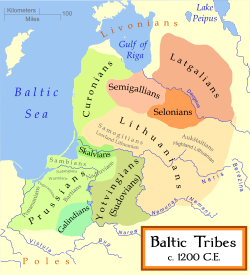
Baltic tribes and Prussian clans c. 1200

The Prussian uprisings were two major and three smaller uprisings by the Old Prussians, one of the Baltic tribes, against the Teutonic Knights that took place in the 13th century during the Prussian Crusade. The crusading military order, supported by the Popes and Christian Europe, sought to conquer and convert the pagan Prussians. In the first ten years of the crusade, five of the seven major Prussian clans fell under the control of the less numerous Teutonic Knights. However, the Prussians rose against their conquerors on five occasions.

The first uprising was supported by Duke Swietopelk II, Duke of Pomerania. The Prussians were successful at first, reducing the Knights to only five of their strongest castles. The duke then suffered a series of military defeats and was eventually forced to make peace with the Teutonic Knights. With Duke Swietopelk's support for the Prussians broken, a prelate of Pope Innocent IV negotiated a peace treaty between the Prussians and the Knights. This treaty was never honored or enforced, especially after the Prussian victory in the Battle of Krücken at the end of 1249.[1]

The second uprising, known in historiography as "the great Prussian uprising", was prompted by the 1260 Battle of Durbe, the largest defeat suffered by the Teutonic Knights in the 13th century.[2] This uprising was the longest, largest, and most threatening to the Teutonic Order, who again were reduced to five of their strongest castles. Reinforcements for the Knights were slow to arrive, despite repeated encouragements from Pope Urban IV, and the position of the Order looked set to worsen. The Prussians lacked unity and a common strategy and reinforcements finally reached Prussia in around 1265. One by one, the Prussian clans surrendered and the uprising was ended in 1274.

The later three lesser uprisings relied on foreign assistance and were suppressed within one or two years. The last uprising in 1295 effectively ended the Prussian Crusade, and Prussia became a Christian territory with a number of settlers from different German states.

Background

[edit]
Timeline of Teutonic conquest[3]
Year Prussian clan
1233–1237 Pomesanians
1237 Pogesanians
1238–1241 Warmians,
Natangians,
Bartians
1252–1257 Sambians
1274–1275 Nadruvians

Although the Prussians repelled early incursions by the Order of Dobrzyń, they were outnumbered by attacks from Poland, Ruthenians in the southeast and the Teutonic Knights from the west. The Teutonic Order was called to the Culmerland in 1226 by Konrad I of Masovia, who began a number of expeditions and crusades against the Prussians and later asked the Knights to protect him from raids by the Prussians. Preoccupied with crusades in the Holy Land, the Teutonic Knights arrived only in 1230. Their first task was to build a base on the left bank of Vistula at Vogelsang, opposite of Toruń (Thorn), which was completed a year later.[4] Led by Hermann Balk, the Knights did not repeat the mistakes of the previous Order and did not push eastwards into the forest of the interior.[5] They would further build fortified log (later brick and stone) castles along major rivers and the Vistula Lagoon to serve as basis for future expansion. In 1231–1242, forty such castles were built.[6] The Prussians faced major difficulties in capturing these castles as they were accustomed only to combat in open fields. Most conflicts occurred either in summer or winter. Heavily armoured knights could not travel and fight on land soaked by water from melting snow or autumn rains. Summer campaigns were most dangerous as the Knights would immediately build new castles in the conquered territory.[3] The Teutonic Knight's strategy proved successful: in ten years, five of the seven major Prussian clans fell under control of the less-numerous Teutonic Knights.[3] However, the Prussians further resisted the conquerors, leading to five uprisings over the following fifty years.

First Prussian uprising (1242–1249)

[edit]
Ruins of the Teutonic castle in Rehden (today Radzyń Chełmiński Castle). It was one of five castles not captured by the Prussians.

The first Prussian uprising was influenced by three major events.[7] Firstly, the Livonian Knights – a subsidiary of the Teutonic Knights – lost the Battle on the Ice on Lake Peipus to Alexander Nevsky in April 1242. Secondly, southern Poland was devastated by a Mongol invasion in 1241; Poland lost the Battle of Legnica and the Teutonic Knights lost one of its most trusted allies that often supplied troops. Thirdly, Duke Swantopolk II of Pomerania was fighting against the Knights, who supported his brothers' dynastic claims against him. It has been implied that the new castles of the Knights were competing with his lands over the trade routes along the Vistula River.[5] While some historians embrace the Swantopolk–Prussian alliance without hesitation,[7] others are more careful. They point out that the historical information came from documents written by the Teutonic Knights and must have been ideologically charged to persuade the Pope to declare a crusade not only against the pagan Prussians but also against the Christian duke.[1]

Statue for Swantopolk II of Pomerania in a park in Oliwa

Prussians besieged Teutonic castles and managed to capture all except for Elbing (Elbląg) and Balga in the eastern regions of Natangia, Barta and Warmia; Thorn (Toruń), Culm (Chełmno), and Rehden (Radzyń Chełmiński) in the western parts.[8] In December 1242, the Knights were able to capture Sartowice, Swantopolk's castle on the banks of the Vistula. The ensuing five-week siege of Sartowice failed to recapture the fortress and Swantopolk lost 900 men.[9] In the spring of 1243, Swantopolk also lost the castle at Nakel (Nakło nad Notecią), which dominated trade on the Noteć River. In the face of these losses, the duke was forced to make a short-lived truce.[10] In the summer of 1243, Prussians with Sudovian help raided the Culmerland (Chełmno Land) and, on their way back, defeated the pursuing Teutonic Knights on 15 June on the banks of the Osa River. Some 400 Teutonic soldiers perished, including their marshal.[11] Swantopolk, encouraged by the defeat, gathered an army of 2,000 men and unsuccessfully besieged Culm (Chełmno).[12]

The Teutonic Knights managed to gather a coalition against Swantopolk: Dukes of Masovia were given territories in Prussia, Dukes of Greater Poland received Nakel, and Dukes of Pomerellia, brothers of Swantopolk, hoped to regain their inheritance.[13] Swantopolk built a castle at Zantyr, where Nogat separated from the Vistula, and launched a blockade of Elbing and Balga. While the castle withstood Teutonic attacks, the blockade was smashed by cogs.[14] In late 1245 Swantopolks's army suffered a great defeat at S(ch)wetz Świecie, and another one in early 1246, where 1,500 Pomeranians were killed.[15] Swantopolk II asked for a truce and Pope Innocent IV appointed his chaplain, Jacob of Liège, the future Pope Urban IV, to handle the peace negotiations.[1] However, the war was renewed in 1247 when large Teutonic reinforcements arrived in Prussia.[11] On Christmas Eve of 1247 the Knights besieged and overwhelmed a major Pomeranian fortress, which they later renamed Christburg (Dzierzgoń), and newly arrived Henry III, Margrave of Meissen subdued the Pogesanians.[16] Swantopolk retaliated and destroyed Christburg, but the Knights rebuilt it in a new location. Both Prussian and Swantopolk's armies failed to capture the new castle. Otto III of Brandenburg raided Warmia and Natangia, forcing the locals to surrender.[17]

The peace talks that began in 1247 achieved little, but a new truce was arranged in September 1248 and peace was made on 24 November 1248.[1] Swantopolk had to return lands seized from his brothers, allow Teutonic Knights to pass through his domains, stop charging tolls on ships using the Vistula, and stop any aid to the Prussians.[18] Prussians were compelled to sign the Treaty of Christburg on 7 February 1249. The treaty provided personal freedom and rights to newly converted Christians. It formally ended the uprising, but already in November 1249 the Natangians defeated the Knights at the Battle of Krücken. The skirmishes lasted until 1253 and some sources cite this year as the end of the uprising.[19] At that point the treaty ceased its political power but remained an interesting historical document.[1]

Great Prussian uprising (1260–1274)

[edit]
Map of the Prussian clans in the 13th century
Schematic map of the second uprising

Preparation and tactics

[edit]

The major revolt began on 20 September 1260. It was triggered by the Lithuanian and Samogitian military victory against the joint forces of the Livonian Order and Teutonic Knights in the Battle of Durbe. As the uprising was spreading through Prussian lands, each clan chose a leader: the Sambians were led by Glande, the Natangians by Herkus Monte, the Bartians by Diwanus, the Warmians by Glappe, the Pogesanians by Auktume.[20] One clan that did not join the uprising was the Pomesanians.[11] The uprising was also supported by Skomantas, leader of the Sudovians. However, there was no one leader to coordinate efforts of these different forces. Herkus Monte, who was educated in Germany, became the best known and most successful of the leaders, but he commanded only his Natangians.

The Prussians besieged many castles that the Knights had built and could not send large armies to fight in the west. Prussians were not familiar with Western European siege tactics and machinery and relied on siege forts, built around the castle, to cut the supplies to the garrisons. The Teutonic Knights could not raise large armies to deliver supplies to the starving garrisons and smaller castles began to fall.[21] Those castles were usually destroyed and the Prussians manned just a few castles, notably one in Heilsberg (Lidzbark Warmiński), because they lacked technology to defend the captured castles and organization to provide food and supplies to stationed garrisons.[22] On 29 August 1261 Jacob of Liège, who negotiated the Treaty of Christburg after the first uprising, was elected as Pope Urban IV.[23] He, having an inside scope on events in Prussia, was especially favourable to the Teutonic Knights and issued 22 papal bulls in three years of his papacy calling for reinforcements to the Knights.[24] However, the reinforcements were slow to come as dukes of Poland and Germany were preoccupied with their own disputes and the Livonian Order was fighting the Semigallian uprising.[25]

Early Prussian success

[edit]
Pope Urban IV (1261–1264) was especially supportive of the Teutonic cause in Prussia. He served as a papal prelate negotiating the Treaty of Christburg after the first Prussian uprising.

The first reinforcement to the Teutonic forces arrived in early 1261, but was wiped out on 21 January 1261 by Herkus Monte in the Battle of Pokarwis.[5] In January 1262 reinforcements arrived from the Rhineland, led by Wilhelm VII, Duke of Jülich, who was obliged by Pope Alexander IV to fulfil his crusader duties in Prussia.[26] This army broke the siege of Königsberg but as soon as the army returned home, the Sambians resumed the siege and were reinforced by Herkus Monte and his Natangians. Herkus was later injured and the Natangians retreated, leaving the Sambians unable to stop supplies reaching the castle and the siege eventually failed.[27] Prussians were more successful capturing castles deeper into the Prussian territory (with an exception of Wehlau, now Znamensk), and the Knights were left only with strongholds in Balga, Elbing, Culm, Thorn, and Königsberg.[11] Most castles fell in 1262–1263, and Bartenstein fell in 1264. The Prussians destroyed captured forts instead of using them for their own defence, so the end of successful sieges meant that large Prussian forces did not have to stay near their home and were then free to operate in other parts of Prussia,[28] raiding the Culmerland and Kuyavia.

A recovered Herkus Monte raided Culmerland with a large force and took many prisoners in 1263. While returning to Natangia, Herkus and his men were confronted by a contingent of their enemies. In the Battle of Löbau that ensued, Prussians killed 40 knights, including the Master and the Marshal.[29] The Prussians also received help from Lithuanians and Sudovians. In summer of 1262 Treniota and Shvarn attacked Masovia, killing Duke Siemowit I, and raided Culmerland, provoking Pogesanians to join the uprising.[11] The assassination of King Mindaugas of Lithuania and subsequent dynastic fights prevented Lithuanians from further campaigns. Skomantas, leader of Sudovians, raided Culm (Chełmno) in 1263[30] and in 1265.

Turning point

[edit]
King Ottokar II of Bohemia participated twice in the Prussian Crusade: in 1254, when he founded Königsberg, named in his honor, and in 1267, when he helped to suppress the Great Prussian Uprising.

The year of 1265 was the turning point in the uprising: more substantial reinforcements for the Teutonic Knights started arriving in Prussia[11] and Sambia abandoned the fight. Teutonic castles in Königsberg and Wehlau on the Pregel River cut off the region from the rest of Prussia. Supplies to Königsberg were brought by sea, and the castle served as the basis for raids in surrounding Samland (Sambia). The Livonian Order sent troops to Königsberg and the joint forces defeated the Sambians in a decisive battle forcing them to surrender.[31] In 1265 reinforcements arrived from Germany: armies of Duke Albrecht of Braunschweig and Margrave Albert of Meissen arrived in Prussia,[5] but were unable to achieve much.[32] In 1266 Otto III and John I, co-rulers of Brandenburg, built a castle in the Natangian lands between Balga and Königsberg and named it Brandenburg (since 1945 Ushakovo). Due to bad weather they did not organize campaigns into Prussian lands.

When the Dukes returned home, Brandenburg was captured by Glappe and his Warmians.[32] The very next year Otto returned to rebuild the castle. Both John and Otto died before the end of 1267, and Otto's son was killed in a tournament. Subsequent Dukes of Brandenburg were not as supportive of the Knights.[32] In 1266 Duke Swantopolk, the supporter of the Prussians during the First Uprising, died and his sons Mestwin and Warcisław briefly joined the Prussians in the uprising.[33] In 1267 King Ottokar II of Bohemia, who already participated in the Prussian Crusade in 1254 and who was promised by Pope Urban IV all Prussian lands he could conquer,[34] finally arrived in Prussia. His only achievement was forcing Duke Mestwin to reconcile with the Teutonic Knights. His large army was unable to campaign due to an early thaw: heavily armed knights could hardly fight during the wet and swampy spring season.[35]

The warfare with the Prussians relied on guerilla raids in the border regions. Small groups of men, a dozen to a hundred, made quick raids on farms, villages, border posts, etc. This was a positional warfare where neither side could defeat the other, but the Teutonic Knights relied on future reinforcements from Germany and Europe, while Prussians were draining their local resources.[36] After the massacre of surrendered Teutonic soldiers in the Battle of Krücken in 1249, the Knights refused to negotiate with the Prussians. The Prussians were also unable to coordinate their efforts and develop a common strategy: while each clan had its own leader, there was no single leader of all the clans. The Natangians had to watch for attacks from Balga, Brandenburg, Wehlau, and Königsberg while the Warmians were threatened by garrisons at Christburg and Elbing.[37] This way only Diwane and his Bartians were able to continue the war in the west.[38] They made several minor expeditions to Culmerland each year.

End of the uprising

[edit]
A non-contemporary illustration of Teutonic triumph in Prussia: a native Prussian man is crushed by the victorious Teutonic Knights (Christoph Hartknoch, 1684)

The major Prussian offensive was organized in 1271 together with Linka, leader of the Pogesanians.[39] The Bartian infantry and Pogesanians besieged a border castle, but were fended off by the Knights from Christburg. The Prussians who managed to escape joined their cavalry while the Knights established a camp on the opposite bank of the Dargune River (Dzierzgoń River), blocking the route home. When Christians retired for the night, one half of the Prussian army crossed the river in a distance, to attack the Knights from the rear, while the other half charged straight across the river. The Knights were encircled.[40] The Battle of Paganstin saw twelve knights and 500 men killed.[39] The Prussians immediately assaulted Christburg and almost captured it. The Prussians were looting the surrounding area when cavalry from Elbing arrived. Many of the Prussian infantry perished while cavalry escaped.[41] Despite these losses, Diwane was soon back and blocked roads leading to Christburg hoping to starve the castle. Diwane was killed during a siege of a small post at Schönsee (Wąbrzeźno) in 1273.[39]

In the winter of 1271–1272 reinforcements arrived from Meissen, led by Count Dietrich II.[5] The army invaded Natangia and besieged an unnamed Natangian castle. While the assault claimed 150 lives of the crusaders, most of Natangian resistance was broken and the region was decimated.[42] Herkus Monte, with a small group of his followers, was forced to withdraw to the forests of southern Prussia. Within a year he was captured and hanged.[43] The last Prussian leader, Glappe of Warmians, was hanged when his siege campaign on Brandenburg (now Ushakovo) was attacked from the rear.[44] The last tribe standing were the Pogesanians, who made a surprise raid into Elbing and ambushed its garrison. In 1274 the Knights made a great expedition to avenge this raid, capturing the rebel headquarters at Heilsberg (Lidzbark Warmiński) and ending the uprising.[45]

The Knights proceeded to rebuild and strengthen castles destroyed by the Prussians. A number of Prussians escaped either to Sudovia or to Lithuania, or were resettled by the Knights. Many free peasants were made into serfs. Local nobles had to convert and give hostages, and only a few of them were granted privileges to retain their noble status.[42] From 1274 to 1283 the Teutonic Knights conquered Skalvians, Nadruvians, and Sudovians/Yotvingians.[3]

Further uprisings and aftermath

[edit]
Grand Duke Vytenis, who the Prussians hoped would help defeat the Teutonic Knights in 1295

After the Great Uprising, the Prussians rose a number of times against the Knights, but these uprisings were much smaller in scale and posed no real danger to the Teutonic Knights, who could concentrate on further conquests. The number of uprisings is variously considered to be two or three.[46] They were suppressed within a year or two and showed exhaustion and division of the Prussian tribes. The third uprising in 1276 was provoked by Skomantas, leader of the Sudovians, who successfully raided Teutonic lands.[47] The next year he, with help from the Lithuanians, led 4,000 men into the Culmerland (Chełmno Land).[30] The uprising failed to spread after Theodoric, vogt of Sambia, convinced the Sambians not to join the insurrection; Natangians and Warmians had also accepted baptism and promised their loyalty to the Knights.[11] The Pogesanians alone continued the fight and were crushed. Survivors with their Bartian chief escaped to Hrodna in the Grand Duchy of Lithuania[48] where they joined some of the Bartians, Skalvians, and all of the Nadruvians, who fled there after the Great Uprising.[5]

The last two Prussian attempts to rid itself of the Teutonic rule were made relying on the foreign powers who were enemies of the Knights. The first one in 1286, also known as the fourth uprising, depended upon help from the Duke of Rügen, the grandson of Swantopolk. The plot was soon revealed and the Bartians and Pogesanians suffered the consequences.[49] In 1295 the last uprising was limited to Natangia and Sambia and depended upon help from Vytenis, Grand Duke of Lithuania. The rebels captured Bartenstein (Bartoszyce) by surprise and plundered as far as Königsberg, but were never a serious threat.[50] By that time Prussian nobility was already baptized and pro-Teutonic to the extent that peasants killed them first before attacking the Knights.[51]

This last attempt effectively ended the Prussian Crusade and the Knights concentrated on conquering Samogitia and Lithuania. Lithuanian historians note that fierce resistance by the Prussians won time for the young Lithuanian state to mature and strengthen so it could withstand the hundred-year crusade, culminating in the 1410 Battle of Grunwald, with minimal territorial losses.[3] The Prussian lands were repopulated by colonists from Germany, who after the 16th century eventually outnumbered the natives. It is estimated that around 1400 Prussians numbered 100,000 and comprised about half of the total population in Prussia.[52] The Prussians were subject to Germanization and assimilation and eventually became extinct sometime after the 16th century. It is believed that the Prussian language became extinct sometime at the beginning of the 18th century.[53]

See also

[edit]

References

[edit]
Revisions and contributorsEdit on WikipediaRead on Wikipedia
from Grokipedia
The Prussian uprisings were coordinated revolts by the pagan , a Baltic tribal confederation inhabiting the southeastern Baltic coast, against the invading Teutonic Knights' program of conquest, forced , and exploitation through tributes and labor in the 13th century. The First Prussian Uprising (1242–1249) erupted amid the Knights' rapid expansion following their relocation from , allying with Duke Swantopelk II of who feared encirclement and provided military support to Prussian tribes like the Pomesanians and Pogesanians, resulting in the destruction of several Order castles before concluding with the Treaty of Christburg, which nominally protected converted Prussians' but preserved Teutonic dominance. The Great Prussian Uprising (1260–1274), the more extensive and protracted rebellion, united multiple Prussian clans under leaders such as Herkus Monte of the Natangians—a former captive educated in tactics and knightly warfare in —who orchestrated ambushes, s on fortified strongholds like , and alliances with Lithuanian pagans, nearly dismantling the Order's hold until reinforcements from Emperor and papal crusading bulls enabled brutal reprisals that razed Prussian strongholds, imposed collective punishments, and accelerated the tribes' demographic collapse through warfare, famine, and coerced assimilation. These uprisings, chronicled primarily in Teutonic sources that emphasize Order resilience and divine favor while downplaying Prussian agency due to the scarcity of native records, highlighted the causal tensions between indigenous autonomy and crusading imperialism, ultimately entrenching German settlement and eroding Prussian linguistic and cultural identity by the 14th century.

Pre-Conquest Context

Prussian Tribal Society and Pagan Practices

The organized society into approximately ten to twelve tribes, each occupying distinct regions such as , Natangia, Nadruvia, Pamede, , Bartia, Scalovia, Sudovia, Galindia, and Kulm. These tribes formed a loose that cooperated during external wars but experienced internal conflicts. Governance occurred at the regional level through a ruler advised by an assembly of nobles, with the smallest social unit being the laūks, a family-based settlement akin to a field or household cluster. Warfare and raiding were central to Prussian life, with tribal structures emphasizing readiness and as routine activities. relied on , herding, collection, and , supplemented by expeditions against neighbors. extended to a supreme figure, the krīvu kirvaits, a elected from the priestly class who held authority over multiple tribes and Baltic groups. Prussian paganism constituted a polytheistic system centered on natural forces, with worship conducted in sacred groves like Romuva and Rāmava. Principal deities included Patrimpas, associated with youth and fertility; Parkuns (), governing thunder, natural phenomena, and justice; and Patolis, linked to death and the underworld. A creator god, Deivs or Ukapirmis, oversaw the pantheon, alongside lesser figures such as Kurķis for crops and Aušauts for health. Rituals involved sacrifices of food, , and war spoils—burnt on holy fires in groves—with occasional offerings reported in Christian chronicles, though these accounts derive from adversarial sources prone to exaggeration. Priests, including lower-tier waīdilai for and sacrifices, and specialized castes like tulissones and ligaschones for funerals, directed ceremonies. practices featured of the deceased with possessions and horses, followed by interpreting the smoke's direction to divine the soul's fate, accompanied by ritual wailing and dirges. Ashes were interred in clay pots, reflecting beliefs in soul liberation through fire.

Interactions with Christian Neighbors and Crusade Justifications

The , a confederation of Baltic pagan tribes, interacted with Christian neighbors primarily through trade and warfare, with the latter escalating in the 12th and early 13th centuries. Economic exchanges included the export of collected from Baltic shores, which Prussians traded southward via established routes reaching Polish territories and beyond, often astonishing them with the high value placed on the resin by Christian merchants. However, these contacts were overshadowed by frequent raids into Christian lands, particularly , where Prussian warriors sought slaves, livestock, and other plunder, prompting defensive and offensive responses from Polish dukes. Duke Konrad I of (r. 1194–1247) faced repeated Prussian incursions that threatened his duchy, leading to multiple failed expeditions aimed at subduing the tribes, including crusading efforts in 1209, 1219, and 1220. Early initiatives, such as the appointment of Bishop Christian of Prussia by around 1215, sought peaceful conversion but met fierce resistance; the bishop was captured during a Samland in 1217, and Prussians executed or expelled subsequent envoys while intensifying border raids. These acts of hostility, including the slaying of clergy, underscored the Prussians' adherence to their polytheistic beliefs and rejection of . The was justified on religious grounds as a defensive holy war against persistent and aggression toward , with papal bulls framing the campaigns as necessary for conversion and protection of Christian frontiers. proclaimed a crusade against the Prussian pagans in 1217, urging neighbors to participate and assisting endeavors in the region. Earlier calls, such as those by in 1195 and reiterated by Innocent III, targeted Baltic pagans broadly for their refusal to abandon and their threats to adjacent realms. While religious rhetoric emphasized salvation and divine mandate, underlying motivations included securing trade routes, reducing raids for captives and goods, and enabling territorial expansion by Polish rulers like Konrad, who later invited military orders to bolster defenses.

Teutonic Order's Conquest Phase

Invitation by Polish Duke and Initial Invasions (1230s)

Duke Konrad I of Masovia, facing persistent raids by the pagan Old Prussians into his territories during the 1220s, initiated negotiations with the Teutonic Order around 1225–1226 to secure military assistance against these incursions and to promote Christianization in the region. In March 1226, Holy Roman Emperor Frederick II issued the Golden Bull of Rimini, which authorized the Order to conquer, govern, and Christianize Prussian lands, providing imperial backing independent of Polish sovereignty claims. In 1230, Grand Master formalized the alliance with Konrad I, who granted the the (Kulmerland) as a in , serving as a strategic base for operations against the Prussians. This arrangement enabled the Knights to launch the initial phase of the , a joint effort aimed at subduing the Baltic tribes through military force and establishing permanent settlements. The Order's early invasions in the 1230s focused on the western Prussian tribes, beginning with the construction of fortresses such as the one at (Thorn) in 1231, which facilitated raids and defensive positions along the River. By 1233, Teutonic forces, reinforced by crusader volunteers, defeated Prussian forces in engagements near the town of Djadin, compelling tribes like the Pomesanians to submit temporarily and accept tribute obligations. These campaigns emphasized rapid and scorched-earth tactics to break Prussian resistance, though full consolidation awaited later decades amid ongoing revolts.

Consolidation of Control and Early Christianization (1230s–1240s)

In 1230, Hermann Balk, appointed as the first Landmeister of Prussia, led a contingent of approximately twenty Teutonic Knights and two hundred sergeants to the region, establishing a base at the newly constructed Vogelsang castle near Toruń before initiating the construction of the Thorn (Toruń) fortress in 1231. This marked the beginning of systematic consolidation, with the Order focusing on erecting wooden and earth fortifications to secure conquered territories and serve as launch points for further incursions into Prussian tribal lands. By 1232, additional strongholds such as Culm (Chełmno) were fortified, enabling the Knights to defend against local resistance and expand control over the Chełmno Land granted by Duke Konrad of Masovia. Military campaigns intensified in the early 1230s, targeting key Prussian tribes. In summer 1233, a crusading host of around 10,000, bolstered by papal indulgences, advanced into Pomesania, defeating tribal forces and compelling submission; the Knights subsequently founded the Marienwerder () castle to anchor their hold on the area. Similar operations subdued the Pogesanians by the mid-1230s, with victories often followed by the destruction of pagan strongholds and the imposition of tribute. reinforced the Order's position through the of Rieti in 1234, affirming their sovereignty over acquired lands directly under papal authority, independent of Polish ducal claims. Early efforts accompanied territorial gains, involving coerced mass baptisms of Prussian leaders and their followers as a prerequisite for peace and survival. Priests integrated into military expeditions administered sacraments en masse after battles, though adherence remained superficial amid ongoing pagan practices and resentment. By the 1240s, bishoprics such as Pomesania and Samland were nominally established under Teutonic oversight, with the Order merging with the in 1237 following their defeat at Saule, thereby extending resources for Prussian pacification. Despite these advances, incomplete assimilation and sporadic revolts foreshadowed broader unrest, as the Knights' harsh methods prioritized control over genuine conversion.

First Prussian Uprising (1242–1249)

Immediate Triggers and External Support

The First Prussian Uprising erupted in late 1242 amid the Teutonic Knights' military setbacks, particularly their defeat at the Battle of the Ice on April 5, 1242, against Novgorod forces led by , which strained resources and diverted knights to the Livonian front. This vulnerability was compounded by Prussian grievances over excessive tributes, forced labor for castle construction, destruction of pagan sacred sites, and coercive efforts that disrupted traditional social structures. Concurrent conflicts, including Duke Swietopelk II of 's war against the Order over territorial encroachments, further weakened Teutonic control, creating an opportune moment for coordinated resistance. External support primarily came from Swietopelk II, the Christian Duke of , who allied with Prussian pagans alarmed by the Knights' expansion threatening his eastern borders. Swietopelk provided military aid, including troops that joined Prussian forces in assaults on Teutonic strongholds such as Chełmno and Lubawa, enabling initial successes that reduced the Order to holding only five castles by early 1243. Limited opportunistic involvement from Lithuanian tribes occurred, exploiting the chaos, though their role remained secondary compared to Pomeranian backing. This alliance reflected pragmatic anti-Teutonic interests rather than shared pagan ideology, as Swietopelk sought to curb the Order's influence in Pomerellia and adjacent Prussian territories.

Course of Rebellion and Teutonic Response

The First Prussian Uprising erupted in late 1242, exploiting the Teutonic Knights' vulnerabilities following their defeat by Novgorodian forces at the earlier that year, which strained resources and morale. Prussian tribes launched coordinated assaults across the region, overrunning and destroying most Christian settlements and fortifications between Balga and Elbing, leaving the Knights confined to just three key strongholds: Thorn (Toruń), Kulm (Chełmno), and Rehden (Radzyń Chełmiński). These attacks were bolstered by external allies, including Duke Swantopelk II of , who invaded from the south with Christian forces, and Lithuanian pagans conducting raids from the east, enabling Prussians to kill thousands of German settlers, burn villages, and enslave survivors in a bid to expel the conquerors and restore tribal . The Teutonic Knights responded by fortifying their remaining positions and appealing for crusader reinforcements from , , and the Papacy; papal legate (later ) excommunicated Swantopelk II and preached a crusade against to counter the allied threat. Early counteroffensives included the capture of Sartowitz in 1242, securing a foothold for resupply. By 1244, a Teutonic force of around 400 knights under local commanders decisively defeated a estimated at 4,000 near Rensen, shattering rebel momentum through superior tactics and discipline, which allowed gradual reclamation of lost territories. Guerrilla resistance persisted into the late 1240s, with Prussians ambushing supply lines and avoiding pitched battles, but Teutonic forces adapted by conducting punitive raids and scorched-earth operations; in 1246, knights ambushed a rebel column near , inflicting heavy casualties and disrupting coordination with Pomeranian allies. A severe setback for the Knights occurred in November 1249 at the Battle of Krücken, where Prussians feigned surrender before massacring 53 knights, an act that hardened Teutonic resolve and branded the rebels as treacherous in contemporary accounts, prompting intensified campaigns despite mediation efforts. The rebellion's suppression culminated in the Treaty of Christburg, signed on February 7, 1249, under Pantaleon's auspices, granting Prussians limited rights to personal freedom and in exchange for tribute, , and to the Order, though enforcement remained uneven and sowed seeds for future unrest. This outcome reflected ' strategic reliance on fortified bases, external crusader levies numbering in the thousands annually, and divide-and-rule tactics among Prussian clans, rather than outright , preserving nominal control amid ongoing low-level insurgency.

Treaty of Christburg and Temporary Resolution

The Treaty of Christburg, signed on February 7, 1249, marked a negotiated pause in the First Prussian Uprising following the withdrawal of external support from Duke Swietopelk II of in 1248, which weakened Prussian resolve and prompted delegations from major clans such as the Pomesanians and Pogesanians to seek terms with the . Mediated by the Jacques of , the agreement addressed grievances raised by Prussian converts against the Order's administration, including excessive tributes and restrictions on mobility, while affirming the Order's territorial conquests in exchange for concessions to pacify the rebels. Key provisions granted personal freedom and hereditary land rights to Prussians who maintained their Christian , prohibiting enslavement or forced labor except as for crimes, and limiting annual tributes to modest amounts such as one mark of silver per hide of land or specific quantities of grain and livestock. The also allowed Prussians to directly to the papal against Order abuses and required the construction of churches in Prussian territories, aiming to integrate the population into the emerging Teutonic state structure while curbing pagan . These terms compelled submission from most clans, enabling the Order to redirect resources toward and , though enforcement relied on ongoing presence amid lingering resentment. The resolution proved temporary, as non-signatory groups and treaty violators persisted in raids, culminating in the Prussian ambush at Krücken in November 1249, where rebels massacred approximately 54 surrendered Teutonic knights, exposing the fragility of the peace and necessitating further papal interventions to reaffirm Order authority. Despite this, the treaty established a legal framework for Prussian subjugation that influenced subsequent crusading policies, prioritizing conversion-backed assimilation over outright extermination, though systemic distrust between natives and conquerors undermined long-term stability.

Great Prussian Uprising (1260–1274)

Catalyst of the Battle of Durbe and Prussian Mobilization

The Teutonic Order's strategic imperative to subdue , a pagan enclave disrupting the linkage between their Prussian and Livonian domains, drove the 1260 campaign culminating in the . n unrest intensified following the 1251 of Lithuanian , which alienated pagan factions; by 1259–1260, n leader spearheaded rebellion against Mindaugas's authority, inviting Teutonic intervention under the guise of crusade. In spring 1260, a combined of roughly 1,800 men—comprising 120 Teutonic Knights under Burkhard von Dreileben and Livonian forces led by Master Volquin von , bolstered by Prussian and Courlandian auxiliaries—advanced into to crush the insurgents and fortify Christian outposts. On July 13, 1260, near Lake Durbe in present-day , n and Lithuanian warriors ambushed the crusaders in marshy terrain, inflicting a rout that killed approximately 150 knights, including both commanders, and scattered the survivors. This annihilation eroded the Order's perceived military supremacy, a psychological pillar of their prior subjugation of Prussian tribes through superior and fortified positions. Prussian chronicles and Order records attest that tidings of Durbe's outcome disseminated swiftly via trade routes and deserters, galvanizing latent resentment among tribes chafing under labor, tithes, and coerced baptisms imposed since the 1230s conquest. The battle served as the proximate catalyst for the Great Prussian Uprising, as subjugated Prussians discerned an opportune moment to expel the invaders while reinforcements from remained distant. Mobilization ensued promptly, igniting in September 1260—coinciding with the eve of St. Matthew's Day (September 21)—across multiple Prussian territories. Tribes such as the Natangians, , Pogesanians, and Warmians convened assemblies to appoint war chiefs, eschewing centralized command in favor of decentralized tribal levies totaling thousands of warriors armed with spears, axes, and bows. Herkus Monte, a Natangian leader (c. 1230–1273) versed in Latin scholarship and siege techniques from studies in , emerged as a pivotal figure, rallying his kinsmen to assault Natangian strongholds like Bartenstein. Initial strikes demolished rural chapels, massacred missionary priests, and enslaved German settlers, while besieging key castles to sever supply lines; these actions, documented in the Order's Chronicle of Prussia, underscored a deliberate resurgence of pagan solidarity against alien rule.

Guerrilla Warfare, Key Leaders, and Lithuanian Alliances

After the on July 13, 1260, which killed approximately 150 Teutonic Knights and emboldened Prussian resistance, the rebels largely abandoned large-scale confrontations in favor of . Prussian forces conducted ambushes on knightly convoys, scorched-earth retreats to deny resources, and sudden assaults on weakly defended castles and settlements, thereby prolonging the conflict and eroding the Order's control over rural areas. These tactics inflicted heavy attrition on crusading armies, as small Prussian bands exploited forests and swamps for cover, avoiding the superior of the Teutonic Knights. Herkus Monte (c. 1230–1273), a Natangian Prussian noble educated as a in , emerged as the uprising's most effective leader, commanding Natangian tribesmen with knowledge of siege warfare and knightly organization gained from his time among Germans. Initially possibly serving the Order, Monte defected around 1260, rallying thousands to capture and raze key strongholds like Königsberg in 1261, though the city was recaptured soon after. Other tribal leaders, such as those from Sambia and Pogesania, operated semi-independently, coordinating raids but lacking unified command, which ultimately hampered strategic cohesion. Monte's forces numbered up to 4,000 at peaks, focusing on Natangia and adjacent regions until his death in a 1273 ambush by Teutonic reinforcements. Prussians forged opportunistic alliances with pagan , who shared enmity toward the Teutonic Order's expansionism, enabling cross-border raids and combined assaults on Order positions. Lithuanian Duke (r. 1268–1282) dispatched auxiliaries to support Prussian operations, participating in victories like the 1261 Battle of Löbau, where allied forces slew 40 knights including high-ranking officers. These pacts provided Prussians with additional manpower—Lithuanian contingents often exceeding 1,000—and facilitated refugee flows, though mutual suspicions and Lithuania's own wars limited deeper integration. Such cooperation disrupted Teutonic logistics across the Prussian-Lithuanian frontier until the uprising's suppression in 1274.

Critical Engagements and Strategic Shifts

The Great Prussian Uprising saw several critical engagements that highlighted the initial Prussian successes under leaders like Herkus Monte. In early 1261, Monte's forces achieved a decisive victory at the Battle of Pokarwen, defeating a crusading army and killing the Teutonic commander von Reider, which bolstered Prussian morale and enabled further offensives against knightly strongholds. This triumph, part of Monte's campaign as a Natangian war-leader trained in warfare, allowed Prussians to besiege key fortifications such as , blockading it by land and river to starve out the garrison. Subsequent clashes underscored Prussian tactical prowess in asymmetric warfare. At the Battle of Löbau in 1263, Monte's warriors ambushed and killed the Livonian Order's master Helmrich and marshal Dietrich, disrupting Teutonic coordination despite the knights' cavalry advantages. However, reinforcements from shifted momentum; in 1262, counts from and Mark relieved and inflicted heavy casualties on Sambian rebels, killing approximately 3,000. These engagements revealed Prussian reliance on surprise attacks and sieges targeting isolated garrisons, exploiting the knights' expeditionary absences. Strategic shifts emerged as the uprising prolonged. Prussians, lacking unified command across tribes, transitioned from bold offensives to guerrilla tactics, harassing supply lines and avoiding pitched battles against reinforced Teutonic forces allied with Lithuanian raids for diversion. The adapted by fortifying castles like Christburg and Heilssberg as defensive bastions, prioritizing attrition over open-field confrontations and summoning papal-indulged crusaders—such as those under Anno von Sangerhausen in 1261 and later campaigns—to systematically subdue tribes. This approach proved effective; by 1272, Monte's capture and execution marked the Natangians' subjugation, culminating in the 1274 seizure of Heilssberg that ended organized resistance. Later engagements, including the 1271 Battle of Pagastin, reflected Prussian desperation with fragmented raids against knightly columns, but Teutonic numerical superiority and fortified networks eroded rebel cohesion. The Order's strategy of demographic reinforcement through settler influxes and punitive expeditions further isolated Prussian holdouts, transforming the conflict from rebellion to systematic reconquest.

Final Suppression and Punitive Measures

The turning point in suppressing the Great Prussian Uprising came in 1272, when a large crusade led by Dietrich of devastated Warmian and Natangian lands, prompting the submission of the , Natangians, Warmians, and Barthians by 1273. In the same year, Natangian leader Herkus Monte was captured and executed by hanging and stabbing, further eroding organized resistance. By 1274, Teutonic forces under Dietrich of and Günther von Regenstein seized Heilssberg castle in Pogesanian territory, the uprising's last major stronghold, leading to the surrender of the Pogesanians and most remaining clans. That year, Nadrovian strongholds fell after sustained assaults, with Teutonic Knights employing scorched-earth tactics that razed border fortresses, destroyed villages like Görken in Natangia, and systematically subdued holdouts through Nadruvian territory. Punitive measures were severe and aimed at breaking Prussian : adult males in captured areas were often killed, while women and children faced enslavement or forced relocation, as seen in the Nadrovian campaigns where survivors were distributed as laborers to loyal Teutonic allies. Rebels and apostates forfeited rights under the 1249 Treaty of Christburg, reducing many free Prussians to on Order lands, with only compliant nobles retaining limited and equality alongside German settlers. These actions contributed to a demographic collapse, with estimates indicating a roughly 50% through , , , emigration to , and assimilation into German-speaking society by the late 13th century. Full pacification extended to 1283, as residual groups like the Sudovians were similarly targeted, their lands left as depopulated buffers.

Later Resistance and State Building

Minor Uprisings (1280s–1290s)

In the decade following the Great Prussian Uprising's suppression in 1274, the Teutonic Order's consolidation of power—through extensive brick castle construction, heavy German colonization, and punitive enslavement of unreconciled Prussians—largely quelled organized native resistance, reducing it to isolated, short-lived outbreaks. These events, occurring amid ongoing Lithuanian raids, involved small Prussian bands but failed to mobilize broader tribal support or threaten Order strongholds, underscoring the demographic and imbalance by the late 13th century. A notable attempt unfolded in 1286, when Prussian elements sought to revive against Teutonic overlordship, yet insufficient participation ensured its rapid collapse without endangering knightly garrisons or supply lines. The uprising's forlorn character reflected not only the Order's fortified positions but also internal Prussian divisions, including coerced conversions and flight of pagan holdouts to , which fragmented potential insurgent cohesion. The final recorded Prussian revolt erupted in January 1295, confined to the regions of Natangia and Sambia, where insurgents hoped for reinforcement from Grand Duke of amid his campaigns against the Order. Lacking the guerrilla depth or alliances of prior conflicts, this localized effort depended on external pagan aid that proved unreliable, allowing Teutonic forces to suppress it swiftly through superior mobility and local intelligence from assimilated Prussians. By mid-1295, the disturbance had dissipated, marking the effective termination of Old Prussian military autonomy and the Prussian Crusade's core phase, as native tribes transitioned to subservient roles under German ecclesiastical and secular administration.

Demographic Engineering and Prussian Assimilation

Following the suppression of the Great Prussian Uprising by 1274, the Teutonic Order pursued systematic repopulation strategies to address depopulation caused by warfare, executions, and flight, estimated to have reduced the native Old Prussian population from around 170,000 at the start of the 13th century to a fraction thereof through direct losses exceeding 80,000 killed or displaced. The Order and its bishops incentivized migration from German-speaking regions, the Low Countries, and Scandinavia by granting hereditary land rights, tax exemptions, and municipal privileges under the Kulm Law, which prioritized settlers in urban and rural foundations; this effort established over 100 towns and approximately 1,000 villages by the early 14th century, fundamentally altering the ethnic composition and agricultural landscape through drainage of marshes and introduction of advanced farming techniques. Old Prussians who survived were demoted to servile status, bound to estates as laborers and compelled to adopt , with the Order enforcing policies that restricted native and promoted linguistic and cultural integration into the dominant German settler society. Laws explicitly encouraged intermarriage between natives and Germans, while economic dependence on German lords accelerated the shift to German as the administrative and commercial language; major waves of peaked around 1320, after which second-generation settlers continued expansion, leading to a German-speaking majority by the mid-14th century. Residual Old Prussian identity endured in rural enclaves, with the persisting among some communities until the , but full assimilation into German culture was effectively complete by the late , as native elites had been decimated and lower strata absorbed through servility and intermixing. This process, driven by the Order's strategic imperatives for security and economic viability, transformed from a Baltic tribal society into a German-dominated monastic state, with surviving Prussian elements contributing genetically but not distinctly to the region's identity.

Enduring Impacts and Assessments

Formation of the Teutonic State and Economic Foundations

Following the suppression of the Great Prussian Uprising in 1274 and the systematic conquest of remaining territories by 1283, the Teutonic Order established firm control over Prussia, transforming the region into the core of its sovereign monastic state known as the Ordensstaat. This consolidation built upon earlier foundations laid during the Prussian Crusade initiated in 1230, after the Order received imperial privileges via the Golden Bull of Rimini in March 1226, which authorized conquest and rule over pagan lands without feudal obligations to secular lords. By 1283, with the death of Grand Master Hartman von Heldrungen, the Order had reduced Prussian resistance to isolated pockets and secured its theocratic governance structure, centered on a network of fortified commanderies and castles such as Thorn (founded 1231) and Kulm (1232). The state operated as a centralized military-religious entity under the Grand Master, incorporating four Prussian bishoprics established in 1243 (Kulm, Pomesania, Warmia, and Sambia) to enforce Christianization and administer ecclesiastical lands. Economic viability depended on rapid and resource extraction to sustain the Order's military apparatus and attract settlers. The Order incentivized German migration through land grants and legal privileges, settling crusaders and peasants on conquered estates to replace depopulated Prussian communities, which fostered agricultural intensification via manorial systems producing , , and . Tithes from agrarian output and tariffs on trade routes provided core revenue, with the Order engineering water management for mills to enhance productivity. Urban development accelerated under Kulm law (also known as law), a municipal code granted to approximately 88 settlements by the Order, which granted towns , market rights, and inheritance freedoms modeled on German precedents, thereby stimulating commerce and craftsmanship. Trade networks, particularly through Hanseatic League ports like Thorn and Danzig, formed a pillar of prosperity, exporting Prussian amber, falcons, beer, and later grain surpluses to markets in Bohemia, Italy, and the Rhineland in exchange for luxury goods and war materiel. The Order's monopoly on amber processing and control of Vistula River access enabled tariff collection that funded castle construction and campaigns, while limiting rival Polish trade to maintain economic dominance. This system, though extractive toward surviving Prussian subjects, generated sufficient wealth by the 14th century to relocate the Order's headquarters to Marienburg in 1309, symbolizing the state's maturation into a regional power.

Cultural Erasure vs. Civilizational Advancement Debates

The suppression of the Great Prussian Uprising and subsequent assimilation efforts by the sparked enduring historiographical debates over whether the process represented the erasure of a distinct indigenous or the advancement of regional through institutional and technological integration. Proponents of the cultural erasure perspective emphasize the near-total of the , a Baltic tongue unrelated to German, which ceased to be spoken by the early following centuries of Germanization, plagues, and famines that decimated remaining speakers. This linguistic loss extended to the disappearance of pre-Christian pagan traditions, including oral and rituals documented in Teutonic chronicles as involving human sacrifices, with no surviving indigenous written records due to the society's preliterate status. Modern nationalist interpretations, such as those from revivalist groups, frame the conquest as a deliberate targeting ethnic identity, citing mass killings during uprisings and forced deportations of resistant clans. In contrast, arguments for civilizational advancement highlight the Teutonic Order's role in introducing feudal land management, architecture, and organized trade networks that transformed the marshy, forested Prussian territories into productive agricultural and commercial hubs. Post-uprising, the Order's commanderies facilitated drainage projects and , boosting yields and supporting urban growth in sites like Thorn (Toruń), where new economic patterns emerged. , though initially coercive, integrated Prussians into a literate, legal framework under canon and civil law, curtailing intertribal warfare and enabling participation in broader European markets, including amber exports that enriched the Ordensstaat. Economic analyses indicate that the Order's administrative structures did not impede long-term development, as evidenced by the absence of economic discontinuities along former borders after its . Historiographical assessments reveal tensions between medieval Teutonic sources, which depicted Prussians as barbaric heathens justifying conquest as a , and contemporary critiques influenced by postcolonial frameworks that prioritize indigenous agency over empirical outcomes. While atrocities occurred on both sides during the uprisings, including Prussian raids on Christian settlers, the net result was demographic replacement through and assimilation, yielding a hybrid that laid foundations for East Prussia's later prosperity under the Hohenzollerns. suggests that without external intervention, the fragmented Prussian tribes—lacking or metallurgy advantages—faced likely subjugation by neighboring or , underscoring the conquest's role in stabilizing and elevating the region's material conditions despite cultural costs.

References

Add your contribution
Related Hubs
User Avatar
No comments yet.