Hubbry Logo
SambiansSambiansMain
Open search
Sambians
Community hub
Sambians
logo
8 pages, 0 posts
0 subscribers
Be the first to start a discussion here.
Sambians
Sambians
from Wikipedia

The Sambians were a Prussian tribe. They inhabited the Sambia Peninsula north of the city of Königsberg (now Kaliningrad). Sambians were located in a coastal territory rich in amber and engaged in trade early on (see Amber Road). Therefore, they established contacts with foreign nations before any other Prussians.[citation needed] However, as with all other Prussians, they were conquered by the Teutonic Knights, and, exposed to assimilation and Germanization, became extinct sometime in the 17th century.

Key Information

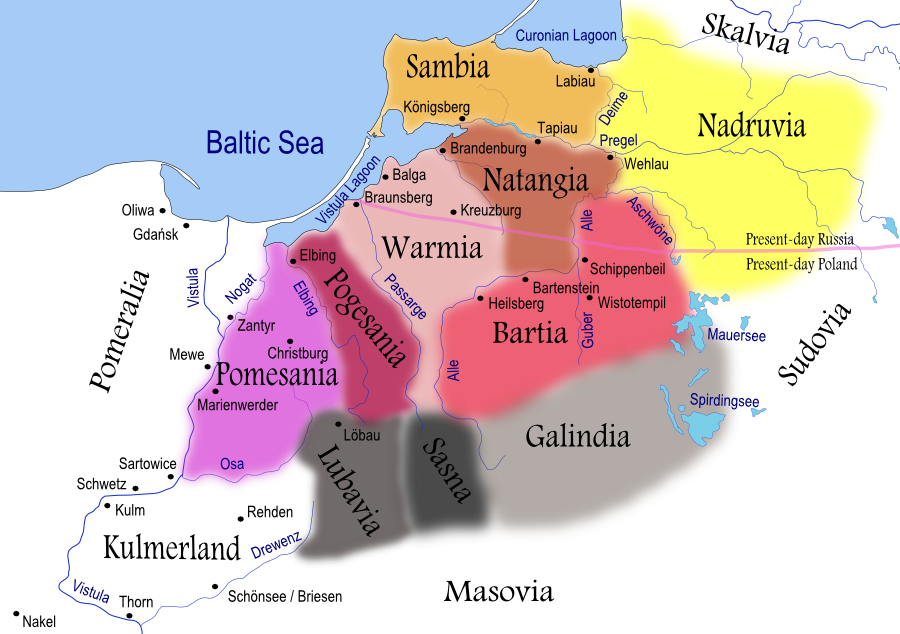
The Sambians bordered the Natangians in the south, and the Nadruvians in the east.

History

[edit]

Engaged in the amber trade, Sambia was the richest and most densely populated region of Prussia. It provides a wealth of artifacts from the Bronze Age, including imported goods from the Roman Empire. Sambians, unlike other Prussians, did not cremate their dead. They built earth barrows above graves and surrounded them with stone circles.[1] The name of the clan was first mentioned in 1073 by Adam of Bremen, who calls them "most humane people".[2] Warfare with Danes continued from the mid-9th century to beginning of the 13th century. It is known that there was Wiskiauten, a Viking settlement in Sambia, that flourished for about 300 years.[3] Swedes maintained more peaceful relations and fostered trade.[4]

The 13th century saw the rise of another enemy, the Teutonic Knights, a crusading military order from the Holy Roman Empire. Its goal was to conquer all pagans and convert them to Roman Catholicism. The conquest of Sambia during the Prussian Crusade was delayed by the First Prussian Uprising that broke out in 1242. The uprising technically ended in 1249 by signing the Treaty of Christburg, but skirmishes lasted for four more years. Only in 1254–1255 could the Knights arrange a large campaign against the Sambians. King Ottokar II of Bohemia participated in the expedition and as a tribute the Knights named the newly founded Königsberg Castle in his honor.[4] The Sambians rose against the Knights during the Great Prussian Uprising (1260–1274), but were the first ones to surrender. When other clans tried to resurrect the uprising in 1276 Theodoric, vogt of Sambia convinced the Sambians not to join the insurrection; Natangians and Warmians followed the Sambian lead and the uprising was crushed within a year.[5] In 1243, the Bishopric of Samland (Sambia) was established as the church administration of the region, as arranged by the papal legate William of Modena. At the end of the 13th century, Sambians numbered only about 22,000.[6] They gave in to Germanization later than western tribes that were conquered earlier. In 1454, the region was incorporated by King Casimir IV Jagiellon to the Kingdom of Poland.[7] After the subsequent Thirteen Years' War, the longest of all Polish–Teutonic wars, since 1466, Sambia formed part of Poland as a fief held by the Teutonic Order,[8] and after 1525 held by secular Ducal Prussia.

According to Peter von Dusburg, Sambia was subdivided in 15 territorial units. Their German names (from east to west) are: Germau, Medenau, Rinau, Pobeten, Wargen, Rudau, Laptau, Quedenau, Schaaken, Waldau, Caimen, Tapiau, Labiau, Laukischken, and Wehlau.[4]

References

[edit]
Revisions and contributorsEdit on WikipediaRead on Wikipedia
from Grokipedia
The Sambians were a West Baltic tribe belonging to the , an indigenous people who inhabited the southeastern coast from approximately the 9th century AD until their conquest in the 13th century. They occupied the fertile and densely populated —known in as Samland—located in what is now the of , extending north and west of the site that would become (modern ). As one of at least nine distinct Old Prussian tribal groups, alongside the Pomesanians, Pogesanians, and Natangians, the Sambians maintained a semi-autonomous society centered on , , and amber trade, with a culture rooted in polytheistic beliefs and communal governance. The Sambians first appear in historical records during the early medieval period, first mentioned by in 1073 as a humane people, highlighting their early contacts with Scandinavian and Germanic chroniclers. Their territory's strategic position along amber-rich coasts made it a focal point for external incursions, culminating in the launched by the Teutonic Knights in the 1230s; by the late 13th century, following the Great Prussian Uprising (1260–1274) and fierce resistance led by local leaders like the noble Glande, the Knights had established control over Sambia, reducing its population through warfare, forced conversions, and massacres to around 22,000 by 1290. Despite this subjugation, the region's high population density allowed Sambians to retain a Baltic ethnic majority longer than other Prussian tribes, with elements of their and customs enduring into the 16th and 17th centuries through printed catechisms in Old Prussian. Ultimately, German colonization and assimilation policies led to the Sambians' cultural extinction by the , though their legacy persists in the of the and as a symbol of Old Prussian resistance against medieval Christian . Archaeological from sites in the , including fortified settlements and burial mounds, underscores their pre-Christian societal structure, while historical chronicles portray them as formidable warriors who delayed the full Teutonic domination of the area.

Geography

Location and Borders

The Sambia Peninsula served as the core homeland of the Sambians, an Old Prussian tribe, situated along the southeastern coast of the in what is now the northern part of , . This peninsula lies immediately north of the medieval stronghold of (modern ), extending eastward from the and providing direct maritime access that facilitated trade and cultural exchanges. The territory's borders were defined by neighboring Prussian tribes and natural features: to the south by the Natangians, to the east by the Nadruvians, and to the north and west by the open waters of the and the adjacent . These boundaries, marked by rivers such as the and the Nemunas (Memel), created a strategically enclosed yet accessible region that influenced the Sambians' interactions with external powers, including a brief reference to the Teutonic Knights' conquest in the mid-13th century. Environmentally, Sambia featured predominantly flat, fertile lowlands ideal for , supported by a maritime climate with summer temperatures averaging 17–19°C, alongside dense woodlands of , , , and , extensive wetlands, marshes, and coastal zones renowned for their deposits. These -rich beaches and sandy outcrops were central to the region's economic significance, while the arable soils enabled sustained settlement. A notable site within this landscape is Wiskiauten (near modern Mokhovoye), a trading settlement active from the 9th to 11th centuries, characterized by over 500 burial mounds and evidence of multi-ethnic in , furs, and domestic livestock like . By the late 13th century, following the Teutonic conquest, the Sambian numbered around 22,000, indicative of dense occupation across the peninsula's approximately 2,000 km² at an estimated density of 11 inhabitants per square kilometer.

Territorial Subdivisions

The Sambian territory was organized into 15 distinct territorial units, referred to as territoria, which formed the foundational structure of local administration and social cohesion prior to the Teutonic conquest in 1255. These units, each encompassing multiple villages and exhibiting a high degree of external while maintaining loyalty to the broader Sambian tribe, were documented by the 14th-century Teutonic chronicler Peter of Dusburg in his Chronicon terrae Prussiae. Examples of these territoria include Germau (in the eastern region near modern Jurbarkas in ), Tapiau (central area corresponding to present-day Gvardeysk in ), and Labiau (western coastal zone aligning with contemporary Polessk). This arrangement supported local governance by delegating responsibilities for decision-making and to tribal elders or representatives, ensuring efficient such as and communal labor. In defense, the territoria mobilized warriors for tribal resistance against external threats, leveraging fortified strongholds as rallying points during pre-conquest conflicts. The subdivisions also played a pivotal role in economic activities, particularly the collection and distribution of , which washed ashore along Sambia's Baltic coasts and fueled prosperous trade networks extending to neighboring Baltic tribes and beyond. Key settlements within these units, such as the proto-urban area that later developed into (modern ), functioned as central hubs for aggregating resources and facilitating exchange, underscoring the territoria's integration into regional commerce.

History

Origins and Early Contacts

The Sambians, an ethnic group belonging to the broader Baltic Prussians, trace their prehistoric origins to the settlements on the in the southeastern . Archaeological evidence from the Roman reveals a distinct Sambian-Natangian culture characterized by fortified settlements, burial grounds, and artifacts linking them linguistically and materially to neighboring Baltic peoples such as the and . This culture emerged from earlier West Baltic Barrow traditions, with sites indicating continuous habitation and economic prosperity tied to local resources like . The first explicit historical reference to the Sambians appears in the 11th-century chronicle Gesta Hammaburgensis ecclesiae pontificum by , written around 1073–1076, where he identifies them as a Prussian tribe noted for their involvement in the trade and describes them as "the most humane of all the peoples" in the region. Adam's account highlights their economic role in exchanging for metals and , underscoring Sambia's position as a key node in Baltic commerce. This mention reflects growing medieval awareness of Prussian groups amid expanding northern European trade . Early trade relations connected the Sambians to distant powers, beginning with Roman interactions via the from the 1st to 3rd centuries CE, when —abundant on the Sambian coast—was exported southward in exchange for Roman glassware, coins, and bronze items found in local graves. By the , in the 9th and 10th centuries, Scandinavian settlers, including , established a trading at Wiskiauten (modern Mohovoe) on the peninsula, evidenced by mixed burial sites containing Norse weapons, jewelry, and Prussian , suggesting peaceful coexistence and joint exploitation. These contacts fostered cultural exchanges without significant conflict prior to later conquests. In the early medieval period, Sambian society remained firmly pagan, structured around tribal hierarchies and amber-based wealth, with resistance to nascent Christian missionary activities from Hamburg-Bremen and Scandinavian sources. Chronicles like Adam of Bremen's note the Prussians' adherence to polytheistic beliefs and occasional hostility toward Christian envoys, who achieved limited conversions before organized ; such resistance preserved indigenous practices amid external pressures.

Prussian Crusade and Conquest

The Teutonic Knights launched their invasion of Sambia in 1254, supported by King , who led a force of approximately 60,000 men in a rapid campaign that devastated settlements such as Medenau and Rudau. By early 1255, the Sambians faced overwhelming pressure, submitting hostages and nominally accepting to avert total destruction, though resistance persisted among some noble families like that of Nalubo. This conquest marked the culmination of the Knights' efforts to subdue the last major independent Prussian tribe, transforming Sambia into a base for further expansion. In 1255, amid the conquest, the Knights founded Königsberg Castle on a strategic hill near the Prussian settlement of Tuwangste, naming it in honor of Ottokar and constructing it with forced Prussian labor under the command of Brother Burchard von Hornhausen. The fortress served as a vital stronghold, despite early challenges including Sambian attacks on supply ships along the Pregel River and attempts to undermine it with improvised bridges and siege towers. This establishment solidified Teutonic control over the region, enabling raids into neighboring Lithuanian territories and facilitating the influx of German settlers. The conquest provoked widespread resentment, erupting into the Great Prussian Uprising of 1260–1274, in which the Sambians, led by the noble Glande, actively participated by massacring German priests, merchants, and loyal natives while besieging key Teutonic outposts. Although primarily a Natangian leader, Herkus Monte coordinated broader resistance efforts, reinforcing Sambian forces and directing joint operations that desecrated churches and targeted Christian settlements across lower and upper . The uprising, initially sparked by the ' violation of the 1249 Treaty of Christburg, spread rapidly, with Sambians destroying nascent German communities and coordinating with other tribes like the Natangians and Bartians. A pivotal event was the Siege of Königsberg in 1262–1263, where Sambian forces under Glande, bolstered by Monte's reinforcements, constructed siege towers and blockaded the fortress, causing severe starvation among the defenders and capturing the lower town. The Knights repelled the assault with aid from the Counts of Jülich and Mark, who inflicted heavy casualties—estimated at around 3,000 Sambians—lifting the siege and forcing the rebels to retreat. Monte's tactical knowledge, gained from prior service with the Knights, proved crucial, as he reportedly declared during the battle, "Today I will send you to Heaven," before wounding a knight with a lance. Despite such efforts, the Sambians, isolated by the Pregel River's defenses, struggled in prolonged engagements and were among the first tribes to surrender by 1274, following devastating losses and the deaths of key leaders like Monte in 1273. A subsequent Sambian revolt erupted around 1276, tied to the broader third Prussian uprising (1275–1283), where local leaders like Bonse incited resistance in districts such as Rinau, targeting castles like Fischhausen but ultimately failing due to internal divisions and Teutonic suppression. The Knights quelled the unrest through executions and negotiations, imposing tribute obligations on surviving Sambian nobles to ensure loyalty and fund ongoing fortifications. Figures like Brother Dietrich of Lödla played a role in dissuading rebels, leading to submissions that ended organized resistance in Sambia. In the immediate aftermath, the intensified , framing the Sambian landscape as a pagan to be cleansed through and missionary means, including the destruction of sacred groves and the erection of over 670 parish churches across by the early . Castles like Labiau (also known as Lochstedt), constructed around 1270, served as bases to suppress lingering "wickedness" and oversee production, while Königsberg evolved into a pilgrimage hub with relics such as those of St. Rupert by 1306. These efforts, bolstered by papal indulgences and processions, integrated Sambia into the Teutonic state, though sporadic revolts underscored the fragility of the .

Germanization and Extinction

Following the Second Peace of Thorn in 1466, which concluded the Thirteen Years' War between Poland and the , the remaining territories of the Order in , including Sambia, were transformed into a held under the sovereignty of the Polish crown. This arrangement subordinated the Teutonic Grand Master to the Polish king, requiring homage and limiting the Order's while preserving its administrative control over eastern Prussian lands such as Sambia. In 1525, amid the Protestant Reformation, Grand Master Albert of Brandenburg-Ansbach secularized the Teutonic Order's Prussian holdings, converting them into the secular with himself as its first duke. Sambia, as part of these territories, fell under this new ducal authority, which remained a Polish fief but shifted toward as the , further eroding the Order's monastic structure. The processes of Germanization in Sambia accelerated under ducal rule through intermarriage between German settlers and remaining Prussian families, the widespread adoption of the in administration, , and daily life, and forced conversions to that suppressed native pagan practices. These factors, combined with economic pressures from German and , led to a sharp decline in Prussian ethnic identity by the 17th and 18th centuries, as native customs were supplanted by German ones. The Sambians effectively became extinct as a distinct ethnic group by the early 18th century, with the last native speakers of the Old Prussian language—concentrated in Sambia as the final dialect holdout—dying out around 1700, marking the complete linguistic and cultural assimilation into German society. By this point, no organized communities practiced traditional Prussian rites, and the population had fully integrated into the German-speaking framework of the region. Politically, the Duchy of Prussia was elevated to the Kingdom of Prussia in 1701 under Elector Frederick III (as Frederick I), incorporating Sambia into the Hohenzollern realm and solidifying its German-oriented governance. The region was reorganized as the Province of in 1773, remaining under control until 1945, when northern , including former Sambia, was ceded to the at the and established as the , with the expulsion of its German population completing the demographic transformation.

Society and Culture

Religion and Mythology

The Sambians, as part of the Old Prussian tribes, adhered to a polytheistic pagan centered on and ancestral veneration, with key deities including , the god of thunder, , and , who was invoked for in battles and favorable . Another prominent figure was Patrimpas, regarded as a supreme deity associated with , animals, and prosperity, often honored alongside Perkūnas in a of major gods. Worship occurred primarily in sacred groves known as alkai or ramuwen, such as those in Sambian locations like Caymen, Osterovo, Romanovo, and Mamowo, where rituals involved animal sacrifices, communal feasts, and offerings to ensure bountiful harvests and communal harmony. Priests, known as krivis or kriwe, held significant in Sambian , serving as spiritual leaders who maintained sacred fires, interpreted omens through lots, and convened assemblies for religious and political decisions, often from central sites like Romowe. These resisted efforts, viewing the incoming faith as a threat to Prussian and traditions, which fueled uprisings during the . Their role extended to overseeing rituals that reinforced tribal unity, making them pivotal in preserving pagan practices against external pressures. The conversion of the Sambians to was imposed during Teutonic Knight rule following the conquest of Sambia in 1255, involving forced baptisms and the destruction of pagan idols and groves as stipulated in the 1249 Treaty of Christburg, which mandated the construction of churches to replace sacred sites. The establishment of the Bishopric of in 1255 further institutionalized Christian authority in the region, with bishops like Michael of Sambia issuing decrees in the to suppress lingering pagan rites. Despite these measures, pagan elements persisted into the , evident in continued sacrifices, such as a 1520 black bull offering in Sambia to ward off threats, and the maintenance of ancestral cults alongside Christian observances. Syncretism emerged in post-conquest Sambian folklore, where pagan deities were equated with Christian saints—such as Perkūnas associated with St. George or Elijah—and rituals blended with feast days, allowing elements of the old faith to survive within a Christian framework until the Reformation diminished overt pagan influences. This fusion reflected the gradual erosion of pure paganism while preserving cultural continuity in rural traditions.

Social Structure and Economy

The Sambian was organized around a hierarchical structure typical of Old Prussian tribes, featuring elected tribal chiefs who held temporary during wartime and administrative roles in peacetime, overseeing clan-based groups. Free peasants, comprising the majority of the population, enjoyed political rights within their clans and managed individual land holdings for , while communal pastures and forests were shared among kin groups. At the bottom were slaves, a small unfree class primarily consisting of prisoners of or their descendants, who performed labor on estates or were traded abroad. This clan-centric system emphasized collective decision-making, with nobles providing advisory influence to the broader free population. The economy of the Sambians relied heavily on , with free peasants cultivating and oats using a three-year system on family plots averaging about 42 acres, supplemented by rearing. and served as auxiliary pursuits, while was widespread, producing wax and for both local use and export. The trade, often called "Baltic gold," dominated economic activity and elevated Sambia as the wealthiest region due to its coastal location yielding vast deposits; elites controlled processing and exchange, fostering a strong across the tribe's 15 territorial subdivisions. Sambian trade networks extended beyond local internal markets in their subdivisions, where goods like grains and livestock circulated, to broader exchanges exporting , furs, and wax for imports such as metals and salt. flowed northward to Scandinavian centers like and southward along the , reaching and the Islamic by the , often via Viking intermediaries along river routes to the and beyond. These connections, centered at ports like near Elbing and later , underscored Sambia's role as a key Baltic hub before external disruptions. The and Teutonic Knights' conquest from 1233 to 1283 profoundly altered Sambian society, dismantling tribal hierarchies and clan autonomy in favor of feudal , where peasants became tied to knightly estates and subject to taxation based on ploughshares. This shift disrupted traditional communal land use and amber trade monopolies held by local elites, integrating the region into the Order's centralized economy and reducing the Sambians' independent prosperity.

Burial Practices

The Sambians, a Baltic inhabiting the Sambian Peninsula (modern , ), primarily practiced inhumation burials in earth barrows (tumuli) and flat cemeteries during the pre-Christian era, setting their customs apart from the rites observed among some neighboring Baltic groups such as the . These tumuli, often constructed from earth and stone mounds, were sometimes surrounded by rectangular or rounded stone enclosures, reflecting a structured funerary tied to territorial markers and social hierarchy. Archaeological evidence indicates a shift from earlier West Baltic Barrow culture cremations to predominant inhumations by the Roman Iron Age (1st–5th centuries AD), with bodies oriented northward in pits lined by stone pavements. Grave goods in Sambian burials underscored warrior status and participation in amber trade networks, including iron weapons such as swords, spearheads, and axes; jewelry like silver snake-head bracelets, gold rings, and fibulae; and amber beads alongside Roman imports like glass vessels and coins. These artifacts, often found in high-status male and female graves, suggest stratified society where elites were equipped for the afterlife, with horse sacrifices in rider burials symbolizing mobility and prestige. For instance, the Aleika-3 cemetery on the Sambian Peninsula yielded over 50 horse-inclusive inhumations from the 2nd–5th centuries AD, featuring equestrian gear and luxury items indicative of a patrimonial elite. Similarly, the Lauth (Bol'shoe Isakovo) site near Labiau (modern Polessk) revealed rich graves with Roman coins, amber necklaces, and weapons, highlighting trade wealth from the late Roman period (3rd–4th centuries AD). The Grebieten burial ground, located on the peninsula's western coast, further exemplifies these practices with over 600 inhumations spanning a millennium, including spearheads, fibulae, and amber artifacts that demonstrate continuity in pagan traditions. By the 14th century, following the and forced Christianization by the , Sambian burial practices evolved toward churchyard inhumations, abandoning pagan tumuli and grave goods in favor of simpler Christian rites aligned with ecclesiastical oversight. This transition, evident in the decline of indigenous cemeteries after the mid-13th century, marked the assimilation of Sambian customs into broader Germanized Christian norms, though some pre-Christian sites saw residual use into later periods.

Language and Legacy

Old Prussian Dialect

The Sambian dialect of Old Prussian belonged to the West Baltic branch of the within the Indo-European family, closely related to other Prussian dialects such as Pomesanian and Nadruvian but distinguished by regional phonological variations in the Samland (Sambia) territory. Unlike the Pomesanian dialect's shift of long *ē (as in Lithuanian), the Sambian preserved long *ā akin to Latvian forms, evident in words like semā ("") and mūti (""). These features reflect local adaptations in a coastal region rich in deposits, influencing vocabulary tied to and trade, such as terms potentially deriving from Proto-Baltic like gint- (shining or protective), seen in related Lithuanian gintaras for , underscoring Sambia's role in the ancient economy. Surviving Sambian vocabulary is sparse but includes words for daily life and natural elements drawn from 16th-century religious texts, such as tawas ("father"), rēnkan ("hand"), buttan ("house"), and wijrs ("man"), highlighting familial, domestic, and social concepts. The Elbing Vocabulary, though primarily Pomesanian from around 1400, provides comparative lexical insights into shared Prussian terms for geography and objects, like žemė variants for land, which align with Sambian forms in catechisms. No extensive Sambian-specific lexicon exists, but these fragments reveal a language with free accentuation, including circumflex and acute tones, and vowel shifts adapted to local usage. Written records of the Sambian dialect are confined to Lutheran catechisms from the 14th to 16th centuries, including the three Königsberg editions of 1545 and 1561, which were bilingual German-Old Prussian texts aimed at non-Germanized peasants and translated from Martin Luther's works to aid religious instruction. Additional traces appear in personal and place names within German administrative documents, such as toponyms like Krome (1463), but no complete Sambian narratives or secular texts survive, limiting analysis to religious and nominal fragments. The Sambian dialect underwent gradual extinction through linguistic assimilation into German, accelerated by the Teutonic Order's policies and Reformation-era catechization, with the last fluent speakers in Sambia likely disappearing around 1700 amid broader language decline. By the early , plagues and famines from 1709–1711 eradicated remaining native speakers across , leaving only toponyms and loanwords in Low Prussian German as linguistic remnants.

Modern Legacy

Archaeological interest in the Sambians has intensified in the , particularly through excavations in that uncover sites associated with their ancient settlements and burial practices. A notable example is the Putilovo-2 burial ground on the Sambian Peninsula, explored since 2015 as part of the "Amber in the ancient cultures" project led by the Kaliningrad Regional Amber Museum; this site has yielded over 100 graves from the 3rd to 7th centuries AD, containing artifacts, remains, and imported Roman-era goods, illustrating the wealth and trade networks of Sambian elites. Similar discoveries at other locations, such as hillforts and cemeteries in the southeastern Baltic region, have reinforced scholarly understanding of the Sambian-Natangian culture's role in the AD settlement systems. The Regional Amber Museum serves as a key institution for preserving and interpreting Sambian legacy, featuring exhibits on 's historical significance from the era (ca. 4000–2000 BC) through , including adornments and household items linked to ancient Prussian tribes like the Sambians. These displays, encompassing over 3,000 inclusions and the world's second-largest nugget, highlight the material's centrality to Sambian economy and ritual practices, drawing thousands of visitors annually and supporting ongoing research into pre-Teutonic Baltic heritage. In and , modern movements for Prussian identity revival have emerged, often intertwined with broader Baltic nationalism, as groups seek to reclaim Old Prussian cultural elements—such as mythology and symbols—to foster regional pride distinct from Slavic or Germanic influences. These efforts include neopagan organizations like Romuva in , which incorporate Prussian folklore into contemporary rituals and was officially recognized as a by the Lithuanian in December 2024, and cultural societies in promoting awareness of shared Baltic roots amid post-communist identity reconstruction. The retains its name directly derived from the Sambians, an extinct Old Prussian that inhabited the area north of what is now , preserving a tangible link to their territorial legacy in modern geography. continues as a prominent regional emblem in , where over 90% of the world's deposits are found, symbolizing the Sambians' ancient role in trade routes and evoking their enduring cultural imprint on the Baltic coast. Following , Soviet administration in systematically erased the German overlay on Prussian history through renaming, of sites, and resettlement, yet this policy inadvertently stimulated 20th- and 21st-century interest in the pre-Teutonic Sambian heritage as a foundation for a unique Russian-Baltic regional identity. Since the , rehabilitation projects have focused on restoring or highlighting ancient Prussian elements, such as archaeological sites and amber-related artifacts, to differentiate local patrimony from Teutonic and Nazi associations, as seen in academic studies and museum initiatives.

References

Add your contribution
Related Hubs
User Avatar
No comments yet.