



Community hub
Recent from talks
Contribute something
Nothing was collected or created yet.
Fixed effects model
View on Wikipedia| Part of a series on |
| Regression analysis |
|---|
| Models |
| Estimation |
| Background |

In statistics, a fixed effects model is a statistical model in which the model parameters are fixed or non-random quantities. This is in contrast to random effects models and mixed models in which all or some of the model parameters are random variables. In many applications including econometrics[1] and biostatistics[2][3][4][5][6] a fixed effects model refers to a regression model in which the group means are fixed (non-random) as opposed to a random effects model in which the group means are a random sample from a population.[7][6] Generally, data can be grouped according to several observed factors. The group means could be modeled as fixed or random effects for each grouping. In a fixed effects model each group mean is a group-specific fixed quantity.
In panel data where longitudinal observations exist for the same subject, fixed effects represent the subject-specific means. In panel data analysis the term fixed effects estimator (also known as the within estimator) is used to refer to an estimator for the coefficients in the regression model including those fixed effects (one time-invariant intercept for each subject).
Qualitative description
[edit]Such models assist in controlling for omitted variable bias due to unobserved heterogeneity when this heterogeneity is constant over time. This heterogeneity can be removed from the data through differencing, for example by subtracting the group-level average over time, or by taking a first difference which will remove any time invariant components of the model.
There are two common assumptions made about the individual specific effect: the random effects assumption and the fixed effects assumption. The random effects assumption is that the individual-specific effects are uncorrelated with the independent variables. The fixed effect assumption is that the individual-specific effects are correlated with the independent variables. If the random effects assumption holds, the random effects estimator is more efficient than the fixed effects estimator. However, if this assumption does not hold, the random effects estimator is not consistent. The Durbin–Wu–Hausman test is often used to discriminate between the fixed and the random effects models.[8][9]
Formal model and assumptions
[edit]Consider the linear unobserved effects model for observations and time periods:


- for and



Where:
- is the dependent variable observed for individual at time .
- is the time-variant (the number of independent variables) regressor vector.
- is the matrix of parameters.
- is the unobserved time-invariant individual effect. For example, the innate ability for individuals or historical and institutional factors for countries.
- is the error term.


Unlike , cannot be directly observed.
Unlike the random effects model where the unobserved is independent of for all , the fixed effects (FE) model allows to be correlated with the regressor matrix . Strict exogeneity with respect to the idiosyncratic error term is still required.

Statistical estimation
[edit]Fixed effects estimator
[edit]Since is not observable, it cannot be directly controlled for. The FE model eliminates by de-meaning the variables using the within transformation:

where , , and .
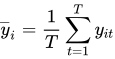
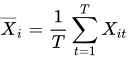
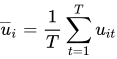
Since is constant, and hence the effect is eliminated. The FE estimator is then obtained by an OLS regression of on .


At least three alternatives to the within transformation exist with variations:
- One is to add a dummy variable for each individual (omitting the first individual because of multicollinearity). This is numerically, but not computationally, equivalent to the fixed effect model and only works if the sum of the number of series and the number of global parameters is smaller than the number of observations.[10] The dummy variable approach is particularly demanding with respect to computer memory usage and it is not recommended for problems larger than the available RAM, and the applied program compilation, can accommodate.

- Second alternative is to use consecutive reiterations approach to local and global estimations.[11] This approach is very suitable for low memory systems on which it is much more computationally efficient than the dummy variable approach.
- The third approach is a nested estimation whereby the local estimation for individual series is programmed in as a part of the model definition.[12] This approach is the most computationally and memory efficient, but it requires proficient programming skills and access to the model programming code; although, it can be programmed including in SAS.[13][14]
Finally, each of the above alternatives can be improved if the series-specific estimation is linear (within a nonlinear model), in which case the direct linear solution for individual series can be programmed in as part of the nonlinear model definition.[15]
First difference estimator
[edit]An alternative to the within transformation is the first difference transformation, which produces a different estimator. For :


The FD estimator is then obtained by an OLS regression of on .


When , the first difference and fixed effects estimators are numerically equivalent. For , they are not. If the error terms are homoskedastic with no serial correlation, the fixed effects estimator is more efficient than the first difference estimator. If follows a random walk, however, the first difference estimator is more efficient.[16]


Equality of fixed effects and first difference estimators when T=2
[edit]For the special two period case (), the fixed effects (FE) estimator and the first difference (FD) estimator are numerically equivalent. This is because the FE estimator effectively "doubles the data set" used in the FD estimator. To see this, establish that the fixed effects estimator is:
![{\displaystyle {FE}_{T=2}=\left[(x_{i1}-{\bar {x}}_{i})(x_{i1}-{\bar {x}}_{i})'+(x_{i2}-{\bar {x}}_{i})(x_{i2}-{\bar {x}}_{i})'\right]^{-1}\left[(x_{i1}-{\bar {x}}_{i})(y_{i1}-{\bar {y}}_{i})+(x_{i2}-{\bar {x}}_{i})(y_{i2}-{\bar {y}}_{i})\right]}](https://wikimedia.org/api/rest_v1/media/math/render/svg/0bec812495fc9c91ab3b4483db602006732de4e3)
Since each can be re-written as , we'll re-write the line as:


![{\displaystyle {FE}_{T=2}=\left[\sum _{i=1}^{N}{\dfrac {x_{i1}-x_{i2}}{2}}{\dfrac {x_{i1}-x_{i2}}{2}}'+{\dfrac {x_{i2}-x_{i1}}{2}}{\dfrac {x_{i2}-x_{i1}}{2}}'\right]^{-1}\left[\sum _{i=1}^{N}{\dfrac {x_{i1}-x_{i2}}{2}}{\dfrac {y_{i1}-y_{i2}}{2}}+{\dfrac {x_{i2}-x_{i1}}{2}}{\dfrac {y_{i2}-y_{i1}}{2}}\right]}](https://wikimedia.org/api/rest_v1/media/math/render/svg/1ad1c97e73a14826b3cd0e14aec665df7916b2bb)
![{\displaystyle =\left[\sum _{i=1}^{N}2{\dfrac {x_{i2}-x_{i1}}{2}}{\dfrac {x_{i2}-x_{i1}}{2}}'\right]^{-1}\left[\sum _{i=1}^{N}2{\dfrac {x_{i2}-x_{i1}}{2}}{\dfrac {y_{i2}-y_{i1}}{2}}\right]}](https://wikimedia.org/api/rest_v1/media/math/render/svg/e550eea4fb5bb3e05b5313a9ee93b4c27e481277)
![{\displaystyle =2\left[\sum _{i=1}^{N}(x_{i2}-x_{i1})(x_{i2}-x_{i1})'\right]^{-1}\left[\sum _{i=1}^{N}{\frac {1}{2}}(x_{i2}-x_{i1})(y_{i2}-y_{i1})\right]}](https://wikimedia.org/api/rest_v1/media/math/render/svg/0cfb9fca2b4452e92c9bcb07e86dd495ef08573a)
![{\displaystyle =\left[\sum _{i=1}^{N}(x_{i2}-x_{i1})(x_{i2}-x_{i1})'\right]^{-1}\sum _{i=1}^{N}(x_{i2}-x_{i1})(y_{i2}-y_{i1})={FD}_{T=2}}](https://wikimedia.org/api/rest_v1/media/math/render/svg/9fdb23850f173a02c99cf064121292e00d89116b)
Chamberlain method
[edit]Gary Chamberlain's method, a generalization of the within estimator, replaces with its linear projection onto the explanatory variables. Writing the linear projection as:

this results in the following equation:

which can be estimated by minimum distance estimation.[17]
Hausman–Taylor method
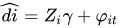
[edit]Need to have more than one time-variant regressor () and time-invariant regressor () and at least one and one that are uncorrelated with .


Partition the and variables such that where and are uncorrelated with . Need .
![{\displaystyle {\begin{array}{c}X=[{\underset {TN\times K1}{X_{1it}}}\vdots {\underset {TN\times K2}{X_{2it}}}]\\Z=[{\underset {TN\times G1}{Z_{1it}}}\vdots {\underset {TN\times G2}{Z_{2it}}}]\end{array}}}](https://wikimedia.org/api/rest_v1/media/math/render/svg/cdb068178ecab189cd0508407871a109b928c171)


Estimating via OLS on using and as instruments yields a consistent estimate.

Generalization with input uncertainty
[edit]When there is input uncertainty for the data, , then the value, rather than the sum of squared residuals, should be minimized.[18] This can be directly achieved from substitution rules:


- ,

then the values and standard deviations for and can be determined via classical ordinary least squares analysis and variance-covariance matrix.

Use to test for consistency
[edit]Random effects estimators may be inconsistent sometimes in the long time series limit, if the random effects are misspecified (i.e. the model chosen for the random effects is incorrect). However, the fixed effects model may still be consistent in some situations. For example, if the time series being modeled is not stationary, random effects models assuming stationarity may not be consistent in the long-series limit. One example of this is if the time series has an upward trend. Then, as the series becomes longer, the model revises estimates for the mean of earlier periods upwards, giving increasingly biased predictions of coefficients. However, a model with fixed time effects does not pool information across time, and as a result earlier estimates will not be affected.
In situations like these where the fixed effects model is known to be consistent, the Durbin-Wu-Hausman test can be used to test whether the random effects model chosen is consistent. If is true, both and are consistent, but only is efficient. If is true the consistency of cannot be guaranteed.


See also
[edit]Notes
[edit]- ^ Greene, W.H., 2011. Econometric Analysis, 7th ed., Prentice Hall
- ^ Diggle, Peter J.; Heagerty, Patrick; Liang, Kung-Yee; Zeger, Scott L. (2002). Analysis of Longitudinal Data (2nd ed.). Oxford University Press. pp. 169–171. ISBN 0-19-852484-6.
- ^ Fitzmaurice, Garrett M.; Laird, Nan M.; Ware, James H. (2004). Applied Longitudinal Analysis. Hoboken: John Wiley & Sons. pp. 326–328. ISBN 0-471-21487-6.
- ^ Laird, Nan M.; Ware, James H. (1982). "Random-Effects Models for Longitudinal Data". Biometrics. 38 (4): 963–974. doi:10.2307/2529876. JSTOR 2529876.
- ^ Gardiner, Joseph C.; Luo, Zhehui; Roman, Lee Anne (2009). "Fixed effects, random effects and GEE: What are the differences?". Statistics in Medicine. 28 (2): 221–239. doi:10.1002/sim.3478. PMID 19012297. S2CID 16277040.
- ^ a b Gomes, Dylan G.E. (20 January 2022). "Should I use fixed effects or random effects when I have fewer than five levels of a grouping factor in a mixed-effects model?". PeerJ. 10 e12794. doi:10.7717/peerj.12794. PMC 8784019. PMID 35116198.
- ^ Ramsey, F., Schafer, D., 2002. The Statistical Sleuth: A Course in Methods of Data Analysis, 2nd ed. Duxbury Press
- ^ Cameron, A. Colin; Trivedi, Pravin K. (2005). Microeconometrics: Methods and Applications. Cambridge University Press. pp. 717–19. ISBN 978-0-521-84805-3.
- ^ Nerlove, Marc (2005). Essays in Panel Data Econometrics. Cambridge University Press. pp. 36–39. ISBN 978-0-521-02246-0.
- ^ Garcia, Oscar. (1983). "A stochastic differential equation model for the height growth of forest stands". Biometrics. 39 (4): 1059–1072. doi:10.2307/2531339. JSTOR 2531339.
- ^ Tait, David; Cieszewski, Chris J.; Bella, Imre E. (1986). "The stand dynamics of lodgepole pine". Can. J. For. Res. 18 (10): 1255–1260. doi:10.1139/x88-193.
- ^ Strub, Mike; Cieszewski, Chris J. (2006). "Base–age invariance properties of two techniques for estimating the parameters of site index models". Forest Science. 52 (2): 182–186. doi:10.1093/forestscience/52.2.182.
- ^ Strub, Mike; Cieszewski, Chris J. (2003). Burkhart, HA (ed.). Fitting global site index parameters when plot or tree site index is treated as a local nuisance parameter. Proceedings of the Symposium on Statistics and Information Technology in Forestry; 2002 September 8–12; Blacksburg, Virginia: Virginia Polytechnic Institute and State University. pp. 97–107.
- ^ Cieszewski, Chris J.; Harrison, Mike; Martin, Stacey W. (2000). "Practical methods for estimating non-biased parameters in self-referencing growth and yield models" (PDF). PMRC Technical Report. 2000 (7): 12. Archived from the original (PDF) on 2016-03-04. Retrieved 2015-12-24.
- ^ Schnute, Jon; McKinnell, Skip (1984). "A biologically meaningful approach to response surface analysis". Can. J. Fish. Aquat. Sci. 41 (6): 936–953. doi:10.1139/f84-108.
- ^ Wooldridge, Jeffrey M. (2001). Econometric Analysis of Cross Section and Panel Data. MIT Press. pp. 279–291. ISBN 978-0-262-23219-7.
- ^ Chamberlain, Gary (1984). Chapter 22 Panel data. Handbook of Econometrics. Vol. 2. pp. 1247–1318. doi:10.1016/S1573-4412(84)02014-6. ISBN 978-0-444-86186-3. ISSN 1573-4412.
- ^ Ren, Bin; Dong, Ruobing; Esposito, Thomas M.; Pueyo, Laurent; Debes, John H.; Poteet, Charles A.; Choquet, Élodie; Benisty, Myriam; Chiang, Eugene; Grady, Carol A.; Hines, Dean C.; Schneider, Glenn; Soummer, Rémi (2018). "A Decade of MWC 758 Disk Images: Where Are the Spiral-Arm-Driving Planets?". The Astrophysical Journal Letters. 857 (1): L9. arXiv:1803.06776. Bibcode:2018ApJ...857L...9R. doi:10.3847/2041-8213/aab7f5. S2CID 59427417.
References
[edit]- Christensen, Ronald (2002). Plane Answers to Complex Questions: The Theory of Linear Models (Third ed.). New York: Springer. ISBN 0-387-95361-2.
- Gujarati, Damodar N.; Porter, Dawn C. (2009). "Panel Data Regression Models". Basic Econometrics (Fifth international ed.). Boston: McGraw-Hill. pp. 591–616. ISBN 978-007-127625-2.
- Hsiao, Cheng (2003). "Fixed-effects models". Analysis of Panel Data (2nd ed.). New York: Cambridge University Press. pp. 95–103. ISBN 0-521-52271-4.
- Wooldridge, Jeffrey M. (2013). "Fixed Effects Estimation". Introductory Econometrics: A Modern Approach (Fifth international ed.). Mason, OH: South-Western. pp. 466–474. ISBN 978-1-111-53439-4.
External links
[edit]Fixed effects model
View on GrokipediaOverview
Qualitative Description
The fixed effects model is a statistical approach in panel data analysis that controls for unobserved individual-specific factors that remain constant over time, such as innate ability or geographic location. By focusing on changes within each entity over time, it isolates the effects of time-varying variables while eliminating bias from time-invariant confounders, providing a robust method for causal inference in observational studies.[1]Historical Context
The fixed effects model has its conceptual roots in the statistical techniques pioneered by Ronald A. Fisher during the 1920s, particularly in the development of analysis of variance (ANOVA) for experimental design in agricultural research, where fixed effects were employed to capture specific, non-random variations attributable to treatments or blocks in controlled experiments.[3] In the field of econometrics, foundational work on handling unobserved heterogeneity in panel data emerged in the mid-1960s with Balestra and Nerlove's (1966) introduction of error components models, which provided a framework for pooling cross-sectional and time-series observations to estimate dynamic relationships while decomposing disturbances into individual-specific and idiosyncratic components, serving as a precursor to explicit fixed effects approaches.[4] The model's formalization accelerated in the 1970s and early 1980s as researchers addressed biases from omitted time-invariant variables. Yair Mundlak's 1978 contribution emphasized the use of within-group variation to control for correlated individual effects, proposing projections of unobserved heterogeneity onto means of explanatory variables to test and correct for pooling inconsistencies in time-series and cross-section data.[5] Building on this, Gary Chamberlain's 1980 work developed consistent estimation methods for fixed effects in covariance analysis with qualitative outcomes, enabling robust inference on average partial effects amid discrete individual heterogeneity.[6] Early applications of fixed effects models proliferated in labor economics during this period, notably in panel studies of wages, where the approach was used to isolate the impact of time-varying factors like experience or education on earnings by absorbing persistent individual-specific influences such as innate ability or family background.[7] The 1980s marked further evolution with extensions to accommodate endogeneity; Hausman and Taylor's (1981) instrumental variables estimator relaxed strict exogeneity by leveraging time-invariant exogenous variables as instruments for those correlated with fixed effects, thus allowing estimation of effects for both time-varying and invariant regressors in panels with unobservable individual heterogeneity.[8] By the 1990s, the fixed effects model's accessibility expanded significantly through its integration into econometric software, including Stata's xtreg command for fixed- and random-effects panel regression, which became available in the late 1990s and facilitated efficient computation of within-estimators, alongside R's early support for fixed effects via factor variables and linear models, democratizing the technique for empirical researchers across disciplines.[9]Model Specification
Formal Model
The fixed effects model is formulated within the framework of panel data, which consists of observations on cross-sectional units (such as individuals, firms, or countries) indexed by , over time periods indexed by . The outcome variable is denoted , representing the dependent variable for unit at time , while is a vector of time-varying explanatory variables (regressors) for the same unit and period.[10] The core equation of the fixed effects model is given by where is the vector of parameters of interest that measure the effects of the regressors on the outcome, is the fixed individual-specific effect, and is the idiosyncratic error term capturing unobserved shocks specific to unit and time . The term accounts for all time-invariant unobserved heterogeneity that is unique to unit , such as innate ability, geographic location, or institutional factors that do not change over the sample periods but may be correlated with the regressors .[10][11] To eliminate the fixed effects in estimation, the model can be transformed by subtracting the individual-specific time average (demeaning) from each observation, yielding where , , and . This within-unit transformation removes the time-invariant component while preserving the parameters for subsequent estimation.[10] Identification of in the fixed effects model relies on the strict exogeneity assumption, which posits that the idiosyncratic errors are uncorrelated with all past, present, and future regressors for each unit, conditional on the fixed effects: for all . This condition ensures that the regressors do not respond to future shocks and rules out feedback from outcomes to regressors, allowing the fixed effects estimator to consistently recover even when correlates with the .[10]Core Assumptions
The fixed effects model relies on several core assumptions for identification and consistent estimation of :- Strict exogeneity: for all , ensuring that the regressors are uncorrelated with the idiosyncratic errors conditional on the fixed effects.[10]
- Rank condition: The within-unit variation in the regressors must be sufficient for identification, specifically , where is the number of regressors, to avoid perfect multicollinearity in the transformed model.[10]
- Error structure: The idiosyncratic errors have zero mean conditional on the regressors and fixed effects, with no further restrictions on serial correlation or heteroskedasticity required for consistency (though they affect efficiency). For the within estimator to be unbiased in finite samples under normality, homoskedasticity and no serial correlation may be assumed.[10]