



Community hub
Recent from talks
Contribute something
Nothing was collected or created yet.
Probit model
View on Wikipedia| Part of a series on |
| Regression analysis |
|---|
| Models |
| Estimation |
| Background |

In statistics, a probit model is a type of regression where the dependent variable can take only two values, for example married or not married. The word is a portmanteau, coming from probability + unit.[1] The purpose of the model is to estimate the probability that an observation with particular characteristics will fall into a specific one of the categories; moreover, classifying observations based on their predicted probabilities is a type of binary classification model.
A probit model is a popular specification for a binary response model. As such it treats the same set of problems as does logistic regression using similar techniques. When viewed in the generalized linear model framework, the probit model employs a probit link function.[2] It is most often estimated using the maximum likelihood procedure,[3] such an estimation being called a probit regression.
Conceptual framework
[edit]Suppose a response variable Y is binary, that is it can have only two possible outcomes which we will denote as 1 and 0. For example, Y may represent presence/absence of a certain condition, success/failure of some device, answer yes/no on a survey, etc. We also have a vector of regressors X, which are assumed to influence the outcome Y. Specifically, we assume that the model takes the form

where P is the probability and is the cumulative distribution function (CDF) of the standard normal distribution. The parameters β are typically estimated by maximum likelihood.

It is possible to motivate the probit model as a latent variable model. Suppose there exists an auxiliary random variable

where ε ~ N(0, 1). Then Y can be viewed as an indicator for whether this latent variable is positive:

The use of the standard normal distribution causes no loss of generality compared with the use of a normal distribution with an arbitrary mean and standard deviation, because adding a fixed amount to the mean can be compensated by subtracting the same amount from the intercept, and multiplying the standard deviation by a fixed amount can be compensated by multiplying the weights by the same amount.
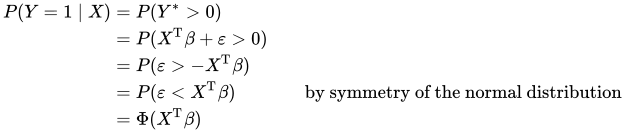
To see that the two models are equivalent, note that
Model estimation
[edit]Maximum likelihood estimation
[edit]Suppose data set contains n independent statistical units corresponding to the model above.

For the single observation, conditional on the vector of inputs of that observation, we have:


where is a vector of inputs, and is a vector of coefficients.


The likelihood of a single observation is then

![{\displaystyle {\mathcal {L}}(\beta ;y_{i},x_{i})=\Phi (x_{i}^{\operatorname {T} }\beta )^{y_{i}}[1-\Phi (x_{i}^{\operatorname {T} }\beta )]^{(1-y_{i})}}](https://wikimedia.org/api/rest_v1/media/math/render/svg/7b725c7be0cf07fe1b49aa70c0fe7899369dd762)
In fact, if , then , and if , then .




Since the observations are independent and identically distributed, then the likelihood of the entire sample, or the joint likelihood, will be equal to the product of the likelihoods of the single observations:
![{\displaystyle {\mathcal {L}}(\beta ;Y,X)=\prod _{i=1}^{n}\left(\Phi (x_{i}^{\operatorname {T} }\beta )^{y_{i}}[1-\Phi (x_{i}^{\operatorname {T} }\beta )]^{(1-y_{i})}\right)}](https://wikimedia.org/api/rest_v1/media/math/render/svg/eccf5da2fb9c57c14d7d8d1190f53a70e16902e7)
The joint log-likelihood function is thus

The estimator which maximizes this function will be consistent, asymptotically normal and efficient provided that exists and is not singular. It can be shown that this log-likelihood function is globally concave in , and therefore standard numerical algorithms for optimization will converge rapidly to the unique maximum.

![{\displaystyle \operatorname {E} [XX^{\operatorname {T} }]}](https://wikimedia.org/api/rest_v1/media/math/render/svg/c49cd71d5514ee259b992c50b9b0e2d3411e2b92)
Asymptotic distribution for is given by

where
![{\displaystyle \Omega =\operatorname {E} {\bigg [}{\frac {\varphi ^{2}(X^{\operatorname {T} }\beta )}{\Phi (X^{\operatorname {T} }\beta )(1-\Phi (X^{\operatorname {T} }\beta ))}}XX^{\operatorname {T} }{\bigg ]},\qquad {\hat {\Omega }}={\frac {1}{n}}\sum _{i=1}^{n}{\frac {\varphi ^{2}(x_{i}^{\operatorname {T} }{\hat {\beta }})}{\Phi (x_{i}^{\operatorname {T} }{\hat {\beta }})(1-\Phi (x_{i}^{\operatorname {T} }{\hat {\beta }}))}}x_{i}x_{i}^{\operatorname {T} },}](https://wikimedia.org/api/rest_v1/media/math/render/svg/6827d289e05d1d8eba285321e5f8c37ce645952a)
and is the Probability Density Function (PDF) of standard normal distribution.

Semi-parametric and non-parametric maximum likelihood methods for probit-type and other related models are also available.[4]
Berkson's minimum chi-square method
[edit]This method can be applied only when there are many observations of response variable having the same value of the vector of regressors (such situation may be referred to as "many observations per cell"). More specifically, the model can be formulated as follows.

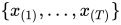
Suppose among n observations there are only T distinct values of the regressors, which can be denoted as . Let be the number of observations with and the number of such observations with . We assume that there are indeed "many" observations per each "cell": for each .



Denote

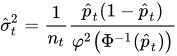
Then Berkson's minimum chi-square estimator is a generalized least squares estimator in a regression of on with weights :



It can be shown that this estimator is consistent (as n→∞ and T fixed), asymptotically normal and efficient.[citation needed] Its advantage is the presence of a closed-form formula for the estimator. However, it is only meaningful to carry out this analysis when individual observations are not available, only their aggregated counts , , and (for example in the analysis of voting behavior).
Albert and Chib Gibbs sampling method
[edit]Gibbs sampling of a probit model is possible with the introduction of normally distributed latent variables z, which are observed as 1 if positive and 0 otherwise. This approach was introduced in Albert and Chib (1993),[5] which demonstrated how Gibbs sampling could be applied to binary and polychotomous response models within a Bayesian framework. Under a multivariate normal prior distribution over the weights, the model can be described as
![{\displaystyle {\begin{aligned}{\boldsymbol {\beta }}&\sim {\mathcal {N}}(\mathbf {b} _{0},\mathbf {B} _{0})\\[3pt]z_{i}\mid \mathbf {x} _{i},{\boldsymbol {\beta }}&\sim {\mathcal {N}}(\mathbf {x} _{i}^{\operatorname {T} }{\boldsymbol {\beta }},1)\\[3pt]y_{i}&={\begin{cases}1&{\text{if }}z_{i}>0\\0&{\text{otherwise}}\end{cases}}\end{aligned}}}](https://wikimedia.org/api/rest_v1/media/math/render/svg/6257fc6d04760989dd49dd8e57e4c88bb9914768)
From this, Albert and Chib (1993)[5] derive the following full conditional distributions in the Gibbs sampling algorithm:
![{\displaystyle {\begin{aligned}\mathbf {B} &=(\mathbf {B} _{0}^{-1}+\mathbf {X} ^{\operatorname {T} }\mathbf {X} )^{-1}\\[3pt]{\boldsymbol {\beta }}\mid \mathbf {z} &\sim {\mathcal {N}}(\mathbf {B} (\mathbf {B} _{0}^{-1}\mathbf {b} _{0}+\mathbf {X} ^{\operatorname {T} }\mathbf {z} ),\mathbf {B} )\\[3pt]z_{i}\mid y_{i}=0,\mathbf {x} _{i},{\boldsymbol {\beta }}&\sim {\mathcal {N}}(\mathbf {x} _{i}^{\operatorname {T} }{\boldsymbol {\beta }},1)[z_{i}\leq 0]\\[3pt]z_{i}\mid y_{i}=1,\mathbf {x} _{i},{\boldsymbol {\beta }}&\sim {\mathcal {N}}(\mathbf {x} _{i}^{\operatorname {T} }{\boldsymbol {\beta }},1)[z_{i}>0]\end{aligned}}}](https://wikimedia.org/api/rest_v1/media/math/render/svg/cde4c0622a32a97b402e24cf67ee614d6d92f452)
The result for is given in the article on Bayesian linear regression, although specified with different notation, while the conditional posterior distributions of the latent variables follow a truncated normal distribution within the given ranges. The notation is the Iverson bracket, sometimes written or similar. Thus, knowledge of the observed outcomes serves to restrict the support of the latent variables.

![{\displaystyle [z_{i}<0]}](https://wikimedia.org/api/rest_v1/media/math/render/svg/c9dc441c4b899432e39c36e57036c6c8b8f81bc1)

Sampling of the weights given the latent vector from the multinormal distribution is standard. For sampling the latent variables from the truncated normal posterior distributions, one can take advantage of the inverse-cdf method, implemented in the following R vectorized function, making it straightforward to implement the method.

zbinprobit <- function(y, X, beta, n) {
  meanv <- X %*% beta
  u <- runif(n)  # uniform(0,1) random variates
  cd <- pnorm(-meanv)  # cumulative normal CDF
  pu <- (u * cd) * (1 - 2 * y) + (u + cd) * y
  cpui <- qnorm(pu)  # inverse normal CDF
  z <- meanv + cpui  # latent vector
  return(z)
}
Model evaluation
[edit]The suitability of an estimated binary model can be evaluated by counting the number of true observations equaling 1, and the number equaling zero, for which the model assigns a correct predicted classification by treating any estimated probability above 1/2 (or, below 1/2), as an assignment of a prediction of 1 (or, of 0). See Logistic regression § Model for details.
Performance under misspecification
[edit] | This section may require cleanup to meet Wikipedia's quality standards. The specific problem is: Need to adopt the notation of the rest of the article, fix grammar, and make prose clearer. (June 2019) |
Consider the latent variable model formulation of the probit model. When the variance of conditional on is not constant but dependent on , then the heteroscedasticity issue arises. For example, suppose and where is a continuous positive explanatory variable. Under heteroskedasticity, the probit estimator for is usually inconsistent, and most of the tests about the coefficients are invalid. More importantly, the estimator for becomes inconsistent, too. To deal with this problem, the original model needs to be transformed to be homoskedastic. For instance, in the same example, can be rewritten as , where . Therefore, and running probit on generates a consistent estimator for the conditional probability






![{\displaystyle 1[\beta _{0}+\beta _{1}x_{1}+\varepsilon >0]}](https://wikimedia.org/api/rest_v1/media/math/render/svg/8382c313b0b45810d103fd2284a24329f296aad6)
![{\displaystyle 1[\beta _{0}/x_{1}+\beta _{1}+\varepsilon /x_{1}>0]}](https://wikimedia.org/api/rest_v1/media/math/render/svg/ac08150760aecce4a2829f68868301ef8fec8a23)



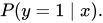
When the assumption that is normally distributed fails to hold, then a functional form misspecification issue arises: if the model is still estimated as a probit model, the estimators of the coefficients are inconsistent. For instance, if follows a logistic distribution in the true model, but the model is estimated by probit, the estimates will be generally smaller than the true value. However, the inconsistency of the coefficient estimates is practically irrelevant because the estimates for the partial effects, , will be close to the estimates given by the true logit model.[6]

To avoid the issue of distribution misspecification, one may adopt a general distribution assumption for the error term, such that many different types of distribution can be included in the model. The cost is heavier computation and lower accuracy for the increase of the number of parameter.[7] In most of the cases in practice where the distribution form is misspecified, the estimators for the coefficients are inconsistent, but estimators for the conditional probability and the partial effects are still very good.[citation needed]
One can also take semi-parametric or non-parametric approaches, e.g., via local-likelihood or nonparametric quasi-likelihood methods, which avoid assumptions on a parametric form for the index function and is robust to the choice of the link function (e.g., probit or logit).[4]
History
[edit]The probit model is usually credited to Chester Bliss, who coined the term "probit" in 1934,[8] and to John Gaddum (1933), who systematized earlier work.[9] However, the basic model dates to the Weber–Fechner law by Gustav Fechner, published in Fechner (1860), and was repeatedly rediscovered until the 1930s; see Finney (1971, Chapter 3.6) and Aitchison & Brown (1957, Chapter 1.2).[9]
A fast method for computing maximum likelihood estimates for the probit model was proposed by Ronald Fisher as an appendix to Bliss' work in 1935.[10]
See also
[edit]References
[edit]- ^ Oxford English Dictionary, 3rd ed. s.v. probit (article dated June 2007): Bliss, C. I. (1934). "The Method of Probits". Science. 79 (2037): 38–39. Bibcode:1934Sci....79...38B. doi:10.1126/science.79.2037.38. PMID 17813446.
These arbitrary probability units have been called 'probits'.
- ^ Agresti, Alan (2015). Foundations of Linear and Generalized Linear Models. New York: Wiley. pp. 183–186. ISBN 978-1-118-73003-4.
- ^ Aldrich, John H.; Nelson, Forrest D.; Adler, E. Scott (1984). Linear Probability, Logit, and Probit Models. Sage. pp. 48–65. ISBN 0-8039-2133-0.
- ^ a b Park, Byeong U.; Simar, Léopold; Zelenyuk, Valentin (2017). "Nonparametric estimation of dynamic discrete choice models for time series data" (PDF). Computational Statistics & Data Analysis. 108: 97–120. doi:10.1016/j.csda.2016.10.024.
- ^ a b Albert, J., & Chib, S. (1993). "Bayesian Analysis of Binary and Polychotomous Response Data." Journal of the American Statistical Association, 88(422), 669-679.
- ^ Greene, W. H. (2003), Econometric Analysis, Prentice Hall, Upper Saddle River, NJ.
- ^ For more details, refer to: Cappé, O., Moulines, E. and Ryden, T. (2005): "Inference in Hidden Markov Models", Springer-Verlag New York, Chapter 2.
- ^ Bliss, C. I. (1934). "The Method of Probits". Science. 79 (2037): 38–39. Bibcode:1934Sci....79...38B. doi:10.1126/science.79.2037.38. PMID 17813446.
- ^ a b Cramer 2002, p. 7.
- ^ Fisher, R. A. (1935). "The Case of Zero Survivors in Probit Assays". Annals of Applied Biology. 22: 164–165. doi:10.1111/j.1744-7348.1935.tb07713.x. Archived from the original on 2014-04-30.
- Aitchison, John; Brown, James Alan Calvert (1957). The Lognormal Distribution: With Special Reference to Its Uses in Economics. University Press. ISBN 978-0-521-04011-2.
{{cite book}}: ISBN / Date incompatibility (help) - Cramer, J. S. (2002). The origins of logistic regression (PDF) (Technical report). Vol. 119. Tinbergen Institute. pp. 167–178. doi:10.2139/ssrn.360300.
- Published in: Cramer, J. S. (2004). "The early origins of the logit model". Studies in History and Philosophy of Science Part C: Studies in History and Philosophy of Biological and Biomedical Sciences. 35 (4): 613–626. doi:10.1016/j.shpsc.2004.09.003.
- Fechner, Gustav Theodor (1860). Elemente der Psychophysik [Elements of psychophysics]. Vol. band 2. Leipzig: Breitkopf und Härtel.
- Finney, D. J. (1971). Probit analysis.
Further reading
[edit]- Albert, J. H.; Chib, S. (1993). "Bayesian Analysis of Binary and Polychotomous Response Data". Journal of the American Statistical Association. 88 (422): 669–679. doi:10.1080/01621459.1993.10476321. JSTOR 2290350.
- Amemiya, Takeshi (1985). "Qualitative Response Models". Advanced Econometrics. Oxford: Basil Blackwell. pp. 267–359. ISBN 0-631-13345-3.
- Gouriéroux, Christian (2000). "The Simple Dichotomy". Econometrics of Qualitative Dependent Variables. New York: Cambridge University Press. pp. 6–37. ISBN 0-521-58985-1.
- Liao, Tim Futing (1994). Interpreting Probability Models: Logit, Probit, and Other Generalized Linear Models. Sage. ISBN 0-8039-4999-5.
- McCullagh, Peter; John Nelder (1989). Generalized Linear Models. London: Chapman and Hall. ISBN 0-412-31760-5.
External links
[edit] Media related to Probit model at Wikimedia Commons
- Econometrics Lecture (topic: Probit model) on YouTube by Mark Thoma

| International | |
|---|---|
| National | |
| Other | |

Probit model
View on GrokipediaOverview and Foundations
Definition and Purpose
The probit model is a type of generalized linear model employed in statistics to analyze binary dependent variables, where the response probability is linked to a linear combination of predictors via the inverse of the cumulative distribution function of the standard normal distribution.[3][6] This approach models the probability of a dichotomous outcome, such as an event occurring (coded as 1) versus not occurring (coded as 0), under the assumption that the error terms in the underlying process follow a normal distribution.[3][1] The primary purpose of the probit model is to estimate and predict probabilities for binary events, particularly in scenarios where the latent, unobserved factors influencing the outcome are believed to exhibit symmetric, bell-shaped variability consistent with normality.[4] It serves as a tool for understanding how covariates affect the likelihood of outcomes like participation in an activity or the onset of a condition, providing a framework that bounds predictions between 0 and 1 while capturing nonlinear relationships.[7] This makes it suitable for applications requiring probabilistic interpretation without assuming a logistic error structure. The name "probit" derives from "probability unit," a term coined by Chester Ittner Bliss in 1934 to describe a transformation that converts observed probabilities into a scale aligned with the standard normal distribution, facilitating linear analysis of sigmoid-shaped response curves.[8] Bliss introduced this in the context of bioassay experiments to quantify toxicity thresholds, building on earlier psychometric work by Louis Leon Thurstone in 1927 that applied normal distributions to comparative judgments.[9] The probit scale thus standardizes probabilities for easier modeling and comparison across studies. In practice, the probit model finds widespread use in economics to predict labor force participation, where covariates such as education, age, and marital status influence the probability of employment among individuals. Similarly, in epidemiology, it models disease incidence, estimating the likelihood of conditions like chronic illnesses based on risk factors including demographics and exposures.[10] These applications highlight its role in deriving covariate-specific probabilities for policy and health interventions.Relation to Logit and Other Binary Choice Models
The probit model and the logit model are both parametric approaches to binary choice modeling, differing primarily in their choice of cumulative distribution function (CDF) for the latent error term. The probit model applies the standard normal CDF, denoted as Φ, to map the linear predictor to probabilities, resulting in an S-shaped curve that is symmetric around 0.5. In contrast, the logit model uses the logistic CDF, Λ, which produces a similar sigmoidal shape but with heavier tails and a less steep central slope compared to the probit. This difference arises because the logistic distribution is leptokurtic relative to the normal distribution assumed in probit, leading to marginally different predicted probabilities, especially at extreme values of the predictors; however, empirical studies show that the models often yield substantively similar results in most applications.[11][12] The linear probability model (LPM), which uses ordinary least squares to directly regress the binary outcome on predictors, serves as a simpler baseline but faces limitations that the probit model mitigates. LPM predictions can fall outside the [0,1] interval, violating the bounded nature of probabilities, and its error variance is inherently heteroskedastic, varying with the predicted probability as var(y|x) = p(x)[1 - p(x)]. Probit addresses these by enforcing predictions within [0,1] through the normal CDF and accounting for the nonlinear, heteroskedastic structure via maximum likelihood estimation, though it requires more computational effort.[13][14] Another alternative is the complementary log-log (cloglog) model, which employs the CDF of the extreme value distribution, producing asymmetric probability curves that approach 0 and 1 at different rates. Unlike the symmetric error assumptions in probit and logit, the cloglog model is suited to scenarios with inherent asymmetry, such as discrete-time survival analysis, but probit is generally preferred when normality and symmetry align with theoretical expectations, as in many bioassay contexts.[15][16] The following table summarizes key distinctions among these models:| Model | Link Function | Error Distribution | Typical Use Cases |
|---|---|---|---|
| Probit | Probit (Φ⁻¹(p)) | Standard normal | Bioassays with symmetric responses; models assuming normality[17][11] |
| Logit | Logit (ln(p/(1-p))) | Logistic | General binary outcomes; interpretable odds ratios for convenience[12][18] |
| Linear Probability | Identity (p) | Homoskedastic (idealized) | Quick linear approximations despite boundary and heteroskedasticity issues[13][14] |
| Complementary Log-Log | Cloglog (ln(-ln(1-p))) | Extreme value (Type I) | Asymmetric events, e.g., survival or rare events analysis[15][16] |