Hubbry Logo
Projection (linear algebra)Projection (linear algebra)Main
Open search
Projection (linear algebra)
Community hub
Projection (linear algebra)
logo
8 pages, 0 posts
0 subscribers
Be the first to start a discussion here.
Projection (linear algebra)
from Wikipedia
The transformation P is the orthogonal projection onto the line m.

In linear algebra and functional analysis, a projection is a linear transformation from a vector space to itself (an endomorphism) such that . That is, whenever is applied twice to any vector, it gives the same result as if it were applied once (i.e. is idempotent). It leaves its image unchanged.[1] This definition of "projection" formalizes and generalizes the idea of graphical projection. One can also consider the effect of a projection on a geometrical object by examining the effect of the projection on points in the object.

Definitions

[edit]

A projection on a vector space is a linear operator such that .

When has an inner product and is complete, i.e. when is a Hilbert space, the concept of orthogonality can be used. A projection on a Hilbert space is called an orthogonal projection if it satisfies for all . A projection on a Hilbert space that is not orthogonal is called an oblique projection.

Projection matrix

[edit]
  • A square matrix is called a projection matrix if it is equal to its square, i.e. if .[2]: p. 38 
  • A square matrix is called an orthogonal projection matrix if for a real matrix, and respectively for a complex matrix, where denotes the transpose of and denotes the adjoint or Hermitian transpose of .[2]: p. 223 
  • A projection matrix that is not an orthogonal projection matrix is called an oblique projection matrix.


The eigenvalues of a projection matrix must be 0 or 1.

Examples

[edit]

Orthogonal projection

[edit]

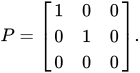
For example, the function which maps the point in three-dimensional space to the point is an orthogonal projection onto the xy-plane. This function is represented by the matrix

The action of this matrix on an arbitrary vector is
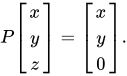
To see that is indeed a projection, i.e., , we compute

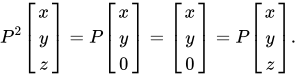
Observing that shows that the projection is an orthogonal projection.

Oblique projection

[edit]

A simple example of a non-orthogonal (oblique) projection is
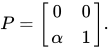
Via matrix multiplication, one sees that showing that is indeed a projection.

The projection is orthogonal if and only if because only then

Properties and classification

[edit]
The transformation T is the projection along k onto m. The range of T is m and the kernel is k.

Idempotence

[edit]

By definition, a projection is idempotent (i.e. ).

Open map

[edit]

Every projection is an open map onto its image, meaning that it maps each open set in the domain to an open set in the subspace topology of the image.[citation needed] That is, for any vector and any ball (with positive radius) centered on , there exists a ball (with positive radius) centered on that is wholly contained in the image .

Complementarity of image and kernel

[edit]

Let be a finite-dimensional vector space and be a projection on . Suppose the subspaces and are the image and kernel of respectively. Then has the following properties:

  1. is the identity operator on :
  2. We have a direct sum . Every vector may be decomposed uniquely as with and , and where

The image and kernel of a projection are complementary, as are and . The operator is also a projection as the image and kernel of become the kernel and image of and vice versa. We say is a projection along onto (kernel/image) and is a projection along onto .

Spectrum

[edit]

In infinite-dimensional vector spaces, the spectrum of a projection is contained in as Only 0 or 1 can be an eigenvalue of a projection. This implies that an orthogonal projection is always a positive semi-definite matrix. In general, the corresponding eigenspaces are (respectively) the kernel and range of the projection. Decomposition of a vector space into direct sums is not unique. Therefore, given a subspace , there may be many projections whose range (or kernel) is .


If a projection is nontrivial it has minimal polynomial , which factors into distinct linear factors, and thus is diagonalizable.

Product of projections

[edit]

The product of projections is not in general a projection, even if they are orthogonal. If two projections commute then their product is a projection, but the converse is false: the product of two non-commuting projections may or may not be a projection.

If two orthogonal projections commute then their product is an orthogonal projection. If the product of two orthogonal projections is an orthogonal projection, then the two orthogonal projections commute (more generally: two self-adjoint endomorphisms commute if and only if their product is self-adjoint).

Orthogonal projections

[edit]

When the vector space has an inner product and is complete (is a Hilbert space) the concept of orthogonality can be used. An orthogonal projection is a projection for which the range and the kernel are orthogonal subspaces. Thus, for every and in , . Equivalently:


A projection is orthogonal if and only if it is self-adjoint. Using the self-adjoint and idempotent properties of , for any and in we have , , and where is the inner product associated with . Therefore, and are orthogonal projections.[3] The other direction, namely that if is orthogonal then it is self-adjoint, follows from the implication from to for every and in ; thus .

The existence of an orthogonal projection onto a closed subspace follows from the Hilbert projection theorem.

Properties and special cases

[edit]

An orthogonal projection is a bounded operator. This is because for every in the vector space we have, by the Cauchy–Schwarz inequality: Thus .


For finite-dimensional complex or real vector spaces, the standard inner product can be substituted for .

Formulas
[edit]

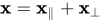
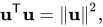
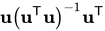
A simple case occurs when the orthogonal projection is onto a line. If is a unit vector on the line, then the projection is given by the outer product (If is complex-valued, the transpose in the above equation is replaced by a Hermitian transpose). This operator leaves u invariant, and it annihilates all vectors orthogonal to , proving that it is indeed the orthogonal projection onto the line containing u.[4] A simple way to see this is to consider an arbitrary vector as the sum of a component on the line (i.e. the projected vector we seek) and another perpendicular to it, . Applying projection, we get by the properties of the dot product of parallel and perpendicular vectors.

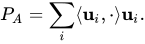
This formula can be generalized to orthogonal projections on a subspace of arbitrary dimension. Let be an orthonormal basis of the subspace , with the assumption that the integer , and let denote the matrix whose columns are , i.e., . Then the projection is given by:[5] which can be rewritten as

The matrix is the partial isometry that vanishes on the orthogonal complement of , and is the isometry that embeds into the underlying vector space. The range of is therefore the final space of . It is also clear that is the identity operator on .

The orthonormality condition can also be dropped. If is a (not necessarily orthonormal) basis with , and is the matrix with these vectors as columns, then the projection is:[6][7]

The matrix still embeds into the underlying vector space but is no longer an isometry in general. The matrix is a "normalizing factor" that recovers the norm. For example, the rank-1 operator is not a projection if After dividing by we obtain the projection onto the subspace spanned by .

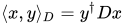
In the general case, we can have an arbitrary positive definite matrix defining an inner product , and the projection is given by . Then

When the range space of the projection is generated by a frame (i.e. the number of generators is greater than its dimension), the formula for the projection takes the form: . Here stands for the Moore–Penrose pseudoinverse. This is just one of many ways to construct the projection operator.

If is a non-singular matrix and (i.e., is the null space matrix of ),[8] the following holds:

If the orthogonal condition is enhanced to with non-singular, the following holds:

All these formulas also hold for complex inner product spaces, provided that the conjugate transpose is used instead of the transpose. Further details on sums of projectors can be found in Banerjee and Roy (2014).[9] Also see Banerjee (2004)[10] for application of sums of projectors in basic spherical trigonometry.

Oblique projections

[edit]

The term oblique projections is sometimes used to refer to non-orthogonal projections. These projections are also used to represent spatial figures in two-dimensional drawings (see oblique projection), though not as frequently as orthogonal projections. Whereas calculating the fitted value of an ordinary least squares regression requires an orthogonal projection, calculating the fitted value of an instrumental variables regression requires an oblique projection.

A projection is defined by its kernel and the basis vectors used to characterize its range (which is a complement of the kernel). When these basis vectors are orthogonal to the kernel, then the projection is an orthogonal projection. When these basis vectors are not orthogonal to the kernel, the projection is an oblique projection, or just a projection.

A matrix representation formula for a nonzero projection operator

[edit]

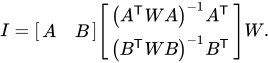
Let be a linear operator such that and assume that is not the zero operator. Let the vectors form a basis for the range of , and assemble these vectors in the matrix . Then , otherwise and is the zero operator. The range and the kernel are complementary spaces, so the kernel has dimension . It follows that the orthogonal complement of the kernel has dimension . Let form a basis for the orthogonal complement of the kernel of the projection, and assemble these vectors in the matrix . Then the projection (with the condition ) is given by

This expression generalizes the formula for orthogonal projections given above.[11][12] A standard proof of this expression is the following. For any vector in the vector space , we can decompose , where vector is in the image of , and vector So , and then is in the kernel of , which is the null space of In other words, the vector is in the column space of so for some dimension vector and the vector satisfies by the construction of . Put these conditions together, and we find a vector so that . Since matrices and are of full rank by their construction, the -matrix is invertible. So the equation gives the vector In this way, for any vector and hence .

In the case that is an orthogonal projection, we can take , and it follows that . By using this formula, one can easily check that . In general, if the vector space is over complex number field, one then uses the Hermitian transpose and has the formula . Recall that one can express the Moore–Penrose inverse of the matrix by since has full column rank, so .

Singular values

[edit]

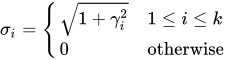
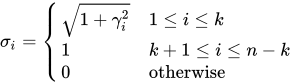
is also an oblique projection. The singular values of and can be computed by an orthonormal basis of . Let be an orthonormal basis of and let be the orthogonal complement of . Denote the singular values of the matrix by the positive values . With this, the singular values for are:[13] and the singular values for are This implies that the largest singular values of and are equal, and thus that the matrix norm of the oblique projections are the same. However, the condition number satisfies the relation , and is therefore not necessarily equal.

Finding projection with an inner product

[edit]

Let be a vector space (in this case a plane) spanned by orthogonal vectors . Let be a vector. One can define a projection of onto as where repeated indices are summed over (Einstein sum notation). The vector can be written as an orthogonal sum such that . is sometimes denoted as . There is a theorem in linear algebra that states that this is the smallest distance (the orthogonal distance) from to and is commonly used in areas such as machine learning.

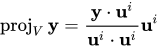
y is being projected onto the vector space V.

Canonical forms

[edit]

Any projection on a vector space of dimension over a field is a diagonalizable matrix, since its minimal polynomial divides , which splits into distinct linear factors. Thus there exists a basis in which has the form

where is the rank of . Here is the identity matrix of size , is the zero matrix of size , and is the direct sum operator. If the vector space is complex and equipped with an inner product, then there is an orthonormal basis in which the matrix of P is[14]

where . The integers and the real numbers are uniquely determined. . The factor corresponds to the maximal invariant subspace on which acts as an orthogonal projection (so that P itself is orthogonal if and only if ) and the -blocks correspond to the oblique components.

Projections on normed vector spaces

[edit]

When the underlying vector space is a (not necessarily finite-dimensional) normed vector space, analytic questions, irrelevant in the finite-dimensional case, need to be considered. Assume now is a Banach space.

Many of the algebraic results discussed above survive the passage to this context. A given direct sum decomposition of into complementary subspaces still specifies a projection, and vice versa. If is the direct sum , then the operator defined by is still a projection with range and kernel . It is also clear that . Conversely, if is projection on , i.e. , then it is easily verified that . In other words, is also a projection. The relation implies and is the direct sum .

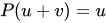
However, in contrast to the finite-dimensional case, projections need not be continuous in general. If a subspace of is not closed in the norm topology, then the projection onto is not continuous. In other words, the range of a continuous projection must be a closed subspace. Furthermore, the kernel of a continuous projection (in fact, a continuous linear operator in general) is closed. Thus a continuous projection gives a decomposition of into two complementary closed subspaces: .

The converse holds also, with an additional assumption. Suppose is a closed subspace of . If there exists a closed subspace such that X = UV, then the projection with range and kernel is continuous. This follows from the closed graph theorem. Suppose xnx and Pxny. One needs to show that . Since is closed and {Pxn} ⊂ U, y lies in , i.e. Py = y. Also, xnPxn = (IP)xnxy. Because is closed and {(IP)xn} ⊂ V, we have , i.e. , which proves the claim.

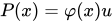
The above argument makes use of the assumption that both and are closed. In general, given a closed subspace , there need not exist a complementary closed subspace , although for Hilbert spaces this can always be done by taking the orthogonal complement. For Banach spaces, a one-dimensional subspace always has a closed complementary subspace. This is an immediate consequence of Hahn–Banach theorem. Let be the linear span of . By Hahn–Banach, there exists a bounded linear functional such that φ(u) = 1. The operator satisfies , i.e. it is a projection. Boundedness of implies continuity of and therefore is a closed complementary subspace of .

Applications and further considerations

[edit]

Projections (orthogonal and otherwise) play a major role in algorithms for certain linear algebra problems:

As stated above, projections are a special case of idempotents. Analytically, orthogonal projections are non-commutative generalizations of characteristic functions. Idempotents are used in classifying, for instance, semisimple algebras, while measure theory begins with considering characteristic functions of measurable sets. Therefore, as one can imagine, projections are very often encountered in the context of operator algebras. In particular, a von Neumann algebra is generated by its complete lattice of projections.

Generalizations

[edit]

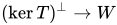
More generally, given a map between normed vector spaces one can analogously ask for this map to be an isometry on the orthogonal complement of the kernel: that be an isometry (compare Partial isometry); in particular it must be onto. The case of an orthogonal projection is when W is a subspace of V. In Riemannian geometry, this is used in the definition of a Riemannian submersion.

See also

[edit]

Notes

[edit]

References

[edit]
[edit]
Revisions and contributorsEdit on WikipediaRead on Wikipedia
from Grokipedia
In linear algebra, a projection is a linear transformation P:VVP: V \to V on a vector space VV that satisfies the idempotence condition P2=PP^2 = P, meaning applying the transformation twice yields the same result as applying it once. This property implies that PP maps every vector in VV onto its image (a subspace of VV), while vectors in the kernel of PP are mapped to zero, effectively projecting along those directions. More specifically, PP is the projection onto its image subspace along its kernel subspace. Orthogonal projections are an important subclass where the kernel of PP is the of the , ensuring that the projection of any vector xx onto the subspace WW (the ) is the point in WW closest to xx in the Euclidean norm. For such projections, PP is (P=PP^* = P) in inner product spaces, and it minimizes the distance xPx\|x - Px\|. In finite-dimensional Euclidean spaces like Rn\mathbb{R}^n, orthogonal projections onto a subspace WW can be represented by symmetric idempotent matrices, known as projection matrices. The scalar projection of a vector b\mathbf{b} onto a nonzero vector a\mathbf{a} is given by baa\frac{\mathbf{b} \cdot \mathbf{a}}{\|\mathbf{a}\|}, representing the signed of the component of b\mathbf{b} in the direction of a\mathbf{a}. The is then \projab=(baa2)a\proj_{\mathbf{a}} \mathbf{b} = \left( \frac{\mathbf{b} \cdot \mathbf{a}}{\|\mathbf{a}\|^2} \right) \mathbf{a}, which lies along the line spanned by a\mathbf{a} and is orthogonal to the error vector b\projab\mathbf{b} - \proj_{\mathbf{a}} \mathbf{b}. For projections onto higher-dimensional subspaces spanned by an , the projection is the sum of projections onto each basis vector. Projections play a fundamental role in various applications, including solving least-squares problems by projecting data onto subspaces to find optimal approximations, decomposing vectors into components, and facilitating algorithms like Gram-Schmidt orthogonalization. In matrix form, if AA has full column rank, the projection matrix onto the column space of AA is P=A(ATA)1ATP = A(A^T A)^{-1} A^T, which is idempotent and symmetric. These concepts extend to abstract vector spaces and are essential for understanding more advanced topics such as and .

Definitions

Projection operator

In linear algebra, a projection is defined as a P:VVP: V \to V on a VV over a field FF that satisfies the condition P2=PP^2 = P. This means that for every vector vVv \in V, applying the operator twice yields the same result as applying it once: P(P(v))=P(v)P(P(v)) = P(v). The property ensures that PP acts as an identity on its while annihilating its kernel, providing a way to decompose the space without overlap. The of PP, denoted im(P)\operatorname{im}(P), consists precisely of the fixed points of the operator, that is, the subspace {vVP(v)=v}\{v \in V \mid P(v) = v\}. To see this, note that if wim(P)w \in \operatorname{im}(P), then w=P(u)w = P(u) for some uVu \in V, so P(w)=P2(u)=P(u)=wP(w) = P^2(u) = P(u) = w. Conversely, if P(v)=vP(v) = v, then v=P(v)im(P)v = P(v) \in \operatorname{im}(P). The kernel of PP, denoted ker(P)\ker(P), is the subspace {vVP(v)=0}\{v \in V \mid P(v) = 0\}, which captures the directions completely nullified by the projection. A fundamental consequence of is that VV decomposes as the im(P)ker(P)\operatorname{im}(P) \oplus \ker(P). For any vVv \in V, write v=P(v)+(vP(v))v = P(v) + (v - P(v)); here, P(v)im(P)P(v) \in \operatorname{im}(P) and vP(v)ker(P)v - P(v) \in \ker(P) since P(vP(v))=P(v)P2(v)=P(v)P(v)=0P(v - P(v)) = P(v) - P^2(v) = P(v) - P(v) = 0. This decomposition is unique because the sum is direct: if wim(P)ker(P)w \in \operatorname{im}(P) \cap \ker(P), then w=P(u)w = P(u) for some uu and P(w)=0P(w) = 0, so P2(u)=0P^2(u) = 0 implies P(u)=0P(u) = 0, hence w=0w = 0. The concept of projections traces back to early 20th-century developments in linear algebra, with formalization in finite-dimensional contexts appearing in Paul Halmos's influential 1942 text Finite-Dimensional Vector Spaces, where projections are linked to decompositions. Orthogonal projections represent a special case where the decomposition respects an inner product structure.

Projection matrix

In finite-dimensional vector spaces over the real or complex numbers, a linear projection operator onto a subspace is represented by a square matrix PP with respect to a chosen basis PP satisfies the condition P2=PP^2 = P. This matrix condition directly corresponds to the abstract property that applying the projection twice yields the same result as applying it once. The eigenvalues of an idempotent matrix PP must satisfy λ2=λ\lambda^2 = \lambda, so they are either 0 or 1. Consequently, the trace of PP, which is the sum of its eigenvalues, equals the number of eigenvalues equal to 1 (counting multiplicities), and this number is precisely the of the of the projection, dim(im(P))\dim(\operatorname{im}(P)). Since the nonzero eigenvalues are all 1, the rank of PP—the of its —also equals the trace: rank(P)=trace(P)\operatorname{rank}(P) = \operatorname{trace}(P). Under a , the matrix representation of a projection transforms via similarity. If PP is the matrix of the projection with respect to basis B\mathcal{B}, and SS is the invertible change-of-basis matrix from basis C\mathcal{C} to B\mathcal{B}, then the matrix QQ with respect to C\mathcal{C} is given by Q=S1PSQ = S^{-1} P S. This preserves the , as (S1PS)2=S1P2S=S1PS(S^{-1} P S)^2 = S^{-1} P^2 S = S^{-1} P S, along with the trace and rank relations. For a concrete example in R2\mathbb{R}^2 with the standard basis, the projection onto the x-axis is represented by the matrix P=(1000).P = \begin{pmatrix} 1 & 0 \\ 0 & 0 \end{pmatrix}. This satisfies P2=PP^2 = P, has trace 1, and rank 1, consistent with projecting onto a one-dimensional subspace.

Examples

Orthogonal projection onto a line

The orthogonal projection of a vector onto a line in Euclidean space represents the point on that line closest to the vector, achieved by dropping a perpendicular from the vector's tip to the line, thereby minimizing the Euclidean distance. This geometric construction ensures that the error vector (the difference between the original vector and its projection) is perpendicular to the line, forming a right angle at the foot of the projection. In Rn\mathbb{R}^n equipped with the standard , consider a line passing through the origin spanned by a u\mathbf{u} (so u=1\|\mathbf{u}\| = 1). The orthogonal projection of a vector vRn\mathbf{v} \in \mathbb{R}^n onto this line is given by projuv=(vu)u,\text{proj}_{\mathbf{u}} \mathbf{v} = (\mathbf{v} \cdot \mathbf{u}) \mathbf{u}, where vu\mathbf{v} \cdot \mathbf{u} is the scalar projection, representing the signed length of the component of v\mathbf{v} along u\mathbf{u}. This formula decomposes v\mathbf{v} into its parallel component along the line, projuv\text{proj}_{\mathbf{u}} \mathbf{v}, and a component vprojuv\mathbf{v} - \text{proj}_{\mathbf{u}} \mathbf{v}, satisfying (vprojuv)u=0(\mathbf{v} - \text{proj}_{\mathbf{u}} \mathbf{v}) \cdot \mathbf{u} = 0. In matrix form, the projection operator onto the line spanned by the column u\mathbf{u} is the rank-one matrix P=uuT.P = \mathbf{u} \mathbf{u}^T. Applying this to v\mathbf{v} yields Pv=u(uTv)=(vu)uP \mathbf{v} = \mathbf{u} (\mathbf{u}^T \mathbf{v}) = (\mathbf{v} \cdot \mathbf{u}) \mathbf{u}, confirming the formula above. Moreover, P2=uuTuuT=u(uTu)uT=u(1)uT=PP^2 = \mathbf{u} \mathbf{u}^T \mathbf{u} \mathbf{u}^T = \mathbf{u} (\mathbf{u}^T \mathbf{u}) \mathbf{u}^T = \mathbf{u} (1) \mathbf{u}^T = P, illustrating the of the projection. A concrete example occurs in R2\mathbb{R}^2, where the line is the x-axis, spanned by the unit vector u=(10)\mathbf{u} = \begin{pmatrix} 1 \\ 0 \end{pmatrix}. For any v=(v1v2)\mathbf{v} = \begin{pmatrix} v_1 \\ v_2 \end{pmatrix}, the projection is projuv=(v10)\text{proj}_{\mathbf{u}} \mathbf{v} = \begin{pmatrix} v_1 \\ 0 \end{pmatrix}, with matrix P=(1000).P = \begin{pmatrix} 1 & 0 \\ 0 & 0 \end{pmatrix}. Visually, this collapses the y-component of v\mathbf{v} to zero while preserving the x-component, decomposing v\mathbf{v} into a horizontal segment along the line and a vertical segment perpendicular to it.

Oblique projection onto a subspace

In linear algebra, an oblique projection onto a subspace VV of a is defined as the that sends every vector to its unique component in VV along a complementary subspace WW, where the full space decomposes as the VWV \oplus W, but the direction parallel to WW is not orthogonal to VV. Unlike orthogonal projections, the "error" vector (the component in WW) does not lie in the of VV, resulting in intersections at non-right angles. A illustrative example occurs in R2\mathbb{R}^2, where we project onto the one-dimensional subspace VV spanned by the standard basis vector e1=(1,0)\mathbf{e}_1 = (1, 0)^\top (the x-axis) along the complementary direction given by W=W = span{(1,1)}\{(1, 1)^\top\}. The projection matrix for this oblique projection is P=(1100).P = \begin{pmatrix} 1 & -1 \\ 0 & 0 \end{pmatrix}. This matrix satisfies P2=PP^2 = P, confirming it is a projection operator, with range P=VP = V and kernel P=WP = W. For a general vector v=(v1,v2)\mathbf{v} = (v_1, v_2)^\top, the projected vector is Pv=(v1v2,0)P\mathbf{v} = (v_1 - v_2, 0)^\top. To compute this, consider the parametric line starting from v\mathbf{v} and parallel to (1,1)(1, 1)^\top: v+t(1,1)\mathbf{v} + t (1, 1)^\top. Setting the second coordinate to zero yields v2+t=0v_2 + t = 0, so t=v2t = -v_2, and the first coordinate becomes v1v2v_1 - v_2, landing on the x-axis. Geometrically, this oblique projection "slides" vectors parallel to the direction (1,1)(1, 1)^\top until they intersect the x-axis, forming an acute or obtuse depending on the position, rather than dropping perpendicularly as in the orthogonal case (which would simply set the second coordinate to zero, yielding (v1,0)(v_1, 0)^\top). This sliding produces a shearing or skewing effect in visualizations, distorting shapes in a way that preserves lengths along the subspace but stretches or compresses transversely. For instance, the unit vector (0,1)(0, 1)^\top projects to (1,0)(-1, 0)^\top, a of 1 along the direction to reach the axis, highlighting the non-perpendicular nature. In contrast, the orthogonal projection of the same vector lands at (0,0)(0, 0)^\top, with a right- foot. Such examples underscore how oblique projections arise in applications like non-Euclidean coordinate transformations or certain numerical methods where is not required.

Properties

Idempotence and range-kernel relation

A linear projection P:VVP: V \to V on a finite-dimensional VV is characterized by its property, P2=PP^2 = P. This condition implies that the image of PP, denoted im(P)\operatorname{im}(P), is precisely the fixed-point set of PP, fix(P)={vVPv=v}\operatorname{fix}(P) = \{ v \in V \mid P v = v \}. To see im(P)fix(P)\operatorname{im}(P) \subseteq \operatorname{fix}(P), take any wim(P)w \in \operatorname{im}(P), so w=Puw = P u for some uVu \in V; then Pw=P2u=Pu=wP w = P^2 u = P u = w. Conversely, if vfix(P)v \in \operatorname{fix}(P), then Pv=vP v = v, so vim(P)v \in \operatorname{im}(P). Thus, im(P)=fix(P)\operatorname{im}(P) = \operatorname{fix}(P). The idempotence of PP also establishes a complementary relation between the range and kernel: dimV=dimim(P)+dimker(P)\dim V = \dim \operatorname{im}(P) + \dim \ker(P). By the rank-nullity theorem, dimim(P)+dimker(P)=dimV\dim \operatorname{im}(P) + \dim \ker(P) = \dim V, so it suffices to show that V=im(P)ker(P)V = \operatorname{im}(P) \oplus \ker(P). First, the intersection is trivial: if vim(P)ker(P)v \in \operatorname{im}(P) \cap \ker(P), then v=Puv = P u for some uu and Pv=0P v = 0, so P2u=0P^2 u = 0 implies Pu=0P u = 0, hence v=0v = 0. For the sum, any vVv \in V decomposes as v=Pv+(vPv)v = P v + (v - P v), where Pvim(P)P v \in \operatorname{im}(P) and P(vPv)=PvP2v=0P(v - P v) = P v - P^2 v = 0, so vPvker(P)v - P v \in \ker(P). This direct sum decomposition holds under the finite-dimensional assumption, though it extends to infinite-dimensional spaces with additional topological considerations for completeness. From the decomposition, the operator IPI - P is also a projection, satisfying (IP)2=I2P+P2=IP(I - P)^2 = I - 2P + P^2 = I - P since P2=PP^2 = P. Moreover, Pvim(P)P v \in \operatorname{im}(P) and (IP)vker(P)(I - P) v \in \ker(P) for all vVv \in V. The subspace im(P)\operatorname{im}(P) is invariant under PP, as P(im(P))=im(P)P(\operatorname{im}(P)) = \operatorname{im}(P) because elements of im(P)\operatorname{im}(P) are fixed by PP. Similarly, ker(P)\ker(P) is invariant under IPI - P, since for zker(P)z \in \ker(P), (IP)z=zPz=z(I - P) z = z - P z = z. In the special case of orthogonal projections, this decomposition is orthogonal with respect to the inner product.

Spectrum and eigenvalues

The eigenvalues of a projection operator PP satisfy P2=PP^2 = P, so if Pv=λvPv = \lambda v for some eigenvector v0v \neq 0, then P2v=λPv=λ2vP^2 v = \lambda Pv = \lambda^2 v, but also P2v=Pv=λvP^2 v = Pv = \lambda v, implying λ2=λ\lambda^2 = \lambda or λ(λ1)=0\lambda(\lambda - 1) = 0. Thus, the only possible eigenvalues are λ=0\lambda = 0 and λ=1\lambda = 1. The eigenspace corresponding to eigenvalue 1 consists of all vectors vv such that Pv=vPv = v, which are precisely the fixed points of PP and form the im(P)\operatorname{im}(P). Similarly, the eigenspace for eigenvalue 0 is the kernel ker(P)\ker(P), comprising vectors annihilated by PP. In finite-dimensional spaces, the σ(P)\sigma(P) of a projection operator is {0,1}\{0, 1\}, where the algebraic multiplicity of 1 equals the dimension of im(P)\operatorname{im}(P), or the rank of PP. If the projection is trivial (rank 0 or full dimension), one eigenvalue may have multiplicity 0, but the spectrum remains a subset of {0,1}\{0, 1\}. Projections are always diagonalizable, as the minimal polynomial divides x(x1)x(x-1), which has distinct linear factors; thus, there are no nontrivial Jordan blocks for either eigenvalue. The decomposition V=im(P)ker(P)V = \operatorname{im}(P) \oplus \ker(P) provides a basis of eigenvectors.

Product of projections

If two projections PP and QQ on a finite-dimensional commute, i.e., PQ=QPPQ = QP, then their product PQPQ is the projection onto the of their ranges, im(PQ)=im(P)im(Q)\operatorname{im}(PQ) = \operatorname{im}(P) \cap \operatorname{im}(Q). The kernel of PQPQ is given by ker(PQ)=ker(Q)+(IP)V\ker(PQ) = \ker(Q) + (I - P)V, where VV is the underlying . These descriptions follow from the and the invariance of subspaces under operators. In general, without commutativity, the product PQPQ may not be idempotent, though specific conditions such as Q(im(P))im(P)Q(\operatorname{im}(P)) \subseteq \operatorname{im}(P) can ensure by making the range of PP invariant under QQ. Under such invariance, im(PQ)=P(im(Q))\operatorname{im}(PQ) = P(\operatorname{im}(Q)), which lies within im(P)\operatorname{im}(P). Even if one projection is orthogonal and the other oblique, their product, when a projection, is typically oblique unless additional conditions hold. For instance, the product of an orthogonal projection onto a subspace and an may yield an onto their . Products of projections appear in iterative algorithms, such as the method of alternating projections, where successive applications converge to the projection onto the intersection of subspaces under compatibility conditions.

Orthogonal projections

Definition and inner product characterization

In an VV, a linear operator P:VVP: V \to V is an orthogonal projection if it is a projection (i.e., P2=PP^2 = P) and with respect to the inner product, meaning Pv,w=v,Pw\langle Pv, w \rangle = \langle v, Pw \rangle for all v,wVv, w \in V, or equivalently P=PP^* = P where PP^* denotes the adjoint operator. For a subspace UVU \subseteq V, the orthogonal projection PUP_U onto UU is characterized by the properties that PUu=uP_U u = u for all uUu \in U, PUvUP_U v \perp U for all vker(PU)v \in \ker(P_U), and V=Uker(PU)V = U \oplus \ker(P_U) where the direct sum is orthogonal (i.e., ker(PU)=U\ker(P_U) = U^\perp). This characterization ensures that for any vVv \in V, v=PUv+(vPUv)v = P_U v + (v - P_U v) with PUvUP_U v \in U and vPUvUv - P_U v \in U^\perp. The orthogonal projection onto a fixed subspace UU is unique: if QQ is another linear operator satisfying the above characterization, then Q=PUQ = P_U. This uniqueness follows from the orthogonal V=UUV = U \oplus U^\perp, which allows only one way to split each vector vv into components in UU and UU^\perp. To derive an explicit formula in the finite-dimensional case, suppose {u1,,uk}\{u_1, \dots, u_k\} is an for UU. Then the orthogonal projection is given by PUv=i=1kv,uiuiP_U v = \sum_{i=1}^k \langle v, u_i \rangle u_i for all vVv \in V, or in operator notation, PU=i=1kuiuiP_U = \sum_{i=1}^k u_i u_i^* where ui(w)=w,uiu_i^*(w) = \langle w, u_i \rangle./Appendix_A:_Linear_Algebra/A.5:_Inner_Product_and_Projections) This formula arises by expressing vv in the orthogonal basis extension to VV and retaining only the components in UU. Although the definition and properties extend to Hilbert spaces where UU is closed, the focus here is on finite-dimensional inner product spaces, where all subspaces are closed and the construction is straightforward.

Properties and special cases

Orthogonal projections are operators with respect to the inner product, satisfying P=PP = P^*, where PP^* denotes the . This self-adjointness ensures that the decomposition of the space V=im(P)ker(P)V = \operatorname{im}(P) \oplus \ker(P) is orthogonal, meaning im(P)ker(P)\operatorname{im}(P) \perp \ker(P). Consequently, for all vectors v,wVv, w \in V, (IP)v,Pw=0,\langle (I - P)v, Pw \rangle = 0, which follows directly from the definition of the adjoint and the projection property P2=PP^2 = P. Orthogonal projections are also positive semidefinite operators, satisfying Pv,v0\langle Pv, v \rangle \geq 0 for all vVv \in V, with equality holding if and only if vim(P)v \perp \operatorname{im}(P). This property arises because the eigenvalues of PP are either 0 or 1, both non-negative. Special cases of orthogonal projections include the identity operator P=IP = I, which projects onto the entire space VV (where ker(P)={0}\ker(P) = \{0\}), and the zero operator P=0P = 0, which projects onto the trivial subspace {0}\{0\} (where im(P)={0}\operatorname{im}(P) = \{0\}). For rank-1 projections onto the span of a uu (i.e., u=1\|u\| = 1), the operator takes the form P=uuP = uu^*, where uu^* is the ( in the complex case). As operators, orthogonal projections are diagonalizable, admitting an orthonormal basis of eigenvectors with eigenvalues 0 or 1 corresponding to the dimensions of ker(P)\ker(P) and im(P)\operatorname{im}(P), respectively. Over the real or complex numbers, this diagonalization is orthogonal (unitary). The operator norm of an orthogonal projection satisfies P=1\|P\| = 1 whenever dim(im(P))>0\dim(\operatorname{im}(P)) > 0, derived from the fact that the supv0Pv,vv2=1\sup_{v \neq 0} \frac{\langle Pv, v \rangle}{\|v\|^2} = 1, as the maximum eigenvalue is 1. A key consequence of the orthogonality in the decomposition is the Pythagorean identity: for all vVv \in V, v2=Pv2+(IP)v2,\|v\|^2 = \|Pv\|^2 + \|(I - P)v\|^2, which holds because Pv(IP)vPv \perp (I - P)v.

Oblique projections

Matrix representation

In a finite-dimensional Rn\mathbb{R}^n equipped with the , the matrix representation of an onto a subspace UU along a complementary subspace WW, where Rn=UW\mathbb{R}^n = U \oplus W, is constructed using basis matrices for these subspaces. Let ARn×kA \in \mathbb{R}^{n \times k} have columns that form a basis for UU, and let BRn×(nk)B \in \mathbb{R}^{n \times (n-k)} have columns that form a basis for WW. The matrix S=[A B]Rn×nS = [A \ B] \in \mathbb{R}^{n \times n} is then invertible, as the columns of SS form a basis for Rn\mathbb{R}^n. The projection matrix PP is given by P=S(Ik000(nk)×(nk))S1,P = S \begin{pmatrix} I_k & 0 \\ 0 & 0_{(n-k) \times (n-k)} \end{pmatrix} S^{-1}, where IkI_k denotes the k×kk \times k . This formula arises because, in the basis defined by the columns of SS, the projection operator simply retains the components in the first kk coordinates (spanning UU) and sets the remaining coordinates (spanning WW) to zero. Transforming back to the standard basis yields the expression above. To derive this, note that for any vRnv \in \mathbb{R}^n, there exist unique coefficients cRkc \in \mathbb{R}^k and dRnkd \in \mathbb{R}^{n-k} such that v=Ac+Bdv = A c + B d. The projection PvP v is then AcA c, the unique component in UU with vPvWv - P v \in W. In matrix form, (cd)=S1v\begin{pmatrix} c \\ d \end{pmatrix} = S^{-1} v, so Pv=[A B](c0)=S(Ik000)S1vP v = [A \ B] \begin{pmatrix} c \\ 0 \end{pmatrix} = S \begin{pmatrix} I_k & 0 \\ 0 & 0 \end{pmatrix} S^{-1} v. This ensures PP is idempotent, as P2=PP^2 = P. For example, in R2\mathbb{R}^2, take U=span{(1,0)T}U = \operatorname{span}\{ (1,0)^T \} so A=(10)A = \begin{pmatrix} 1 \\ 0 \end{pmatrix}, and W=span{(1,1)T}W = \operatorname{span}\{ (1,1)^T \} so B=(11)B = \begin{pmatrix} 1 \\ 1 \end{pmatrix}. Then S=(1101)S = \begin{pmatrix} 1 & 1 \\ 0 & 1 \end{pmatrix} with S1=(1101)S^{-1} = \begin{pmatrix} 1 & -1 \\ 0 & 1 \end{pmatrix}, and P=(1101)(1000)(1101)=(1100).P = \begin{pmatrix} 1 & 1 \\ 0 & 1 \end{pmatrix} \begin{pmatrix} 1 & 0 \\ 0 & 0 \end{pmatrix} \begin{pmatrix} 1 & -1 \\ 0 & 1 \end{pmatrix} = \begin{pmatrix} 1 & -1 \\ 0 & 0 \end{pmatrix}. Applying PP to v=(x,y)Tv = (x,y)^T yields (xy,0)TU(x - y, 0)^T \in U, and vPv=(y,y)TWv - P v = (y, y)^T \in W.

Singular values and norms

In linear algebra, the singular values of an oblique projection operator PP onto a subspace along a complementary direction differ markedly from those of an orthogonal projection. While orthogonal projections have singular values that are either 0 or 1, the nonzero singular values of an oblique projection can exceed 1, reflecting the non-orthogonality and potential amplification of vectors during projection. Specifically, the singular values consist of zeros corresponding to the kernel and nonzero values that are at least 1, with values greater than 1 arising when the range and kernel subspaces are not orthogonal. The largest singular value σmax(P)\sigma_{\max}(P) coincides with the operator norm P2\|P\|_2, which satisfies P21\|P\|_2 \geq 1, with equality if and only if PP is an orthogonal projection. This norm measures the maximum stretching induced by PP, and for oblique projections, it strictly exceeds 1 unless the projection is orthogonal. In finite-dimensional spaces, all linear operators, including oblique projections, are bounded, but the norm being greater than 1 highlights the ill-conditioning often associated with oblique cases. A key geometric interpretation links the norm to the angle between the subspaces: P2=1/sinθ\|P\|_2 = 1 / \sin \theta, where θ(0,π/2]\theta \in (0, \pi/2] is the Friedrichs angle between the range im(P)\operatorname{im}(P) and kernel ker(P)\ker(P), defined via cosθ=sup{u,v:uim(P),vker(P),u=v=1}\cos \theta = \sup \{ |\langle u, v \rangle| : u \in \operatorname{im}(P), v \in \ker(P), \|u\| = \|v\| = 1 \}. When θ=π/2\theta = \pi/2 (orthogonal case), sinθ=1\sin \theta = 1 and P2=1\|P\|_2 = 1; smaller θ\theta yields larger norms, indicating near-parallel subspaces. This relation, originally established by Ljance, underscores the sensitivity of oblique projections to subspace orientation. To compute the singular values of an oblique projection matrix PRn×nP \in \mathbb{R}^{n \times n}, one performs the P=UΣVTP = U \Sigma V^T, where Σ\Sigma contains the singular values on its diagonal, or equivalently, finds the square roots of the eigenvalues of PTPP^T P. The matrix representation of PP, often constructed via bases for the range and kernel, facilitates this numerical process. For instance, consider a 2D example where PP projects onto the x-axis along the direction (b,1)T(b, 1)^T for b0b \neq 0: P=(1b00).P = \begin{pmatrix} 1 & -b \\ 0 & 0 \end{pmatrix}. Then PTP=(1bbb2)P^T P = \begin{pmatrix} 1 & -b \\ -b & b^2 \end{pmatrix}, whose eigenvalues are 0 and 1+b21 + b^2. The singular values are thus 0 and 1+b2>1\sqrt{1 + b^2} > 1
Add your contribution
Related Hubs
User Avatar
No comments yet.