Hubbry Logo
Flag of DelawareFlag of DelawareMain
Open search
Flag of Delaware
Community hub
Flag of Delaware
logo
8 pages, 0 posts
0 subscribers
Be the first to start a discussion here.
Flag of Delaware
Flag of Delaware
from Wikipedia

Delaware
Delawarean flag
UseCivil and state flag Small vexillological symbol or pictogram in black and white showing the different uses of the flagSmall vexillological symbol or pictogram in black and white showing the different uses of the flag
Proportion2:3
AdoptedJuly 24, 1913; 112 years ago (1913-07-24)
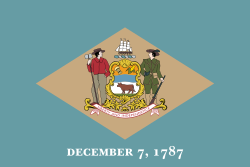
DesignA colonial blue field with the state coat of arms inside a tan rhombus above the date December 7, 1787 in white.

The flag of Delaware consists of a buff-colored rhombus on a field of colonial blue, with the coat of arms of the state of Delaware inside the rhombus. Below the rhombus, the date December 7, 1787, declares the day on which Delaware became the first state to ratify the United States Constitution. The colors of the flag reflect the colors of the uniform of General George Washington.

History

[edit]

During the American Civil War, regiments from Delaware flew a flag which was similar to the current state flag. The design had the state coat of arms on a field of blue. In 1910 the USS Delaware was given a state flag by members of Daughters of the American revolution. It bore the state's coat of arms with the federally's logo on a blue field.[1][2] The banner measured around 4 x 5 feet.[3]

The current flag was adopted on July 24, 1913.[4] In 1946 Governor Walter Bacon gave Denmark a variant of the state flag with a golden rhombus instead of a bluff one, to celebrate the rebuilding of a park near Aalborg.[5]

The coat of arms in the center of the flag was adopted on January 17, 1777. It depicts a shield of horizontal orange, blue, and white stripes. On the stripes are a sheaf of wheat, an ear of corn, and an ox standing on grass, all representing Delaware's agriculture. Above the shield is a sailing ship. Supporting the shield are a farmer on the left and a soldier on the right. The state motto, below the shield, reads "Liberty and Independence". These symbols are also included on the seal of Delaware.

In 2001, a survey conducted by the North American Vexillological Association (NAVA) placed Delaware's flag 52nd in design quality out of the 72 Canadian provincial, U.S. state and U.S. territorial flags ranked.[6]

Laws that enact the flag

[edit]

The design of the official state flag shall be as follows: A background of colonial blue surrounding a diamond of buff in which diamond is placed the correct coat of arms of the state in the colors prescribed by law and in accordance with §301 of this title, with the date, "December 7, 1787", to be inscribed underneath.

The official state colors, colonial blue and buff, are designated by the Textile Color Card Association of the United States, Inc., New York, as "armor blue" (Cable No. 10663), and "golden beige" (Cable No. 10781) respectively; the color shades having been determined by Colorimetric Specifications of the National Bureau of Standards, United States Department of Commerce, in Test No. 2, 1/140565, dated November 18, 1954, which is on file with the Delaware Public Archives, Dover, Delaware. The colors of the coat of arms and other elements of the state flag shall be the following: Husbandman, trousers of gray-brown, shirt of red, hat and hilling hoe of brown; rifleman, suit of green, binding, bag and leggings of buff, hat of brown, powder flask and feather of gray; shield, frame of shaded yellow, top panel of orange, center panel of blue, lower panel of white, ox of red-brown, grass and corn of green, wheat and branches underfoot of yellow, heraldic wreath to be blue and silver (twisted); ship under full sail to have a dark hull and white sails; date, December 7, 1787, to be white; cord and tassels to be blue and gold.

Governor's flag

[edit]

The official flag of the governor of the state shall be identical to the official state flag except that it shall also bear a fringe of gold surrounding the edge of the flag. The pole upon which the governor's flag is carried shall have mounted thereon a model of a blue hen's fighting cock.

In 1909, Governor John Reybold carried his own flag, but its design is unknown.[7]

[edit]

See also

[edit]

References

[edit]

Further reading

[edit]
[edit]
Revisions and contributorsEdit on WikipediaRead on Wikipedia
from Grokipedia
The flag of Delaware is the official , featuring a field of colonial surrounding a central buff-colored diamond that encloses the , with "December 7, 1787" printed below it in white lettering. Adopted on July 24, 1913, the design draws from colonial-era symbolism to honor the state's agricultural roots, military heritage, and role as the first to ratify the U.S. Constitution. The within the diamond depicts a shield parted horizontally with a upper section bearing a sheaf of and an ear of corn, and a lower silver section with a standing ox; flanked by a with a hoe on the right and a on the left; surmounted by a . The official colors—colonial (Cable No. 10663, "Arno Blue") and buff (Cable No. 10781, "Golden Beige")—were standardized in 1955 based on 1954 National Bureau of Standards testing to ensure uniformity in production. Prior to formal adoption, a similar flag with the was used by Delaware regiments during the , notably carried by soldier Robert Hanna at the in 1862 after the original bearer was wounded. The design has remained unchanged since 1913, embodying 's identity as "The First State" without major controversies or redesign proposals.

Design and Symbolism

Description

The flag of Delaware features a field of colonial blue, representing the colors of George Washington's uniform during the , with a centered buff-colored containing the state . Below the , the date "December 7, 1787"—marking Delaware's of the U.S. —is in white lettering. The occupies the central portion of the flag, with the precisely centered within it, ensuring balanced symmetry across the design. The within the consists of a shield with a shaded frame, divided horizontally into an orange top panel, a center panel, and a white lower panel. On the shield, a sheaf of wheat and green ear of corn appear in the center panel, while a red-brown ox stands on green grass in the lower panel. Above the shield, a sailing ship with a dark hull and white sails serves as the crest. Flanking the shield are two figures: on the left, a husbandman (farmer) dressed in gray-brown trousers, a red shirt, black hat and hoe, white stockings, and black shoes, holding a sheaf of wheat in his left hand and a hoe in his right; on the right, a rifleman in a green suit with buff bindings, a brown hat, gray powder flask and feather, buff bag and leggings, and brown moccasins, gripping a musket in his right hand. Below the shield, a ribbon bears the motto "Liberty and Independence" in golden letters, supported by a and silver heraldic wreath with and gold cord and tassels. The flag lacks a legally mandated or precise dimensions in state law, but it is conventionally produced in a 2:3 proportion to maintain visual . In official renderings, such as those approved by the Archives, the elements are rendered with sharp lines and accurate color matching—colonial blue as "arno blue" (Cable No. 10663) and buff as "golden " (Cable No. 10781)—often in vector formats like for scalability in digital and print applications.

Symbolism

The symbolism of the Delaware draws heavily from the state's colonial-era , emphasizing themes of , defense, and that reflect late 18th-century ideals of and self-reliance. The central elements within the buff diamond— a sheaf of , an ear of corn, and an ox—represent Delaware's agricultural heritage and economic vitality, highlighting the importance of farming and livestock to the state's early development. The farmer figure, depicted tilling the soil with a hoe, symbolizes the peaceful pursuit of and the foundational role of rural labor in fostering state . In contrast, the rifleman or militiaman stands ready with a , embodying defense, military readiness, and the citizen-soldier's commitment to protecting liberties during the Revolutionary War. Above the shield, a denotes Delaware's historical significance in maritime and , underscoring its coastal position and contributions to economic exchange along the Delaware River and Bay. 's colors—blue, orange (or buff), and white—follow heraldic traditions where blue signifies justice and loyalty, orange represents energy and volition, and white denotes purity and innocence. The ribbon banner bearing the motto "Liberty and Independence" encapsulates Delaware's revolutionary spirit and commitment to . Below the , the date "December 7, 1787" commemorates Delaware's ratification of the as the first state, reinforcing its foundational role in the nation's independence. Overall, the flag's design balances symbols of agrarian peace, vigilant defense, and mercantile enterprise, evoking the multifaceted identity of Delaware as a small but pivotal state in the early American republic. The colonial blue and buff field colors further tie the emblem to Revolutionary heritage, mirroring the uniform of General George Washington.

History

Coat of Arms Origins

The coat of arms of Delaware was officially adopted by the Delaware General Assembly on January 17, 1777, as the central element of the state's Great Seal during the American Revolutionary War. A joint committee from both houses of the legislature, appointed in October 1776, developed the design after consulting Philadelphia heraldic artist Pierre Eugene du Simitiere, whose expertise in colonial symbolism shaped its agricultural motifs and heraldic style. The imagery drew inspiration from colonial heraldry, including county crests from the proprietary period under William Penn—such as the wheat sheaf and ear of corn representing Sussex and Kent Counties' farming heritage, and the ship symbolizing New Castle County's shipbuilding industry—along with broader state symbols of prosperity and labor. Following its adoption, the appeared prominently on the used to authenticate official state documents, early Delaware issued in , and various governmental . It also featured on military standards, including regimental colors carried by Delaware troops in conflicts predating the . Similar designs incorporating these elements foreshadowed later vexillological uses, notably in blue regimental flags borne by Delaware units during the Civil War, which echoed the colonial blue field eventually integrated into the 1913 . In a 2001 survey by the North American Vexillological Association (NAVA), the Delaware state flag—centered on the 1777 coat of arms—was ranked 52nd out of 72 U.S. state and Canadian provincial flags for overall design quality, based on evaluations from over 400 respondents emphasizing simplicity, symbolism, and distinctiveness.

Flag Adoption

The Delaware state flag was officially adopted on July 24, 1913, through legislation passed by the Delaware General Assembly. This enactment formalized a design that had evolved from earlier precedents, marking the first official state flag distinct from mere adaptations of the colonial-era coat of arms, which had been established in 1777. The design drew direct inspiration from flags carried by Delaware regiments during the (1861–1865), which displayed the state on a field of colonial blue. These regimental banners emphasized simplicity and historical continuity, influencing the legislative choice to center the within a buff-colored on a colonial blue background, with the inscription "December 7, 1787"—commemorating Delaware's of the U.S. —positioned below in white lettering. Early legislative descriptions highlighted the colonial blue as matching the shade of George Washington's Revolutionary War uniform, while the buff evoked the state's agricultural heritage, ensuring the flag's colors aligned with symbolic intent without excessive complexity. Following adoption, the flag experienced no major redesigns, preserving its core elements through subsequent decades. However, refinements to color standards occurred over time; in , the General Assembly amended the law to specify the official colors as colonial blue (Cable No. 10663, "Arno Blue") and buff (Cable No. 10781, "Golden Beige"), based on 1954 National Bureau of Standards testing to ensure uniformity in official reproductions. These adjustments maintained fidelity to the vision while adapting to modern production techniques.

Legislation

The official status and design of the Flag of Delaware are established in Delaware Code Title 29, Chapter 3, § 306, which mandates a colonial background surrounding a buff containing the state , with the date "December 7, 1787" inscribed below in white letters. This statute originated from an act of the adopted on July 24, 1913, which first specified the flag's core elements, including the placement of the and the commemorative date referencing Delaware's of the U.S. . Subsequent amendments have refined the statute, particularly regarding color specifications and display etiquette. The 1955 amendment (50 Del. Laws, c. 288) introduced precise color standards verified by the National Bureau of Standards, designating "Arno Blue" (Cable No. 10663) for the background and "Golden Beige" (Cable No. 10781) for the diamond, along with detailed hues for coat of arms elements such as the rifleman's green suit and the ship under full sail. A further update in 1999 (72 Del. Laws, c. 91) made a technical adjustment by updating the reference to the archival authority. Usage of the flag is mandated under Delaware Code Title 29, Chapter 5, Subchapter II, § 559, requiring all state agencies, including public schools, to display it outdoors (weather permitting) on their installations, grounds, or buildings where equipped with flagpoles; of Management and Budget provides initial flags at state expense. Protocols for half-staff display are directed by from the , typically in concurrence with U.S. Code guidelines for mourning periods, such as following the death of national figures or on designated remembrance days. Protections against are aligned with federal standards under the First Amendment, as Delaware's (formerly § 3335, Title 11) was ruled unconstitutionally overbroad and vague in Hodsdon v. Buckson (310 F. Supp. 528, D. Del. 1970), prohibiting criminal penalties for expressive conduct like burning or mutilation unless it constitutes unprotected speech such as . Misuse involving physical damage may incur penalties under general criminal mischief provisions in Title 11, § 811, classified as a with fines up to $2,300 and potential .

Specifications

The specifications for the Flag of Delaware are outlined in Delaware Code Title 29, § 306, ensuring uniformity in its design and production. The flag's background is colonial blue, officially designated as "Arno blue" (Cable No. 10663) from the Color Card Association of the , Inc., with verification provided by National Bureau of Standards Test No. 2 (filed as 1/140565 on November 18, 1954) and maintained in the Delaware Public Archives. The central buff-colored () uses "golden " (Cable No. 10781) from the same association. For contemporary , digital rendering, and accuracy as of 2025, these are approximated based on the 1954 standards to ensure precise replication across media while honoring the original textile standards. The flag's overall proportions are not rigidly prescribed in the statute but are standardized in official productions at a ratio of 2:3 or 3:5 to align with common U.S. state flag dimensions. The buff rhombus is centered horizontally and vertically, proportioned to accommodate the state coat of arms without overcrowding the field. These ratios facilitate balanced visual impact when flown or displayed. Elements of the coat of arms within the rhombus adhere to specific color shades detailed in § 306, consistent with the state seal design under § 301, including blue for the shield's center (Textile Color Card #6503), orange for the sheaf and ear of corn (#15238), green for the rifleman's suit and agricultural motifs, red for the farmer's shirt and the ox, and other tones such as buff for bindings, brown for hats and tools, and white for sails and inscriptions. The date "December 7, 1787" appears in white lettering below the rhombus. These details ensure historical fidelity in reproduction. Construction guidelines for official flags emphasize durability and precision, utilizing materials like UV-resistant or fabric to withstand outdoor exposure while maintaining color vibrancy. The and are applied via for solid colors or fine for intricate details, with reinforced stitching along edges and a header with grommets for mounting. The Delaware Division of the Arts references these integrated state seal specifications in overseeing symbolic consistency, with periodic reviews to incorporate manufacturing advancements without altering the codified design.

Variants

Governor's Flag

The Governor's flag of Delaware is the official standard for the chief executive, identical to the in its core design—a colonial field surrounding a buff-colored diamond bearing the state and the inscription "December 7, 1787"—but distinguished by a gold fringe encircling its edges. This fringe serves to denote its exclusive use by the , setting it apart from the standard employed in general contexts. The flag is mounted on a dedicated pole topped with a in the form of a model Blue Hen fighting cock, representing 's state bird and a longstanding symbol of the state's Revolutionary War heritage, where soldiers from the Delaware Regiment were nicknamed the "Blue Hen's Chickens" for their fighting spirit. The Blue Hen was formally designated as the state bird on April 14, 1939, reflecting its cultural significance that likely influenced the addition of this to the Governor's flag in the post-1930s era to emphasize gubernatorial authority. Established concurrently with the state 's adoption on , 1913, the 's flag has evolved as a marker of executive distinction, with its specifications formalized in state law during the mid-20th century. Prior to this, in 1909, John H. P. Reybold employed a unique personal differing from the modern design, though specific details of that earlier version have not survived in historical records. The current configuration, including the gold fringe and Blue Hen , underscores the flag's role in symbolizing leadership continuity from Delaware's founding as the first state to ratify the U.S. . In practice, the Governor's flag is flown at the , Woodburn in Dover; atop the state capitol during gubernatorial proceedings and state ceremonies; and affixed to official vehicles accompanying the . These protocols ensure its prominence in , such as state addresses and diplomatic events. For instance, during the 2025 inauguration of Matthew S. Meyer at , the Governor's flag was displayed alongside national and state symbols to mark the transition of leadership, highlighting its ceremonial importance in affirming the office's authority.

Other Variants

In addition to the standard state flag, historical variants include the regimental colors carried by Delaware troops during the from 1861 to 1865, which consisted of the state coat of arms depicted on blue silk fields to symbolize unit identity and allegiance. Modern adaptations include simplified digital renditions of the flag used on official state websites and in , retaining the core design elements for online representation. The flag has also been subject to vexillological critiques, notably in the 2001 survey, where it ranked 52nd out of 72 and Canadian provincial flags due to its complex seal, prompting ongoing discussions and unadopted proposals for redesigns to enhance and inclusivity, such as incorporating modern symbols for diversity. Other uses feature minor modifications like gold-fringed or bordered versions for ceremonial purposes in state agencies and events, maintaining the original symbolism while adapting to specific contexts.
Add your contribution
Related Hubs
User Avatar
No comments yet.