Hubbry Logo
Flag of AlabamaFlag of AlabamaMain
Open search
Flag of Alabama
Community hub
Flag of Alabama
logo
8 pages, 0 posts
0 subscribers
Be the first to start a discussion here.
Flag of Alabama
Flag of Alabama
from Wikipedia

Alabama
UseCivil and state flag Small vexillological symbol or pictogram in black and white showing the different uses of the flag Small vexillological symbol or pictogram in black and white showing the different uses of the flag Reverse side is congruent with obverse side
Proportion2:3 (by convention)
AdoptedFebruary 16, 1895; 130 years ago (1895-02-16)
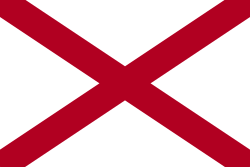
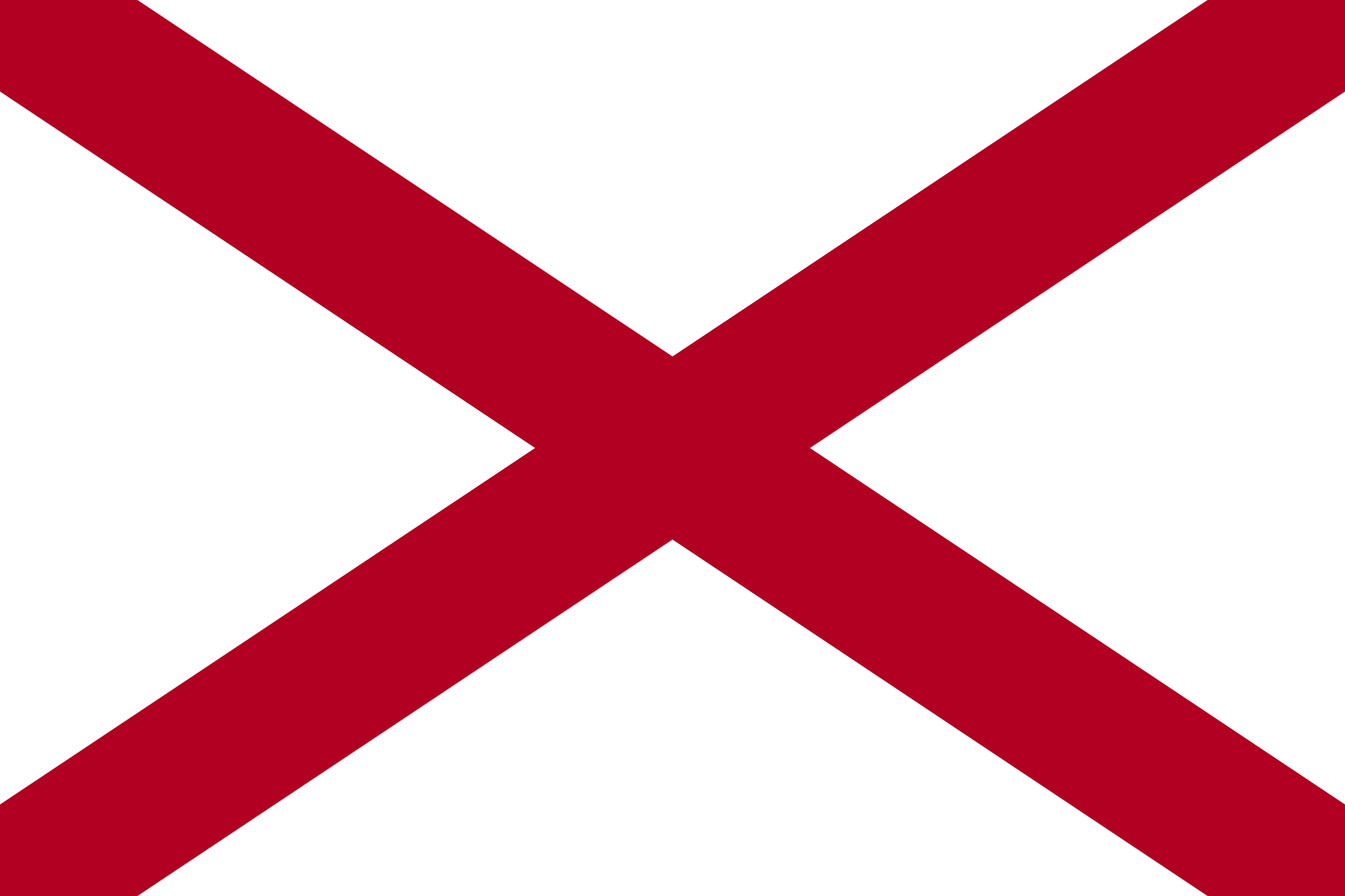
DesignA crimson cross of St. Andrew on a white field.
Designed byJohn W. A. Sanford Jr.
Flag of the governor of Alabama
UseState flag Small vexillological symbol or pictogram in black and white showing the different uses of the flag Small vexillological symbol or pictogram in black and white showing the different uses of the flag Reverse side is mirror image of obverse side
DesignThe state flag with the state military crest and the coat of arms of Alabama in the lower and upper sections

The current flag of the U.S. state of Alabama was adopted by Act 383 of the Alabama Legislature on February 16, 1895. The flag was designed by John W. A. Sanford Jr. and features a crimson cross of St. Andrew on a field of white.[1]

History

[edit]

Secession Convention flag

[edit]

On January 11, 1861, a flag was presented to Alabama Secession Convention in Montgomery, where the Convention passed a resolution designating it as the official flag of the body, to be flown whenever the Convention was in open session.[2][3] The flag was sewn and designed by several women from Montgomery, with much of its painting done by Francis Corra, a painter specializing in military and decorative banners.[2]

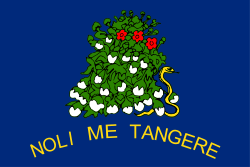
Contemporary descriptions recorded its appearance.[3] The Atlanta Intelligencer reported on January 14 that the banner was made of blue silk, and bordered with white. On January 16, a Montgomery Weekly Advertiser reporter described the flag as one side depicting the Goddess of Liberty holding an unsheathed sword in her right hand and a single-star flag in her left, with the inscription "Alabama — Independent Now and Forever" in an arch above all. The reverse featured a cotton plant with a rattlesnake coiled at its base, the words "Noli Me Tangere", ("Touch Me Not" in Latin) above, and the Coat of Arms of Alabama.

The flag was flown until February 10, 1861, when it was removed after it had been left flying overnight and was torn. It was delivered to the Governor to be placed in the state archives and was never flown again.[2][3]

Following the Federal occupation of Montgomery by Union forces in 1865, the flag was taken to Iowa, where it remained until it was returned to the Alabama state archives in 1939.[2][3]

This flag is depicted on the flag of Mobile, Alabama.[4]

A flag with a similar motif remained in use from February 1861 to April 1862 by the 1st Alabama Infantry, at which time it was taken into Union possession following the capture of the regiment. [5]

Single star flags

[edit]

Around 1861, a number of unofficial flags featuring a single star were flown in Alabama and were commonly referred to as 'state flags,' even though no official design had been adopted.[5] One example is the Young Men's Secession Association flag, considered in a 1861 New York Times article as the "flag of Alabama pro tempore".[6]

Current flag

[edit]
The Alabama state flag displayed at Ivy Green, Helen Keller's birthplace in Tuscumbia
The Alabama state flag with a square shape.
The Alabama state flag as depicted in the 1976 bicentennial postage stamp series.

Alabama's current flag was adopted in 1895. The legislation introduced by Representative John W. A. Sanford Jr. stipulates: "The flag of the state of Alabama shall be a crimson cross of St. Andrew on a field of white. The bars forming the cross shall be not less than six inches broad, and must extend diagonally across the flag from side to side."[7] A St. Andrew's cross represents the cross on which St. Andrew was crucified.[8]

The legislation that created the state flag did not specify whether the flag should be square or rectangular.[2] In 1987, the office of Alabama Attorney General Don Siegelman stated in a letter that the proper shape of the state flag is rectangular, as it had been depicted numerous times in official publications and reproductions.[9] Despite this, the flag is still often depicted as being square, even in official publications of the U.S. federal government.[10]

More than a decade after its adoption, the flag was described as little known among Alabamians.[8] At the time, few U.S. states had their own flags, and the idea of a distinct state flag was still relatively new. Before the adoption of the state flag, the United States flag was used for all official occasions following the end of the Civil War. [2]

The flag of Alabama is very similar to the flag of Florida, which was derived from the Spanish Cross of Burgundy.[11] Southern Alabama was originally part of Spanish Florida and subsequently West Florida. However, Alabama adopted its flag design in 1895, five years earlier than Florida did.

In 2001, a survey conducted by the North American Vexillological Association ranked Alabama's state flag 29th in design quality of the 72 Canadian provincial, U.S. state and U.S. territorial flags.[12]

Statute

[edit]

The Alabama state flag is defined by law as:[2]

"The flag of the State of Alabama shall be a crimson cross of St. Andrew on a field of white. The bars forming the cross shall be not less than six inches broad, and must extend diagonally across the flag from side to side." – (Code 1896, §3751; Code 1907, §2058; Code 1923, §2995; Code 1940, T. 55, §5.)

The cross of St. Andrew referred to in the law is a diagonal cross, known in vexillology as a saltire. Because the bars must be at least six inches (150 mm) wide, small representations of the Alabama flag do not meet the legal definition.

Theories on origin

[edit]
The Hilliard's Legion flag
The Spanish Cross of Burgundy flag

The inspiration for Alabama's flag is not known. Many have noted that the saltire was commonly used on flags of the Confederate States of America. No documentation in the legislative records indicates that the Alabama flag was intended to commemorate the Confederacy.[13] Still, various people have asserted over the decades that the design was drawn from the Confederate battle flag.[11]

In 1900, the Montgomery Advertiser reported the flag was "a memory and a suggestion of the Confederate battle flag".[14] In 1906, a piece in the Birmingham Age-Herald made no specific connection between the Alabama flag and the Confederate battle flag, instead describing only the symbolic history of the St. Andrew's cross itself.[8] In 1915, Thomas M. Owen, the first director of the Alabama Department of Archives and History, wrote that the flag bill's sponsor and the rest of the legislature had intended to "preserve, in permanent form, some of the more distinctive features of the Confederate battle flag".[15] The authors of a 1917 article in National Geographic expressed their opinion that the Alabama flag was based on the Confederate battle flag.[16]

In 1924, Bell Allen Ross, a member of the Daughters of the Confederacy, said that Rep. John W. A. Sanford Jr. modeled his design of the Alabama flag on the battle flag used by his father, John W. A. Sanford, while commanding the Hilliard's Legion regiment.[17] She said Sanford's design was meant to preserve some of the distinctive features of the Confederate battle flag, particularly the Saint Andrew's Cross.[18]

In a 1987 letter, Alabama Attorney General Don Siegelman wrote that the flag was modeled after Sanford's 60th Alabama Infantry Regiment battle flag.[9]

More recent commentators note that the Alabama flag was adopted during a period of promotion of the "Lost Cause" of the culture of the antebellum South.[13] Other former Confederate slave states, beginning with Mississippi, and followed by Florida, had also adopted new state flags around the same time that they disenfranchised African Americans and passed laws establishing Jim Crow segregation.[19][20]

But other contemporary commentators, such as Steve Murray, Director of the Alabama Department of History and Archives, believe the origins of the flag are unclear.[21] According to Murray, the flag's connections to the battle flag are thin and based on suppositions.[21] Murray said, "I would conclude that if they were wanting to evoke the Confederate battle flag, they would have been more explicit about doing it either in the design which could have more closely resembled the Confederate flag."[21] Murray also noted that Alabama may have wanted to approve a new state flag to prepare for an exposition in Atlanta, Georgia, later that year.[21]

It is possible that the Alabama flag is meant to resemble the cross of Burgundy flag[according to whom?] used by the Spanish Empire. As is, both flags are nearly identical, and parts of Alabama were a Spanish colony.[22]

Other flags

[edit]

Governor's flag

[edit]

The flag of the governor of Alabama is a variant of the state flag. In the top saltire, the flag displays the state coat of arms. The bottom saltire contains the state military crest, which consists of a cotton plant with full bursting boll.

Anniversary flags

[edit]

Unofficial flags

[edit]

After the state flag was adopted, there were some unofficial flags bearing the coat of arms being used. In 1896, delegates from the state went to Indianapolis to support presidential candidate Grover Cleveland. The men carried with them a purple banner with the coat of arms in the middle with the words "Here we rest" below.[25]

During the Spanish-American War, the state organized the 1st Regiment Alabama Volunteers to be stationed in Florida. The regiment carried two flags, one was a unique American flag with red, white, and blue stripes[26] with the name of the regiment embroidered on the stripes.[27] The other flag had a blue field with the state's coat of arms in the center. It was painted by Jackson Halstead.[27][28]

See also

[edit]

References

[edit]
[edit]
Revisions and contributorsEdit on WikipediaRead on Wikipedia
from Grokipedia
The flag of Alabama consists of a white field bearing a crimson (saltire) that extends to the edges, with the bars of the cross measuring at least six inches in breadth and joined at the center to form equal proportions. Adopted by the on February 16, 1895, the design employs only two colors—white symbolizing purity and the crimson red matching that of the flag to denote hardiness and valor—making it one of the simplest among U.S. state flags. The choice of the , while officially unnamed in origin by the adopting statute, has been interpreted by contemporaries and historians as potentially drawing from the used during Spanish colonial rule or Scottish heritage via Scotch-Irish settlers, though its diagonal form and timing of adoption in the post-Reconstruction South have fueled persistent associations with the Confederate battle flag's amid the era's Lost Cause . This resemblance has sparked controversies, including its removal from the U.S. Capitol in 2016 over perceived Confederate imagery, yet Alabama officials and voters have consistently defended and retained the flag against proposed redesigns, distinguishing it from changes in neighboring states like .

Design and Specifications

Physical Description

The flag of Alabama features a rectangular white field overlaid with a crimson , known as the Cross of St. Andrew, extending diagonally such that each arm of the cross reaches from one corner to the opposite corner. This design divides the flag into four white isosceles right triangles, one in each quadrant formed by the intersection of the saltire's arms. The bars comprising the saltire are uniform in width, with state stipulating a minimum breadth of six inches. Alabama law specifies the flag's proportions as three feet along the hoist (staff side) and five feet along the fly, establishing a 3:5 . The official colors are white for the field and —a deep red—for the , though no precise shade is codified beyond this description. The contains no additional symbols, text, seals, or fringes, maintaining a stark simplicity. Due to its geometric without oriented emblems, the sides are congruent.

Proportions and Colors

The state flag consists of a white field overlaid by a , or cross of St. Andrew, with the arms of the cross extending diagonally from each corner to the center. Code § 1-2A-2 mandates that the bars forming the cross measure not less than six inches in breadth and intersect such that the overlapping cloth fully conceals the underlying white field at the center point. This construction ensures the cross appears as a continuous element without visible gaps. The same statute omits any prescription for the flag's overall dimensions or aspect ratio, permitting production in varied proportions without legal constraint. In practice, manufacturers typically employ a 2:3 ratio, aligning with common standards for rectangular flags, as evidenced by standard sizes such as 3 by 4.5 feet. Legally, the colors remain unspecified beyond the terms "crimson" for the cross and an implied pure white for the field, lacking codified equivalents in systems like Pantone, RGB, or CMYK. Reproductions commonly approximate crimson using hexadecimal #B10021, RGB values (177, 0, 33), or Pantone 3517 C, while white is rendered as #FFFFFF or RGB (255, 255, 255).
ElementCommon ApproximationHexRGBPantone
Crimson CrossDescriptive "crimson"#B10021(177, 0, 33)3517 C
White FieldPure white#FFFFFF(255, 255, 255)N/A
These color values derive from vexillological references rather than state authority and may vary in application.

Symbolism and Interpretations

Traditional Meanings

The traditional symbolism attributed to the Alabama state flag derives from its heraldic elements, with the crimson (a ) on a field evoking Christian and virtues commonly associated with such designs in . The references the diagonal cross upon which Saint Andrew, patron saint of and one of Christ's apostles, was martyred according to tradition, thereby symbolizing , discipleship, and sacrificial . The hue of the cross conventionally denotes courage, valor, and the blood of martyrs or warriors, reflecting attributes of resilience and resolve emphasized in historical flag interpretations. The field, by contrast, stands for purity of purpose, innocence, and peace, qualities drawn from longstanding in Western where signifies moral clarity and unblemished integrity. These color meanings align with broader conventions rather than unique state-specific mandates, as the 1895 legislative act specified only the flag's physical form—a with bars at least six inches broad on a field—without enumerating symbolic intent. Such interpretations have persisted in popular and descriptive accounts since adoption, underscoring ideals of steadfastness and moral fortitude, though they remain interpretive rather than officially enshrined.

Historical Contexts

The Alabama , adopted on February 16, 1895, by Act 383 of the , features a crimson saltire—designated in the statute as the "cross of St. Andrew"—on a white field, with bars at least six inches broad and squared diagonally at the flaring ends. The legislative record provides no explicit explanation of the design's symbolism, limiting to its physical form amid a post-Reconstruction era marked by the resurgence of Confederate memorialization across the South. This timing coincided with the consolidation of and the romanticization of the Lost Cause narrative, wherein symbols evoking the Confederacy gained prominence in state iconography. Early interpretations explicitly linked the flag to Confederate heritage, noting its visual similarity to the saltire of the Army of Northern Virginia's battle flag, which employed a blue-bordered diagonal on a red field—elements echoed in Alabama's version absent the canton. A 1900 article in the Montgomery Advertiser characterized the design as "a memory and a suggestion of the Confederate battle flag," reflecting contemporary views tying it to the state's Civil War legacy rather than unrelated ethnic motifs. Subsequent reports, such as a 1906 piece in the Birmingham Age-Herald, reinforced this by dubbing it the "Southern ," further embedding it within regional Confederate symbolism. By the mid-20th century, amid rising scrutiny of Confederate emblems during civil rights struggles, alternative narratives emerged positing the as homage to Scottish or Scots-Irish settlers in Alabama, invoking St. Andrew as Scotland's . However, this interpretation lacks primary evidence from the adoption era and diverges from the Scottish national flag's white saltire on blue, rendering it a rationalization rather than a documented intent; the hue and isolated white field more directly parallel Confederate usage than transatlantic . Such shifts highlight how flag symbolism evolves with cultural contestation, yet historical records prioritize the design's alignment with Southern sectional identity over ethnic ancestry claims.

Historical Development

Pre-1861 Flags

Prior to U.S. control, the territory of modern Alabama fell under successive European colonial powers. Spanish explorer claimed portions of the region in 1539, initiating Spanish influence that persisted intermittently until the early 19th century, often under flags such as the . French colonization commenced in 1699 with settlements on , employing the royal standard featuring fleurs-de-lis. British administration followed the 1763 Treaty of Paris, with the raised over the area until its cession to in 1783; Spanish rule over , encompassing southern Alabama, continued until U.S. annexation in 1813. From 1813 onward, as part of the and subsequently the (established March 3, 1817), the flag served as the primary banner. Alabama achieved statehood on December 14, 1819, as the 22nd state, yet maintained the U.S. flag without adopting a distinct state ensign. No official existed for from statehood until January 11, 1861, when a secession-era design was briefly designated amid the state's departure from the Union. Throughout the antebellum period, federal and local entities relied on the and Stripes, reflecting the absence of formalized state until the Civil War onset.

1861 Secession Flag

The Alabama Secession Flag was presented to the Secession Convention on January 11, 1861, in the House Chamber of the State Capitol in Montgomery, coinciding with Alabama's vote to secede from the Union. A resolution passed that day designated the , designed by a group of Montgomery women, as the official banner, directing it to be flown over the Capitol during convention sessions. This marked Alabama's first officially recognized following . The double-sided flag featured distinct designs on each face. The obverse displayed a field with a central figure of holding a in her right hand and, in her left, a flag bearing a single gold star and the word "" arched above it; an arched inscription "Independent now and forever" appeared above the figure, with gold fringe along the edges. The reverse bore a coiled beneath a cotton plant, accompanied by the Latin motto ("Touch me not"), evoking warnings of defiance similar to symbolism, while the cotton plant represented Alabama's agrarian economy; state arms may have been included in the upper fly. These elements underscored themes of , resistance to federal authority, and economic . The flag flew over the Capitol until February 10, 1861, when weather damage necessitated its removal and preservation. It was later stored at the Alabama Department of Archives and History. Historical accounts, including convention debates recorded by William Russell Smith, affirm its role in symbolizing Alabama's brief period of independent sovereignty before integration into Confederate national symbols. No subsequent official adoption replaced it immediately, as Alabama aligned with the Confederate "Stars and Bars" by March 1861.

Post-Civil War Period

Following the Confederate surrender in April 1865, Alabama ceased official use of its 1861 secession flag and other wartime banners associated with the Confederacy. From that point until 1895, the state lacked an official flag and relied on the United States flag for all official occasions, reflecting the reintegration into the Union during Reconstruction and beyond. In 1868, under the Reconstruction constitution, Alabama adopted a new state seal featuring an eagle perched on a with a palm leaf and , accompanied by the "," symbolizing rest from war's labors. This seal was incorporated into the standard of the , which served as a distinctive from 1868 to 1939 but did not function as a . The 's flag typically displayed the state arms centered on a field, distinguishing it from national or military colors. Throughout the post-war decades, unofficial Confederate battle flags persisted in use by veterans' groups and commemorative events, evoking Southern heritage amid ongoing sectional tensions, though these were not sanctioned for state purposes. The absence of a dedicated state flag underscored a deliberate choice to prioritize federal loyalty in official displays until sentiments favoring a distinct emblem culminated in the 1895 adoption.

1895 Adoption

The Alabama state flag was formally adopted on February 16, 1895, via Act No. 383 of the , marking the first official state banner since readmission to the Union after the Civil War. The legislation prescribed a crimson cross of St. Andrew on a field of white, with the cross bar measuring six points in width, flaring outward at the ends, and extending to the flag's edges; dimensions were fixed at two feet in width by three feet in length. This design replaced prior unofficial or inherited symbols, amid a post-Reconstruction push by Southern legislatures to codify distinct state emblems separate from federal colors. State Representative John W. A. Sanford Jr. introduced and advocated for the bill, drawing from his personal and familial ties to Confederate service—his father, John W. A. Sanford Sr., had commanded the 60th , whose unit banner featured a similar configuration. Sanford's proposal aimed to evoke martial heritage without explicit Confederate iconography, though legislative records offer scant detail on debates or alternative submissions. The resulting flag's stark simplicity prioritized visibility and symbolism over elaboration, reflecting practical considerations for manufacturing and display in the late . Subsequent usage incorporated a bar along the hoist side, occupying one-fifth of the width and bearing the cross's termination, though this element was not enumerated in the 1895 and likely stemmed from Sanford's full rendering or customary for distinction from white fields in other banners. The adoption occurred without recorded opposition, underscoring broad consensus in an era when Southern states increasingly formalized symbols tied to regional identity.

Origins and Influences

Pre-Confederate Theories

One theory posits that the saltire design of the Alabama state flag derives from the , a red diagonal cross emblem used by Spanish forces in the during the colonial era from the 1500s to the early 1800s. This banner, adopted by the Habsburgs after the 1477 marriage of I to , featured a formed by four inward-pointing "V" shapes symbolizing the , and it flew over territories including parts of what became during explorations like Hernando de Soto's 1540 expedition through the region. Proponents argue the Alabama flag simplifies this into a plain crimson on white, evoking Spanish colonial heritage in southern , which was incorporated into until ceded to the in 1819. Southern Alabama's inclusion in from 1763 to 1810, and earlier Spanish claims dating to the , provides a historical basis for this interpretation, with the serving as a military and administrative standard in the Gulf Coast area. Some vexillologists note similarities between Alabama's and Florida's flags—both featuring red saltires—and attribute Florida's explicitly to Spanish roots, suggesting a parallel influence for Alabama despite limited direct documentation from the 1895 adoption process. However, this connection remains speculative, as the Cross of Burgundy's distinctive jagged arms differ from the Alabama flag's smooth bars, and no contemporary records from flag designer John W. A. Sanford Jr. reference Spanish precedents. Alternative pre-Confederate influences include French standards flown by settlers in western until the in 1803, though these lack the diagonal cross motif and show no evident link to the 1895 design. Prior to statehood in 1819, the —including —used variants of the U.S. flag without unique state symbols, leaving colonial emblems as the chief candidates for non-Confederate theories. These ideas emphasize continuity from European exploration over later American conflicts, but empirical evidence favoring them is scant compared to documented 19th-century military associations.

Confederate Associations and Debunking

The state flag, adopted on February 16, 1895, via Act No. 383, features a —a diagonal X-shaped —on a white field, with the cross bars specified as not less than six inches broad and extending to the flag's edges. This was sponsored in the legislature by John W. A. Sanford Jr., a Confederate veteran who had served in the 60th during the Civil War. Sanford explicitly modeled the flag after the battle flag of that regiment, which bore a similar saltire configuration akin to the square blue-on-red battle flag of the Confederate , widely used by Alabama units in combat. The adoption occurred under Governor , another Confederate veteran who commanded the 15th at Gettysburg and whose gubernatorial papers at the Alabama State Archives include a color of the proposed flag . This timing aligns with the post-Reconstruction era's widespread Confederate memorialization efforts in the South, including monuments, reunions, and symbolic revivals amid Jim Crow consolidation, where states like Alabama sought to honor soldiers who fought in the 1861–1865 conflict. Alabama contributed over 120,000 troops to the Confederate army, suffering approximately 35,000 casualties, and the flag's evoked the military banners under which those units fought, rather than any national Confederate flag like the Stars and Bars or Stainless Banner. Contemporary observers, such as a 1917 National Geographic article, described the flag as derived from the Confederate battle flag, reflecting its intended nod to martial heritage over abstract . Claims that the flag derives primarily from non-Confederate sources, such as the (a red-and-yellow from colonial administration) or direct Scottish patronage via St. Andrew, lack primary evidentiary support in the design process; Alabama's colonial history under featured the on military standards, but no records link it to the adoption, and the state's demographic ties to were minimal compared to the pervasive Confederate veteran influence in state politics. Similarly, assertions denying any Confederate inspiration—often advanced in modern debates to mitigate —ignore Sanford's own regimental connection and the era's causal context of "Lost Cause" symbolism, where southern legislatures routinely incorporated Civil War motifs to affirm regional identity. The flag is not a verbatim reproduction of the Confederate battle flag, which was square, featured a blue saltire with white-bordered stars on a red field, and served tactical battlefield purposes without white dominance or crimson hue; Alabama's version is rectangular (2:3 proportion), omits stars, and inverts the color scheme for a white field symbolizing purity or surrender avoidance in some veteran interpretations. Equating the two overlooks these distinctions and the legislative text's heraldic phrasing ("crimson cross of St. Andrew"), which named the form but not the motive—empirical ties to Alabama's Confederate infantry flags substantiate homage to state troops, not endorsement of slavery or secession ideology per se, though the adoption's Jim Crow backdrop intertwined with racial hierarchies. No verified primary documents from the 1895 committee refute the military provenance, underscoring the design's rootedness in Civil War commemoration over pre-1861 precedents like Alabama's 1861 secession banner, which used a lozenge pattern unrelated to the saltire.

State Statute

The design and specifications of the flag of Alabama are codified in Alabama Code § 1-2-5, which provides: "The of the state of shall be a of St. Andrew on a field of white. The bars forming the shall be not less than six inches broad, and must extend diagonally across the flag from side to side." This statutory language establishes the as a white field bearing a diagonal , with minimum width requirements for the cross's bars to ensure proportional rendering across varying flag sizes. The provision derives from Act No. 383, enacted by the on February 16, , which formalized the flag's adoption without prescribing exact proportions beyond the bar width minimum, allowing flexibility in construction while preserving the core heraldic elements. Subsequent codification in Title 1, Chapter 2A (the Alabama Act), reaffirms this description in § 1-2A-2 as historical information, without material alterations to the design mandate. No amendments to the descriptive text have been recorded since , maintaining the statute's original intent for a simple, scalable vexillological form.

Regulations and Mandates

Alabama Code Title 1, Chapter 2A, enacted as the Alabama State Flag Act in 2001, establishes protocols for the display of the across public facilities, emphasizing its prominence alongside the flag. Section 1-2A-3 outlines the flag display protocol, requiring the Alabama flag to be flown below or to the left of the U.S. flag when displayed together on separate staffs, with the U.S. flag always in a superior position; the state flag must not touch the ground or be used as drapery. This protocol applies uniformly to mandated displays, ensuring deference to federal flag etiquette while promoting state symbolism. Mandates for display extend to state government operations under Section 1-2-6, which requires the flag to be hoisted on the dome whenever the is in session and to be used in all state ceremonies of pomp. Section 1-2A-7 further compels each state department or agency facility open to the public to prominently display the flag per the protocol in Section 1-2A-3, including at entrances or lobbies where feasible. agencies must equip marked vehicles and facilities with the flag under Section 1-2A-5, while state parks and historic sites follow Section 1-2A-6 for similar prominent placement. County courthouses and annexes where courts convene regularly are required by Section 1-2A-4 to display the flag prominently in accordance with the established protocol. Municipal buildings open to the general public must comply under Section 1-2A-8, mandating display at primary entrances or assembly areas. In public educational institutions supported by state funds, Section 16-43-1 requires both the U.S. and flags to be displayed on flagpoles in front of the main building during school sessions, with teachers reporting compliance. The directs half-staff displays of the to mirror those of the U.S. , applying to all state facilities upon , typically for periods of mourning such as the death of national figures or disasters. No state-specific desecration penalties beyond general vandalism laws apply, though federal protections for the U.S. influence joint displays. These regulations, rooted in the 2001 redesign , aim to standardize usage without overriding local discretion in non-mandated contexts.

Reception and Controversies

Heritage and Pride Perspectives

The Alabama state flag's crimson on a white field is interpreted by many residents as an emblem of the state's historical resilience and commitment to , directly evoking the "Audemus jura nostra defendere" ("We dare defend our rights"), with the red hue signifying the bloodshed endured by Alabamians in conflicts including the Civil War. Adopted on February 16, 1895, amid post-Reconstruction efforts to reclaim Southern identity, the design draws from traditions of valor and sacrifice, fostering a sense of continuity with ancestral struggles against perceived external impositions. Organizations such as the articulate this view by emphasizing the flag's role in commemorating the honor and heroism of Confederate forebears, framing it as a non-racial to familial lineage and regional fortitude rather than endorsement of division. For adherents, the symbol evokes pride in a distinct Southern of and endurance, distinct from later appropriations by fringe elements, and reflective of broader American ideals of defending constitutional liberties against centralized authority. This perspective persists despite external pressures, as evidenced by the flag's retention following legislative debates and the 2001 adoption—and subsequent 2003 repeal—of an alternative design lacking the cross, signaling enduring public and official valuation of historical continuity over modernization. Such interpretations underscore a causal link between the flag and personal identity for many white Alabamians of Confederate descent, where opposition to removal efforts is rooted in empirical attachment to verifiable lineage records and battlefield records rather than abstract ideological conflicts. Proponents argue that conflating the symbol with systemic racism overlooks its primary function as a vexillological marker of state-specific history, including pre-Confederate Scottish Presbyterian influences via the St. Andrew's cross, and prioritizes narrative-driven critiques over the lived experiences of those tracing pride to documented kin service. This stance aligns with surveys indicating that support often correlates with regional heritage pride independent of explicit racial animus, though correlated with conservative values emphasizing historical preservation.

Criticisms and Change Efforts

The design of Alabama's state flag has drawn criticism for its close visual similarity to the Confederate battle flag, with detractors interpreting it as a symbol of racial oppression tied to the Confederacy's defense of and later Jim Crow-era segregation. Organizations such as the have condemned the flag's use on state property, asserting it fosters division and disrespects Black Alabamans, who represented 26.4% of the population in 2020 census data. For example, in July 2015, Rev. Robert Shanklin of the Huntsville chapter demanded removal of the emblem from Alabama State Trooper vehicles and uniforms, calling it offensive amid national debates over Confederate iconography. Change efforts targeting the flag directly have been limited and unsuccessful, though related Confederate symbols faced pressure post-2015 . In June 2015, Governor Robert Bentley directed removal of four standalone Confederate flags from Capitol grounds, citing the massacre's racial motivations, but spared the state flag itself. In April 2016, the removed Alabama's flag from the U.S. Capitol due to its "Confederate imagery," though it was later reinstated after objections from state officials. Persistent advocacy includes 2020 legislation by Rep. Laura Hall (D-Huntsville) to excise the battle flag from the state —a symbol adjacent to flag debates—but such bills stalled without passage. Local actions, like Baldwin County's 2015 vote to drop Confederate flags from its seal, highlight regional pushback, yet the state flag statute under Code of Alabama § 1-9-12 remains unaltered since 1895.

Governor's Flag

The flag of the of is a variant of the , featuring the same crimson St. Andrew's cross on a white field, with the addition of the state placed in the upper hoist quarter adjacent to the staff and the of in the lower hoist quarter adjacent to the staff. The dimensions, proportions, and colors conform precisely to those prescribed for the state flag under . This design serves to distinguish the governor's personal standard from the general state ensign. The current iteration of the governor's flag became official in 1939, following the legislative adoption of Alabama's that year, which depicts with symbols representing the five governments that have held sovereignty over the region—, , , the Confederacy, and the —surmounted by a maple leaf and supported by flags and a . The , positioned below, bears the state motto "Audemus jura nostra defendere" ("We dare defend our rights") encircling a map of the state. Prior to 1939, from approximately 1868 onward, the governor's flag utilized the state flag base with the Reconstruction-era state seal—an eagle grasping arrows and an olive branch, clutching a scroll reading "Here We Rest"—in the lower hoist quarter, reflecting the seal established during federal military governance post-Civil War. ![Flag of the Governor before 1939](./assets/Flag_of_the_Governor_of_Alabama_18681868%E2%80%931939 No significant alterations to the governor's flag have occurred since 1939, maintaining its role as a personal emblem for the state's chief executive during official duties and ceremonies. The design underscores Alabama's historical transitions while aligning with vexillological standards for gubernatorial flags.

Other Historical and Municipal Flags

The Alabama Bicentennial Flag was created in 2019 to commemorate the state's 200th anniversary of on December 14, 1819. It consists of the numeral "200" centered on a solid background, with the hollow space in the first "0" outlined in the shape of Alabama's map. For the state's centennial in 1919, Mrs. Idyl King Sorsby crafted a commemorative flag resembling the eventual state design but augmented with five stars arranged in a circle above the cross, symbolizing Alabama's position among the original five Deep South states. This unofficial banner served celebratory purposes without legislative adoption. Alabama maintained no official state flag between its statehood in 1819 and 1861, relying instead on the U.S. flag for official displays. Various unofficial or military banners, such as the 1862 flag of Hilliard's Legion—a Confederate unit raised in Montgomery featuring a white field with a red-bordered blue saltire and gold fringe—emerged during this period, though their influence on later designs lacks documented legislative confirmation. Numerous Alabama municipalities have developed distinct flags reflecting local heritage, economy, and governance. Over 460 incorporated cities and towns exist, with flags documented for entities like Mobile (incorporating a fouled and historical colonial motifs), Birmingham (featuring industrial symbols from its steel heritage), and others such as Ragland and Rainbow City, often designed post-20th century to foster civic identity. Comprehensive catalogs of these flags, numbering in the dozens with official adoptions, are compiled by vexillological archives.

References

Add your contribution
Related Hubs
User Avatar
No comments yet.