



Community hub
Recent from talks
Contribute something
Nothing was collected or created yet.
Flying Ranee
View on Wikipedia
| Overview | |
|---|---|
| Service type | Superfast |
| Locale | Maharashtra, Gujarat |
| First service | 17 April 1937 |
| Current operator | Western Railways |
| Route | |
| Termini | Mumbai Central (MMCT) Surat (ST) |
| Stops | 12 |
| Distance travelled | 263 km (163 mi) |
| Average journey time | 4 hours 40 minutes |
| Service frequency | Daily |
| Train number | 12921 / 12922 |
| On-board services | |
| Classes | AC Chair Car, First Class, Non AC Seating LHB coach(2S) |
| Seating arrangements | Yes |
| Sleeping arrangements | No |
| Catering facilities | Discontinued |
| Technical | |
| Rolling stock | LHB coach |
| Track gauge | 1,676 mm (5 ft 6 in) |
| Operating speed | 110 km/h (68 mph) maximum, 56 km/h (35 mph) average including halts |
The 12921/12922 Flying Ranee is a superfast express train belonging to Indian Railways that runs between Mumbai Central (MMCT) and Surat (ST) in India. It is a daily service. It operates as train number 12922 from Surat to Mumbai Central and as train number 12921 in the reverse direction.[1][2]
Coaches
[edit]Flying Ranee is presently operated with an LHB rake consisting of 2 reserved AC chair car coaches, 7 Reserved chair car coaches, 6 General Second class coaches, 1 General second class coaches earmarked for First class MST passholders, 1 General second class coach earmarked for Second class MST passholders, 1 General second class coach earmarked for ladies, 1 General second class earmarked for Second class MST ladies passholders, 1 End-on Generation coach & 1 Seating cum Luggage coach.
This train's rake previously used to include double decker non-AC coaches. These coaches were removed when the train was upgraded with an LHB rake in July 2023.[3]
Service and history
[edit]
Flying Ranee is a classic train that started in India in its Pre-Independence phase. This train started operating in the year 1906. But on 24 April 1914, it was discontinued. The Flying Ranee was restarted on 1 May 1937[4] as a weekend special. It ran between 1937 and 1939, when it was discontinued due to World War II. Since then, it had been discontinued and restarted several times. It finally resumed operations on 1 November 1950 and has been running ever since. On 18 December 1979, double-decker cars were added to the Flying Ranee's rake. Presently it is a daily service.[5][6][7]
It covers the distance of 263 kilometres in 4 hours 40 minutes as 12922 Flying Ranee (56.35 km/h) and 4 hours 40 minutes as 12921 Flying Ranee (55.37 km/h).[citation needed]
Traction
[edit]The train is usually hauled by a Vadodara-based WAP-7 or WAP-5 locomotive.
Prior to the completion of the DC to AC electric conversion of the line on 5 February 2012, dual-traction WCAM-1 locomotive usually hauled the train between Mumbai and Surat.
Time table
[edit]12922 Flying Ranee leaves Surat at 05:05 AM IST every day and reaches Mumbai Central at 09:45 AM IST the same day.
12921 Flying Ranee leaves Mumbai Central at 17:55 PM IST every day and reaches Surat at 22:35 PM IST the same day.
Route and halts
[edit]The important halts of the train are:
Gallery
[edit]-
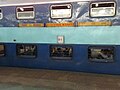 Flying Ranee Double Decker
 -
 Flying Ranee Chair Car
 -
 Flying Ranee at Vangaon railway station
 -
 12921 Flying Ranee – AC Chair Car coach
 -
 12921 Flying Ranee at Mumbai Central


References
[edit]- ^ 12922 Surat - Mumbai Central Flying Ranee
- ^ 12921 Mumbai Central - Surat Flying Ranee
- ^ "No more double decker for Flying Ranee, new rake in". The Times of India. 17 July 2023. ISSN 0971-8257. Retrieved 11 November 2024.
- ^ The Bombay Chronicle, 2 May 1937, page 34
- ^ "Famous Trains". Indian Railways Fan Club. Retrieved 7 July 2013.
- ^ History of "Flying Ranee"
- ^ History of the Bombay-Surat "Flying Ranee"
 Historical trains in India Historical trains in India  | |||||
|---|---|---|---|---|---|
| Active |
| ||||
| Defunct | |||||
| Operational (Non AC) |  | |
|---|---|---|
| Operational (AC) | ||
| Defunct | ||

Flying Ranee
View on GrokipediaOverview
Train Profile
The Flying Ranee is classified as a superfast express train, designated by the numbers 12921 (Mumbai Central to Surat) and 12922 (Surat to Mumbai Central), and is operated by the Western Railway zone of Indian Railways.[7] It provides daily service connecting Mumbai Central (MMCT) and Surat (ST), covering a distance of 263 km in approximately 4 hours and 40 minutes.[8] The train maintains an average speed of 56 km/h, inclusive of halts, while achieving a maximum operational speed of 110 km/h on India's standard broad gauge tracks measuring 1,676 mm.[9] Following its historical inception in 1906 as one of India's early named trains, the Flying Ranee underwent significant modernization in July 2023 with the introduction of Linke Hofmann Busch (LHB) rakes as its standard rolling stock, replacing older double-decker non-AC coaches to enhance safety and passenger comfort.[1][10]Significance and Legacy
The Flying Ranee has played a pivotal role in connecting Mumbai's bustling business hub with Surat's vital textile and diamond industries since its inception in the early 20th century, facilitating essential trade and commuter travel for merchants and workers. As a key link between these commercial centers, the train has supported the movement of goods and personnel, contributing to the economic vitality of western India by enabling daily commutes for diamond traders and textile professionals over the 263-kilometer route.[4][11][12] The nickname "Flying Ranee," bestowed in 1906 by the wife of the then District Superintendent of Bulsar (now Valsad), reflects its reputation for speed—"Flying" denoting its swift service—and "Ranee," meaning queen in Hindi, aligning with British-era conventions that imbued prestigious trains with royal connotations to symbolize reliability and status. This naming underscored its prestige among business travelers, who favored it for completing the Mumbai-Surat journey in approximately four hours, a remarkable feat at the time that cemented its status as a benchmark for superfast intercity services. By 1965, it was officially recognized as India's fastest medium-distance train, influencing the evolution of efficient rail connectivity in the region.[4][3] As one of India's oldest continuously operating named trains, spanning over a century of service, the Flying Ranee embodies the enduring legacy of pre-independence rail innovation and post-colonial modernization. Its introduction of double-decker coaches in 1979 marked it as the nation's first such train, enhancing capacity for growing passenger demands and setting a precedent for innovative rolling stock. In 2023, media coverage highlighted its transition to modern Linke-Hofmann-Busch (LHB) coaches, ending the non-AC double-decker era after 44 years and signaling a shift toward safer, more comfortable travel standards amid ongoing railway upgrades. This evolution underscores the train's adaptability and lasting impact on India's intercity transportation landscape.[3][5][13]History
Origins and Pre-Independence Era
The Flying Ranee was introduced in 1906 by the Bombay, Baroda and Central India Railway (BB&CI) as a weekend special service connecting Bombay Central to Surat, covering the 263 km route in 4 hours and establishing it as a pioneering superfast train of the era with an average speed of around 65 km/h excluding halts.[14][13] The service, primarily catering to business travelers and holidaymakers, was powered by steam locomotives, reflecting the technological standards of early 20th-century Indian rail transport under British administration.[3] Due to escalating resource demands and logistical strains from World War I, the train was discontinued on 24 April 1914, suspending the popular service for over two decades amid broader wartime disruptions to the railway network.[4] The forerunner service, known as the Flying Queen, was introduced on 1 May 1937 as a weekend special but quickly upgraded to a daily operation owing to high demand, linking Bombay Central and Surat with steam traction and maintaining its reputation for speed and reliability in the pre-war years.[15] However, with the onset of World War II in 1939, the service faced another interruption as railway resources were redirected to military needs, halting operations until the post-independence period.[14]Post-Independence Developments
Following India's independence, the Flying Ranee was permanently resumed as a daily service on 1 November 1950 under the unified Indian Railways system, departing Surat with eight coaches and accommodating around 600 passengers to reconnect the vital Mumbai-Surat corridor. The train transitioned from steam to diesel locomotives during the 1950s and 1960s.[3][12][16] The train's operations were integrated into the Western Railway zone on 5 November 1951, when the Bombay, Baroda and Central India Railway—its pre-independence operator—was reorganized and renamed, streamlining administration across the route from Mumbai Central to Surat.[17][18] Electrification of the Mumbai-Surat mainline progressed gradually from the 1960s onward under the 25 kV AC overhead system, initially using DC traction, to support faster and more reliable express services; the Flying Ranee transitioned from diesel to electric traction over time, with full AC conversion completed in 2012.[19] By the 1970s, surging passenger demand driven by industrial growth in Gujarat's textile and diamond sectors prompted coach capacity expansions; on 18 December 1979, the Flying Ranee became the first Indian train fitted with double-decker coaches, adding ten non-air-conditioned second-class units that boosted second-class seating to approximately 1,480 passengers and total train capacity to around 1,996 per trip.[4][3][1] In the 1980s, the introduction of air-conditioned chair car coaches marked a significant upgrade, providing climate-controlled seating for the roughly 3.5-hour journey and attracting more business commuters between Mumbai's commercial hub and Surat's trading centers.[20][21]Modern Upgrades and Changes
The route's electrification advanced with the completion of the DC to AC traction conversion on February 5, 2012, allowing the Flying Ranee to operate under consistent 25 kV AC electric power across its entire length, replacing the earlier mixed dual-traction system and improving efficiency and speed.[22][23] This upgrade eliminated the need for locomotive changes at intermediate points, reducing delays and operational costs while aligning with broader Indian Railways electrification goals. In July 2023, as part of post-COVID-19 safety and comfort enhancements, the double-decker coaches were phased out after over four decades of service and replaced with standard Linke-Hofmann-Busch (LHB) rakes, which offer superior crashworthiness, anti-telescoping features, and increased interior space for better passenger experience.[24][4] By 2025, digital ticketing and real-time tracking were fully integrated via the RailOne app, enabling mobile bookings with a 3% discount on unreserved tickets, live train location updates, and platform information, thereby modernizing access and reducing reliance on manual processes.[25][26]Operations
Route and Halts
The Flying Ranee operates along the Mumbai–Ahmedabad main line of Western Railway, spanning 263 kilometers from Mumbai Central in Maharashtra to Surat in Gujarat. This route hugs the Arabian Sea coast, passing through densely populated urban suburbs, rural coastal areas, and industrial belts, facilitating connectivity between two of India's major economic hubs. The line features quadruple tracks in the initial urban stretch from Mumbai Central through the suburbs to manage high-density commuter traffic, before narrowing to double tracks in less congested sections toward Gujarat. The train makes 12 intermediate halts, providing access to key residential, commercial, and industrial locales. These stops are strategically placed to serve both local passengers and those traveling between Mumbai and Surat. The full sequence of stations is as follows:| Station Name | Key Significance |
|---|---|
| Mumbai Central (MMCT) | Origin station; major terminus in Mumbai's commercial district. |
| Andheri (ADH) | Prominent suburban halt serving Mumbai's airport vicinity and IT parks. |
| Borivali (BVI) | Busy junction in Mumbai's northern suburbs, gateway to Sanjay Gandhi National Park. |
| Palghar (PLG) | Coastal stop in Palghar district, supporting local agriculture and fishing communities. |
| Dahanu Road (DRD) | Halt near Dahanu, known for its beaches and proximity to the Tansa Wildlife Sanctuary. |
| Vapi (VAPI) | Industrial powerhouse in Valsad district, hosting chemical, pharmaceutical, and manufacturing units; a vital stop for workforce commuting.[27][28] |
| Valsad (BL) | Key junction on the Mumbai–Delhi route, serving agricultural heartlands and nearby ports; significant for regional trade. |
| Bilimora Jn (BIM) | Junction facilitating connections to southern Gujarat's textile and diamond industries. |
| Amalsad (AML) | Minor halt in Navsari district, aiding rural passengers and local markets. |
| Navsari (NVS) | Important stop in Gujarat's cultural and educational center, with ties to Parsi heritage sites. |
| Maroli (MRL) | Coastal station supporting fishing and small-scale industries in southern Gujarat. |
| Sachin (SCH) | Halt near Surat's satellite town, linked to textile weaving clusters. |
| Udhna Jn (UDN) | Freight-oriented junction in Surat's industrial zone, handling cargo for diamonds, textiles, and exports; undergoing major redevelopment for enhanced capacity.[29] |
| Surat (ST) | Terminus; bustling commercial hub renowned for diamond polishing and textile trade. |