


Community hub
Recent from talks
Contribute something
Nothing was collected or created yet.
Golden Temple Mail
View on Wikipedia
| Golden Temple Mail | |||||
|---|---|---|---|---|---|
 | |||||
 Golden Temple Mail At Jalandhar City Junction railway station | |||||
| Overview | |||||
| Service type | Mail/Express | ||||
| Locale | Maharashtra, Gujarat, Madhya Pradesh, Rajasthan, Uttar Pradesh, Haryana, Delhi & Punjab | ||||
| First service | 1 September 1928 | ||||
| Current operator | Western Railways | ||||
| Route | |||||
| Termini | Bandra Terminus (BDTS) Amritsar Junction (ASR) | ||||
| Stops | 35 | ||||
| Distance travelled | 1,893 km (1,176 mi) | ||||
| Average journey time | 29hrs 00mnts | ||||
| Service frequency | Daily | ||||
| Train number | 12903 / 12904 | ||||
| On-board services | |||||
| Class |
| ||||
| Seating arrangements | Yes | ||||
| Sleeping arrangements | Yes | ||||
| Catering facilities | Available | ||||
| Observation facilities | Large windows | ||||
| Baggage facilities | Overhead racks | ||||
| Technical | |||||
| Rolling stock | LHB coaches | ||||
| Track gauge | 1,676 mm (5 ft 6 in) | ||||
| Operating speed | 65 km/h (40 mph) average including halts | ||||
| |||||
_Route_map.jpg)
The 12903 / 12904 Golden Temple SF Mail is a Daily Superfast Mail train operated by the Indian Railways that runs daily between Bandra Terminus (BDTS) in Maharashtra and Amritsar Junction (ASR) in Punjab. It is the fastest daily train from Mumbai to Amritsar. It is named after the Golden Temple at Amritsar. The train has operated with modern LHB coaches since 29 September 2020. Before the Partition of India, it would ferry passengers arriving by Steamer from Europe directly from the Ballard Pier in Bombay to the city of Peshawar on India's North-West Frontier.[1] The train ran as the Frontier Mail between 1928 and 1996.
It operates as train number 12903 from Bandra Terminus to Amritsar Junction and as train number 12904 in the reverse direction.
History
[edit]With the opening of the Indian Midland Railway's broad-gauge line between Itarsi and Tundla on 1 March 1889, the first through communication on the broad gauge between Bombay and Delhi was established. At the outset, 2 through carriages from Bombay were attached to the East Indian Railway's 1 Up Howrah–Kalka Mail at Tundla. From thereon, the train ran through to Kalka and Lahore with the name 5 Up Bombay mail. This pattern of operations continued until the early 1900s.
After the opening of the Agra–Delhi Chord railway in 1905, the Great Indian Peninsula Railway and the North Western State Railway started a new through service between Bombay and Lahore, going through Agra, Mathura, Delhi, Bathinda, Ferozepur, Kasur and Raiwind. The new service, christened The Punjab Mail, commenced operations from 15 March 1905, covering the distance of 2,560 kilometres (1,590 mi) in 50 hours.
From 1st April 1911, the Bombay, Baroda and Central India Railway (BB&CIR) started operating a through service between Bombay Colaba Terminus and Peshawar, running through Surat, Baroda, Nagda, Ratlam, Kota, Mathura, Delhi, Saharanpur, Ambala, Amritsar and Lahore, known as the Northern Express, covering 2,487 kilometres (1,545 mi) in 48 hours. In response, the Great Indian Peninsular Railway extended the Punjab Mail to run through to Peshawar.[2] However, owing to the lack of line capacity, both the Punjab Mail and the Northern Express ran together clubbed as a single train between Lahore and Peshawar via Narowal, Sialkot, Rawalpindi route until Lahore-Gujranwala-Rawalpindi line came up in 1920s.
In an effort to improve the quality of the train service, the BB&CI introduced the P&O Express (named after the Peninsular and Oriental Steam Navigation Company) from 27th October, 1927. This effort proved to be successful, and therefore, it was decided that the service be regularised. The erstwhile Northern Express (by now, called the Bombay Peshawar Mail), was sped, and it ran the same schedule as the P&O Express. It would operate with five coaches along with a luxury dining cum lounge car. The passengers of this train had access to luxurious retiring rooms at the stations on the route[2]
From 1st September 1928, the train began operating as the Frontier Mail. The then agent (now known as General Manager) of BB&CI Railway, Sir Ernest Jackson, believed that this train would compete well with the rival GIP Railway's Punjab Limited. Indeed, the Frontier Mail with its shorter route, reduced travel time to just seventy-two hours. During the autumn months between September and December, the train would depart from the Ballard Pier Mole station, on the Bombay Port Trust line. This was for the convenience of the British who arrived in India by the P&O steamer. For the rest of the year, while the train would ply from Colaba, a separate train would run from the mole station in order to enable steamer connectivity. Upon its arrival in Bombay, The BB&CIR Headquarter building outside the Churchgate station would be floodlit to announce the train's safe arrival.
Between 1928 and 1930, a flurry of changes took place in the train services between Bombay and Delhi. As a result of these changes, the Punjab Mail's run was terminated at Lahore from 1 March 1930. However, a bogie composite I and II class through carriage to Peshawar was still run on the Punjab Mail, being attached to the North Western Railway's Northern Express train between Lahore and Peshawar. For these years, the Frontier Mail continued the same route as the former Northern Express, i.e. via Bathinda between Delhi and Lahore. However from 1st September 1930, it was rerouted to run via Ambala and Amritsar on the way to Lahore. Even in the present day, the train follows this route until its terminus at Amritsar.[2]
The train was popular for its punctuality. It was believed that one's Rolex could let them down, but the Frontier Mail couldn't. In fact, when in August 1929, the train arrived 15 minutes late, the driver was asked to reason out the cause for the delay.[1]
During the unrest following the partition of India, the Punjab Mail, along with a host of other trains running to Lahore and beyond, was terminated at Delhi for the period between 1947 to 1948. Shortly after the partition and nationalization of Railways, the service was extended to Dera Baba Nanak near Amritsar on the India–Pakistan border. The train still runs on this route to this day but uptill Amritsar only. The train was finally renamed as the Golden Temple Mail in 1996.
The Frontier Mail also finds a place in romanticised biographies of film actor Prithviraj Kapoor who is believed to have travelled to Bombay from his hometown of Peshawar by the Frontier Mail in 1928 to act in films. Hunterwali, probably India's first action heroine, acted in the film Miss Frontier Mail. The Frontier Mail was the first air conditioned train in the Indian Peninsula. It received an air-conditioned compartment in 1934. Radio facility was provided for the first time on the Golden Temple Mail.
Coaches
[edit]The 12903/04 Golden Temple Mail has one AC First Tier, three AC 2 tier, six AC 3 tier, six Sleeper class, two General unreserved coaches, one General cum baggage coaches. It also has one Railway Mail service coach, one Pantry car & one High Capacity Parcel Van.
Service
[edit]The Golden Temple Mail runs between Bandra Terminus and Amritsar Junction. It is a daily service covering the distance of 1891 km in 29 hours 00 minutes as 12903 Golden Temple Mail averaging 65.28 km/h and 29 hours 15 minutes as 12904 Golden Temple Mail averaging 64.72 km/h.
1955 Crash
[edit]The train operating the service collided with another train in 1955, killing one and injuring 34.[3]
Traction
[edit]It is now regularly hauled by a Vadodara Loco Shed based WAP-7 locomotive from end to end.
Route & halts
[edit]The train runs from Bandra Terminus via Borivali, Surat, Vadodara Junction, Ratlam Junction, Nagda Junction, Kota Junction, Sawai Madhopur Junction, Gangapur City, Bharatpur Junction, Mathura Junction, Hazrat Nizamuddin, Ghaziabad Junction, Meerut City, Muzaffarnagar,Saharanpur Junction, Ambala Cantonment Junction, Ludhiana Junction, Phagwara, Jalandhar City Junction, Beas Junction to Amritsar Junction. The train previously use to Originate from Mumbai Central Terminus.
Gallery
[edit]-
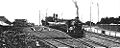 The Frontier Mail departing Ballard Pier Mole Station (c. 1930s)
 -
 Vadodra based WAP-7 locomotive for Golden Temple Mail.
 -
 Sleeper Non-AC LHB coaches of Golden Temple Mail.
 -
 AC 3 tier LHB coach of Golden Temple Mail.
 -
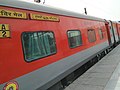 AC 2 tier LHB coach of Golden Temple Mail.
 -
 12903 Golden Temple Mail Blue ICF coach HA1
 -
 12903 Golden Temple Mail Blue ICF coaches
 -
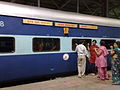 Golden Temple Mail – Blue ICF AC 3 tier coach
 -
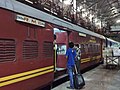 Red ICF Mail coach of Golden Temple Mail
 -
 Golden Temple Mail At Jalandhar City Junction


References
[edit]- ^ a b Shankar, S. "Classic Trains of India- Frontier Mail". www.irfca.org. Archived from the original on 24 June 2002.
- ^ a b c "[IRFCA] Indian Railways FAQ - Famous Trains of IR". www.irfca.org. Retrieved 17 August 2025.
- ^ https://eparlib.nic.in/bitstream/123456789/55981/1/lsd_01_09_22-03-1955.pdf Page no. 50
External links
[edit]- The History of this train at IRFCA
- A PDF document on the history of Frontier Mail
- A description of journeys on the Frontier mail by Norma Probert, the daughter of Percival Middlecoat, senior locopilot of the train during its early years.
- A BB&CIR poster from 1929, advertising the train as the 'Fastest Daily Train Service of India'
- BB&CIR 1937 Timetable: contains time tables for the Frontier Mail
- Golden Temple Mail Train Arrival, Departure times, and other general
- [1] Information on the 1955 accident of Frontier mail (pg.50)
- Golden Temple Mail Route Map
- [2]

 Historical trains in India Historical trains in India  | |||||
|---|---|---|---|---|---|
| Active |
| ||||
| Defunct | |||||
Golden Temple Mail
View on GrokipediaHistory
Inception and Early Operations
The Frontier Mail, the predecessor to the Golden Temple Mail, commenced operations on 1 September 1928 under the Bombay, Baroda and Central India Railway, linking Ballard Pier Mole Station in Bombay to Peshawar via Delhi, Bathinda, Ferozepur, and Lahore.[3] [6] The inaugural route spanned the North-West Frontier Province, serving primarily British officials, civil servants, and mail transport from European steamers arriving at Bombay.[4] Initial consists featured six carriages capable of carrying around 450 passengers alongside postal and goods services.[7] Early operations emphasized reliability over speed, with steam locomotives providing traction and engine changes at inclines like Igatpuri to manage ghat sections.[8] The train maintained an average speed of approximately 50 km/h, achieved through scheduling priority and restriction to seven major intermediate stops, facilitating efficient long-distance connectivity in the pre-electrification era.[9] This service supported trade routes, administrative travel to frontier regions, and emerging pilgrimage demands, underscoring its role as a vital artery in British India's rail network.[10] Following the 1947 Partition of India, the route was realigned to terminate at Amritsar, adapting to altered borders while preserving the link between western India and Punjab.[3] The train's association with the Harmandir Sahib ([Golden Temple](/page/Golden Temple)) gained prominence post-independence, reflecting its facilitation of Sikh pilgrimages and regional commerce, though formal renaming to Golden Temple Mail occurred later in 1996.[4] Conventional bogie stock and steam power defined these formative years, with the service evolving to handle increased civilian and economic traffic amid India's railway nationalization in 1951.[11]Major Upgrades and Modernization
Following Indian independence, the Golden Temple Mail transitioned from steam traction to diesel locomotives during the 1970s, aligning with Indian Railways' broader phase-out of steam engines, which concluded by the mid-1980s. This shift improved operational efficiency by reducing fuel dependency and maintenance needs associated with steam technology. Subsequently, electric traction was introduced in the 1980s as key sections of the Mumbai-Delhi-Amritsar route were electrified, including the completion of the Delhi-Mumbai trunk route via Western Railway by January 1988.[12][13] Electrification of the corridor, progressing through the 1970s and 1980s, enabled the use of high-powered electric locomotives, enhancing reliability and reducing transit times compared to diesel operations. For instance, the average speed of long-distance trains like the Golden Temple Mail increased from approximately 50 km/h under steam traction to over 55 km/h with electric haulage, driven by improved acceleration and fewer loco changes. This modernization effort, documented in Indian Railways' electrification milestones, supported consistent performance on the electrified broad-gauge network.[12][14] In the 1990s, the train received upgraded air-conditioned coaches, expanding beyond its pioneering AC facilities from the pre-independence era to include modern AC 2-tier and AC 3-tier classes, reflecting Indian Railways' push for passenger comfort enhancements. Concurrently, the service was reclassified as a superfast express under numbers 12903 (Mumbai to Amritsar) and 12904 (return), requiring an average speed exceeding 55 km/h, which it achieved at around 59 km/h over its 1,893 km route. These upgrades, facilitated by infrastructure investments, prioritized empirical improvements in speed and reliability over earlier limitations.[6][15]Route and Operations
Route Description and Halts
The Golden Temple Mail traverses a 1,891-kilometer route on Indian Railways' broad-gauge network from Bandra Terminus in Mumbai, Maharashtra, to Amritsar Junction in Punjab, passing through Gujarat's industrial corridors, Madhya Pradesh's border regions, Rajasthan's arid plains, the urban expanse of Delhi and Haryana's agricultural belts, and Punjab's fertile Doab region.[16] The path encounters varied geographical features, including initial coastal and riverine flats near Surat, semi-arid scrublands and low hills in Rajasthan around Kota and Sawai Madhopur, and flat alluvial plains in Punjab, with no significant mountain passes but occasional challenges from sand drifts in desert sections and high passenger density near Delhi.[17] The tracks, standardized at 1,676 mm broad gauge, support electric traction following progressive electrification of the route's key segments, aligning with Indian Railways' network-wide upgrades that reached near-completion by 2025.[18] The scheduled journey spans 29 hours, accommodating 32 halts for passenger boarding, freight precedence, and operational needs.[2] Major halts include the following, with approximate cumulative distances from Bandra Terminus:| Station | Approximate Distance (km) |
|---|---|
| Borivali | 20 |
| Surat | 263 |
| Vadodara Junction | 402 |
| Ratlam Junction | 600 |
| Kota Junction | 940 |
| Sawai Madhopur | 1,050 |
| Mathura Junction | 1,300 |
| New Delhi | 1,400 |
| Ludhiana Junction | 1,700 |
| Jalandhar City | 1,800 |