Hubbry Logo
Fort CarrollFort CarrollMain
Open search
Fort Carroll
Community hub
Fort Carroll
logo
8 pages, 0 posts
0 subscribers
Be the first to start a discussion here.
Fort Carroll
Fort Carroll
from Wikipedia

Fort Carroll
Fort Carroll, Baltimore, Maryland
Fort Carroll is located in Maryland
Fort Carroll
Fort Carroll is located in the United States
Fort Carroll
LocationSoller's Flats, in the Patapsco River, near Curtis Bay, Maryland
Coordinates39°12′53″N 76°31′09″W / 39.21472°N 76.51917°W / 39.21472; -76.51917
Area3.4 acres (1.4 ha)
NRHP reference No.14000955[1]
Added to NRHPApril 14, 2015
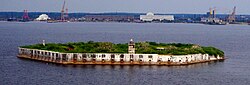
Fort Carroll, next to the Key Bridge

Fort Carroll is a 3.4-acre (1.4 ha) artificial island and abandoned hexagonal sea fort in the middle of the Patapsco River, just south of Baltimore, Maryland. It is named for Charles Carroll of Carrollton (1737–1832), a signer of the Declaration of Independence.

Design and construction

[edit]

In 1847, the State of Maryland permitted the United States War Department to construct a fort in the shallow water of Soller's Point Flats to protect the city of Baltimore. Fort Carroll was important for the defense of Baltimore—before the fort's construction, Fort McHenry just outside the city was the only military defensive structure between Baltimore and the Chesapeake Bay. The fort was part of the "Permanent System" or Third System construction program, which aimed to defend America's most important ports.[2]

Then Brevet-Colonel Robert E. Lee designed the hexagonal structure and supervised the construction, which the U.S. Army Corps of Engineers commenced in 1848. The fort received its name on October 8, 1850. In 1852, Lee left Baltimore to become Superintendent of the United States Military Academy at West Point.

In 1853, a lighthouse, now abandoned, was built on the ramparts to aid navigation into Baltimore Harbor. In 1898, a new lighthouse was built, which is still seen today. It was automated in 1920 and discontinued operations sometime before 1945.

The original design foresaw the fort armed with 225 cannons on three levels. However, in April 1861, at the American Civil War outbreak, Fort Carroll's walls were still less than half the planned height of thirty feet. Only five gun platforms were ready, and only two were armed. Still, the Army placed about thirty cannons and occupied the fort throughout the war. In April 1864, torrential rains flooded the fort's magazines, which led the Army to move all the powder and ammunition to Fort McHenry.

A diagram of the fort based on a 1914 topographic map

Spanish–American War

[edit]

When the United States entered the Spanish–American War in 1898, the Army again defended the fort, although the batteries were completely obsolete by then. The Army, therefore, commenced the construction of modern concrete gun emplacements following the Board of Fortifications designs. The Army created three batteries: Battery Towson[Note 1] (two 12" barbette carriage guns), Battery Heart[Note 2] (two 5-inch M1897 guns on balanced pillar mounts) and Battery Augustin[Note 3] (two 3" balanced pedestal-mount guns).

Fort Carroll. Note that the industrial plant in the background is not on the island.

The new batteries were ready by September 1900, well after the war's end. They received their names on March 30, 1903.

World War I and afterwards

[edit]

After World War I broke out, in 1917, the Army removed the guns from Battery Heart, and in 1918, those from Battery Towson to use elsewhere. By 1920, all guns had been removed from the fort.

In March 1921, the Army officially abandoned Fort Carroll and moved whatever military equipment was left to nearby Fort Howard. The War Department declared the island excess property in 1923 but took no immediate steps to sell the land. A variety of proposals for the use of the island were advanced, including a prison, as well as a 1923 plan advanced by Baltimore mayor William Broening to place an electric "Welcome to Baltimore" sign on the island, accompanied by a statue of Lord Baltimore.[3]

In World War II, the Army used the fort as a firing range. It also served as a checkpoint for vessels.

In May 1958, Baltimore attorney Benjamin Eisenberg purchased the island for US$10,000 (equivalent to $111,592 in 2025), intending to put a casino there, but development plans never materialized.[3] The fort is now an involuntary park. It is also a site for occasional urban explorations (which constitute trespass). In 2013, Preservation Maryland placed Fort Carroll on its list of threatened historic properties.[4] It was listed on the National Register of Historic Places in 2015.[1]

On April 19, 2024, the third temporary alternate channel established after the collapse of the Francis Scott Key Bridge was named after the fort, the beginning of which is to its immediate west.[5]

The three temporary channels as of April 20, 2024

References

[edit]

Notes

[edit]

Further reading

[edit]
[edit]
Revisions and contributorsEdit on WikipediaRead on Wikipedia
from Grokipedia
Fort Carroll is a hexagonal and artificial island situated in the within Baltimore Harbor, , constructed as a coastal defense to protect the city from naval threats. Built on Soller's Point Flats approximately 4.5 miles southeast of and 7 to 8 miles from , the 3.4-acre site features a 246-foot-per-side perimeter with multi-level casemates originally designed to mount up to 225 cannons. Construction of Fort Carroll began in 1848 under the supervision of the U.S. Army Corps of Engineers as part of the Third System of fortifications, with the artificial island formed using a diving bell, wooden piles, and dredged materials from the riverbed. The design was primarily the work of General Joseph Gilbert Totten, Chief of Engineers, though Brevet-Colonel Robert E. Lee provided significant input during the initial planning phase in 1847. Named in honor of Charles Carroll of Carrollton, the last surviving signer of the Declaration of Independence, the fort included utilitarian structures such as a blacksmith shop, carpentry shop, artesian well, and granite stairs leading to brick archways. A lighthouse was added in 1854 atop the parapet, featuring a sixth-order Fresnel lens, which was replaced in 1898 by a square wooden tower with a fifth-order lens; the light was automated in 1920 and fully deactivated in 1945. The fort saw limited active use despite its formidable design, serving as a garrison during the Civil War and Spanish-American War, and later as a storage site for naval mines, a detention facility for foreign seamen, and a pistol range for the 39th Coast Artillery. Flooding damaged the structure in 1864, and by the early , advancements in weaponry rendered it obsolete, leading to its abandonment as a military post in 1921 following . Declared excess federal property in 1923, it was sold to private owners in 1958, but repeated redevelopment attempts have failed, leaving the site in advanced disrepair with salvaged steel from efforts contributing to its decay. Today, Fort Carroll holds historical significance as a well-preserved example of 19th-century coastal engineering, listed on the since 2015, and praised by contemporaries as "a finer piece of engineering work of its kind." Ecologically, the surrounding waters support a thriving , bolstered by restoration efforts from the Chesapeake Bay Foundation since the 1990s, including the planting of over 6 million oysters since 2018 to enhance water filtration and in the urban harbor environment, with ongoing efforts continuing into 2025, including plantings following the 2024 bridge collapse. The site remains inaccessible except by boat and is visible from the site of the former Bridge and Fort Armistead Park, serving as an educational focal point for Harbor environmental programs.

Background

Location and Strategic Importance

Fort Carroll is situated on a 3.4-acre (1.4 ha) artificial island in the , approximately 7 to 8 miles southeast of , , at coordinates 39°12′52″N 76°31′12″W. The island was constructed on , a shallow area in the river's mid-channel, to serve as a strategic barrier controlling access to Harbor. This positioning allowed the fort to command the narrowest navigable portion of the , effectively blocking potential enemy naval advances toward the city's vital port facilities. The fort's development was driven by 19th-century U.S. coastal defense imperatives, particularly following the vulnerabilities exposed during the , when British naval forces threatened major American ports including . The bombardment of in 1814, though repelled, highlighted the need for enhanced fortifications to protect Baltimore's economic lifeline as a key hub for trade and commerce. In response, Congress initiated the Third System of fortifications in 1816, a comprehensive program to modernize and expand seacoast defenses against European naval powers, with over $800,000 allocated initially for stone and brick structures at critical harbors. As part of this Third System, Fort Carroll complemented existing defenses like by providing a downstream to repel invasions before they reached the . Its location on the ensured that any hostile fleet would face enfilading fire from multiple angles, integrating with the broader network of Third System forts designed for layered, mutually supporting harbor protection. This strategic placement underscored Baltimore's status as one of the nation's most defended ports during the era.

Naming and Authorization

The authorization for Fort Carroll originated in 1847, when the granted permission to the War Department to construct fortifications on the shallow waters of Soller's Point Flats in the , addressing the strategic need to protect Harbor from potential naval threats. In 1850, during the early stages of construction, the site was officially named Fort Carroll in honor of (1737–1832), a native and the last surviving signer of the Declaration of Independence, recognizing his contributions to American independence and state heritage. Initial funding for the project was allocated by the U.S. War Department, with oversight and engineering approval managed by the Corps of Engineers under Chief Engineer General Joseph G. Totten, as part of the broader Third System of coastal fortifications—a national defense program initiated in 1816 to modernize and strengthen harbor defenses across key American ports.

Design and Construction

Architectural Design

Fort Carroll's architectural design was conceived by Brevet Colonel in 1848 as part of the Third System of U.S. coastal fortifications, featuring a distinctive hexagonal layout to optimize defensive coverage in Harbor. The fort was planned as a multi-tiered fort on an , with each side measuring approximately 246 feet, encompassing a total area of about 3.45 acres. At its core, the design included a central parade ground surrounded by casemates for housing artillery and troops, reinforced by ramparts to provide elevated firing positions. This configuration allowed for overlapping fields of fire, enhancing the fort's ability to repel naval threats through enfilading fire from strategically placed embrasures in the casemates. The structure was engineered for heavy armament, with provisions for 225 cannons distributed across three levels: lower and middle batteries for close-range defense and an upper tier for longer-range engagements. Supporting these were bomb-proof magazines designed to store securely beneath the main structure, protected from enemy . The walls incorporated scarp elements—steep inner faces to deflect incoming projectiles—further bolstering resilience. Construction materials emphasized durability in a maritime environment, with the exterior walls built from large blocks quarried for strength against fire, while interiors utilized masonry arches and infill for stability and fire resistance. The foundation was created using wooden piles driven up to 45 feet into the riverbed in waters 12 to 15 feet deep, topped with a grillage of timbers and filled with massive stones and mud to form a stable base before erecting the fort proper. This innovative approach, aided by early diving bells and steam-powered pile drivers, addressed the challenges of building on shifting shoals like Sollers Point Flats.

Construction Timeline

Construction of Fort Carroll began in 1848 under the supervision of the , with the initial phase focused on forming an at Sollers Point Flats in the using dredged materials from the riverbed between 1848 and 1851. Engineers employed a to place foundations, driving huge piles into the water 12 to 15 feet deep, followed by a wooden grillage layered with stones and mud fill to create a stable base approximately 3.4 acres in size. By 1857, seawalls were completed, and a total of 85,561 cubic yards of sand had been excavated to support the structure. , then a brevet , oversaw much of this early work until 1852, when funding constraints temporarily slowed progress. Progress continued under subsequent engineers like Henry Brewerton until the outbreak of the Civil War in 1861, at which point the fort's walls stood at less than half the planned 30-foot height, with only five gun platforms ready and two batteries armed, mounting a total of 14 guns. The war halted major construction efforts, exacerbating challenges such as material shortages and labor difficulties amid national resource strains, while tidal flooding posed ongoing risks to the incomplete structure. In April 1864, torrential rains flooded the fort's magazines, forcing the relocation of ammunition to and highlighting vulnerabilities in the partially built defenses. Following the Civil War, construction resumed in 1865 under engineers including J.G. Foster, W.H.C. Whiting, and William P. Craighill, who took charge in 1871. Major work in the 1870s and 1890s involved adding casemates for gun emplacements, water cisterns for supply, and earthwork ramparts to bolster the fortifications against evolving threats. Despite these efforts, funding limitations and structural issues like settling and worm damage to piles persisted, preventing full realization of the original design for 225 guns across three tiers. By 1900, the fort remained incomplete, though modern concrete batteries—Towson, Heart, and Augustin—were finished that September to accommodate larger artillery.

Associated Lighthouse

Fort Carroll's navigational infrastructure included lighthouses designed to mark the hazardous amid the Patapsco River's shipping channels, ensuring safe passage for vessels approaching Harbor. The first was established in 1854 as a small wooden structure mounted on the fort's , featuring a sixth-order to provide visibility for mariners navigating the turn from Brewerton Channel to Channel. This initial setup was relocated multiple times during the ongoing fort construction to accommodate defensive works, demonstrating its adaptive integration with the military site. By 1875, due to structural needs, the was transferred to a new wooden tower erected on the fort's southwest salient, reusing the original lens and fog bell for continued service. The lighthouse was strategically positioned along the island's edge, away from primary gun emplacements, to illuminate shipping lanes without compromising the fort's defensive layout or line of fire. In 1898, the aging original tower and fog bell structure were demolished to install gun batteries, prompting the construction of a replacement square wooden tower approximately 100 feet north, equipped with a fifth-order Fresnel lens and activated on December 30 of that year. This second lighthouse underwent automation in 1920, converting to acetylene gas illumination and a compressed gas fog signal to reduce manned operations amid the fort's declining military role. Following the fort's reduced activity, the U.S. Coast Guard assumed maintenance responsibilities for the light station, preserving its navigational function independent of active defense duties. Technological advancements rendered it obsolete, leading to its deactivation in 1945. As of 2025, remnants of both lighthouses persist in ruins on the overgrown island, with the 1898 square wooden tower particularly deteriorated—its frame exposed to weathering, vegetation overgrowth, and lack of upkeep, placing it on preservation watchlists as an endangered . The earlier 1854-era components have long vanished, leaving only the later structure as a weathered testament to early coastal navigation aids, now serving incidentally as habitat amid the fort's abandonment.

Military Use

Civil War Service

During the , Fort Carroll, located in the south of , , was garrisoned by U.S. Army troops as part of the harbor defenses protecting the city from potential Confederate naval incursions. Despite its incomplete state—with only two of the five gun platforms armed at the outbreak of hostilities in April 1861, as the walls were incomplete—the fort was manned throughout the conflict to serve as a deterrent, though it saw no direct combat action. The armament consisted of approximately 30 cannons placed on the unfinished platforms, a fraction of the original design's planned 225 guns across multiple tiers. These weapons, primarily pieces, were positioned to command the river approaches, contributing to the overall defensive network alongside . In 1864, severe flooding from torrential rains damaged the structure, prompting the temporary relocation of powder magazines and ammunition to for safety, while the garrison maintained operations with adjustments to the parapets for stability. Following the war's end in , the at Fort Carroll was significantly reduced as the immediate threat diminished, though a small detachment remained until construction efforts resumed in earnest during the 1870s. This reflected the broader scaling back of wartime fortifications, with the fort's role shifting from active defense to reserve status.

Spanish–American War Modernization

With the outbreak of the in April 1898, Fort Carroll was reactivated to bolster defenses against potential threats from the Spanish fleet to Baltimore Harbor and the East Coast, though no combat occurred during its brief service. A detachment of the 39th Coast Artillery manned the fort, utilizing its obsolete Third System batteries from the Civil War era while preparations for modernization began. During the war, the fort also served as a storage site for naval mines. As part of the Endicott Board's coastal defense program, the U.S. Army demolished the outdated Third System batteries and constructed three modern concrete emplacements between 1898 and 1900 to equip the fort with contemporary weaponry. Battery Towson featured two 12-inch M1888 rifles on M1892 carriages for long-range coastal bombardment; Battery Heart mounted two 5-inch M1897 guns on balanced pillar mounts for intermediate defense; and Battery Augustin held two 3-inch M1898MI rapid-fire guns on masking parapet mounts for close-range anti-ship fire. These batteries were completed and transferred to the Coast Artillery in 1900, with naming formalized on March 30, 1903, marking the fort's enhanced readiness despite the war's conclusion. Post-upgrade, Fort Carroll's armament totaled six primary guns across the new batteries, supplemented by smaller rapid-fire weapons, at a construction cost of approximately $100,000 for the emplacements—Battery Towson at $79,937, Battery Heart at $12,300, and Battery Augustin at $7,600—representing the site's peak defensive capability before technological obsolescence in subsequent decades.

World War I Operations

During , Fort Carroll played a limited role in the harbor defense of , primarily manned by detachments from nearby as part of the Artillery District of . The fort was garrisoned intermittently between 1917 and 1918 to support coastal surveillance and readiness, though it saw no combat engagements or active artillery firing. With the primary threats shifting toward incursions in U.S. waters, defensive efforts in Baltimore Harbor emphasized non-artillery measures, including the U.S. Navy's deployment of anti-submarine nets across the region to protect key ports. The fort's Endicott-period batteries, including those from the Spanish-American War era, were maintained in a standby status but received minimal operational use. In 1917, the two 5-inch guns of Battery Heart were removed for redeployment to active fronts, followed by the two 12-inch disappearing guns of Battery Towson in 1918. The remaining two 3-inch guns in Battery Augustin were retained through the war but saw no service. Post-armistice accelerated the fort's decline under broader U.S. military initiatives. All guns, including those in Battery Augustin, were removed by May 1920, leaving the installation disarmed. The U.S. Army officially abandoned Fort Carroll in March 1921, transferring remaining equipment to Fort Howard and placing it under caretaker status with only basic preservation efforts. The War Department declared the site surplus property in 1923.

World War II Role

Following its abandonment in the years immediately after , Fort Carroll saw limited reactivation during primarily for auxiliary purposes rather than active combat defense. The site, under the oversight of the U.S. military including the (temporarily integrated into the U.S. Navy from 1941 to 1946), functioned without a permanent garrison but supported harbor security and training activities in Baltimore Harbor. The fort served as a firing range for small-arms and practice, allowing to conduct live-fire exercises on the isolated . Additionally, it acted as a checkpoint for incoming vessels, where foreign seamen were temporarily housed in quarters while their ships underwent fumigation to prevent the spread of pests and diseases before proceeding to the . This role underscored the fort's strategic position in the , aiding in the regulation of maritime traffic during wartime restrictions. By 1945, at the conclusion of the , Fort Carroll was fully deactivated from use, with no ongoing maintenance allocated to its structures. The island's fortifications and ancillary buildings were left to weather and decay, marking the end of its service in modern conflicts.

Deactivation and Legacy

Post-World War I Abandonment

Following the end of , the U.S. Army officially abandoned Fort Carroll as a post in March 1921, transferring any remaining equipment to nearby Fort Howard. In 1923, the War Department declared the island excess property, initiating the full decommissioning process. By 1925, all armaments, including the guns emplaced during the war, had been removed, leaving behind only the fort's casemates and structural remnants. The associated Fort Carroll Lighthouse, automated in 1920, continued operating until it was deactivated in 1945. With no active military or maintenance presence, the fort entered a phase of rapid neglect, as the federal government made no efforts to preserve or secure the property during this period. From the 1920s through the 1940s, the exposed island structures suffered significant deterioration from natural erosion caused by tidal forces in the and human vandalism, including unauthorized scavenging of materials. Despite its isolation and deteriorating condition, the site saw informal civilian use, with locals accessing the island for fishing and early activities amid the emerging ruins. The federal government retained ownership throughout the 1940s, allowing the fort to remain unsecured and unmaintained, which accelerated its decay into an overlooked relic.

Mid-20th Century Ownership Changes

In 1958, the U.S. government sold Fort Carroll to attorney Benjamin N. Eisenberg for $10,000 through the U.S. Army Corps of Engineers, marking the end of federal ownership after decades of abandonment following . Eisenberg envisioned transforming the site into a featuring slot machines to attract visitors, capitalizing on its isolated location in the , but the plans collapsed when courts determined the island fell within County, where gambling was prohibited, unlike the more permissive Anne Arundel County. Subsequent ideas by Eisenberg, such as installing fake cement cannons for a or even a 20-story , also failed to materialize due to logistical and regulatory hurdles. Ownership remained with the Eisenberg family into the 1960s, when developer Robert L. Jackson leased the fort in 1964 with intentions to ferry day-trippers there via for picnics and outings. This venture proved short-lived, lacking the infrastructure and sustained interest needed to succeed, leaving the site largely unused amid its ongoing neglect. By the late , the Eisenbergs, including sons Alan G. and Irvin D., continued holding the property, assessed at $31,500 in 2004, while exploring occasional redevelopment options without success. In the 1990s, developer C. William Struever, president of Struever Bros., Eccles & Rouse, acquired a on the island with plans to convert it into a conference center, aiming to stabilize and repurpose the deteriorating structure. However, these efforts were abandoned around 2003 due to challenges in access, utilities, and construction on the remote , resulting in the fort remaining vacant and increasingly overgrown. Over time, the site's inaccessibility fostered its reputation among urban explorers, though it has never been developed for such activities. As owned by the Eisenberg family as of , Fort Carroll prohibits public access, with legal restrictions enforced through remnants, , and occasional patrols to prevent trespassing on the hazardous, unstable terrain; the site's visibility increased following the March 2024 collapse of the nearby Bridge.

Preservation and Current Status

National Register Listing

Fort Carroll was nominated to the (NRHP) and officially listed on April 14, 2015, under reference number 14000955, recognizing its importance in military architecture and its associations with the Civil War era. The nomination emphasized the fort's role as a key defensive structure built to protect Harbor, highlighting its historical contributions to U.S. coastal fortifications during a period of national vulnerability. The property met NRHP Criteria A (for its association with significant historical events, particularly Civil War defense operations) and C (for its distinctive engineering and architectural design). Its significance stems from the innovative overseen by Brevet Colonel , who designed the hexagonal granite structure as part of the Third System of U.S. seacoast defenses—a rare surviving example of this 19th-century approach aimed at mounting heavy to deter naval threats. The registered boundaries encompass the entire 3.45-acre , including all structures and the surrounding perimeter at the mean low water line, ensuring comprehensive protection of the site's integrity. Prior to its NRHP listing, Preservation Maryland designated Fort Carroll as a "threatened" historic property in 2013, citing ongoing decay from environmental exposure and pressures from potential development that could compromise its preservation. Supporting the nomination, initial surveys documented by the in 2015—drawing from a spring 2014 architectural assessment—underscored the fort's batteries' remarkable structural integrity, with stable foundations and rehabilitative potential, even amid challenges like and prolonged abandonment.

Recent Developments and Threats

The collapse of the Bridge on March 26, 2024, prompted the U.S. to establish the Fort Carroll Temporary Alternate Channel on April 20, 2024, providing a 20-foot-deep, 300-foot-wide pathway for non-deep-draft commercial vessels near the site. This development, part of efforts to restore port access, inadvertently heightened public awareness of the adjacent Fort Carroll, drawing media attention to the abandoned island's historical significance and isolation. In the 2020s, Fort Carroll has gained popularity among urban explorers, with visits frequently documented and shared on platforms like and , showcasing its decaying architecture and bird colonies. These activities have raised significant concerns due to unstable structures, uneven , and exposure to the elements, prompting stricter enforcement of no-trespassing rules by authorities to prevent injuries and further damage. As of November 2025, the fort continues to deteriorate from relentless exposure to weather, including storms and tidal erosion, exacerbated by vandalism and foot traffic from unauthorized visitors. In May 2025, the Foundation and partners resumed oyster restoration efforts at the Fort Carroll sanctuary , over a year after the Key Bridge collapse disrupted activities; this included planting additional oysters to support the thriving underwater ecosystem and enhance water quality in Baltimore Harbor. Proposals for , such as eco-tourism ventures or environmental hubs, alongside fears of outright demolition through neglect, have faced strong opposition from historians and preservation groups, who emphasize the site's role in 19th-century coastal defenses. Fort Carroll remains under private ownership by a group including Beverly Eisenberg, with no ongoing restoration projects despite its 2015 listing on the . The monitors the property for compliance with standards, ensuring any potential alterations respect its integrity.

References

Add your contribution
Related Hubs
User Avatar
No comments yet.