Hubbry Logo
Fort FunstonFort FunstonMain
Open search
Fort Funston
Community hub
Fort Funston
logo
8 pages, 0 posts
0 subscribers
Be the first to start a discussion here.
Fort Funston
Fort Funston
from Wikipedia

Recent photo of an emplacement of Battery Davis. Some of the earth covering the fort has eroded.

Key Information

An image showing the large Dutch sand ladder leading from the parking lot to the beach at Fort Funston.
Steps from the southwest corner of the parking area to the beach.
A 16-inch gun on the road to the fort
Assembling a 16-inch gun carriage at the fort
Panama mount fallen from cliff due to erosion. Another mount can be seen at the top of the cliff.

Fort Funston is a former harbor defense installation located on the West Side of San Francisco in the southwestern part of the city. Formerly known as the Lake Merced Military Reservation, the fort is now a protected area within the Golden Gate National Recreation Area (GGNRA) and is used widely as an off-leash dog park. It was named in honor of Frederick N. Funston (1865–1917), a Major General in the United States Army with strong connections to San Francisco, and included several artillery batteries. The fort is located on Skyline Boulevard at John Muir Drive, west of Lake Merced.

The fort was constructed upon windswept headlands along the Pacific coast and Ocean Beach below, above steep sandstone cliffs that provide a nesting habitat for a colony of bank swallows (Riparia riparia). The last remnants of a sand dune ecosystem that once covered the western half of San Francisco grow along the top of the headlands, with trailheads forming part of the California Coastal Trail that runs through San Francisco County.[1]

History

[edit]

The land was acquired by the federal government in 1900 as the Lake Merced Military Reservation, originally intended to accommodate two 12-inch coast defense mortar batteries in the Coast Defenses of San Francisco (later Harbor Defenses). However, nothing significant was built there until after the American entry into World War I in early 1917. The fort, renamed for Major General Frederick Funston shortly after his death in 1917, began to take shape during World War I, with the construction of a parade ground, barracks and a series of coastal batteries. These were Battery Howe with four 12-inch mortars and Battery Bruff with two 5-inch M1900 guns on pedestal mounts. These weapons were relocated from Batteries McKinnon and Sherwood at Fort Winfield Scott, adjacent to the Presidio.[2][3] Battery Howe was named for Walter Howe, a general and veteran of the Indian war who died in 1915. Battery Bruff was named after Lawrence Bruff, an Ordnance Corps colonel and instructor at West Point who died in 1911. In 1920 Battery Bruff was disarmed due to a withdrawal from Army service of the 5-inch gun.[2] In the early 1920s, Anti-aircraft Battery No. 5 of three 3-inch guns was built at the fort.[4]

Following World War I, the Washington Naval Treaty of 1923 caused the cancellation of numerous battleships and battlecruisers building and planned for the US Navy. Some of the guns intended for these ships were made available to the United States Army Coast Artillery Corps to defend key ports against a potential naval attack. However, only a few of these weapons were emplaced prior to the outbreak of World War II in September 1939. In 1936–1939 Battery Davis was built at Fort Funston, housing two 16-inch Mark 2 Navy guns.[3] These 143-ton guns were moved on railroad cars in 1937 from Mare Island Naval Shipyard to Southern Pacific's Ocean View Station.[5] This was the prototype US 16-inch battery for casemating against air attack, which was adopted for almost all US 16-inch batteries built during the war and retrofitted to most pre-war batteries of this type. It was also the prototype for the Army's M2 carriage; previous ex-Navy 16-inch guns had used a modified M1919 carriage designed for the 16-inch gun M1919.[6] Battery Davis was named for Major General Richmond P. Davis, a Coast Artillery officer who served in France in World War I, retired in 1929 and died in 1937.[7] Also, an unnamed battery of four 155 mm guns on concrete "Panama mounts" was built at the fort circa 1938.

In 1940 Battery Davis was joined by Battery Townsley at Fort Cronkhite. A third 16-inch battery, Battery 129 (also called "Construction 129") at Fort Barry, was built for the San Francisco area during World War II but not completed or armed.[3] Four additional 155 mm guns on Panama mounts were emplaced as Battery Bluff. Also, four 40 mm Bofors gun batteries were placed around the fort.[4]

From December 1941 through April 1944 Fort Funston's garrison included elements of the 18th Coast Artillery Regiment.[8]

The gun batteries were declared obsolete shortly after World War II, but a 90 mm anti-aircraft gun battery was on the site 1953-57 during the Cold War.[4] Fort Funston later became a Nike missile launch site, hosting sites SF-59L (now the parking lot) and SF-61 from 1956 to 1963.[4] The fort was inactivated in 1963 and eventually transferred to the National Park Service to be administered as part of the Golden Gate National Recreation Area. At some point Batteries Howe and Bruff were demolished, while the Panama mounts have either been destroyed by erosion or buried.[3]

Features

[edit]

The area is covered with a network of trails suitable for hiking or horseback riding. There are two Dutch sand ladders that extend down the dunes to the beach. The beach is known for its magnetic sand[9] and strong currents, discouraging swimming.[10] Fort Funston is a popular dog park and the only park in the GGNRA that allows off-leash dogs.

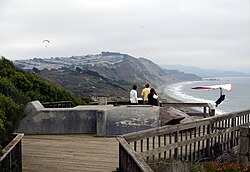
The strong, steady winds make the cliffs overlooking the beach a popular site for hang gliding. The gliding is rated intermediate difficulty (Level III).[11] When the NPS first took over administration of the area in the early 1970s, rangers asked hang gliders what they needed. A few months later NPS opened up a gate so fliers could drive up to the old Nike site to park rather than hike in from the road, and they provided a port-a-potty.

Additionally, the world record for the farthest thrown object was set here in 2003 by Erin Hemmings, who threw an Aerobie flying ring 1,333 feet.[12][13]

Wildlife

[edit]

See also

[edit]

References

[edit]

Further reading

[edit]
[edit]
Revisions and contributorsEdit on WikipediaRead on Wikipedia
from Grokipedia
Fort Funston is a protected unit of the Golden Gate National Recreation Area (GGNRA) situated on the western edge of , , encompassing approximately 246 acres of coastal bluffs, sand dunes, and beaches along the . Originally acquired by the U.S. Army in 1900 as a battery known as the Military Reservation, it was renamed in honor of Major General for his leadership in the relief efforts and served as a key defensive site until its decommissioning in 1963. Today, it functions primarily as a recreational park, renowned for its 200-foot-high sandy bluffs—the largest remaining dune field on the —and as one of the premier launch sites in the United States, while preserving remnants of its military past, including World War II-era gun emplacements and Nike missile sites. Established as part of the GGNRA in 1974 following the area's transfer from military to control, Fort Funston balances historical interpretation with ecological conservation and public access. Its military history includes the construction of Battery Richmond Davis in 1938, which housed two 16-inch guns capable of firing shells up to 25 miles to protect the Strait, and later the deployment of Nike anti-aircraft missiles during the era from the 1950s until 1963. Decommissioning efforts, such as Operation Blowtorch in 1948, dismantled much of the artillery, but structures like the repurposed Nike missile barracks—now serving as a ranger station and environmental science center—remain as interpretive sites. The site's natural features support diverse wildlife and restoration initiatives, including habitat for the threatened bank swallow, which nests in sandstone cliffs from March to June, and a native plant nursery aiding dune stabilization and biodiversity efforts. Visitors engage in activities such as hiking along the 0.88-mile Fort Funston Trail or the more strenuous 11.5-mile Coastal Trail segment, off-leash dog walking in designated areas, horseback riding, and observing hang gliders from an accessible viewing deck. The park is open 24 hours daily, accessible via Skyline Boulevard, though its steep bluffs and strong ocean undertows pose hazards, requiring caution for beach access and pet safety.

Overview

Location and Geography

Fort Funston is located on the southwestern coast of the , , at approximately 37°42′53″N 122°30′09″W, forming a key unit within the Golden Gate National Recreation Area (GGNRA), which spans over 82,000 acres across Marin, San Francisco, and San Mateo counties. The site encompasses the former Military Reservation and adjacent coastal lands, originally covering about 237 acres. The area overlooks the , featuring steep sandy bluffs rising up to 200 feet high along the shoreline, which provide dramatic cliffside views and support active erosion processes driven by wave action and wind. Below these bluffs lies a narrow sandy accessible via strenuous trails, while inland areas include the largest remaining active sand dune system on the , interspersed with coastal grasslands stabilized by native vegetation. The terrain is characterized by shifting dunes, erosional zones at the bluffs, and proximity to , an inland freshwater body approximately one mile to the east. Fort Funston experiences a cool, foggy coastal typical of the region, with frequent fog, average annual temperatures ranging from 50–65°F, and persistent strong westerly winds averaging 15–25 mph that contribute to its reputation as a prime location. These winds, combined with the foggy conditions and erosive coastal dynamics, shape the site's unique environmental context, including ongoing bluff retreat at rates of about 2 feet per year in some areas. The boundaries of Fort Funston extend from Skyline Boulevard (California State Route 35) on the east to the on the west, encompassing coastal bluffs and dunes while bordering urban and recreational areas to the north and south. It lies adjacent to and to the east, with the broader GGNRA connecting it northward toward sites like Fort Miley near , though separated by urban development and Ocean Beach.

Naming and Significance

Fort Funston was renamed in August 1917, shortly after the death of (1865–1917), to honor his distinguished service in the U.S. Army. Funston gained national acclaim for his daring capture of Philippine insurgent leader during the Philippine-American War in 1901, an operation that earned him the , and for his decisive leadership in coordinating military relief and firefighting efforts in the aftermath of the . In 1974, following legislation in 1972, Fort Funston became part of the (GGNRA), transforming the former battery into a public park focused on conservation, recreation, and historical interpretation. This repurposing reflects a larger pattern in U.S. coastal history, where many World War II-era defense installations were adapted into open spaces for public enjoyment following their obsolescence. The site has since become a beloved destination for off-leash across its expansive bluffs and trails, launched from wind-swept cliffs overlooking the Pacific, and scenic overlooks providing views of the ocean and distant coastline. Fort Funston holds cultural significance as a preserved within the national park system, where remnants of its military past—such as gun batteries and a Nike launch area—coexist with natural dunes and habitats to educate visitors on themes of defense, , and urban transition. It drew over 750,000 visitors each year as of 2001.

History

Early Acquisition and Construction

The U.S. Army acquired the initial land for what would become Fort Funston in 1900, establishing it as the Military Reservation to support harbor defense efforts along the coast. This purchase formed part of a broader network of coastal fortifications designed to protect the entrance, with the site's elevated bluffs providing strategic oversight of the Pacific approaches to . The reservation's early development was influenced by post-Spanish-American War priorities, though significant construction was delayed until the lead-up to . In 1917, amid preparations for U.S. entry into , the Army renamed the Military Reservation as Fort Funston in honor of Major General , who had commanded federal troops during the relief operations and died that February. The renaming coincided with expanded land acquisition, including additional parcels purchased from the Spring Valley Water Company to complete the site's oceanfront and inland sections. Construction of initial defensive batteries began shortly thereafter, focusing on rapid emplacement of relocated artillery to bolster harbor defenses against potential naval incursions. Among the earliest structures were Battery Bruff and Battery Howe, both completed between 1917 and 1919 and adapted to the site's sandy coastal terrain using bunkers and elevated fire control stations. Battery Bruff featured two 5-inch rapid-fire guns on pedestal mounts, transferred from Fort at the , intended for close-range anti-ship fire but quickly deemed obsolete under post-war and disarmed by 1919. Battery Howe, a larger mortar battery, housed four 12-inch mortars in two pits—also sourced from Fort —capable of lobbing high-explosive shells up to nine miles to target enemy vessels beyond the harbor mouth. These installations emphasized durable, low-profile concrete construction to withstand erosion from the Pacific cliffs while integrating observation posts for coordinated fire control across the bay's defense system.

World War II Operations

During World War II, Fort Funston reached its peak as a coastal defense site with the completion of Battery Davis, constructed between November 1936 and May 1940 at a cost of approximately $670,000. This reinforced concrete casemated battery housed two 16-inch Mark II-M1 naval guns mounted on M1919MI barbette carriages, originally manufactured for the USS Saratoga but repurposed for land defense. Each gun could fire 2,240-pound armor-piercing shells up to 25 miles, providing formidable protection against potential naval incursions into San Francisco Bay. The battery was manned by the U.S. Army Coast Artillery Corps and played a key role in the Harbor Defenses of , conducting regular fire control drills to maintain readiness and performing anti-submarine surveillance using listening devices to detect approaching vessels or aircraft. Although the guns were test-fired during training, they were never used in , as no attack materialized on the West Coast. Nonetheless, the installation was essential for safeguarding the Pacific Fleet and harbor shipping from Japanese naval threats. Fort Funston's garrison expanded significantly during the war to support operations, housing Coast Artillery personnel in and providing facilities for daily life amid heightened alert status. Soldiers worked 24-hour shifts in concrete observation posts following the Japanese in , monitoring for threats in coordination with the Harbor Defense Command. Enhancements in the 1940s included systems for improved detection and fire control, as well as searchlights for nighttime defense against air and sea incursions. As part of the broader response to Japanese aggression after , Fort Funston exemplified the U.S. military's rapid fortification of the , deterring potential invasions and ensuring the security of vital West Coast ports.

Decommissioning and Transition to Park

Following , the batteries at Fort Funston were rendered obsolete by advancements in and missile technology, leading to their deactivation beginning in 1948 through Operation Blowtorch, during which the large guns were disassembled and scrapped. The site transitioned to a Nike anti-aircraft missile installation in the 1950s, serving as part of the defense network until its full closure in 1963, after which all military operations ceased. This marked the end of Fort Funston's role as an active U.S. Army coastal defense facility, with the obsolescence of fixed artillery in the missile age prompting the site's surplus declaration. After decommissioning, the U.S. Army transferred the land to the City of in 1962, allowing initial local management for recreational purposes. In 1972, Congress established the Golden Gate National Recreation Area (GGNRA) through Public Law 92-589, incorporating Fort Funston into the new urban park system to preserve its historical, natural, and recreational values. The City of completed the formal transfer of the site, including additional adjacent lands like Ocean Beach, to the in 1973 following a voter-approved measure that supported the expansion of federal park protections. During the transition in the 1970s, remaining military armaments, such as Nike missile components, were removed or repurposed, while concrete bunkers and fire control stations were retained as historical features. The site opened to the public during this period, emphasizing ecological preservation, public access, and interpretation of its military legacy within the broader GGNRA framework. As of 2025, the National Park Service continues to manage Fort Funston, with no active military elements present and ongoing efforts focused on habitat restoration and erosion control to sustain its role as a protected open space.

Physical Features

Military Installations

Fort Funston preserves several key remnants of its coastal defense infrastructure, primarily from the era, as part of the Golden Gate National Recreation Area managed by the (NPS). The most prominent surviving structure is Battery Davis, a casemated battery constructed in 1936 featuring two 16-inch gun emplacements designed to fire shells over 25 miles into the . These emplacements are supported by revetments that provide structural integrity against the site's erosion-prone bluffs, with underground tunnels connecting to ammunition and powder magazines for secure storage and rapid access. The gun pits remain intact but filled in, and the interior has been sealed since the early to prevent unsafe exploration, while the exterior shows signs of weathering, graffiti, and partial concealment by sand dunes, ice plant, and Monterey cypress vegetation. Remnants of earlier batteries, such as Battery Howe and Battery Bruff, are less visible but still evident in the landscape. Battery Howe, built with four 12-inch mortar pits arranged in a typical configuration for , is largely buried or located beneath the Great , with its platforms and pits partially exposed due to ongoing . Similarly, Battery Bruff featured two 5-inch platforms on pedestal mounts for rapid-fire capabilities, though these have been dismantled, leaving foundational elements and associated earthworks now integrated into the surrounding terrain near the highway. These structures exemplify early 20th-century engineering, utilizing to withstand bluff instability, though many components have been obscured or damaged by natural forces over time. Additional preserved features include fire control stations, underground magazines, and observation posts scattered across the site. Fire control stations, such as the Funston Group Command Post and base end stations, remain structurally sound but secured against entry, featuring concrete observation bunkers equipped with historical listening devices and lookouts for targeting coordination. Underground magazines for anti-aircraft batteries are also sealed for safety, with their entrances protected to mitigate vandalism and . Observation posts, including beach-level positions like B2S2, have been partially eroded and filled with sand, highlighting the challenges of maintaining these artifacts on shifting bluffs. No active weaponry has been present since , when the site's defensive role ended. The NPS maintains these installations as interpretive sites within the Fort Funston Historic District, which is eligible for the National Register of Historic Places, emphasizing their role in San Francisco's coastal defense history through on-site signs and exhibits. Engineering adaptations, such as the extensive use of reinforced concrete and strategic placement amid natural barriers, were specifically designed to counter the area's high erosion rates, though ongoing bluff retreat continues to threaten some remnants. Preservation efforts focus on stabilization without full restoration, balancing historical integrity with public safety and environmental protection.

Natural Landforms and Trails

Fort Funston's natural landforms are shaped by the Merced Formation, a sequence of sedimentary rocks deposited approximately 500,000 years ago in a basin adjacent to the . These deposits, consisting of alternating layers of , , , and gravel, were subsequently uplifted through tectonic activity and sculpted by wave action to form a prominent marine terrace about 150 feet above , dating to roughly 100,000 years ago during the Sangamon interglacial period. As part of San Francisco's broader coastal dune ecosystem, the site features active dunes built from Pleistocene-era sands transported by the during glacial advances, creating a dynamic of shifting coastal features. The park's defining landforms include steep bluffs that rise up to 200 feet along the southwest coastline, exposing tilted strata that reflect cycles of ancient marine, shoreline, and nonmarine environments. These bluffs frame the largest remaining dune field on the , where wind and waves continuously reshape the loose, unconsolidated sands. Below lies a seasonal , where high winter waves erode sand offshore to form a rocky platform, while calmer summer waves return it, creating a variable shoreline. The is particularly notable for its dark "magnetic sand," composed largely of —an iron-rich mineral derived from the erosion of Sierran sources—which clings to magnets and gives the sediment its distinctive black hue and magnetic properties. Erosion remains a persistent force at Fort Funston, with the bluffs retreating at an average rate of about 1 inch per year due to undercutting by waves and subaerial weathering, though localized rates can reach 1–2 feet annually in vulnerable sections. This ongoing bluff retreat, accelerated by the weakly lithified nature of the sands, has historically exposed buried World War II-era structures, such as in 1979 when caused a partial of one of the Panama Mount gun emplacements, sending debris tumbling to the below. Such events highlight the site's vulnerability within California's actively coastal zone, where tectonic uplift continually renews the for further marine abrasion. A network of approximately 3 miles of trails allows exploration of these landforms, including bluff-top paths that offer panoramic views of the dunes and . The Sunset Trail, a 0.75-mile paved and wheelchair-accessible route, runs parallel to the coastline past historic Battery Davis, providing easy access to benches and picnic areas amid the sandy bluffs. For beach access, two Dutch sand ladders—flexible wooden staircases embedded in the dunes—descend steeply from the bluff edge, facilitating safe passage over the shifting sands while minimizing erosion; these structures, inspired by European coastal designs, replace earlier paths worn by foot traffic.

Recreation and Activities

Hang Gliding and Sports

Fort Funston serves as a premier destination for hang gliding within the Golden Gate National Recreation Area, designated as a site requiring an H3 (Advanced) rating from the United States Hang Gliding and Paragliding Association (USHPA) to ensure pilot proficiency in handling its dynamic conditions. The site's elevated bluffs, rising approximately 200 feet above the Pacific Ocean, combined with consistent onshore winds typically ranging from 15 to 25 miles per hour, facilitate reliable launches and sustained soaring flights. These winds, driven by the coastal geography, allow pilots to achieve glide ratios of at least 1:1 to reach primary landing zones behind the launch area or secondary zones on the beach below. Hang gliding at Fort Funston gained popularity in the early 1970s following the site's incorporation into the , when local pilots organized the Fellow Feathers club to formalize access and operations. The activity has since become a hallmark of the location, attracting advanced pilots year-round, particularly from to when conditions are most favorable. In 2003, the site hosted a notable athletic achievement when Erin Hemmings set the for the longest throw of an unaided object by hurling an flying ring 1,333 feet (406 meters), leveraging the open bluff terrain and steady breezes. Dedicated facilities support safe and organized flying, including a primary launch ramp at about 160 feet above mean west of the main parking area, equipped with wind indicators, webcams, and weather monitoring stations to assess real-time conditions. The Fellow Feathers club hosts periodic events, such as air races, barbecues, and anniversary celebrations that include competitive elements, fostering community engagement among pilots. Safety protocols are strictly enforced through a special-use permit issued by the to the Fellow Feathers club, mandating USHPA membership, an active H3 rating, and adherence to like FAR-103. Pilots receive a sub-permit upon verification, and operations emphasize monitoring for hazards like gust differentials exceeding 10 mph, with landings requiring precise control to navigate the 200-foot drop to the beach.

Dog Park and Hiking

Fort Funston serves as one of 's premier off-leash dog areas, with approximately 230 acres available for dogs to roam under voice control since the creation of the Golden Gate National Recreation Area in 1972. This policy was established as a core recreational purpose of the park, allowing dogs unrestricted access across dunes, bluffs, and beachfront, except within a designated 12-acre closure in the northwest section to protect sensitive habitats. The expansive terrain draws an average of 1,600 dogs daily, enabling activities such as energetic beach sprints along the black-sand shores and free play amid the rolling bluffs, fostering socialization in a natural coastal setting. On October 28, 2025, a dog fell approximately 40 feet off a bluff while chasing a and was successfully rescued by firefighters, underscoring the need for caution near cliff edges. Hiking at Fort Funston complements its dog-friendly appeal, offering easy to moderate trails that welcome leashed or off-leash pets throughout most areas. A popular option is the 1.6-mile Coastal Trail loop, which winds along cliff edges with views and minimal gain of about 164 feet, suitable for casual walkers and their canine companions. The park provides pet amenities including water stations and stocked waste bag dispensers at key points to support responsible use during outings. These trails briefly connect to broader trail infrastructure, enhancing accessibility for varied paces. The site fosters a strong community among dog owners, hosting regular meetups and events organized by local enthusiast groups that promote social interaction and park stewardship. Management by the balances these gatherings with environmental safeguards, such as the fenced wildlife protection zone for endangered bank swallows, ensuring recreational use does not disrupt native ecosystems. As one of the city's top dog destinations, Fort Funston sees peak crowds on weekends, when hundreds of visitors and their pets flock to the bluffs for group play and relaxed exploration.

Wildlife and Environment

Native Species

Fort Funston's coastal supports a diverse array of adapted to its sandy bluffs, dunes, and scrub habitats within the Golden Gate National Recreation Area (GGNRA). The site's dynamic environment, influenced by ocean winds and , fosters specialized and that contribute to regional . Among the avian inhabitants, bank swallows (Riparia riparia), a state-threatened species, are prominent, nesting in burrows within the site's bluffs from March to July, forming the largest such colony in the . Red-tailed hawks (Buteo jamaicensis) are commonly observed soaring over the open areas, preying on small mammals. Brown pelicans (Pelecanus occidentalis) frequently roost along the coastal cliffs, while migratory shorebirds such as western sandpipers (Calidris mauri) utilize the beaches during seasonal passages. Mammals in the area include coyotes (Canis latrans), which roam the dunes and scrub, scavenging and hunting small prey. Reptiles are represented by the (Sceloporus occidentalis), a common basking species found on logs and rocks amid the native vegetation. The flora consists primarily of native coastal scrub communities, featuring coyote brush (Baccharis pilularis), a resilient shrub that stabilizes dunes with its deep roots, and (Fragaria chiloensis), a low-growing that forms groundcover in sandy soils. However, like ice plant (Carpobrotus edulis), originally introduced for , now outcompetes natives by forming dense mats that smother the . Overall, Fort Funston harbors over 225 recorded bird , reflecting its role as a key stopover in Pacific flyways, and supports broader GGNRA initiatives to restore native habitats through seed collection and planting in on-site nurseries.

Erosion and Conservation

Fort Funston's coastal bluffs and dunes have experienced significant erosion driven by strong Pacific winds, waves, and occasional heavy rainfall, leading to the gradual retreat of the shoreline and exposure of historical military remnants. One notable event occurred in , when a deactivated Panama gun mount collapsed into the ocean after cliff undercutting, revealing World War II-era concrete debris on the below. Subsequent incidents, including landslides in 1989 and the full descent of remaining Panama mounts by 1997, further highlighted the site's vulnerability, with aerial surveys from 2002 to 2004 documenting nearly 15,000 cubic yards of material loss in a key area south of major collapses. These erosional processes threaten both the structural integrity of the bluffs and the habitats they support, such as nesting sites for state-threatened bank swallows. To combat and preserve the landscape, the (NPS) initiated a dune restoration project in at Fort Funston, focusing on removing non-native like European beachgrass and ice plant, which exacerbate sand instability by altering natural dune dynamics. Native with deep root systems, such as beach strawberry and dune tansy, were actively replanted to stabilize shifting sands and restore ecological function, with efforts supported by the Fort Funston Native , which produces up to 25,000 annually for site-wide use. The National Parks Conservancy assists in monitoring these initiatives, tracking vegetation cover and rates to ensure long-term recovery while restricting off-trail access in sensitive zones to minimize human impacts. As of 2025, ongoing geotechnical studies and bluff reinforcement measures are integrated into the broader Ocean Beach Climate Change Adaptation Project, which extends to Fort Funston's boundaries and employs sand nourishment, barriers, and potential extensions to address accelerated from and storms. removal continues as a core component, with ongoing efforts enhancing native scrub communities to bolster coastal resilience. These actions are funded through federal allocations under the Golden Gate National Recreation Area (GGNRA), emphasizing adaptive management that reconciles high recreational use—such as and dog walking—with protection of fragile ecosystems.

References

Add your contribution
Related Hubs
User Avatar
No comments yet.