Hubbry Logo
Genesis RockGenesis RockMain
Open search
Genesis Rock
Community hub
Genesis Rock
logo
8 pages, 0 posts
0 subscribers
Be the first to start a discussion here.
Genesis Rock
Genesis Rock
from Wikipedia
The Genesis Rock
The Genesis Rock on the lunar surface prior to sampling (left of the gnomon, which was used for scale in the photos)
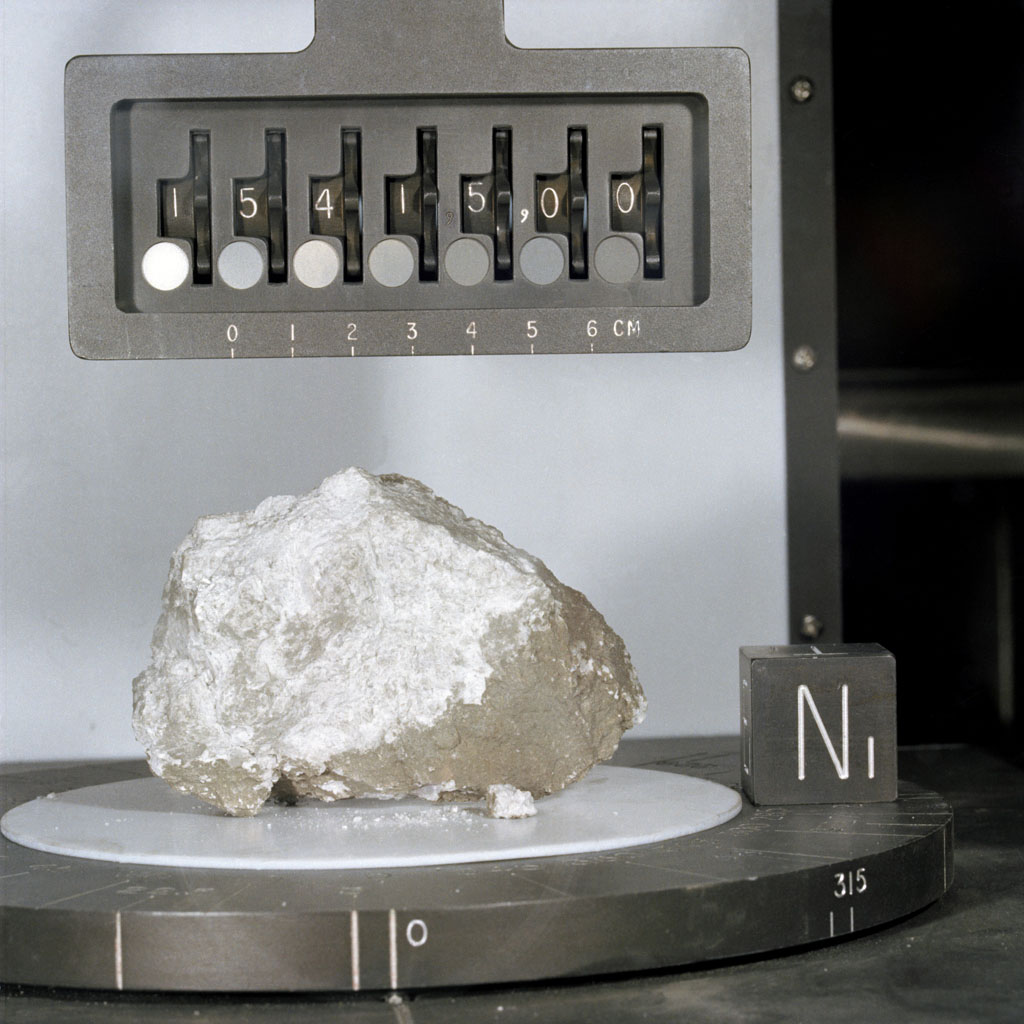
The Genesis Rock on display at the Lunar Sample Laboratory Facility

The Genesis Rock (sample 15415) is a sample of Moon rock retrieved by Apollo 15 astronauts James Irwin and David Scott in 1971 during the second lunar EVA, at Spur crater on Earth's Moon. It has a mass of c. 270 grams (4,200 grains),[1] and is stored at the Lunar Sample Laboratory Facility in Houston, Texas.

Rock

[edit]

Chemical analysis of the Genesis Rock indicated it is an anorthosite, composed mostly of a type of plagioclase feldspar known as anorthite. The rock was formed in the early stages of the Solar System, at least 4 billion years ago.[2]

It was originally thought they had found a piece of the Moon's primordial crust, but later analysis initially showed that the rock was only 4.1 ± 0.1 billion years old, which is younger than the Moon itself, and was formed after the Moon's crust had already solidified. Research has shown that the Genesis Rock is not the oldest sample recovered from the moon, with sample 14321 (retrieved during the Apollo 14 mission) surpassing it.[3] It is still an extremely old sample, formed during the Pre-Nectarian period of the Moon's history. Dating of pyroxenes from other lunar anorthosite samples gave a samarium–neodymium age of crystallization of 4.46 billion years.[4] Other research methods approximate the age of the rock to be between 4 and 5 billion years old.[5]

The discovery of the Genesis Rock

See also

[edit]

References

[edit]
[edit]
Revisions and contributorsEdit on WikipediaRead on Wikipedia
from Grokipedia
The Genesis Rock (sample 15415) is a ferroan lunar rock sample collected during NASA's mission on August 1, 1971, at the rim of Spur Crater in the Hadley-Apennine region of the Moon's near side. Retrieved by astronauts and using the , the 269-gram specimen was nicknamed "Genesis Rock" by the crew for its perceived representation of the Moon's ancient primordial crust, formed during the early solidification of a global ocean. Composed primarily of plagioclase feldspar (approximately 98%), with minor amounts of pyroxene, ilmenite, and silica, the rock exhibits coarse-grained igneous texture and evidence of shock metamorphism from ancient impacts, indicating it has resided near the lunar surface for much of its history. Radiometric dating places its crystallization age at around 4.1 billion years, predating major basin-forming impacts like Imbrium, though metamorphic overprinting complicates precise measurements. Its unbrecciated nature and highland origin make it a key artifact for studying the Moon's geological evolution, providing insights into the differentiation of the lunar crust from a molten state. Subsequent analyses have revealed additional significance, including the detection of trace hydroxyl groups (about 6 parts per million) in its grains via , suggesting the early retained some and challenging models of a completely formation. Housed at NASA's , thin sections of the Genesis Rock continue to support research on lunar , impact history, and comparative planetology.

Discovery and Collection

Apollo 15 Mission Overview

launched on July 26, 1971, from Kennedy Space Center's Launch Complex 39A aboard a rocket. The spacecraft achieved on July 29, 1971, and the Lunar Module successfully landed in the Hadley-Apennine region of the Moon's Imbrium basin on July 30, 1971, approximately 0.5 kilometers from the planned site near Hadley Rille. The mission crew consisted of Commander David R. Scott, who piloted the Command Module Endeavour and commanded surface operations; Command Module Pilot Alfred M. Worden, responsible for orbital activities; and Lunar Module Pilot James B. Irwin, who joined Scott for lunar surface exploration. As the first of the Apollo "J-series" missions, emphasized extended lunar surface stays and enhanced mobility to support in-depth scientific investigation. Primary objectives included exploring the Hadley-Apennine site to study volcanic and tectonic features, collecting diverse geological samples from the and highlands, deploying the Apollo Lunar Surface Experiments Package (ALSEP) for long-term geophysical measurements, and evaluating the (LRV) for traversing up to 100 kilometers across the terrain. These efforts marked a shift toward more ambitious scientific returns, with the LRV enabling access to remote features like rilles and rims previously out of reach. The second (EVA), conducted by Scott and Irwin, began on August 1, 1971, at approximately 7:49 a.m. EDT and lasted 7 hours and 12 minutes. Using the LRV, the astronauts traversed about 13 kilometers, including a drive to the rim of Spur Crater and the slopes of Mount Hadley Delta, to conduct geological sampling, document surface features, and perform maintenance on deployed experiments. This EVA exemplified the mission's focus on systematic exploration of highland terrains, yielding samples that advanced understanding of lunar .

Location and Retrieval

The Genesis Rock was discovered on the rim of Spur Crater, located approximately 3.4 kilometers south of the Lunar Module Falcon in the Hadley-Apennine region of the Moon's . This site, part of the Hadley Delta slope about 50 meters above the surrounding mare plain, featured a mix of highland breccias and basaltic ejecta, providing a key geological traverse point during the mission's second (EVA-2). During EVA-2 on August 1, 1971, astronauts David R. Scott (mission commander) and James B. Irwin (lunar module pilot) approached Spur Crater via the (LRV), parking it about 100 meters east of the crater rim to begin sampling. Scott first spotted the rock from the LRV, noting its distinctive white appearance against the darker , and directed Irwin to assist in the collection effort. The duo descended the slope, with Scott leading the documentation and sampling while Irwin supported by managing tools and the LRV. The retrieval involved Scott prying the rock free from its position on a small pedestal along the rim using a scoop tool from the Apollo Lunar (ALHT), breaking off a white clast embedded in a larger dark brown fragment. This process, captured in mission transcripts, elicited immediate excitement; Scott exclaimed, "Guess what we just found. I think we found what we came for," and further described it as a "crystal rock" dominated by , resembling , while Irwin responded, "Look at the glint!" and affirmed, "I think we found what we came for." The sample was then placed into a special collection bag (SCB 196) and secured under Irwin's seat on the LRV for transport back to the . Designated as NASA lunar sample 15415, the Genesis Rock had a total mass of 269.4 grams, with the extensively studied thin section subsample 15415,16 derived from it. On-site, the astronauts observed its pristine, crystalline condition, which starkly contrasted with the prevalent dark, vesicular basaltic terrain and breccias around Spur Crater, highlighting its potential as a rare highland fragment ejected from deeper lunar crust.

Physical Description

Appearance and Dimensions

The Genesis Rock, sample 15415 from the mission, is a light-colored characterized by its white to grayish hue and coarse-grained crystalline texture, making it visually distinct from the surrounding dark lunar . The rock exhibits a high due to its -rich composition, with shiny, reflective surfaces on the plagioclase crystals that create a subtle glint when viewed under light. Its overall appearance is that of a blocky, angular fragment, roughly the size of a closed fist, with chalky-white zones indicating minor shattering from impact events. Measuring approximately 10 cm in length and about 3 inches (7.6 cm) in height based on photographic documentation, the main piece displays an irregular, subangular shape with smooth grain boundaries visible on its exterior. Surface features include mild shock offsets and polysynthetic twinning patterns in the , which become prominent under magnification and highlight the rock's crystalline structure. The total of the collected sample is 269 grams. In terms of condition, the Genesis Rock is pristine and unbrecciated, lacking evidence of impact melt or significant fragmentation, which sets it apart from the nearby soil on which it was perched during collection at Spur Crater. This well-preserved state, with only mild shock features such as parallel fractures, underscores its value for subsequent petrological studies.

Sample Characteristics

The Genesis Rock, sample 15415, is classified as a ferroan , a type of coarse-grained that is representative of the lunar highlands crust. This classification stems from its dominant calcic composition combined with iron-enriched phases, distinguishing it as a primitive highland material rather than a volcanic product. As a plutonic rock, it formed through slow deep within the lunar crust, exemplifying the early differentiation processes of the . The rock exhibits an equigranular texture, characterized by interlocking crystals with smooth grain boundaries and triple junctions at approximately 120 degrees, indicative of metamorphic recrystallization often termed "Apollonian metamorphism," with grains reaching up to 3 cm in size. It lacks or layering, consistent with its intrusive origin, though some portions display mild cataclastic features from deformation. Structurally, the sample is monomict, consisting of a single rock type without incorporation of foreign fragments, and remains largely non-brecciated. Evidence of shock is minimal, limited to subtle offsets in twinning, suggesting limited exposure to major impact events post-formation. In comparison to other Apollo samples, such as the mare basalts collected from lunar lowlands, the Genesis Rock stands out for its plagioclase-rich nature and low abundance of mafic minerals like pyroxene and olivine. Mare basalts, by contrast, are typically fine-grained volcanic rocks with higher proportions of mafic components and lower plagioclase content, reflecting their origin from mantle-derived melts erupted onto the surface. This distinction underscores the Genesis Rock's role as a highland crustal fragment, separate from the basaltic plains materials.

Composition and Mineralogy

Primary Minerals

The Genesis Rock, lunar sample 15415, is dominated by , a calcium-rich that constitutes 95-98% of its volume. This high purity reflects crystallization from a primitive , with the anorthite exhibiting a composition of An95-An98, typically unzoned and homogeneous. The forms large, euhedral grains up to 1-3 cm in size, characterized by smooth boundaries, trigonal intersections, and prominent polysynthetic twinning, including and pericline laws. These features indicate high-temperature igneous , with mild shock-induced offsets observed in some grains. Minor minerals comprise less than 5% of the rock, primarily diopsidic (Wo46En39Fs16, ~3%) and trace low-calcium (orthoenstatite, Wo2.5En58Fs39.5), occurring as small grains (∼100 μm) often as inclusions in or along boundaries, with exsolution lamellae. Trace amounts of are present, typically associated with , along with trace amounts of silica and , while is either absent or in negligible quantities below detection in most analyses.

Chemical Makeup

The Genesis Rock (sample 15415) displays a major element composition typical of a highly pure ferroan , featuring elevated levels of silica, aluminum, and calcium oxides alongside minimal iron and magnesium content. Analyses indicate SiO₂ at 44.93 wt.%, Al₂O₃ at 35.5–35.71 wt.%, and CaO at 20.57–21 wt.%, while FeO is low at 0.2 wt.%, MgO ranges from 0.16–0.53 wt.%, and TiO₂ is trace at <0.03 wt.%. Na₂O and K₂O are also subdued, at 0.356–0.38 wt.% and 0.015 wt.%, respectively. Trace element profiles reveal depletions in incompatible elements relative to mare basalts, underscoring the rock's primitive highland character. is minimal at ~120 ppm, and rare earth elements (REEs) are scarce, exemplified by La at 0.12–0.39 ppm and Ce at 0.32–0.35 ppm. Volatiles and other incompatibles like Ba (6–22 ppm) and Sr (177–246 ppm) follow this pattern, while siderophile elements remain low: Sc at 0.4–0.437 ppm, Cr at 19–63 ppm, Co at 0.19–0.26 ppm, and Ni at 3–13.3 ppm. Isotopic compositions further highlight its lunar highland affinity. Oxygen isotopes align with those of other highland samples, consistent with formation via rather than external mixing. The Rb-Sr system exhibits a low initial ⁸⁷Sr/⁸⁶Sr ratio of 0.69914, indicative of derivation from an early, unradiogenic source. These signatures, combined with low siderophile abundances, point to an origin involving plagioclase accumulation in a global .

Age and Geological Significance

Dating Methods

The age of the Genesis Rock was investigated through various techniques applied to subsample 15415,16, utilizing whole-rock powders and mineral separates (primarily and ) prepared via mechanical crushing, , and acid leaching to isolate components for isotopic analysis. The Rb-Sr isochron method, which measures the decay of 87Rb to 87Sr in multiple mineral fractions to plot an isochron line whose slope defines the age, was attempted but proved challenging due to the rock's low Rb/Sr ratios (typically <0.1), resulting in limited spread of data points and no reliable isochron. An early study reported a model age of 4.09 ± 0.19 billion years, but systematics issues prevent a definitive age. This technique required high-precision , though initial results had larger uncertainties. The Sm-Nd isochron method, based on the decay of 147Sm to 143Nd, was applied using similar mineral separates to assess early lunar differentiation, providing insights into the initial 143Nd/144Nd ratio. However, no precise isochron age was obtained for 15415 due to potential disturbance from ; the data support an ancient origin but lack resolution for exact timing. This method is complementary, as Nd is more evenly distributed in plagioclase-dominated rocks like the Genesis Rock. Additional methods included **40Ar-**39Ar dating, which involves neutron irradiation to produce **39Ar from 40K and stepwise heating to release argon isotopes, but results were compromised by exposure causing ~40% 40Ar loss and disturbed release spectra without clear plateaus. Ages from this method ranged from 3.91 to 4.09 billion years but were considered minimum estimates due to these effects. U-Pb dating targeted trace elements but was unsuccessful owing to low U concentrations, possible lead loss, and lack of zircons; Pb isotopic compositions suggest evolution over ~0.5 billion years post-Moon formation but no precise crystallization age. Initial 1970s measurements, obtained with early mass spectrometers, had larger error margins (e.g., ±0.19 billion years for Rb-Sr results); while modern techniques like (TIMS) have improved precision for lunar samples generally, no specific revisions yielding tighter uncertainties (e.g., ±0.06 billion years) have been reported for 15415. Overall, studies indicate an age of approximately 4.1 billion years, likely reflecting a metamorphic event rather than primary crystallization.

Role in Lunar Formation Theories

The Genesis Rock, as a pristine ferroan , serves as a key example of the flotation cumulates expected from the of a global approximately 4.4 to 4.5 billion years ago, where low-density minerals rose to form the early crust. This hypothesis posits that the Moon's initial molten state, following its accretion, led to differentiation with anorthositic material accumulating at the surface, and the rock's aligns with models of this process despite later metamorphic overprinting. Its composition provides evidence for the formation of the plagioclase-rich highland crust in the Moon's earliest geological epochs, predating the widespread mare volcanism by more than one billion years and highlighting a prolonged period of crustal stabilization before basaltic flooding. This ancient crust, represented by samples like the Genesis Rock, underscores the Moon's rapid differentiation into a layered body shortly after formation. The rock supports the for the 's origin, in which debris from a collision between proto- and a Mars-sized body () coalesced into the , generating the extensive magma ocean that produced anorthositic relics like this sample as primary crustal material. Oxygen isotopic similarities between and lunar anorthosites further bolster this model, indicating a shared post-impact heritage. Initial interpretations of the Genesis Rock as the Moon's "oldest" sample have been revised, as subsequent analyses revealed older lunar materials (e.g., ~4.4 Ga zircons) and confirmed its ~4.1 Ga age reflects a metamorphic event rather than primary ; nonetheless, it remains pivotal for constraining the timeline of lunar differentiation and crust formation.

Research and Analysis

Initial Post-Mission Studies

Upon return to Earth on August 7, 1971, the lunar samples, including the Genesis Rock (sample 15415), were processed at NASA's Lunar Receiving Laboratory (LRL) in Houston, Texas, where quarantine protocols had been discontinued for this and subsequent missions to expedite scientific access. The samples underwent initial documentation, description, cataloging, and sterile handling to prevent contamination, with the Genesis Rock specifically examined under controlled conditions for preliminary allocation to teams. This curatorial process ensured that subsamples were distributed to consortia of geochemists and petrologists for immediate analysis while preserving the bulk material for future study. Preliminary petrographic examinations conducted in late 1971 and early 1972 confirmed the Genesis Rock as a coarse-grained ferroan anorthosite, composed predominantly of calcic plagioclase feldspar (An96-97) with minor diopsidic augite and trace ilmenite, exhibiting polysynthetic twinning and evidence of mild shock metamorphism. These studies, led by researchers such as R.B. Hargraves, L.S. Hollister, and O.B. James at institutions including Princeton University and the U.S. Geological Survey, highlighted its pristine, primitive nature, suggesting it represented an early fragment of the lunar crust. Initial isotopic dating efforts yielded ages around 4.0 to 4.09 billion years (Ga) via the 40Ar/39Ar method, with Rb-Sr analyses indicating a low initial 87Sr/86Sr ratio consistent with an ancient origin near 4.1 Ga, exciting scientists as evidence of the Moon's "primitive" highland crust formed shortly after lunar accretion. Key contributions included Rb-Sr work by teams involving G.J. Wasserburg and D.A. Papanastassiou at the California Institute of Technology, and broader oversight by Paul Gast, chief of planetary sciences at NASA's Manned Spacecraft Center, who coordinated early geochemical assessments. Findings were rapidly disseminated through seminal publications, such as Hargraves and Hollister (1972) and James (1972) in Science, underscoring the rock's significance in lunar petrology. The discovery's public resonance was amplified by the astronauts' on-site naming of the rock as "Genesis Rock" during the mission, evoking its role in revealing the Moon's ancient history, and featured prominently in press releases that emphasized its estimated 4.15 Ga age as a milestone in understanding solar system evolution. This moniker and the ensuing media coverage, including reports in , positioned the sample as a symbol of Apollo's scientific triumphs, bridging lunar exploration with broader questions of planetary origins.

Contemporary Scientific Insights

Recent advancements in non-destructive imaging have enabled detailed examination of the Genesis Rock's internal structures. Micro-CT scans, utilizing high-resolution X-ray computed tomography, have been applied to Apollo lunar samples, including anorthosites like the Genesis Rock, to visualize grain boundaries, fractures, and inclusions without sample alteration. These scans reveal complex internal textures indicative of the rock's formation in the lunar magma ocean and subsequent impact history. Complementing this, electron microprobe analyses have mapped trace elements within the rock's plagioclase and pyroxene phases, providing insights into magmatic differentiation and minor element distributions at micron-scale resolution. A significant 2013 study using infrared (FTIR) spectroscopy detected trace hydroxyl (OH) groups in the of the Genesis Rock (subsample 15415,238), with contents ranging from 5.0 to 6.4 parts per million (ppm). This finding, part of broader analyses of ferroan anorthosites from Apollo missions, indicates that the early retained primordial in its interior, challenging prior assumptions of a completely dry lunar mantle and suggesting an initial magma ocean of up to 320 ppm. In anticipation of the program's sample returns from the , researchers have re-examined legacy Apollo samples such as the Genesis Rock to establish baselines for volatile signatures and impact chronologies. Comparative analyses highlight how the rock's anorthositic composition and lack of direct magma ocean flotation crust representation contrast with potential Artemis materials, aiding interpretations of volatile enrichment and basin-forming events like the South Pole-Aitken impact. The Genesis Rock is currently housed in the Lunar Sample Laboratory Facility at NASA's in , , within nitrogen-purged cabinets to prevent and degradation. Ongoing non-destructive analyses, including spectroscopic and techniques, continue to yield new data from this and other Apollo samples, supporting over 50 years of cumulative research.

References

Add your contribution
Related Hubs
User Avatar
No comments yet.