Hubbry Logo
Georgia CarrollGeorgia CarrollMain
Open search
Georgia Carroll
Community hub
Georgia Carroll
logo
8 pages, 0 posts
0 subscribers
Be the first to start a discussion here.
Georgia Carroll
Georgia Carroll
from Wikipedia

Key Information

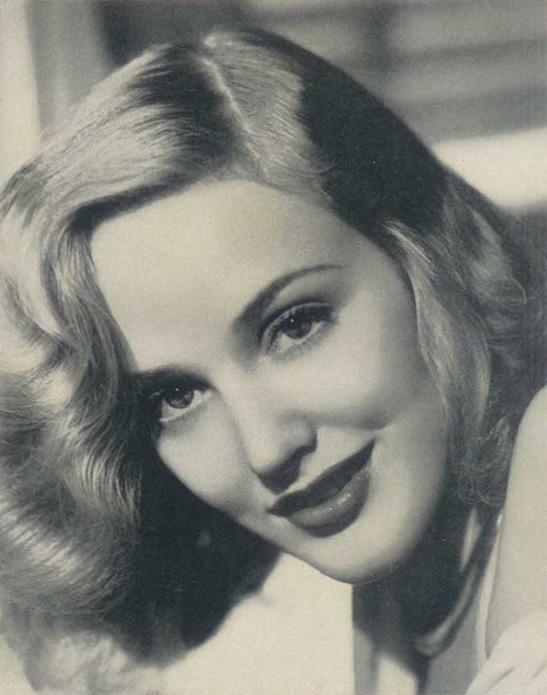
Georgia Carroll (November 18, 1919 – January 14, 2011) was an American singer, fashion model, and actress, best known for her work with Kay Kyser's big band orchestra in the mid-1940s. She and Kyser were married in 1944 until he died in 1985.

The daughter of Mr. and Mrs. Roger Carroll,[1] she was born in Blooming Grove, Texas, where her father raised sheep.[2] Her family moved to Dallas, Texas, where she graduated from Woodrow Wilson High School.[1]

One of Carroll's early jobs was modeling for a department store in Dallas, Texas. She eventually went to New York City and worked for the John Powers modeling agency.[2] While she worked as a model in New York, she took vocal lessons.[3]

She had her first brush with celebrity when she was the model for "The Spirit of the Centennial" statue at the 1936 Texas Centennial Exposition at Fair Park in Dallas, Texas. The statue still stands in front of what is now The Women's Museum. She was a 1937 graduate of Woodrow Wilson High School in Dallas and has been inducted into the school's Hall of Fame along with many other well-known graduates.[citation needed]

Carroll came to Hollywood when producers wanted her to play Daisy Mae in a film version of the Li'l Abner. Her height cost her that opportunity, however, when she turned out to be taller than the actor selected to play the title character.[2]

Her acting career began in 1941 when she appeared in several uncredited small roles in films such as Maisie Was a Lady with Lew Ayres and Ann Sothern, Ziegfeld Girl with Judy Garland, as well as You're in the Army Now and Navy Blues, in both of which she appeared with the Navy Blues Sextette. She appeared as Betsy Ross in the James Cagney musical Yankee Doodle Dandy in 1942. She also did modelling during this time, appearing in advertisements for Jewelite hairbrushes, among other products. Anne Taintor used some of these advertisements featuring Carroll to express the voice of the modern woman.[citation needed][clarification needed]

In 1943, Carroll joined Kay Kyser's band, Kay Kyser's Kollege of Musical Knowledge, as a featured vocalist. Capitalizing on her good looks, she was given the nickname "Gorgeous Georgia Carroll", probably as a joking reference to the professional wrestler George Wagner, who used the name Gorgeous George. As a member of Kyser's band, Carroll appeared in three films: Around the World, Carolina Blues, and most notably the World War II-era "morale booster" Thousands Cheer which gave fans a chance to see Kyser and his band in Technicolor. Kyser's band has a featured performance near the end of the film, with Carroll delivering a key solo interlude of the Arthur Freed/Nacio Herb Brown standard "Should I?"

Carroll (second from left) with her husband, Governor W. Kerr Scott, First Lady Mary White Scott, and John Anderson at the North Carolina Inaugural Ball in 1949.

In 1945, Carroll married Kyser and made no further film appearances, retiring from performing in 1946; Kyser retired from performing in 1951. The couple, who had three children, remained married until his death in 1985. Carroll had been living in Chapel Hill since retirement. The University of North Carolina at Chapel Hill is custodian of a large archive of documents and material about Kay Kyser which was donated by Carroll.[4]

References

[edit]
[edit]
Revisions and contributorsEdit on WikipediaRead on Wikipedia
from Grokipedia
Georgia Carroll (November 18, 1919 – January 14, 2011) was an American singer, fashion model, and actress best known for her work as a vocalist with Kay Kyser's orchestra in the mid-1940s and for her roles in several Hollywood films during . Born Georgia Ann Carroll in Blooming Grove, , a small town near , she showed early talent in singing, dancing, and acting, performing locally from age seven and modeling part-time at as a teenager. At 17, she was discovered by modeling agent and quickly gained prominence, appearing on covers of magazines such as and Vogue, as well as in advertisements and as the model for the "Spirit of the Centennial" statue at the 1936 . In 1941, she moved to Hollywood, signed a with Warner Brothers, and began her film with uncredited roles in pictures like Maisie Was a Lady and . Carroll's breakthrough came in 1943 when she joined Kay Kyser's orchestra as a featured singer, earning the nickname "Gorgeous Georgia Carroll" for her performances alongside the band in films and live shows. She appeared in 14 films during the 1940s, including notable roles as in Yankee Doodle Dandy (1942), a singer in (1943) where she performed "Should I," and supporting parts in (1943) with —with whom she formed a lifelong friendship—and Carolina Blues (1944). Her work with Kyser's band, which popularized songs like "Three Little Fishies" and hosted the radio and television show Kay Kyser's Kollege of Musical Knowledge, made her a prominent figure in the big band era. In June 1944, Carroll eloped with bandleader in , , in a spontaneous wedding after meeting him on the set of Around the World. The couple had three daughters—Kimberly, Carroll, and Amanda (the latter predeceasing her in 1993)—and remained married until Kyser's death in 1985. She continued performing with the band and on television until retiring in 1951 to focus on raising her family in , where the couple had settled. In later years, Carroll pursued education, earning a in studio art from the at Chapel Hill in 1970, and co-founded the Chapel Hill Preservation Society to support historic conservation efforts. She also donated the archive to UNC Chapel Hill, making it publicly accessible from 2008. Carroll died at age 91 in Chapel Hill, survived by two daughters and five grandchildren.

Early life

Childhood and family background

Georgia Carroll was born on , 1919, in Blooming Grove, , a small rural town in Navarro County, to parents Roger Mills Carroll and Aileen Rogers Carroll. Her father worked in , and she was born on her grandfather's outside the town, reflecting the family's ties to the agricultural life of early 20th-century . The Carrolls resided in Navarro County during her infancy before moving to , Harris County, by the 1930 census, and then relocating to , , in the 1930s, where the family settled in the urban environment of the city's growing metropolitan area. From a young age, Carroll showed promise in the , beginning to sing on local radio competitions before she turned seven and receiving formal training in and dancing. These early activities highlighted her natural aptitude for performance, nurtured within the cultural context of , where community events and family encouragement played a key role in developing young talents. Her family's dynamics further shaped her formative years, particularly through the influence of a devoted who served as a "classic stage mother," transporting her to concerts, recitals, and operettas to hone her skills. This supportive environment in her upbringing, transitioning from rural roots to the opportunities of , instilled a strong foundation for her lifelong interest in entertainment and the arts.

Education and early talents

Georgia Carroll graduated from Woodrow Wilson High School in Dallas, Texas, in 1937. Born in 1919, she had begun developing her talents in , dancing, and during her childhood, engaging in these pursuits as hobbies that laid the foundation for her later artistic endeavors. These early interests were nurtured through her teenage years in , where her family had relocated, allowing her to explore local opportunities that highlighted her performative skills prior to entering professional fields. In recognition of her subsequent achievements as a singer, model, and actress, Carroll was inducted into the High School Hall of Fame, honoring her as one of the school's distinguished alumni. This accolade underscores the impact of the foundational experiences she gained during her high school education.

Modeling career

Beginnings in Texas and New York

As a teenager attending Woodrow Wilson High School in Dallas, Georgia Carroll began her modeling career as a part-time fashion model at the Neiman Marcus department store. This entry-level role provided her initial exposure to the fashion industry while she balanced her studies and emerging talents. A pivotal moment came earlier, in 1936, when at age 16 Carroll entered the Miss Bluebonnet contest tied to the Texas Centennial Exposition. Although she did not win, her participation led to being selected as the face model for the "Spirit of the Centennial" statue at Fair Park in Dallas, sculpted by Raoul Josset and José Martin. She posed only for the head, declining requests to model nude for the full figure, which highlighted her early boundaries in a demanding field. The statue, symbolizing Texas heritage, remains a lasting emblem of her debut visibility. Encouraged by her aunt, Carroll moved to shortly after high school at age 17, seeking broader opportunities in the competitive modeling scene. There, she quickly signed with the prestigious agency, a leading force in the industry that represented top talents and shaped modern fashion modeling. Powers himself hired her on the spot, recognizing her potential amid the era's rigorous standards and high competition among aspiring models from across the country. Her early experiences in New York involved adapting to fast-paced assignments and the pressures of a market dominated by elite photographers and publications, marking her transition from regional work to national prominence.

Notable modeling achievements

At the age of 17, Georgia Carroll achieved her first major modeling breakthrough by gracing the cover of magazine, a milestone that launched her into national prominence after being scouted by the agency. This appearance was the first of nine covers and features on the covers of leading publications such as Vogue, Cosmopolitan, and throughout the 1930s and early 1940s. Carroll's image became ubiquitous in print media, appearing in countless advertisements for products including picture frames and campaigns, which contributed to her widespread recognition as one of the most photographed women in America during that era. Her extensive media exposure earned her the nickname "the first super-model," reflecting her pioneering status in an industry where models were increasingly celebrated as celebrities in their own right. Collaborating with renowned photographers like and Horst P. Horst, Carroll helped shape fashion trends through her poised and elegant portrayals, which emphasized sophisticated femininity and accessibility in everyday wear. By achieving commercial success and visibility on such a scale, she played a key role in elevating modeling from a niche pursuit to a respected and viable professional career for women, inspiring future generations in the field.

Entertainment career

Film acting roles

Georgia Carroll arrived in Hollywood in 1941, drawn by modeling prospects that soon evolved into acting opportunities, leading her to sign a contract with Warner Brothers studios. This transition marked the start of her brief film career, where she took on small, often uncredited parts in several productions. Her initial appearances included uncredited roles in films such as Maisie Was a Lady (1941), where she shared the screen with and ; Ziegfeld Girl (1941), alongside ; Navy Blues (1941), as a member of the Navy Blues Sextet; and You're in the Army Now (1941). These minor contributions highlighted her emerging presence in Hollywood during the early years of . In 1942, Carroll secured a more prominent role as Betsy Ross in the Warner Brothers biographical musical Yankee Doodle Dandy, starring James Cagney as George M. Cohan. The film, released amid the war, functioned as a key morale booster, celebrating American patriotism through Cohan's life and songs like "Over There." Beyond these, she appeared in other minor roles during 1941–1942, including an uncredited part as a Hollywood blonde in The Man Who Came to Dinner (1941) and a bit role in The Falcon's Brother (1942), further supporting the era's wartime entertainment efforts.

Vocalist with Kay Kyser's band

In 1943, following the departure of vocalist after seven years with the orchestra, Georgia Carroll joined Kay Kyser's band as the featured female singer. Under contract with Warner Brothers Studios at the time, Carroll was initially assigned to accompany the band for an army camp performance; Kyser, impressed by her vocal abilities during the show, offered her the position on the spot. This transition marked a pivotal moment for the band, known as Kay Kyser's Kollege of Musical Knowledge, as Carroll brought her modeling poise and clear to the ensemble. Billed onstage and on radio as "Gorgeous Georgia Carroll" to capitalize on her striking appearance and prior fame as a Powers model, she quickly became a central attraction. Her performances included popular tunes like "There Goes That Song Again," a 1944 hit that showcased her smooth delivery and helped propel the band's recordings to commercial success. Carroll's tenure coincided with the group's peak, as the Kollege of Musical Knowledge radio program drew massive audiences—often topping ratings charts—through its blend of swing music, comedy quizzes, and lighthearted entertainment tailored for wartime morale. The band also undertook extensive USO tours, performing over 600 shows for troops worldwide during World War II, with Carroll's contributions enhancing their appeal as uplifting, accessible big band fare. Carroll's vocal work extended to film, where she appeared with the band in musical features that captured the era's swing fervor. Notable roles included singing in the all-star wartime (1943), the globe-trotting USO-themed Around the World (1943), and the comedy Carolina Blues (1944), each highlighting the orchestra's energetic style and her poised stage presence. By 1944, her popularity was evident in industry polls, such as finishing fourth in Billboard's college band vocalist survey. However, she retired from performing in 1946 at age 26, stepping away to focus on family life amid the band's winding down of major tours.

Personal life

Marriage to Kay Kyser

Georgia Carroll met in 1943 when she joined his as a featured vocalist for the radio program The Kollege of Musical Knowledge. Their professional collaboration quickly blossomed into romance, as Carroll performed alongside Kyser in films such as Around the World (1943) and Carolina Blues (1944), showcasing her singing talents within his popular swing ensemble. The couple eloped and married on June 8, 1944, in during a break from USO tours entertaining troops overseas. According to accounts from Kyser's associates, the impromptu wedding followed an incident where the pair was pulled over for speeding in , prompting the officiating officer to suggest they wed immediately in the nearby city. Their union integrated Carroll more deeply into Kyser's entertainment circle, where she contributed to the band's high-energy performances and radio broadcasts, enhancing its family-friendly appeal during the wartime era. Following the marriage, Carroll balanced her commitments as Kyser's wife with ongoing band duties, including live shows and recordings that maintained the group's status as a top radio attraction. However, in the late 1940s, she chose to retire from , prioritizing her marriage and starting a family over her rising career in entertainment. Her support as Kyser's wife continued to influence the band's family-oriented dynamic until his retirement in 1951.

Family and retirement

After retiring from show business in the late 1940s, Georgia Carroll Kyser devoted herself to raising her three children with husband : daughters Kimberly, Carroll, and . The couple welcomed their first daughter in 1946, followed by the others in subsequent years, prioritizing family amid Kyser's winding down of his entertainment career. Carroll Kyser, the middle child, passed away in 1993. In the early 1950s, following Kyser's retirement from performing and broadcasting, the family relocated from Beverly Hills, California, to Chapel Hill, North Carolina, where both had ties to the University of North Carolina. There, Carroll Kyser embraced homemaking, supporting her husband's transition into roles in education and Christian Science ministry, including his work as a practitioner, teacher, and lecturer for the church. She avoided the public spotlight to focus on child-rearing and maintaining family privacy, fostering a stable domestic life while Kyser contributed to UNC's arts programs and church leadership. This period marked a deliberate shift toward private family priorities, with Carroll Kyser occasionally pursuing personal interests, such as earning a in studio art from UNC in 1970 after years of part-time study. Her dedication to extended through Kyser's later years as a prominent figure, including his appointment as honorary president of The , The First Church of Christ, Scientist, in 1983 for one year.

Later years and death

Post-retirement activities

After retiring from entertainment in 1951, Georgia Carroll and her husband relocated to , where Kyser, a alumnus, immersed himself in and religious activities. Carroll supported Kyser's endeavors as he became a , spearheaded for the UNC hospital, and contributed to initiatives in healthcare, public television, and highway safety. She focused on family life as a homemaker while pursuing her own , earning a in studio art from the at Chapel Hill in 1970. Carroll played a key role in preserving her husband's legacy by donating extensive archives to the at Chapel Hill. In 2006 and subsequent years, including accessions in 2009, 2012, 2016, and 2023, she gifted the and Georgia Carroll Kyser Papers (1906-2004) and a collection of photographs (circa 1906-1985) to the university's Southern Historical Collection, now part of the Wilson Special Collections Library. These materials document Kyser's career, their family life, and his post-retirement contributions, including his work with the Kyser Foundation, which provided scholarships for music and dramatic arts at UNC. Without seeking the spotlight, Carroll engaged in charitable and community efforts centered on historical preservation in Chapel Hill. In 1972, she co-founded the Chapel Hill Preservation Society alongside Ida Friday, wife of UNC President Emeritus William Friday, to protect the town's architectural heritage from development. Her involvement reflected a quiet dedication to local history and culture, aligning with the couple's long-term residence in the community until Kyser's death in 1985.

Death and legacy

Georgia Carroll passed away on January 14, 2011, at the age of 91 in , where she had resided for many years. Her family announced the death, and she was survived by two daughters and five grandchildren. A memorial service was held later that month at Gerrard Hall on the at Chapel Hill campus. She was buried at Old Chapel Hill Cemetery in Chapel Hill, . Carroll's legacy endures as a trailblazing figure in mid-20th-century American entertainment, particularly as a model who graced covers of magazines like Redbook, Vogue, and Cosmopolitan in and , helping to elevate modeling standards through her work with prestigious agencies such as and collaborations with . As a vocalist with Kay Kyser's during , she contributed to the era's morale-boosting performances, appearing in films like Around the World and Carolina Blues, and her clear, emotive style influenced subsequent female singers in the tradition by embodying poise and accessibility in wartime entertainment. In , her early modeling in , including posing as the inspiration for the Spirit of the Centennial statue at , symbolizes the state's vibrant contributions to American and arts during the Depression and war years.
Add your contribution
Related Hubs
User Avatar
No comments yet.