Hubbry Logo
German Wirehaired PointerGerman Wirehaired PointerMain
Open search
German Wirehaired Pointer
Community hub
German Wirehaired Pointer
logo
8 pages, 0 posts
0 subscribers
Be the first to start a discussion here.
German Wirehaired Pointer
from Wikipedia
German Wirehaired Pointer
Other namesDeutsch Drahthaar
Deutscher Drahthaariger Vorstehhund
Drahthaar
OriginGermany
Kennel club standards
VDH standard
Fédération Cynologique Internationale standard
Dog (domestic dog)

The German Wirehaired Pointer is a medium to large-sized griffon type breed of dog developed in the 19th century in Germany for versatile hunting. It became a leading gun dog in Germany in the later part of the 20th century. It is the result of the careful mixing and crossing of the Wirehaired Pointing Griffon, German Shorthaired Pointer, German Roughhaired Pointer, and the hunting Pudelpointer in the late 19th century.

History

[edit]

The German Wirehaired Pointer traces its origins back to 1880. The breed originated in Germany, where Baron Sigismund von Zedlitz und Neukirch was a leading breeder,[1] wanting to create a versatile hunting dog that would work closely with either one person or a small party of persons hunting on foot in varied terrain; from the mountainous regions of the Alps, to dense forests, to more open areas with farms and small towns. The breed the Germans desired had to have a coat that would protect the dogs when working in heavy cover or in cold water, yet be easy to maintain. Careful crosses of the German pointer with many other breeds. Sources differ on the exact lineage, though the Wirehaired Pointing Griffon, Pudelpointer, Stichelhaar, and Deutscher-Kurzhaar are commonly accepted as the most likely contributors. This is a dog that can fully respond to the needs of its hunter. The goal was to develop a wire-coated, medium-sized dog that could:

  • Search for, locate and point upland game
  • Work both feather and fur with equal skill and retrieve water fowl
  • Be a close-working, easily trained gun dog
  • Be able to track and locate wounded game
  • Be fearless when hunting "sharp" game such as fox
  • Be a devoted companion and pet; and
  • Be a watchdog for its owner's family and property.

All "drahts" must meet rigorous hunt and physical evaluations before being eligible for breeding. In addition to searching and pointing, these tests include the tracking and recovery of all game including wounded game such as fox, rabbit, deer and boar, which may not be required of a dog that hunts birds predominantly.

For upland (i.e. non-waterfowl) bird work, many GWPs have distinguished themselves with all-breed Field Championships and Master Hunter titles. When purchasing a working GWP, attention needs to be paid to identifying breeders that place emphasis on all aspects of the versatile hunting dog. Among these breeders can be found accomplished dogs including Dual Championships (both field and show).

Description

[edit]

Appearance

[edit]
Female Drahthaar

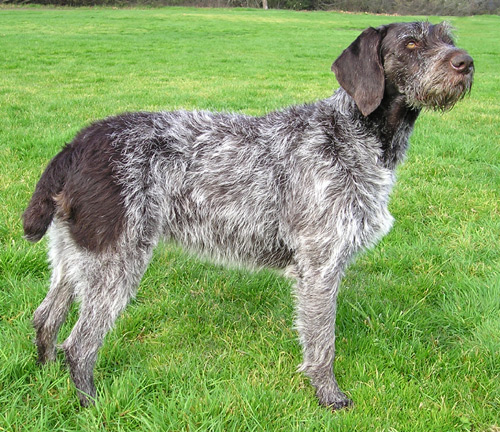
The German Wirehaired Pointer is a well muscled, medium to large-sized dog of distinctive appearance. Balanced in size and sturdily built, the breed's most distinguishing characteristics are its weather resistant, wire-like coat and its facial furnishings. Typically pointer in character and style, the German Wirehaired Pointer (GWP) is an intelligent, energetic and determined hunter. The tail is typically docked to two-fifths of the natural length. In countries where docking is prohibited the tail should be of sufficient length to reach down to the hocks. Like all German pointers, they have webbed feet. This dog can have a similar appearance and therefore is sometimes confused with the Spinone Italiano, Český Fousek, or Wirehaired Pointing Griffon.[citation needed]

Coat

[edit]

The functional wiry coat is the breed's most distinctive feature. A dog must have a correct coat to be of correct type. The coat is weather resistant and water-repellent. The undercoat is dense enough in winter to insulate against the cold but is so thin in summer as to be almost invisible. The distinctive outer coat is straight, harsh, wiry and flat lying, and is from one to two inches in length. The outer coat is long enough to protect against the punishment of rough cover, but not so long as to hide the outline of the dog. On the lower legs the coat is shorter and between the toes it is of softer texture. On the skull the coat is naturally short and close fitting. Over the shoulders and around the tail it is very dense and heavy. The tail is nicely coated, particularly on the underside, but devoid of feather. Eyebrows are of strong, straight hair. Beard and whiskers are medium length. The hairs in the liver patches of a liver and white dog may be shorter than the white hairs. A short smooth coat, a soft woolly coat, or an excessively long coat is to be severely penalized when showing. While maintaining a harsh, wiry texture, the puppy coat may be shorter than that of an adult coat. The coat of the puppy should be shorter than 1 inch the adult coat should be kept at 1 inch long.

Gait

[edit]

The dog should be evaluated at a moderate gait. The breed standard is that the movement is free and smooth with good reach in the forequarters and good driving power in the hindquarters. The topline should remain firm.

German Wirehaired Pointer head

Color

[edit]

The colors are liver (brown) and white or black and white ticked usually with some solid patches, and solid liver (brown) with or without a white chest patch.[2]

Health

[edit]

A 2024 UK study found a life expectancy of 13 years for the breed compared to an average of 12.7 for purebreeds and 12 for crossbreeds.[3]

References

[edit]
Revisions and contributorsEdit on WikipediaRead on Wikipedia
from Grokipedia
The German Wirehaired Pointer is a medium-sized, versatile sporting dog breed developed in during the late as an all-purpose gundog capable of , pointing, retrieving, and tracking on both land and water. This rugged breed, recognized by the (AKC) in 1959, features a distinctive harsh, wiry that provides protection against weather and rough terrain, along with facial furnishings like a bushy and eyebrows. Males typically stand 24 to 26 inches at the shoulder and weigh 50 to 70 pounds, while females are slightly smaller at a minimum of 22 inches in height and 45 to 60 pounds. The is liver and white—usually either liver and white spotted, liver roaned, or liver and white ticked and roaned—though solid liver is also correct; black is severely penalized but occasionally appears. The breed's muscular, balanced build supports endurance in field work. Originating from crosses between the German Shorthaired Pointer, Pudelpointer, Wirehaired Pointing Griffon, and Stichelhaar, the German Wirehaired Pointer was bred to excel in diverse hunting environments, from uplands to wetlands, and was introduced to the United States around 1920. Beyond hunting, these intelligent and affectionate dogs thrive as family companions, excelling in activities like agility, obedience, and therapy work, provided they receive substantial daily exercise and mental stimulation to channel their high energy. With a lifespan typically of 12 to 16 years—a 2024 UK study reported an average of 13 years—they are generally hardy but benefit from health screenings for hips, elbows, eyes, heart, and thyroid issues.

History

Origins and Development

The , known in as the Deutsch Drahthaar, originated in the late 19th century as breeders sought to develop a rugged, all-purpose suited to the country's varied landscapes, including forests, fields, and water. German hunters desired a that could point upland gamebirds, retrieve waterfowl, track wounded animals, and withstand harsh weather conditions, prompting systematic crossbreeding programs around 1880. Leading the effort was Baron Sigismund von Zedlitz und Neukirch, a prominent nobleman and advocate for performance-oriented breeding of pointing dogs, who influenced the creation of wirehaired varieties through his work on related breeds like the . Breeders crossed the for its pointing instinct and endurance, the for retrieving ability and coat texture, the Stichelhaar (a rough-haired pointer) for hardiness, and the Griffon d'arret a poil dur Korthals for wirehaired protection against thorns and water. These combinations aimed to produce a medium-sized with a harsh, weather-resistant coat, sharp scenting skills, and versatility across fur, feather, and track work, marking the breed's evolution into a true griffon-type hunter. Early litters from these crosses appeared in the 1880s, with the first notable standardized breeding efforts emphasizing field performance over mere appearance. The Verein Deutsch Drahthaar, founded in 1902, formalized the breed's standards by requiring rigorous field testing—known as the JGHV trials—for all breeding stock, ensuring only dogs proven in simulations for , retrieving, and tracking were used to propagate the line. This focus on natural ability solidified the German Wirehaired Pointer's role as a multi-game specialist for upland birds, water retrieval, and blood tracking.

Recognition and Modern Role

The Deutsch Drahthaar, the German name for the German Wirehaired Pointer, was first formally recognized in through the founding of its dedicated breed club, the Verein Deutsch Drahthaar (VDD), in , under the umbrella of the Verband für das Deutsche Hundewesen (VDH). The breed gained international status with recognition by the Fédération Cynologique Internationale (FCI) in 1955, establishing its standard as a versatile gundog. , the first imports arrived in the early 1920s, leading to official recognition by the (AKC) in 1959 and the simultaneous establishment of the German Wirehaired Pointer Club of America (GWPCA) as the national parent club. Today, the German Wirehaired Pointer excels in competitive field trials, where it demonstrates its historical hunting versatility through events like AKC hunt tests and horseback field trials that evaluate pointing, retrieving, and tracking abilities. The breed also participates in agility, obedience, and rally competitions, showcasing its intelligence and athleticism in performance sports sanctioned by organizations such as the AKC and United Kennel Club (UKC). Beyond competition, it serves as a loyal companion for active families, particularly those engaged in outdoor pursuits like hiking and running, provided they meet its high exercise needs. In , VDD breeding regulations strictly emphasize proven hunting performance and health, requiring prospective breeding dogs to pass rigorous hunt tests such as the Jugendprüfung (VJP) for natural ability and the Hauptprüfung (HZP) for advanced field work, along with veterinary evaluations for , eye conditions, and coat quality. These standards ensure the breed's ongoing utility as a versatile while maintaining genetic health and working drive.

Physical Characteristics

Appearance and Conformation

The German Wirehaired Pointer is a medium to large-sized sporting , with males typically measuring 24 to 26 inches at the and females standing at least 22 inches tall, typically weighing 50 to 70 pounds. This build emphasizes functionality for , with a muscular yet agile frame that balances power and endurance. According to the (AKC) standard, the body is slightly longer than tall in a 10:9 proportion, creating a nearly square appearance that supports efficient movement over varied terrain. The overall conformation features a deep chest that reaches to the elbows, a straight and firm back, and a high-set traditionally docked to approximately two-fifths of its natural length in countries where docking is permitted. The (FCI) standard similarly describes a robust, slightly sloping topline from to , with a broad, muscular and well-arched for optimal lung capacity during fieldwork. Forelegs are straight and parallel with strong, flat bones, while hindquarters provide balanced angulation for propulsion, all contributing to a sturdy yet elegant structure suited to versatile gundog duties. The head is proportionate to the body, with a moderately long muzzle, straight , and dark brown eyes that convey ; pendulous ears are medium-sized, rounded, and set high on the . Feet are round and webbed, aiding in capabilities essential for retrieving from . In motion, the breed exhibits a smooth, ground-covering with powerful reach from the front and strong drive from the rear, maintaining a level topline without rolling or bouncing—qualities that underscore its heritage. The wiry coat texture briefly complements this conformation by providing weather resistance without altering the underlying skeletal proportions.

Coat, Color, and Grooming

The German Wirehaired Pointer possesses a distinctive double designed for rugged outdoor work, featuring a harsh, wiry outer layer that measures 1 to 2 inches in length on the body, providing protection from thorns, burrs, and harsh weather while remaining largely waterproof. This outer is straight, dense, and flat-lying, composed of strong, crisp individual hairs that lie close to the body without wooliness or softness, except for the dense, finer undercoat that insulates against cold and aids in water repellency. The 's wiry texture contributes to low shedding overall, with only minimal loose hair released seasonally, making it suitable for active lifestyles without excessive indoor fur buildup. Accepted coat colors adhere closely to the , primarily liver and in ticked or roaned patterns, though solid liver is also permissible. A red head is typical, often accented by a small blaze on the or a marking on the chest, while on the feet is considered undesirable. Black and white combinations occur rarely, and any black in the coat is severely penalized under the official standard. Grooming requirements for the German Wirehaired Pointer emphasize preserving the coat's natural texture and functionality, with hand-stripping recommended twice yearly—typically in spring and fall—to remove the dead outer hairs and stimulate fresh growth without damaging the wiry quality. Weekly brushing using a comb and soft slicker brush suffices for routine maintenance, effectively removing dirt, loose undercoat, and any tangles while distributing natural oils to enhance weather resistance. Bathing should be infrequent, only as needed to prevent drying out the skin or softening the coat, and clipping is discouraged as it ruins the harsh texture essential for the breed's protective covering.

Temperament and Behavior

Personality Traits

The German Wirehaired Pointer is highly intelligent and alert, with a strong derived from its origins as a versatile . These traits make the breed responsive and eager to please, enabling it to excel in demanding tasks that require focus and endurance. Affectionate and loyal by nature, German Wirehaired Pointers form deep bonds with their owners, often displaying devotion that borders on protectiveness without veering into aggression. This loyalty manifests as a reliable companionship, where the dog prioritizes interaction and family well-being. Characterized by boundless energy and enthusiasm, the breed thrives on activity but can become willful or engage in destructive behaviors if understimulated or bored. This high drive reflects its heritage as an active field dog, necessitating outlets to maintain balanced behavior. German Wirehaired Pointers tend to be reserved toward strangers, exhibiting caution rather than shyness, which underscores their natural watchdog instincts. They remain vigilant and alert to unfamiliar situations without unnecessary hostility, warming up once introductions are made.

Suitability for Families and Activities

The German Wirehaired Pointer is generally affectionate and forms strong bonds with family members, making it a suitable companion for active households when properly socialized from an early age. It tends to do well with calm, older children who can match its playful energy, though supervision is essential to prevent accidental roughhousing due to the breed's boisterous nature, which may overwhelm toddlers. This breed is typically compatible with other dogs, especially if introduced properly, owing to its sociable instincts as a pack-oriented . However, its strong makes it less ideal for households with cats or small pets unless raised together from puppyhood, as it may instinctively chase or view them as quarry. German Wirehaired Pointers thrive best with active families in rural or suburban environments that provide ample space for exercise, excelling in pursuits like hunting, hiking, running, and dog sports such as agility or obedience trials. They are not well-suited to apartment living or sedentary lifestyles, as their high energy levels demand several hours of vigorous daily activity to prevent boredom or destructive behavior. Additionally, they are prone to separation anxiety if left alone for extended periods, preferring close human companionship and potentially developing anxious habits without it.

Training and Exercise

Training Approaches

The German Wirehaired Pointer's intelligence and eagerness to please make it highly responsive to positive reinforcement methods, which emphasize rewards such as praise, treats, and play to encourage desired behaviors. This approach aligns with the breed's sensitive nature, where harsh corrections can lead to fearfulness or reluctance, whereas reward-based techniques build confidence and strengthen the handler-dog bond. Owners should begin with short, engaging sessions focused on basic commands like sit, stay, and come, gradually increasing complexity to match the dog's enthusiasm for learning. Early is essential, with the generally spanning 3 to 14 weeks of age, to mitigate the breed's natural wariness toward unfamiliar people, animals, or environments, ensuring a well-adjusted adult . obedience classes, typically starting around 8 weeks after initial vaccinations, capitalize on the young 's instinctive desire to follow and bond during this window, fostering reliable and while preventing behavioral issues. Consistent from the handler is crucial to channel the breed's independent streak, providing clear boundaries without dominance to maintain motivation. For those pursuing the breed's hunting heritage, advanced training introduces specialized commands for pointing, retrieving, and tracking, often building on foundational obedience to harness the dog's innate drive. These sessions should incorporate real-world scenarios, such as scent work or simulated hunts, to keep the dog engaged and prevent boredom. A key challenge is the high prey drive, which demands dedicated recall practice in distracting environments to ensure safety off-leash; positive reinforcement here, using high-value rewards, proves most effective in overriding instincts without eroding trust.

Exercise and Daily Care Requirements

The German Wirehaired Pointer is a high-energy sporting breed that requires substantial vigorous daily exercise to maintain physical health and prevent behavioral issues like boredom-induced destructiveness. Suitable activities include running, , or field work, which align with the breed's heritage and help channel their boundless stamina. Without adequate outlets, these s may become restless or overly vocal, underscoring the need for consistent routines tailored to their active nature. In addition to physical exertion, mental stimulation is essential to satisfy their intelligent and purposeful , with puzzle toys or scent games providing engaging challenges that mimic tracking instincts. Off-leash areas are ideal for such activities, allowing safe exploration while reinforcing their drive and reducing anxiety from understimulation. Feeding should consist of a high-quality diet formulated for active sporting s, provided in two meals per day to support their energy demands and promote ; portion sizes should be determined based on the 's weight, age, and activity level, with veterinary guidance recommended. Owners must monitor for gastric dilatation-volvulus (GDV or bloat), a heightened in deep-chested breeds like the German Wirehaired Pointer due to factors such as rapid eating or single large meals; preventive measures include portion control and avoiding exercise immediately after feeding. For housing, a spacious yard with secure is preferred to accommodate their need for outdoor movement and exploration, though they adapt well to family homes with ample activity opportunities. Due to their dense, weather-resistant coat, supervision is necessary during hot weather to prevent overheating, as the thick undercoat can retain warmth despite its insulating properties.

Health and Longevity

Common Health Issues

The German Wirehaired Pointer is prone to , a hereditary malformation of the hip joint where the ball and socket do not fit properly, leading to joint instability, pain, , and lameness, particularly in active dogs. , another developmental orthopedic issue, involves abnormal growth of the elbow joint components, such as fragmented coronoid processes or ununited anconeal processes, resulting in lameness, swelling, and reduced mobility. Eye conditions are also common in the breed, including cataracts, which cause opacity in the lens and progressive vision loss or blindness if untreated. , a genetic , leads to the gradual deterioration of the retina's photoreceptor cells, resulting in night blindness followed by total vision loss. Von Willebrand's disease, specifically type II, is a severe inherited bleeding disorder in German Wirehaired Pointers caused by a deficiency in the protein essential for blood clotting, leading to prolonged bleeding after injury, surgery, or spontaneously from mucous membranes. Among other health concerns, gastric dilatation-volvulus (bloat) poses a risk due to the breed's deep-chested conformation, where the stomach fills with gas and twists, causing rapid abdominal distension, shock, and potentially fatal complications if not addressed immediately. Skin allergies, often manifesting as itching, rashes, or infections, can arise from environmental factors or the wiry trapping irritants, and may be exacerbated by underlying . , an endocrine disorder involving insufficient thyroid hormone production, results in symptoms such as lethargy, weight gain, hair loss, and recurrent or ear infections. Cancer risks increase in older s, with —a highly aggressive —particularly affecting the limbs, causing lameness, swelling, and fracture, often with a poor prognosis despite treatment.

Lifespan and Preventive Measures

The German Wirehaired Pointer typically enjoys a lifespan of 12 to 16 years with appropriate care, though individual longevity can vary based on , , and . According to the (AKC), the breed's average lifespan is 14 to 16 years, while the Veterinary Centers of America (VCA) reports a range of 12 to 14 years. Preventive care is essential to maximize lifespan and , beginning with routine veterinary check-ups at least annually to monitor overall health and detect issues early. Core vaccinations against diseases such as parvovirus, distemper, and , along with regular deworming and / prevention, form the foundation of proactive health maintenance, as recommended by the AKC Canine Health Foundation. Dental hygiene, including weekly brushing with canine-formulated and professional cleanings every six to 12 months, helps prevent , which can contribute to systemic health problems in aging dogs. Spaying or also plays a key role, significantly reducing the risk of certain cancers, such as mammary tumors in females and in males, according to research from the School of . Nutrition and weight management are critical to preventing joint strain, particularly given the breed's predisposition to hip and elbow dysplasia. A balanced diet tailored to the dog's age, activity level, and size helps maintain an ideal body condition score, avoiding obesity that exacerbates orthopedic issues, as noted by veterinary experts at Chapin Veterinary Care Center. For breeding programs, genetic screening through organizations like the Orthopedic Foundation for Animals (OFA) is recommended to identify and mitigate hereditary risks, including DNA tests for von Willebrand's disease type II and progressive retinal atrophy, ensuring healthier litters and longer-lived individuals, per guidelines from the German Wirehaired Pointer Club of America (GWPCA). As German Wirehaired Pointers enter their senior years around age 8, monitoring for age-related decline becomes vital, with adjustments to support conditions like . Transitioning to senior-specific diets enriched with , chondroitin, and omega-3 fatty acids can aid joint health and mobility, while low-impact activities and weight control further alleviate strain, according to AKC nutritional guidelines. Regular veterinary assessments during this phase allow for tailored interventions, such as or supplements, to promote comfort and extend active years.

References

Add your contribution
Related Hubs
User Avatar
No comments yet.