Hubbry Logo
PudelpointerPudelpointerMain
Open search
Pudelpointer
Community hub
Pudelpointer
logo
8 pages, 0 posts
0 subscribers
Be the first to start a discussion here.
Pudelpointer
Pudelpointer
from Wikipedia
Pudelpointer
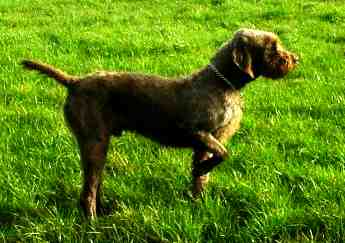
Pudelpointer pointing
OriginGermany
Kennel club standards
VDH standard
Fédération Cynologique Internationale standard
Dog (domestic dog)

The Pudelpointer is a versatile hunting dog breed from Germany.[1][2] It is a pointing breed that came from a cross between the standard poodle (pudel) and the English Pointer.

Appearance

[edit]

The breed weighs between 44 and 66 lb (20 and 30 kg), stands 21 to 26 in (53 to 66 cm) at the shoulder, and comes in liver, chestnut, and occasionally black coats. The ideal coat is harsh, wiry, and dense. The dogs shed very little.

History

[edit]

In 1881, a German breeder, Baron 'Hegewald' von Zedlitz, worked on producing his ideal tracking, pointing, and retrieving gun dog, suitable for work on both land and water.[3] From seven poodles and 90 different pointers, he developed the Pudelpointer. The original sire was Tell, an English Pointer belonging to Kaiser Frederick III and the original dam was a German hunting pudel named Molly who was owned by Hegewald.

The goal was to produce a dog that was willing and easy to train, intelligent, and loved water and retrieving, like the poodle, and add to that a great desire to hunt, a strong pointing instinct, and an excellent nose, like in the English Pointer, as well as being an excellent companion in the home.

The Poodle breed had much stronger genes, and so many more Pointers were used to achieve the balanced hunting dog that was desired. A mix of 11 Pudels and 80 Pointers were used during the first 30 years to achieve the desired traits and results.

The breed was introduced to North America in 1956 by Bodo Winterhelt, who remained involved in maintaining the breed standard until his death in 2018.[4][5][6] His Winterhelle Kennel was the foundation of the breed in North America. In 1977 Winterhelt founded the Pudelpointer Club of North America in Canada.

In Germany as well as North America, its performance standards are its most important trait. Before being approved for breeding, dogs and bitches must pass Hunt Test with minimum scores of their performance tests of its field, tracking, and water skills set by the various breed clubs. These clubs are the Verein Pudelpointer in Germany and the following clubs in North America: NAPPA, PCNA and VPP-GNA). The North American Versatile Hunting Dog Association (NAVHDA) also tests Pudelpointers and other breeds of versatile hunting dogs.

The Pudelpointer never became a popularized breed in the United States in part because breeders have actively avoided recognition by the American Kennel Club. Breeders believe that AKC recognition would place too much emphasis on form over function, possibly splitting the breed into a show breed and separate working class.[7]

See also

[edit]

References

[edit]
[edit]
Revisions and contributorsEdit on WikipediaRead on Wikipedia
from Grokipedia
The Pudelpointer is a medium-sized, versatile breed originating from , developed in the late through selective crosses between the German hunting Pudel and the English Pointer to create a excelling in , retrieving, and tracking on land and water. The breed's creation began in 1881 when Baron von Zedlitz und Neukirch initiated systematic breeding, starting with the first cross between an English Pointer sire named "Tell"—owned by Kaiser Frederick III—and a German hunting Pudel dam named "Molly," owned by Hegewald; this effort incorporated approximately 90 Pointers and seven Pudels (possibly including Barbet ancestors of the Wasser Poodle) over subsequent generations to refine traits like intelligence, water affinity, and endurance. By 1892, a breed register was established, and in 1897, the Verein Pudelpointer club was founded to standardize the breed. The Pudelpointer is recognized by the (FCI, standard No. 216) and the (UKC since 2006), while in , the Pudelpointer Club of North America promotes the breed through organizations like the North American Versatile Hunting Dog Association (NAVHDA) and the Versatile Hunting Dog Federation (VHDF); it remains in the American Kennel Club's Service (since 2016), with annual puppy registrations around 400 worldwide as of 2025, reflecting its niche but dedicated following among upland hunters. The Pudelpointer features an athletic build with a dense, wiry in shades of liver brown or , stands 22–27 inches at the shoulder, and weighs 45–70 pounds. It is intelligent, trainable, and affectionate, with a strong instinct, generally robust but prone to and . The breed has a lifespan of 12–14 years.

Physical Characteristics

Size and Build

The Pudelpointer is a medium-sized characterized by a sturdy, athletic build designed for in the field. Height at the is 22 to 26 inches, with deviations considered faults in breed standards. Weight ranges from 45 to 75 pounds, distributed proportionally to maintain a lean, muscular frame that supports prolonged hunting activities without excess bulk. The body exhibits a harmonious conformation, slightly longer than tall in a 10:9 , featuring a straight topline, pronounced , short and firm back, and well-muscled that transition to a medium-length, slightly sloping . The chest is broad and deep with well-sprung, arched , providing ample capacity for stamina, while a slight tuck-up at the contributes to agility. Strong, straight forelegs with parallel bones and good angulation meet powerful hindquarters, where long, broad upper thighs and well-angulated stifles enable explosive propulsion for and retrieving. The tail is set even with the , carried level or saber-like, and traditionally docked to about two-thirds length, though natural tails reaching the hocks are permissible where docking is prohibited. The head is proportionate in length and width, with a flat of moderate breadth, slightly rounded sides, and a pronounced stop leading to a straight, balanced muzzle of equal length to the skull. Dark or eyes convey , set in tight lids, while medium-sized ears hang pendulously close to the head, high-set with rounded tips. The broad, pigmented muzzle supports a scissor bite with full , facilitating detection and handling in versatile roles. These structural traits underscore the breed's functionality as a , with robust limbs and a compact yet dynamic frame optimized for both upland and water work.

Coat and Coloration

The Pudelpointer's is double-layered, featuring a harsh, wiry outer and a dense undercoat that renders it water-repellent and highly protective against harsh weather, thorns, and underbrush encountered in hunting environments. According to the breed standard, the is close-lying, hard, and rough in texture, with a dense undercoat providing essential insulation and . The North American Pudelpointer Society emphasizes its density and harshness, noting that it should offer optimal protection against environmental elements and injuries. The outer typically measures 1 to 2 inches in length, presenting in wiry, rough, or slightly smooth variations that resist matting and tangling effectively. The Pudelpointer Club of North America describes acceptable coat types ranging from wire (0.75–1.5 inches) to rough (1.5–2.5 inches), all supported by a shorter, dense undercoat for comprehensive coverage. This structure contributes to low to moderate shedding, which occurs seasonally as the undercoat renews, resulting in minimal loose hair year-round. While not classified as , the breed's reduced and infrequent shedding can make it more tolerable for individuals with mild allergies compared to heavy-shedding breeds. Coloration is predominantly solid, with the recognizing liver (brown) and as standard hues; dead leaf tones are also accepted in some registries. Small markings are permitted on the chest, paws, or toes, but extensive patches, blazes, or parti-color patterns are faults or disqualifications to preserve the breed's uniform, functional appearance. The specifies solid brown, dead leaf, or coats, allowing only minor accents without other deviations. Grooming needs are straightforward and low-maintenance, centered on weekly brushing with a firm brush to remove , distribute natural oils, and prevent minor tangles in the wiry texture. Hand-stripping—manually plucking dead outer hairs—is recommended seasonally, especially in spring before warmer weather, to promote a healthy regrowth and is particularly practiced on show specimens; baths should be infrequent, only as needed to avoid stripping protective oils. This regimen supports the coat's natural resilience without requiring professional intervention for working dogs.

Temperament and Behavior

Personality Traits

The Pudelpointer is renowned for its intelligent and eager-to-please , making it a highly trainable and responsive . This breed exhibits a calm and self-controlled , remaining even-keeled in various situations while displaying a strong enthusiasm for work and keen hunting instincts. These traits stem from its breeding as a versatile , combining the Pointer's drive with the Poodle's sharpness and adaptability. In terms of energy, the Pudelpointer possesses a high level that demands regular physical exercise and mental stimulation to prevent boredom and potential mischief. While mellow and composed at home, it becomes energetic and focused during work or play, thriving on activities like retrieving or field exercises. Its trainability is exceptional, allowing it to excel in structured tasks without excessive hyperactivity indoors. Socially, the Pudelpointer is affectionate and loyal toward family members, often forming strong bonds and showing a friendly, sociable nature overall. It tends to be reserved yet non-aggressive with strangers, prioritizing its role as a companion over excessive vigilance, and is not overly vocal, barking primarily to alert rather than guard. This balanced demeanor contributes to its low tendency toward herding behaviors, as it is bred specifically for pursuits rather than livestock management. The breed's instincts are sharply honed for pointing, retrieving, and tracking, with a natural versatility that allows it to perform effectively in fields, woods, and without shyness toward or gunfire. These innate drives, coupled with its adaptability, make the Pudelpointer a dedicated hunter focused on purposeful work rather than territorial guarding.

Suitability for Families and Activities

The Pudelpointer is well-suited for active families, particularly those with older children, due to its gentle, outgoing, and playful temperament that fosters strong bonds with household members. When properly socialized and trained, the breed demonstrates patience and tolerance around kids, making it a reliable companion in dynamic home environments. However, supervision is essential with toddlers, as the dog's energetic playfulness and hunting instincts may lead to unintentional roughness during interactions. Regarding interactions with other animals, the Pudelpointer's strong —rooted in its heritage—often makes it unsuitable for households with small pets such as cats, rabbits, or , as it may view them as rather than companions. Early can mitigate this tendency, allowing the to coexist peacefully with other dogs or larger animals, though ongoing management is advised to prevent chasing behaviors. The notes that Pudelpointers are generally friendly with other dogs when introduced properly, but their instincts require vigilant oversight in multi-pet homes. In terms of lifestyle compatibility, the Pudelpointer thrives in rural or suburban settings with ample outdoor space, aligning best with owners who enjoy hiking, running, or other vigorous pursuits. It demands at least 1 to 2 hours of daily exercise, including activities like swimming or fetch, to channel its high energy levels and maintain mental sharpness. Apartment living is not recommended, as the breed's need for room to roam and play can lead to frustration in confined spaces without access to green areas. Beyond hunting, the Pudelpointer adapts effectively to non-field roles, excelling in dog sports such as agility, obedience, and rally due to its intelligence and eagerness to please. It can serve as a versatile companion for therapy work or general family activities when its exercise and stimulation needs are met, providing loyalty and engagement without requiring a hunting focus. This adaptability stems from the breed's versatile nature, allowing it to transition into a fulfilling pet role in active households. Owners should be prepared for challenges, including the potential for destructive behaviors like chewing or digging if the dog is under-exercised or bored, as its high energy unmet can result in unwanted habits. The Pudelpointer's independent streak, inherited from its Pointer lineage, demands experienced handlers who can provide consistent leadership and mental challenges to prevent stubbornness or disengagement. Thus, it is best for committed owners familiar with working breeds rather than novices seeking a low-maintenance .

Health and Wellness

Common Health Issues

Pudelpointers are generally considered a robust , but like many large dogs, they are predisposed to certain genetic and conformational issues that can affect their quality of life. Primary concerns include orthopedic conditions such as hip and elbow dysplasia, which stem from inherited joint malformations, as well as risks associated with their body structure. Hip dysplasia is one of the most prevalent genetic conditions in Pudelpointers, characterized by an abnormal development of the where the ball and socket do not fit properly, leading to joint instability, pain, and eventual . This malformation is polygenic, influenced by both and environmental factors like rapid growth or overexertion, and symptoms often manifest in young adulthood as limping, bunny-hopping , reluctance to rise or exercise, and decreased activity levels. Elbow dysplasia, akin to but affecting the front limbs, involves inherited abnormalities in the elbow 's growth, such as fragmented coronoid processes or incongruent joint surfaces, which can cause lameness as early as four to ten months in affected lines. Symptoms include swelling around the elbows, cracking or popping sounds during movement, stiffness upon rising, and difficulty with jumping or running, potentially progressing to chronic arthritis if untreated. Epilepsy is another notable genetic concern in Pudelpointers, characterized by recurrent seizures without an identifiable underlying cause, often beginning between 1 and 4 years of age. Symptoms may include loss of , convulsions, , vocalizing, and involuntary or during episodes lasting seconds to minutes. The breed's standards emphasize prevention through and ; affected dogs can be managed with lifelong medications under veterinary supervision. Other notable concerns include gastric dilatation-volvulus (GDV), commonly known as bloat, which is more likely in Pudelpointers owing to their deep, broad chest that allows the stomach to distend and twist, trapping gas and cutting off blood flow—a life-threatening emergency that can occur suddenly. Symptoms encompass unproductive retching, abdominal distension, restlessness, rapid breathing, and collapse, often within hours of onset. Additionally, their hanging ears can trap moisture and debris, predisposing them to chronic ear infections () characterized by head shaking, odor, redness, discharge, and . To mitigate these risks, breeders should conduct , including Orthopedic Foundation for Animals (OFA) radiographic evaluations or PennHIP assessments for hip and , which provide scores indicating joint laxity and future disease risk, as well as DNA tests for through certified labs. These screenings help select breeding stock with "excellent" or "good" ratings, reducing incidence in subsequent generations.

Lifespan and Maintenance

The Pudelpointer has an average lifespan of 12 to 15 years when provided with appropriate care and maintenance. This longevity can be supported by a balanced lifestyle that addresses their needs as an active breed, helping to mitigate risks such as or joint strain. A proper diet is essential for maintaining the Pudelpointer's energy levels and overall health, consisting primarily of high-quality, protein-rich formulated for active or working breeds. Daily portions typically range from 2 to 3 cups, divided into two meals and adjusted based on the 's age, weight, activity level, and metabolism to prevent ; consultation with a is recommended for personalized feeding plans. Treats should comprise no more than 10% of the daily caloric intake to avoid nutritional imbalances. Pudelpointers require substantial daily exercise to channel their high energy and maintain , typically 1 to 2 hours of vigorous activities such as running, swimming, or field work. Insufficient activity can lead to restlessness or weight gain, so owners should incorporate mental stimulation like scent games alongside physical exertion. Grooming routines for Pudelpointers extend beyond their low-shedding to include regular nail trimming every 4 to 6 weeks to prevent overgrowth and discomfort, dental through weekly brushing or dental chews to reduce plaque buildup, and ear cleaning after exposure or weekly to avoid infections in their floppy s. These practices promote and early detection of issues. Routine veterinary care is crucial for , including annual wellness exams to monitor overall , up-to-date vaccinations against common diseases, and year-round parasite prevention for fleas, ticks, and heartworms. Spaying or is often advised around 6 to 12 months to reduce risks of certain reproductive cancers, though timing should be discussed with a vet based on the dog's lifestyle.

History and Development

Origins in

The development of the Pudelpointer breed began in 1881 in Wolfsdorf, Schlesien (now part of ), when the first deliberate cross was made between a black German hunting Poodle named "Molly" and an English Pointer named "Tell," owned by Kaiser Frederick III. This mating produced a litter including "Cora von Wolfsdorf," marking the inception of a new versatile lineage. The initiative was led by Baron Sigismund von Zedlitz und Neukirch, who wrote under the pseudonym Hegewald and envisioned a dog that merged the Pointer's exceptional scenting ability, pointing instinct, endurance, and field drive with the Poodle's intelligence, water affinity, retrieving skills, trainability, and protective wiry coat. Hegewald, a prominent hunting dog expert and author, aimed to create an all-purpose hunter capable of working upland game birds and waterfowl across diverse German terrains, from forests to wetlands. Over the subsequent decades, early breeders like Hegewald and Otto Oberländer conducted systematic selections, incorporating 11 Poodles and over 80 Pointers in the foundational lines to stabilize desirable traits such as the wiry coat, calm temperament, and reliable hunting performance. The first official litter registration occurred through the breed's inaugural studbook, published in 1907 by Oberländer, which formalized the tracking of pedigrees and breeding outcomes from these early efforts. To preserve and standardize the breed, the Verein der Pudelpointerzüchter—later known as the Verein Pudelpointer e.V.—was founded on July 17, 1897, in , with Hegewald serving as honorary president and Oberländer as a key organizer.

Spread and Recognition

The Pudelpointer was introduced to in 1956 through imports by H.D. Hume and Sigbert (also known as Sigbot or Bodo) Winterhelt, who brought the first dogs from and initiated breeding efforts in . These early imports laid the foundation for the breed's establishment outside its native country, with Winterhelt's efforts focusing on promoting the dog's versatile hunting abilities. The breed's growth in the United States gained momentum with the founding of the Pudelpointer Club of North America (PCNA) in 1977 by Winterhelt in , which serves as the official breed club and studbook while emphasizing performance in versatile hunting tests. The PCNA has prioritized breeding for field utility over conformation, aligning with organizations that evaluate dogs on natural ability, tracking, and retrieving skills. Post-World War II, the Pudelpointer's presence in Europe was severely limited due to the depletion of breeding stock from wartime destruction and , restricting its development primarily to . The breed experienced a resurgence in , particularly the and , alongside continued cultivation in select European nations such as the , , , , and the . The United Kennel Club (UKC) recognized the Pudelpointer in 2006, classifying it in the Versatile Gun Dog group to highlight its multi-purpose hunting traits. The North American Versatile Hunting Dog Association (NAVHDA) also endorses the breed for rigorous performance testing, including natural ability and utility evaluations that assess field prowess without emphasis on appearance. As of 2025, the Fédération Cynologique Internationale (FCI) has recognized the breed on a definitive basis since 1959 in Group 7 (Continental Pointing Dogs), originating from Germany, while it remains in the American Kennel Club's (AKC) Foundation Stock Service, making it eligible for pointing breed hunt tests since 2016 but not yet for full conformation competition. Worldwide, the Pudelpointer remains relatively rare, with approximately 400 puppies whelped annually across key regions including the and .

Breeding and Use

Breed Standards and Breeding

The Pudelpointer breed standard, as established by the (UKC), emphasizes a balanced, medium-to-heavy build suited for versatile hunting, with males measuring 23.5 to 27 inches at the and females 21.5 to 25 inches, prioritizing functionality for field, wood, and water work over aesthetic exaggerations. The North American Pudelpointer Society (NAPS) similarly describes the breed as an agile, powerful gundog with a dense, hard coat in brown, black, or dead leaf shades, weighing 45 to 75 pounds, and underscores its calm temperament and strong hunting instinct without promoting show-ring extremes. The Pudelpointer Club of (PCNA) reinforces this by classifying acceptable coats into rough (1.5–2.5 inches, ideal for climates), wire (0.75–1.5 inches, suited for field work), and prohibiting smooth/short coats under 0.75 inches for breeding to ensure weather resistance and protection. NAVHDA recognizes the Pudelpointer as one of 35 versatile hunting breeds, focusing on natural abilities like tracking, pointing, and retrieving rather than conformational ideals. Key disqualifications in the UKC standard include bite faults (overshot, undershot, or wry), eye abnormalities ( or ), lack of undercoat or beard, non-standard colors beyond solid brown, dead leaf, or black with small white markings, and temperamental issues such as viciousness or extreme shyness. NAPS adds prohibitions against solid white patches on the body, diagnosed , and temperament disorders like gun shyness or , ensuring dogs remain reliable hunters. Builds exceeding limits or featuring soft, non-weatherproof coats are implicitly rejected to preserve the breed's robust, work-oriented physique. Breeding practices for Pudelpointers prioritize purity and health, with organizations like the North American Pudelpointer Alliance (NAPPA) prohibiting to other breeds and instead drawing from established genetic pools in and , including Czech lines, to maintain breed integrity. Mandatory health clearances include certification free of via OFA or equivalent, alongside evaluations for eye conditions and stability. NAPPA and NAPS require breeding stock to achieve NAVHDA prizes—males in Utility tests and females scoring at least 105 points with a prize in Natural Ability, UPT, or Utility tests—to verify natural hunting aptitude and avoid overbreeding for non-functional traits. Ethical guidelines emphasize performance over show breeding, with breeders actively hunting their dogs and using tools like BreedMate software to calculate coefficients up to 25 generations, preventing depression through selective pairings of diverse pedigrees. Litters typically average 6 to 8 puppies, supporting sustainable population growth without compromising quality.

Hunting Capabilities and Training

The Pudelpointer serves as a versatile , excelling in , tracking, and retrieving across land and water environments. Its far-seeking enables effective scent detection, while its powerful yet gentle ensures game is carried without damage, making it ideal for handling birds and small mammals. This combination of traits stems from its genetic blend of Pointer agility and Poodle versatility, allowing it to perform multiple roles in a single hunt. In field performance, Pudelpointers demonstrate strong endurance for all-day hunts, covering wide areas at a medium to fast gallop while maintaining focus on game. They adeptly handle upland birds like pheasants, , and partridges, as well as waterfowl such as , and small game including rabbits and hares. Their protective, water-repellent coat supports work in harsh conditions, including retrieving from cold waters, and they often exhibit intelligent behaviors like pinning running birds or tracking wounded with a vocal alert. Training Pudelpointers emphasizes positive reinforcement and force-free methods to leverage their eager-to-please temperament and intelligence, though moderate guidance can be applied without issue. Programs typically start with basic obedience to establish control, advancing to scent work with pigeons or quail, followed by gradual introductions to gunfire and birds to build steadiness. Field exercises then incorporate pointing drills, retrieving simulations on land and water, and tracking simulations, often using tools like e-collars for refinement once foundational skills are solid. Key age milestones in development include early socialization by 12 weeks to foster confidence and prevent shyness, with initial field exposure around 6 months focusing on natural instincts like pointing and basic retrieves. Formal hunting training intensifies from 8 to 16 months, aligning with NAVHDA's Natural Ability Test eligibility at up to 16 months, and full physical and mental maturity for advanced work typically arrives by 2 years. Beyond traditional , Pudelpointers achieve notable success in NAVHDA tests, with averages exceeding 100 points in Natural Ability assessments and many earning top scores, validating their versatility. Their tracking prowess also suits blood trailing for big game, while strong water skills enable participation in dock diving events.

References

Add your contribution
Related Hubs
User Avatar
No comments yet.