Hubbry Logo
GiraudpuriGiraudpuriMain
Open search
Giraudpuri
Community hub
Giraudpuri
logo
8 pages, 0 posts
0 subscribers
Be the first to start a discussion here.
Giraudpuri
Giraudpuri
from Wikipedia

Giraudpuri is a village in the Baloda Bazar district of Chhattisgarh, India. Located beside the Jonk River, it is the birthplace of the Satnami sect's founder Guru Ghasidas, and a pilgrimage centre for the Satnamis.[1]

Key Information

History

[edit]

The village is notable as the birth place of Guru Ghasidas, the founder of the Satnam panth (religious sect).[2] It is a major place of pilgrimage (dham) for the Satnamis.[1] His son Balakdas purchased land in Girodhpuri to strengthen the Satnami sect.[3] A jayanti mela (birth anniversary fair) held in honour of Ghasidas was first held in Giraudpuri in 1932.[4]

The village was originally known as "Girod". By the time Chhattisgarh became a state in 2000, the Satnamis had become a politically important voting group. The state government renamed the village to "Girodpuri" ("Girod town"), and started developing the area as a tourist centre to generate income, and to gain the political support of the Satnamis. The government built a temple, surrounded by other infrastructure such as hostels, parking areas, and space for the makeshift shops and stalls to be set up during the annual mela. The government also developed roads leading to the area, and advertised the site as an important pilgrimage centre of the state. As a result of these efforts, the attendance at the mela increased from around 20,000 in 2001 to over 500,000 in 2008.[5]

In 2022, the INC-led Chhattisgarh government announced that the village will be renamed to "Baba Guru Ghasidas Dham Giroudpuri".[6]

Tourism

[edit]

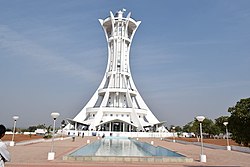
The main landmark of the village is Guru Ghasidas Jaitkham, a 77 metre high tower used as a pilgrimage centre by the Satnamis.[7] A jaitkham ("victory pillar") is a Satnami object of worship, and a symbol of their distinct sectarian identity.[4] It is also known as Jaithkham, Jaitkhambh, Jait Khamba, Jait Khamb, or Jai Stambh. The Jaitkham at Giraudpuri was commissioned by the BJP-led Chhattisgarh government, and constructed by a Kolkata-based firm as an earthquake-resistant structure. The project was scheduled to be completed in 2007 at a cost of 17 crores,[8] but was completed in 2015 at a cost of 51.43 crores.[7] In 2010, while questioning the government on the delay and the cost overruns, the opposition INC leaders alleged that the tower was originally planned to be 122 m high, but the BJP government denied this.[8] When Chief Minister Raman Singh inaugurated the tower on 18 December 2015, it was said to be the tallest concrete structure in India.[7][9] Visitors can climb the tower up to 65m taking the spiral stairs or elevators. At its centre, the structure has a conference hall with a capacity to hold 2000 people.[7]

Charan Kund, sacred pond, is another pilgrimage site in the village. Amrit Kund, a pond whose water is said to be sweet, is located a kilometre from the village. The annual Giraudpuri Mela (fair), also known as the "Guru Darshan Mela", is held at the village.[10][11]

References

[edit]
Revisions and contributorsEdit on WikipediaRead on Wikipedia
from Grokipedia

Giraudpuri, also known as Giroudpuri Dham, is a village and prominent pilgrimage center in the Baloda Bazar district of , , situated at the confluence of the and Jonk rivers, approximately 40 kilometers from Balodabazar and 80 kilometers from Bilaspur. It serves as the birthplace of Ghasidas, born into a farming family around 1756, who founded the Satnami Panth, a reformist sect emphasizing devotion to , social equality, rejection of hierarchies and idol worship, and ethical living including . The site holds deep spiritual significance as Ghasidas's tapobhumi, where he meditated under the Auradhara tree, and features key structures such as the Jaitkhamb—a towering pillar symbolizing truth in Satnami tradition—and sacred ponds like Charan Kund and Amrit Kund, drawing pilgrims for worship at his revered 'seat'.
Annually, Giraudpuri hosts the Giraudpuri Mela, a major gathering of Satnami devotees held at Charan Kund to commemorate Guru Ghasidas and propagate his teachings, with the 2025 event scheduled from March 4 to 6. This pilgrimage underscores the sect's enduring influence in challenging social orthodoxies and fostering community solidarity among primarily Scheduled Caste adherents in .

Geography and Location

Physical Setting and Environment

Giraudpuri is a village located in the Baloda Bazar of , , approximately 40 km from Balodabazar and 80 km from Bilaspur. The area forms part of the broader Chhattisgarh Plain, characterized by undulating terrain and fertile alluvial soils deposited by regional river systems. The site occupies a position at the of the River, one of 's major eastward-flowing rivers originating in the , and its tributary the Jonk River, which drains the surrounding plateaus before merging. This riverside setting influences the local environment through seasonal water levels, supporting riparian vegetation and agriculture in the vicinity, though the Mahanadi basin is known for monsoon-related inundation risks. The surrounding landscape is predominantly rural, encompassing agricultural fields, scattered villages, and natural features including the enduring Auradhara tree, a prominent botanical in the tapobhumi zone that underscores the integration of arboreal elements with the site's topography.

History

Origins and Guru Ghasidas

Guru was born on December 18, 1756, in Giraudpuri village, situated in the Baloda Bazar district of present-day , , approximately 130 kilometers from . He belonged to a family, a caste traditionally associated with leatherwork and deemed untouchable under the prevailing Hindu , which enforced hereditary occupations and barriers that marginalized such groups economically and socially. His parents, Mahngu Das and Amrotin Devi, lived in humble circumstances amid a regional context of feudal misrule, resource extraction by local rulers, and entrenched caste-based exploitation that limited access to land, education, and religious participation for lower castes. During his early life, Ghasidas encountered the dominant Hindu religious framework, characterized by idol veneration in temples, priestly intermediaries, and rituals that codified distinctions through practices like segregation in and social interactions. These elements, intertwined with broader societal structures, perpetuated inequalities by linking spiritual purity to birth-based hierarchy, rendering lower castes like Chamars ineligible for higher ritual roles and exposing them to exploitative labor without recourse. Observing these dynamics firsthand in his rural setting, developed a critique rooted in the evident discrepancies between professed religious ideals of and the material realities of , leading him to question idol-centric devotion as a mechanism that sustained and elite control rather than fostering equitable truth-seeking. In response, Ghasidas initiated the dissemination of teachings emphasizing —an abstract, formless truth—as the sole object of devotion, explicitly rejecting idol worship and rituals on grounds of their observed role in entrenching social divisions and obscuring direct ethical conduct. He advocated for equality among followers irrespective of birth, drawing adherents primarily from marginalized communities who experienced the causal harms of hierarchical exclusion, such as economic subjugation and . This early propagation, beginning in Giraudpuri, laid the empirical foundation for the site's recognition as the origin point of his movement, tied directly to his birthplace and initial reformist activities amid 18th-century Central Indian conditions.

Development of the Pilgrimage Site

Following the death of Guru in 1850, his son Balakdas acquired land in Giraudpuri to bolster the Satnami sect's foothold at the site, transforming it from a mere birthplace into an organized center for devotees. This initiative coincided with the sect's rapid expansion, as by mid-century, the majority of Chhattisgarhi Chamars and substantial numbers of caste Hindus had embraced Satnami affiliation, driving increased pilgrim visits and the need for dedicated spaces. Annual jayanti melas commemorating Ghasidas' birth further solidified its role, attracting gatherings that necessitated basic memorials and assembly areas. In the late 19th and 20th centuries, community-driven efforts led to the incremental addition of symbolic infrastructure, including the erection of the Guru Ghasidas Jaitkham—a 77-meter tower functioning as a and congregation point for Satnamis. This structure, emblematic of the sect's principles, accommodated growing pilgrim numbers amid the Satnami population's spread across , particularly post-1820s when lower-caste adherents formed the core following. Regional administrative recognition intensified after Chhattisgarh's statehood in 2000, with the site formally designated as a under district oversight, reflecting its entrenched status without altering its organic evolution from familial consolidation to communal hub.

Religious Significance

The Satnami Sect and Its Teachings

The Satnami sect, established by Guru Ghasidas (c. 1756–1850), revolves around devotion to , conceptualized as the singular, formless divine truth omnipresent in all creation, eschewing anthropomorphic representations. Ghasidas's doctrines explicitly repudiate idol worship, Vedic incantations, and Brahmin-mediated rituals, which he deemed mechanisms of and exploitation that diverted adherents from direct communion with truth. This rejection extended to prohibitions on animal sacrifices, intoxicants such as liquor and , and offerings to deities, positioning Satnam as sufficient for spiritual fulfillment without intermediary priesthoods. Central to the teachings is an assertion of human equality, predicated on innate capability rather than birth ascribed , aiming to dismantle hierarchies that confined lower strata—such as leather workers and sweepers—to hereditary menial roles while barring them from , land ownership, or participation. critiqued Brahminical dominance for perpetuating observable causal chains of harm: purity-pollution doctrines enforced economic dependency through priestly fees and , fostering cycles of poverty and indignity among the oppressed. In response, the sect promotes (aatmanirbharta), dignifying manual labor as honorable and essential, while condemning or as erosions of personal agency. Ethical imperatives of (truth) and (non-violence) underpin these principles, urging empirical discernment over dogmatic adherence and fostering brotherhood free from discrimination. Orthodox Hindu commentators have characterized the sect as heterodox for subverting varna-based order and scriptural traditions, arguing such reforms undermine the purported cosmic harmony of . Satnami defenders, however, substantiate their stance through evidence of hierarchical abuses—such as enforced yielding measurable social fragmentation—framing the movement as pragmatic rectification rather than disruption.

Sacred Elements and Practices at Giraudpuri

Giraudpuri holds profound significance as the tapobhumi, or site of ascetic practice, where Guru Ghasidas meditated beneath the Auradhara tree to achieve , a practice pilgrims emulate through silent reflection and personal contemplation at the preserved tree. The Charan Kund, a sacred nearby, facilitates immersion and purification, underscoring the site's emphasis on inner devotion over elaborate ceremonies. The Jaitkhamb, a monumental pillar exceeding 240 feet in height and symbolizing of truth over falsehood, functions as the primary object of , distinct from Hindu idol and representing the Satnami commitment to a formless , Satnam. Devotees engage in devotional around the pillar and participate in satsangs—communal gatherings of chanting bhajans and ethical —that prioritize direct personal to Satnam without intermediary priests or Brahmanical mediation. Satnami practices at the site reject meat consumption and idol-centric rituals, aligning with Ghasidas's teachings of ethical and monotheistic purity, though empirical surveys on pilgrim adherence remain scarce. Critics within the argue that syncretic elements, such as introduced yagnas and temple-like structures at Giraudpuri, undermine the sect's original reformist intent to eradicate caste-based rituals and Hindu , with observers noting RSS-influenced Hinduization efforts since the 1920s that contradict Ghasidas's anti-Brahmanism. This tension highlights ongoing debates over whether localized observances preserve causal reform or dilute first-principles devotion through accreted traditions.

Architecture and Infrastructure

Key Structures and Monuments

The Guru Ghasidas Jaitkham stands as the foremost monument at Giraudpuri, a 77-meter-tall tower that serves as a central pilgrimage landmark for the Satnami community. Symbolizing victory and unwavering faith—derived from "jaitkham," meaning "victory pillar"—this white structure was engineered for earthquake resistance and completed in the early 21st century. Its height surpasses that of Delhi's Qutub Minar by approximately 5 meters, making it a prominent architectural feature amid the site's devotional landscape. Adjacent to the Jaitkham is the Guru Ghasidas Gaddi, a simple seat or throne representing the location of the guru's meditation and teachings. This unadorned structure facilitates veneration by pilgrims, who regard it as a sacred point of direct connection to 's legacy, without reliance on icons or elaborate rituals. Supporting these focal points are white temple-like buildings that embody the Satnami sect's rejection of idol worship, featuring interiors devoid of deities or ornate . Constructed with functional simplicity to reflect the movement's origins in egalitarian and , these edifices prioritize communal gathering and reflection over opulent display, though the scale of the Jaitkham introduces a monumental element to the otherwise modest .

Recent Developments

The Jaitkham at Giraudpuri, a towering memorial emblematic of Satnami devotion, was inaugurated on December 18, 2015, by . Standing at 253 feet (77 meters) tall with an octagonal base, it exceeds the height of Delhi's Qutub Minar by approximately 5 meters and features internal stairs allowing pilgrims to ascend for observance and reflection. Construction, initiated around 2007, incorporated to support large gatherings, enhancing the site's capacity to accommodate devotees during peak seasons. The project received support from both state and central governments, reflecting efforts to bolster pilgrimage infrastructure in rural . The Ministry of Tourism sanctioned ₹5 under the Product Infrastructure Development for Destination & Circuits scheme specifically for Giroudpuri's enhancements, aiding improvements in access and amenities that facilitate greater participation by remote Satnami communities. These developments have pragmatically expanded the site's utility, enabling structured assembly and visibility for thousands, though initial delays pushed completion beyond the 2007 target.

Cultural and Social Role

Festivals and Gatherings

The Giraudpuri Mela, an annual gathering central to Satnami devotion, occurs at Charan Kund, a sacred revered as the site of Guru ' footprints. Devotees converge for rituals emphasizing the sect's principles of truth and equality, including ritual bathing in holy waters, under the Aurdhaara tree, and veneration at the guru's seat. The event typically spans three days, with preparations involving early-morning processions known as prabhat pheris, where participants chant hymns and perform panthi dances honoring ' life. Peak activities feature continuous recitals of guru mahima—praise of ' virtues—alongside bhajans, discourses on (true name) philosophy, and communal meals fostering social cohesion among attendees from across and beyond. These gatherings, which draw large crowds sufficient to prompt risk assessments in local disaster plans, underscore empirical patterns of devotion but highlight logistical strains, such as coordination for dispersal amid riverine terrain and temporary infrastructure. In 2025, the mela unfolded from March 4 to 6, exemplifying sustained attendance despite varying seasonal factors. While promoting interpersonal bonds through shared practices, such mass assemblies occasionally expose tensions in maintaining doctrinal purity, as informal interpretations may arise in unstructured interactions, though sect leaders prioritize core teachings via organized sessions. Guru Ghasidas Jayanti, observed on December 18 to mark the founder's birth in 1756, amplifies these dynamics with focused commemorations at Giraudpuri, including intensified panthi performances and guru-vani recitations that reinforce causal links between Ghasidas' rejection of idolatry and communal self-reliance. Historical records indicate the jayanti mela's origins in 1932, evolving into a key venue for empirical reinforcement of Satnami identity amid regional social challenges. Crowd management relies on phased entry to sacred sites like Amrit Kund, mitigating dispersal bottlenecks observed in prior years.

Influence on Satnami Community

Giraudpuri serves as the foundational pilgrimage site for the Satnami community, reinforcing collective identity through annual gatherings that commemorate Guru Ghasidas' birthplace and teachings on equality and . These pilgrimages, drawing thousands of devotees, foster social cohesion among Satnamis, who constitute a predominant segment of Chhattisgarh's approximately 11% population concentrated in the state's central plains. The site's symbolic centrality has historically sustained the sect's emphasis on honest labor and rejection of exploitative practices, contributing to incremental mobility; colonial-era observations noted Satnamis elevating their status by abandoning notions of pollution and acquiring landholdings as early as the 1860s. The pilgrimage's role extends to promoting practical social outcomes, such as reduced adherence to superstitious s through reinforced advocacy against and caste-based ceremonies, aligning with empirical shifts in community practices toward monotheistic devotion and ethical labor. However, achievements in mobility remain partial, as Satnamis continue facing systemic and atrocities despite the sect's foundational push for , with modern protests at Giraudpuri highlighting ongoing demands for recognition. Internal schisms, including divergences over guru lineages and ritual interpretations, have fragmented unity, as evidenced by multiple Satnami subgroups emerging from the original movement. Critics from traditionalist viewpoints contend that the Satnami sect's challenge to hierarchies disrupts the functional stability of India's varna-based , prioritizing individual assertion over established reciprocal duties, though such perspectives often overlook the sect's roots in response to entrenched . Conversely, the movement's egalitarian has empowered lower-strata adherents, including leather workers and laborers, to seek economic independence, yet it has also ossified into an endogamous group, replicating exclusionary dynamics under a veneer of reform.

Visiting and Accessibility

Travel and Logistics

Giraudpuri is accessible primarily by road from nearby cities in . It lies approximately 40 kilometers from Baloda Bazar, reachable via state highways that connect to National Highway 130. From Bilaspur, the distance is about 80 kilometers, typically covered by car or bus in 1.5 to 2 hours under normal conditions. The nearest airport is in , roughly 100 kilometers away, with onward travel by taxi or bus to Baloda Bazar before proceeding to Giraudpuri. Railway access is available via stations at (30 kilometers from Baloda Bazar), , Bilaspur, or , followed by local road transport. Public buses operate from these hubs, though private vehicles are recommended for flexibility on rural roads. Its location at the confluence of the and Jonk rivers influences seasonal travel, with rains from July to September often causing road disruptions, flooding, and limited connectivity in the region. Dry months from October to March offer the most reliable access, with lower risks of waterlogged paths. Visitors should verify road conditions, as facilities remain basic, including limited accommodations and eateries geared toward pilgrims rather than tourists.

Tourism Features and Visitor Experience

Giraudpuri's tourism appeal lies primarily in its natural setting at the confluence of the and Jonk rivers, providing visitors with expansive riverine views and a sense of rural tranquility amid Chhattisgarh's countryside. The site's serene landscapes and peaceful ambiance attract those interested in low-key nature observation, though developed recreational facilities such as or trails are absent. Visitors typically engage in self-guided walks around the riverside and surrounding village areas, reflecting the site's modest scale and lack of formalized guided tours or commercial attractions. Basic amenities, including roadside eateries and seasonal markets during non-pilgrimage periods, cater to day-trippers, but overnight options remain sparse and geared toward budget travelers. Feedback from accounts highlights the site's calm as a draw for relaxation, contrasted by challenges like underdeveloped roads and minimal signage, which may deter those expecting polished tourist infrastructure.

References

Add your contribution
Related Hubs
User Avatar
No comments yet.