


Community hub
Recent from talks
Contribute something
Nothing was collected or created yet.
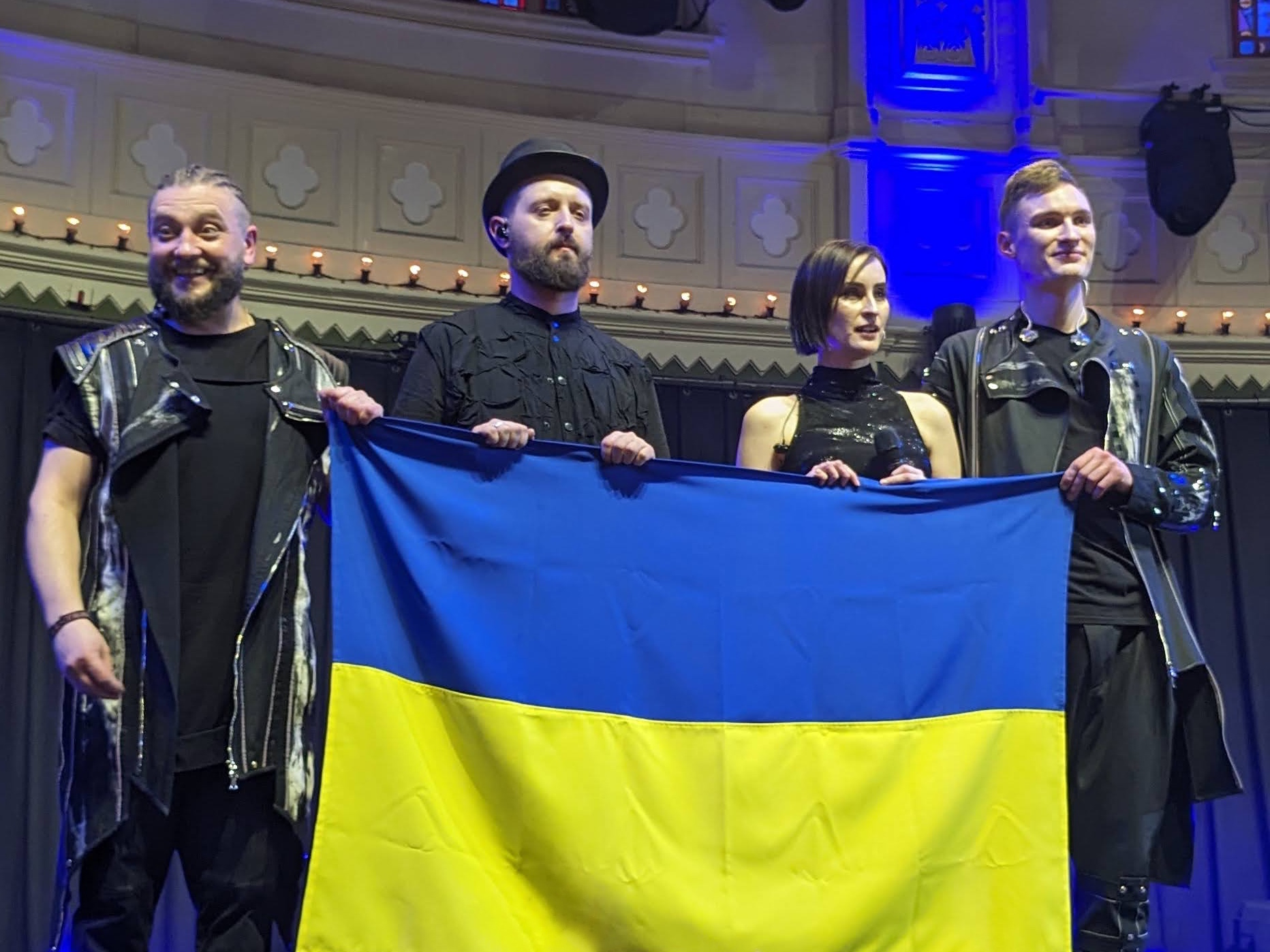
Go_A (Ukrainian: Ґоу_Ей) is a Ukrainian folktronica band formed in 2012. The band represented Ukraine in the Eurovision Song Contest 2021, performing "Shum", and placed fifth in the final.
Key Information


The band's name was made by combining the English word "Go" with the Greek letter "Alpha", which symbolizes the beginning of everything, and the band's name is symbolic for "return to the roots".[1][2][3][4]
The band includes vocalist Kateryna Pavlenko from Nizhyn, keyboardist and percussionist Taras Shevchenko from Kyiv, Ihor Didenchuk from Lutsk (also a member of rap group Kalush), and Ivan Hryhoriak from Bukovyna.[5]
The band sings near-exclusively in the Ukrainian language.[6]
History
[edit]The group was founded after keyboardist and percussionist Taras Shevchenko, not related to the poet of the same name, met folk singer Kateryna Pavlenko in 2012. In December 2012, the first song "Koliada" (Коляда) was released.
The band gained attention after the release of the single "Vesnianka" (Веснянка), which won the national competition The Best Track in Ukraine 2015.[7] For six weeks, the song stayed at number one on the 10Dance chart of the Kiss FM radio station in Ukraine and was awarded Discovery of the Year by the radio station.[1]
In November 2016, Go_A released their debut album Idy na zvuk (Іди на звук; Follow the Tune) via Moon Records Ukraine.[8] The album consists of ten songs, including "Vesnjanka".[9] In early 2017, they released a Christmas single "Shchedryi vechir" (Щедрий вечір) in collaboration with Katya Chilly.[10]
Eurovision Song Contest (2020–21)
[edit]
On 22 February 2020, Go_A, performing "Solovey", earned the right to represent Ukraine in the Eurovision Song Contest 2020 by winning both the public vote and the jury vote in the Ukrainian national final.[11] was cancelled due to the COVID-19 pandemic and Suspilne announced that the band would represent the country in the Eurovision Song Contest 2021.[12] On 4 February 2021, it was announced that "Shum" would be the song that Go_A would be performing in Rotterdam at the Eurovision Song Contest. "Shum" placed fifth, with 364 combined public and jury points. However, in the public vote, "Shum" placed second with 267 points.[13] Band member Ihor Didenchuk is also a member of rap group Kalush, which won the contest for Ukraine the following year.[14]
Post-Eurovision Song Contest (2021–present)
[edit]The band played shows in Europe in late 2022 and early 2023.[15] At the Eurovision Song Contest 2023, Go_A performed "Shum" during the flag parade in the show's final, alongside past Ukrainian entrants including Jamala, Tina Karol, and Verka Serduchka. They also appeared on stage during Duncan Laurence's performance of "You'll Never Walk Alone" during the interval.[16]
Band members
[edit]- Kateryna Pavlenko – lead vocals
- Taras Shevchenko – keyboards, mixing, percussion
- Ihor Didenchuk – sopilka, percussion, upright bass, backing vocals
- Ivan Hryhoriak – guitars
Discography
[edit]Albums
[edit]| Title | Details | Peak chart positions |
|---|---|---|
| LTU [17] | ||
| Idy na zvuk |
|
56 |
Singles
[edit]| Title | Year | Peak chart positions | Album | |||||||||
|---|---|---|---|---|---|---|---|---|---|---|---|---|
| UKR Air [18] |
BEL (FL) [19] |
GER [20] |
IRE [21] |
LTU [17] |
NLD [22] |
SWE [23] |
SWI [24] |
UK [25] |
US Elec [26] | |||
| "Kolyada" | 2012 | — | — | — | — | — | — | — | — | — | — | Non-album single |
| "Vesnyanka" | 2015 | — | — | — | — | — | — | — | — | — | — | Idy na zvuk |
| "Shchedryy vechir" (with Katya Chilly) | 2017 | — | — | — | — | — | — | — | — | — | — | Non-album singles |
| "Rano-ranenko" | 2019 | — | — | — | — | — | — | — | — | — | — | |
| "Solovey" | 2020 | 16 | — | — | — | — | — | — | — | — | — | |
| "Dobrym lyudyam na zdorovya" | — | — | — | — | — | — | — | — | — | — | ||
| "Shum" | 2021 | 17 | 29 | 66 | 37 [27] |
3 | 19 | 27 | 36 | 59 | 20 | |
| "Kalyna" | 2022 | — | — | — | — | — | — | — | — | — | — | |
| "Rusalochki" | 2023 | — | — | — | — | — | — | — | — | — | — | |
| "Vorozhyla" | — | — | — | — | — | — | — | — | — | — | Dovbush (soundtrack) | |
| "Dumala" | — | — | — | — | — | — | — | — | — | — | Non-album singles | |
| "Krip" | 2024 | — | — | — | — | — | — | — | — | — | — | |
| "—" denotes a recording that did not chart or was not released. | ||||||||||||
References
[edit]- ^ a b "Про гурт "Go-A" Телерадіокомпанія "ВЕЖА"" [About the band "Go-A" TV and radio company "TOWER"] (in Ukrainian). Archived from the original on 16 October 2020. Retrieved 22 February 2020.
- ^ "Переможці нацвідбору на "Євробачення": 10 цікавих фактів про гурт Go-A". Elle – модний жіночий журнал (in Ukrainian). 24 February 2020. Retrieved 8 August 2024.
- ^ Кириленко, Оксана (11 February 2020). "Фіналісти першого півфіналу нацвідбору на «Євробачення-2020» гурт Gо_A, хто вони?". poglyad.tv (in Ukrainian). Погляд. Retrieved 8 August 2024.
- ^ Кобилюк, Микола (23 February 2020). "Солістка з Ніжина, а гітарист – з Буковини: що відомо про гурт Go-A, який поїде на Євробачення". Молодий буковинець. Retrieved 8 August 2024.
- ^ Go_A. "About Us". Archived from the original on 5 May 2024. Retrieved 8 June 2024.
- ^ Estrin, Daniel; Lysenko, Olena (22 February 2022). "For Ukrainian musicians, rejecting Russia is a matter of national pride". WBUR-FM. Archived from the original on 4 March 2023. Retrieved 4 March 2023.
- ^ "Конкурс The Best Track in Ukraine 2015 объявил победителей!" [The Best Track in Ukraine 2015 contest announced the winners!]. tochka.net (in Russian). 15 December 2015. Archived from the original on 2 December 2021. Retrieved 4 March 2023.
- ^ "Електрофолк-гурт Go-A представив дебютний альбом" [Electrofolk band Go-A presented their debut album]. musicinua.com (in Ukrainian). 2 November 2016. Archived from the original on 26 February 2020. Retrieved 26 February 2020.
- ^ "#Ідиназвук by Goa on Apple Music". Apple Music. 29 November 2016. Archived from the original on 3 March 2020. Retrieved 26 February 2020.
- ^ Veen, Renske ten (27 April 2021). "Go_A: 10 facts about Ukraine's Eurovision 2021 group". wiwibloggs. Archived from the original on 15 July 2024. Retrieved 25 March 2024.
- ^ "Go_A will represent Ukraine in Rotterdam". Eurovision.tv. 22 February 2020. Archived from the original on 1 June 2023. Retrieved 8 June 2024.
- ^ Herbert, Emily (18 March 2020). "Ukraine: Go_A Will Represent Ukraine at Eurovision 2021". Eurovoix. Archived from the original on 18 March 2020.
- ^ "Latest news: Go_A has new song for Eurovision 2021!". Eurovision.tv. European Broadcasting Union. 4 February 2021. Archived from the original on 4 February 2021.
- ^ Marco, Muntean (10 February 2022). "Kalush Orchestra: "'Stefania' track is about the dearest person, Mom"". ESCBubble. Retrieved 22 February 2022.
- ^ "Dear friends, as promised, we are announcing additional concert dates. This time we are returning to Belgium, Finland and the Netherlands. You welcomed us so warmly during the previous part of the tour. And we'll also visit countries where we've never been before. Denmark, Sweden and Norway, we look forward to meeting you. You mean the world to us! The ticket links are in our stories and bio. See you". Archived from the original on 4 March 2023. Retrieved 4 March 2023 – via Instagram.
- ^ Hainey, Fionnula (13 May 2023). "Eurovision 2023: Who are GO_A, Jamala, Tina Karol, and Verka Serduchka?". The Manchester Evening News. Archived from the original on 14 May 2023. Retrieved 14 May 2023.
- ^ a b "2021 21-os savaitės klausomiausi (TOP 100)" [2021 21st most listened (TOP 100)]. agata.lt (in Lithuanian). 28 May 2021. Archived from the original on 25 February 2024. Retrieved 8 June 2024.
- ^ *"Solovey": "Ukraine Airplay Chart for 2020-03-20". Tophit. Archived from the original on 27 March 2020. Retrieved 31 May 2021.
- "Shum": "Ukraine Airplay Chart for 2021-05-21". Tophit. Archived from the original on 28 May 2021. Retrieved 31 May 2021.
- ^ "Discografie Go_A" (in Dutch). Ultratop. Archived from the original on 2 June 2021. Retrieved 31 May 2021.
- ^ "Discographie Go_A". offiziellecharts.de (in German). Archived from the original on 27 October 2021. Retrieved 29 May 2021.
- ^ "Discography Go_A". irish-charts.com. Archived from the original on 27 October 2021. Retrieved 29 May 2021.
- ^ "Discografie Go_A". dutchcharts.nl. Archived from the original on 27 October 2021. Retrieved 29 May 2021.
- ^ "Veckolista Singlar, vecka 21" [Weekly list Singles, week 21, 2021]. Sverigetopplistan. Archived from the original on 29 May 2021. Retrieved 28 May 2021.
- ^ "Discographie Go_A". hitparade.ch (in German). Archived from the original on 2 June 2021. Retrieved 31 May 2021.
- ^ "Go_A | full Official Chart History". Official Charts Company. Archived from the original on 2 June 2021. Retrieved 29 May 2021.
- ^ "Hot Dance/Electronic Songs Chart". Billboard. Archived from the original on 16 June 2021. Retrieved 15 June 2021.
- ^ "Official Irish Singles Chart Top 50". Official Charts Company. 28 May 2021. Archived from the original on 29 May 2021. Retrieved 29 May 2021.
| International | |
|---|---|
| Artists | |

History
Formation and early career (2012–2015)
Go_A was founded in Kyiv, Ukraine, in 2012 by sound producer Taras Shevchenko, who sought to blend traditional Ukrainian folk elements with electronic music.[1] Shevchenko initially collaborated with vocalist Kateryna Pavlenko, an ethnic singer specializing in authentic Ukrainian vocal styles, after their meeting sparked experiments in reinterpreting folk songs through modern production techniques.[3] Over the following year, Shevchenko assembled additional musicians to formalize the group, focusing on electro-folk fusion that incorporated instruments like the sopilka (a traditional Ukrainian flute) alongside synthesizers and beats.[4] The band's debut single, "Kolyada" (Ukrainian for "Christmas carol"), was released in 2012, marking their entry into the Ukrainian music scene with a track that combined ancient ritual chants and electronic rhythms.[5] This release laid the groundwork for their signature folktronica sound, though it received limited initial attention amid the nascent electro-folk genre in Ukraine.[6] Go_A performed sporadically in local venues and festivals during 2013–2014, refining their live sets while building a small following through underground electronic and ethno-music circles.[7] Breakthrough within Ukraine occurred in 2015 with the single "Vesnianka" (Ukrainian for "Spring Song"), a high-energy reinterpretation of a pagan spring ritual melody infused with dance beats and Pavlenko's powerful vocals. The track topped radio charts and won the national competition "The Best Track in Ukraine," organized by the Ukrainian Music Association, elevating Go_A's profile and securing radio play on major stations like NRJ Ukraine.[4] This success validated their approach of modernizing folklore, attracting interest from labels and producers, though the band remained independent and focused on organic growth rather than commercial pop trends.Breakthrough and pre-Eurovision releases (2016–2019)
In 2016, Go_A achieved their initial breakthrough in the Ukrainian music scene with the song "Vesnianka", which won the national contest The Best Track in Ukraine.[8] The track subsequently entered radio rotation and topped the "10Dance" chart for six weeks, leading to a nomination for Discovery of the Year at the YUNA awards.[8] This success highlighted the band's folktronica style, blending traditional Ukrainian vocals with electronic elements, and paved the way for wider recognition.[9] Later that year, on November 29, Go_A released their debut album Idy na zvuk (Іди на звук, translated as "Follow the Tune") through Moon Records Ukraine.[10] The album comprised ten tracks, including "Vesnianka" and other fusions of ethnic percussion, synthesizers, and folk-inspired lyrics, marking the culmination of four years of experimentation since their 2012 formation.[11] It solidified their presence in Ukraine's alternative music landscape by reinterpreting folklore through modern production.[9] In early 2017, the band issued a Christmas single titled "Shchedryi vechir" (Щедрий вечір), featuring collaboration with singer Katya Chilly, which extended their seasonal appeal within electro-folk circles.[11] Activity remained sporadic through 2018, with focus on live performances rather than new studio output. By 2019, Go_A self-released the double single "Rano-ranenko" (Рано-раненько), further showcasing their electronic reinterpretations of Ukrainian traditional motifs and building anticipation for international exposure.[11] These pre-Eurovision efforts established a niche following, emphasizing cultural preservation amid electronic innovation, though mainstream commercial peaks awaited later contests.[4]Eurovision selection and participation (2020–2021)
Go_A was internally selected by Ukrainian broadcaster Suspilne (UA:PBC) to represent Ukraine at the Eurovision Song Contest 2020 following their victory in the national final Vidbir on February 22, 2020, with the song "Solovey".[12] In the Vidbir final, the band received the maximum 6 points from both the jury and televote, totaling 12 points.[12] "Solovey", blending electronic beats with Ukrainian folk elements, was intended for performance in Rotterdam, Netherlands.[13] The Eurovision Song Contest 2020 was cancelled on March 18, 2020, due to the COVID-19 pandemic, preventing Go_A's participation.[3] In response, UA:PBC announced on the same day that Go_A would represent Ukraine in the 2021 contest, allowing the band to prepare a new entry.[1] For the 2021 edition, Go_A submitted "Shum" as their entry, which was unanimously selected by a five-member jury on February 1, 2021, and publicly announced on February 4.[14] The song, meaning "noise" or "buzz" in Ukrainian, incorporated ancient pagan rituals and electronic folk influences.[15] At the contest in Rotterdam from May 18–22, 2021, Go_A performed "Shum" in the first semi-final on May 18, qualifying for the grand final.[2] In the final on May 22, Ukraine placed fifth with 364 points, comprising 187 from jury votes and 177 from televoting.[2]Post-Eurovision activities and Russian invasion impact (2021–2022)
Following their fifth-place finish at the Eurovision Song Contest 2021 in Rotterdam on May 22, Go_A commenced an active international touring schedule later that year.[1] In October 2021, the band announced a series of concerts across the Netherlands, Belgium, and Lithuania for November and December, marking their initial post-Eurovision European outreach.[16] The band maintained momentum into early 2022 with performances at European music events, including a live set at Eurosonic Noorderslag (ESNS) in Groningen, Netherlands, on February 18.[17] No major studio releases occurred during this period beyond promotional extensions of their Eurovision entry "Shum," which had been revamped pre-contest in March 2021.[18] Russia's full-scale invasion of Ukraine on February 24, 2022, disrupted planned activities, including the cancellation of a guest performance at Iceland's Söngvakeppnin national final on March 5 due to travel and safety constraints amid the escalating conflict.[19] Band members, originating from Kyiv and other affected areas, evacuated to safer locations but prioritized resilience by resuming live shows abroad to generate funds and amplify awareness of Ukraine's cultural identity and the invasion's toll.[1] This included a June 2022 appearance at the Glastonbury Festival's John Peel Stage in the United Kingdom, where they performed amid the ongoing war.[1] By mid-2022, Go_A organized a fundraising tour spanning 14 countries and 28 cities in Europe and Canada, directing proceeds toward Ukrainian relief efforts while emphasizing the band's role in countering narratives of cultural erasure through their folktronica performances.[20] These efforts sustained their visibility despite domestic infrastructure damage and displacement risks, with the group continuing to integrate traditional Ukrainian elements into sets as a form of resistance.[9]Continued releases and tours amid wartime challenges (2023–2025)
In 2023, Go_A conducted their most extensive tour to date, the Ukrainian Magic Tour, which encompassed 23 countries and featured around 40 performances in regions including Britain, Scandinavia, the Balkans, Georgia, and Turkey.[1] The tour included sold-out concerts at notable venues such as Paradiso in Amsterdam, Indigo at the O2 in London, Nalen in Stockholm, Roxy in Prague, and additional shows in Dublin and Paris.[1] These international efforts served to promote Ukrainian culture and raise funds in response to Russia's ongoing invasion of Ukraine, which had displaced band members in 2022 and continued to pose logistical and safety challenges for domestic activities.[1] [21] The band released several singles in 2023, including "Rusalochki" and "Dumala," maintaining their folktronica style amid wartime disruptions that limited studio work and local performances in Ukraine.[22] In 2024, Go_A continued the Ukrainian Magic Tour with a European leg starting in April, featuring shows in Heerlen, Utrecht, Hamburg, and festivals such as EarthGarden in Malta, SubKult in Sweden, Castlefest, and Summersound in Latvia.[23] [24] [25] This phase emphasized celebrating Ukrainian heritage through live sets, including DJ performances showcasing electronic interpretations of folk elements, while navigating travel restrictions and security concerns stemming from the conflict.[23] [26] Key 2024 releases included the single "Krip" on April 24, accompanied by an official music video, and a remix collaboration on "Vorozhyla" with Korolova, Rokston, and Monokate, released September 6.[27] [28] [29] These tracks reinforced Go_A's fusion of traditional Ukrainian motifs with modern electronics, produced under constraints of the war that necessitated remote collaborations and reliance on international platforms for distribution.[23] Into 2025, the band scheduled further performances, including a DJ set in Amsterdam and a concert in Kyiv on February 27, 2026, at Atlas, demonstrating resilience against ongoing hostilities that have prompted many Ukrainian artists to prioritize overseas engagements for sustainability.[30] [31] Despite speculation of exhaustion from relentless touring since 2021, no official disbandment has occurred, with activities focused on cultural preservation and support for Ukraine's defense efforts.[32]Musical style and influences
Folktronica fusion and production techniques
Go_A's folktronica style fuses traditional Ukrainian folk music with electronic elements, primarily through producer Taras Shevchenko's approach of layering modern electronic dance beats and synthesizers beneath authentic folk vocals and instrumentation. This involves reinterpreting ancient folklore motifs, such as spring awakening rituals, by packaging them in digital soundscapes that emphasize rhythmic drive and harmonic contrast. Shevchenko, who handles keyboards, percussion, and overall production, draws from diverse genres to create a cohesive blend, starting from collaborations initiated in 2012 when he sought to merge ethno vocals with EDM structures.[33][1][15] Central to their production is vocalist Kateryna Pavlenko's use of the "white voice" technique, an ancient Ukrainian method employing an open throat for resonant, bright-toned projection without falsetto, often extended to extreme vocal ranges for polyphonic effects mimicking traditional group singing. These vocals are then integrated with electronic production via ethnic drums, guitar amplification, and programmed rhythms, producing tracks like "Shum" (2020) that alternate between acoustic folk authenticity and pulsating synth-driven drops. Shevchenko's role ensures harmonic balance, avoiding dilution of folk roots while amplifying them through contemporary processing for live and recorded formats.[15][34] The band's techniques prioritize causal fidelity to source materials, sampling or emulating traditional sounds—such as percussive elements evoking ancient rites—within DAW environments to generate movement-oriented ("Go") energy, as reflected in their name's etymology. This results in a hybrid where electronic elements provide propulsion without overshadowing the organic timbre of folk-derived components, evident in their Eurovision 2021 entry's structure of building from sparse vocal chants to full electronic crescendos.[33][1]Integration of Ukrainian folklore and modern electronics
Go_A's music exemplifies folktronica by layering traditional Ukrainian vocal techniques and mythological motifs atop electronic production, including synthesized beats, basslines, and atmospheric effects crafted primarily by multi-instrumentalist Taras Shevchenko.[1][15] This integration reinterprets folklore—such as Carpathian ritual chants and Hutsul ethnic singing styles performed by vocalist Kateryna Pavlenko—with modern dance rhythms and digital sound design, preserving oral traditions while adapting them for contemporary audiences.[33][3] A core technique involves sampling or adapting folk melodies and lyrics into electronic frameworks; for instance, the 2020 single "Shum" derives its chorus from vesnyanky spring ritual songs tied to the pagan "shum" ceremony, where participants invoked forest spirits through rhythmic chants, fused here with dark techno pulses and echoing synths to evoke unity and seasonal renewal.[35][1] The track's folklore base traces to ancient Polissian variants from the Chernobyl region, with Pavlenko's unaltered ethnic vocal delivery contrasting programmed percussion and guitar riffs for a hybrid texture.[36] Shevchenko's production emphasizes authenticity by incorporating live ethnic drums alongside MIDI-triggered loops, avoiding full synthesis of folk elements to retain acoustic timbre, as seen in earlier works like "Vedy" (2018), which weaves Carpathian legends into EDM drops.[25][23] This method not only revives lesser-known Ukrainian narratives but also amplifies them through electronic amplification, enabling global dissemination without diluting cultural specificity.[15]Band members
Current lineup
In July 2025, lead vocalist Kateryna Pavlenko departed Go_A to pursue a solo career under her pseudonym Monokate, leaving the band's instrumental core intact.[37][38] The group has since continued performing, including DJ sets emphasizing electronic and Ukrainian dance elements, without announcing a replacement vocalist.[39] The current members are:- Taras Shevchenko: Founder, keyboards, mixing, percussion, and production; handles much of the electronic and sampling elements central to the band's folktronica sound.[1]
- Ihor Didenchuk: Sopilka (traditional Ukrainian flute), percussion, upright bass, and backing vocals; contributes ethnic instrumentation and has been a member since the band's early years.[1]
- Ivan Hryhoriak: Guitar and additional production support; joined later to enhance the band's live dynamics and modern rock influences.[1][8]
Changes and contributions
Go_A's lineup evolved through numerous iterations following its inception in 2012, when sound producer Taras Shevchenko collaborated with vocalist Kateryna Pavlenko to experiment with Ukrainian folk elements in electronic music.[1] The group reportedly cycled through 14 different personnel configurations in its early years as Shevchenko assembled musicians to develop the folktronica style, reflecting ongoing refinements to balance traditional and modern sounds.[4] By 2020, ahead of their Eurovision involvement, the core quartet stabilized with Pavlenko handling lead vocals, Shevchenko on keyboards and percussion, Ihor Didenchuk on traditional wind instruments, and Ivan Hryhoriak on bass guitar.[3] The Russian invasion of Ukraine in February 2022 disrupted operations, scattering members geographically—Shevchenko relocated abroad—and hindering new productions amid wartime conditions.[25] A major shift occurred in July 2025, when Pavlenko departed to pursue a solo career, altering the band's vocal dynamic and prompting uncertainty about future direction.[37] [38] Taras Shevchenko has driven the band's production, integrating techno rhythms, heavy guitar elements, and synthesizers with folk motifs while composing core tracks and managing mixing.[1] [3] Kateryna Pavlenko contributed authentic ethnic vocals, specializing in "white voice" techniques and extreme ranges rooted in folklore, alongside co-writing lyrics and melodies that emphasized Ukrainian heritage.[1] Ihor Didenchuk supplied traditional instrumentation, including sopilka, frilka, floyara, telynka, trembita, and drymba, grounding the electronic framework in vernacular authenticity as a dedicated folklorist.[1] Ivan Hryhoriak anchored rhythms with bass and guitar, incorporating experimental approaches from progressive metal and acoustics to enhance the hybrid texture.[1] These roles collectively enabled Go_A's signature fusion, though postwar logistics tested their sustained collaboration.[25]Discography
Studio albums
Go_A's debut studio album, Idy na zvuk (Ukrainian: Іди на звук, translated as "Follow the Sound" or "#Ідиназвук"), was released on November 1, 2016, by Moon Records Ukraine.[11] The 10-track record marked the culmination of the band's early experiments fusing traditional Ukrainian folk vocals and instrumentation with electronic production, featuring songs like "Vesnianka" (a folk-inspired track incorporating spring ritual elements) and "Vohni" (exploring fire motifs through layered synths and percussion).[40] Recorded primarily in Kyiv, the album emphasized authentic ethnic melodies sourced from Ukrainian cultural heritage, processed with modern digital effects to create a folktronica sound.[41] As of October 2025, Idy na zvuk remains the band's sole full-length studio album, with subsequent releases primarily consisting of singles and extended plays rather than additional LPs.[42] A 2021 digital reissue under the stylized title #Ідиназвук preserved the original tracklist without new material, serving to broaden international accessibility amid rising global interest post-Eurovision.[40] The album's production highlighted the contributions of core members, including vocalist Kateryna Pavlenko's ethereal delivery and Taras Shevchenko's electronic arrangements, establishing Go_A's signature style of revitalizing folklore through technology.[11]Singles and extended plays
Go_A released their debut single "Kolyada" in December 2012, marking the start of their musical experiments blending Ukrainian folklore with electronic elements.[41] The band followed with "Vesnyanka" on November 29, 2016, a track that won the "Best Track in Ukraine" competition and propelled their recognition within the country.[43] In 2017, they issued the Christmas-themed single "Shchedryi vechir" in collaboration with singer Katya Chilly. "Rano-ranen'ko" arrived on July 3, 2019, incorporating traditional motifs into a dance-oriented production.[44] "Solovey", released February 4, 2020, was selected as Ukraine's entry for the Eurovision Song Contest 2020, which was canceled due to the COVID-19 pandemic. The band then released "Shum" on January 22, 2021, with an updated Eurovision version following on March 9, 2021; it represented Ukraine at the 2021 contest, finishing fifth overall.[45] Post-Eurovision, Go_A issued "Kalyna" in 2022 amid the Russian invasion of Ukraine. Subsequent singles include "Rusalochki" and "Dumala" in 2023, followed by "Krip" and "Vorozhyla" (featuring Monokate) in 2024.[46] No extended plays have been released by the band as of October 2025.[11]Live performances and tours
Key tours and festival appearances
Go_A gained international prominence through their live performance at the Eurovision Song Contest 2021 in Rotterdam, Netherlands, where they presented "Shum" during the first semi-final on May 18 and the grand final on May 22, ultimately placing fifth with 364 points from jury and televote combined.[2][15]
Following their Eurovision success, the band conducted a European tour spanning November and December 2021, with stops in the Netherlands, Belgium, and Lithuania to capitalize on newfound visibility.[16]
In 2023, Go_A initiated the Ukrainian Magic Tour, a series of concerts across Europe featuring electro-folk sets, including performances in Tallinn, Estonia (November 6), Vilnius, Lithuania (November 8), Gdańsk, Poland (November 9), Warsaw, Poland (November 11), and Wrocław, Poland (November 12).[47] The tour extended into 2024 with additional dates such as Heerlen, Netherlands (April 14), Bochum, Germany (April 15), Vienna, Austria (April 25), and The Hague, Netherlands (April 28), emphasizing Ukrainian cultural elements through live renditions and DJ sets.[24]
Among festival appearances, Go_A performed at the Glastonbury Festival in Pilton, United Kingdom, from June 22 to 27, 2022, marking a significant UK debut amid a diverse lineup.[48] Further festivals included EarthGarden in Malta and SubKult Festivalen in Sweden, both in June 2024, alongside Castlefest and Fonnefeesten in August 2024, showcasing their fusion style to international audiences.[23]
Adaptations during geopolitical events
Following the Russian Federation's full-scale invasion of Ukraine on February 24, 2022, all members of Go_A evacuated the country in the initial days, relocating abroad alongside hundreds of thousands of other Ukrainians to ensure their safety.[1] This geopolitical crisis profoundly disrupted domestic activities, compelling the band to adapt their live performance strategy by prioritizing international venues over Ukrainian ones, where ongoing conflict posed severe risks to travel, infrastructure, and audience safety.[1] The band maintained its touring schedule abroad, conducting shows across Europe in late 2022 and early 2023 to sustain visibility and cultural outreach amid the war. For instance, Go_A performed at Club Academy in Manchester, United Kingdom, on October 18, 2022, delivering a set that resonated with audiences supportive of Ukraine's plight.[49] These adaptations included logistical shifts to base operations outside Ukraine, enabling continued electro-folk performances that preserved the group's folktronica style while navigating travel restrictions and heightened security concerns.[9] During the 2023 Eurovision Song Contest held in Liverpool, England—relocated from Ukraine due to the invasion—Go_A participated as guests, contributing to an event that provided emotional uplift for Ukrainians. Band members described the occasion as a "big moment" that "raised our spirits and helped us to fight," highlighting how such high-profile appearances served as platforms for morale-boosting symbolism rather than routine commercial tours.[50] This reflected a broader adaptation pattern: leveraging international stages to amplify Ukrainian resilience and folklore, with performances often infused with patriotic undertones absent in pre-invasion setlists.[9] Throughout the conflict, Go_A's persistence in live festivals and venues underscored a commitment to artistic continuity, though scaled back in scope compared to pre-2022 plans, focusing on diaspora communities and supportive European markets to mitigate financial strains from halted domestic revenue.[9] No evidence indicates significant alterations to core production techniques, but venue selections emphasized stability and proximity to Ukrainian expatriates, facilitating audience engagement in safer environments.[49]Reception and achievements
Critical and commercial reception
"Shum," Go_A's entry for the Eurovision Song Contest 2021, achieved notable commercial success through streaming platforms, amassing over 100 million streams on Spotify.[1] The track topped Spotify's Global Viral 50 chart shortly after the Eurovision grand final on May 22, 2021.[51] It also marked a milestone as the first Ukrainian Eurovision song to enter Billboard charts, peaking at number 27 on the Hot Dance/Electronic Songs chart and number 12 on the Dance/Electronic Digital Song Sales chart in May 2021.[52] In the Eurovision contest, Ukraine finished fifth overall with 364 points, including 97 from juries and 267 from televotes.[2] The song's streaming peaks extended to regional charts, such as number one in Lithuania and number three in Latvia and Ukraine.[53] Critics and audiences lauded "Shum" for its electro-folk fusion, blending traditional Ukrainian elements like sopilka flute melodies with modern electronic beats and percussion.[54] On Rate Your Music, the single holds a 3.7 out of 5 rating from over 600 users, who praised lead singer Kateryna Pavlenko's vocals and the track's cohesive "mad hybrid" of Eastern European folk and hardcore electronic styles.[54] Reviewers from Wiwibloggs described the Eurovision remix as a "fun party anthem," though some panelists preferred the original version for its recognizability.[55] An academic analysis in Popular Music highlighted the performance's evocation of melancholy and ecstasy, interpreting it as a multimedial commentary on ecological and cultural survival amid the Anthropocene.[9] Go_A's live shows have received positive feedback for their high-energy delivery, with comparisons to The Prodigy due to heavy bass and electronic intensity.[49] European critics have identified influences from techno, drum and bass, and even heavy metal in the band's sound, distinguishing it from pure folktronica.[25] Earlier single "Solovey," intended for Eurovision 2020, was noted for its traditional vocal style juxtaposed against contemporary production.[56] Overall reception emphasizes the band's innovative preservation of Ukrainian heritage through experimental music, though commercial data beyond "Shum" remains limited, with success tied primarily to festival appearances and digital platforms.[1]Awards, nominations, and chart performance
Go_A represented Ukraine at the Eurovision Song Contest 2021 with the song "Shum", qualifying from the first semi-final on 18 May 2021 and placing fifth in the grand final on 22 May 2021 with 364 points, including 158 from juries and 206 from televoting.[2] The performance earned the band the Eurovision Awards 2021 for Most Innovative Stage Production, announced on 31 December 2021.[57] Additionally, Go_A won the Wiwibloggs Vision Music Awards 2021 for Best Use of Props, based on reader votes announced on 18 August 2021.[58] The band received earlier recognition with a win in The Best Track In Ukraine contest in 2016 for "Vesnianka", which topped dance charts on a new radio station.[8] In late 2020, Go_A was nominated for the YUNA Music Awards as Discovery of the Year. They were also nominated for KissFM Discovery of the Year around the same period.[8] "Shum" achieved notable chart success post-Eurovision, debuting at number 69 on the Spotify Global Top 200—the first Ukrainian-language song to enter the chart—and reaching number 80 on the Billboard Global Excl. US chart, marking the debut of a Ukrainian-language track there.[59][52] The song peaked at number 1 on streaming charts in Lithuania and number 3 in Latvia and Ukraine, among other countries, as reported in July 2021.[53] By May 2024, "Shum" had accumulated 100 million streams on Spotify.[60]| Chart | Peak Position | Source |
|---|---|---|
| Spotify Global Top 200 | 69 | [59] |
| Billboard Global Excl. US | 80 | [52] |
| Spotify Lithuania | 1 | [53] |
| Spotify Latvia | 3 | [53] |
| Spotify Ukraine | 3 | [53] |