


Community hub
Recent from talks
Contribute something
Nothing was collected or created yet.
Trilobite
View on Wikipedia
| Trilobite | |
|---|---|

| |
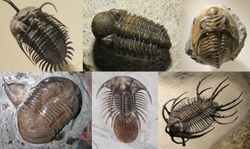
| Montage of trilobite genera: Top row: Walliserops, Phacops and Cambropallas; bottom row: Isotelus, Kolihapeltis and Ceratarges | |
Scientific classification 
| |
| Kingdom: | Animalia |
| Phylum: | Arthropoda |
| Clade: | †Artiopoda |
| Subphylum: | †Trilobitomorpha |
| Class: | †Trilobita Walch, 1771[3] |
| Orders | |
Trilobites (/ˈtraɪləˌbaɪts, ˈtrɪlə-/;[4][5][6] meaning "three-lobed entities") are extinct marine arthropods that form the class Trilobita. One of the earliest groups of arthropods to appear in the fossil record, trilobites were among the most successful of all early animals, existing in oceans for almost 270 million years, with over 22,000 species having been described. Because trilobites had wide diversity and an easily fossilized mineralised exoskeleton made of calcite, they left an extensive fossil record. The study of their fossils has facilitated important contributions to biostratigraphy, paleontology, evolutionary biology, and plate tectonics. Trilobites are placed within the clade Artiopoda, which includes many organisms that are morphologically similar to trilobites, but are largely unmineralised. The relationship of Artiopoda to other arthropods is uncertain.
Trilobites evolved into many ecological niches; some moved over the seabed as predators, scavengers, or filter feeders, and some swam, feeding on plankton. Some even crawled onto land.[7] Most lifestyles expected of modern marine arthropods are seen in trilobites, with the possible exception of parasitism (where scientific debate continues).[8] Some trilobites (particularly the family Olenidae) are even thought to have evolved a symbiotic relationship with sulfur-eating bacteria from which they derived food.[9] The largest trilobites were more than 70 centimetres (28 in) long and may have weighed as much as 4.5 kilograms (9.9 lb).[10]
The first appearance of trilobites in the fossil record defines the base of the Atdabanian/Cambrian Stage 3 time period of the Early Cambrian around 521 million years ago. Trilobites were already diverse and globally dispersed shortly after their origination, with trilobites reaching an apex of diversity during the late Cambrian–Ordovician, and remained diverse during the following Silurian and early Devonian. During the mid-late Devonian, their diversity strongly declined, being impacted by successive extinction events, including the Taghanic event, the Late Devonian mass extinction/Kellwasser event and the Hangenberg/end-Devonian mass extinction, wiping out most trilobite diversity and leaving Proetida as the only surviving order. Their diversity moderately recovered during the Early Carboniferous, before dropping to persistently low levels during the late Carboniferous and Permian periods, though they remained widespread until the end of their existence. The last trilobites disappeared in the end-Permian mass extinction event about 251.9 million years ago, by which time only a handful of species remained.
Evolution
[edit]Trilobite relatives
[edit]Trilobites belong to the Artiopoda, a group of extinct arthropods morphologically similar to trilobites, though only the trilobites had heavily mineralised exoskeletons. Thus, other artiopodans are typically only found in exceptionally preserved deposits, mostly during the Cambrian period.
The exact relationships of artiopods to other arthropods is uncertain. Some scholars consider them closely related to chelicerates (which include horseshoe crabs, sea spiders, and arachnids) as part of a clade called Arachnomorpha, while others consider them to be more closely related to Mandibulata (which contains insects, crustaceans and myriapods) as part of a clade called Antennulata.[11]
Cladogram of Artiopoda including trilobites after Berks et al. 2023.[12]


Fossil record of early trilobites
[edit].jpg)


The earliest trilobites known from the fossil record are redlichiids and ptychopariid bigotinids dated to around 520 million years ago.[1][2] Contenders for the earliest trilobites include Profallotaspis jakutensis (Siberia), Fritzaspis spp. (western US), Hupetina antiqua (Morocco)[13][14] and Serrania gordaensis (Spain).[15] Trilobites appeared at a roughly equivalent time in Laurentia, Siberia and West Gondwana.[14][16]
All Olenellina lack facial sutures (see below), and this is thought to represent the original state. The earliest sutured trilobite found so far (Lemdadella), occurs almost at the same time as the earliest Olenellina, suggesting the trilobites origin lies before the start of the Atdabanian, but without leaving fossils.[1] Other groups show secondary lost facial sutures, such as all Agnostina and some Phacopina. Another common feature of the Olenellina also suggests this suborder to be the ancestral trilobite stock: early protaspid stages have not been found, supposedly because these were not calcified, and this also is supposed to represent the original state.[17] Earlier trilobites may be found and could shed more light on their origins.[1][18][19]
Three specimens of a trilobite from Morocco, Megistaspis hammondi, dated 478 million years old contain fossilized soft parts.[20][21] In 2024, researchers discovered soft tissues and other structures including the labrum in well-preserved trilobite specimens from Cambrian Stage 4 of Morocco, providing new anatomical information regarding the external and internal morphology of trilobites, and the cause of such extraordinary preservation is probably due to their rapid death after an underwater pyroclastic flow.[22]
Divergence and extinction
[edit]
Trilobites saw great diversification over time.[23] For such a long-lasting group of animals, it is no surprise that trilobite evolutionary history is marked by a number of extinction events where some groups perished, and surviving groups diversified to fill ecological niches with comparable or unique adaptations. Generally, trilobites maintained high diversity levels throughout the Cambrian and Ordovician periods before entering a drawn-out decline in the Devonian, culminating in the final extinction of the last few survivors at the end of the Permian period.[24]
Evolutionary trends
[edit]Principal evolutionary trends from primitive morphologies, such as exemplified by Eoredlichia,[25] include the origin of new types of eyes, improvement of enrollment and articulation mechanisms, increased size of pygidium (micropygy to isopygy), and development of extreme spinosity in certain groups.[24] Changes also included narrowing of the thorax and increasing or decreasing numbers of thoracic segments.[25] Specific changes to the cephalon are also noted; variable glabella size and shape, position of eyes and facial sutures, and hypostome specialization.[25] Several morphologies appeared independently within different major taxa (e.g. eye reduction or miniaturization).[25]
Effacement, the loss of surface detail in the cephalon, pygidium, or the thoracic furrows, is also a common evolutionary trend. Notable examples of this were the orders Agnostida and Asaphida, and the suborder Illaenina of the Corynexochida. Effacement is believed to be an indication of either a burrowing lifestyle or a pelagic one. Effacement poses a problem for taxonomists since the loss of details (particularly of the glabella) can make the determination of phylogenetic relationships difficult.[26]
Cambrian
[edit]Although it has historically been suggested that trilobites originated during the Precambrian[1][27] this is no longer supported, and it is thought that trilobites originated shortly before they appeared in the fossil record.[16] Very shortly after trilobite fossils appeared in the lower Cambrian, they rapidly diversified into the major orders that typified the Cambrian—Redlichiida, Ptychopariida, Agnostida, and Corynexochida. The first major crisis in the trilobite fossil record occurred in the Middle Cambrian; surviving orders developed isopygius or macropygius bodies and developed thicker cuticles, allowing better defense against predators (see Thorax below).[28] The Late Cambrian marks the beginning of the apex of trilobite diversity.[29] The end-Cambrian mass extinction event marked a major change in trilobite fauna; almost all Redlichiida (including the Olenelloidea) and most Late Cambrian stocks became extinct.[24] A continuing decrease in Laurentian continental shelf area[30] is recorded at the same time as the extinctions, suggesting major environmental upheaval.
Notable trilobite genera appearing in the Cambrian include:[31]
- Abadiella (Lower Cambrian)
- Buenellus (Lower Cambrian)
- Judomia (Lower Cambrian)
- Olenellus (Lower Cambrian)
- Ellipsocephalus (Middle Cambrian)
- Elrathia (Middle Cambrian)
- Paradoxides (Middle Cambrian)
- Peronopsis (Middle Cambrian)
- Xiuqiella (Middle Cambrian)
- Yiliangella (Middle Cambrian)
- Yiliangellina (Middle Cambrian)
- Olenus (Late Cambrian)
Ordovician
[edit]

The Early Ordovician is marked by vigorous radiations of articulate brachiopods, bryozoans, bivalves, echinoderms, and graptolites, with many groups appearing in the fossil record for the first time.[24] Although intra-species trilobite diversity seems to have peaked during the Cambrian,[32] trilobites were still active participants in the Ordovician radiation event, with a new fauna taking over from the old Cambrian one.[33] Phacopida and Trinucleioidea are characteristic forms, highly differentiated and diverse, most with uncertain ancestors.[24] The Phacopida and other "new" clades almost certainly had Cambrian forebears, but the fact that they have avoided detection is a strong indication that novel morphologies were developing very rapidly.[17] Changes within the trilobite fauna during the Ordovician foreshadowed the mass extinction at the end of the Ordovician, allowing many families to continue into the Silurian with little disturbance.[33] Ordovician trilobites were successful at exploiting new environments, notably reefs. The Ordovician mass extinction did not leave the trilobites unscathed; some distinctive and previously successful forms such as the Telephinidae and Agnostida became extinct. The Ordovician marks the last great diversification period amongst the trilobites: very few entirely new patterns of organisation arose post-Ordovician. Later evolution in trilobites was largely a matter of variations upon the Ordovician themes. By the Ordovician mass extinction, vigorous trilobite radiation has stopped, and gradual decline is foreshadowed.[24] The Ordovician marks the apex of trilobite morphological and species diversity.[29]
Some of the genera of Trilobites appearing in the Ordovician include:[31]
- Cyclopyge (Early to Late Ordovician)
- Selenopeltis (Early to Late Ordovician)
- Parabolina (Early Ordovician)
- Cheirurus (Middle Ordovician)
- Eodalmanitina (Middle Ordovician)
- Trinucleus (Middle Ordovician)
- Triarthrus (Late Ordovician)
Silurian and Devonian
[edit].png)
Most Early Silurian families constitute a subgroup of the Late Ordovician fauna. Few, if any, of the dominant Early Ordovician fauna survived to the end of the Ordovician, yet 74% of the dominant Late Ordovician trilobite fauna survived the Ordovician. Late Ordovician survivors account for all post-Ordovician trilobite groups except the Harpetida.[33] Silurian and Devonian trilobite assemblages are superficially similar to Ordovician assemblages, dominated by Lichida and Phacopida (including the well-known Calymenina).[25] The Silurian diversity of trilobites was high during the Llandovery and Wenlock, though there was a sharp drop during the Pridoli at the end of the period, followed by a diversification during the Early Devonian, reaching a highpoint of 180 trilobite genera during the Emsian stage.[29]
The Middle-Late Devonian was a decisive turning point in trilobite history, with the Taghanic event during the Givetian sharply decreasing trilobite diversity, particularly in shallow water environments, which was followed by the Late Devonian mass extinction/Kellwasser event (involving a combination of sea level change and marine anoxia) at the Frasnian–Famennian boundary, widely regarded as one of the most significant mass extinction events in Earth's history, decimating the groups diversity including the extinction of the orders Corynexochida, Harpetida and Odontopleurida, with the low trilobite diversity in its aftermath in the Famennian, consisting only of the orders Phacopida and Proetida, being again strongly impacted by the Hangenberg event (also called the end-Devonian mass extinction) at the end of the Devonian, with both shallow water and deep water trilobites being affected.[29] Only a single order, the Proetida, survived into the Carboniferous.[24]
Genera of trilobites during the Silurian and Devonian periods include:[31]
- Dalmanites (Early to Late Silurian)
- Calymene (Silurian)
- Encrinurus (Silurian)
- Exallaspis (Middle to Late Silurian)
- Paralejurus (Early Devonian)
- Lioharpes (Early-Middle Devonian)
- Phacops (Middle to Late Devonian)
Carboniferous and Permian
[edit]The Proetida, the only trilobite order to survive the end of the Devonian, continued through the Carboniferous period and lasted until the end of the Permian (when the vast majority of species on Earth were wiped out).[24] Proetids are generally morphologically homogeneous (similar to each other), having a generally conservative bodyform,[34] and were probably all predators or scavengers. Trilobites rapidly diversified during the earliest Carboniferous (Tournasian), reaching diversity levels unseen since prior to the Taghanic event, though most of this diversification was of the family Phillipsiidae, with other trilobite families barely rebounding. During the Serpukhovian at the end of the Early Carboniferous, trilobite diversity again strongly declined, and trilobite diversity remained stagnantly low throughout the late Carboniferous. Trilobite diversity may have been effected by ecological changes during the Carboniferous, such as the rise of durophagous fish with crushing mouthparts.[29]
By the end of the Carboniferous, the diversity of trilobites had dropped to only 1.8–2.2% (around 7 genera[35]) of the peak diversity it had had during the early Paleozoic, with this low diversity continuing into the Permian. During the Permian period, while trilobites were widespread and occurred in a variety of environments, they were typically rare components of local faunas, in sharp contrast to their often great abundance earlier in the Paleozoic.[34] Permian trilobite diversity reached a peak during the Guadalupian with diversity sharply dropping by the beginning of the following Lopingian.[36]
Some of the genera of trilobites during the Carboniferous and Permian periods include:[31]
- Archegonus (Early to Middle Carboniferous)
- Hesslerides (Middle Carboniferous)
- Endops (Middle Permian)
- Triproetus (Late Carboniferous to Early Permian)
- Ditomopyge (Late Carboniferous to Late Permian)
- Pseudophillipsia (Late Carboniferous to Late Permian)
Final extinction
[edit]At the end of the Permian (Changhsingian), only two genera of trilobites remained extant, Acropyge and Pseudophillipsia.[34] Late Permian trilobites primarily occurred in shallow marine carbonate platform environments, but were also found in deep water, and were widespread, ranging towards the poles.[34]
Exactly why the trilobites became extinct is not clear; with repeated extinction events (often followed by apparent recovery) throughout the trilobite fossil record, a combination of causes is likely. After the extinction event at the end of the Devonian period, what trilobite diversity remained was bottlenecked into the order Proetida. Decreasing diversity[37] of genera limited to shallow-water shelf habitats coupled with a drastic lowering of sea level (regression) meant that the final decline of trilobites happened shortly before the end Permian mass extinction event.[25] With so many marine species involved in the Permian extinction, the end of nearly 300 million successful years for the trilobites would not have been unexpected at the time.[37]
Fossil distribution
[edit]


Trilobites appear to have been primarily marine organisms, since the fossilized remains of trilobites are always found in rocks containing fossils of other salt-water animals such as brachiopods, crinoids, and corals. Some trackways suggest trilobites made at least temporary excursions onto land.[7] Within the marine paleoenvironment, trilobites were found in a broad range from extremely shallow water to very deep water. Trilobites, like brachiopods, crinoids, and corals, are found on all modern continents, and occupied every ancient ocean from which Paleozoic fossils have been collected.[38] The remnants of trilobites can range from the preserved body to pieces of the exoskeleton, which it shed in the process known as ecdysis. In addition, the tracks left behind by trilobites living on the sea floor are often preserved as trace fossils.
There are three main forms of trace fossils associated with trilobites: Rusophycus, Cruziana and Diplichnites—such trace fossils represent the preserved life activity of trilobites active upon the sea floor. Rusophycus, the resting trace, are trilobite excavations involving little or no forward movement and ethological interpretations suggest resting, protection and hunting.[39] Cruziana, the feeding trace, are furrows through the sediment, which are believed to represent the movement of trilobites while deposit feeding.[40] Many of the Diplichnites fossils are believed to be traces made by trilobites walking on the sediment surface.[40] Care must be taken as similar trace fossils are recorded in freshwater[41] and post-Paleozoic deposits,[42] representing non-trilobite origins.
Trilobite fossils are found worldwide, with thousands of known species. Because they appeared quickly in geological time, and moulted like other arthropods, trilobites serve as excellent index fossils, enabling geologists to date the age of the rocks in which they are found. They were among the first fossils to attract widespread attention, and new species are being discovered every year.

In the United States, the best open-to-the-public collection of trilobites is located in Hamburg, New York. The shale quarry, informally known as Penn Dixie, stopped mining in the 1960s. The large amounts of trilobites were discovered in the 1970s by Dan Cooper.[43] As a well-known rock collector, he incited scientific and public interest in the location.[44] The fossils are dated to the Givetian (387.2–382.7 million years ago) when the Western New York Region was 30 degrees south of the equator and completely covered in water.[45] The site was purchased from Vincent C. Bonerb by the Town of Hamburg with the cooperation of the Hamburg Natural History Society to protect the land from development.[43] In 1994, the quarry became Penn Dixie Fossil Park & Nature Reserve when they received 501(c)3 status and was opened for visitation and collection of trilobite samples. The two most common found samples are Eldredgeops rana and Greenops.[46]
A famous location for trilobite fossils in the United Kingdom is Wren's Nest, Dudley, in the West Midlands, where Calymene blumenbachii is found in the Silurian Wenlock Group. This trilobite is featured on the town's coat of arms and was named the Dudley Bug or Dudley Locust by quarrymen who once worked the now abandoned limestone quarries. Llandrindod Wells, Powys, Wales, is another famous trilobite location. The well-known Elrathia kingi trilobite is found in abundance in the Cambrian Wheeler Shale of Utah.[47]
Spectacularly preserved trilobite fossils, often showing soft body parts (legs, gills, antennae, etc.) have been found in British Columbia, Canada (the Cambrian Burgess Shale and similar localities); New York, US (Ordovician Walcott–Rust quarry, near Russia, New York, and Beecher's Trilobite Bed, near Rome, New York); China (Lower Cambrian Maotianshan Shales near Chengjiang); Germany (the Devonian Hunsrück Slates near Bundenbach) and, much more rarely, in trilobite-bearing strata in Utah (Wheeler Shale and other formations), Ontario, and Manuels River, Newfoundland and Labrador.
Sites in Morocco also yield very well-preserved trilobites, many buried in mudslides alive and so perfectly preserved. An industry has developed around their recovery, leading to controversies about practices in restoral.[48] The variety of eye and upper body forms and fragile protuberances is best known from these samples preserved similarly to bodies in Pompeii.
The French palaeontologist Joachim Barrande (1799–1883) carried out his landmark study of trilobites in the Cambrian, Ordovician and Silurian of Bohemia, publishing the first volume of Système silurien du centre de la Bohême in 1852.
Importance
[edit]The study of Paleozoic trilobites in the Welsh-English borders by Niles Eldredge was fundamental in formulating and testing punctuated equilibrium as a mechanism of evolution.[49][50][51]
Identification of the 'Atlantic' and 'Pacific' trilobite faunas in North America and Europe[52] implied the closure of the Iapetus Ocean (producing the Iapetus suture),[53] thus providing important supporting evidence for the theory of continental drift.[54][55]
Trilobites have been important in estimating the rate of speciation during the period known as the Cambrian explosion because they are the most diverse group of metazoans known from the fossil record of the early Cambrian.[56][57]
Trilobites are excellent stratigraphic markers of the Cambrian period: researchers who find trilobites with alimentary prosopon, and a micropygium, have found Early Cambrian strata.[58] Most of the Cambrian stratigraphy is based on the use of trilobite marker fossils.[59][60][61]
Trilobites are the state fossils of Ohio (Isotelus), Wisconsin (Calymene celebra) and Pennsylvania (Phacops rana).
Taxonomy
[edit].jpg)
_(15270893371).jpg)

.jpg)


.jpg)


The 10 most commonly recognized trilobite orders are Agnostida, Redlichiida, Corynexochida, Lichida, Odontopleurida, Phacopida, Proetida, Asaphida, Harpetida and Ptychopariida. In 2020, an 11th order, Trinucleida, was proposed to be elevated out of the asaphid superfamily Trinucleioidea.[62] Sometimes the Nektaspida are considered trilobites, but these lack a calcified exoskeleton and eyes. Some scholars have proposed that the order Agnostida is polyphyletic, with the suborder Agnostina representing non-trilobite arthropods unrelated to the suborder Eodiscina. Under this hypothesis, Eodiscina would be elevated to a new order, Eodiscida.
Over 22,000 species of trilobite have been described.[34]
Despite their rich fossil record with thousands of described genera found throughout the world, the taxonomy and phylogeny of trilobites have many uncertainties.[63] Except possibly for the members of the orders Phacopida and Lichida (which first appear during the early Ordovician), nine of the eleven trilobite orders appear prior to the end of the Cambrian. Most scientists believe that order Redlichiida, more specifically its suborder Redlichiina, contains a common ancestor of all other orders, with the possible exception of the Agnostina. While many potential phylogenies are found in the literature, most have suborder Redlichiina giving rise to orders Corynexochida and Ptychopariida during the Lower Cambrian, and the Lichida descending from either the Redlichiida or Corynexochida in the Middle Cambrian. Order Ptychopariida is the most problematic order for trilobite classification. In the 1959 Treatise on Invertebrate Paleontology,[64] what are now members of orders Ptychopariida, Asaphida, Proetida and Harpetida were grouped together as order Ptychopariida; subclass Librostoma was erected in 1990[65] to encompass all of these orders, based on their shared ancestral character of a natant (unattached) hypostome. The most recently recognized of the nine trilobite orders, Harpetida, was erected in 2002.[66] The progenitor of order Phacopida is unclear.
Morphology
[edit]
When trilobites are found, only the exoskeleton is preserved (often in an incomplete state) in all but a handful of locations. A few locations (Lagerstätten) preserve identifiable soft body parts (legs, gills, musculature & digestive tract) and enigmatic traces of other structures (e.g. fine details of eye structure) as well as the exoskeleton. Of the 20,000 known species only 38 have fossils with preserved appendages.[67]
Trilobites range in length from minute at less than 1 millimetre (0.039 in) to very large at over 70 centimetres (28 in), with an average size range of 3–10 cm (1.2–3.9 in). Supposedly the smallest species is Acanthopleurella stipulae with a maximum of 1.5 millimetres (0.059 in).[68] The world's largest-known trilobite specimen, assigned to Isotelus rex is 72 cm (28 in) in length. It was found in 1998 by Canadian scientists in Ordovician rocks on the shores of Hudson Bay.[30] However, a partial specimen of the Ordovician trilobite Hungioides bohemicus found in 2009 in Arouca, Portugal is estimated to have measured when complete 86.5 cm (34.1 in) in length.[69][70][71]

Only the upper (dorsal) part of their exoskeleton is mineralized, composed of calcite and calcium phosphate minerals in a lattice of chitin,[72] and is curled round the lower edge to produce a small fringe called the "doublure". Their appendages and soft underbelly were non-mineralized.[73] [74] Three distinctive tagmata (sections) are present: cephalon (head); thorax (body) and pygidium (tail).
Terminology
[edit]As might be expected for a group of animals comprising c. 5,000 genera,[75] the morphology and description of trilobites can be complex. Despite morphological complexity and an unclear position within higher classifications, there are a number of characteristics which distinguish the trilobites from other arthropods: a generally sub-elliptical, dorsal, chitinous exoskeleton divided longitudinally into three distinct lobes (from which the group gets its name); having a distinct, relatively large head shield (cephalon) articulating axially with a thorax comprising articulated transverse segments, the hindmost of which are almost invariably fused to form a tail shield (pygidium). When describing differences between trilobite taxa, the presence, size, and shape of the cephalic features are often mentioned.
During moulting, the exoskeleton generally splits between the head and thorax, which is why so many trilobite fossils are missing one or the other. In most groups facial sutures on the cephalon helped facilitate moulting. Similar to lobsters and crabs, trilobites would have physically "grown" between the moult stage and the hardening of the new exoskeleton.
Cephalon
[edit]

A trilobite's cephalon, or head section, is highly variable with a lot of morphological complexity. The glabella forms a dome underneath which sat the "crop" or "stomach". Generally, the exoskeleton has few distinguishing ventral features, but the cephalon often preserves muscle attachment scars and occasionally the hypostome, a small rigid plate comparable to the ventral plate in other arthropods. A toothless mouth and stomach sat upon the hypostome with the mouth facing backward at the rear edge of the hypostome.
Hypostome morphology is highly variable; sometimes supported by an un-mineralised membrane (natant), sometimes fused onto the anterior doublure with an outline very similar to the glabella above (conterminant) or fused to the anterior doublure with an outline significantly different from the glabella (impendent). Many variations in shape and placement of the hypostome have been described.[65] The size of the glabella and the lateral fringe of the cephalon, together with hypostome variation, have been linked to different lifestyles, diets and specific ecological niches.[8]
The anterior and lateral fringe of the cephalon is greatly enlarged in the Harpetida, in other species a bulge in the pre-glabellar area is preserved that suggests a brood pouch.[76] Highly complex compound eyes are another obvious feature of the cephalon.
Facial sutures
[edit]Facial or cephalic sutures are the natural fracture lines in the cephalon of trilobites. Their function was to assist the trilobite in shedding its old exoskeleton during ecdysis (or molting).[77]
All species assigned to the suborder Olenellina, that became extinct at the very end of the Early Cambrian (like Fallotaspis, Nevadia, Judomia, and Olenellus) lacked facial sutures. They are believed to have never developed facial sutures, having pre-dated their evolution. Because of this (along with other primitive characteristics), they are thought to be the earliest ancestors of later trilobites.[78][1]
Some other later trilobites also lost facial sutures secondarily.[78] The type of sutures found in different species are used extensively in the taxonomy and phylogeny of trilobites.[79]
Dorsal sutures
[edit]The dorsal surface of the trilobite cephalon (the frontmost tagma, or the 'head') can be divided into two regions—the cranidium and the librigena ("free cheeks"). The cranidium can be further divided into the glabella (the central lobe in the cephalon) and the fixigena ("fixed cheeks").[80] The facial sutures lie along the anterior edge, at the division between the cranidium and the librigena.
Trilobite facial sutures on the dorsal side can be roughly divided into five main types according to where the sutures end relative to the genal angle (the edges where the side and rear margins of the cephalon converge).[81]
- Absent – Facial sutures are lacking in the Olenellina. This is considered a primitive state, and is always combined with the presence of eyes.
- Proparian – The facial suture ends in front of the genal angle, along the lateral margin.[80] Example genera showing this type of suture include Dalmanites of Phacopina (Phacopida) and Ekwipagetia of Eodiscina (Agnostida).
- Gonatoparian – The facial suture ends at the tip of the genal angle.[82] Example genera showing this type of suture include Calymene and Trimerus of Calymenina (Phacopida).[79]
- Opisthoparian – The facial suture ends at the posterior margin of the cephalon.[79] Example genera showing this type of suture include Peltura of Olenina (Ptychopariida) and Bumastus of Illaenina (Corynexochida). This is the most common type of facial suture.[79]
- Hypoparian or marginal – In some trilobites, dorsal sutures may be secondarily lost. Several exemplary time series of species show the "migration" of the dorsal suture until it coincides with the margins of the cephalon.[80] As the visual surface of the eye is on the diminishing free cheek (or librigena), the number of lenses tends to go down, and eventually the eye disappears. The loss of dorsal sutures may arise from the proparian state, such as in some Eodiscina like Weymouthia, all Agnostina, and some Phacopina such as Ductina. The marginal sutures exhibited by the harpetids and trinucleioids are derived from opisthoparian sutures.[83] On the other hand, blindness is not always accompanied by the loss of facial sutures.

The primitive state of the dorsal sutures is proparian. Opisthoparian sutures have developed several times independently. There are no examples of proparian sutures developing in taxa with opisthoparian ancestry. Trilobites that exhibit opisthoparian sutures as adults commonly have proparian sutures as instars (known exceptions being Yunnanocephalus and Duyunaspis).[84] Hypoparian sutures have also arisen independently in several groups of trilobites.
The course of the facial sutures from the front of the visual surface varies at least as strongly as it does in the rear, but the lack of a clear reference point similar to the genal angle makes it difficult to categorize. One of the more pronounced states is that the front of the facial sutures do not cut the lateral or frontal border on its own, but coincide in front of the glabella, and cut the frontal border at the midline. This is, inter alia, the case in the Asaphida. Even more pronounced is the situation that the frontal branches of the facial sutures end in each other, resulting in yoked free cheeks. This is known in Triarthrus, and in the Phacopidae, but in that family the facial sutures are not functional, as can be concluded from the fact that free cheeks are not found separated from the cranidium.
There are also two types of sutures in the dorsal surface connected to the compound eyes of trilobites.[79][85] They are:
- Ocular sutures – are sutures surrounding the edges of the compound eye. Trilobites with these sutures lose the entire surface of the eyes when molting. It is common among Cambrian trilobites.
- Palpebral sutures – are sutures which form part of the dorsal facial suture running along the top edges of the compound eye.
Ventral sutures
[edit]
Dorsal facial sutures continue downward to the ventral side of the cephalon where they become the Connective sutures that divide the doublure. The following are the types of ventral sutures.[85]
- Connective sutures – are the sutures that continue from the facial sutures past the front margin of the cephalon.
- Rostral suture – is only present when the trilobite possesses a rostrum (or rostral plate). It connects the rostrum to the front part of the dorsal cranidium.
- Hypostomal suture – separates the hypostome from the doublure when the hypostome is of the attached type. It is absent when the hypostome is free-floating (i.e. natant). it is also absent in some coterminant hypostomes where the hypostome is fused to the doublure.
- Median suture – exhibited by asaphid trilobites, they are formed when instead of becoming connective sutures, the two dorsal sutures converge at a point in front of the cephalon then divide straight down the center of the doublure.
Rostrum
[edit]The rostrum (or the rostral plate) is a distinct part of the doublure located at the front of the cephalon. It is separated from the rest of the doublure by the rostral suture.
During molting in trilobites like Paradoxides, the rostrum is used to anchor the front part of the trilobite as the cranidium separates from the librigena. The opening created by the arching of the body provides an exit for the molting trilobite.
It is absent in some trilobites like Lachnostoma.
Hypostome
[edit].png)

The hypostome is the hard mouthpart of the trilobite found on the ventral side of the cephalon typically below the glabella. The hypostome can be classified into three types based on whether they are permanently attached to the rostrum or not and whether they are aligned to the anterior dorsal tip of the glabella.
- Natant – Hypostome not attached to doublure. Aligned with front edge of glabella.
- Conterminant – Hypostome attached to rostral plate of doublure. Aligned with front edge of glabella.
- Impendent – Hypostome attached to rostral plate but not aligned to glabella.
Thorax
[edit]The thorax is a series of articulated segments that lie between the cephalon and pygidium. The number of segments varies between 2 and 103[86] with most species in the 2 to 16 range.[68]
Each segment consists of the central axial ring and the outer pleurae, which protected the limbs and gills. The pleurae are sometimes abbreviated or extended to form long spines. Apodemes are bulbous projections on the ventral surface of the exoskeleton to which most leg muscles attached, although some leg muscles attached directly to the exoskeleton.[87] Determining a junction between thorax and pygidium can be difficult and many segment counts suffer from this problem.[68]
Volvation
[edit]
Trilobite fossils are often found "enrolled" (curled up) like modern pill bugs for protection; evidence suggests enrollment ("volvation") helped protect against the inherent weakness of the arthropod cuticle that was exploited by anomalocarid predators.[28] The earliest evidence of volvation is a little over 510 million years old and has been found in Olenellidae, but these forms did not have any of the interlocking mechanisms found in later trilobites.[88]
Some trilobites achieved a fully closed capsule (e.g. Phacops), while others with long pleural spines (e.g. Selenopeltis) left a gap at the sides or those with a small pygidium (e.g. Paradoxides) left a gap between the cephalon and pygidium.[68] In Phacops, the pleurae overlap a smooth bevel (facet) allowing a close seal with the doublure.[87] The doublure carries a Panderian notch or protuberance on each segment to prevent over rotation and achieve a good seal.[87] Even in an agnostid, with only 2 articulating thoracic segments, the process of enrollment required a complex musculature to contract the exoskeleton and return to the flat condition.[89]
Pygidium
[edit]The pygidium is formed from a number of segments and the telson fused together. Segments in the pygidium are similar to the thoracic segments (bearing biramous limbs) but are not articulated. Trilobites can be described based on the pygidium being micropygous (pygidium smaller than cephalon), subisopygous (pygidium sub equal to cephalon), isopygous (pygidium equal in size to cephalon), or macropygous (pygidium larger than cephalon).
Prosopon (surface sculpture)
[edit]
Trilobite exoskeletons show a variety of small-scale structures collectively called prosopon. Prosopon does not include large scale extensions of the cuticle (e.g. hollow pleural spines) but to finer scale features, such as ribbing, domes, pustules, pitting, ridging and perforations. The exact purpose of the prosopon is not resolved but suggestions include structural strengthening, sensory pits or hairs, preventing predator attacks and maintaining aeration while enrolled.[68] In one example, alimentary ridge networks (easily visible in Cambrian trilobites) might have been either digestive or respiratory tubes in the cephalon and other regions.[24]
Spines
[edit]Some trilobites such as those of the order Lichida evolved elaborate spiny forms, from the Ordovician until the end of the Devonian period. Examples of these specimens have been found in the Hamar Laghdad Formation of Alnif in Morocco. Spectacular spined trilobites have also been found in western Russia; Oklahoma, US; and Ontario, Canada.
Some trilobites had horns on their heads similar to several modern beetles. Based on the size, location, and shape of the horns it has been suggested that these horns may have been used to combat for mates. Horns were widespread in the family Raphiophoridae (Asaphida).[90] Another function of these spines was protection from predators. When enrolled, trilobite spines offered additional protection. This conclusion is likely to be applicable to other trilobites as well, such as in the Phacopid trilobite genus Walliserops, that developed spectacular tridents.[91]
Soft body parts
[edit]

Only 21 or so species are described from which soft body parts are preserved,[87][92] so some features (e.g. the posterior antenniform cerci preserved only in Olenoides serratus)[93] remain difficult to assess in the wider picture.[94]
Appendages
[edit]

Trilobites had a single pair of preoral antennae and otherwise undifferentiated biramous limbs (four cephalic pairs,[95][96] followed by one pair per thoracic segment and some pygidium pairs).[87][92] Each endopodite (walking leg) had six or seven segments,[92] homologous to other early arthropods.[94] Endopodites are attached to the coxa, which also bore a feather-like exopodite, or gill branch, which was used for respiration and, in some species, swimming.[94] A 2021 study found that the upper limb branch of trilobites is a "well-developed gill" that oxygenates the hemolymph, comparable to the book gill in modern horseshoe crab Limulus. In Olenoides, the partially articulated junction with the body is distinct from the exopods of Chelicerata or Crustacea.[97][98] The inside of the coxa (or gnathobase) carries spines, probably to process prey items.[99] The last exopodite segment usually had claws or spines.[87] Many examples of hairs on the legs suggest adaptations for feeding (as for the gnathobases) or sensory organs to help with walking.[94]
Digestive tract and diet
[edit]
The toothless mouth of trilobites was situated on the rear edge of the hypostome (facing backward), in front of the legs attached to the cephalon. The mouth is linked by a small esophagus to the stomach that lay forward of the mouth, below the glabella. The "intestine" led backward from there to the pygidium. The "feeding limbs" attached to the cephalon are thought to have fed food into the mouth, possibly "slicing" the food on the hypostome and/or gnathobases first. Recent propagation phase-contrast synchrotron microtomography, or (PPC-SRμCT), which is a 3d imagining of tissue related to an organism's function,[100] of a sample of Bohemolichas incola show large concentrations of undigestible fragments of Conchoprimitia osekensis, a small-shelled species now extinct, in the B. incola sample digestive tract.
The fragments are indicative of durophagous predation (shell crushing). As the composition of the shells found were not taxonomically significant, rather based on physical properties regarding the shell strength and size, B. incola was opportunistic for food classifying feeding habits to be similar to scavengers.[101] The remains of shells address another digestive aspect of B. incola, in the enzymatic ways in which these indigestible shells were siphoned out of little nutrition leaving only fragments behind. These remnants build on the concept of early Trilobites potentially having glands that secrete enzymes that aid in the digestive process.[102]
Internal organs
[edit]While there is direct and implied evidence for the presence and location of the mouth, stomach and digestive tract (see above) the presence of heart, brain and liver are only implied (although "present" in many reconstructions) with little direct geological evidence.[94]
Musculature
[edit]Although rarely preserved, long lateral muscles extended from the cephalon to midway down the pygidium, attaching to the axial rings allowing enrollment while separate muscles on the legs tucked them out of the way.[87]
Sensory organs
[edit]Many trilobites had complex eyes; they also had a pair of antennae. Some trilobites were blind, probably living too deep in the sea for light to reach them. As such, they became secondarily blind in this branch of trilobite evolution. Other trilobites (e.g., Phacops rana and Erbenochile erbeni) had large eyes that were for use in well lit, predator-filled waters.
Antennae
[edit]
The pair of antennae suspected in most trilobites (and preserved in a few examples) were highly flexible to allow them to be retracted when the trilobite was enrolled. One species (Olenoides serratus) preserves antenna-like cerci, which project from the rear of the trilobite.[93]
Eyes
[edit]
Even the earliest trilobites had complex, compound eyes with lenses made of calcite (a characteristic of all trilobite eyes), confirming that the eyes of arthropods and probably other animals could have developed before the Cambrian.[103] Improving eyesight of both predator and prey in marine environments has been suggested as one of the evolutionary pressures furthering an apparent rapid development of new life forms during what is known as the Cambrian explosion.[104]
Trilobite eyes were typically compound, with each lens being an elongated prism.[105] The number of lenses in such an eye varied: some trilobites had only one, while some had thousands of lenses in a single eye. In compound eyes, the lenses were typically arranged hexagonally.[24] The fossil record of trilobite eyes is complete enough that their evolution can be studied through time, which compensates to some extent for the lack of preservation of soft internal parts.[106]
Lenses of trilobites' eyes were made of calcite (calcium carbonate, CaCO3). Pure forms of calcite are transparent, and some trilobites used crystallographically oriented, clear calcite crystals to form each lens of each eye.[107] Rigid calcite lenses would have been unable to accommodate to a change of focus like the soft lens in a human eye would; in some trilobites, the calcite formed an internal doublet structure,[108] giving superb depth of field and minimal spherical aberration, according to optical principles discovered by French scientist René Descartes and Dutch physicist Christiaan Huygens in the 17th century.[105][108] A living species with similar lenses is the brittle star Ophiocoma wendtii.[109]
In other trilobites, with a Huygens interface apparently missing, a gradient-index lens is invoked with the refractive index of the lens changing toward the center.[110]
Sublensar sensory structures have been found in the eyes of some phacopid trilobites.[111] The structures consist of what appear to be several sensory cells surrounding a rhadomeric structure, resembling closely the sublensar structures found in the eyes of many modern arthropod apposition eyes, especially Limulus, a genus of horseshoe crabs.[111]
- Holochroal eyes had a great number (sometimes over 15,000) of small (30–100 μm, rarely larger)[106] lenses. Lenses were hexagonally close packed, touching each other, with a single corneal membrane covering all lenses.[107] Each lens was in direct contact with adjacent lenses. Holochroal eyes are the ancestral eye of trilobites, and are by far the most common, found in all orders except the Agnostida, and through the entirety of the Trilobites' existence.[106] Little is known of the early history of holochroal eyes; Lower and Middle Cambrian trilobites rarely preserve the visual surface.[106] The spatial resolving power of grated eyes (such as holochroal eyes) is dependent on light intensity, circular motion, receptor density, registered light angle, and the extent to which the signal of individual rhabdoms are neurally combined. This implies that lenses need to be larger under low light conditions (such as for Pricyclopyge, when comparing it to Carolinites), and for fast moving predators and prey. As the circular velocity caused by the forward speed of an animal itself is much higher for the ommatidia directed perpendicular to the movement, fast-moving trilobites (such as Carolinites) have eyes flattened from the side and more curved were ommatia are directed to the front or back. Thus eye morphology can be used to make assumptions about the ecosystem of trilobites.[112]
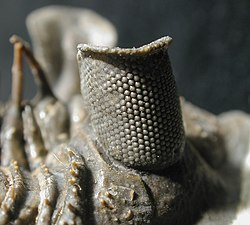
The schizochroal eye of Erbenochile erbenii; the eye shade is unequivocal evidence that some trilobites were diurnal.[113] - Schizochroal eyes typically had fewer (around 700), larger lenses than holochroal eyes and are found only in Phacopina. Each lens had a cornea, and adjacent lenses were separated by thick interlensar cuticle, known as sclera. Schizochroal eyes appear quite suddenly in the early Ordovician, and were presumably derived from a holochroal ancestor.[106] Field of view (all-around vision), eye placement and coincidental development of more efficient enrollment mechanisms point to the eye as a more defensive "early warning" system than directly aiding in the hunt for food.[106] Modern eyes that are functionally equivalent to the schizochroal eye were not thought to exist,[107] but are found in the modern insect species Xenos peckii.[114]
- Abathochroal eyes are found only in Cambrian Eodiscina, and have around 70 small separate lenses that had individual cornea.[115] The sclera was separate from the cornea, and was not as thick as the sclera in schizochroal eyes.[107] Although well preserved examples are sparse in the early fossil record, abathochroal eyes have been recorded in the lower Cambrian, making them among the oldest known.[107] Environmental conditions seem to have resulted in the later loss of visual organs in many Eodiscina.[107]

Secondary blindness is not uncommon, particularly in long lived groups such as the Agnostida and Trinucleioidea. In Proetida and Phacopina from western Europe and particularly Tropidocoryphinae from France (where there is good stratigraphic control), there are well studied trends showing progressive eye reduction between closely related species that eventually leads to blindness.[107]
Several other structures on trilobites have been explained as photo-receptors.[107] Of particular interest are "macula", the small areas of thinned cuticle on the underside of the hypostome. In some trilobites macula are suggested to function as simple "ventral eyes" that could have detected night and day or allowed a trilobite to navigate while swimming (or turned) upside down.[110]
Sensory pits
[edit]
There are several types of prosopon that have been suggested as sensory apparatus collecting chemical or vibrational signals. The connection between large pitted fringes on the cephalon of Harpetida and Trinucleoidea with corresponding small or absent eyes makes for an interesting possibility of the fringe as a "compound ear".[107]
Development
[edit]
Trilobites grew through successive moult stages called instars, in which existing segments increased in size and new trunk segments appeared at a sub-terminal generative zone during the anamorphic phase of development. This was followed by the epimorphic developmental phase, in which the animal continued to grow and moult, but no new trunk segments were expressed in the exoskeleton. The combination of anamorphic and epimorphic growth constitutes the hemianamorphic developmental mode that is common among many living arthropods.[116]
Trilobite development was unusual in the way in which articulations developed between segments, and changes in the development of articulation gave rise to the conventionally recognized developmental phases of the trilobite life cycle (divided into three stages), which are not readily-comparable with those of other arthropods. Actual growth and change in external form of the trilobite would have occurred when the trilobite was soft shelled, following moulting and before the next exoskeleton hardened.[117]

Trilobite larvae are known from the Cambrian to the Carboniferous[118] and from all sub-orders.[117][119] As instars from closely related taxa are more similar than instars from distantly related taxa, trilobite larvae provide morphological information important in evaluating high-level phylogenetic relationships among trilobites.[117]
Despite the absence of supporting fossil evidence, their similarity to living arthropods has led to the belief that trilobites multiplied sexually and produced eggs.[117][120] Some species may have kept eggs or larvae in a brood pouch forward of the glabella,[76] particularly when the ecological niche was challenging to larvae.[9] Size and morphology of the first calcified stage are highly variable between (but not within) trilobite taxa, suggesting some trilobites passed through more growth within the egg than others. Early developmental stages prior to calcification of the exoskeleton are a possibility (suggested for fallotaspids),[17] but so is calcification and hatching coinciding.[117]
The earliest post-embryonic trilobite growth stage known with certainty are the "protaspid" stages (anamorphic phase).[117] Starting with an indistinguishable proto-cephalon and proto-pygidium (anaprotaspid) a number of changes occur ending with a transverse furrow separating the proto-cephalon and proto-pygidium (metaprotaspid) that can continue to add segments. Segments are added at the posterior part of the pygidium, but all segments remain fused together.[117][119]
The "meraspid" stages (anamorphic phase) are marked by the appearance of an articulation between the head and the fused trunk. Prior to the onset of the first meraspid stage the animal had a two-part structure—the head and the plate of fused trunk segments, the pygidium. During the meraspid stages, new segments appeared near the rear of the pygidium as well as additional articulations developing at the front of the pygidium, releasing freely articulating segments into the thorax. Segments are generally added one per moult (although two per moult and one every alternate moult are also recorded), with number of stages equal to the number of thoracic segments. A substantial amount of growth, from less than 25% up to 30%–40%, probably took place in the meraspid stages.[117]
The "holaspid" stages (epimorphic phase) commence when a stable, mature number of segments has been released into the thorax. Moulting continued during the holaspid stages, with no changes in thoracic segment number.[117] Some trilobites are suggested to have continued moulting and growing throughout the life of the individual, albeit at a slower rate on reaching maturity.
Some trilobites showed a marked transition in morphology at one particular instar, which has been called "trilobite metamorphosis". Radical change in morphology is linked to the loss or gain of distinctive features that mark a change in mode of life.[121] A change in lifestyle during development has significance in terms of evolutionary pressure, as the trilobite could pass through several ecological niches on the way to adult development and changes would strongly affect survivorship and dispersal of trilobite taxa.[117] It is worth noting that trilobites with all protaspid stages solely planktonic and later meraspid stages benthic (e.g. asaphids) failed to last through the Ordovician extinctions, while trilobites that were planktonic for only the first protaspid stage before metamorphosing into benthic forms survived (e.g. lichids, phacopids).[121] Pelagic larval life-style proved ill-adapted to the rapid onset of global climatic cooling and loss of tropical shelf habitats during the Ordovician.[30]
There is no evidence that trilobites reabsorbed their exoskeletons during moulting.[122] Some authors have argued that the failure of trilobites to reabsorb their mineralised exoskeletons when they moulted was a functional disadvantage when compared to modern arthropods that generally do reabsorb their cuticles, as it took substantially longer to reconstruct their exoskeletons, making them more vulnerable to predators.[123]
History of usage and research
[edit]
Rev. Edward Lhwyd published in 1698 in The Philosophical Transactions of the Royal Society, the oldest scientific journal in the English language, part of his letter "Concerning Several Regularly Figured Stones Lately Found by Him", that was accompanied by a page of etchings of fossils.[124] One of his etchings depicted a trilobite he found near Llandeilo, probably on the grounds of Lord Dynefor's castle, he described as "the skeleton of some flat Fish".[2]
The discovery of Calymene blumenbachii (the Dudley locust) in 1749 by Charles Lyttleton, could be identified as the beginning of trilobite research. Lyttleton submitted a letter to the Royal Society of London in 1750 concerning a "petrified insect" he found in the "limestone pits at Dudley". In 1754, Manuel Mendez da Costa proclaimed that the Dudley locust was not an insect, but instead belonged to "the crustaceous tribe of animals". He proposed to call the Dudley specimens Pediculus marinus major trilobos (large trilobed marine louse), a name which lasted well into the 19th century. German naturalist Johann Walch, who executed the first inclusive study of this group, proposed the use of the name "trilobite". He considered it appropriate to derive the name from the unique three-lobed character of the central axis and a pleural zone to each side.[125]

Written descriptions of trilobites date possibly from the third century BC and definitely from the fourth century AD. The Spanish geologists Eladio Liñán and Rodolfo Gozalo argue that some of the fossils described in Greek and Latin lapidaries as scorpion stone, beetle stone, and ant stone, refer to trilobite fossils. Less ambiguous references to trilobite fossils can be found in Chinese sources. Fossils from the Kushan formation of northeastern China were prized as inkstones and decorative pieces.[124]
In the New World, American fossil hunters found plentiful deposits of Elrathia kingi in western Utah in the 1860s. Until the early 1900s, the Ute Native Americans of Utah wore these trilobites, which they called pachavee (little water bug), as amulets.[126][127] A hole was bored in the head and the fossil was worn on a string.[126] According to the Ute themselves, trilobite necklaces protect against bullets and diseases such as diphtheria.[126][127] In 1931, Frank Beckwith uncovered evidence of the Ute use of trilobites. Travelling through the badlands, he photographed two petroglyphs that most likely represent trilobites. On the same trip he examined a burial, of unknown age, with a drilled trilobite fossil lying in the chest cavity of the interred. Since then, trilobite amulets have been found all over the Great Basin, as well as in British Columbia and Australia.[124]
In the 1880s, archaeologists discovered in the Grotte du Trilobite (Caves of Arcy-sur-Cure, Yonne, France) a much-handled trilobite fossil that had been drilled as if to be worn as a pendant. The occupation stratum in which the trilobite was found has been dated as 15,000 years old. Because the pendant was handled so much, the species of trilobite cannot be determined. This type of trilobite is not found around Yonne, so it may have been highly prized and traded from elsewhere.[124]
See also
[edit]References
[edit]- ^ a b c d e f B. S., Lieberman (2002), "Phylogenetic analysis of some basal early Cambrian trilobites, the biogeographic origins of the eutrilobita, and the timing of the Cambrian radiation", Journal of Paleontology, 76 (4) (4 ed.): 692–708, doi:10.1666/0022-3360(2002)076<0692:PAOSBE>2.0.CO;2
- ^ a b c Fortey, Richard (2000), Trilobite!: Eyewitness to Evolution, London: HarperCollins, ISBN 978-0-00-257012-1
- ^ Robert Kihm; James St. John (2007). "Walch's trilobite research – A translation of his 1771 trilobite chapter". In Donald G. Mikulic; Ed Landing; Joanne Kluessendorf (eds.). Fabulous fossils – 300 years of worldwide research on trilobites (PDF). New York State Museum Bulletin. Vol. 507. University of the State of New York. pp. 115–140. Archived from the original (PDF) on 2014-07-14.
- ^ Jones, Daniel (2003) [1917]. "trilobite". In Peter Roach; James Hartmann; Jane Setter (eds.). English Pronouncing Dictionary. Cambridge: Cambridge University Press. ISBN 978-3-12-539683-8.
- ^ "trilobite". Merriam-Webster.com Dictionary. Merriam-Webster.
- ^ "trilobite". Dictionary.com Unabridged (Online). n.d.
- ^ a b "Trilobites ventured beyond the ocean". Nature. 505 (7483): 264–265. January 2014. doi:10.1038/505264e.
- ^ a b Fortey, Richard (2004). "The Lifestyles of the Trilobites" (PDF). American Scientist. 92 (5): 446–453. doi:10.1511/2004.49.944. Archived from the original (PDF) on 2006-09-18.
- ^ a b Fortey, Richard (June 2000), "Olenid trilobites: The oldest known chemoautotrophic symbionts?", Proceedings of the National Academy of Sciences, 97 (12): 6574–6578, Bibcode:2000PNAS...97.6574F, doi:10.1073/pnas.97.12.6574, PMC 18664, PMID 10841557
- ^ "Trilobite | fossil arthropod". 22 August 2023.
- ^ Aria, Cédric (2022-04-26). "The origin and early evolution of arthropods". Biological Reviews. 97 (5): 1786–1809. doi:10.1111/brv.12864. ISSN 1464-7931. PMID 35475316. S2CID 248402333.
- ^ Berks, H. O.; Nielsen, M. L.; Flannery-Sutherland, J.; Nielsen, A. T.; Park, T.-Y. S.; Vinther, J. (2023). "A possibly deep branching artiopodan arthropod from the lower Cambrian Sirius Passet Lagerstätte (North Greenland)". Papers in Palaeontology. 9 (3). e1495. Bibcode:2023PPal....9E1495B. doi:10.1002/spp2.1495. S2CID 259253098.
- ^ Hollingsworth, J. S. (2008). "The first trilobites in Laurentia and elsewhere". In I. Rábano; R. Gozalo; D. García-Bellido (eds.). Advances in trilobite research (PDF). Fourth International Trilobite Conference, Toledo, June, 16–24, 2008. Cuadernos del Museo Geominero, Nº 9. Madrid, Spain: Instituto Geológico y Minero de España. ISBN 978-84-7840-759-0. Archived from the original (PDF) on July 10, 2015.
- ^ a b Bushuev E., Goryaeva I., Pereladov V. (2014). "New discoveries of the oldest trilobites Profallotaspis and Nevadella in the northeastern Siberian Platform, Russia" (PDF). Bull. Geosci. 89 (2): 347—364. doi:10.3140/bull.geosci.1406. Archived from the original (PDF) on 2022-03-19.
{{cite journal}}: CS1 maint: multiple names: authors list (link) - ^ Linan, Eladio; Gozalo, Rodolfo; Dies Alvarez, María Eugenia (2008), "Nuevos trilobites del Ovetiense inferior (Cámbrico Inferior bajo) de Sierra Morena (España)", Ameghiniana, 45 (1): 123–138
- ^ a b Holmes, James D.; Budd, Graham E. (2022-11-04). "Reassessing a cryptic history of early trilobite evolution". Communications Biology. 5 (1): 1177. doi:10.1038/s42003-022-04146-6. ISSN 2399-3642. PMC 9636250. PMID 36333446.
- ^ a b c Clowes, Chris, Trilobite Origins, archived from the original on May 14, 2011, retrieved April 12, 2009
- ^ Jell, P. (2003), "Phylogeny of Early Cambrian trilobites", in Lane, P. D.; Siveter, D. J.; Fortey, R. A. (eds.), Trilobites and Their Relatives: Contributions from the Third International Conference, Oxford 2001, Special Papers in Palaeontology, vol. 70, Blackwell Publishing & Palaeontological Association, pp. 45–57
- ^ Sam Gon III. "First Trilobites".
- ^ "Found: Guts of 470-Million-Year-Old Sea Creature". 2017-02-06. Archived from the original on February 6, 2017. Retrieved 2017-02-07.
- ^ Gutiérrez-Marco, Juan C.; García-Bellido, Diego C.; Rábano, Isabel; Sá, Artur A. (2017-01-10). "Digestive and appendicular soft-parts, with behavioural implications, in a large Ordovician trilobite from the Fezouata Lagerstätte, Morocco". Scientific Reports. 7 39728. Bibcode:2017NatSR...739728G. doi:10.1038/srep39728. ISSN 2045-2322. PMC 5223178. PMID 28071705.
- ^ El Albani, A.; Mazurier, A.; Edgecombe, G. D.; Azizi, A.; El Bakhouch, A.; Berks, H. O.; Bouougri, E. H.; Chraiki, I.; Donoghue, P. C. J.; Fontaine, C.; Gaines, R. R.; Ghnahalla, M.; Meunier, A.; Trentesaux, A.; Paterson, J. R. (2024). "Rapid volcanic ash entombment reveals the 3D anatomy of Cambrian trilobites". Science. 384 (6703): 1429–1435. Bibcode:2024Sci...384.1429E. doi:10.1126/science.adl4540. PMID 38935712.
- ^ "The evolution of trilobites – Paleoart". Archived from the original on 2018-12-12. Retrieved 2019-11-26.
- ^ a b c d e f g h i j Clarkson, E. N. K. (1998), Invertebrate Paleontology and Evolution (4th ed.), Oxford: Wiley/Blackwell Science, p. 452, ISBN 978-0-632-05238-7
- ^ a b c d e f Fortey, R. A.; Owens, R. M. (1997), "Evolutionary History", in Kaesler, R. L. (ed.), Treatise on Invertebrate Paleontology, Part O, Arthropoda 1, Trilobita, revised. Volume 1: Introduction, Order Agnostida, Order Redlichiida, Boulder, CO & Lawrence, KS: The Geological Society of America, Inc. & The University of Kansas, pp. 249–287, ISBN 978-0-8137-3115-5
- ^ Samuel M. Gon III (July 20, 2008). "Evolutionary Trends in Trilobites". A Guide to the Orders of Trilobites. Archived from the original on May 17, 2013. Retrieved April 14, 2011.
- ^ Fortey, R. A.; Briggs, D. E. G.; Wills, M. A. (1996), "The Cambrian evolutionary "explosion": decoupling cladogenesis from morphological disparity", Biological Journal of the Linnean Society, 57: 13–33, doi:10.1111/j.1095-8312.1996.tb01693.x
- ^ a b Nedin, C. (1999), "Anomalocaris predation on nonmineralized and mineralized trilobites", Geology, 27 (11): 987–990, Bibcode:1999Geo....27..987N, doi:10.1130/0091-7613(1999)027<0987:APONAM>2.3.CO;2
- ^ a b c d e Bault, Valentin; Balseiro, Diego; Monnet, Claude; Crônier, Catherine (July 2022). "Post-Ordovician trilobite diversity and evolutionary faunas". Earth-Science Reviews. 230 104035. Bibcode:2022ESRv..23004035B. doi:10.1016/j.earscirev.2022.104035.
- ^ a b c Rudkin, D.A.; Young, G. A.; Elias, R. J.; Dobrzanske, E. P. (2003), "The world's biggest trilobite: Isotelus rex new species from the Upper Ordovician of northern Manitoba, Canada", Journal of Paleontology, 70 (1): 99–112, Bibcode:2003JPal...77...99R, doi:10.1666/0022-3360(2003)077<0099:TWBTIR>2.0.CO;2
- ^ a b c d Prehistoric Life: The Definitive Visual History of Life On Earth. London: Dorling Kindersley. 2009. p. 76,88,89,90,91,104,105,127,161,180,181. ISBN 978-0-7566-5573-0.
- ^ Webster, Mark (2007), "A Cambrian peak in morphological variation within trilobite species", Science, 317 (5837): 499–502, Bibcode:2007Sci...317..499W, doi:10.1126/science.1142964, PMID 17656721, S2CID 36290256
- ^ a b c Adrain, Jonathan M.; Fortey, Richard A.; Westrop, Stephen R. (1998), "Post-Cambrian trilobite diversity and evolutionary faunas" (PDF), Science, 280 (5371): 1922–5, Bibcode:1998Sci...280.1922A, doi:10.1126/science.280.5371.1922, PMID 9632387
- ^ a b c d e Hopkins, Melanie J.; Wagner, Peter J.; Jordan, Katherine J. (2023-04-17). "Permian trilobites and the applicability of the "living fossil" concept to extinct clades". Frontiers in Ecology and Evolution. 11 1166126. Bibcode:2023FrEEv..1166126H. doi:10.3389/fevo.2023.1166126. ISSN 2296-701X.
- ^ Brezinski, David K. (January 2023). "Biogeographic patterns in Late Paleozoic trilobites". Palaeogeography, Palaeoclimatology, Palaeoecology. 609 111319. Bibcode:2023PPP...60911319B. doi:10.1016/j.palaeo.2022.111319.
- ^ Lerosey-Aubril, Rudy; Feist, Raimund (2012), "Quantitative Approach to Diversity and Decline in Late Palaeozoic Trilobites", Earth and Life, Dordrecht: Springer Netherlands, pp. 535–555, doi:10.1007/978-90-481-3428-1_16, ISBN 978-90-481-3427-4
- ^ a b Owens, R. M. (2003), "The stratigraphical distribution and extinctions of Permian trilobites.", in Lane, P. D.; Siveter, D. J.; Fortey R. A. (eds.), Trilobites and Their Relatives: Contributions from the Third International Conference, Oxford 2001, Special Papers in Palaeontology, vol. 70, Blackwell Publishing & Palaeontological Association, pp. 377–397
- ^ Burns, Jasper (1991). "Fossil Collecting in the Mid-Atlantic States". The Johns Hopkins University Press. p. 5.
- ^ Baldwin, C. T. (1977), "Rusophycus morgati: an asaphid produced trace fossil from the Cambro-Ordovician of Brittany and Northwest Spain", Journal of Paleontology, 51 (2): 411–425, JSTOR 1303619
- ^ a b Garlock, T. L.; Isaacson, P. E. (1977), "An Occurrence of a Cruziana Population in the Moyer Ridge Member of the Bloomsberg Formation (Late Silurian) – Snyder County, Pennsylvania", Journal of Paleontology, 51 (2): 282–287, JSTOR 1303607
- ^ Woolfe, K. J. (1990), "Trace fossils as paleoenvironmental indicators in the Taylor Group (Devonian) of Antarctica", Palaeogeography, Palaeoclimatology, Palaeoecology, 80 (3–4): 301–310, Bibcode:1990PPP....80..301W, doi:10.1016/0031-0182(90)90139-X
- ^ Zonneveld, John-Paul; Pemberton, S. George; Saunders, Thomas D. A.; Pickerill, Ronald K. (1 October 2002). "Large, Robust Cruziana from the Middle Triassic of Northeastern British Columbia: Ethologic, Biostratigraphic, and Paleobiologic Significance". PALAIOS. 17 (5): 435–448. Bibcode:2002Palai..17..435Z. doi:10.1669/0883-1351(2002)017<0435:LRCFTM>2.0.CO;2. S2CID 131613992.
- ^ a b Caroyln Raeke; Tom Earnst; Mike Vogel; Harold Mcneil (August 18, 1995). "Town Board, Natural History Society on Quest to Save Hamburg Fossil Trove". The Buffalo News.
- ^ Barbara O'Brien (2013-10-13). "They'll never run out of fossils at Penn Dixie". The Buffalo News. Retrieved October 13, 2013.
- ^ Matt Gryta; Tom Ernst (March 4, 1990). "Drive Seeks to Preserve Fossil Site Hamburg Quarry Considered Valuable". The Buffalo News.
- ^ "Trilobites". Penn Dixie Fossil Park & Nature Preserve. 2016-03-15. Retrieved July 16, 2017.
- ^ Robert R. Gaines; Mary L. Droser (2003), "Paleoecology of the familiar trilobite Elrathia kingii: an early exaerobic zone inhabitant" (PDF), Geology, 31 (11): 941–4, Bibcode:2003Geo....31..941G, doi:10.1130/G19926.1
- ^ "A quick guide to identifying fake trilobites!". 29 October 2019.
- ^ Eldredge, Niles & Gould, Stephen Jay (1972), "Punctuated equilibria: an alternative to phyletic gradualism", in Schopf, Thomas J. M. (ed.), Models in Paleobiology, San Francisco, CA: Freeman, Cooper, pp. 82–115, ISBN 978-0-87735-325-6 Reprinted in Eldredge, Niles (1985), Time frames: the rethinking of Darwinian evolution and the theory of punctuated equilibria, New York: Simon and Schuster, ISBN 978-0-671-49555-8
- ^ Mayr, Ernst (1992), "Speciational Evolution or Punctuated Equilibria?", in Peterson, Steven A.; Somit, Albert (eds.), The Dynamics of evolution: the punctuated equilibrium debate in the natural and social sciences, Ithaca, N.Y.: Cornell University Press, pp. 25–26, ISBN 978-0-8014-9763-6, archived from the original on 2018-09-07, retrieved 2008-11-21
- ^ Shermer, Michael (2001), The borderlands of science: where sense meets nonsense, Oxford, UK: Oxford University Press, ISBN 978-0-19-514326-3
- ^ Windley, B. F. (1996), The Evolving Continents (3 ed.), John Wiley & Sons, pp. xvi, 526, ISBN 978-0-471-91739-7
- ^ Harland, W. B.; Gayer, R. A. (1972), "The Arctic Caledonides and earlier oceans", Geological Magazine, 109 (4): 289–314, Bibcode:1972GeoM..109..289H, doi:10.1017/S0016756800037717, S2CID 131091660
- ^
Hughes Patrick, "Alfred Wegener (1880–1930): A Geographic Jigsaw Puzzle", On the shoulders of giants, Earth Observatory, NASA, archived from the original on August 8, 2007, retrieved December 26, 2007,
... on January 6, 1912, Wegener ... proposed instead a grand vision of drifting continents and widening seas to explain the evolution of Earth's geography.
- ^ Alfred Wegener (1966), The origin of continents and oceans, Biram John, Courier Dover, p. 246, ISBN 978-0-486-61708-4
- ^ Lieberman, BS (1999), "Testing the Darwinian Legacy of the Cambrian Radiation Using Trilobite Phylogeny and Biogeography", Journal of Paleontology, 73 (2): 176–181, Bibcode:1999JPal...73..176L, doi:10.1017/S0022336000027700, S2CID 88588171
- ^ Lieberman, B. S. (2003), "Taking the pulse of the Cambrian radiation", Integrative and Comparative Biology, 43 (1): 229–237, doi:10.1093/icb/43.1.229, PMID 21680426
- ^ Schnirel, B.L. (2001), Trilobite Evolution and Extinction, Dania, Florida: Graves Museum of Natural History
- ^ Geyer, Gerd (1998). "Intercontinental, trilobite-based correlation of the Moroccan early Middle Cambrian". Canadian Journal of Earth Sciences. 35 (4): 374–401. Bibcode:1998CaJES..35..374G. doi:10.1139/cjes-35-4-374.
- ^ Babcock, L. E.; Peng, S.; Geyer, G.; Shergold, J. H. (2005), "Changing perspectives on Cambrian chronostratigraphy and progress toward subdivision of the Cambrian System", Geosciences Journal, 9 (2): 101–106, Bibcode:2005GescJ...9..101B, doi:10.1007/BF02910572, S2CID 128841167
- ^ "International Sub-commission on Cambrian Stratigraphy". Archived from the original on 2008-04-20. Retrieved 2009-05-27.
- ^ Bignon, Arnaud; Waisfeld, Beatriz G.; Vaccari, N. Emilio; Chatterton, Brian D. E. (2020-07-02). "Reassessment of the Order Trinucleida (Trilobita)". Journal of Systematic Palaeontology. 18 (13): 1061–1077. Bibcode:2020JSPal..18.1061B. doi:10.1080/14772019.2020.1720324. ISSN 1477-2019. S2CID 212995185.
- ^ Fortey, R. A. (2001), "Trilobite systematics: The last 75 years", Journal of Paleontology, 75 (6): 1141–1151, Bibcode:2001JPal...75.1141F, doi:10.1666/0022-3360(2001)075<1141:TSTLY>2.0.CO;2, S2CID 86291472[permanent dead link]
- ^ Moore, R. C., ed. (1959), Treatise on Invertebrate Paleontology, Part O, Arthropoda 1, Trilobita, Boulder, CO & Lawrence, KA: The Geological Society of America & The University of Kansas Press, pp. xix + 560 pp., 415 figs, ISBN 978-0-8137-3015-8
{{citation}}: ISBN / Date incompatibility (help) - ^ a b Fortey, R. A. (1990), "Ontogeny, Hypostome attachment and Trilobite classification" (PDF), Palaeontology, 33 (3): 529–576, archived from the original on March 26, 2009, retrieved June 22, 2009
- ^ Ebach, M. C.; McNamara, K. J. (2002), "A systematic revision of the family Harpetidae (Trilobita)", Records of the Western Australian Museum, 21 (3): 135–167, doi:10.18195/issn.0312-3162.21(3).2002.235-267
- ^ We finally know how trilobites mated, thanks to new fossils
- ^ a b c d e Whittington, H. B. (1997), "Morphology of the Exoskeleton", in Kaesler, R. L. (ed.), Treatise on Invertebrate Paleontology, Part O, Arthropoda 1, Trilobita, revised. Volume 1: Introduction, Order Agnostida, Order Redlichiida, Boulder, CO & Lawrence, KA: The Geological Society of America, Inc. & The University of Kansas, pp. 1–85, ISBN 978-0-8137-3115-5
- ^ Gutiérrez-Marco, Juan C.; Sá, Artur A.; García-Bellido, Diego C.; Rábano, Isabel; Valério, Manuel (2009). "Giant trilobites and trilobite clusters from the Ordovician of Portugal". Geology. 37 (5): 443–446. Bibcode:2009Geo....37..443G. doi:10.1130/g25513a.1. ISSN 1943-2682.
- ^ "Os Mais Importantes Fósseis de Portugal" (in European Portuguese). National Geographic (Portugal). 7 November 2018. Retrieved 1 May 2021.
- ^ "Fósseis de trilobites: um tesouro nacional – Museu das Trilobites – Centro de Interpretação Geológica de Canelas – Arouca" (in European Portuguese). museudastrilobites.pt. Retrieved 1 May 2021.
- ^ "Microstructure and composition of the trilobite exoskeleton" (PDF).
- ^ Cambrian Ocean World: Ancient Sea Life of North America
- ^ Dynamic Paleontology: Using Quantification and Other Tools to Decipher the History of Life
- ^ Jell, P. A.; Adrain, J. M. (2003), "Available generic names for trilobites", Memoirs of the Queensland Museum, 48 (2): 331–553
- ^ a b Fortey, R. A.; Hughs, N. C. (1998), "Brood pouches in trilobites", Journal of Paleontology, 72 (4): 639–649, Bibcode:1998JPal...72..638F, doi:10.1017/S0022336000040361, S2CID 89175427.
- ^ Riccardo Levi-Setti (1995), Trilobites, University of Chicago Press, ISBN 978-0-226-47452-6
- ^ a b Chris Clowes (April 15, 2006). "Trilobite Origins". Peripatus. Archived from the original on May 14, 2011. Retrieved April 13, 2011.
- ^ a b c d e Samuel M. Gon III (February 3, 2009). "Trilobite Facial Sutures". A Guide to the Orders of Trilobites. Archived from the original on May 17, 2011. Retrieved April 13, 2011.
- ^ a b c Rhona M. Black (1988), The elements of palaeontology (2 ed.), Cambridge University Press, pp. 151–152, ISBN 978-0-521-34836-2
- ^ Michael Kipping. "Change of suit". www.trilobita.de. Retrieved April 13, 2011.
- ^ Pat Vickers Rich; Mildred Adams Fenton; Carroll Lane Fenton; Thomas Hewitt Rich (1989), The fossil book: a record of prehistoric life, Dover books on animals, Courier Dover Publications, p. 204, ISBN 978-0-486-29371-4
- ^ Euan Clarkson; Riccardo Levi-Setti & Gabor Horvath (2006), "The eyes of trilobites: The oldest preserved visual system", Arthropod Structure & Development, 35 (4): 247–259, Bibcode:2006ArtSD..35..247C, doi:10.1016/j.asd.2006.08.002, PMID 18089074
- ^ Dai, T.; Zhang, X. (2008). "Ontogeny of the trilobite Yunnanocephalus yunnanensis from the Chengjiang lagerstätte, lower Cambrian, southwest China". Alcheringa. 32 (4): 465–468. Bibcode:2008Alch...32..465D. doi:10.1080/03115510802418057. ISSN 0311-5518. S2CID 129582955.
- ^ a b Euan Neilson Kerr Clarkson (1998), Invertebrate palaeontology and evolution, Wiley-Blackwell, ISBN 978-0-632-05238-7
- ^ Paterson, J.R.; Edgecombe, G.D. (2006). "The Early Cambrian trilobite Family Emuellidae Popock, 1970: Systematic position and revision of Australian Species". Journal of Paleontology. 85 (3): 496–513. doi:10.1666/0022-3360(2006)80[496:TECTFE]2.0.CO;2. S2CID 84868780.
- ^ a b c d e f g Bruton, D. L.; Haas, W. (2003), "Making Phacops come alive", in Lane, P. D.; D. J. Siveter; R. A. Fortey (eds.), Trilobites and Their Relatives: Contributions from the Third International Conference, Oxford 2001, Special Papers in Palaeontology, vol. 70, Blackwell Publishing & Palaeontological Association, pp. 331–348, ISBN 978-0-901702-81-4
- ^ Early rollers: scientists pinpoint very first 'enrolling' animal
- ^ Bruton, D. L.; Nakrem, H. A. (2005), "Enrollment in a Middle Ordovician agnostoid trilobite" (PDF), Acta Palaeontologica Polonica, 50 (3 ed.): 441–448, retrieved June 22, 2009
- ^ Knell, R. J.; Fortey, R. A. (2005). "Trilobite spines and beetle horns: sexual selection in the Palaeozoic?". Biology Letters. 1 (2): 196–199. doi:10.1098/rsbl.2005.0304. PMC 1626209. PMID 17148165.
- ^ New Scientist magazine (2005), Earliest combatants in sexual contests revealed (published May 28, 2005)
- ^ a b c Hughes, Nigel (2003), "Trilobite tagmosis and body patterning from morphological and developmental perspectives", Integrative and Comparative Biology, 43 (1) (1 ed.): 185–205, doi:10.1093/icb/43.1.185, PMID 21680423, archived from the original on 2006-10-03
- ^ a b Whittington, H. B. (1980), "Exoskeleton, moult stage, appendage morphology, and habits of the Middle Cambrian trilobite Olenoides serratus", Palaeontology, 23: 171–204
- ^ a b c d e Whittington, H. B. (1997), "The Trilobite Body.", in Kaesler, R. L. (ed.), Treatise on Invertebrate Paleontology, Part O, Arthropoda 1, Trilobita, revised. Volume 1: Introduction, Order Agnostida, Order Redlichiida, Boulder, CO & Lawrence, KA: The Geological Society of America, Inc. & The University of Kansas, pp. 137–169, ISBN 978-0-8137-3115-5
- ^ 'Prehistoric Pompeii' - Trilobites killed by volcanic ash reveal features never seen before
- ^ Rapid volcanic ash entombment reveals the 3D anatomy of Cambrian trilobites
- ^ Hou, Jin-bo; Hughes, Nigel C.; Hopkins, Melanie J. (2021-03-01). "The trilobite upper limb branch is a well-developed gill". Science Advances. 7 (14) eabe7377. Bibcode:2021SciA....7.7377H. doi:10.1126/sciadv.abe7377. ISSN 2375-2548. PMC 8011964. PMID 33789898.
- ^ "450-million-year-old sea creatures had a leg up on breathing". phys.org. Retrieved 2021-04-07.
- ^ Ramskold, L.; Edgecombe, G. D. (1996), "Trilobite appendage structure – Eoredlichia reconsidered", Alcheringa, 20 (4): 269–276, Bibcode:1996Alch...20..269R, doi:10.1080/03115519608619471
- ^ Töpperwien, Mareike; Gradl, Regine; Keppeler, Daniel; Vassholz, Malte; Meyer, Alexander; Hessler, Roland; Achterhold, Klaus; Gleich, Bernhard; Dierolf, Martin; Pfeiffer, Franz; Moser, Tobias; Salditt, Tim (2018-03-21). "Propagation-based phase-contrast x-ray tomography of cochlea using a compact synchrotron source". Scientific Reports. 8 (1): 4922. Bibcode:2018NatSR...8.4922T. doi:10.1038/s41598-018-23144-5. ISSN 2045-2322. PMC 5862924. PMID 29563553.
- ^ Kraft, Petr; Vaškaninová, Valéria; Mergl, Michal; Budil, Petr; Fatka, Oldřich; Ahlberg, Per (September 27, 2023). "Uniquely preserved gut contents illuminate trilobite palaeophysiology". Nature. 622 (7983). Nature.com: 545–551. Bibcode:2023Natur.622..545K. doi:10.1038/s41586-023-06567-7. PMC 10584673. PMID 37758946.
- ^ "Fossilised trilobite gut contents reveal what ancient arthropods were eating". www.nhm.ac.uk. Retrieved 2023-11-02.
- ^ McCall, G. J. H. (2006), "The Vendian (Ediacaran) in the geological record: Enigmas in geology's prelude to the Cambrian explosion", Earth-Science Reviews, 77 (1–3): 1–229, Bibcode:2006ESRv...77....1M, doi:10.1016/j.earscirev.2005.08.004
- ^ Parker, Andrew (2003), In the Blink of an Eye, Cambridge, MA: Perseus Books, ISBN 978-0-7382-0607-3, OCLC 52074044
- ^ a b Levi-Setti, Riccardo (1993), Trilobites (2 ed.), Chicago, IL: University of Chicago Press, p. 342, ISBN 978-0-226-47451-9
- ^ a b c d e f Clarkson, E. N. K. (1979), "The Visual System of Trilobites", Palaeontology, Encyclopedia of Earth Science, 22: 1–22, doi:10.1007/3-540-31078-9_67, ISBN 978-0-87933-185-6
- ^ a b c d e f g h i Clarkson, E. N. (1997), "The Eye, Morphology, Function and Evolution", in Kaesler, R. L. (ed.), Treatise on Invertebrate Paleontology, Part O, Arthropoda 1, Trilobita, revised. Volume 1: Introduction, Order Agnostida, Order Redlichiida, Boulder, CO & Lawrence, KA: The Geological Society of America, Inc. & The University of Kansas, pp. 114–132, ISBN 978-0-8137-3115-5
- ^ a b Clarkson, E. N. K.; Levi-Setti, R. L. (1975), "Trilobite eyes and the optics of Descartes and Huygens", Nature, 254 (5502): 663–7, Bibcode:1975Natur.254..663C, doi:10.1038/254663a0, PMID 1091864, S2CID 4174107
- ^ Joanna Aizenberg; Alexei Tkachenko; Steve Weiner; Lia Addadi; Gordon Hendler (2001), "Calcitic microlenses as part of the photoreceptor system in brittlestars", Nature, 412 (6849): 819–822, Bibcode:2001Natur.412..819A, doi:10.1038/35090573, PMID 11518966, S2CID 4327277
- ^ a b Bruton, D. L.; Haas, W. (2003b), "The Puzzling Eye of Phacops", in Lane, P. D.; Siveter, D. J.; Fortey R. A. (eds.), Trilobites and Their Relatives: Contributions from the Third International Conference, Oxford 2001, Special Papers in Palaeontology, vol. 70, Blackwell Publishing & Palaeontological Association, pp. 349–362
- ^ a b Schoenemann, Brigitte; Clarkson, Euan (2013). "Discovery of some 400 million year-old sensory structures in the compound eyes of trilobites". Scientific Reports. 3 1429. Bibcode:2013NatSR...3.1429S. doi:10.1038/srep01429. PMC 3596982. PMID 23492459.
- ^ McCormick, T.; Fortey, R.A. (1998). "Independent testing of a paleobiological hypothesis: the optical design of two Ordovician pelagic trilobites reveals their relative paleobathymetry". Paleobiology. 24 (2): 235–253. doi:10.1666/0094-8373(1998)024[0235:ITOAPH]2.3.CO;2. JSTOR 2401241. S2CID 132509541.
- ^ Fortey, R.; Chatterton, B. (2003), "A Devonian Trilobite with an Eyeshade", Science, 301 (5640): 1689, doi:10.1126/science.1088713, PMID 14500973, S2CID 45993674
- ^ Buschbeck, Elke; Ehmer, Birgit; Hoy, Ron (1999), "Chunk Versus Point Sampling: Visual Imaging in a Small Insect", Science, 286 (5442): 1178–80, doi:10.1126/science.286.5442.1178, PMID 10550059
- ^ Jell, P. A. (1975), "The abathochroal eye of Pagetia, a new type of trilobite eye", Fossils and Strata, 4: 33–43, doi:10.18261/8200049639-1975-02, ISBN 82-00-04963-9
- ^ Sam Gon III. "Trilobite Development". Archived from the original on 2016-04-26. Retrieved 2009-05-28.
- ^ a b c d e f g h i j Chatterton, B. D. E.; Speyer, S. E. (1997), "Ontogeny", in Kaesler, R. L. (ed.), Treatise on Invertebrate Paleontology, Part O, Arthropoda 1, Trilobita, revised. Volume 1: Introduction, Order Agnostida, Order Redlichiida, Boulder, CO & Lawrence, KA: The Geological Society of America, Inc. & The University of Kansas, pp. 173–247, ISBN 978-0-8137-3115-5
- ^ Lerosey-Aubril, R.; Feist, R. (2005), "First Carboniferous protaspid larvae (Trilobita)", Journal of Paleontology, 79 (4): 702–718, doi:10.1666/0022-3360(2005)079[0702:FCPLT]2.0.CO;2, S2CID 130584215
- ^ a b Rudy Lerosey-Aubril. "The Ontogeny of Trilobites". Archived from the original on October 27, 2009. Retrieved November 8, 2010.
- ^ Zhang, X.; Pratt, B. (1994), "Middle Cambrian arthropod embryos with blastomeres", Science, 266 (5185): 637–9, Bibcode:1994Sci...266..637Z, doi:10.1126/science.266.5185.637, PMID 17793458, S2CID 35620499
- ^ a b Chatterton, B. D. E.; Speyer, S. E. (1989), "Larval ecology, life history strategies, and patterns of extinction and survivorship among Ordovician trilobites", Paleobiology, 15 (2): 118–132, Bibcode:1989Pbio...15..118C, doi:10.1017/S0094837300009313, S2CID 89379920
- ^ Daley, Allison C.; Drage, Harriet B. (March 2016). "The fossil record of ecdysis, and trends in the moulting behaviour of trilobites". Arthropod Structure & Development. 45 (2): 71–96. Bibcode:2016ArtSD..45...71D. doi:10.1016/j.asd.2015.09.004. PMID 26431634.
- ^ Brandt, Danita S. (January 2002). "Ecydsial efficiency and evolutionary efficacy among marine arthropods: implications for trilobite survivorship". Alcheringa: An Australasian Journal of Palaeontology. 26 (3): 399–421. Bibcode:2002Alch...26..399B. doi:10.1080/03115510208619264. ISSN 0311-5518. S2CID 84274343.
- ^ a b c d John J. McKay (2011-11-22). "The first trilobite". OhioLINK ETD Center. Retrieved 3 October 2012.
- ^ Alex J. Chestnut. "Using morphometrics, phylogenetic systematics and parsimony analysis to gain insight into the evolutionary affinities of the Calymenidae Trilobita". OhioLINK ETD Center. Archived from the original on March 31, 2012. Retrieved August 21, 2011.
- ^ a b c Joleen Robinson (October 1970), "Tracking the Trilobites", Desert Magazine
- ^ a b van der Geer, Alexandra; Dermitzakis, Michael (2010). "Fossils in pharmacy: from "snake eggs" to "Saint's bones"; an overview" (PDF). Hellenic Journal of Geosciences. 45: 323–332.
Bibliography
[edit]- Fortey, Richard (2000), Trilobite: Eyewitness to Evolution, New York: Vintage Books, ISBN 978-0-375-70621-9
- Lawrence, Pete (2014), Trilobites of the World: An atlas of 1000 photographs, Manchester: Siri Scientific Press, ISBN 978-0-9574530-3-6, archived from the original on 2014-03-08, retrieved 2014-04-15
- Levi-Setti, Riccardo (2014), The Trilobite Book: A Visual Journey, Chicago: University of Chicago Press, Bibcode:2014tbvj.book.....L, ISBN 978-0-226-12441-4
External links
[edit]

- A Guide to the Orders of Trilobites Archived 2019-02-18 at the Wayback Machine. A site with information covering trilobites from all angles. Includes many line drawings and photographs as well as monthly news. Created and maintained by Sam Ohu Gon III.
- The Virtual Fossil Museum – Class Trilobita[dead link]. Includes extensive photographs organized by taxonomy and locality.
- Western Trilobites Association. Provides information about the WTA's projects and photos of specimens found by members and contributors. Designed and maintained by Kevin D. Brett and Roger Perkins.
- Kevin's Trilobite Gallery. Archival collection of photographs of trilobite fossils. Created by Kevin D. Brett.
- Information on fraudulently made trilobites Archived 2013-01-21 at the Wayback Machine
- The Paleontological Society
- Chisholm, Hugh, ed. (1911). . Encyclopædia Britannica (11th ed.). Cambridge University Press.
- When Trilobites Ruled the World by Natalie Angier, New York Times, March 3, 2014.
- American Museum of Natural History Trilobite website
- Trilobites in Houston Museum of Natural Sciences


Trilobite
View on GrokipediaTaxonomy
Higher classification
Trilobites are classified as the extinct class Trilobita within the phylum Arthropoda, specifically belonging to the clade Artiopoda, a group of mostly Paleozoic marine euarthropods characterized by biramous appendages and a post-abdominal region lacking walking legs.[5] In recent phylogenetic analyses incorporating fossil evidence, Trilobita occupies a basal position among total-group euarthropods, appearing abruptly in the early Cambrian around 521 Ma.[6] Traditionally, trilobites were grouped within the subphylum Chelicerata or the broader Arachnomorpha (also termed Arachnata), reflecting perceived similarities in body organization with chelicerates like horseshoe crabs and eurypterids; however, modern studies based on cladistic analyses of morphology and developmental genes increasingly position them as stem-group arthropods or as a sister clade to Chelicerata within a revised Arachnomorpha, rejecting a direct inclusion in crown-group Chelicerata due to differences in appendage structure and Hox gene expression.[7][8] The defining synapomorphies of Trilobita include a tripartite body division into cephalon (head), thorax (body), and pygidium (tail), resulting in a trilobate exoskeleton with three longitudinal lobes separated by axial and pleural furrows; a robust, calcified dorsal exoskeleton; and holochroal compound eyes featuring numerous contiguous lenses covered by a single cornea, which are apomorphic for the group and enabled advanced vision in marine environments.[5][9] Additional shared traits encompass circumocular sutures around the eyes and dorsal facial sutures facilitating ecdysis (molting), though the latter vary in presence across early lineages like olenellines.[6] These features distinguish trilobites from other arthropods while underscoring their monophyly, supported by parsimony analyses that identify at least a dozen exoskeletal and ocular synapomorphies.[7] Within the broader arthropod phylogeny, Trilobita is nested in Artiopoda alongside related extinct groups such as the non-mineralized Trilobitomorpha (e.g., naraoiids) and Vicissicaudata (e.g., aglaspids), united by similarities in appendage biramy and tagmosis.[5] Debates persist on the monophyly of trilobitomorphs, with some cladistic studies affirming a monophyletic clade encompassing biomineralized trilobites and soft-bodied relatives based on shared cephalic and thoracic features, while others argue for paraphyly if certain Cambrian forms like Retifacies represent stem artiopodans outside a strict trilobite lineage.[6][7] Formally, the class Trilobita is subdivided into 10 orders, reflecting evolutionary diversification from the Cambrian to Permian; prominent examples include the early Cambrian Redlichiida (e.g., families Paradoxiidae and Olenellidae, characterized by proparian sutures), the Ordovician-Silurian Phacopida (e.g., families Phacopidae and Dalmanitidae, with schizochroal eyes derived from holochroal ancestors), and the late Paleozoic Proetida (e.g., family Proetidae, the sole order surviving to the end-Permian extinction).[10] Other key orders encompass Corynexochida, Asaphida, and Olenida, with suborders such as Redlichiina and Ptychopariina organizing families based on suture types and thoracic segment counts; Agnostida is sometimes treated separately due to its blind, planktonic forms.[6] This hierarchical taxonomy, continually refined through phylogenetic systematics, accommodates over 22,000 described species while highlighting trilobites' role as index fossils.[10]Diversity and species
Trilobites exhibit remarkable diversity, with over 22,000 species described to date, representing one of the most speciose extinct groups of marine arthropods.[11] This diversity is particularly pronounced in the Ordovician period, when trilobite faunas reached their zenith in terms of genus and species richness, reflecting adaptive radiations in shallow marine environments.[12] The class Trilobita encompasses 10 orders, each with distinctive morphological and ecological traits that contributed to their overall variety. For instance, the order Agnostida comprises small, typically blind trilobites with isopygous (cephalon and pygidium of similar size and shape) exoskeletons and only two or three thoracic segments, often interpreted as pelagic or semi-pelagic forms adapted to open-water habitats.[13] In contrast, the order Asaphida, one of the largest and most morphologically diverse, includes forms ranging from small to large sizes with variable thoracic segment counts (often 9–12) and features such as spinose margins on the pygidium, enabling a wide array of benthic lifestyles across Cambrian to Devonian strata.[14] Among the many notable genera, Paradoxides stands out for its large size—up to 60 cm in length—and semicircular cephalon with sickle-shaped eyes, characteristic of mid-Cambrian paradoxidid trilobites that inhabited shallow epicontinental seas.[15] Phacops, a prominent Devonian phacopid, is recognized for its globose cephalon housing large holochroal compound eyes that provided near-360-degree vision, along with the ability to enroll into a protective ball.[16] Olenellus, an early Cambrian olenellid, exemplifies primitive trilobite morphology with a well-developed cephalon featuring large crescentic eyes and a small, poorly developed pygidium, marking it as one of the earliest diverging lineages.[17] Recent paleontological research continues to uncover new trilobite diversity; in 2023, geologists identified 10 previously unknown species from Ordovician volcanic ash deposits in Thailand, including the asaphid Tsinania sirindhornae, which exhibits elongated thoracic spines and enhances our knowledge of Southeast Asian faunas.[18]Morphology
Exoskeleton and segmentation
The trilobite body plan is characterized by a tripartite division along the anterior-posterior axis, consisting of the cephalon (head shield), thorax (segmented body), and pygidium (tail shield).[19] This organization reflects an ancestral arthropod tagmosis, where the cephalon houses sensory and feeding structures, the thorax facilitates locomotion and flexibility, and the pygidium provides posterior protection.[19] The exoskeleton, which defines the external morphology of trilobites, was a chitinous cuticle biomineralized primarily with calcite, forming a rigid, protective structure divided longitudinally into three lobes: a central axial lobe flanked by two pleural lobes.[20] In some species, an outer layer of calcium phosphate (apatite) supplemented the calcite, enhancing durability, while the organic chitin matrix provided flexibility before full calcification.[20] This tri-lobed configuration, from which the group derives its name, extended across all body regions and supported transverse segmentation.[21] Trilobite segmentation varied across body regions, with the cephalon typically fusing 5 somites into a single shield (often appearing as 2-3 visible units based on glabellar and genal features), the thorax comprising a highly variable number of articulated segments (from 2 to over 100, with a maximum of 103 in the emuellid Balcoracania dailyi), and the pygidium fusing one or more posterior segments (often 2 or more) into a terminal plate.[22] Thoracic segment count influenced overall body flexibility and enrollment capability, with higher numbers allowing greater mobility but requiring more energy for molting.[23] Pygidial fusion patterns often inversely correlated with thoracic segments, optimizing balance between articulation and protection.[23] Standard anatomical terminology for trilobites includes the sagittal axis (midline length along the body), transverse axis (perpendicular to sagittal, across width), and adaxial direction (toward the axial lobe from pleural regions), which describe orientations in the tri-lobed exoskeleton.[24] Many trilobites exhibited volvation, or enrollment, where the thorax flexed to bring the cephalon and pygidium together, enclosing soft tissues via interlocking pleural margins and spines for defense against predators.[25] This behavior relied on the segmented exoskeleton's modular design, with thoracic articulations enabling tight coiling without structural failure.[25]Cephalon
The cephalon, or head shield, of trilobites is the anterior-most division of the exoskeleton, formed by the fusion of the acron and several anterior somites, and it exhibits considerable morphological variation across taxa. Cephalon shapes range from semicircular or parabolic outlines in many Cambrian and Ordovician forms, such as holmiid trilobites, to more elongate or subtriangular configurations in others, like certain olenellines, often widening ontogenetically to accommodate growth and sensory structures.[26][27] These variations reflect adaptations to diverse ecological niches, with broader forms potentially enhancing stability during locomotion on soft substrates.[28] A defining feature of the trilobite cephalon is the presence of facial sutures, which are lines of weakness that facilitated molting by allowing controlled separation of exoskeletal parts. Three primary types are recognized: opisthoparian sutures, which curve posteriorly from the eyes toward the rear of the cephalon; gonatoparian sutures, which meet at or near the midline behind the eyes; and proparian sutures, which arch anteriorly across the front margin.[27][29] These sutures enabled the "sutural gape" mode of ecdysis in most trilobites, where the librigenae—the free cheeks lateral to the central cranidium—disarticulated, creating an anterior opening for the animal to exit the old exoskeleton.[30][27] Post-molting, the librigenae remained as separate, often teardrop-shaped sclerites that could be reattached or discarded, with their morphology varying from spinose to smooth depending on the taxon.[30] This mechanism was prevalent across trilobite orders, though some derived groups like Phacopida showed reduced reliance on facial sutures for molting.[31] The rostrum, an anterior projection of the cephalon formed by the rostral plate, served as a structural element in molting and potentially aided in burrowing or feeding behaviors. In many trilobites, the rostrum abutted the hypostome along a functional suture, allowing ventral separation during ecdysis to expose the mouth region.[32] Its pointed or rounded form may have facilitated sediment penetration for deposit-feeding species, as inferred from associated trace fossils like Cruziana, though direct evidence links it more consistently to exoskeletal articulation than to specific locomotion.[33] Underlying the cephalon ventrally, the hypostome is a hardened plate that covered the mouth and participated in feeding mechanics. It could be natant (free-floating), conterminant (aligned and attached to the rostral doublure), or impendent (attached but offset from the glabella), with variations influencing oral cavity enclosure.[34] Food grooves on the hypostome, often paired and directed toward the mouth, channeled particles from appendages to the digestive tract, supporting deposit or suspension feeding in many taxa.[35] In some Cambrian trilobites, a soft-tissue labrum was attached to the hypostome, enhancing sealing and efficiency during ingestion.[34]Thorax
The thorax represents the flexible, elongate middle tagma of the trilobite body, consisting of a variable number of articulating segments that connect the cephalon to the pygidium.[36] It is characterized by a central axial lobe flanked by bilateral pleural regions, with each segment divided into an axial ring and pleural rings separated by furrows.[37] The number of thoracic segments typically ranges from 10 to 20 in most trilobite taxa, though this varies widely across lineages, from as few as 2 in agnostoids like Agnostus to over 100 in early Cambrian emuellids such as Balcoracania dailyi, which possesses up to 103 segments.[36][38][39] Structurally, the axial lobe of the thorax comprises a series of raised rings separated by transverse axial furrows, while the pleural regions feature parallel pleural furrows that extend from the axial furrows to the margins, often terminating in rounded or spined tips.[36] These furrows, along with articulating half-rings on the posterior margins of each segment, provide the primary sites of flexibility, allowing the thorax to bend and flex without disrupting the overall exoskeletal integrity.[37] In many species, the pleural regions widen posteriorly or bear spines, enhancing the thoraxes' adaptability to different habitats.[36] The thoraxes' articulated design played a crucial role in locomotion, enabling lateral bending and undulation through metachronal waves propagated along the segments, which facilitated both benthic crawling and pelagic swimming. For instance, in taxa like Placoparia cambriensis with 12 thoracic segments, this articulation supported efficient hopping gaits during swimming at speeds up to 16 cm/s, while fewer segments in species like Lonchodomas promoted stability on substrates. Certain adaptations, such as prolonged genal spines extending posteriorly from the cephalon over the anterior thorax in raphiophorids like Ampyx, likely aided in stabilizing the body during such movements or enrollment for defense.[40]Pygidium
The pygidium represents the fused posterior portion of the trilobite body, serving as the tail shield and formed through the fusion of one or more posterior thoracic somites with the telson.[41] This fusion creates a rigid structure that contrasts with the flexible segmentation of the thorax, where individual somites allow for articulation.[42] In ontogeny, the pygidium develops as a zone of segment addition, with new somites incorporated via fusion during growth stages.[43] Pygidial size varies relative to the cephalon, influencing overall body proportions and classified into three main categories: micropygous, where the pygidium is smaller than the cephalon; isopygous, where the two are approximately equal in size; and macropygous, where the pygidium exceeds the cephalon in size.[44] Micropygous forms predominate in early trilobites like those in the order Redlichiida, while macropygous pygidia occur in later groups such as some proetids.[42] These ratios reflect evolutionary adaptations in body plan, with isopygous conditions common in blind or pelagic forms for streamlined morphology.[24] The shape of the pygidium diversifies across trilobite lineages, typically semicircular, triangular, or spinose, with variations linked to ecological roles.[24] Semicircular outlines are prevalent in many ordovician and devonian taxa, providing broad coverage, while triangular forms taper posteriorly for maneuverability.[45] Spinose pygidia, featuring marginal or axial spines, likely enhanced defense by deterring predators during enrollment, as seen in several devonian and permian species.[46] For instance, the late paleozoic genus Ditomopyge exhibits a spiny pygidium with prominent marginal projections, combining a broad semicircular outline with defensive ornamentation.[47] Structurally, the pygidium comprises a central axis flanked by pleural regions, with the axis defined by bounding furrows and composed of multiple rings that decrease in size posteriorly.[42] Pleural ribs radiate from the axis across the pleural lobes, varying in number (typically 7-12) and convexity, which can create a geniculate profile for added rigidity.[45] In Ditomopyge scitula, for example, the pygidium displays 7-10 strongly geniculate pleural ribs and an axis with 10-13 rings, contributing to its robust, defensive form.[45]Surface ornamentation and spines
The surface of the trilobite exoskeleton was characterized by prosopon, a term encompassing various microscopic to macroscopic ornamentations that contributed to structural integrity and functional adaptations. These features included pits, granules, terraces, and pustules, which varied in density and arrangement across taxa and body regions. Pits often served as muscle attachment sites, enhancing the exoskeleton's strength by providing secure anchors for appendages and supporting enrollment during defensive postures.[48] Granules and pustules reinforced the cuticle's mechanical properties, distributing stress to prevent cracking under environmental pressures or during locomotion.[48] Terrace ridges, in particular, formed cuesta-like patterns that improved hydrodynamics by reducing drag in water currents, while also aiding in sediment interaction for benthic species.[49] Such ornamentations were preserved in fine detail in certain fossils, allowing quantitative analysis that revealed their role in species-specific adaptations rather than random variation.[50] Macrospines represented larger projections integral to the exoskeleton's surface, prominently developed on the cephalon, thorax, and pygidium. Genal spines extended from the posterior corners of the cephalon, providing leverage for stability during burrowing or swimming and deterring predators by increasing the animal's apparent size.[42] Pleural spines on the thorax projected laterally from segment margins, enhancing balance in mobile forms and facilitating defensive enrollment by interlocking with adjacent structures.[19] Pygidial spines, often radiating from the posterior margin, contributed to tail stability and protection, with some taxa evolving elongated forms that projected anteriorly when coiled to seal gaps.[19] In odontopleurid trilobites like Leonaspis and Dicranurus, these spines functioned primarily in defense, forming barriers against attack while minimizing hydrodynamic disruption in shallow marine settings.[51] Ornamentation patterns exhibited environmental correlations, with pelagic trilobites displaying smoother surfaces and fewer terrace ridges—averaging 8.9 per pygidial doublure compared to 16.1 in benthic forms—to optimize streamlining in open water.[49] Benthic species, conversely, bore more ornate prosopon and pronounced spines, aiding grip on substrates and camouflage in complex seafloor habitats.[52] This variation underscored adaptive divergence, as evidenced by eigenshape analyses separating ecological modes based on ridge morphology.[49] Spines and prosopon collectively enhanced volvation, the ability to enroll into a protective sphere, by enabling interlocking mechanisms that sealed the body against threats. In derived trilobites, genal and pygidial spines aligned during coiling to form a tight fit, with terrace ridges on opposing margins facilitating stable articulation.[46] Such adaptations, convergent across euarthropods, improved defensive efficiency without compromising mobility, as seen in Ordovician taxa with specialized ventral structures.[53]Paleobiology
Appendages and locomotion
Trilobites possessed biramous appendages, consisting of an inner endopod used primarily for walking and an outer exopod functioning as a paddle for swimming or ventilation.[54] The endopod typically comprised 5 to 7 podomeres, enabling flexible locomotion along the seafloor, while the exopod's flattened, paddle-like structure facilitated rhythmic beating for propulsion in water.[55] These appendages were arranged in a homonomous series beneath the exoskeleton, with variations in podomere count across species reflecting adaptations to specific environments.[56] Preceding the biramous limbs, trilobites had a pair of uniramous antennae attached to the preoral region of the cephalon, serving sensory roles in detecting environmental cues.[57] These elongate, flagelliform structures lacked branching and were equipped with chemosensory and tactile setae, aiding navigation in low-visibility benthic habitats.[58] Locomotion in trilobites was predominantly benthic, involving crawling along the substrate using coordinated endopod movements, though some species employed exopod flapping for short bursts of swimming.[59] Burrowing behaviors were also common, particularly among infaunal forms, where appendages dug into sediment to create shelters or access food. A 2025 study on exceptionally preserved Olenoides serratus specimens from the Burgess Shale revealed that these trilobites exhibited unique limb mobility, with endopods capable of alternating gaits for efficient walking and burrowing, distinct from modern analogs like horseshoe crabs.[60] This adaptability highlights the versatility of trilobite appendages in mid-Cambrian marine ecosystems.[61] Recent discoveries have further illuminated cephalic appendage diversity, including a 2024 finding of an extra pair of legs beneath the head in Triarthrus eatoni fossils from upstate New York, suggesting enhanced mobility for maneuvering in complex seafloor terrains.[62] These additional biramous limbs, preserved in pyrite, likely contributed to improved stability and sensory-motor integration during locomotion.Feeding and digestion
Trilobites employed a variety of mouthparts for food manipulation, primarily involving the hypostome and associated soft tissues. The hypostome, a plate-like structure on the ventral side of the cephalon, often featured a soft-tissue labrum that assisted in handling prey or detritus, as evidenced by exceptionally preserved Cambrian specimens from Morocco. Gnathobases, robust tooth-like structures on the endopods of the cephalic appendages, facilitated grinding and crushing of food items, enabling mechanical breakdown before ingestion.[34][34] The digestive tract of trilobites was typically divided into foregut, midgut, and hindgut regions, with variations in complexity across species and geological periods. The foregut, located near the mouth beneath the glabella, often consisted of a two-chambered ventriculus for initial storage and processing, as seen in Ordovician examples. The midgut featured paired digestive caecae or glands extending into the cephalon and thorax for nutrient absorption, while the hindgut narrowed posteriorly toward the anus at the pygidial axis. In many taxa, such as those from the Upper Cambrian Pterocephalia, the overall gut formed a straight sagittal tube rather than a coiled structure, filled with detrital minerals indicative of deposit feeding. Cambrian trilobites from the Weeks Formation lagerstätte in Utah displayed a J-shaped foregut with multiple caecae, suggesting efficient handling of ingested material.[64][64][65] Dietary habits among trilobites varied, encompassing detritivory, scavenging, and predation, inferred from fossilized gut contents and coprolites. Exceptional preservation in an Ordovician trilobite, Bohemolichas incola, revealed a polyphagous diet including ostracods, hyoliths, echinoderm plates, and bivalve fragments, pointing to opportunistic scavenging on small benthic invertebrates. Cambrian specimens from China showed sediment-filled guts with organic detritus, supporting a detritivorous lifestyle where incidental ingestion of silica grains occurred during feeding. Coprolites attributed to trilobites, often containing fragmented shells or mineral grains, further indicate scavenging or deposit-feeding behaviors in various taxa. Predatory habits are suggested in some groups by gnathobase adaptations for crushing prey, though direct evidence remains limited.[64][66][66] Recent discoveries of soft-tissue feeding apparatus in 2024 Moroccan Cambrian trilobites, preserved through rapid volcanic ash entombment, have illuminated early euarthropod feeding structures, including a slit-like mouth and detailed gnathobases, enhancing understanding of trilobite alimentary evolution. These fossils confirm the presence of a labrum attached to the hypostome, resolving long-standing debates on its functional role in food manipulation.[34][34]Sensory systems
Trilobites possessed well-developed compound eyes as their primary visual organs, with three distinct types identified across their evolutionary history. The holochroal eye, the most common type found in the majority of trilobite species, features numerous small lenses arranged closely together beneath a single shared cornea, enabling broad visual fields suitable for detecting motion in well-lit environments.[67] In contrast, the schizochroal eye, unique to the suborder Phacopina within Phacopida, consists of larger, separated lenses each covered by its own cornea and backed by individual crystalline cones, which likely provided higher resolution and better performance in low-light conditions.[67] The abathochroal eye, restricted to early eodiscid trilobites, is characterized by small, annular lenses individually shielded by a thin cuticular cornea, representing a primitive form possibly adapted for shallow-water habitats.[67] The lenses of trilobite compound eyes were composed of calcite crystals, a mineral with a high refractive index that facilitated light focusing and transparency.[68] This calcite structure also enabled sensitivity to ultraviolet (UV) light, as the material's birefringence and photoluminescent properties under UV-A excitation extended the visible spectrum, potentially enhancing contrast detection in marine settings.[69] A 2025 theoretical study modeling photoluminescence in these calcite lenses under natural underwater lighting conditions demonstrated that such emissions could broaden the exploitable visual spectrum, suggesting trilobites possessed advanced, modern-like visual systems capable of processing environmental cues akin to those in contemporary arthropods.[70] Beyond vision, trilobites relied on antennae and antennules for chemotactile sensing, allowing detection of chemical gradients and tactile stimuli in their aquatic surroundings. These filiform appendages, homologous to those in other euarthropods, bore chemosensory sensilla that facilitated orientation toward food sources or mates through olfaction and touch.[58] The exoskeleton featured sensory pits and setae, hair-like structures housed in pores, which served as mechanoreceptors for vibration and flow detection; biomechanical analyses indicate these setae could sense fluid velocity changes as low as 7 μm/s, aiding in predator avoidance and schooling behavior.[71][72]Reproduction and development
Trilobite development is characterized by a distinct post-embryonic ontogeny divided into three successive periods: the protaspid, meraspid, and holaspid stages.[73] The protaspid stage represents the larval phase, where the entire body is enclosed within a single, unarticulated dorsal shield that lacks free thoracic segments; this stage typically includes a few instars and emphasizes the initial formation of internal segmentation before external expression.[73] Transitioning to the meraspid stage marks the juvenile period, during which thoracic segments are progressively released from the posterior growth zone (pygidium) through a series of molts, with each degree of the meraspid period defined by the number of articulating thoracic segments added.[73] The holaspid stage signifies adulthood, where the thorax reaches its fixed segment count, and subsequent molts serve primarily for size increase without further segmentation.[73] Growth in trilobites occurred iteratively via ecdysis, or molting, which allowed for exoskeleton expansion and, during the meraspid phase, the addition of new trunk segments from a subterminal growth zone in a process known as anamorphic development.[73] This hemianamorphic pattern—combining segment addition in juveniles with a stable adult segment number—facilitated adaptation to environmental demands, as evidenced in species like Aulacopleura koninckii, where early molts released one or more segments per instar until thoracic completion.[74] Molting assemblages, such as those from Cambrian deposits, further indicate synchronized ecdysis events, potentially linked to behavioral strategies for protection during vulnerability.[75] Reproduction in trilobites is inferred to have involved external fertilization, with males grasping females using specialized appendages during spawning, akin to behaviors in modern horseshoe crabs.[76] Fossil evidence includes pyritized eggs clustered ventrally on adult Triarthrus eatoni specimens from the Ordovician, suggesting broadcast spawning without internal brooding; these eggs, measuring approximately 200 μm, precede the larger protaspid larvae and support an unmineralized embryonic phase.[77] Paired or clustered adult fossils, such as those in Burgess Shale assemblages of Olenoides serratus, likely represent mass mating and molting events, reinforcing external fertilization as the primitive arthropod mode.[78] Sexual dimorphism in trilobites was generally subtle, manifesting in size disparities or minor ornamentation differences in some species, though direct evidence is rare due to preservation biases.[76] A notable exception occurs in Olenoides serratus, where mature males possessed reduced, hook-like clasper appendages on thoracic endopodites for gripping females, representing the earliest known ventral sexual dimorphism in trilobites and indicating sexually selected mating structures by the mid-Cambrian.[76] Such traits highlight how dimorphism supported reproductive behaviors without major dorsal modifications in most taxa.[79]Evolutionary history
Origins and early trilobites
Trilobites emerged abruptly in the fossil record during the early Cambrian, with their earliest known occurrences dating to approximately 515 million years ago (Ma).[34] This timing aligns with the base of Cambrian Stage 3 in the global chronostratigraphic framework, marking the initial diversification of crown-group euarthropods.[80] The oldest recognized genera, including Gigoutella mauretanica and Protolenus sp., appear in shallow-water deposits in Morocco, with Fallotaspis occurring shortly after across multiple paleocontinents, including Laurentia, Siberia, and West Gondwana, often in association with other early shelly fossils.[81][34] These initial trilobites exhibit a basic tripartite body plan but with limited morphological complexity compared to later forms.[80] Exceptional preservation in volcanic ash deposits has recently revealed detailed anatomy, including appendages and digestive structures, for these early forms.[34] No body fossils of trilobites or their direct ancestors have been identified in Precambrian strata, creating significant gaps in the pre-Cambrian fossil record.[80] Trace fossils suggestive of arthropod activity appear slightly earlier, around 535 Ma, but these predate definitive trilobite remains and do not conclusively link to trilobite lineages.[81] Potential precursors include trilobitomorphs from the Ediacaran period, such as Spriggina, an elongate, annulate organism sometimes interpreted as a basal arthropod or stem-group bilaterian, though its affinity to trilobites remains controversial and heterodox.[82] Other non-trilobite arthropods, including lobopodians and early euarthropod stem groups, represent broader precursors within the arthropod clade, but trilobites themselves show a Cambrian origin without an extended unfossilized Precambrian history.[80] The initial radiation of trilobites occurred rapidly following their appearance, characterized by small-bodied, spiny forms adapted to shallow marine environments.[83] These early taxa, often less than a few centimeters in length, inhabited oxygenated carbonate platforms and nearshore settings on paleocontinents like Siberia, where sea-level oscillations facilitated habitat expansion and speciation.[83] Spines and ornamentation likely served defensive roles in these predator-scarce but dynamically changing ecosystems, with low diversity assemblages dominated by fallotaspidoids and related families.[80] This burst of evolution coincided with broader Cambrian marine oxygenation events, enabling the establishment of trilobites as key components of early benthic communities.[84]Diversification by period
Trilobites underwent an explosive diversification during the Cambrian Period, rapidly evolving into a wide array of forms that dominated early Paleozoic marine ecosystems. This radiation, part of the broader Cambrian explosion, saw the emergence of numerous lineages, with polymerid trilobites becoming the predominant group by the mid-Cambrian, characterized by their multiparticulate thoraces and adaptability to diverse benthic habitats.[19][85][86] The Ordovician Period marked the zenith of trilobite diversity, with an estimated peak of around 5,500 species across global assemblages, reflecting adaptations to expanding shallow marine environments.[87] Prominent groups included asaphids, which thrived in various shelf settings, and the rise of pelagic forms that exploited open-water niches during the Great Ordovician Biodiversification Event.[87][88] In the Silurian and Devonian periods, trilobites continued to diversify, particularly through phacopids that developed advanced schizochroal eyes featuring large, widely spaced calcite lenses for enhanced low-light vision in deeper waters. However, this era also initiated a gradual decline in overall diversity, as competitive pressures from other arthropods and environmental shifts reduced trilobite dominance.[89][90][91] By the Carboniferous and Permian periods, trilobite diversity had plummeted to low levels, with only a few genera persisting in isolated refugia amid increasing ecological constraints. Survival was limited to specialized proetids in marginal marine and deeper-water habitats, as evidenced by recent discoveries of Lopingian (late Permian) trilobites from the North Caucasus in Russia, highlighting their restricted global distribution.[92][93][94] Throughout their evolutionary history, trilobites exhibited trends toward increasing morphological specialization, such as enhanced segmentation for niche exploitation, alongside a general reduction in body size, particularly in later clades adapting to oxygen-limited environments.[19][95]Extinction
Trilobites became extinct during the end-Permian mass extinction event, dated to approximately 252 million years ago, which marked the boundary between the Permian and Triassic periods and is recognized as the most severe biotic crisis in Earth's history, eliminating over 90% of marine species.[96][97] This event, often termed the "Great Dying," coincided with massive volcanic eruptions from the Siberian Traps, leading to profound environmental perturbations that trilobites, already diminished in diversity after earlier Paleozoic extinctions, could not withstand.[98] No trilobite fossils have been documented in post-Permian strata, confirming their total eradication at this boundary.[11] By the late Permian, trilobite diversity had contracted sharply, with only a few genera persisting as holdouts in restricted marine environments. Species within the genus Ditomopyge, such as D. scitula and D. decurtata, represent some of the final survivors, inhabiting shallow tropical seas on carbonate platforms, including regions like West Texas and equatorial Pangea.[99][100] These proetid trilobites, adapted to benthic lifestyles, endured in low-latitude, warm-water settings but were confined to marginal habitats amid a backdrop of global faunal turnover.[101] The extinction of trilobites is attributed to a combination of environmental stressors during the Permian-Triassic crisis, including widespread ocean anoxia, acidification, and intensified biotic competition. Volcanism-induced warming expanded oxygen minimum zones, creating lethal hypoxic conditions that suffocated bottom-dwelling trilobites reliant on well-oxygenated seafloors for survival.[97][102] Ocean acidification, driven by elevated atmospheric CO₂, eroded the calcitic exoskeletons of trilobites and disrupted carbonate sediment formation in their habitats.[103] Additionally, competition escalated with the rise of more adaptable marine invertebrates, such as early crustaceans and mollusks, which outcompeted trilobites for resources in changing ecosystems.[104] Recent analyses of trilobite paleophysiology highlight how their deposit-feeding mechanisms, involving inefficient particle processing under low-oxygen conditions, exacerbated vulnerability to these perturbations, contributing to their inability to recover.[105]Fossil record
Global distribution
Trilobite fossils exhibit a widespread distribution across the major Paleozoic supercontinents, reflecting their adaptation to diverse marine environments during the era. On Laurentia (present-day North America), early trilobites such as olenellids appeared in the uppermost Begadean Stage of the Cambrian, with characteristic cratonic faunas including bathyurid forms dominating shelf settings.[106][107] In contrast, Baltica (Scandinavia and parts of northern Europe) hosted megistaspinid trilobites, separated from Laurentia by the Iapetus Ocean, while West Gondwana (South America, Africa, and parts of Europe) and peri-Gondwanan regions preserved early assemblages alongside Siberia, indicating near-simultaneous origins around the Cambrian-Precambrian boundary.[108][109][6] These distributions highlight trilobites' role in reconstructing paleogeography, with faunal provinces like the "Canadian" brachiopod-trilobite associations on Laurentia differing from those on Baltica and Gondwana.[110] In biostratigraphy, trilobites serve as key index fossils for correlating Cambrian and Ordovician stages, particularly in the lower Paleozoic where their rapid evolution enables precise zonation. The Olenellus zone, defined by olenellid trilobites such as Olenellus and Bonnia, marks the base of the Cambrian Series 2 in Laurentia and equivalent strata globally, facilitating correlations across the Waucoban Series.[111][112][113] Further subdivisions, such as the Bonnia-Olenellus to Ehmaniella zones, rely on interval-range biozones of these taxa, while Ordovician stages incorporate pelagic forms like Carolinites for intercontinental matching.[114][115] This utility stems from trilobites' abundance and provincialism, allowing global stratigraphic frameworks despite tectonic disruptions.[116] Trilobite diversity displayed clear latitudinal gradients throughout the Paleozoic, with the highest generic richness concentrated in low-latitude tropical regions from the Early Silurian through the Middle Devonian.[117] This pattern, evident in genera like phacopids, reflects warmer equatorial waters supporting complex reef and shelf ecosystems, while high-latitude assemblages were sparser until greenhouse conditions in the Late Devonian flattened the gradient.[118][119] Gondwanan margin deposits further illustrate this, showing post-extinction rebounds with reduced provinciality and broader low-latitude distributions.[120] Recent discoveries continue to refine our understanding of trilobite distributions. In Nevada, USA, a 2022 study reported a new trilobite fauna from the upper Stage 4 Harkless Formation, including genera like Proliostracus and Variopelta, enhancing correlations for Cambrian Series 2 in western Laurentia.[121] Similarly, in 2025, Lopingian (Late Permian) strata from the North Caucasus, Russia, yielded Paraphillipsia urushtensis sp. nov., the first such species from the region, alongside Neogriffithides artamonovorum sp. nov., underscoring late trilobite survival in peri-Gondwanan settings.[94][122] These finds highlight ongoing exploration in understudied areas, revealing end-Paleozoic holdouts.[123]Preservation and exceptional fossils
Trilobite fossils are predominantly preserved as impressions or molds of their calcified exoskeletons in marine sedimentary rocks, such as limestones and shales, where rapid burial in fine-grained sediments protected the hard dorsal carapace from decay and erosion.[124][4] Due to their ecdysozoan biology, trilobites frequently molted throughout their lives, resulting in exuviae that vastly outnumber complete, articulated specimens in the fossil record; most preserved fossils represent fragmented or disarticulated molts rather than intact bodies.[124] Exceptional preservation in lagerstätten has revealed soft tissues and appendages that are otherwise absent from the typical record. The Burgess Shale in British Columbia, Canada, a Cambrian konservat-lagerstätte, contains numerous specimens of Olenoides serratus with preserved legs and gills, enabling recent quantitative analyses of appendage mobility and inferred walking mechanics in 2025.[60] Similarly, the Ordovician Beecher's Trilobite Bed in New York, USA, yields pyritized fossils of Triarthrus eatoni that preserve detailed appendages, including evidence for five cephalic pairs in 2024 studies, due to rapid mineralization in low-oxygen, sulfidic conditions.[125] In the High Atlas Mountains of Morocco, Cambrian volcanic ash deposits have entombed Ellipsocephalus trilobites in three dimensions, preserving soft tissues like antennae, mouths, and digestive tracts through rapid entombment and mineralization in 2024 discoveries.[34] Soft body parts, such as gills and digestive structures, are exceedingly rare in trilobite fossils, occurring in fewer than 0.2% of the approximately 22,000 described species, typically only in these specialized lagerstätten where anoxic or rapid burial inhibited decay.[126] Taphonomic biases further skew the record, with undersampling of small-bodied or pelagic trilobites due to preferential preservation of larger, benthic forms with robust exoskeletons in siliciclastic and carbonate deposits, as well as preparation techniques that favor complete sclerites over delicate or fragmentary remains.[127][128]Research history
Early discoveries
The earliest scientific descriptions of trilobites date back to the late 17th century, when naturalists began documenting these fossils as curiosities embedded in rock. In 1686, Robert Plot commented on trilobite specimens from the Dudley locality in England, describing them without recognizing their organic origin.[129] In 1698, Edward Lhwyd provided the first published illustration of a trilobite in a letter to Martin Lister (published in 1699), though it was not formally named.[11] Lhwyd advanced this work in his 1699 publication Lithophylacii Britannici Ichnographia, where he illustrated several Welsh trilobites, such as Ogygiocarella (then unnamed), and misinterpreted them as flattened fish or echinoid-like forms rather than arthropods.[129] By the mid-18th century, Charles Lyttelton described trilobites from the same Dudley Silurian limestones, noting their segmented structure and comparing them to crustaceans, marking an early step toward accurate classification.[129] The 19th century saw a surge in trilobite research, driven by systematic collecting and stratigraphic studies in Europe. In Bohemia (modern Czech Republic), French geologist Joachim Barrande initiated extensive excavations starting in the 1830s, uncovering thousands of specimens from Cambrian to Devonian rocks, with a particular focus on Silurian trilobites from sites like Skryje and Buřňov.[129] His multi-volume Systême silurien du centre de la Bohême (1846–1877) cataloged over 3,500 species, establishing Bohemia as a global reference for trilobite diversity and morphology, though he controversially proposed a separate "colonies" theory for Bohemian faunas.[130] Concurrently, Swedish paleontologist Johann Wilhelm Dalman described 17 new trilobite species in 1827, drawing from Öland and Scania localities, while Ignaz von Born's earlier 1772 catalog of Bohemian fossils laid groundwork for these efforts.[129] Early misconceptions persisted, with some trilobites misclassified as mollusks (e.g., pygidia likened to bivalve shells) or plant remains due to their flattened, segmented appearance, delaying recognition of their arthropod affinities until Johann Leopold Walch's 1771 treatise formally named them "Trilobita" and affirmed their animal nature.[129] In North America, trilobite discoveries accelerated alongside geological surveys, particularly in New York, where Devonian strata yielded abundant Phacops specimens. James De Kay identified Phacops rana (now Eldredgeops rana) in the Onondaga Limestone near Albany in 1824, establishing it as a key index fossil for regional stratigraphy.[131] James Hall's 1852 monograph on New York Paleozoic fossils further documented Phacops and other genera from sites like Trenton Falls, contributing to the era's biostratigraphic framework.[129] British paleontologist John William Salter, working as an assistant at the British Museum (now Natural History Museum), advanced classifications through his unfinished Monograph of British Trilobites (1863–1883) for the Palaeontographical Society, incorporating specimens from Dudley and international exchanges, including North American material.[132] The British Museum became a hub for 19th-century collectors, amassing trilobite holdings from donors like Charles Stokes and field expeditions, which fueled taxonomic revisions and public interest in these "Dudley bugs."[4]Modern studies and recent findings
In the mid-20th century, Harry B. Whittington's detailed reexamination of the Burgess Shale fossils, initiated in the 1970s, provided unprecedented insights into the soft anatomy and diversity of early trilobites, revealing their role as highly varied arthropods during the Cambrian explosion.[133] Concurrently, electron microscopy studies, such as those on the compound eyes of Devonian phacopid trilobites like Phacops rana, uncovered intricate lens structures and photoreceptor arrangements, demonstrating advanced visual capabilities akin to modern arthropods.[134] Advancements in imaging techniques have since enabled non-destructive analysis of trilobite morphology. Micro-computed tomography (CT) scanning has revealed previously hidden soft parts, including appendages and digestive structures in Cambrian species from Morocco, preserved in three dimensions through volcanic ash entombment.[34] Cladistic analyses, employing parsimony methods on morphological characters, have refined trilobite phylogenies, such as those within the Olenelloidea superfamily, highlighting early divergences and evolutionary patterns from the Cambrian onward.[135] Recent discoveries from 2023 to 2025 have further illuminated trilobite biology and cultural significance. In 2024, exceptionally preserved fossils of the Ordovician trilobite Triarthrus eatoni from upstate New York revealed an extra pair of cephalic appendages beneath the head, suggesting enhanced sensory or feeding functions not previously documented.[62] That same year, Cambrian trilobites from Moroccan volcanic deposits yielded the most detailed soft-tissue preservation to date, including intact antennae, limbs, and gut contents, via micro-CT reconstruction.[34] Studies on trilobite vision continued to advance, with 2020 analyses of Silurian compound eyes confirming crystalline cones and rhabdoms comparable to those in extant insects, underscoring conserved arthropod visual evolution.[136] Additionally, a 2025 excavation in Galicia, Spain, uncovered a 460-million-year-old trilobite fossil modified into a Roman amulet, indicating prehistoric fossils were valued in classical antiquity for protective or symbolic purposes.[137] Ongoing research draws inferences from modern arthropod genomics to reconstruct trilobite development, such as Hox gene patterns inferred from chelicerate and crustacean genomes, which suggest tagmosis (body segmentation) evolved early in trilobite lineages.[138] Climate impact models, integrating fossil body size data with Paleozoic environmental proxies, indicate trilobite diversification and extinction events were episodically tied to sea-level fluctuations and oxygenation changes, with body size reductions during Ordovician cooling phases.[139]References
- https://phys.org/news/2024-09-trilobite-fossils-upstate-york-reveal.html