Hubbry Logo
Goose pullingGoose pullingMain
Open search
Goose pulling
Community hub
Goose pulling
logo
8 pages, 0 posts
0 subscribers
Be the first to start a discussion here.
Contribute something
Goose pulling
Goose pulling
from Wikipedia
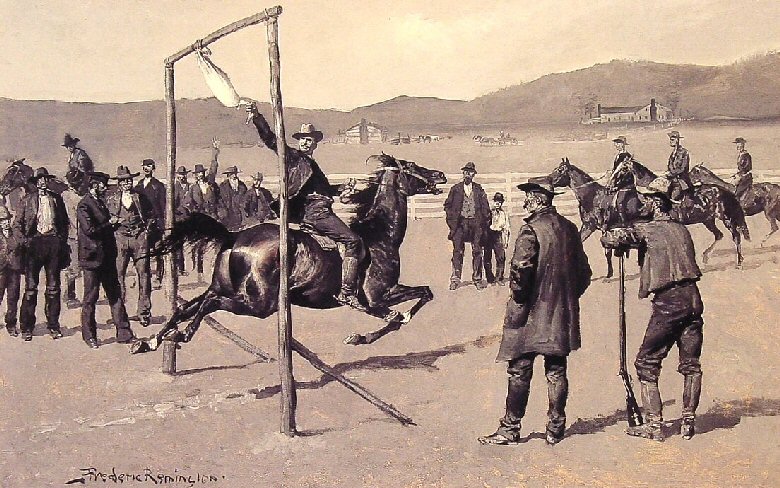
Live goose pulling in 19th-century West Virginia, as depicted by Frederic Remington

Goose pulling (also called gander pulling, goose riding, pulling the goose or goose neck tearing[1]) was a blood sport practiced in parts of the Netherlands, Belgium, England, and North America from the 17th to the 19th centuries. It originated in the 12th century in Spain and was spread around Europe by the Spanish Third. The sport involved fastening a live goose with a well-greased head to a rope or pole that was stretched across a road. A man riding on horseback at a full gallop would attempt to grab the bird by the neck in order to pull the head off.[2] Sometimes a live hare was substituted.[3]

It is still practiced today, using a dead goose or a dummy goose, in parts of Belgium as part of Shrove Tuesday and in some towns in Germany as part of the Shrove Monday celebrations. When practicing with the dead goose, it is killed prior by a veterinarian.[citation needed] In Grevenbicht in the Netherlands, the use of dead geese was prohibited in 2019, being replaced by artificial geese.[4]

It is referred to as ganstrekken in the Netherlands, gansrijden in Belgium and Gänsereiten in Germany.

The practice

[edit]
Laws regarding goose pulling (riding, cutting) around the world.
  Goose pulling discontinued; live goose pulling until 20th century
  Dead goose pulling; live goose pulling banned in 20th century
  Dummy and dead goose pulling; local bans on dead goose pulling in 21st century
  Dummy goose pulling; live goose pulling banned in 20th century, dead goose pulling banned in 2019
  No data

Spain

[edit]

In El Carpio de Tajo goose pulling is practised on every July 25th to celebrate the liberation (Reconquista) from the Arabs in 1141.[5] Later, during the dictatorship of Franco, the use of live geese was prohibited by a new animal protection law. Instead of geese, ribbons tied to sticks were used, which the riders had to insert into metal rings. When democracy returned to Spain, the use of geese was again allowed. It is currently only practiced with dead geese during the Day of the Geese, part of the San Antolín festival in the Basque fishing-town of Lekeitio.[6] Animal rights advocates object that even killing the goose before the practice is cruel and should be criminalised. Those in favour of allowing the practice to continue argue that it is a part of Basque culture, those opposed to the practice feel humaneness should take precedence over tradition.[7]

Netherlands

[edit]

Goose pulling is attested in the Netherlands as early as the start of the 17th century; the poet Gerbrand Adriaensz Bredero referred to it in his 1622 poem Boerengeselschap ("Company of Peasants"), describing how a party of peasants going to a goose-pulling contest near Amsterdam end up in a brutal brawl, leading to the lesson that it is best for townspeople to stay away from peasant pleasures.[8]

Although the use of live geese was banned in the 1920s, the practice still arouses some controversy. In 2008 the Dutch Party for Animals (PvdD) proposed that it should be banned in the last remaining village of Grevenbicht; the organisers, Folk Verein Gawstrèkkers Beeg, rejected the proposal, pointing out that there was no question of cruelty to animals because the geese were already dead.[9] In 2019, dead goose pulling was also prohibited and the practice was henceforth performed with dummy geese.[4]

Belgium

[edit]

Goose pulling in Belgium was done with live geese until the 1920s, when this was prohibited.[10] Since then, geese are first killed painlessly by a veterinarian ahead of the game, and wrapped in a net to conceal its shape to the audience.[10] Belgian goose pulling is accompanied by an elaborate set of customs. The rider who succeeds in pulling off the goose's head is "crowned" as the "king" of the village for one year and given a crown and mantle. At the end of his "king year" the ruling king has to treat his village "subjects" to a feast of beer, drinks, cigars and bread pudding or sausages held either at his home or at a local pub. Each year the village kings of the region compete with each other to become the "emperor".[10] Children participate as well; in 2008, the children's goose pulling tournament in Lillo near Antwerp was won by a 14-year-old who won 390 euros and a trip to the Plopsaland theme park.[11]

France

[edit]
Ancestral tradition of the game called Le cou de l'oie (goose neck) in a Manzat street (Auvergne, France).

Goose pulling was practiced in Manzat in the Auvergne until at least the 1970s.[12][13] It is still practice in Saint-Bonnet-près-Riom (Auvergne)[14] and in pays basque.[15] (See the French page: jeu de l'oie)

Germany

[edit]
Dead goose pulling in Germany (2010)

In Wattenscheid-Höntrop it is believed that the custom was brought by Spanish soldiers who were stationed in 1598 and 1599 during the Eighty Years' War and later in the Thirty Years' War.[16] In May 2017, a petition signed by 100,000 citizens to stop using dead geese prompted the two goose-riding clubs from Höntrop and Sevinghausen to hold future events with a rubber dummy goose.[17]

The Velbert village of Langenhorst still practices with dead geese. In some other places of Germany it was forbidden. Goose pulling was banned in Werl in 1961. In Dortmund and Essen dummy geese are used.[18]

Switzerland

[edit]

Gansabhauet ('goose cutting') is held every 11 November (Saint Martin's Day) in Sursee. A dead goose is suspended in the middle of the town square, whose neck the competitors, one after the other, try to cut with a saber.[19]

United Kingdom

[edit]

The sport appears to have been relatively uncommon in Britain, as all references are to it as a curiosity practised somewhere else. The 1771 Philip Parsons locates it in "Northern parts of England" and assumes it is unknown in Newmarket in East Anglia. Parsons described how it was carried out in England:

In the Northern parts of England it is no unusual diversion, to tie a rope across a street, and let it swing about the distance of ten yards from the ground. To the middle of this a living cock is tied by the legs. As he swings in the air, a set of young people ride one after another, full speed, under the rope, and rising in the stirrups, catch at the animal's head, which is close clipped and well soaped, in order to elude the grasp. Now he who is able to keep his seat in his saddle, and his hold of the bird's head, so as to carry it off in his hand, bears away the palm, and becomes the noble hero of the day.[20]

In a satirical letter to Punch in 1845 it is regarded as a practice known only to the Spaniards, like bull-fighting.[21]

The serious work Observations on the popular antiquities of Great Britain, of 1849, calls it "Goose-riding" and says it has been "practiced in Derbyshire within the memory of persons now living", and that the antiquary Francis Douce (1757–1834) had a friend who remembered it "when young" in Edinburgh in Scotland.[22]

From these references it would appear to have died out in Britain by the end of the 18th century.

United States

[edit]

The Dutch settlers of North America brought it to their colony of New Netherland and from there it was transmitted to English-speaking Americans. Goose-pulling was taken up by those at the lower levels in American society,[3] though it could attract the interest of all social strata. In the pre-Civil War South, slaves and whites competed alongside each other in goose-pulling contests watched by "all who walk in the fashionable circles."[23] Charles Grandison Parsons described the course of one such contest held in Milledgeville, Georgia, in the 1850s:

At the appointed time, rude whisky tents, and festive seats, and shades, were prepared around the "pulling course;" and thousands of spectators – ladies as well as gentlemen, the elite as well as the vulgar – assembled to engage in or witness the favorite sport...

Tickets were issued by the proprietor of the gander, at fifty cents each, to all gentlemen present who wished for them, and they entered their names as "pullers". The pullers were to start about ten rods [about 50 m / 165 ft] from the gander, on horseback, riding at full speed, and as they passed along under the gander, they had the privilege of pulling off his head – which would entitle them to the additional privilege of eating him...

One entered the list – a "gentleman of property and standing" – and dashed over the course. The poor gander – seeming quite resigned to his fate, or not comprehending his danger, and not knowing how to "dodge" – had his neck seized by the first rider; but being well oiled, and his head so small, and his strength not yet exhausted, he slipped his head through the puller's hand without suffering much from the twist... After this he kept a sharp look out, and many pullers passed by without being able to grapple his neck. The game went on, and the pullers increased, till the jaded gander could elude their grasp no longer. An old Cracker – with a sandpaper glove on – pulled off his head at last, amid the shouts of a wondering host of intoxicated competitors.[23]

The prizes of a goose-pulling contest were trivial – often the dead bird itself, other times contributions from the audience or rounds of drinks. The main draw of such contests for the spectators was the betting on the competitors, sometimes for money or more often for alcoholic drinks.[3] One contemporary observer commented that "the whoopin', and hollerin', and screamin', and bettin', and excitement, beats all; there ain't hardly no sport equal to it."[24] Goose-pulling contests were often held on Shrove Tuesday and Easter Monday, with competitors "engaged in this sport not just for its excitement but also to prove they were "real men," physically strong, brave, competitive and willing to take risks."[25]

Unlike some other contemporary blood sports, goose pulling was often frowned upon. In New Amsterdam (modern New York) in 1656, Director General Pieter Stuyvesant issued ordinances against goose pulling, calling it "unprofitable, heathenish and pernicious."[2] Many contemporary writers professed disgust at the sport; an anonymous reviewer in the Southern Literary Messenger, writing in 1836, described goose pulling as "a piece of unprincipled barbarity not infrequently practised in the South and West."[26] William Gilmore Simms described it as "one of those sports which a cunning devil has contrived to gratify a human beast. It appeals to his skill, his agility, and strength; and is therefore in some degree grateful to his pride; but, as it exercises these qualities at the expense of his humanity, it is only a medium by which his better qualities are employed as agents for his worser nature."[27]

The sport was challenging, as the oiling of the goose's neck made it difficult to retain a grip on it, and the bird's flailing made it difficult to target in the first place. Sometimes the organisers would add an extra element of difficulty; one writer describing an event in the American South witnessed "a [man], with a long whip in hand ... stationed on a stump, about two rods [10 m / 32 ft] from the gander, with orders to strike the horse of the puller as he passed by."[28] The reaction of the startled horse would make it even more difficult for the puller to grab the goose as he went by. Many riders missed altogether; others broke the goose's neck without snapping off the head.[29] The American poet and novelist William Gilmore Simms wrote that

It is only the experienced horseman, and the experienced sportsman, who can possibly succeed in the endeavor. Young beginners, who look on the achievement as rather easy, are constantly baffled; many find it impossible to keep the track; many lose the saddle, and even where they succeed in passing beneath the saplings without disaster, they either fail altogether in grasping the goose, which keeps a constant fluttering and screaming; or, they find it impossible to retain their grasp, at full speed, upon the greasy and eel-like neck and head which they have seized.[27]

Goose-pulling largely died out in the United States after the Civil War, though it was still occasionally practised in parts of the South as late as the 1870s; a local newspaper in Osceola, Arkansas, reported of an 1870s picnic that "after eats, gander-pulling was engaged in. Mr. W.P. Hale succeeded in pulling in twain the gander's breathing apparatus, after which dancing was resumed."[30]

A variant called "rooster pulling" has survived in New Mexico for some time. A rooster was buried in the sand up to its neck, and riders would try to pull it up as they rode past. This was later done with bottles buried in the sand. "Rooster racing in the Hispanic villages of northern New Mexico exists only in the history books and in the minds of a few men and women who ... still recall the popular sport of yesteryear".[31]

Footnotes

[edit]

Further reading

[edit]
[edit]
Revisions and contributorsEdit on WikipediaRead on Wikipedia
from Grokipedia

Goose pulling, also known as gander pulling or goose riding, is a historical blood sport originating in medieval Europe, particularly the Netherlands and surrounding regions, in which participants mounted on horseback attempt to decapitate a live goose suspended upside down by its feet with a heavily greased neck while galloping past at speed. The objective is for the rider to grasp and yank the bird's head free in a single motion, with success often requiring multiple attempts amid the slippery challenge and the goose's struggles; the victor claims the carcass as a prize.
The practice dates back to at least the and was imported to by Dutch settlers in (present-day New York) as early as 1654, where it became a festive event tied to holidays like or , drawing crowds for its spectacle of strength and equestrian skill. It spread to English colonies and persisted in areas like the American South into the , often featured in rural celebrations despite intermittent official prohibitions, such as those issued by colonial authorities concerned with public order rather than . Variants existed across , , and under names like gänsereiten or cou d'oie, emphasizing the rider's grip and momentum to overcome the grease and avian resistance. By the late 19th and early 20th centuries, goose pulling declined amid rising sentiments, leading to legal bans in many jurisdictions for its inherent cruelty, though isolated modern adaptations using dead or artificial geese have surfaced in traditionalist communities, reigniting debates over cultural preservation versus ethical standards. The 's legacy endures in artistic representations, such as Frederic Remington's 1902 painting A Gander Pull, which captures its raw physicality and context.

History

Origins in medieval Spain

Goose pulling, known in Spanish contexts as carreras de gansos or descuello de ganso, is commonly attributed to emerging in medieval around the , potentially as a form of equestrian amusement or training simulating battlefield grasps amid the era's knightly culture. However, no primary archival records or contemporary chronicles substantiate practices during this period, with claims of such antiquity largely anecdotal and propagated through secondary accounts lacking empirical backing. The earliest documented evidence in Spain appears in the early modern period, specifically 1631, when records first confirm the Antzar Eguna (Day of the Geese) in Lekeitio, Basque Country, as part of the San Antolín festivities on September 5. In this variant, a greased goose is suspended over the harbor, and competing teams in boats vie to decapitate it by hand, symbolizing a ritual sacrifice for bountiful fishing yields or communal strength—a tradition evolving from maritime folk customs rather than documented medieval rites. Similarly, in El Carpio de Tajo, Toledo, annual horse-mounted goose decapitations occur on July 25, tied to the feast of Santiago Apóstol and purportedly commemorating a 1141 Christian victory over Muslim forces during the . Despite the historical linkage, the event's formalization as a recurring spectacle aligns more closely with 16th- or 17th-century fiesta traditions, possibly influenced by the spread of Tercios soldiers who exported similar games across Europe. These Spanish iterations highlight regional adaptations emphasizing religious patronage and local lore over verified medieval precedents.

Spread across Europe and to the Americas

From its medieval origins in , goose pulling disseminated across Europe through cultural diffusion, military interactions, and festive traditions during the early modern period. By the 17th century, the practice had reached , where it was known as cou d'oie and described by Cardinal de Retz in his memoirs of civil wars (1648–1653) as a popular Parisian spectacle involving riders attempting to decapitate a greased-neck goose suspended from a pole. In the , it became embedded in customs, termed gans trekken in the and gansrijden in , often held as communal events testing equestrian skill and strength into the . German-speaking regions adapted it as Gänsereiten, a variant featuring horseback riders clubbing or pulling at live geese, which persisted in rural festivals despite periodic official disapproval. Colonists transported the sport to the Americas, with Dutch settlers introducing it to (modern New York) by the mid-17th century; in 1656, Director-General issued an ordinance condemning goose pulling as "unprofitable, heathenish, and extremely detrimental to the public good," reflecting early regulatory pushback amid its recreational appeal. English and other European migrants popularized gander pulling in during the colonial era, where it served as a tavern-based diversion emphasizing manhood and horsemanship, with a tough, greased gander suspended for riders to seize and behead. In , it was tied to Easter gatherings, while in , it thrived antebellum as a reinforcing social bonds among planters and frontiersmen. The activity extended westward into frontier regions, such as Georgia, where Augustus Baldwin Longstreet documented a match in his 1835 Georgia Scenes, portraying it as a rowdy test of agility amid cheering crowds.

Decline in the 19th and 20th centuries

In , goose pulling, introduced by Dutch settlers in the , experienced a sharp decline after the ended in 1865, with the practice largely vanishing from northern regions while lingering sporadically in the South during the 1870s. This downturn aligned with broader , which reduced open spaces for such events, and growing public unease over the sport's inherent cruelty and the associated rowdiness of crowds, which often led to injuries and public disorder. By the late , the activity had faded from mainstream colonial and early American festivities, supplanted by less violent entertainments amid rising humanitarian sentiments that targeted blood sports generally. In , particularly the Netherlands, , and parts of where the sport had deep roots, decline was more gradual but accelerated in the early due to organized animal welfare campaigns. The use of live geese, central to the traditional mechanics, was banned across several countries in the , effectively curtailing the authentic form of the practice and forcing adaptations with dead or dummy birds. Legal prohibitions reflected a confluence of factors, including evolving ethical views on animal suffering—evident in contemporaneous suppressions of cockfighting and —and practical enforcement against events that drew unregulated, boisterous gatherings. By the mid-20th century, goose pulling in its original live-animal variant had been eradicated in most former strongholds, persisting only in sanitized, non-lethal variants in isolated rural communities, such as certain Belgian festivals. This trajectory mirrored the fate of other pre-industrial blood sports, driven not merely by moralistic reforms but by causal shifts in , legal frameworks prioritizing public order, and empirical recognition of the unnecessary brutality involved, as documented in period accounts of event disruptions and veterinary critiques.

Mechanics of the practice

Core rules and setup

![Frederic Remington's depiction of gander pulling]float-right Goose pulling, also known as gander pulling, involved suspending a live by its feet from a pole, , or stretched across a or path, typically at a height accessible to a mounted rider. The bird's neck was thoroughly greased with or similar to increase the difficulty of grasping and tearing it. This setup was common in and from the 17th to 19th centuries, often as part of festive or communal events. Participants, usually men on horseback, would gallop at full speed beneath the suspended , reaching out to seize its head or neck in an attempt to wrench it free from the body. Multiple riders typically took sequential turns, with the event continuing until the head was successfully removed, at which point the successful puller was declared the winner and often celebrated as a . The use of a tough, older gander (male ) was preferred to withstand initial failed attempts. No formal scoring beyond decapitation existed in the core practice; success depended on the rider's speed, grip strength, and timing amid the goose's struggles. The sport required horsemanship skills, as the gallop demanded precise control to align with the swinging bird. Alcohol consumption among participants was frequent, contributing to the chaotic and perilous nature of the event.

Variants by mode of participation

The predominant mode of participation in goose pulling involved equestrians riding at full gallop beneath a suspended goose to wrench its head free, a practice documented across Europe and early North America from the 17th to 19th centuries. The rider's success hinged on equine speed, personal grip strength, and overcoming the grease applied to the bird's neck, with the goose often alive and flapping to heighten difficulty. This format emphasized velocity and momentum, distinguishing it from static or slower engagements, and persisted in modified forms using deceased geese during Shrove Tuesday events in regions like the Netherlands (ganstrekken), Belgium (gansrijden), and Germany (gänsereiten). Pedestrian variants, though less prevalent, occurred in certain locales where participants ran or advanced on foot to grasp and decapitate the , often requiring multiple attempts due to the absence of horseback . These were reportedly banned earlier in some areas for perceived inefficiency or lesser spectacle compared to mounted versions, reflecting regulatory preferences for the more dynamic equestrian style. Regional adaptations further diversified participation, as in Spain's Basque Country where the seaside antzar jokoa entailed competitors leaping from boats into water to seize a hung over a harbor, blending manual dexterity with aquatic approach rather than terrestrial speed. Inland Basque iterations approximated land-based pulling but retained the emphasis on direct bodily engagement without mounts. Such modifications underscored local environmental influences on the sport's execution while preserving the core objective of dismemberment.

Equipment and preparation of the goose

The primary for goose pulling centered on a sturdy pole or stretched taut across a roadway or open path, typically at a height of approximately 10 to 12 feet to allow mounted participants to reach the suspended . The itself, often a mature gander selected for its toughness and resistance to , was the core element, with historical accounts favoring older males whose sinewy necks prolonged the challenge. Preparation of the goose involved suspending it alive by its feet or heels from the crossbar, ensuring the head dangled freely for grasping. The neck and head were liberally coated with grease or oil—commonly or —to render the surface slippery, thereby increasing difficulty and requiring precise technique from riders or runners. This lubrication not only heightened the sport's competitive element but also minimized immediate injury to the bird until the fatal pull, as evidenced in 17th- and 18th-century European and colonial American practices. In some variants, multiple geese were prepared sequentially along the course to sustain the event, with the setup reinforced by stakes or supports to withstand repeated impacts from galloping horses. The goose was not stunned or altered beyond greasing, preserving its reflexive struggles which added to the peril for participants. Historical records from Dutch and English traditions confirm that no specialized tools beyond the suspension apparatus were used for the bird itself, emphasizing raw physical contest over mechanical aids.

Regional variations

Practices in the Netherlands and Belgium

In the and , goose pulling—known locally as ganstrekken or gansrijden—persists as a folk tradition primarily during (Vastelaovend in Limburg dialect), concentrated in the border-straddling Limburg region. Participants, typically men on horseback, compete to decapitate a goose suspended by its feet from a wooden frame or pole, with the event emphasizing speed, , and horsemanship. The goose is humanely euthanized by a prior to the event, then prepared by greasing its neck with soap or oil to increase difficulty, diverging from historical uses of live birds to align with modern standards. The most prominent Dutch example occurs annually in , organized by the Folkloristische Vereiniging Gawstrèkkers Beeg, on (carnavalsdinsdag) at precisely 15:11 on the Burgemeester Kotenplein. Riders charge at full gallop, seizing the goose's neck in one hand to wrench it free; success crowns the victor as "Goose King" (Gansjekning), followed by a communal feast. This horseback variant traces to medieval customs but has been modified since the , with live geese phased out in by the early 1900s and similar adaptations in the to avoid legal challenges under animal cruelty statutes. In , parallel events unfold across multiple Walloon and Flemish locales during , often at over a festivals, where the core mechanics mirror the Dutch form but may incorporate regional twists like strikes in some towns. These gatherings reinforce bonds, with the dead goose's use justified by organizers as a humane preserving cultural heritage against welfare critiques.

Spanish and French traditions

In Spain, goose pulling manifests prominently in the Basque Country town of Lekeitio through the annual Antzar Eguna, or Day of the Geese, integrated into the San Antolín festival celebrations on September 5. This event, with origins tracing back over 300 years, involves participants—typically young men in traditional blue nankeen shirts and gingham neckerchiefs—boarding boats in the harbor to grasp a greased, suspended dead goose (or rubber replica) by the neck. Ropes attached to the goose are rhythmically pulled by groups onshore, hoisting contestants airborne before they plunge into the water, with success measured by detaching the head. The practice, formalized in the festival since 1877, evolved from likely pre-modern rituals possibly linked to seafaring sacrifices for bountiful catches, though live geese have been replaced by deceased ones in contemporary iterations to mitigate cruelty concerns. French traditions of goose pulling, termed jeu du cou de l'oie or "goose neck game," persist in rural villages during patronal festivals, featuring variants of decapitation using suspended dead poultry. In places like Saint-Bonnet-près-Riom in Puy-de-Dôme, participants pull heads from dangling oies, ducks, or rabbits, a custom documented as early as the 17th century when Cardinal de Retz described similar urban games in Paris amid the Fronde upheavals. Other locales, such as Lesmont in Aube, employ sabers for blindfolded strikes on inverted geese, a method practiced annually until local votes or prefectural bans curtailed it in 2025. Despite animal welfare challenges leading to prohibitions in sites like Arfeuilles in Allier that same year, defenders invoke cultural continuity from medieval folk sports, where the act tested dexterity amid communal revelry. These events underscore a shift from live-animal use to cadavers, reflecting regulatory pressures while preserving ritual elements.

German and Swiss adaptations

In Germany, Gänsereiten involves riders on horseback attempting to detach the head of a dead goose suspended by its feet from a crossbar, typically during Carnival festivities in North Rhine-Westphalia locales such as Bochum-Wattenscheid and Recklinghausen. The custom, documented as early as 1534 in Recklinghausen, originated from influences of Spanish soldiers during the 16th-century wars, evolving from live to dead geese by the early 20th century to mitigate animal suffering while preserving the greased-neck challenge for grip. Modern iterations emphasize cultural continuity, with clubs like those in Wattenscheid maintaining the event annually since at least the 17th century, though facing protests from animal welfare groups since the 1990s. In , the Gansabhauet adaptation in , canton, diverges by featuring stationary sabre decapitation of two dead geese hung by the neck from a wire on a town hall stage, held each November 11 on . First recorded in historical accounts predating 1880—when children's accompanying games were formalized—this medieval-derived rite uses pre-killed birds to comply with welfare standards, with the winner claiming the carcass. Recognized as , Sursee's event remains the sole surviving instance of similar goose contests once widespread in , prioritizing precision strikes over mounted pulling.

Anglo-American forms

Goose pulling, known locally as gander pulling in American contexts, was practiced in as a involving the suspension of a live for participants to decapitate, though it waned earlier than in . In Britain, the game typically featured riders attempting to grasp and pull the head from a greased-necked hung from a pole or branch, testing equestrian skill and amid festive gatherings. In colonial America, the practice arrived via Dutch settlers in by the early 17th century, evolving into a widespread amusement particularly around in Southern states like and . Gander pulling emphasized manly virtues of daring and horsemanship during the colonial and antebellum eras, with events drawing crowds to rural fairs and holidays. A tough, mature gander was selected, its neck liberally coated in grease or oil, then hoisted by the feet from a crossbar or tree limb at a height allowing mounted riders to charge beneath and wrench the head free in one swift motion. American variants often occurred on horseback at full gallop, heightening the challenge and spectacle, as riders competed for bragging rights or small prizes like the bird itself if successfully decapitated. The sport persisted into the in Western territories, as illustrated in Frederic Remington's 1902 painting A Gander-Pull, which captures engaging in the pursuit amid open plains. While sharing core mechanics with European forms, Anglo-American iterations integrated local colonial traditions, such as tying events to religious holidays, and reflected a cultural valorization of raw physical prowess in agrarian societies.

Cultural and social context

Role in festivals and community events

Goose pulling features prominently in traditional European festivals, acting as a communal that unites participants and spectators in celebrating local heritage. In , the practice occurs at over a dozen annual events tied to or seasons, where competitors on horseback or bicycles attempt to decapitate a suspended goose, drawing crowds to villages for this ritualistic competition. In the , gansrijden persists in locales like during festivities, serving as a highlight of pre-Lenten merriment and reinforcing social bonds through competitive displays of skill. Similarly, in Germany's region, such as Sevinghausen, Gänsereiten integrates into parades and folk gatherings organized by local clubs, where riders vie for the goose in events documented as early as 2010. Spain's Basque Country exemplifies the event's festive role in Lekeitio's San Antolín celebrations on , known as Antzar Eguna or Goose Day, where teams leap from a 10-meter harbor wall to seize greased geese dangled from a crane, culminating in community feasts and attracting thousands annually. These gatherings historically awarded winners prizes like or , emphasizing the practice's function in fostering camaraderie and seasonal rites amid evolving concerns.

Perceived skills tested and entertainment value

In goose pulling, participants were perceived to demonstrate horsemanship by maintaining control of a galloping horse while precisely timing a reach to grasp the suspended goose's neck, a feat requiring balance and speed management under momentum. This skill was emphasized in historical variants across and , where riders competed in sequences until the head was detached, rewarding those with superior equestrian command. The game also tested dexterity and , as the goose's head was liberally greased with substances like or to increase difficulty, demanding quick reflexes and forceful pulling to overcome the slipperiness and the bird's resistance. Accounts from colonial America and the highlight how failure often resulted from inadequate hand-eye coordination or insufficient power, positioning success as a mark of physical prowess. in leaning or extending from the saddle without losing seat further underscored the perceptual emphasis on coordinated athleticism. Entertainment value derived from the spectacle of high-stakes , where crowds gathered for the thrill of repeated attempts, for victors, and the visceral drama of partial successes or failures, often amid festivals. Historical records from 17th- to 19th-century and Anglo-American regions portray it as a communal akin to other rough pastimes, appealing through its raw display of human versus animal despite ethical critiques even then. The winner typically received the as a , enhancing the event's allure as both sport and provisioning ritual, though modern retrospectives note its barbarity overshadowed any purported skill showcase.

Comparisons to other historical blood sports

Goose pulling, like and , involved tethering a live animal for violent human or canine assault, prioritizing public spectacle and the victim's prolonged suffering over mutual combat. In , prevalent in from the 16th to 19th centuries, packs of mastiffs attacked a chained in an , often drawing crowds of thousands including royalty; similarly, the goose was suspended by its feet across a road or pole, enduring repeated grasps and pulls until decapitated, with the event's brutality amplified by the bird's defensive struggles. Both practices tested participants' prowess—equestrian timing in goose pulling versus dogs' tenacity in baiting—while fostering and communal revelry, though baiting emphasized canine breeding for ferocity whereas goose pulling relied on rider speed and . Comparisons to cockfighting and dogfighting highlight contrasts in agency: those inter-animal contests, documented across since antiquity and peaking in the 18th-19th centuries, pitted bred fighters like gamecocks or terriers in pits until one succumbed, rewarding for and endurance rather than human intervention. Goose pulling diverged by centering human dexterity, with riders galloping at full speed to wrench the greased goose's head, often requiring multiple passes and resulting in near-certain avian fatality, akin to the guaranteed bloodshed in fights but without the animals' volitional clash. Historical accounts note cockfighting's Roman origins and Elizabethan popularity, paralleling goose pulling's medieval roots in the , yet both faced parallel ethical critiques by the 1800s for wanton cruelty, leading to bans under emerging laws like England's 1835 Cruelty to Animals Act. Fox-tossing offers a closer analog in gratuitous torment, as 17th-18th century German and Dutch enthusiasts released foxes or hares for teams to hurl skyward using slings, only for pursuing to maul them mid-air, mirroring goose pulling's festive, aristocratic appeal and emphasis on coordinated violence for diversion. Unlike the baiting variants' arena confinement, both tossing and pulling incorporated open-field dynamics and timing, underscoring shared cultural roles in pre-Lenten catharsis, though fox-tossing's higher lethality rate—up to 500 animals per event—exceeded typical goose pulls limited to one bird. Across these sports, empirical patterns reveal a decline tied to and , with survivals in rural pockets contrasting outright eradications elsewhere by the early .

Controversies and debates

Animal welfare arguments against the practice

The practice of goose pulling has drawn criticism from animal welfare advocates for subjecting the bird to acute physical trauma and psychological distress. A live goose is inverted and suspended by its feet from a pole or frame, inducing stress from prolonged restraint and blood rushing to the head, which can lead to disorientation and as evidenced in descriptions of the bird struggling violently during events. Riders then grasp and yank the greased neck in an attempt to detach the head, often requiring multiple passes if unsuccessful, resulting in lacerations, muscle tears, and partial that extend suffering rather than ensuring instantaneous death. From a biological standpoint, geese possess nociceptors and neural pathways capable of registering , similar to other vertebrates, and manual neck traction lacks the precision of approved euthanasia methods like with immediate severance, which requires specific force application to disrupt the promptly. In contrast, the sport's haphazard pulling—dependent on rider speed, grip, and goose resistance—frequently fails to achieve rapid unconsciousness, as the bird's robust neck resists clean separation, causing asphyxiation or over seconds to minutes. The American Veterinary Medical Association's euthanasia guidelines emphasize that killing methods must minimize detectable or distress, a criterion unmet by this recreational , which prioritizes competition over animal insensibility. Opponents, including the Dutch Party for the Animals and other groups, argue the event normalizes gratuitous violence against sentient animals for , contravening ethical principles that deem unnecessary harm unjustifiable regardless of cultural precedent. Greasing the neck with substances like or adds potential chemical irritation to already traumatized tissues, exacerbating discomfort without serving any non-recreational purpose. These concerns contributed to bans on live goose pulling in regions such as the by the early 20th century and by the 1850s, reflecting a consensus that the practice's welfare deficits outweigh purported traditional value.

Cultural heritage defenses and traditionalist perspectives

Advocates for preserving goose pulling variants highlight their embeddedness in regional cultural identities and historical festivities, arguing that discontinuation would sever ties to ancestral practices without commensurate benefits. In the Netherlands and Belgium, trekpaard trekken integrates with demonstrations of the Belgian Brabant draft horse, officially recognized as intangible cultural heritage since efforts in the 1970s and 1980s to sustain the breed and traditional handling skills. Participants and organizers maintain that these events promote equine preservation, community cohesion, and rural skills amid urbanization, adapting to use deceased or artificial geese where live variants face restrictions. In , Gänsereiten endures in areas like Bochum-Wattenscheid as a or bachelor competition, valued for testing agility and horsemanship in a ritualistic context dating to , with defenders viewing it as emblematic of local customs resistant to external ethical interventions. Traditionalists contend that such survivals counteract the erosion of folk traditions by modern regulatory frameworks, emphasizing empirical continuity over abstract welfare ideals, as evidenced by ongoing festivals despite petitions for abolition. French iterations, such as cou d'oie in villages like Arfeuilles and Saint-Bonnet-près-Orcival, are defended by residents as integral to Assumption Day patronal feasts, with revivals in 2023 and 2025 underscoring commitment to heritage amid animal rights opposition; locals assert that using pre-killed birds renders the practice symbolically benign while honoring centuries-old communal rites. These perspectives prioritize causal links between tradition and social fabric—fostering intergenerational transmission and regional pride—over uniform prohibitions, critiquing activist-driven bans as dismissive of context-specific historical norms.

Broader ethical questions on historical norms vs. modern standards

The persistence of goose pulling into the illustrates a historical ethical where intentional harm in recreational contexts was normalized, often justified by communal bonding and displays of prowess rather than deliberate deliberation. In pre-modern and colonial America, such blood sports aligned with anthropocentric frameworks that prioritized utility and spectacle, viewing animals primarily as resources with negligible intrinsic standing. This norm persisted amid broader acceptance of practices like cockfighting and , where societal consensus deemed the entertainment value sufficient to outweigh observable suffering, absent systematic veterinary or neurobiological insights into . Modern ethical standards, shaped by 20th-century advancements in animal ethology—demonstrating geese's nociceptors and stress responses akin to higher vertebrates—reframe these acts as gratuitous cruelty, incompatible with principles of minimizing unnecessary sentience-based harm. Philosophers such as argued against animal cruelty not for the animals' sake but to prevent human moral desensitization, a rationale echoed in contemporary welfarist critiques that link blood sports to broader societal risks of violence normalization. Utilitarians like extend this by rejecting , contending that an animal's capacity for suffering demands equivalent ethical weight to human equivalents, rendering historical tolerances ethically deficient under informed scrutiny. Debates persist on whether modern prohibitions constitute ethical progress or anachronistic imposition, with relativists cautioning against presentism that erodes without accounting for historical scarcities of alternatives. For instance, analyses of analogous traditions like posit 's value as conditional, meriting preservation only if it aligns with evolving empirical understandings of welfare rather than sentimental absolutism. Truth-seeking favors the latter: causal from behavioral studies confirms acute distress in restrained geese during pulling, unmitigated by cultural excuses, while historical norms reflected informational gaps rather than defensible reasoning. Defenders invoking often overlook that many such practices declined organically with and mechanized , suggesting modern standards reflect genuine refinement over arbitrary fiat.

Historical and current bans by region

In Europe, prohibitions on live goose pulling emerged in the early 20th century, with the practice of using live animals banned around the 1920s in countries such as the Netherlands, Belgium, and Germany due to growing concerns over animal cruelty. Earlier historical restrictions date to at least 1656, when an ordinance denounced the activity as "unprofitable, heathenish and pernicious," likely in colonial contexts influenced by European settlers. Today, live variants remain strictly prohibited across the European Union under broader animal welfare regulations, though adaptations using dead or dummy geese persist in localized festivals in the Netherlands (known as ganstrekken), Belgium (gansrijden), and certain German towns (Gänsereiten). In 2008, the Dutch Party for Animals proposed extending bans to dead goose versions, but the motion failed amid defenses of cultural tradition. In , goose pulling—introduced by Dutch settlers to (now New York) and practiced in southern states like and through the 19th century—largely ceased after the , with no formal nationwide ban but effective prohibition under state-level animal cruelty laws enacted progressively from the late 19th to early 20th centuries. These statutes, such as those criminalizing intentional harm to animals, render any revival with live or distressed geese illegal in all U.S. states, though no recent prosecutions tied specifically to the sport are documented. Elsewhere, the practice has been discontinued without notable modern revivals or specific regional bans documented outside its historical European and North American strongholds, aligning with international trends toward animal protection standards.

Adaptations with dead or artificial geese

In response to animal welfare criticisms, practitioners in regions including Belgium, the Netherlands, and Germany have substituted live geese with deceased ones, which are humanely euthanized by a veterinarian prior to the event. The dead bird's neck is greased and suspended from a pole or rope, allowing riders on horseback to grasp and attempt to decapitate it during festivals such as Shrove Tuesday celebrations, thereby retaining the traditional mechanics while avoiding prolonged suffering to a live animal. This modification has enabled the sport's persistence in areas where live goose pulling was banned in the 20th century, with the deceased goose providing a stationary target that simplifies gripping compared to a struggling live bird. Further adaptations have emerged following prohibitions on dead geese. In , , the longstanding use of deceased birds—practiced for many years as a compromise—was outlawed in 2019, prompting a shift to artificial geese constructed from synthetic materials. These dummy versions mimic the appearance and weight of a real , with a greased designed to be pulled, preserving the communal and skillful elements of the event amid evolving legal standards. Similar substitutions occur in select European locales, such as certain Basque Country festivals, where custom plastic geese replace biological ones entirely, ensuring the tradition's continuity without any avian involvement. Proponents argue these changes balance with contemporary ethics, though critics maintain that even non-living adaptations glorify violence inherent to the sport's origins.

Persistence and revivals in isolated areas

Despite widespread bans and ethical scrutiny, goose pulling endures in modified forms within select rural and culturally distinct European communities, often adapting to use deceased or artificial geese to evade prohibitions on live animal harm. These isolated locales, shielded by longstanding traditions and limited external influence, maintain the practice as a communal rite tied to local identity and seasonal festivities. In the , the small village of in Limburg province hosts the Gawstrekke annually on , positioning it as the country's sole remaining venue for the event, where participants on foot or horseback vie to decapitate a greased suspended overhead. This persistence reflects adaptation, with the goose typically pre-killed humanely by a prior to the contest. Germany's rural northern regions, particularly in and surrounding areas, sustain Gänsereiten during autumn or periods in various towns, employing dead geese to align with contemporary animal protection statutes while upholding the horseback-pulling format. Events documented as recently as underscore the tradition's vitality in these agrarian pockets, where community cohesion outweighs urban-driven reforms. In Spain's Basque coastal town of , the Antzar Eguna on September 5 integrates a nautical variant during the San Antolín festival, with rowers attempting to sever a goose's neck from boats; recent iterations from 2023 onward have shifted to mechanical or deceased substitutes amid welfare debates, yet the spectacle draws crowds affirming its cultural entrenchment in this peripheral maritime enclave. France preserves echoes in rural settings, such as the goose-neck game in Saint-Bonnet-près-Riom, , where 2023 footage revealed participants manipulating pre-deceased geese, illustrating revival through sanitized means in villages insulated from metropolitan oversight. Similar Basque-influenced events in northern French communes like Sara further exemplify localized tenacity against national animal rights campaigns. These instances highlight not outright revivals from but adaptive continuations in geographically and socially peripheral areas, where empirical resistance to homogenization preserves pre-modern , though sourced reports from groups warrant caution regarding potential in depictions of ongoing practices.

References

Add your contribution
Related Hubs
Contribute something
User Avatar
No comments yet.