Hubbry Logo
VelbertVelbertMain
Open search
Velbert
Community hub
Velbert
logo
8 pages, 0 posts
0 subscribers
Be the first to start a discussion here.
Velbert
Velbert
from Wikipedia

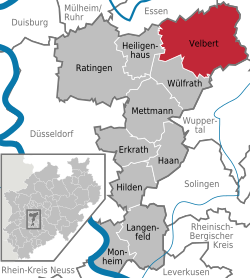
Velbert (German pronunciation: [ˈfɛlbɐt] , Low Rhenish: Vèlbed) is a town in the district of Mettmann, in the German state of North Rhine-Westphalia. The town is renowned worldwide for the production of locks and fittings.

Key Information

Geography

[edit]

Velbert is located on the hills of 'Niederberg' (meaning Lower Mountain), part of the Berg region, approx. 20 kilometres north-east of the capital of North Rhine-Westphalia, Düsseldorf, and 12 kilometers north-west of Wuppertal on the south side of the Ruhr river.

Velbert stands on the highest part of the Niederberg region and also in its centre. Its average elevation is around 230 metres above sea level; its highest point, at 303 metres, is the Hordt-Berg, and its lowest, at around 70.6 metres, is in Nierenhof am Deilbach. The highest point in Velbert itself is 263 metres above sea level, at the corner of Friedrichstraße and Langenberger Straße.

Incorporation

[edit]

As part of the reform of local government districts in North Rhine-Westphalia that came into effect on 1 January 1975, the formerly independent cities of Velbert, Neviges and Langenberg were merged to form the present city of Velbert.

History

[edit]

Velbert was first mentioned in AD 875 as Feldbrahti and was ruled by the abbey at Werden.

Administration

[edit]

Velbert is divided into three administrative areas, reflecting the three former cities: Velbert-Mitte (Central Velbert), Neviges and Langenberg. There are also numerous suburbs, including Tönisheide, Losenburg, Nordpark, Langenhorst, Birth, Röttgen and Hefel.

Politics

[edit]

The current mayor of Velbert has been Dirk Lukrafka of the Christian Democratic Union (CDU) since 2014. The most recent mayoral election was held on 13 September 2020, with a runoff held on 27 September, and the results were as follows:

Candidate Party First round Second round
Votes % Votes %
Dirk Lukrafka Christian Democratic Union 12,730 40.9 12,352 50.4
Esther Kanschat Alliance 90/The Greens 6,686 21.5 12,132 49.6
Rainer Hübinger Social Democratic Party 5,148 16.5
August-Friedrich Tonscheid Velbert Differently 1,915 6.2
Cem Demircan Independent Velbert Citizens 1,862 6.0
Helmut Stiegelmeier Pirate Party Germany 1,262 4.1
Birgit Onori The Left 1,009 3.2
Marcel Stubbe Independent 521 1.7
Valid votes 31,133 98.3 24,484 99.4
Invalid votes 540 1.7 137 0.6
Total 31,673 100.0 24,621 100.0
Electorate/voter turnout 65,876 48.1 65,837 37.4
Source: City of Velbert (1st round, 2nd round)

City council

[edit]
Results of the 2020 city council election.

The Velbert city council governs the city alongside the Mayor. The most recent city council election was held on 13 September 2020, and the results were as follows:

Party Votes % +/- Seats +/-
Christian Democratic Union (CDU) 9,471 30.4 Decrease 4.2 21 ±0
Alliance 90/The Greens (Grüne) 6,543 21.0 Increase 10.2 15 Increase 8
Social Democratic Party (SPD) 5,435 17.4 Decrease 9.7 12 Decrease 5
Independent Velbert Citizens (UVB) 2,343 7.5 Increase 2.2 5 Increase 2
Alternative for Germany (AfD) 1,998 6.4 New 4 New
Velbert Differently (Anders) 1,643 5.3 Decrease 1.3 4 ±0
Free Democratic Party (FDP) 1,392 4.5 Increase 0.4 3 ±0
The Left (Die Linke) 1,174 3.8 Decrease 1.6 3 ±0
Pirate Party Germany (Piraten) 1,177 3.8 Increase 1.3 3 Increase 1
Independent 18 0.1 New 0 New
Valid votes 31,194 98.5
Invalid votes 471 1.5
Total 31,665 100.0 70 Increase 8
Electorate/voter turnout 65,875 48.1 Increase 1.1
Source: City of Velbert

Coat of arms

[edit]

The first coat of arms was created in 1882 and abolished in local government reform of 1975. It showed the lion of the Counts, later Dukes, of Berg (originally the symbol of Limburg) and keys referring to locksmithing, a traditional industry in Velbert.

After 1975 a new coat of arms was created that included heraldic symbols for all three formerly independent towns. The key, referring to Velbert's main traditional industry, was retained with a simpler design. Langenberg is represented by an oak leaf, referring to the oak in the old arms of Langenberg. The chevrons in the bit of the key refer to the coat of arms of the lords of Hardenberg, from the coat of arms of Neviges.

Economics

[edit]

The main traditional industry of Velbert is small scale manufacturing, mostly metal based, typical products include locks, hinges, small tools, hoseclamps. Most companies are small to medium scale and many evolved from backyard forges. There are also companies producing parts for the automotive industry, for example the suppliers of vehicle access systems Witte Automotive and Huf. As well as this Stein & Co Gmbh, the makers of Sebo vacuum cleaners, are based in the city.

Transportation

[edit]

The autobahns serving Velbert are the Aachen-Kassel A 44 and the Velbert-Sonnborner Kreuz A 535.

Velbert's S-Bahn service runs every 30 minutes line S9, from Recklinghausen / Haltern am See–- Gladbeck to BottropEssen-Nierenhof - Langenberg-Neviges - Rosenhügel-Wuppertal - Hagen, which is an attractive line to commuters though substantially to the east of the old town of Velbert, which has no railway connection left. The operational stations serving the city are Langenberg, Neviges, Nierenhof and Rosenhügel.

In 2011 most of the former railway line within the city was converted to a cyclepath. The former station buildings at Velbert-West and Velbert-Central are now restaurants, and the station at Velbert-Tönisheide is disused. All three were on the discontinued Niederberg Railway (Wülfrath-Velbert-HeiligenhausKettwig).

Velbert also used to have a tram service, and was the meeting point of tramlines from Heidhausen, Neviges, Wülfrath and Hösel with Heiligenhaus. Nowadays a number of bus routes connect Velbert to the surrounding cities. The city belongs to the Verkehrsverbund Rhein-Ruhr.

Twin towns – sister cities

[edit]

Velbert is twinned with:[3]

Friendly cities

[edit]

Velbert also has friendly relations with:[3]

Sites of interest

[edit]

Theatres

[edit]
  • The central theatre of the town is in Forum Niederberg.

Museums

[edit]

The town's museum is also located in Forum Niederberg. It is the German museum for locks and metal fittings. The museum exhibits a broad variety of keys and locks.

Buildings

[edit]
  • Maria, Königin des Friedens, or Nevigeser Wallfahrtsdom, also known as Mariendom, in Neviges which was designed by the famous architect Gottfried Böhm
  • Hardenberg Castle in Neviges
  • Historical town centres in Neviges and Langenberg
  • Event Church in Langenberg
  • Bürgerhaus (Citizen's house) in Langenberg
  • Transmission towers in Langenberg for MW, FM and TV (303.7 m and 170m high)
  • City hall incl. Thomas-Carré in Velbert-Mitte
  • The Art Nouveau church called Christuskirche (Christ Church) in Velbert-Mitte

Notable people

[edit]

References

[edit]

Further reading

[edit]
[edit]
Revisions and contributorsEdit on WikipediaRead on Wikipedia
from Grokipedia
Velbert is a town in the Mettmann district of , , situated in the . As of 31 December 2023, it has a population of 85,352 and covers an area of 74.9 km². The town was formed on 1 January 1975 through the administrative merger of the former municipalities of Velbert, Neviges, and Langenberg as part of West 's municipal reorganization. Velbert is renowned as a center for the lock and hardware industry, with a long tradition of small-scale metal manufacturing dating back to the , including producers of locks, hinges, fittings, and related systems headquartered there, such as CES (founded ) and EMKA. This industrial heritage has shaped the local economy, which remains focused on and specialized manufacturing, alongside modern services, education, and cultural facilities. The town maintains a balance of urban development and green spaces, contributing to its appeal within the densely populated area.

Geography

Location and Terrain

Velbert lies in the Mettmann district of North Rhine-Westphalia, Germany, with geographic coordinates of approximately 51.335° N, 7.043° E. The city occupies a central position in the Niederbergisches Land, situated between the metropolitan areas of Düsseldorf (about 20 km southwest), Essen (to the north), and Wuppertal (roughly 12 km southeast), within the broader Rhine-Ruhr metropolitan region. This positioning places Velbert on the southern periphery of the Ruhr industrial area, south of the Ruhr River. The terrain consists of the undulating hills typical of the Niederberg region, part of the Bergisches Land plateau. Velbert's average elevation is around 230 meters above sea level, with the urban center at approximately 245 meters. The highest elevation within municipal boundaries is the Hordt-Berg at 303 meters, while the lowest point, near Nierenhof am Deilbach, descends to about 70.6 meters. This varied topography includes forested hills, narrow valleys, and streams that contribute to local drainage toward the Ruhr River system.

Climate and Environment

Velbert features a temperate (Köppen Cfb), with mild summers and cool, damp winters typical of the western region. The average annual temperature is 10.2 °C, with July highs averaging around 23 °C and January lows near 1 °C. Temperatures rarely drop below -7 °C or exceed 29 °C. Precipitation is abundant and evenly distributed, totaling approximately 1,095 mm annually, with being the wettest month at about 100 mm. There are roughly 177 rainy days per year, contributing to lush but also frequent overcast conditions. The city's environment benefits from its position in the Niederberg hills, part of the broader Neanderland landscape, which includes extensive forests, meadows, and streams comprising a significant portion of Velbert's land area. These natural features support and recreation, with numerous forest trails available for . Velbert pursues active environmental policies, including a municipal biodiversity strategy emphasizing species-rich green spaces and climate adaptation measures such as green roofs and facades to mitigate urban heat and enhance air quality. A green and open spaces concept promotes near-natural designs in urban areas to improve habitat quality and public recreation. The city also addresses climate change impacts through a dedicated adaptation plan focusing on rising temperatures and extreme weather.

Demographics

Population Dynamics

Velbert's population expanded markedly during the 19th and 20th centuries, fueled by industrialization in and lock , which attracted workers to the region. By , the figure surpassed 50,000 residents, reflecting post-war economic recovery and urban consolidation. The 1975 incorporation of Neviges contributed an additional 24,932 inhabitants, elevating the total significantly and marking a key administrative expansion. The peaked near 90,000 in 1996, coinciding with the height of local industry before pressures emerged. Subsequent decades saw stagnation followed by modest decline, attributable to structural economic shifts away from , an aging , and below-replacement rates typical of western German industrial municipalities. Annual growth rates hovered around 0.07% in the early , with estimates placing the 2024 at approximately 82,463 prior to register updates. As of 30, 2025, official register data recorded 85,083 residents, including 15,774 foreign nationals (18.53%). Recent monthly trends indicate net losses: in 2025 alone, the population fell by 49, driven by a natural balance of -41 (61 births versus 102 deaths) and a migration balance of -8 (337 inflows against 345 outflows, excluding internal moves). Despite a slight uptick since 2018, overall dynamics point to stability with downward pressure from negative natural increase and subdued net migration. Projections from regional analyses forecast a gradual decline through 2050, aligning with broader patterns in North Rhine-Westphalia's former and districts, where out-migration of younger cohorts exacerbates aging. District-level variations persist, with Velbert-Mitte comprising 59.65% of the total (50,708), followed by Neviges (22.04%) and Langenberg (18.35%).

Ethnic and Social Composition

As of December 31, 2022, Velbert's population of 82,445 included 14,142 non-German citizens, comprising 17.2% of the total, an increase from 14.5% in 2018. This figure reflects ongoing trends, with the city hosting residents from 127 nationalities as of early 2025. Among children under 18, approximately one-third have a migrant background, rising to 42% in daycare settings as of 2022; concentrations are highest in urban clusters like the southern Nordstadt and Innenstadt areas. Naturalizations totaled 239 in 2023, predominantly from , underscoring historical labor migration patterns from that country alongside more recent inflows from and the . Socially, Velbert exhibits a stratified structure shaped by its industrial heritage in and toolmaking, with a notable working-class base transitioning amid . Unemployment stood at 6.7% in March 2023, above regional averages, correlating with higher reliance on social benefits: 12.3% of those under 65 received SGB II (Hartz IV) support in 2022, escalating to 20.3% for children under 15. is disproportionately concentrated among migrant households, where 55.9% of foreign children under 15 depended on such aid in 2022, compared to overall rates; this reflects causal links between low-wage sectors, mismatches, and integration barriers rather than inherent group traits. Educationally, 24% of children resided in low-education households (no qualifications or up to 9th grade) during 2018–2020, with language proficiency deficits affecting 33% overall—peaking at 46.3% in central districts—impeding upward mobility. Income disparities have widened, evidenced by a growing divide between affluent suburbs and deprived inner-city zones, with disposable income at €23,856 in 2021 below North Rhine-Westphalia's . Social fragmentation manifests in spatial segregation, where high-poverty clusters overlap with migrant enclaves, fostering parallel societies; official analyses attribute this to economic polarization rather than cultural incompatibility alone, though empirical data on and school performance substantiate integration challenges. Despite these pressures, 29,534 residents contributed to in mid-2023, indicating a resilient employed core in and services.

History

Early Settlement and Medieval Development

The territory encompassing modern Velbert exhibits evidence of early medieval settlement dating to the 9th century, particularly along the Ruhr-Wupper corridor near the Frankish-Saxon frontier, facilitated by monastic influences from the Werden Abbey established in 796. Velbert received its earliest documented reference in 875 under the name Feldbrahti, interpreted as deriving from a term for "fallow field," at which time it fell under the administrative oversight of the Werden Abbey, reflecting the region's integration into Carolingian ecclesiastical networks. By circa 1000, foundational ecclesiastical structures emerged, including the Chapel of Saint Ida—now incorporated into Velbert's Old Church—and the Chapel of Saint Margaret in the Windrath area, underscoring the role of religious institutions in consolidating agrarian communities amid feudal fragmentation. These developments coincided with broader patterns of manorial organization in the , where local began asserting control over dispersed peasant holdings. In 1220, the districts of Langenberg and Neviges appeared in charters for the first time, subsumed within the lordship, which governed 16 peasant communities extending from Dönberg to Voßnacken and emphasized collection and judicial authority. This period marked initial steps toward localized governance, with the family establishing a priestly society at the Neviges church site, though the structure itself predated formal records. operations, exploiting local deposits due to favorable , generated documentary evidence by 1301, laying groundwork for extractive economies that would later define the area. Further medieval consolidation occurred in 1326 with the inaugural record of the "Offers"—likely a local assembly or court—in Velbert, indicative of emerging communal self-regulation. The pivotal transfer of the domain to the Counts of Berg and Ravensberg in 1354, documented in sales charters, shifted regional power dynamics and is linked to the earliest mentions of the Hardenberg moated castle site, symbolizing fortified noble residence amid territorial consolidations. These events positioned Velbert within the County of Berg's feudal hierarchy, fostering gradual tied to , proto-industry, and pilgrimage routes.

Industrial Rise and Key Milestones

Velbert's industrial development emerged from a foundation of craftsmanship, with the town gaining European renown by 1700 for its production of locks and fittings, initially through small-scale smithies and forges. This craft tradition, supported by local deposits, evolved into organized manufacturing during the mid-19th century as demand for hardware grew amid Germany's broader industrialization. The establishment of Velbert's first iron foundry in 1851 provided critical infrastructure for casting components used in locks and fittings, enabling larger-scale output beyond artisanal limits. Shortly thereafter, the installation of the town's inaugural in 1861 introduced mechanized power to local operations, significantly boosting efficiency in metal processing and assembly. Pioneering enterprises accelerated this momentum; for instance, Heinrich Schulte founded a lock and fittings manufactory in 1840, initially relying on manual tools but later incorporating steam technology—such as C. Ed. Schulte's adoption of a in 1896, which heralded factory-based industrial production in the sector. By 1880, the lock and fittings industry employed 47% of Velbert's approximately 9,000 inhabitants, establishing it as the economic core. Export growth underscored the sector's rise, with outbound goods volume expanding from 850 tonnes in to 13,376 tonnes by 1911, driven by international demand for Velbert's precision hardware. Technological milestones included C. Ed. Schulte's 1909 introduction of replaceable locking cylinders—the first in —offering enhanced security through greater key variations and modular design. By 1914, individual firms like C. Ed. Schulte employed 130 workers and shipped products worldwide, solidifying Velbert's reputation as a hub for innovative metal goods. The Deutsches Schloss- und Beschlägemuseum's opening in 1929 served as a cultural , documenting over four millennia of lock while highlighting Velbert's contributions to modern .

Modern Era, Wars, and Incorporation

In the early 20th century, Velbert's economy continued to thrive on small-scale and lock manufacturing, with the region experiencing growth amid Germany's industrialization, though punctuated by economic instability during the . Local industries, centered on precision tools and hardware, benefited from the area's established craftsmanship traditions dating back centuries. During the Nazi era and World War II, Velbert's strategic metal processing industries prompted defensive measures, including the construction of the Kruppsche Nachtscheinanlage, a decoy factory on the Rottberg designed to mimic the Krupp works in Essen and divert Allied bombers. This Kammhuber-Linie initiative, operational from 1941 to 1944, featured lighting simulations, fake buildings, and a control bunker to simulate industrial activity at night, contributing to Velbert being less heavily bombed than nearby Ruhr targets despite its economic role. However, the war involved forced labor, with camps such as the one on Heegerstraße in Langenberg housing prisoners compelled to work in local firms until liberation by American forces in April 1945. Post-war reconstruction began amid collapse, with democratic institutions reestablished between 1945 and 1950 through local elections and administrative reforms under Allied occupation, fostering economic recovery via the and the . Velbert's industries rebounded, leveraging pre-war expertise in locks and fittings to support Germany's export-driven growth, though daily life initially involved shortages and rebuilding efforts. The modern configuration of Velbert emerged from North Rhine-Westphalia's kommunale Gebietsreform, enacted via the Düsseldorf-Gesetz of September 10, 1974, which merged the independent cities of Velbert, Neviges, and Langenberg effective January 1, 1975, creating a unified municipality with approximately 80,000 residents. This consolidation, resisted locally until the end, aimed to streamline administration and enhance regional efficiency amid population shifts and urban pressures, dividing the new city into administrative districts reflecting the former entities: Velbert-Mitte, Neviges, and Langenberg. The reform also incorporated adjacent areas like parts of Wülfrath, expanding the city's footprint and integrating diverse industrial and residential zones.

Administration and Politics

Municipal Governance

Velbert's municipal governance adheres to the Gemeindeordnung Nordrhein-Westfalen (GO NRW), which establishes a dual structure of elected legislative and executive bodies. The Stadtrat, or city council, functions as the primary decision-making assembly, comprising 80 members elected via in multi-member districts every five years. This size was expanded from 70 seats following the September 14, 2025, elections to accommodate the vote distribution and prevent overhang mandates. The council forms factions by party or group, appoints committees for specialized oversight (e.g., on , , and public services), and approves key policies, ordinances, and the annual . In the 2025 elections, voter turnout for the council was 53.6%. The CDU secured the largest share at 30.4%, followed by AfD at 18.0%, SPD at 15.3%, Grüne at 14.4%, Unabhängige Velberter Bürger (UVB) at 7.0%, Die Linke at 4.2%, and Velbert anders at 3.7%; remaining votes distributed among minor lists did not yield full proportionality details but aligned with the expanded seat allocation. Smaller groups like FDP, which entered the council, may form working groups rather than full factions due to threshold rules adjusted in 2025. The Bürgermeister, elected directly by citizens for a concurrent five-year term, heads the executive administration, implements council decisions, represents the city externally, and chairs council sessions. Dirk Lukrafka (CDU) won the office in a September 28, 2025, runoff with 61.2% of valid votes (turnout 35.7%) against Esther Kanschat (Grüne) at 38.8%, succeeding his prior term. The mayor oversees departments for areas like , social welfare, and , with support from three honorary deputy mayors elected by the council and the semi-autonomous Technische Betriebe Velbert for operational tasks.

Political Landscape and Elections

Velbert's municipal elections occur every five years, determining the composition of the 80-member city council (Stadtrat), elected via proportional representation, and the full-time mayor (Bürgermeister), chosen by direct vote with a runoff if no candidate secures an absolute majority in the first round. The council handles legislative matters, while the mayor leads the executive and chairs council meetings. In the September 14, 2025, election, the Christian Democratic Union (CDU) emerged as the largest party with 30.4% of the valid votes, maintaining its dominant position amid a fragmented field that included established national parties and local voter groups. The Alternative for Germany (AfD) placed second with 18.0%, reflecting gains in support for its platform emphasizing immigration control and local economic priorities. The Social Democratic Party (SPD) received 15.3%, followed by Alliance 90/The Greens (Grüne) at 14.4%, the Independent Velbert Citizens (UVB) at 7.0%, The Left (Die Linke) at 4.2%, Velbert Gemeinsam (VG) at 3.3%, Velbert anders at 3.7%, Free Democratic Party (FDP) at 3.2%, and Pirates (PIRATEN) at 0.6%; voter turnout was 53.6%. The council expanded from 70 seats in 2020 to 80, driven by population thresholds under North Rhine-Westphalian law. The mayoral contest proceeded to a runoff, where Lukrafka (CDU) defeated Esther Kanschat (Grüne) on September 28, 2025, with 61.2% to her 38.8% amid lower turnout of 35.7%. In the first round, Lukrafka led with 42.3%, ahead of Kanschat's 19.0% and other candidates including Frank Josef Höschler (UVB) at 15.6% and Volker Münchow (SPD) at 14.5%. Lukrafka's re-election, confirmed by the election committee on October 2, 2025, underscores the CDU's enduring appeal in Velbert, rooted in its focus on , infrastructure, and traditional values, contrasting with progressive emphases from Greens and SPD. Local politics feature a mix of national parties and independents like UVB and Velbert anders, which advocate for citizen initiatives on issues such as urban development and service provision, often critiquing perceived inefficiencies in party-dominated governance. The AfD's rise signals voter concerns over migration and economic stagnation in deindustrialized areas, while coalition-building—typically CDU-led—remains essential given no single party's majority. In the prior election, the CDU held 20 of 70 seats, with Greens and SPD trailing.

Coat of Arms and Civic Symbols

The coat of arms of Velbert depicts a silver key set against a red field, with the bow of the key surmounted by a green oak leaf and the left-facing blade overlaid by a black double chevron. The key represents the longstanding lock and hardware manufacturing industry centered in the original Velbert municipality. The oak leaf symbolizes the ancient oak stands on the hills surrounding Langenberg. The double chevron originates from the pre-merger arms of Neviges and denotes the historical overlordship of the House of Hardenberg in that area. The red and silver colors derive from the heraldry of the County of Berg, to which the region historically belonged. Designed by heraldist Walther Bergmann, the arms were adopted in 1975 to unify the symbols of Velbert, Langenberg, and Neviges following their administrative merger effective January 1, 1975. The city flag is a horizontal triband of red-white-red in the proportions 1:4:1, with the coat of arms placed in the central white stripe, shifted toward the hoist side.

Economy

Core Industries and Historical Strengths

Velbert's historical economic strengths originated in small-scale ironworking and in the Bergisches Land, where local and extraction transitioned to importing iron and by the to fuel expanding handicrafts. This laid the foundation for the locksmith and hardware sector, with production of locks, keys, and fittings emerging from medieval workshops and gaining prominence over 400 years, as documented in regional historical accounts. By the , the industry industrialized, with foundries specializing in castings tailored to lock and hardware needs, supporting growth in precision metal components for doors, windows, and furniture. Companies like CES, established around , exemplify this evolution, initially producing basic locks before expanding into armored production during and postwar security innovations. Similarly, Wilhelm Karrenberg founded Wilka in 1865, starting with rudimentary tools to manufacture advanced locking mechanisms. The core industries today center on the Schloss- und Beschlagindustrie, encompassing mechanical and electronic locking systems, security hardware, and fittings for automotive, construction, and furniture sectors, with Velbert retaining its status as a key production hub. This sector's resilience is evidenced by institutions like the Deutsches Schloss- und Beschlägemuseum, established in 1956 by local industry leaders to preserve 4,000 years of locking technology heritage, including Velbert-specific exhibits. Trade volumes underscore historical momentum, rising from 850 tons in 1891 to 13,376 tons by 1911, enabling sustained export-oriented growth.

Current Challenges and Adaptations

Velbert's economy, historically anchored in , foundries, and tool manufacturing, has faced persistent challenges from structural decline in traditional industries. By the early , the number of foundries in the had dwindled from over 30 to just one, reflecting broader trends in the region's periphery, exacerbated by global competition, rising energy costs, and . This contraction contributed to a 9% loss in and a 3% decrease between 2000 and 2010, particularly affecting ancillary sectors like milling and turning. Company closures led to high vacancy rates in industrial and residential areas, such as the , where socioeconomic segregation intensified, with non-German residents comprising 92.1% of high-rise occupants against a average of 11.3%. Contemporary pressures include Germany's macroeconomic stagnation, with local assessments a 0.5% contraction in amid high inflation, supply chain disruptions, and labor shortages in skilled trades—issues acutely felt in Velbert's SME-dominated . Demographic aging and outmigration compound these, straining the tax base and innovation capacity in a region reliant on , which still accounts for a significant share of output despite diversification efforts. To adapt, Velbert has leveraged prior experience with , repurposing sites like the Röbbeck industrial area for modern uses since the 20th century's end. programs, funded by federal initiatives such as Stadtumbau West (allocating €4.697 million by 2015), demolished obsolete high-rises in Nordpark between 2007 and 2012, replacing them with 40 family-oriented low-rise homes by 2017 to stabilize neighborhoods and attract residents. agencies promote SME innovation, site marketing, and funding access, while regional partnerships with the IHK and Kreis focus on revitalizing brownfield commercial zones. In September 2025, the city commissioned a study to broaden its economic base beyond legacy sectors, aiming for enhanced resilience through targeted diversification into , services, and high-tech . These measures seek to mitigate vacancy and foster inward investment, though success hinges on addressing persistent skills gaps and external shocks like dependency.

Infrastructure

Transportation Networks

Velbert benefits from robust road connectivity, primarily through the B224 federal highway, which is constructed to near-autobahn standards and facilitates efficient access. From the south and west, drivers reach the city via the and A46 autobahns connecting to the B224, with multiple interchanges located directly within municipal boundaries. Approaches from the north and east utilize the A52 autobahn, exiting at -Rüttenscheid before proceeding along the B224 through . Rail infrastructure serves Velbert peripherally, as the city possesses no central passenger station. Key stops include Velbert-Langenberg, accommodating the RE49 Regional-Express (Wupper-Lippe-Express) at hourly intervals and S9 S-Bahn services every 30 minutes, alongside Velbert-Nierenhof on the S9 line from Wuppertal via Essen-Überruhr. Regionalbahn connections extend to districts such as Neviges, linking to broader networks in Wuppertal and Essen. Public bus services form the core of intra-city and regional mobility, integrated into the Verkehrsverbund Rhein-Ruhr (VRR) with a dense network of lines, including two StädteSchnellBus express routes to , , and Heiligenhaus. Notable operations encompass lines 627 (hourly), 647 and 649 (every 20 minutes), and OV2, with the X17 express bus providing direct access to 's and Fernbahnhof. lies about 20 minutes distant by car via the A44, while offers secondary connectivity via from Velbert-Langenberg, averaging 1 hour 33 minutes.

Utilities and Urban Development

Stadtwerke Velbert GmbH serves as the primary municipal utility provider, delivering , , and to households and businesses across the city. As the designated basic supplier for , it ensures continuous and equitable service, including green tariff options derived from renewable sources. In 2024, Gelsenwasser AG acquired a 15% stake in the company, enhancing efforts in municipal utilities while Stadtwerke Velbert maintains operational control over its 380 kilometers of distribution network. Wastewater management falls under the responsibility of Technische Betriebe Velbert AöR (TBV), which maintains approximately 325 kilometers of sewer lines and associated treatment facilities to handle domestic and industrial effluent. TBV also oversees solid , , and disposal, promoting separation practices and operating facilities for compost and recyclable materials to minimize environmental impact. Complementary services include the DBV Deponiebetriebsgesellschaft Velbert mbH, which manages operations and centers, emphasizing as a secondary but necessary environmental measure. Urban development in Velbert emphasizes integrated renewal (Stadterneuerung), addressing social, cultural, economic, and ecological dimensions to enhance livability in core areas. The StadtRaumVelbert 2025 initiative outlines ongoing projects, including preservation efforts in historic districts like Velbert-Langenberg through integrated action plans that balance , , and new . Since 2004, federal Social City programs have funded neighborhood revitalization in districts such as Losenburg, yielding tangible improvements in housing and public spaces. Recent efforts include the Altstadtmanagement project for Neviges city center, launched to coordinate revitalization and economic activation. Between 2014 and 2020, supported the of 89 units, contributing to sustained residential development amid demographic pressures. Utilities integration supports these initiatives via coordinated upgrades, such as energy-efficient networks aligned with ecological goals.

Culture and Landmarks

Museums and Cultural Institutions

The Deutsches Schloss- und Beschlägemuseum, located in Velbert-Mitte, is the world's only scientifically curated museum dedicated to locking and security technology. It houses approximately 1,000 exhibits on permanent display spanning 4,000 years of history, drawn from a total collection exceeding 70,000 items, including historical locks, fittings, patents, and archival materials. The museum, which received a dedicated modern building in 2021 adjacent to a historic , emphasizes the technical evolution of security devices and their cultural context within Velbert's longstanding hardware industry. In Velbert's Langenberg district, Schloss serves as the oldest culturally utilized architectural monument in the Mettmann district, functioning as a and event venue within its medieval defensive structure originally built as a residence for the Hardenberg family. The site hosts exhibitions on and , alongside markets and cultural programs that highlight regional heritage. The Forum Velbert, renovated and reopened in summer 2023, operates as a multifunctional cultural and educational hub in the city center, accommodating events, screenings in partnership with external cinemas, performances, and community gatherings. Managed by local cultural operators, it includes spaces for learning and exchange, reflecting Velbert's emphasis on accessible public culture. Additional smaller institutions, such as for and the Historisches Bürgerhaus Langenberg for artistic events, contribute to the city's decentralized tied to its districts.

Theatres and Performing Arts

The performing arts scene in Velbert centers on venues operated by the Velberter Kulturloewen, the municipal cultural and events entity responsible for programming across the city's three districts—Mitte, Neviges, and Langenberg—encompassing theater, music theater, and chamber concerts, , and kleinkunst (variety arts). These facilities host professional touring productions, local events, and workshops, with modern technical capabilities supporting diverse formats. Forum Velbert, located at Oststraße 20 in the district, features a dedicated theater hall alongside event rooms, a music studio, and rehearsal spaces, accommodating stage performances, creative workshops, and cultural programs. It integrates with the municipal and supports barrier-free access, contributing to community-oriented arts activities. In Langenberg, the Historisches Bürgerhaus—a restored historic structure in the old town—provides the primary large-scale venue with its Großer Saal (500 seats, including a balcony for 147), equipped for theater, musicals, and via modern lighting, sound, and staging, augmented by an Art-Déco organ. The adjacent Kleiner Saal (180 seats) excels in acoustics for chamber concerts and smaller productions, while both halls offer air-conditioned, accessible spaces for performances and events. The Vorburg Schloss Hardenberg in Neviges rounds out the network, hosting cultural events as a protected heritage site adaptable for stage uses. Local amateur efforts include the Theaterring Velbert e.V., a registered association fostering community theater. Recent examples feature original productions like the 2025 musical Der Zeit(ungs)sprung at Forum Velbert, blending local history with performance.

Historic Buildings and Sites

The historic districts of Langenberg and Neviges preserve Velbert's architectural heritage, featuring half-timbered facades, slate-covered buildings, and structures reflecting 19th-century industrial prosperity from local mills and factories. Langenberg's old town, with its narrow cobblestone alleys and terraced layout along the Hardenberger Bach, exemplifies Bergisch architectural styles developed at the confluence of streams that powered early industries like paper and textiles. The Historisches Bürgerhaus Langenberg stands as a prominent cultural landmark in the district's core, constructed between 1913 and 1917 to designs by architect Arno Fritsche and donated to the community by industrialists Sophie and Albert Colsman. Opened in 1916, the building rises 12 meters from the Hardenberger Bach to Hauptstraße, serving as a venue for events and embodying early 20th-century civic pride; it received protected monument status in 1982 and underwent core renovation from 2006 to 2016. In Neviges, Schloss Hardenberg represents a shift from medieval fortifications to residential architecture, with the current moated castle built in the early atop remnants of a 12th- to 14th-century rock castle used for defense. The Hardenberg family abandoned the upper ruins around 1700 for this more comfortable structure in the valley, which includes an outer bailey now used for events, though the main building has been closed to the public since 2003 due to structural concerns. The site's evolution underscores transitions in local nobility from feudal strongholds to refined estates amid regional industrialization.

International Relations

Twin Towns and Partnerships

Velbert has established formal twin town partnerships (Städtepartnerschaften) with five cities to promote cultural, educational, and economic exchanges. These include in (since 1965), in the (since 1966), in (since 2012), Podujeva in , and Morąg in . The partnership with emphasizes school and youth exchanges, with ongoing activities such as delegations and cultural events marking the 60th anniversary in 2025. The link with focuses on similar cross-border initiatives, reflecting post-World War II reconciliation efforts common in European twinnings. More recent partnerships, such as with Igoumenitsa formalized in 2012, involve community and association-level engagements, while those with Podujeva and Morąg—approved around 2019—support targeted projects like sustainable waste management stipends in Kosovo and broader European identity-building. A dedicated partnership committee coordinates these efforts, involving volunteers, schools, and local organizations to facilitate visits, joint events, and youth parliaments.

Friendly Cities and Exchanges

Velbert maintains a friendship agreement with Hacıbektaş, Turkey, established via a formal friendship treaty in 2000. This relation emphasizes cultural ties and mutual visits, distinct from full twin town partnerships, and supports informal exchanges between residents and organizations. The city facilitates youth and educational exchanges as part of broader international outreach, often building on initial friendly contacts before formalizing ties. For example, non-school youth encounters with Morąg, Poland, occurred in 2017 and 2018, involving participants from both municipalities to promote interpersonal understanding, which preceded the 2019 partnership agreement. Such initiatives align with Velbert's designation as an "Europaaktive Kommune" since 2017, enabling projects like the "Fo(u)r Europe" collaboration on social inclusion and , which incorporate cross-border voluntary exchanges and administrative networking without requiring twin status.

Notable Residents

Andreas Luthe (born March 10, 1987), a former professional footballer who served as a goalkeeper for Bundesliga clubs including and , was born in Velbert. Alexander Mies (born June 25, 1992), a racing driver who has competed in the VLN Endurance Championship, GT4 , and 24 Hours of —achieving multiple class victories including three in the 2016 VLN Junior class—was born in Velbert. Paul Meier, a decathlete who placed third at the 1993 IAAF World Indoor Championships and later transitioned to a career as a project engineer, was born in Velbert; he is married to Olympic gold medalist Heike Henkel. Lüder Lüers (October 27, 1926 – March 3, 2022), a who co-founded the children's aid organization Kindernothilfe in 1959, was born in Velbert. Tim Kamrad (born 1993), a known for his 2017 hit "I Believe" which garnered over 8 million views, was born and raised in Velbert.

References

Add your contribution
Related Hubs
User Avatar
No comments yet.