Hubbry Logo
Isle of GrainIsle of GrainMain
Open search
Isle of Grain
Community hub
Isle of Grain
logo
8 pages, 0 posts
0 subscribers
Be the first to start a discussion here.
Isle of Grain
Isle of Grain
from Wikipedia

Isle of Grain (Old English Greon, meaning gravel) is a village and the easternmost point of the Hoo Peninsula within the district of Medway in Kent, south-east England.[2] Once an island and now forming part of the peninsula, the area is almost all marshland and is a major habitat for diverse wetland birds.[3] The village constitutes a civil parish, which at the 2011 census had a population of 1,648,[1] a net decrease of 83 people in 10 years.

Key Information

History

[edit]
London Stone, Yantlet Creek
The Grain Tower (constructed in 1855), and causeway seen at low tide 2008
Anti-tank obstacles on the beach at the Isle of Grain

Extract from the Topographical Dictionary of Great Britain and Ireland by John Gorton, 1833:[4]

"GRAINE, ISLE OF, co. Kent"

"A parish in the Hundred of Hoo, lathe of Aylesford, opposite to Sheppey at the mouth of the Thames; it is about three miles and a half long, and two and a half broad and is formed by Yantlet Creek running from the Medway to the Thames. The Creek was filled up, and had a road across it for 40 years until 1823, when the Lord Mayor ordered it to be again reopened, so as to give about eight feet navigation for barges at spring tide; thus saving a distance of fourteen miles into the Medway, and avoiding the danger of going round by the Nore."

The severing of the road resulted in an inconclusive High Court case in 1824, and by 1835 the causeway had been reinstated. The goods route from the Medway Towns to the upper Thames Estuary was later shortened by the Thames and Medway Canal, although this route, too, was abandoned.

In various warm years the incidence of "marsh fever" (malaria) was extremely high. Since the removal of livestock from marshy areas, the number of native mosquitoes has greatly declined, and Britain's last recorded outbreak of malaria was in 1918.

Yantlet Creek at the south of the Yantlet Line was the downstream limit of the City of London's ownership of the bed of the River Thames. It is marked by a London Stone beside the mouth of the creek. Its successor for navigation purposes, the Port of London Authority, also owns the river bed down to here but has navigation policing rights on a debatable area of estuary or sea as far as the seaside resort of Margate which has normal sea salinity.

Grain Tower, a fort about a quarter of a mile off-shore and accessible at low tide, was completed in 1855. Concrete emplacements and shelters were added during the World Wars when the tower, in addition to mounting guns, was used as a boom control point. The boom was a chain supporting antisubmarine nets across the two rivers, preventing entry by German U-boats. The tower was decommissioned in 1956.[5]

The Isle of Grain was also the site of Grain Fort, built in the 1860s and used for coastal defence until the 1950s. The fort was almost completely demolished about 1960, leaving only the original earth rampart, complete with some tunnels running underground.

The oil-fired power station from the village.
Isle of Grain and the Medway Estuary from the air

Until 1982 the south of the Isle was home to the large Kent oil refinery. Construction of this facility for BP took from 1948 to 1952, and it suffered flooding almost immediately when the North Sea flood of 1953 breached the sea wall.

In the 1990s the refinery site was chosen for a purpose-built facility to make concrete lining segments for the Channel Tunnel. There was not the space to make the sections at the Shakespeare Cliff construction site near Folkestone at the tunnel's entrance, so the Isle of Grain was used because large quantities of granite aggregate could be delivered there by ship from Glensanda in Scotland, and the finished sections could then be transported by a pre-existing rail link to east Kent.[6] Following completion of the Channel Tunnel, the site is now part-occupied by London Thamesport, the UK's third largest container port. The remainder is allocated for industrial and warehousing use under the Thames Gateway project.

Next to the former BP site is Grain Power Station, built in the 1970s, which previously burnt oil. It was mothballed in 2003, but reopened in 2006 to provide up to three per cent of the National Grid supply. The oil-fired power station was demolished in 2015 and a new gas-fired station now stands on the site. Another major installation is a new Grain Liquefied Natural Gas (LNG) import facility.

The Isle of Grain is the landing point for the BritNed undersea power cable between The Netherlands and the UK. It will also be the landing point for the NeuConnect interconnector linking the UK to Germany, planned for completion in 2028.

Settlements

[edit]

An 1801 map shows that the ancient village of Grain was at one time called St James in the Isle of Grain. Like others in the Hundred of Hoo, the village was named after the dedication of its parish church; for example Allhallows (All Saints), St Mary Hoo, Hoo St Werburgh.

Wallend is the other settlement, now uninhabited and contained within a fenced-off industrial site. The Medway Power Station now occupies the site.

Port Victoria

[edit]

Local historian Alan Bignell gives this description of the new port and accompanying railway:

In the late 1870s the South Eastern Railway decided to promote a line through the (Hoo) district, with a view to competing for the traffic from London to Sheerness, formerly an almost unchallenged stronghold of the London, Chatham and Dover Railway. For some years past a steamer had been running from Sheerness to Strood, whence South Eastern trains gave a connection to London. ... the journey was of some length, along the rather tortuous course of the Medway. In 1879 the South Eastern obtained an act for a branch leaving their North Kent line at a point about (3.5 miles) from Gravesend ... to Stoke ... In the following year powers were obtained for an extension, (3.5 miles) long, to St James, in the Isle of Grain, where a deep-water pier was to be built on the Medway. A ferry was to connect the new pier with Sheerness ...

[citation needed]

The railway was opened throughout on 11 September 1882. The pier was built for passenger traffic and Queen Victoria was a passenger. Bignell records that she "... took a rather curious fancy to Grain as a chosen departure point for trips to Germany" and there are claims that Port Victoria "was built essentially as a railway station at the end of a line from Windsor".[citation needed]

The project was not a success and the ferry service was withdrawn in 1901, and the pier upon which the station was located fell into disuse by 1931, with the station moving to a new site just inland. It was closed completely in 1951, and the 1.75 miles (2.82 km) of line taken up. The site is now occupied by industry, though the foundations of the pier are still visible at low tide to this day and are clearly visible on aerial photographs of the area at coordinates 51°26′00″N 0°42′11″E / 51.433253°N 0.703179°E / 51.433253; 0.703179 (Port Victoria, Kent).

From about 1912 an airship station, RNAS Kingsnorth was positioned at Grain by the Admiralty. From the beginning of World War I regular patrols were made along the Thames estuary from this station, as part of English Channel defences. In 1914 Port Victoria housed a Royal Navy aircraft repair depot adjacent to the station. Activities at these bases declined after 1918, until in 1924 defence cuts saw their closure. The site is now occupied by Kingsnorth Power Station.

But soon the course of the ship opens the entrance of the Medway, with its men-of-war moored in line, and the long wooden jetty of Port Victoria, with its few low buildings like the beginning of a hasty settlement upon a wild and unexplored shore. The famous Thames barges sit in brown clusters upon the water with an effect of birds floating upon a pond. —Joseph Conrad, The Mirror of the Sea

Airport proposal

[edit]

A suggestion in 2003 to site a new London international airport to lie just west of Grain aroused a lot of local opposition, as well as from environmental groups such as the Royal Society for the Protection of Birds.

In November 2011 architects Foster & Partners published proposals to expand the transport system of South East England. These, called the Thames Hub, would include building a new four-runway airport on the Isle of Grain, partially on land reclaimed from the estuary. This plan was controversial.[7][8] On 13 April 2012, Richard Deakin, the head of National Air Traffic Services, commented that "the very worst spot you could put an airport is just about here ... We're a little surprised that none of the architects thought it worthwhile to have a little chat."[9]

In an interim report on 17 December 2013, the Airports Commission shortlisted three options. Grain was not among them.[10] The Commission's final recommendations were released in July 2015. These stated that a Grain airport "had substantial disadvantages that collectively outweighed potential benefits", and the proposal was then abandoned.[11]

Sport

[edit]

On 16 June 1857 the Isle was the site of a heavyweight championship prize-fight between William Perry (known as the Tipton Slasher) and Tom Sayers. The fight was won by Sayers who claimed the title of heavyweight champion of England.[12]

See also

[edit]

References

[edit]
[edit]
Revisions and contributorsEdit on WikipediaRead on Wikipedia
from Grokipedia
The Isle of Grain is a comprising the eastern tip of the Hoo in , , forming a low-lying marshy promontory that projects into the confluence of the Thames and estuaries. Originally an island separated from the mainland by Yantlet Creek and other waterways, it became integrated into the peninsula through historical efforts. The parish encompasses approximately 3,000 hectares of primarily flat terrain dominated by grazing marshes, with a population of 1,730 as of the 2021 census. Historically significant for its strategic coastal position, the Isle of Grain has hosted defensive fortifications since the , including Grain Fort and , developed to protect from naval threats via the Thames approach. During , the area featured anti-invasion obstacles, decoy installations, and facilities supporting Allied operations such as for undersea fuel pipelines. Post-war industrialization transformed the landscape, with the establishment of the BP Kent Oil Refinery in 1950 and the operational from 1979 until its decommissioning in 2015, reflecting the peninsula's role in Britain's energy infrastructure. Today, much of the former industrial sites are being repurposed, including the development of Grain Coastal Park for public recreation and , highlighting the area's transition from military and to amid its habitats supporting diverse bird species. The parish's remoteness and isolation contribute to its character as one of Kent's least-visited locales, preserving archaeological and natural features like ancient churches and tidal creeks.

Geography

Location and Topography

The Isle of Grain constitutes the eastern extremity of the Hoo Peninsula in Kent, south-east England, within the Medway unitary authority district. It is positioned at the confluence of the River Thames estuary to the north and the River Medway to the south, approximately 48 kilometres (30 miles) east of central London by straight-line distance. Historically perceived as an island due to surrounding creeks and marshes, it connects to the mainland via low-lying isthmuses, with Yantlet Creek nearly isolating it from the Hoo Peninsula's core. Topographically, the Isle of Grain features predominantly flat, low-lying terrain dominated by marshlands and alluvial deposits, with average elevations around 2 metres above . The underlying geology comprises formations overlain by recent from estuarine , contributing to an open, expansive landscape beyond the peninsula's inland ridge of higher ground formed by chalk, clay, and sand hills. Limited elevations occur in central and eastern areas, supporting small settlements amid otherwise waterlogged and silty expanses vulnerable to tidal influences.

Geological and Hydrological Features

The Isle of Grain, part of the Hoo Peninsula in , , is underlain by Eocene bedrock of the London Clay Formation, a low-permeability clay sequence that forms unproductive strata with limited potential across much of the northern study area. Overlying this are superficial deposits, including river terrace sands and gravels up to 7 meters thick in the first and second terraces of the Thames, with higher terraces featuring thinner accumulations. These deposits, dominated by , clay, and with minor layers, reflect alluvial and estuarine sedimentation in a subsiding environment shaped by tidal influences. Hydrologically, the peninsula lies at the confluence of the Thames and estuaries, forming a strongly tidal system with complex channels, salt marshes, and intertidal mudflats that experience regular flooding and deposition from estuarine processes. The surrounding s exhibit high due to suspended s, supporting dynamic geomorphological features like shallow creeks and drowned valleys, while freshwater marshes persist inland near Allhallows amid broader stress from urban demands and variability. Superficial deposits maintain hydrological connectivity to underlying aquifers, such as the and Thanet Sands, facilitating limited but vulnerable to saline intrusion in this low-lying coastal setting.

History

Pre-Industrial Era

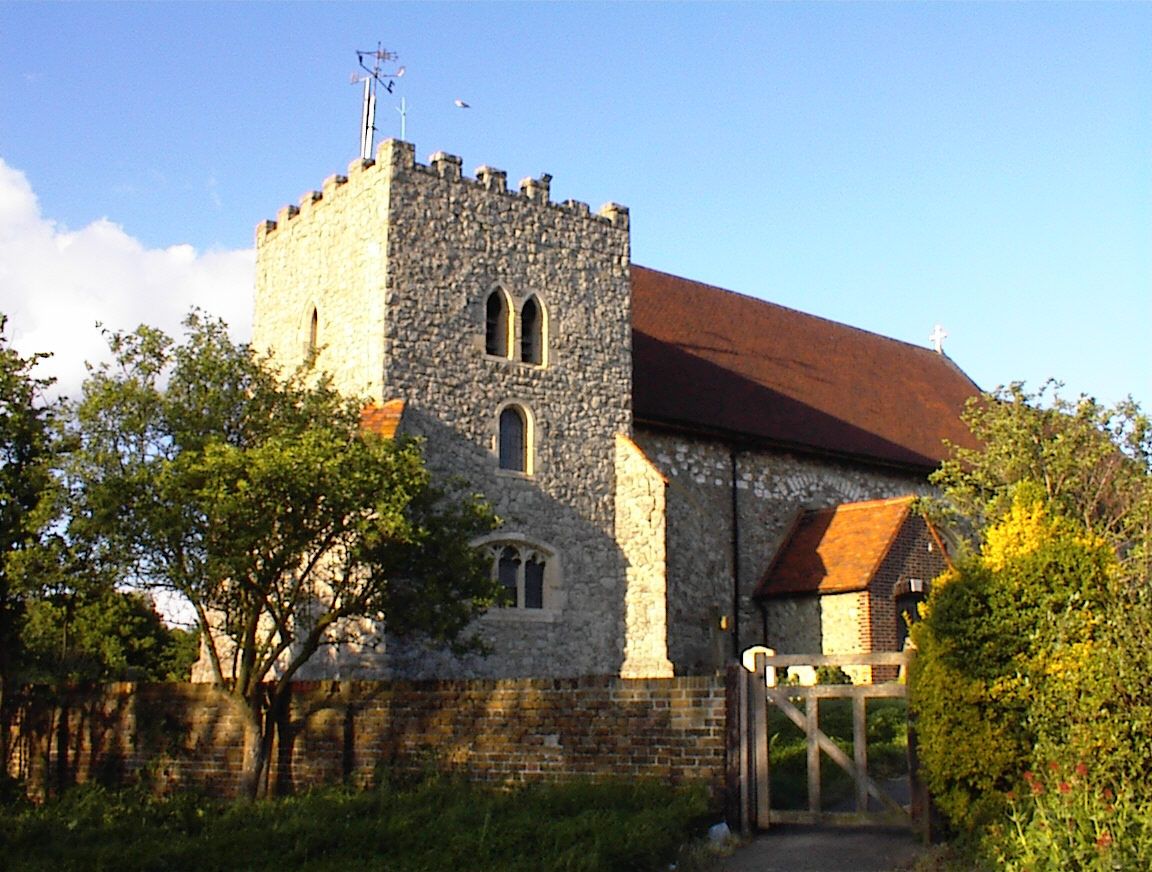
The Isle of Grain, derived from the "Grean" meaning gravelly or sandy ground, was recorded as such in the early 12th-century Textus Roffensis manuscript. Originally a true island separated by tidal creeks, it formed part of the Hoo in , characterized by low-lying marshes and pasture lands suitable for grazing. St James Church, the parish's principal medieval structure, originated in the Norman period with a basic two-cell layout constructed in the , later extended in the late 12th and 13th centuries before partial rebuilding. The church featured three aisles and a by the late and belonged to the nunnery at Minster-in-Sheppey, to which it was appropriated before the reign of Edward I (1272–1307). A 15th-century Ragstone west doorway with an angel-bearing shield represents surviving later . The local economy centered on and salt production, with saltpans operational near the southern shore and continuing until at least the late , employing a small of salt workers alongside laborers and bailiffs. reclamation for farming shaped settlement patterns, with hamlets like Wallend and Grain developing on higher ground amid the wetlands. Manorial history traces to the archbishopric of Canterbury, granted to Henry VIII in 1545, subsequently passing to Sir George Broke in 1551 before forfeiture to the Crown in 1603. The London Stone at Yantlet Creek, marking the eastern jurisdictional limit of the City of London's conservancy over the River Thames, has been documented since at least 1588, with medieval precedents in boundary records.

Industrialization and Maritime Developments

The Isle of Grain's maritime infrastructure saw initial formal development in the late with the extension of the Hundred of Hoo Railway in 1882 to the southern marshes, enabling a and service at Port Victoria for and goods across the estuary. This facility supported local connectivity to and broader traffic, marking an early shift from predominantly agricultural use to structured waterfront access. Industrialization commenced in earnest in 1908 when the Admiralty constructed oil storage tanks on the peninsula, linked to the naval dockyard at , to support emerging naval needs amid the transition from to oil-powered ships. By 1928, a dedicated depot with an integrated had been established, facilitating direct oil imports and laying groundwork for expanded refining operations. These installations transformed the marshy southern shoreline into a strategic node for bulk liquid cargo handling, with jetties accommodating tankers for storage and initial processing. The mid-20th century accelerated these trends through the Anglo-Iranian Oil Company's construction of a large-scale from 1950 onward, officially opened in to process Kuwaiti crude oil locally rather than exporting it unrefined. This facility, later known as the Kent Refinery under , reached a capacity of 10 million tons of crude annually by the , driving further maritime enhancements such as deepened approaches and expanded berthing for supertankers. The attached , including multiple jetties, handled increasing volumes of imports, integrating rail links opened in to serve the site and underscoring the peninsula's pivot to energy-dependent industry. In the , initial elements had already emerged alongside storage, evolving into this comprehensive complex that prioritized efficiency in and ing.

20th-Century Infrastructure and Conflicts

In the early , the Isle of Grain saw the establishment of military facilities, including an experimental seaplane station near Grain village, reflecting its strategic position at the confluence of the Thames and estuaries. During , these installations supported experiments, though details on operational scale remain limited in primary records. World War II prompted extensive defensive fortifications on the Isle of Grain due to its vulnerability to invasion from the continent. Coastal artillery batteries, searchlight emplacements, and pillboxes were constructed along the shoreline to protect the Medway approach, with Grain Tower Battery rearmed with two 57-mm quick-firing guns. Anti-invasion measures included dragon's teeth concrete obstacles and anti-tank cubes erected circa 1940 along seven miles of suitable landing beaches, supplemented by barbed wire entanglements, Dannert wire rolls, and anti-aircraft stakes to impede potential German landings. No major engagements occurred on the peninsula itself, but these defenses formed part of Britain's broader coastal stop-line strategy against . Post-war infrastructure development accelerated with the construction of the oil refinery, commissioned in 1953 after starting in 1950, achieving a capacity of 11 million tonnes of crude oil annually by expansion. This facility, one of Britain's largest, included jetties for tanker unloading and spurred rail enhancements, with Grain railway station opening in September 1951 primarily to serve refinery operations. The , an oil-fired plant with 1,320 MW capacity, followed in the 1970s, entering service in 1979 to utilize refinery byproducts, though it was decommissioned in 2012 amid shifts to cleaner energy. These projects transformed the Isle into a key energy hub, with oil storage and processing roots tracing to installations that expanded significantly by mid-century.

Economy and Industry

Port Facilities and Trade

The Isle of Grain hosts several specialized port facilities, primarily focused on energy imports and handling. Key installations include the Grain LNG Terminal, Thamesport terminal, and a BP aviation fuel terminal, all privately operated under the statutory oversight of the Ports Authority. The Grain LNG Terminal, located on the River Medway, serves as Europe's largest LNG import and facility, with two jetties accommodating large carriers such as QFlex (70,000–217,000 m³) and vessels for simultaneous berthing. It features 1,000,000 m³ of storage capacity and a output of 15 million tonnes per annum, equivalent to approximately 20% of gas demand, connected via cryogenic pipelines to the national grid. Services encompass unloading, blending, , reloading—the first such capability in the —and truck loading for small-scale LNG distribution. In trade operations, Grain LNG facilitates critical LNG imports to bolster UK energy security, achieving operational records including 369 ship loadings in March 2023 and unloading its 500th vessel by 2023. Recent contracts include a long-term storage and regasification deal with QatarEnergy, with the inaugural cargo arriving on 15 July 2025, and a February 2024 agreement with Venture Global for 3 million tonnes per annum capacity. As of August 2025, National Grid announced the sale of the terminal to Centrica for £1.7 billion, aiming to enhance domestic gas supply resilience. Thamesport operates as a deep-water container terminal on the Isle of Grain, specializing in containerized freight and supporting for the southeast region, though specific annual throughput figures remain limited in public data. The aviation fuel terminal handles imports and storage of , serving aviation distribution networks via connections. Collectively, these facilities underscore the Isle of Grain's role in energy trade and maritime within the , distinct from broader container expansions at nearby ports like .

Energy Production and Terminals

The Isle of Grain is home to major energy infrastructure, including natural gas-fired power generation and the Grain LNG import terminal, which collectively contribute to the UK's energy supply and security. The , operated by , is a 1,415 MW combined cycle gas turbine (CCGT) facility fueled by . It succeeded an oil-fired predecessor of 1,320 MW capacity that operated from 1979 until its decommissioning in 2012 due to environmental regulations under the EU's Large Combustion Plant Directive. The current station incorporates combined heat and power (CHP) capabilities, generating three CCGT units that produce while supplying in the form of hot water to the adjacent Grain LNG terminal for processes; construction of this configuration was completed around at a cost of approximately £500 million. The Grain LNG Terminal, situated on the peninsula, functions as Europe's largest LNG facility, with an annual regasification capacity of 21.7 billion cubic meters and 1 million cubic meters of storage across multiple tanks. It supports unloading from LNG carriers up to vessel size (approximately 266,000 cubic meters capacity) at two jetties on the River Medway, followed by storage, blending, via vaporizers, and distribution including truck loading. In August 2025, National Grid sold to a of and Energy Capital Partners for £1.7 billion, enabling the former to refocus on electricity and gas transmission while affirming the site's role in long-term energy security. An expansion project is underway to enhance and storage capacities. On October 21, 2025, initiated operations for LNG delivery, storage, and at , utilizing 7.2 million tons per year of capacity to integrate into the 's gas network.

Settlements and Demographics

Primary Villages and Communities

The primary settlement and community on the Isle of Grain is the village of , situated at the peninsula's eastern extremity amid predominantly marshland terrain. This compact village functions as the area's central hub, characterized by its relative isolation and tight-knit social structure, with residents historically tied to local maritime, agricultural, and industrial activities. As of the 2021 United Kingdom census, the Isle of Grain , encompassing Grain, recorded a of 1,730 residents. Key communal facilities in Grain include St James Church, a public house known as the Black Pig, and a handful of small shops, which support daily life in what has been described as one of Kent's most remote locations. The village's layout features clustered housing set back from the shoreline, reflecting a modest, working-class character without upscale developments. Community cohesion remains strong despite proximity to , with local groups advocating for preservation amid ongoing infrastructural pressures. Historically, a secondary hamlet named Wallend existed on slightly elevated ground toward the peninsula's center, supporting agricultural laborers with cottages and outbuildings until the mid-20th century. Wallend is now uninhabited, its site fenced off and repurposed for industrial use, including the former Medway Power Station and related infrastructure, leaving Grain as the sole active community. No other distinct villages or organized communities persist on the Isle, with scattered farmsteads and isolated properties integrated into the broader Grain parish. The civil parish of Isle of Grain had a population of 1,731 at the 2001 census, which declined to 1,648 by 2011 before increasing modestly to 1,730 in the 2021 census. This equates to an annual population growth rate of 0.49% from 2011 to 2021, indicating overall stability amid minor fluctuations. Historically, the population numbered around 250 in 1840, with gradual expansion over subsequent decades linked to shifts from agriculture toward industrial employment opportunities on the Hoo Peninsula. Socioeconomic indicators reflect a semi-rural community shaped by nearby , including operations and . Home ownership stands at 77.12% of households, exceeding Medway's 64.71% and England's 61.31% averages, ranking the area fifth among Medway's 22 wards for this metric. The rate is 57.88% among working-age residents, with full-time work comprising 75.78% of those employed and at a low 3.82%; part-time accounts for 24.22%. Occupational distribution emphasizes practical and industrial roles, with professional occupations at 14.49% (the largest category) and process plant/machine operatives at 9.99%, aligning with local demand from LNG terminals and maritime facilities. Educational profiles show 21.1% of adults holding level 4 qualifications (e.g., degrees), below England's 33.92%, alongside 22.06% with no qualifications, suggesting a oriented toward vocational skills rather than higher academia. Specific income or deprivation data at the level remain limited, though the area's industrial ties contribute to resilience compared to more urban parts of .

Environment and Ecology

Natural Habitats and Biodiversity

The Isle of Grain's natural habitats are dominated by coastal wetlands, including extensive salt marshes, intertidal mudflats, and grazing marshes, which form a critical component of the broader and Marshes complex. These features arise from the peninsula's position at the of the and , creating dynamic intertidal zones with mudflats rich in and supporting algal beds such as Enteromorpha. The area is designated as part of the and Marshes (SSSI), reflecting its geological and ecological value, with salt marshes transitioning inland to grazing lands that enhance habitat connectivity. Biodiversity in these habitats centers on wetland ecosystems, with the salt marshes and mudflats hosting diverse assemblages of and of international importance. The region supports rare invertebrate species, including the nationally scarce brown-banded carder bee (Bombus humilis) and shrill carder bee (Bombus sylvarum), alongside high diversity documented in surveys yielding over 250 species in short-term sampling efforts. Avifauna is particularly significant, featuring breeding populations of rare birds such as marsh harriers at the RSPB-managed Northward Hill reserve, and internationally important numbers of overwintering wildfowl and waders within the 's assemblage of at least 18 waterfowl species. communities include nationally scarce species, with the overall supporting one endangered and at least 14 scarce taxa, though specific enumerations for the Isle of Grain emphasize saline-tolerant adapted to tidal influences.

Industrial Impacts and Mitigation Efforts

The decommissioning of the Isle of Grain Power Station in 2015 marked the end of significant coal-fired emissions, but legacy mercury contamination persists in Thames Estuary sediments, with concentrations peaking at industrial highs correlated to historical operations of nearby power plants including Grain, contributing to toxic metal accumulation positively linked to total organic carbon levels. Former BP oil refinery sites on the peninsula remain contaminated with asbestos, oil, and industrial chemicals across 189 hectares of brownfield land, posing risks to soil and groundwater quality. Ongoing industrial activities at the Grain LNG Terminal and associated port facilities generate air quality concerns from dust, noise, and potential releases, alongside contaminated land legacies evaluated in assessments. Methane emissions from LNG operations, though minimized through infrastructure design, have been quantified and audited, with terminal-wide verification confirming levels below global benchmarks as of 2024. These impacts extend to estuarine ecosystems, where power station outfalls historically affected juvenile fish nurseries, including bass habitats in the Thames. Mitigation efforts include mandatory Environmental Impact Assessments (EIAs) for expansions, incorporating ecological surveys, air and noise modeling, and landscape impact evaluations to scope and address effects prior to approval. Construction phases require detailed Construction Environmental Management Plans (CEMPs) to control site-specific , with statutory consultees ensuring compliance for estuary-sensitive locations. The Grain LNG Terminal achieved world-first independent certification for in 2024 via MiQ standards, demonstrating operational controls that limit leaks and support regulatory methane reduction targets. Brownfield remediation on contaminated sites follows planning conditions, prioritizing contaminant stabilization to prevent migration into adjacent salt marshes, though full restoration lags behind development pressures. Proposed battery storage and power projects undergo scoping for flood risk and controls, integrating cumulative impact assessments to balance needs with preservation.

Infrastructure and Proposals

Transport Networks

The Isle of Grain's road network is dominated by the A228, a that provides the primary link from the peninsula's settlements to the Hoo Peninsula and onward to the A2 and motorways near Rochester, facilitating access to Towns and . This route incorporates the B2001 Grain Road and crosses the A228 Stoke railway bridge, which serves as the only vehicular connection to the mainland and has been plagued by potholes, flooding vulnerabilities, and repair delays, exacerbating isolation during disruptions. Further development on the peninsula remains constrained by this limited road capacity, lacking dual carriageways or alternative routes to mitigate congestion from industrial traffic. Rail connectivity relies on the freight-only Hundred of Hoo branch line, diverging from the at Hoo Junction and extending to for servicing port and facilities, with no operations since the mid-20th century. A 2023 proposal to construct a new station and restore services along 5.5 km of the line, at an estimated cost of £63 million, was shelved by due to cost overruns exceeding initial projections by over 50%, prompting a pivot to road and bus enhancements instead. Land for the potential station site is preserved for future consideration, but current prioritizes heavy goods transport over commuter needs. Public bus services are sparse, with routes such as the 191 linking to and Rochester operating limited frequencies, typically hourly or less, and reliant on the A228 for all access. These services, provided by operators like , connect to regional rail hubs but face reliability issues from road conditions, underscoring the area's dependence on private vehicles for most travel. No active ferry or maritime passenger links exist, though historical pier infrastructure at nearby Port Victoria supported such operations until the .

Airport and Integrated Hub Concepts

The Thames Hub Airport concept, developed by Foster + Partners, proposed a four-runway international hub on a platform in the at the Isle of Grain to address capacity constraints at existing London airports like Heathrow, which operates near 99% runway utilization. This site was selected for its potential to enable aircraft approaches over water, minimizing overflights of densely populated areas in and reducing associated noise and security risks. The design envisioned an initial capacity of 90 million passengers per annum by an opening in 2029, scalable to 180 million by 2050, with up to 200 air traffic movements per hour and efficient 45-minute connection times. Integration with broader infrastructure formed a core element of the hub vision, combining aviation with extensions from HS1 and for 28-minute access to (e.g., Waterloo), targeting a 65% mode share and connectivity to 10.7 million people within 60 minutes. An orbital rail network around would link to HS2, northern cities, and the , alongside intermodal freight logistics and utilities distribution via underground "Spine" conduits. Energy aspects included a tidal barrier or lagoon for renewable power generation and flood defenses aligned with the 2100 plan, estimated at £6-7 billion, providing dual benefits of habitat management and protection against sea-level rise. Proponents projected economic impacts including 388,000 UK jobs supported by 2050 and £726 billion in cumulative from 2015-2050, with local effects of 134,000 jobs and £16.6 billion annual GVA. Environmental considerations highlighted lower per-passenger CO2 emissions (130-140 kg versus Heathrow's 280 kg with expansion) and noise exposure for 31,500 people compared to 967,000 at an expanded Heathrow, though the project would affect 1,830 hectares of intertidal and routes. Critics, including architects like Sir Terry Farrell, argued the £50 billion cost risked creating a "white elephant" on the "wrong side" of for , potentially squandering Heathrow's established and jobs while threatening for up to 230,000 birds of international importance. The Airports Commission rejected Thames Estuary options, including the Isle of Grain site, in September 2014, citing prohibitive costs exceeding £50 billion, significant local environmental damage, operational risks from bird strikes and , and suboptimal location relative to London's primary economic centers. No viable revival of these concepts has advanced as of 2025, with focus shifting to expansions at Heathrow and Gatwick.

Recreation and Culture

Local Sports and Leisure Activities

The Isle of Grain supports community sports primarily through facilities maintained by the St James Isle of Grain Parish Council, including a floodlit Multi-Use Games Area (MUGA) suitable for football, , and other ball sports, alongside a skateboard ramp and outdoor fitness equipment such as rowers, cross trainers, and air walkers. Grain Football Club operates as a local amateur outfit, fielding a veterans team in the Kent County Football League on Saturdays and an over-18s first team for Sunday fixtures, emphasizing community participation over professional competition. Leisure centers on outdoor and nature-based pursuits, with extensive walking opportunities along the Thames and paths, including a 1.2-mile flat trail in Grain Coastal Park and the broader 23.5-mile (38 km) King Charles III England Coast Path stretch from Iwade to , which opened to public access in stages concluding by 2023. draws enthusiasts to the peninsula's marshes and beaches, where such as black-tailed godwits and common shelducks are regularly observed, particularly during migration periods. Shoreline fishing remains a traditional activity, targeting estuarine amid the area's tidal waters. These low-impact options align with the Isle's rural, coastal character, supplemented by children's play areas for family recreation.

Cultural Heritage Sites

The Church of St James stands as the principal ecclesiastical heritage site on the Isle of Grain, designated as a Grade I listed building by . Originating from Norman origins with a typical two-cell structure, it was extended and partially rebuilt in the late , reflecting medieval architectural evolution in the region. The church served the ancient parish, historically linked to the nunnery at Minster-in-Sheppey before the 13th century, underscoring its longstanding role in local religious and communal life. Further east, the London Stone at Yantlet Creek represents a key maritime boundary marker, listed as Grade II. This granite obelisk, erected in 1856, delineates the eastern limit of the City of London's conservancy jurisdiction along the Thames Estuary's south bank, connecting to the Yantlet Line across to . It symbolizes historical jurisdictional extents over tidal waters, with the creek itself having silted significantly over time, altering the local landscape. Defensive structures constitute another facet of the Isle's heritage, notably Grain Tower, a Grade II listed artillery tower constructed between 1848 and 1855 as part of 19th-century coastal fortifications. Encompassing broader coastal artillery defenses east and southeast of Grain village, these form a scheduled monument designated in 1976, including gun emplacements and associated features from the Victorian era through World War II adaptations. Grain Fort, built in the 1860s to guard the Medway and Thames confluence, survives in partial form despite 1960s demolitions of its keep and infilling of emplacements for safety. Additional listed structures, such as the Hogarth Inn, contribute to the vernacular architectural heritage, though industrial developments have impacted preservation of agricultural outbuildings and laborers' cottages from the 19th century. These sites collectively highlight the Isle's transition from agrarian and ecclesiastical roots to strategic defensive roles amid estuarine threats.

References

Add your contribution
Related Hubs
User Avatar
No comments yet.