


Community hub
Recent from talks
Contribute something
Nothing was collected or created yet.
Great circle
View on Wikipedia | This article needs additional citations for verification. (April 2025) |


In mathematics, a great circle or orthodrome is the circular intersection of a sphere and a plane passing through the sphere's center point.[1][2]
Discussion
[edit]Any arc of a great circle is a geodesic of the sphere, so that great circles in spherical geometry are the natural analog of straight lines in Euclidean space. For any pair of distinct non-antipodal points on the sphere, there is a unique great circle passing through both. (Every great circle through any point also passes through its antipodal point, so there are infinitely many great circles through two antipodal points.) The shorter of the two great-circle arcs between two distinct points on the sphere is called the minor arc, and is the shortest surface-path between them. Its arc length is the great-circle distance between the points (the intrinsic distance on a sphere), and is proportional to the measure of the central angle formed by the two points and the center of the sphere.
A great circle is the largest circle that can be drawn on any given sphere. Any diameter of any great circle coincides with a diameter of the sphere, and therefore every great circle is concentric with the sphere and shares the same radius. Any other circle of the sphere is called a small circle, and is the intersection of the sphere with a plane not passing through its center. Small circles are the spherical-geometry analog of circles in Euclidean space.
Every circle in Euclidean 3-space is a great circle of exactly one sphere.
The disk bounded by a great circle is called a great disk: it is the intersection of a ball and a plane passing through its center. In higher dimensions, the great circles on the n-sphere are the intersection of the n-sphere with 2-planes that pass through the origin in the Euclidean space Rn + 1.
Half of a great circle may be called a great semicircle (e.g., as in parts of a meridian in astronomy).
Derivation of shortest paths
[edit]To prove that the minor arc of a great circle is the shortest path connecting two points on the surface of a sphere, one can apply calculus of variations to it.
Consider the class of all regular paths from a point to another point . Introduce spherical coordinates so that coincides with the north pole. Any curve on the sphere that does not intersect either pole, except possibly at the endpoints, can be parametrized by



provided is allowed to take on arbitrary real values. The infinitesimal arc length in these coordinates is


So the length of a curve from to is a functional of the curve given by

![{\displaystyle S[\gamma ]=r\int _{a}^{b}{\sqrt {\theta '^{2}+\phi '^{2}\sin ^{2}\theta }}\,dt.}](https://wikimedia.org/api/rest_v1/media/math/render/svg/529ea36236f5ec3d9b1eba8447cc80ca1f04c1a0)
According to the Euler–Lagrange equation, is minimized if and only if
![{\displaystyle S[\gamma ]}](https://wikimedia.org/api/rest_v1/media/math/render/svg/fd04c39c6e63382ba18b7dcbea0096d75a472d34)
- ,
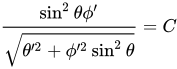
where is a -independent constant, and


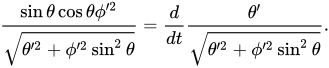
From the first equation of these two, it can be obtained that
- .
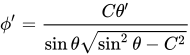
Integrating both sides and considering the boundary condition, the real solution of is zero. Thus, and can be any value between 0 and , indicating that the curve must lie on a meridian of the sphere. In a Cartesian coordinate system, this is



which is a plane through the origin, i.e., the center of the sphere.
Applications
[edit]Some examples of great circles on the celestial sphere include the celestial horizon, the celestial equator, and the ecliptic. Great circles are also used as rather accurate approximations of geodesics on the Earth's surface for air or sea navigation (although it is not a perfect sphere), as well as on spheroidal celestial bodies.
The equator of the idealized earth is a great circle and any meridian and its opposite meridian form a great circle. Another great circle is the one that divides the land and water hemispheres. A great circle divides the earth into two hemispheres and if a great circle passes through a point it must pass through its antipodal point.
The Funk transform integrates a function along all great circles of the sphere.
See also
[edit]References
[edit]- ^ W., Weisstein, Eric. "Great Circle -- from Wolfram MathWorld". mathworld.wolfram.com. Retrieved 2022-09-30.
{{cite web}}: CS1 maint: multiple names: authors list (link) - ^ Weintrit, Adam; Kopcz, Piotr (2014). Loxodrome (Rhumb Line), Orthodrome (Great Circle), Great Ellipse and Geodetic Line (Geodesic) in Navigation. USA: CRC Press, Inc. ISBN 978-1-138-00004-9.
External links
[edit]- Great Circle – from MathWorld Great Circle description, figures, and equations. Mathworld, Wolfram Research, Inc. c1999
- Great Circles on Mercator's Chart by John Snyder with additional contributions by Jeff Bryant, Pratik Desai, and Carl Woll, Wolfram Demonstrations Project.
Great circle
View on GrokipediaFundamentals
Definition
A great circle is defined as the intersection of a sphere with a plane that passes through the sphere's center, resulting in a circle that divides the sphere into two equal hemispheres.[6][7] This distinguishes great circles from small circles, which form from the intersection of the sphere with a plane that does not pass through the center; great circles are unique in having the same radius and diameter as the sphere itself.[8][9] The concept emerged in ancient Greek studies of the celestial sphere, with early observations noted by Aristotle, and was formalized within spherical geometry by Menelaus of Alexandria in his treatise Sphaerics during the 1st century AD.[10][11] On the great circle, every point lies at an equal distance from the sphere's center, and its circumference measures , where is the sphere's radius, representing the maximum possible circular path on the surface.[12][13]Geometric Properties
In spherical geometry, any two distinct non-antipodal points on a sphere determine a unique great circle, as these points, together with the sphere's center, define a unique plane whose intersection with the sphere yields the circle.[14] This great circle divides the sphere into two equal hemispheres and consists of two arcs connecting the points: a shorter minor arc and a longer major arc, with the minor arc being the unique shortest path unless the points are antipodal, in which case all arcs are equal in length.[1] For antipodal points, which lie directly opposite each other through the sphere's center, infinitely many great circles pass through both, as any plane containing the line joining them and the center intersects the sphere in such a circle.[15] Two distinct great circles on a sphere always intersect at exactly two antipodal points, since their defining planes, each passing through the sphere's center, intersect along a line through that center, and the circle intersections occur where this line meets the sphere.[15] At these intersection points, the angle between the two great circles is defined as the dihedral angle between their respective planes, which can be computed from the angle between the planes' normal vectors and remains constant along the circles.[16] This intersection property underscores the inherent symmetry of great circles, as the configuration is invariant under rotation about the axis joining the intersection points. Great circles serve as the analogs of straight lines in spherical geometry, providing the geodesics—or shortest paths—on the sphere's surface while appearing curved when embedded in three-dimensional Euclidean space.[14] Unlike Euclidean straight lines, however, great circles are closed curves with constant curvature equal to that of the sphere, and they exhibit central symmetry with respect to the sphere's center.[1] Every great circle passes through the antipodal points of any point on it, reinforcing their role in connecting diametrically opposite locations uniformly across the sphere.[17]Mathematical Derivation
Shortest Paths on a Sphere
On a sphere, geodesics are defined as the curves that locally minimize the distance between points, representing the shortest paths on the surface. Due to the sphere's constant positive curvature, these geodesics coincide with arcs of great circles, as any other curve between two points would have a longer length.[18] The derivation of this property relies on the variational principle from the calculus of variations, which seeks to minimize the total arc length along a path on the sphere. For a sphere of radius , the infinitesimal arc length element in spherical coordinates is given by the metric , where is the polar angle and is the azimuthal angle. Parameterizing the path by , the functional to minimize is . Applying the Euler-Lagrange equations yields Clairaut's theorem, a conserved quantity (constant), which corresponds to constant angular momentum about the axis and integrates to the equation of a plane passing through the sphere's center, confirming that the minimizing paths are great circle arcs. In contrast, rhumb lines, which maintain a constant bearing (azimuth), do not satisfy these equations and thus yield longer paths, as their variable curvature relative to the geodesic deviates from the minimum-length condition.[18] A symmetry-based proof further demonstrates that great circles are the unique shortest paths (except in special cases). The sphere's rotational symmetry and the transitivity of its isometry group imply that geodesics starting from a point in a given direction must lie on a great circle, as any deviation would not be preserved under rotations while maintaining the geodesic property.[19] An exception occurs for antipodal points, which are directly opposite each other on the sphere (separated by angular distance ); here, every great circle passing through them has identical length , resulting in infinitely many minimal geodesics of equal shortness.[20] In the limit of small distances, where the angular separation is much less than , great circle arcs approximate straight lines in the tangent plane at the starting point, mirroring the geodesics of Euclidean flat space.[18]Relevant Formulas
The great-circle distance can be derived from the spherical law of cosines. For two points with latitudes and longitudes on a sphere of radius , the central angle satisfies and the distance is .[1] The haversine formula provides an efficient method for computing the great-circle distance between two points on a sphere, given their latitudes and longitudes , by leveraging the haversine function to avoid numerical instability near small angles. The central angle is calculated as where and , all in radians; the distance is then , with as the sphere's radius. This formula, derived from spherical trigonometry, is particularly suitable for spherical approximations in navigation due to its simplicity and accuracy for most practical distances.[21] The initial bearing (azimuth) from one point to another along the great circle is determined using the two-argument arctangent function to handle all quadrants correctly, given by where angles are in radians and the result is typically converted to degrees for navigation (0° north, increasing clockwise). This formula computes the forward azimuth at the starting point, essential for plotting great-circle routes.[22] To define the plane of a great circle passing through two points, convert the spherical coordinates and to Cartesian position vectors and , assuming unit radius for direction; the normal vector to the plane is then the cross product . This vector-based approach facilitates geometric operations like intersection with other circles.[23] All angular inputs and outputs in these formulas must be in radians for trigonometric consistency, with the Earth's mean radius km used for terrestrial applications to convert angular distances to linear ones.[21]Examples
Terrestrial Examples
The equator represents the primary great circle on Earth, coinciding with 0° latitude and symmetrically dividing the planet into the Northern and Southern Hemispheres. This imaginary line encircles the globe at its widest point, with a circumference of approximately 40,075 kilometers, serving as a fundamental reference in geography and geodesy.[24] Unlike smaller circles formed by other parallels of latitude, the equator's status as a great circle ensures it passes through the center of the Earth, maximizing its length and utility in global measurements. Meridians, or lines of longitude, constitute another set of great circles on Earth's surface, each extending from the North Pole to the South Pole and intersecting at these polar points. Every meridian qualifies as a great circle because it lies in a plane that includes the planet's center, forming semicircles of equal length—approximately 20,038 kilometers from pole to pole. Notable examples include the Prime Meridian, which passes through Greenwich, England, at 0° longitude, and the 180° meridian, also known as the International Date Line, which roughly bisects the Pacific Ocean. These meridians provide essential longitudinal references, enabling the global coordinate system that underpins mapping and location services.[26] Historical measurements of great circles have been pivotal in understanding Earth's dimensions. In the 3rd century BC, the Greek scholar Eratosthenes employed the arc of a great circle—specifically, a portion of the meridian between Syene (modern Aswan) and Alexandria—to estimate the planet's circumference. By observing the angle of the sun's rays at these locations and knowing the north-south distance of about 800 kilometers, he calculated the full circumference as roughly 40,000 kilometers, remarkably close to modern values. This method relied on the geometric properties of great circle arcs to scale local observations to global proportions.[27] In contemporary geodesy, technologies like the Global Positioning System (GPS) facilitate precise tracing and measurement of great circle paths, enhancing accuracy in determining Earth's shape and surface distances. GPS satellites enable receivers to compute positions along these shortest spherical routes, supporting applications in surveying and reference frame establishment, such as aligning with the World Geodetic System. For instance, data from GPS networks confirm the paths of key meridians like the Prime and 180° lines with sub-centimeter precision. Great circles often manifest in counterintuitive paths when viewed on flat maps, particularly those using the Mercator projection, which distorts polar regions. A classic illustration is the great circle route from New York City to London, which arcs northward over Newfoundland and southern Greenland to minimize distance—covering about 5,570 kilometers—rather than following a straight line on a map that would appear southward.[28] This curvature highlights how great circles optimize terrestrial connections, appearing bent on projections designed for navigation at constant bearings.Astronomical Examples
In astronomy, the celestial equator represents the projection of Earth's equatorial plane onto the celestial sphere, forming a great circle that serves as the fundamental reference for equatorial coordinate systems, where celestial objects are located using right ascension and declination. This great circle lies midway between the north and south celestial poles and divides the celestial sphere into northern and southern hemispheres, analogous to Earth's equator but extended infinitely outward. It is essential for defining the positions of stars and other celestial bodies as observed from Earth.[26][29] The ecliptic, another prominent great circle on the celestial sphere, traces the apparent annual path of the Sun against the background stars due to Earth's orbit around the Sun. It is inclined at approximately 23.5 degrees to the celestial equator, a tilt resulting from Earth's axial obliquity, which causes the seasonal variations in sunlight distribution. This plane also approximates the paths of the Moon and planets, as their orbits are nearly coplanar with Earth's; the ecliptic defines the zodiac, a band of twelve constellations through which these bodies appear to move.[30][31][32] Hour circles function as meridians on the celestial sphere, consisting of great circles that pass through both the north and south celestial poles and intersect the celestial equator at right angles, thereby serving as lines of constant right ascension in equatorial coordinates. These circles rotate with the apparent daily motion of the stars due to Earth's rotation, providing a framework for tracking celestial objects over time. In observational astronomy, telescopes mounted on equatorial platforms align and track along hour circles by adjusting the right ascension axis, allowing precise following of stars as they cross the sky; for instance, setting circles on such mounts are calibrated to these coordinates for locating targets.[33][34] In stellar navigation, Polaris, located near the north celestial pole, helps determine latitude by sighting along the observer's local hour circle (meridian), where the star's altitude above the horizon equals the observer's latitude north of the equator. Beyond Earth, great circles appear in other celestial bodies; Jupiter's equator, for example, approximates a great circle on its oblate spheroid surface, tilted by only about 3 degrees relative to its orbital plane around the Sun, influencing its banded cloud patterns and rotational dynamics. Similarly, the lunar terminator—the boundary separating the illuminated and dark hemispheres of the Moon—traces a great circle on the lunar surface, determined by the plane perpendicular to the Sun-Moon line of sight, which maximizes contrast for observing surface features during crescent phases.[35]Applications
Navigation and Route Planning
In historical navigation, sailors primarily relied on rhumb lines—constant bearing paths that appear as straight lines on Mercator charts—for ease of compass steering, but these were longer than the true shortest routes on the Earth's surface.[36] The development of great circle sailing became feasible in the 18th century following advancements in determining longitude at sea, particularly through John Harrison's marine chronometer, which allowed precise timekeeping to compute positions accurately and plot great circle arcs.[37] Traditional navigation tools like the magnetic compass and sextant enabled mariners to measure latitude via celestial observations and longitude via chronometer comparisons with solar time, facilitating the plotting of great circle routes as sequences of waypoints.[38] However, Mercator projections, which preserve angles for rhumb line navigation, distort great circle paths into curves, necessitating the use of gnomonic projections where great circles appear as straight lines for accurate route planning.[39] In modern navigation, Electronic Chart Display and Information Systems (ECDIS) integrate GPS and electronic nautical charts to automatically compute and display great circle routes, allowing planners to define start and end points and generate intermediate waypoints that approximate the arc for practical steering.[40] Applications such as SkyVector further support this by providing online tools for visualizing and calculating great circle distances and headings between waypoints on digital aeronautical charts.[41] Waypoint optimization along these routes, often using algorithms to minimize deviations while adhering to vessel constraints, ensures efficient passage planning.[42] Following great circle routes yields significant fuel and time savings, with distance reductions of up to 7.8% on westbound transatlantic voyages compared to rhumb lines, depending on airspeed and routing specifics.[43] Challenges in great circle navigation arise particularly in polar regions, where magnetic compass errors amplify due to proximity to the poles, and sea ice concentrations necessitate deviations to avoid entrapment or damage. Regulatory frameworks, such as the International Maritime Organization's Polar Code, impose additional route restrictions to mitigate environmental risks and ensure vessel safety, often forcing planners to incorporate buffer zones or alternative paths around ice-prone areas.[44]Aviation and Maritime Travel
In aviation, commercial flights predominantly follow great circle routes to minimize distance and fuel consumption, as these paths represent the shortest arcs on Earth's spherical surface. For instance, trans-Pacific flights from Los Angeles International Airport (LAX) to Sydney Kingsford Smith Airport (SYD) arc northward over the Pacific Ocean rather than a straight line on flat maps, covering approximately 6,500 nautical miles.[45][46] However, Extended-range Twin-engine Operational Performance Standards (ETOPS) regulations for twin-engine aircraft require routes to remain within a specified time from suitable diversion airports, often causing deviations from pure great circle paths to ensure safety over remote areas like the southern Pacific.[47] In maritime shipping, container vessels and tankers similarly prioritize great circle routes as a baseline for fuel efficiency, reducing transit distances and operational costs compared to rhumb lines or detours. Weather routing software, such as systems developed by StormGeo, adjusts these routes in real-time for currents, winds, and ballast conditions, optimizing beyond the static great circle while aiming to minimize fuel use—sometimes recommending deviations that save thousands in costs despite longer paths.[48][49][50] Technological aids enable precise adherence to great circle navigation in both sectors. Inertial Navigation Systems (INS) compute position and velocity using onboard accelerometers and gyroscopes, allowing aircraft and ships to track great circle headings without external references, while integration with Global Positioning System (GPS) provides corrections for drift and confirms arc compliance.[51] Autopilots in aviation and maritime autopilots follow these computed great circle arcs by making continuous, subtle heading adjustments—typically every few minutes—to maintain the curved path, as the initial bearing changes progressively along the route.[52] Polar routes exemplify great circle applications, with trans-Arctic flights from Europe to Asia significantly reducing distances compared to southern paths via the Middle East.[53] In shipping, emerging Northern Sea Routes (NSR) via the Arctic bypass traditional chokepoints like the Suez and Panama Canals, shortening Europe-Asia voyages by 30-50% and avoiding canal fees, though ice and infrastructure limit year-round use. As of 2025, the NSR has seen increased traffic, with over 50 transit voyages recorded by September and new agreements between Russia and China to expand container shipments.[54][55][56] These optimized great circle paths contribute to environmental benefits by lowering fuel burn and emissions; for example, stricter adherence in aviation could reduce CO2 output by adjusting routes closer to theoretical minima, where actual flights often exceed great circle distances by 5%.[57][58] In the 2020s, International Maritime Organization (IMO) regulations, including the 2023 Strategy on Reduction of GHG Emissions from Ships targeting 20-30% cuts by 2030 and net-zero by 2050, promote route optimization as a key operational measure alongside energy efficiency improvements.[59][60]References
- https://science.[nasa](/page/NASA).gov/learn/basics-of-space-flight/chapter2-1/