


Community hub
Recent from talks
Contribute something
Nothing was collected or created yet.
Ferencváros Stadion
View on Wikipedia
The Ferencváros Stadion, also known as the Groupama Aréna for sponsorship purposes, is a multi-purpose stadium in Ferencváros, Budapest, Hungary and the home of Ferencvárosi TC.[1][2] With a capacity of 22,000, it was for a time the largest stadium in Hungary (between the demolition of the larger Ferenc Puskás Stadium in 2017 and the opening of the Puskás Aréna in November 2019). It was built on the site of the former Flórián Albert Stadium, the club's previous home, which was demolished in 2013.
Key Information


The French insurance group Groupama purchased the naming rights to the stadium. However, the name cannot be used when hosting FIFA and UEFA events, since these governing bodies have policies forbidding corporate sponsorship from companies that are not official tournament partners.
History
[edit]Planning
[edit]Since 1911, Ferencváros had played their home games at Stadion Albert Flórián, originally named Üllői úti Stadion. The stadium had had a major upgrade from 1971 to 1974, and in the 21st century the club desired a stadium with an expanded capacity. Reconstruction of Stadion Albert Flórián was rejected for financial reasons, and plans to demolish the stadium and replace it with an entirely new structure were presented at a press conference in April 2012 by Gábor Kubatov, the president of Ferencváros. The proposed capacity of 22,600 would make it the second biggest stadium in Hungary.
The new stadium would be reorientated 90° and closer to Gyáli út, with a pitch 10 cm below ground level. Corporate hospitality, a restaurant, shop and museum were all planned, along with expanded changing facilities.[3]
Construction
[edit]
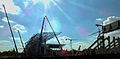
Market építő Zrt won the tender to construct the stadium, with a projected cost of 13.5 billion Ft. Construction started on 28 March 2013,[4] with an estimated completion time of autumn 2014.[5]
On 24 May 2013, Balázs Fürjes, MP of the Hungarian Parliament and person responsible for the investment, announced that the stadium would be finished on time. The construction of the new stadium is expected to be completed by the fall of 2014. In 2013 there will be 5,4 billion HUF available for the project and 8,1 billion HUF in 2014. Mihály Varga, minister of national economy of Hungary, said that the sale of the estate, which will be gained by rotating the stadium by 90°, will cover the expenses of the stadium. If the construction is not completed on time, the constructor company (Market Épitő Zrt.) will have to pay 65 million HUF daily.[6]
Melinda Várkonyi said that an 82-millimetre grenade was found at the building site of the new stadium. Allegedly the shell originates from a Soviet grenade launcher from the Second World War.[7]
On 3 October 2013, Balázs Fürjes, MP of the Hungarian Parliament, said that the construction of the stadium is of record speed. It was quite sure that the club could start the 2014–15 Hungarian League season in the new stadium. The Ferencváros club centre was opened, where the fans of the club can take a look at the plans of the new stadium or a 3D film can be watched about the future stadium. Balázs Fürjes also pointed out that the new stadium will be a multi-purpose stadium where concerts, conferences, cultural events can be held apart from association football matches. He also mentioned that the elements of the old Albert stadium will be used for the construction of the new stadium. Therefore, it is a green investment for two reasons: for the colours of the club, and for the eco-friendly construction. The steel structure, which weighs 2800 tons, was made in Kecskemét while the concrete structure, which is 25,000 cubic metres, was made in Dunaújváros. The construction of the new stadium gives jobs for almost 2000 blue-collar workers.[8]
On 17 January 2014, new photos about the new stadium were released on the Facebook site of the Albert Stadium.[9]
On 18 April 2014, it was announced that a 3-metre-tall statue of Ferencváros Ballon d'Or winner Flórián Albert will be erected in front of the main entrance. Sándor Kligl, sculptor and artist, was asked to make the bronze statue. The artist also said that he saw playing the Ferencváros legend live and it was worth going to the stadium just because of him. He was commissioned with many different tasks but this has been the most special one in his life. Junior Flórián Albert said that it was a moving moment to look at his father statue.[10]
In April 2014, Lagardère Unlimited Stadium Solutions, the dedicated agency for stadia and arena operations owned by Lagardère Unlimited, signed a long-term naming right contract with and French insurer Groupama. The deal includes the operation, management and marketing of the new arena. Lagardère Unlimited Stadium Solutions is currently involved in consulting, operations and marketing services in several stadiums worldwide, including Commerzbank-Arena in Frankfurt, Imtech Arena in Hamburg and two stadiums in Brazil. On 2 July 2014, it was announced that the name of the new stadium would be the Groupama Arena.

On 7 July 2014, it was announced that the first kick would be executed by Ferencváros legend, Ferenc Rudas.[11]
It was revealed that one of the halls will be named after former Ferencváros and Barcelona legend László Kubala who played for Ferencváros between 1945 and 1946 and scored 33 goals in 50 matches.[12][13]
On 4 August 2014, the first unofficial match was played at the stadium in front of 6,500 spectators. Ferencváros old-boys team including Szeiler, Dzurják, Lipcsei, Telek, and Lisztes hosted their arch-rival Újpest old-boys including Kovács, Szlezák, Fehér, Egressy, and Mészöly. The final result was 6–5 to Újpest. The tickets for free those supporters who purchased season tickets before the match and for the workers and their relatives who contributed to the construction of the new stadium.[14]
On 10 August 2014, Ferencváros played the opening match against Chelsea F.C. The first goal at the new stadium was scored by Ferencváros Legened, Zoltán Gera in the 17th minute. However, in the second half Ramires (51st minute) and Fàbregas scored (81st minute) which resulted the 2–1 defeat at the new stadium for the home side.[15][16][17]
On 10 August 2014, around 2,500 spectators belonging to the B Közép organised an alternative match at the stadium of BKV Előre SC in protest against the high entrance fees earmarked by the leadership of Ferencváros, the entrance security checks, and that Chelsea would play the opening match against Ferencváros and not the Austrian archrival Rapid Wien. The two teams included the supporters of Ferencváros and Rapid Wien.[18]
On 24 August 2014, the first Hungarian League match was played at the stadium. Ferencváros beat Nyíregyháza 3–1. The first goal was scored by Busai in the 13th minute.[19]
On 7 September 2014, Hungary played their first match at the stadium against Northern Ireland. The UEFA Euro 2016 qualifier ended with a 2–1 away victory.[20]
On 14 November 2014, Hungary won their first match at the new stadium by beating Finland 1–0 thanks to Gera's 84th-minute goal in the UEFA Euro 2016 qualifier.[21]
On 9 July 2015, Ferencváros played their first international match at the stadium against Dutch club Go Ahead Eagles in the second leg of the first qualifying round of the 2015–16 UEFA Europa League, with Ferencváros winning 4–1.[22]
On 20 May 2016 the first non-UEFA member was hosted in the stadium when Hungary played against Ivory Coast in a goalless friendly tier.[23]
On 22 September 2017, it was announced that the first CONCACAF member to play at the stadium will be national team of Costa Rica.[24]
The final of the 2018–19 UEFA Women's Champions League was held at the stadium on 18 May 2019.[25]
Sport arena
[edit]The stadium was categorised as a Category 4 facility by the UEFA which is suitable for Nemzeti Bajnokság I, Magyar Kupa, UEFA European Championship qualifying, FIFA World Cup qualification, UEFA Champions League group stage and quarter-final. In addition, the stadium can host FIFA U-17 World Cup and U21 FIFA U20 World Cup.[26]
The capacity of the arena is 23,800 for Nemzeti Bajnokság I and Magyar Kupa matches and 22,000 for UEFA and FIFA matches. The difference is due to the fact that there are standing stands in the B-közép and the visitors sector.[27] The area of the stadium is 19,042 square metres, including the pitch it is 28,746.5 square metres. The main building has four floors, and under it there is a three-level garage which can host 354 vehicles. There is a car park in front of the main building which can host 106 cars. Next to the stadium there is also a parking lot which can host 405 cars.[28]
The construction took 14 months. During the construction 60 000 cubic metre was moved. The amount of the concrete used in the construction was 24 492 cubic metre, while the steel structure was 2708 tons. The steel structure was manufactured in Kecskemét, while the pre-fabricated concrete was made in Dunaújváros.[29]
Construction costs
[edit]The stadium cost 53.3 million USD. The price per seat was 1,996 USD. In 2014, the arena was the fifth cost-per-seat building and sixth by price in Hungary. Nagyerdei Stadion of Debrecen overtook in cost, but not in cost-per-seat.[30]
Tenants
[edit]Székesfehérvár-based MOL Vidi FC played their home matches of the 2018–19 UEFA Europa League group stage against BATE Borisov, PAOK FC, and Chelsea F.C. in the stadium due to the reconstruction of Sóstói Stadion.
Music
[edit]Besides football, the stadium can be configured to hold many other events, particularly major concerts but also private events like weddings and conferences. The first concert at the new stadium was given by Depeche Mode on 22 May 2017.
Concerts
[edit]| List of concerts | ||||||
|---|---|---|---|---|---|---|
| Year | Date | Main act(s) | Opening act(s) | Tour / Concert name | Tickets sold | |
| 2017 | 22 May | Depeche Mode | — | Global Spirit Tour | 25,200 | |
| 23 August | Robbie Williams | The Heavy Entertainment Show Tour | ||||
Facilities and innovations
[edit]Fradi Museum
[edit]On 7 August 2014, The Fradi Museum was opened. The visitors to the museum can get acquainted with the history of Ferencváros. Cups, trophies and flags can be seen at the museum such as Flórián Albert's 1967 Ballon d'Or, the trophy of the 1937 Mitropa Cup, Tibor Nyilasi's Silver shoe, and the trophy of the 1965 Inter-Cities Fairs Cup Final along with many other trophies and cups in connection with the club can be seen.[31]
Cashless catering
[edit]The Cashless catering system is used in the premises of the entire stadium.[32]
Vascular technology
[edit]The arena has been the first stadium in Hungary where vein matching or vascular technology has been installed.
Transport
[edit]Groupama Arena is located in the ninth district of Budapest, Hungary. The arena can be approached by Budapest Metro Line 3. The nearest Metro station is called Népliget.
| Service | Station/Stop | Line/Route | Walking distance from Groupama Arena |
|---|---|---|---|
Budapest Metro   |
Népliget | Blue | 100 m 2 mins |
| Budapest tram | Népliget | 1 | 100 m 2 mins |
| Budapest Bus | Népliget | 254E 901 914 914A 918 937 950 |
100 m 2 mins |
Milestone matches
[edit]| 10 August 2014 | Ferencváros  | 1–2 |  Chelsea Chelsea | Friendly match (Opening match) |
Gera  17' 17' |
(Report) | Ramires 51' Fàbregas 81' |
Attendance: 20,000 Referee: István Vad (Hungary) |
| 24 August 2014 | Ferencváros | 3–1 | Nyíregyháza | 2014–15 Nemzeti Bajnokság I (First Nemzeti Bajnokság I match) |
| Busai 13' Gera 28' Mateos 67' |
(Report) | Bajzát 78' |
Attendance: 12,128 Referee: István Vad (Hungary) |
| 17 September 2014 | Ferencváros | 2–0 | Zalaegerszeg | 2014–15 Ligakupa (First Ligakupa match) |
| Ugrai 34' Nagy 82' |
(Report) | Attendance: 437 Referee: József Berger (Hungary) |
| 4 March 2015 | Ferencváros | 5–0 | Csákvár | 2014–15 Magyar Kupa (First Magyar Kupa match) |
| Busai 7' 62' 70' Lamah 37' Ramírez 64' |
(Report) | Attendance: 3,514 Referee: Karakó (Hungary) |
| 9 July 2015 | Ferencváros | 4–1 |  Go Ahead Eagles Go Ahead Eagles | 2015–16 Europa League (First Europa League match) |
| Gera 4' Böde 20' Busai 45' Haraszti 89' |
(Report) | Türüç 90+3' |
Attendance: 0[33] Referee: TBD |

Magyar Kupa finals
[edit]| 20 May 2015 | Videoton | 0–4 | Ferencváros | 2015 Magyar Kupa Final |
| (Report) | Varga 53' Batik 60' Lamah 53' Szolnoki 86' (og.) |
Attendance: 15,127 Referee: Zoltán Iványi (Hungary) |
| 7 May 2016 | Újpest | 0–1 | Ferencváros | 2016 Magyar Kupa Final |
| (Report) | Gera 79' |
Attendance: 19,000 Referee: Zoltán Iványi (Hungary) |
| 31 May 2017 | Vasas | 1–1 (a.e.t.) (4–5 p) | Ferencváros | 2017 Magyar Kupa Final |
| (CEST) 20:30 | Kulcsár 47' |
Report | 26' Varga |
Attendance: 14,970 Referee: Péter Solymosi |
| Penalties | ||||
Remili  Berecz Ristevski  Vida Gaál |
Varga Leandro Radó Sternberg Cukic |
|||
| 23 May 2018 | Puskás Akadémia | 2–2 (a.e.t.) (4–5 p) | Újpest | 2018 Magyar Kupa Final |
| 20:00 CEST | Knežević 38' Perošević 66' |
Zsótér 55' Bojović 63' |
Attendance: 11270 |
| 25 May 2019 | Honvéd | 1–2 | MOL Vidi | 2019 Magyar Kupa Final |
| Holender 14' (pen.) |
(Report) | Šćepović 79' Hadžić 90+1' |
Attendance: 12,777 Referee: Zoltán Iványi (Hungary) |
Hungary national football team matches
[edit]| 7 September 2014 Euro 2016 Q | Hungary | 1–2 |  Northern Ireland Northern Ireland | |
| 18:00 CET | Priskin 75' |
Report | McGinn 81' K. Lafferty 88' |
Attendance: 20,672 Referee: Deniz Aytekin (Germany) |
| 14 November 2014 Euro 2016 Q | Hungary | 1–0 |  Finland Finland | |
| 20:45 CET | Gera 84' |
Report | Attendance: 19,500 Referee: Clément Turpin (France) |
| 18 November 2014 Friendly match | Hungary | 1–2 |  Russia Russia | |
| 20:30 CET | Nikolić 86' |
Report | Ignashevich 49' Kerzhakov 80' |
Attendance: 4,000 Referee: Cüneyt Çakır (Turkey) |
| 29 March 2015 Euro 2016 Q | Hungary | 0–0 |  Greece Greece | |
| 20:45 CET | Report | Attendance: 22,000 Referee: Sergei Karasev (Russia) |
| 4 September 2015 Euro 2016 Q | Hungary | 0–0 |  Romania Romania | |
| 20:45 CET | Report | Attendance: 22,060 Referee: Felix Brych (Germany) |
| 8 October 2015 Euro 2016 Q | Hungary | 2–1 |  Faroe Islands Faroe Islands | |
| 20:45 CET | Böde 63', 71' |
Report | Jakobsen 11' |
Attendance: 16,175 Referee: Robert Schörgenhofer (Austria) |
| 15 November 2015 Euro 2016 Q PO | Hungary | 2–1 |  Norway Norway | |
| 20:45 CET | Priskin 14' Henriksen 83' (o.g.) |
Report | Henriksen 87' |
Attendance: 22,000 Referee: Carlos Velasco Carballo (Spain) |
| 26 March 2016 Friendly match | Hungary | 1–1 |  Croatia Croatia | |
| 18:00 CET | Dzsudzsák 79' |
Report | Mandžukić 18' |
Attendance: 20,300 Referee: Radek Prihoda (Czech Republic) |
| 20 May 2016 Friendly match | Hungary | 0–0 |  Ivory Coast Ivory Coast | |
| 18:00 CET | Report | Attendance: 19,900 Referee: Vlado Glođović (Serbia) |
| 7 October 2016 2018 FIFA WC Q | Hungary | 2–3 |  Switzerland Switzerland | |
| 20:45 CET | Szalai 53', 71' |
Report (FIFA) Report (UEFA) |
Seferovic 51' Rodríguez 67'Stocker 89' |
Attendance: 21,546 Referee: Björn Kuipers (Netherlands) |
| 13 November 2016 2018 FIFA WC Q | Hungary | 4–0 |  Andorra Andorra | |
| 18:00 CET | Gera 34' Lang 43'Gyurcsó 73'Szalai 88' |
Report (FIFA) Report (UEFA)[dead link] |
Attendance: 21,344 Referee: Christos Nicolaides (Cyprus) |
| 15 November 2016 Friendly match | Hungary | 0–2 |  Sweden Sweden | |
| 19:45 CET | Report | 30' Larsson 67' Thelin |
Attendance: 16,842 Referee: Paolo Valeri (Italy) |
| 5 June 2017 Friendly match | Hungary | 0–3 | Russia | |
| 20:30 CET | Report | 20' Smolov 40' Eppel (o.g.) 89' Poloz |
Attendance: 12,442 Referee: Christian Dingert (Germany) |
| 31 August 2017 2018 FIFA WC Q | Hungary | 3–1 |  Latvia Latvia | |
| 20:45 CET | 6' Kádár 26' Szalai 68' Dzsudzsák |
Report | 40' Freimanis |
Attendance: 20,036 Referee: Yevhen Aranovsky (Ukraine) |
| 3 September 2017 2018 FIFA WC Q | Hungary | 0–1 |  Portugal Portugal | |
| 20:45 CET | Report | 48' A. Silva |
Attendance: 21,344 Referee: Danny Makkelie (Netherlands) |
| 10 October 2017 2018 FIFA WC Q | Hungary | 1–0 | Faroe Islands | |
| 20:45 CET | Böde 81' |
Report | Attendance: 18,775 Referee: Roi Reinshreiber (Israel) |
| 14 November 2017 Friendly match | Hungary | 1–0 |  Costa Rica Costa Rica | |
| 20:15 CET | Nikolić 37' |
Report | Attendance: 9,860 Referee: Alexander Harkam (Austria) |
| 23 March 2018 Friendly match | Hungary | 2–3 |  Kazakhstan Kazakhstan | |
| 19:00 CET | Szalai 21' Németh 68' |
Report | 6' Murtazayev 21' Zaynutdinov 39' Seidakhmet |
Attendance: 9,038 Referee: Tomasz Musial (Poland) |
| 27 March 2018 Friendly match | Hungary | 0–1 |  Scotland Scotland | |
| 20:00 CET | Report |
|
Attendance: 9,000 Referee: Harald Lechner (Austria) |
| 9 June 2018 Friendly match | Hungary | 1–2 |  Australia Australia | |
| 17:30 CEST | Report | Attendance: 10,091 Referee: Matej Jug (Slovenia) |
| 11 September 2018 2018–19 UEFA NL | Hungary | 2–1 | Greece | |
| 20:45 CET |
|
Report |
|
Attendance: 120 Referee: Aleksei Kulbakov (Belarus) |
| 15 November 2018 2018–19 UEFA NL | Hungary | 2–0 |  Estonia Estonia | |
| 20:45 CET | Report | Attendance: 7,775 Referee: Enea Jorgji (Albania) |
| 18 November 2018 2018–19 UEFA NL | Hungary | 2–0 | Finland | |
| 20:45 CET | Report | Attendance: 9,200 Referee: Slavko Vinčić (Slovenia) |
| 24 March 2019 Euro 2020 Q | Hungary | 2–1 | Croatia | |
| 18:00 CET | Report |
|
Attendance: 19,400 Referee: Willie Collum (Scotland) |
| 11 June 2019 Euro 2020 Q | Hungary | 1–0 |  Wales Wales | |
| 20:45 CET |
|
Report | Attendance: 18,350 Referee: Matej Jug (Slovenia) |
| 9 September 2019 Euro 2020 Q | Hungary | 1–2 |  Slovakia Slovakia | |
| 20:45 CET |
|
Report | Attendance: 22,000 Referee: Antonio Mateu Lahoz (Spain) |
| 13 October 2019 Euro 2020 Q | Hungary | 1–0 |  Azerbaijan Azerbaijan | |
| 18:00 CET |
|
Report | Attendance: 11,300 Referee: Dennis Higler (Netherlands) |
Note:
- Q = qualification
- PO = play-off
- WC = World Cup
- NL = Nations League
Statistics
[edit]- As of 9 December 2020
| Match | P | W | D | L | GD |
|---|---|---|---|---|---|
| Qualifier | 18 | 12 | 2 | 4 | 27–13 |
| Friendly | 9 | 1 | 2 | 6 | 6–14 |
| Total | 27 | 13 | 4 | 10 | 33–27 |
Top-scorer: Ádám Szalai (8 goals)
Average attendances
[edit]- As of 19 May 2025
This table includes only domestic league matches.
| Season | Ferencvárosi TC | Ref | |||||||
|---|---|---|---|---|---|---|---|---|---|
| Division | GP | Average | Change | Highest Gate | Lowest Gate | ||||
| 2014–15 | NB I | 15 | 8,384 | – | 21,217 | vs Újpest | 3,465 | vs Pápa | [34] |
| 2015–16 | NB I | 17 | 7,737 | −7.7% | 17,489 | vs Újpest | 4,858 | vs Puskás Akadémia | [35] |
| 2016–17 | NB I | 17 | 6,721 | −13.1% | 11,760 | vs Újpest | 4,754 | vs MTK Budapest | [36] |
| 2017–18 | NB I | 17 | 9,066 | +34.8% | 19,125 | vs Debrecen | 4,911 | vs Szombathelyi Haladás | [37] |
| 2018–19 | NB I | 17 | 10,715 | +18.2% | 20,675 | vs Újpest | 6,771 | vs Puskás Akadémia | [38] |
| 2019–20 | NB I | 15[39] | 9,175 | −14.3% | 18,759 | vs Újpest | 2,123 | vs Kisvárda | [40] |
| 2020–21 | NB I | 5[41] | 7,623 | −16.9% | 15,789 | vs Újpest | 2,921 | vs Mezőkövesd | [42] |
| 2021–22 | NB I | 17 | 8,709 | +14.2% | 20,155 | vs Újpest | 5,677 | vs Mezőkövesd, ZTE | [43] |
| 2022–23 | NB I | 16 | 10,430 | +19.7% | 18,197 | vs Újpest | 7,051 | vs Puskás Akadémia | [44] |
| 2023–24 | NB I | 17 | 11,340 | +8.7% | 20,357 | vs Újpest | 6,127 | vs Mezőkövesd | [45] |
| 2024–25 | NB I | 16 | 11,236 | −0.9% | 19,021 | vs Puskás Akadémia | 6,695 | vs MTK Budapest | [46] |
Gallery
[edit]-
 The construction of the stadium
 -
 The construction of the stadium in the summer of 2013
 -

-
 The exterior of the stadium at the corner of Üllői út and Könyves Kálmán körút
 -
 The statue of Flórián Albert
 -
 The main entrance
 -
 The exterior of the stadium
 -
 The entrance of the Arena in the Üllői út
 -
 The eagle statue
 -
 By night
 -
 birdview
 -
 birdview


.jpg)

See also
[edit]References
[edit]
- ^ "Groupama Aréna". Groupama Arena Official Website. 4 July 2014.
- ^ "Groupama Arena". Stadiumdb.com. 4 October 2014.
- ^ "Grandiózus célok a Fradinál: bemutatták az új Albert-stadion terveit – fotók". Nemzeti Sport. 13 April 2012.
- ^ "Építkezés után bontás: holnap leteszik az új Fradi-stadion alapkövét". Nemzeti Sport. 27 March 2013.
- ^ "FTC: közel 13.5 milliárd forintért építik fel a Fradi új stadionját". Nemzeti Sport. 19 March 2013.
- ^ "FTC: Időben elkészül az új Albert-stadion – Fürjes". Nemzeti Sport. 25 May 2013.
- ^ "FTC: gránátot találtak az Albert-stadion bontása közben". Nemzeti Sport. 31 May 2013.
- ^ "Rekordsebességgel épül az új FTC-stadion". Nemzeti Sport. 3 October 2013.
- ^ "FTC: épül-szépül a zöld-fehérek új stadionja – fotók". Nemzeti Sport. 17 January 2014.
- ^ "FTC: az új stadion előtt szobrot állítanak Albertről – fotó". Nemzeti Sport. 17 January 2014.
- ^ "FTC: egy legenda végzi el a kezdőrúgást a Chelsea ellen". Nemzeti Sport. 7 July 2014.
- ^ "FTC: Barca-legendáról nevezik el az új stadion egyik termét". Nemzeti Sport. 27 July 2014.
- ^ "Ferencváros no olvida a Kubala". Mundo Deportivo. 27 July 2014.
- ^ "Fradi: 11 gól és Újpest-siker az új stadion főpróbáján". Nemzeti Sport. 4 August 2014.
- ^ "Geráé az első gól, a Chelsea-é a győzelem az új Fradi-stadionban". Nemzeti Sport. 10 August 2014.
- ^ "Ferencváros 1–2 Chelsea". Chelsea. 10 August 2014.
- ^ "Didier Drogba: Chelsea striker injured in friendly victory". BBC Sport. 10 August 2014.
- ^ "FTC: szurkolói hangulatkeltés az alternatív gálameccsen". Nemzeti Sport. 10 August 2014.
- ^ "NB I: a Ferencváros a Szpari legyőzésével avatta stadionját". Nemzeti Sport. 24 August 2014.
- ^ "Lafferty aglow after Northern Irish Hungary win". Uefa.com. 7 September 2014.
- ^ "Gera strikes late as Hungary edge Finland". Uefa.com. 14 November 2014.
- ^ "Ferencváros 4–1 Go Ahead Eagles". Uefa.com. 9 July 2015.
- ^ "Hungary 0—0 Ivory Coast". UEFA.com. 20 May 2016. Archived from the original on 28 May 2016. Retrieved 22 May 2016.
- ^ "Válogatott: Luxemburggal és Costa Ricával játszunk novemberben". Nemzeti Sport. 22 September 2017. Retrieved 22 September 2017.
- ^ "Budapest to host 2019 UEFA Women's Champions League final". UEFA. 20 September 2017.
- ^ "A sas új fészke – az FTC új stadionja". epiteszforum.hu. 6 September 2014. Archived from the original on 28 May 2016. Retrieved 10 October 2014.
- ^ "Látta már Thomas Doll és a Fradi öltözőjét? – NSO tv". youtube.com. Retrieved 1 October 2014.
- ^ "Groupama Aréna". faninfo.hu. 7 August 2014. Archived from the original on 7 March 2016. Retrieved 10 October 2014.
- ^ "Európa legmodernebb stadionja". groupamaarena.com. Retrieved 10 October 2014.
- ^ "Stadium of the Year: How much did a stadium cost in 2014?". Stadium Database. 12 February 2015.
- ^ "Fotók: Albert Flórián és szotyiárus-szobor is került az új Fradi-stadionhoz". ulloi129.hu. 7 August 2014. Retrieved 1 October 2014.
- ^ "FTC: nem készpénzzel kell fizetni az új Fradi-stadionban". Nemzeti Sport. 4 August 2014.
- ^ "UEFA Appeals Body decisions". UEFA.com. 5 September 2014.
- ^ "2014–15 Nézőszámok". magyarfutball.hu. 24 May 2016.
- ^ "2015–16 Nézőszámok". magyarfutball.hu. 24 May 2016.
- ^ "2016–17 Nézőszámok". magyarfutball.hu. 28 March 2017.
- ^ "2017–18 Nézőszámok". magyarfutball.hu. 20 December 2019.
- ^ "2018–19 Nézőszámok". magyarfutball.hu. 20 December 2019.
- ^ Only 15 matches are counted out of 17 due to closed doors during the COVID pandemic.
- ^ "2019–20 Nézőszámok". magyarfutball.hu. 9 December 2020.
- ^ Only 5 matches are counted out of 16 due to closed doors during the COVID pandemic.
- ^ "2020–21 Nézőszámok". magyarfutball.hu. 6 August 2023.
- ^ "2021–22 Nézőszámok". magyarfutball.hu. 6 August 2023.
- ^ "2022–23 Nézőszámok". magyarfutball.hu. 6 August 2023.
- ^ "2023–24 Nézőszámok". magyarfutball.hu. 28 May 2024.
- ^ "2024–25 Nézőszámok". magyarfutball.hu. 19 May 2025.


| |||||||
| |||||||


Ferencváros Stadion
View on GrokipediaHistory
Planning and Development
The aging Üllői úti stadion, also known as Albert Flórián Stadion and originally constructed in 1911, had become inadequate for contemporary football standards by the 2010s, with its effective capacity reduced to 18,100 seats due to safety concerns, outdated facilities, and failure to meet UEFA Category 4 requirements for European competitions.[1] The venue, which had served as Ferencvárosi TC's home since the club's early years, suffered from structural deterioration and limited amenities, prompting calls for replacement to support the club's ambitions in domestic and international play. Planning for the new Ferencváros Stadion was formally initiated in 2012 under the leadership of Ferencvárosi TC president Gábor Kubatov and managing director Pál Orosz, who secured crucial backing from the Hungarian government as part of a broader national program to revitalize football infrastructure.[7] Key stakeholders included Ferencvárosi TC, the Hungarian Football Federation, and state authorities, with the government assuming ownership and primary funding responsibility to classify the project as one of strategic national importance.[8] Reconstruction of the existing site was rejected due to prohibitive costs, leading to decisions for full demolition and a new build.[9] The site was selected at the location of the former Albert Flórián Stadion in Budapest's Ferencváros district, along Üllői út avenue, to preserve the club's historical connection to the area while enabling integration with urban transport links near the city's southeastern bypass.[7] The architectural design was handled by S.A.M.O. Tervező és Ingatlanfejlesztő Kft., focusing on a multi-purpose venue with enhanced spectator experience and sustainability elements.[10] Government approval followed swiftly in 2012, accompanied by an initial budget allocation of approximately €40 million from state funds, marking a pivotal step toward construction commencement the following year.[11]Construction and Opening
Construction of the Ferencváros Stadion began in March 2013 on the site of the former Albert Flórián Stadion, following the demolition of the old venue. The project was executed by the Hungarian contractor Market Építő Zrt. and completed in just 14 months, enabling the stadium to open ahead of the 2014–15 season despite logistical hurdles inherent to large-scale urban construction. This rapid timeline was notable for a facility of its scale, involving extensive groundwork and structural assembly in Budapest's densely populated Ferencváros district.[12] The build process incorporated substantial materials, including approximately 24,492 cubic meters of concrete for the foundation and stands, and 2,708 tons of steel for the framework and roof supports, highlighting the engineering demands of creating a modern multi-purpose venue. These elements were prefabricated off-site to accelerate on-site progress, with the steel structure manufactured in Kecskemét and concrete produced in Dunaújváros. The stadium's core was operational by mid-2014, allowing for final installations such as seating and lighting.[13] The stadium was inaugurated on 10 August 2014 with a pre-season friendly match between Ferencváros and Chelsea F.C., ending in a 1–2 defeat for the hosts. The first goal of the new venue was scored by Ferencváros midfielder Zoltán Gera in the 17th minute, followed by Chelsea's equalizer from Ramires and a winner by Cesc Fàbregas. The opening ceremony featured addresses from Hungarian Prime Minister Viktor Orbán and club officials, celebrating the return of Ferencváros to their traditional home after temporary relocation. Approximately 20,000 spectators attended the event, filling much of the initial capacity under UEFA restrictions.[14] Following the opening, operational management was handed over to Lagardère Unlimited Stadium Solutions in April 2014 under a long-term agreement, covering ticketing, marketing, and facility operations to ensure smooth integration into professional football use. Early adjustments included compliance upgrades to secure UEFA Category 4 certification, the highest rating for European competitions, which involved enhancements to safety, media facilities, and pitch conditions shortly after inauguration. This status enabled the stadium to host international matches from the outset.[15][16]Design and Specifications
Architecture and Capacity
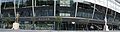
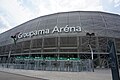
The Groupama Aréna, commonly referred to as Ferencváros Stadion, exemplifies modern stadium architecture with its all-seater configuration and a prominent green exterior that embodies the club's traditional colors, creating a visually striking "Go Green" theme visible from surrounding areas in Budapest.[4] Designed by S.A.M.O. Tervező és Ingatlanfejlesztő in 2012, the structure incorporates metal mesh facades and glass elements on the main grandstand, blending functionality with aesthetic appeal suited for both football and multi-purpose events. The stadium holds BREEAM certification for its sustainable design features.[7][17] The stadium's seating layout is organized into four principal stands—North, South, East, and West—offering comprehensive coverage for spectators, with all 23,704 seats protected under a metal-sheet roof.[1][2] This total capacity reduces to 22,000 for UEFA-governed international matches to ensure compliance with required distances from the pitch to seating areas.[1] Premium facilities include 34 luxury skyboxes and 2,969 VIP seats, primarily concentrated on the West stand, which also houses commercial spaces like a club museum and megastore.[7][1] At the heart of the venue lies a regulation football pitch measuring 105 meters by 68 meters, surfaced with a hybrid natural grass system reinforced by polypropylene fibers for improved resilience and playability, a feature introduced upon the stadium's 2014 opening.[18][3] Nighttime events are supported by integrated LED floodlights, ensuring optimal visibility across the field and stands. Accessibility is enhanced through dedicated ramps and seven high-efficiency elevators, promoting ease of navigation for all visitors, including those with mobility needs.[4]Construction Details and Costs
The construction of Ferencváros Stadion, known as Groupama Aréna, was completed in 2014 at an initial cost of approximately €40 million, funded primarily through direct investments by the Hungarian government as part of a wider national program to modernize sports infrastructure during the 2010s; the final cost reached around €47 million (HUF 14.7 billion).[1][19][20] The project encompassed extensive site preparation, including the demolition of the previous Albert Flórián Stadion in spring 2013 and the rotation of the new stands by 90 degrees to optimize layout and access. Materials played a central role in the build, with structural concrete usage totaling around 25,000 cubic meters and the roof steel structure weighing about 2,700 tons, highlighting the scale of engineering required for a multi-purpose venue of this capacity. Labor and construction were managed by domestic contractor Market Építő Zrt., completing the work in just 14 months despite the tight budget, which had risen from an initial HUF 13.5 billion.[7][21][1] Financial aspects were bolstered by sponsorship integration, with naming rights secured by the French insurance company Groupama starting in July 2014, providing ongoing revenue streams beyond the initial build. Post-construction, the stadium is owned by the Hungarian state through Magyar Nemzeti Vagyonkezelő Zrt., while operations are managed by Sportfive Hungary Ltd., with Ferencvárosi TC as the primary tenant.[22][23][2]Facilities and Innovations
Visitor Amenities
The Fradi Museum, opened on August 7, 2014, serves as a dedicated space for visitors to explore the rich legacy of Ferencvárosi TC through an array of club trophies, historical exhibits, and interactive displays highlighting the club's more than 120-year history since its founding in 1899.[24][25] The museum showcases around 300 relics, including memorabilia from key achievements across various sports, offering an immersive experience that educates fans on the club's cultural and sporting significance.[25] Access is available during specified hours, with guided stadium tours often incorporating the museum for a complete behind-the-scenes look.[26] Catering options at the stadium include concession stands offering a variety of food and beverage choices for spectators, supported by a cashless payment system introduced in 2014 using fan cards for efficient transactions.[27] This setup streamlines purchases during events, reducing wait times and enhancing convenience for attendees. The stadium provides extensive restroom facilities distributed across levels to accommodate large crowds, along with heated seats in premium seating areas for added comfort during matches.[28] These amenities ensure accessibility and hygiene standards suitable for a UEFA Category 4 venue.[28] VIP services feature all-inclusive lounges and 34 skyboxes capable of hosting up to 500 guests, offering exclusive views, catered dining, and private accommodations for corporate or high-end spectators.[2][7] These spaces emphasize luxury and personalization, with direct pitch access and enhanced facilities.[29] To support diverse visitors, the stadium includes designated family zones for those attending with children, accessible via specific gates, and provides designated accessible parking spaces for disabled visitors to facilitate easy entry and mobility, including a new area established in 2025 through a partnership with Provident.[6][30] These features promote inclusivity, with additional accommodations like wheelchair-accessible seating integrated throughout the venue.[31]Technological and Sustainability Features
The Groupama Aréna incorporates advanced biometric technology for secure and efficient entry, particularly for season ticket holders. In 2014, upon the stadium's opening, it became the first venue in Hungary to implement a palm vein recognition system developed by BioSec, which scans unique vascular patterns in the hand to authenticate fans and prevent unauthorized access or hooliganism. This innovation has processed over 100,000 entries without reported incidents of violence in its initial years, enhancing safety while reducing entry times.[32][33][34] Sustainability features are integral to the stadium's design, aligning with BREEAM certification standards for eco-efficiency.[10] The venue collects rainwater for irrigation and other non-potable uses, minimizing water consumption. Energy-efficient LED lighting illuminates the interior and exterior, supplemented by natural daylight through extensive glazed facades. Additionally, a rooftop solar panel system comprising 1,350 panels with a 499 kW capacity generates approximately 600,000 kWh annually, covering a portion of the stadium's electricity needs, while a 100 m² solar collector supports 40% of hot water requirements.[35][36][37] Digital infrastructure supports modern fan experiences with comprehensive Wi-Fi coverage available throughout the 22,700-seat arena, enabling connectivity for spectators during events. Two large LED scoreboards, each measuring 63 square meters, provide high-resolution displays for match statistics, replays, and advertisements, ensuring visibility from all seating areas.[38][39] The playing surface employs a Desso GrassMaster hybrid pitch system, combining natural grass with synthetic fibers for enhanced durability and stability, including undersoil heating to maintain optimal conditions year-round. Security measures include a high-resolution CCTV network integrated with access controls, contributing to the overall safety framework alongside the biometric entry system.[40][41]Tenants and Usage
Primary Tenants
The primary tenant of Ferencváros Stadion, also known as Groupama Aréna, is Ferencvárosi TC (FTC), the Hungarian professional football club, which has used the venue as its home ground since the stadium's opening in 2014.[42] FTC hosts its Nemzeti Bajnokság I (NB I) league matches, UEFA Europa League and Conference League fixtures, and training sessions at the stadium, with a capacity tailored to accommodate its fanbase for domestic and European competitions.[2] The Hungarian national football team has occasionally utilized the stadium as a home venue from 2014 to 2019, primarily for UEFA Euro qualifiers and international friendlies, including matches against Croatia, Wales, Slovakia, and Azerbaijan in 2019.[1] This usage supported the team's campaigns during a period when the stadium met UEFA Category 4 standards for international play.[3] In 2018, MOL Vidi FC (now Fehérvár FC) served as a temporary tenant for its UEFA Europa League group stage home matches, including fixtures against BATE Borisov, PAOK FC, and Chelsea FC, due to renovations at its own Sóstói Stadion that prevented compliance with UEFA requirements.[43] The stadium is owned by the Hungarian state and operated under long-term agreement by Lagardère Unlimited Stadium Solutions, a subsidiary of the Lagardère Group, which manages ticketing, marketing, and event operations to ensure commercial viability.[15] Non-football usage is limited, focusing mainly on corporate events and conferences, complementing its primary role in sports.[42]Football Events and Competitions
The Groupama Aréna, formerly known as Ferencváros Stadion, primarily hosts the home matches of Ferencvárosi TC in the Nemzeti Bajnokság I (NB I), Hungary's premier football league. As the club's main venue since its opening in 2014, it accommodates approximately 15-20 regular season games per campaign, allowing Ferencvárosi TC to compete in the 33-round schedule that defines the domestic championship. These fixtures form the core of the stadium's football calendar, drawing consistent support from the club's dedicated fanbase. In European competitions, the stadium has been a key site for Ferencvárosi TC's UEFA engagements since 2014, featuring qualifiers and group stage matches in the UEFA Champions League and UEFA Europa League. The club has advanced to the Champions League group stage on one occasion and the Europa League group stage three times, alongside participation in the UEFA Conference League group stage once, with all home legs played at the arena to meet UEFA's Category 4 standards.[44] Domestically, the venue supports cup competitions through hosting various rounds of the Magyar Kupa, Hungary's premier knockout tournament, including multiple finals that underscore its role in national football events.[3] The stadium also sees occasional use for lower-tier games, such as those involving Ferencvárosi TC's youth academy teams and the women's squad in the NB I Women league, providing a professional setting for developmental and gender-specific competitions. Record crowds for NB I league games, especially high-stakes derbies against rivals like Újpest FC, have surpassed 20,000 spectators, reflecting the intense local rivalries that energize the venue.[45]Entertainment and Other Events
Concerts
The Ferencváros Stadion, operating as Groupama Aréna, has established itself as a premier venue for major international music tours since its 2014 opening, hosting high-profile performances that draw tens of thousands of attendees while utilizing its flexible layout for stage configurations on the pitch area. The stadium's first major concert occurred on May 22, 2017, when Depeche Mode headlined their Global Spirit Tour, selling out the event with 25,200 fans in attendance and marking the venue's debut as a concert space. Later that summer, on August 23, Robbie Williams delivered a dynamic show from his Heavy Entertainment Show Tour, supported by synth-pop duo Erasure, captivating a large crowd with hits spanning his solo career and Take That era.[46] Subsequent years saw a diverse array of rock and metal acts take the stage. Iron Maiden performed on June 7, 2022, during their Legacy of the Beast World Tour, with openers Shinedown and Lord of the Lost, achieving an attendance of 21,206 and featuring elaborate theatrical elements inspired by the band's comic book mythology.[47] Hungarian artists have also featured prominently, including local electronic group F.O.X. as the opening act for Depeche Mode's 2017 show, blending synthwave influences with the headliners' electronic legacy.[48] The arena's multi-purpose architecture supports concert adaptations by placing temporary stages on the field, maintaining a typical capacity of around 22,000 while ensuring optimal sightlines and sound coverage across all sections.[28]Cultural Impact
The Groupama Aréna, home to Ferencvárosi TC, has emerged as a potent symbol of revival in Budapest's Ferencváros district, blending historical significance with modern urban renewal following its 2014 opening. The stadium's construction aligned with broader efforts to modernize Hungarian football infrastructure, replacing the aging Flórián Albert Stadium and catalyzing district-wide regeneration through contemporary architecture and public spaces.[49][28] This post-2014 transformation reflects national ambitions to elevate football facilities, positioning the arena as a beacon of progress in a neighborhood long associated with the club's green-and-white heritage.[1] Community engagement at the stadium fosters deep ties between Ferencvárosi TC and local residents, with initiatives like fan festivals, club anniversary celebrations, and educational programs hosted through the Fradi Museum. The museum, integrated into the arena complex, offers interactive exhibits on the club's 125-year history, including contests, memorabilia displays, and guided stadium tours that educate visitors on Ferencváros' legacy while promoting fan loyalty.[26][30] These activities extend to broader CSR efforts, such as youth-oriented events that encourage participation in club traditions and sports heritage.[50] Economically, the stadium has provided a significant boost to the local area, generating revenue through events, matches, and tourism while creating ongoing opportunities in hospitality and services. By 2016, just two years after opening, the arena achieved profitability with €10 million in sales returns, rising further in subsequent years and supporting thousands of jobs in Budapest's tourism sector.[51] Its role in attracting international visitors for football and cultural events has enhanced the district's vibrancy, contributing to sustained economic growth in the 2020s.[52] The arena's design and operations have earned international acclaim, including a nomination for Stadium of the Year 2015 by StadiumDB.com and the Best New Venue award at TheStadiumBusiness Awards in 2015, highlighting its excellence in fan experience and multipurpose functionality.[53][1] These recognitions underscore the stadium's contributions to elevating spectator comfort and event hosting standards. Social initiatives linked to the stadium emphasize inclusivity and development, with Ferencvárosi TC's "Ferencváros Against Racism" campaign utilizing the Groupama Aréna for awareness-raising events and matchday policies to combat discrimination. In partnership with Football Against Racism in Europe (FARE), these efforts have reduced racist incidents at the venue and engaged the community in promoting diversity.[54] Youth development programs, including academy training and community sports sessions, leverage the stadium's facilities to nurture talent and foster social responsibility among young fans.[55]Notable Matches
Milestone Matches
The Ferencváros Stadion, known as Groupama Aréna for sponsorship purposes, opened with a friendly match on 10 August 2014, where Ferencváros faced Chelsea FC, losing 1–2 in front of an attendance of 20,000 spectators. Zoltán Gera scored the home side's only goal in the 22nd minute, but Ramires and Cesc Fàbregas replied for the visitors in the second half, marking the stadium's inaugural fixture and highlighting its readiness for high-profile encounters.[56] The first competitive victory at the venue came in the Hungarian NB I on 24 August 2014, when Ferencváros defeated Nyíregyháza Spartacus 3–1. Attila Busai opened the scoring in the 13th minute, followed by goals from Zoltán Gera and Leonardo, securing a 3–1 win that established the stadium as a fortress for domestic league play.[57] Ferencváros' European competitive debut at the stadium occurred on 9 July 2015 in the UEFA Europa League first qualifying round second leg against Go Ahead Eagles, resulting in a 4–1 victory (aggregate 5–2). Goals from Zoltán Gera (two), Dániel Böde, and Zsolt Haraszti advanced the club to the next round, providing valuable experience for future continental campaigns despite the overall elimination later in the tournament. (primary source: UEFA match report via uefa.com archives for 2015/16 season.)[58] The stadium's highest-scoring home match to date took place on 20 April 2025 in the NB I, where Ferencváros thrashed Nyíregyháza Spartacus 7–0, setting a club record for margin of victory at the venue. Goals were scored by Alekszandar Pesic (two), Matheus Saldanha (two), Alex Tóth, Lenny Joseph, and Barnabás Varga, underscoring the team's dominance in domestic competitions during their ongoing title streak.[59] In the 2024–25 season, Ferencváros achieved a notable milestone in the UEFA Europa League league phase with a 3–1 home win over Ludogorets Razgrad on 6 November 2025, their first victory in this format at the stadium. Goals from G. Kanichowsky, another Ferencváros player, and Leo Joseph secured the points, boosting the club's European standing and demonstrating improved competitiveness on the continental stage.[60]National Team and Cup Finals
The Groupama Aréna served as the temporary home venue for the Hungarian national football team from its opening in 2014 until 2019, hosting a total of 23 matches during key qualification campaigns for UEFA Euro 2016, the 2018 FIFA World Cup, UEFA Euro 2020, and the inaugural UEFA Nations League.[1] This period marked a revival in Hungarian football, with the stadium's modern facilities and passionate fan support contributing to memorable performances, including the team's qualification for Euro 2016 after a 44-year absence. Notable fixtures included the Euro 2016 play-off second leg against Norway on 15 November 2015, where Hungary secured a 2-1 victory to advance, and various qualifiers that drew fervent crowds despite the venue's capacity limit of around 22,000 seats for international games.[1] The atmosphere at national team matches was renowned for its intensity, with supporters creating an intimidating environment that boosted team morale and pressured opponents. The highest recorded attendance was 21,800 for the 2018 World Cup qualifier against Portugal on 3 September 2017, a tense 0-1 defeat that highlighted the stadium's electric energy despite the result.[61] The final national team game at the arena was a 1-0 victory over Wales in a Euro 2020 qualifier on 11 June 2019, with Máté Pátkai's late goal in front of 18,350 fans sealing a crucial win.[62] Following the completion of the larger Puskás Aréna in late 2019, all subsequent home internationals shifted there to accommodate greater crowds.[1] In addition to international fixtures, the Groupama Aréna has been a prominent host for Magyar Kupa finals, establishing itself as a neutral venue for these high-stakes domestic clashes from 2015 onward. The 2014–15 final saw Ferencváros triumph 4–0 over Diósgyőr on 20 May 2015, with goals from Leonardo, Gergő Lovrencsics (two), and Zoltán Gera, drawing a lively crowd to celebrate the home team's dominance. Subsequent finals included the 2015–16 edition, where Videoton edged Ferencváros 1–0 on 14 May 2016; the 2016–17 final, a 2–1 Ferencváros win against MTK Budapest on 31 May 2017; the 2017–18 clash ending in Újpest's 1–0 victory over Puskás Akadémia on 23 May 2018; and the 2018–19 final, where Honvéd defeated Videoton 1–0 on 25 May 2019. These events up to 2019 showcased the stadium's suitability for cup deciders, with post-2019 finals relocating to the Puskás Aréna for expanded capacity.[63] The finals often featured intense rivalries and contributed to the venue's reputation for hosting decisive, atmosphere-driven encounters in Hungarian football.Attendance and Statistics
Average Attendances
The average attendance at Ferencváros Stadion for Ferencvárosi TC's home matches in the Nemzeti Bajnokság I has shown steady growth since the stadium's opening in 2014, reflecting the club's on-field success and improved fan engagement. In the 2014–15 season, the average stood at approximately 8,500 spectators per match, marking a significant increase from the club's previous venue, where figures hovered around 5,000 to 6,000 in the early 2010s. By the 2024–25 season, this had risen to 11,493, driven by consistent title challenges and broader appeal.[64][65] Key factors influencing these trends include the club's multiple league titles, such as the 2018–19 and 2022–23 NB I victories, which correlated with attendance peaks like the 10,715 average in 2019. European campaigns have also boosted numbers, with home legs in UEFA competitions often drawing crowds exceeding 18,000, such as the 18,789 for a 2025 Europa League match against Ludogorets Razgrad. Derby fixtures against rivals like Újpest FC further elevate turnout, frequently approaching sell-outs with over 18,000 spectators in recent home Budapest derbies.[64][60][66] The COVID-19 pandemic disrupted this upward trajectory temporarily; the 2020–21 season saw a reduced average of about 7,623 across the limited home games with spectators due to restrictions, but post-recovery figures rebounded strongly, reaching 8,709 in 2021–22 and stabilizing above 10,000 thereafter. Into the 2025–26 season, data as of November 2025 indicates levels at 10,376 after six home matches, suggesting continued growth amid the club's ongoing dominance and above the league average of around 4,500.[67][68][69]| Season | Average Home Attendance | Notes |
|---|---|---|
| 2014–15 | 8,500 | Post-stadium opening rise |
| 2018–19 | 10,715 | Title-winning season peak |
| 2020–21 | 7,623 | COVID-impacted (limited games) |
| 2021–22 | 8,709 | Post-COVID rebound |
| 2024–25 | 11,493 | Recent high with European involvement |
| 2025–26 (partial, as of Nov 2025) | 10,376 | After 6 matches; ongoing trend |