Hubbry Logo
Hemoglobin subunit alphaHemoglobin subunit alphaMain
Open search
Hemoglobin subunit alpha
Community hub
Hemoglobin subunit alpha
logo
8 pages, 0 posts
0 subscribers
Be the first to start a discussion here.
Hemoglobin subunit alpha
from Wikipedia

HBA1
Available structures
PDBOrtholog search: PDBe RCSB
Identifiers
AliasesHBA1, HBA-T3, HBH, hemoglobin subunit alpha 1, METHBA, ECYT7
External IDsOMIM: 141800; MGI: 96015; HomoloGene: 469; GeneCards: HBA1; OMA:HBA1 - orthologs
Orthologs
SpeciesHumanMouse
Entrez
Ensembl
UniProt
RefSeq (mRNA)

NM_000558

NM_008218

RefSeq (protein)

NP_000508
NP_000508.1
NP_000549.1

NP_001077424

Location (UCSC)Chr 16: 0.18 – 0.18 MbChr 11: 32.23 – 32.23 Mb
PubMed search[3][4]
Wikidata
View/Edit HumanView/Edit Mouse

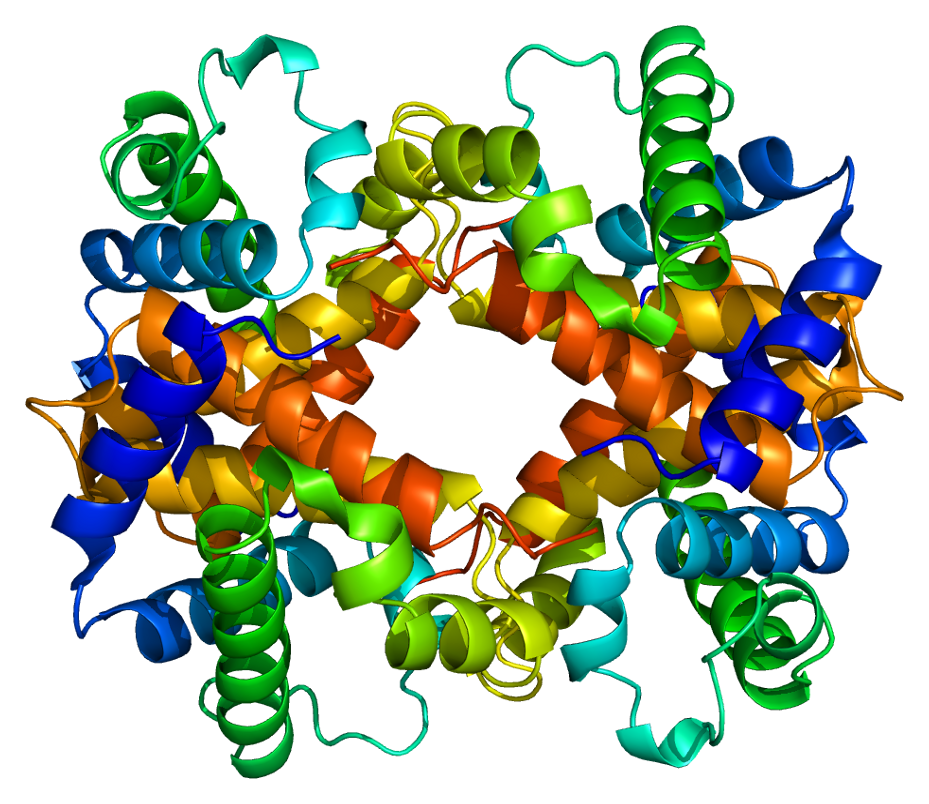
Hemoglobin subunit alpha, Hemoglobin, alpha 1,[5] is a hemoglobin protein that in humans is encoded by the HBA1 gene.[6]

Gene

[edit]

The human alpha globin gene cluster located on chromosome 16 spans about 30 kb and includes seven loci: 5'- zeta - pseudozeta - mu - pseudoalpha-1 - alpha-2 - alpha-1 - theta - 3'. The alpha-2 (HBA2) and alpha-1 (HBA1; this gene) coding sequences are identical. These genes differ slightly over the 5' untranslated regions and the introns, but they differ significantly over the 3' untranslated regions.[6]

Protein

[edit]

Two alpha chains plus two beta chains constitute HbA, which in normal adult life accounts for about 97% of the total hemoglobin; alpha chains combine with delta chains to constitute HbA-2, which with fetal hemoglobin (HbF), composed of alpha and gamma chains, make up the remaining 3% of adult hemoglobin.[6]

Clinical significance

[edit]

Alpha thalassemias result from deletions of each of the alpha genes as well as deletions of both HBA2 and HBA1; some nondeletion alpha thalassemias have also been reported.[6]

Interactions

[edit]

Hemoglobin subunit alpha has been shown to interact with hemoglobin subunit beta (HBB).[7][8]

See also

[edit]

References

[edit]

Further reading

[edit]
[edit]
Revisions and contributorsEdit on WikipediaRead on Wikipedia
from Grokipedia
Hemoglobin subunit alpha is a subunit that forms two of the four chains in the tetrameric structure of adult (HbA), the primary oxygen-transporting protein found in red blood cells. Encoded by the HBA1 and HBA2 genes located in the alpha-globin gene cluster on the short arm of , the alpha subunit is a 141-amino-acid polypeptide with a molecular weight of approximately 15.25 kDa. It binds a —a ring complexed with ferrous iron—that reversibly coordinates oxygen, enabling the cooperative binding and release of up to four oxygen molecules per hemoglobin tetramer (composed of two alpha and two beta subunits). The protein's structure features eight alpha-helices (labeled A through H), with the heme group nestled in a pocket between the E and F helices, stabilized by a proximal residue (His87) and modulated by a distal (His58) for oxygen affinity. In its functional role, hemoglobin subunit alpha facilitates the transport of oxygen from the lungs to peripheral tissues while also aiding in and delivery, with by effectors like 2,3-bisphosphoglycerate (2,3-BPG) that bind at the alpha-beta interface to decrease oxygen affinity in low-oxygen environments. The alpha subunits contribute to the tetramer's quaternary structure through stable alpha1-beta1 and sliding alpha1-beta2 interfaces, which undergo conformational shifts between tense (T, deoxy) and relaxed (R, oxy) states to achieve sigmoidal oxygen-binding kinetics with a P50 value of about 26 mmHg. Mutations or deletions in HBA1 or HBA2 can lead to , a group of inherited blood disorders characterized by reduced or absent alpha-globin production, resulting in ineffective and varying degrees of , from mild (carrier state) to severe ( or ). The alpha subunit also interacts with chaperone proteins like alpha-hemoglobin stabilizing protein (AHSP) to prevent aggregation of free alpha chains, ensuring proper assembly into functional .

Genetics

Gene Location and Structure

The hemoglobin subunit alpha is encoded by two nearly identical genes, HBA1 and HBA2, located on the short arm of at cytogenetic band 16p13.3 within the alpha-globin . The cluster spans approximately 30 kb and is arranged from the telomeric (5') to centromeric (3') direction as follows: the embryonic zeta-globin gene (HBZ), pseudozeta-globin, mu-globin, pseudoalpha-1, HBA2 (proximal to the locus control region), HBA1 (distal to HBA2), and the theta-1 globin gene (HBQ1). Each gene spans approximately 1.1 kb and consists of three exons interrupted by two small introns of about 100-150 bp each. Exon 1 (roughly 92 bp) encodes the N-terminal region, including helices A and B; exon 2 (about 224 bp) encodes the central portion with the E helix and the heme-binding pocket; and exon 3 (approximately 113 bp) encodes the C-terminal region, including helices G and H. The HBA1 and HBA2 genes share identical coding sequences but differ by four nucleotides in their noncoding regions (primarily in introns and untranslated regions), resulting in production of the same 141-amino-acid alpha-globin protein from both. The cluster also includes upstream zeta-globin genes that are expressed during embryonic development. The alpha-globin gene cluster exhibits high sequence similarity across mammalian species, underscoring its evolutionary conservation for oxygen transport functions. A key regulatory element, the locus control region (LCR) spanning 10-15 kb upstream, enhances high-level expression of the cluster (as detailed in the Expression and Regulation section).

Expression and Regulation

The expression of hemoglobin subunit alpha (α-globin) genes is restricted to erythroid precursor cells and is dynamically regulated across developmental stages to ensure appropriate production. During early embryogenesis, the ζ-globin gene, located upstream in the α-like cluster, is predominantly expressed in primitive erythroid cells, pairing with ε-globin chains to form embryonic hemoglobins such as Hb Gower and Hb Portland. This embryonic pattern transitions around 5–6 weeks of , with a progressive switch to α-globin expression that becomes dominant by the fetal stage and persists at high levels in definitive erythroid lineages throughout postnatal life. This developmental timing is orchestrated by the spatial organization of the and interactions with upstream enhancers, maintaining high α-globin output in maturing erythroblasts to support oxygen transport demands. The α-globin locus features a complex array of regulatory elements that coordinate long-range transcriptional control. The locus control region (LCR), positioned approximately 40 kb upstream of the ζ-globin gene, contains multiple DNase I hypersensitive sites (HS-40 through HS-1) that function as enhancers to activate and synchronize expression across the cluster. Among these, the multispecies conserved sequences (MCS-R1 to MCS-R4), corresponding to HS-48, HS-40, HS-33, and HS-10, are critical for stage-specific regulation; notably, MCS-R2 (HS-40) is indispensable for high-level α-globin transcription by facilitating looping and promoter interactions. These elements ensure erythroid-specific activation while repressing expression in non-erythroid tissues, with conserved motifs binding lineage-specific factors to adapt expression to developmental needs. Quantitative of α-globin production is maintained by the four functional alleles (two HBA2 and two HBA1 genes in diploid cells), which collectively synthesize α-chains in precise stoichiometric balance with β-chains to form adult (α₂β₂). In healthy adults, this results in α-globin contributing approximately half the mass of circulating , supporting total levels of 14–18 g/dL. Any imbalance, such as overproduction of α-chains relative to β-chains, leads to toxic accumulation of free α-globin tetramers, precipitating in erythroid precursors and contributing to the pathophysiology of β-thalassemia. Transcriptional activation involves erythroid-specific factors like and KLF1, which bind promoter regions and LCR elements to drive high-level expression during terminal erythroid differentiation; recruits co-activators to initiate , while KLF1 amplifies output by integrating signals from upstream enhancers. Post-transcriptionally, the miR-144/451 cluster modulates α-globin mRNA stability and translation efficiency in erythroblasts, with miR-144 selectively repressing embryonic α-hemoglobin synthesis to facilitate the ζ-to-α switch and miR-451 targeting regulators of mRNA decay to prevent excess accumulation. These mechanisms collectively fine-tune α-globin levels, ensuring balanced hemoglobin assembly without disrupting .

Molecular Properties

Primary Sequence and Tertiary Structure

The hemoglobin subunit alpha, also known as alpha-globin, is a polypeptide chain composed of 141 amino acids, resulting in a molecular weight of approximately 15.3 kDa. Its primary sequence begins with the N-terminal tripeptide Val-Leu-Ser, followed by Pro-Ala-Asp-Lys-Thr-Asn-Val-Lys-Ala-Ala-Trp-Gly-Lys-Val-Gly-Ala-His-Ala-Gly-Glu-Tyr, and includes several conserved residues critical for function, such as histidine at position 87 (His87, serving as the proximal heme ligand) and phenylalanine at position 43 (Phe43, positioned in the distal heme pocket). Compared to the beta-globin chain, the alpha chain is shorter by five amino acids, contributing to subtle differences in overall polypeptide length while maintaining the core globin motif. The isoelectric point (pI) of the alpha subunit is approximately 7.7, influenced by its relatively high content of basic residues like lysine and arginine, which affect solubility and interactions in physiological conditions. The tertiary structure of the alpha-globin chain adopts the canonical globin fold, characterized by eight alpha-helices designated A through H, which form a compact globular domain that encapsulates the heme prosthetic group. This fold is stabilized by hydrophobic interactions and hydrogen bonds, with the heme bound non-covalently in a crevice between the E and F helices; the iron atom at the heme center is axially coordinated by the imidazole nitrogen of His87 (F8) on the proximal side, while the distal side accommodates ligands like molecular oxygen via His58 (E7). Key structural features include the shorter H helix in alpha-globin relative to beta-globin, and stabilizing salt bridges in the deoxy conformation, such as the salt bridge between Asp126 (H9) of one alpha chain and Arg141 (HC3) of the other alpha chain, which helps maintain the tense (T) state and modulates oxygen affinity.60954-4) Post-translational modifications play a role in the maturation and regulation of alpha-globin. The N-terminal residue undergoes in about 50% of the chains, a modification that influences the protein's charge and potential interactions during hemoglobin assembly. Additionally, sites, such as those at serine 31 and 48, have been identified and may contribute to regulatory mechanisms, including responses to cellular stress or signaling pathways, though their precise roles remain under investigation.

Role in Hemoglobin Assembly

The of the alpha-globin subunit occurs through of its mRNA on ribosomes within erythroid precursors, primarily in proerythroblasts, basophilic and polychromatophilic erythroblasts, and reticulocytes. This process is tightly coordinated with synthesis to ensure proper folding and functionality, with alpha-globin chains emerging as apo-proteins that require rapid stabilization to avoid aggregation. A key player in this stabilization is the alpha-hemoglobin stabilizing protein (AHSP), an erythroid-specific chaperone that binds reversibly to free apo-alpha-globin subunits, preventing their precipitation and limiting the generation of . AHSP facilitates alpha-globin folding and promotes insertion post-translationally, with association rates approximately 20 times faster for AHSP-alpha than for alpha-beta interactions (k' ≈ 10 μM⁻¹ s⁻¹ versus 0.5 μM⁻¹ s⁻¹). In the absence of AHSP, free alpha chains are prone to denaturation and toxicity, as observed in AHSP-deficient models exhibiting erythrocyte inclusions and . Hemoglobin assembly proceeds in the of normoblasts through a sequential process: individual alpha and beta (or gamma) subunits first form stable αβ (or αγ) heterodimers via specific interfaces, followed by the association of two such dimers into the α₂β₂ tetramer () or α₂γ₂ ( F). insertion occurs spontaneously and rapidly after or during subunit folding, driven in part by dimer formation, with beta chains binding prior to complexing with alpha in some pathways. The same alpha chains are utilized in both adult and fetal assembly, though gamma-alpha dimerization is slower than beta-alpha (by a factor of ~4 × 10⁵), reflecting differences in subunit interfaces. Maintaining stoichiometric balance is critical, as alpha and beta (or gamma) chains must be produced in equimolar amounts for efficient tetramerization; excess alpha-globin is toxic due to its instability and propensity for oxidative damage. AHSP binds these excess chains, promoting their degradation via pathways that mitigate proteotoxicity, while ensuring levels remain below those of beta-globin to avoid inhibiting assembly (AHSP concentrations are typically 10-20% of beta). Final hemoglobin maturation, including any residual assembly, occurs in reticulocytes as they enucleate and circulate.

Physiological Functions

Oxygen Transport Mechanism

The alpha subunits of play a central role in the of oxygen within the α₂β₂ tetramer, primarily through their formation of key interfaces with the beta subunits, notably the α₁β₂ contacts. These interfaces undergo significant conformational changes during oxygenation, facilitating the transmission of binding events across the . In the deoxy (T, tense) state, the tetramer adopts a compact structure with low oxygen affinity, while binding of oxygen induces a switch to the oxy (R, relaxed) state, characterized by higher affinity. This transition is initiated at the heme group, where the iron atom moves approximately 0.6 Å into the plane of the porphyrin ring upon oxygenation, pulling on the proximal (His F8) and triggering tertiary changes in the subunit that propagate to the intersubunit interfaces. Allosteric regulation further modulates this mechanism, with the alpha subunits contributing to both effector binding and pH sensitivity. The molecule 2,3-bisphosphoglycerate (2,3-BPG) binds in the central cavity of the deoxy tetramer, forming ionic interactions with residues from both alpha (e.g., Val NA1, His NA2, Lys EF6) and beta subunits, thereby stabilizing the T state and reducing oxygen affinity to promote unloading in tissues. The , which decreases oxygen affinity at lower , involves of specific residues, including 122 (HC3) on the alpha chain, whose imidazole side chain forms a in the T state that breaks upon transition to the R state, releasing protons. The kinetics of oxygen binding reflect the alpha subunits' influence on dimer stability and overall . Adult exhibits a P₅₀ of approximately 26 mmHg under physiological conditions, representing the oxygen at 50% saturation. The Hill , a measure of , is about 2.8, indicating positive less than the theoretical maximum of 4; the alpha chains enhance αβ dimer stability, which is crucial for the subunit rearrangements that amplify binding at intermediate saturations. The overall binding reaction is: \ceHb+4O2Hb(O2)4\ce{Hb + 4 O2 ⇌ Hb(O2)4} This is quantitatively described by the Adair equation, which models the four stepwise association constants (K₁ to K₄): Y=K1p+2K1K2p2+3K1K2K3p3+4K1K2K3K4p44(1+K1p+K1K2p2+K1K2K3p3+K1K2K3K4p4)Y = \frac{K_1 p + 2 K_1 K_2 p^2 + 3 K_1 K_2 K_3 p^3 + 4 K_1 K_2 K_3 K_4 p^4}{4 (1 + K_1 p + K_1 K_2 p^2 + K_1 K_2 K_3 p^3 + K_1 K_2 K_3 K_4 p^4)} where Y is the fractional saturation and p is the oxygen partial pressure; the alpha subunits particularly influence the mid-range constants K₂ and K₃, corresponding to the major allosteric transitions.

Non-Hematopoietic Roles

Alpha-globin, traditionally known for its role in erythroid oxygen transport, exhibits expression in various non-hematopoietic tissues, where it performs functions independent of canonical tetramers. These roles include oxygen sensing, regulation, and defense, often as monomers or dimers stabilized by chaperones like alpha-hemoglobin stabilizing protein (AHSP). In neuronal cells, alpha-globin is expressed in neurons of the and mesencephalic regions, as well as in hippocampal and cortical areas, where it contributes to mitochondrial and delivery to support under normoxic conditions. This expression facilitates iron and protects against by binding , with levels decreasing in aging brains and further reduced in α-synucleinopathies such as due to complex formation with α-synuclein that impairs mitochondrial localization. In Parkinson's models, neuronal alpha-globin overexpression leads to neuron loss and motor deficits, highlighting its delicate balance in . Within vascular tissues, free alpha-globin in endothelial cells functions as a (NO) scavenger by binding NO via its iron, thereby limiting NO diffusion to vascular and regulating to maintain vascular tone. Under hypoxic conditions, endothelial alpha-globin shifts to reductase activity, locally generating NO to promote and ensure oxygen delivery, a process enhanced by interaction with endothelial (eNOS) at myoendothelial junctions. Additionally, alpha-globin exhibits peroxidase-like activity in these cells, detoxifying peroxides and mitigating oxidative damage during inflammation or . Alpha-globin is also detected in other non-hematopoietic sites, such as the and , where it responds to local hypoxia without forming tetrameric . In placental syncytiotrophoblasts, hypoxia induces alpha-globin upregulation, mimicking patterns in preeclamptic tissues and aiding oxygen sensing to support fetal development under low-oxygen environments. In , mitochondrial alpha-globin expression increases during hypoxia, contributing to intracellular oxygen buffering and protection independent of erythroid . Recent research has illuminated alpha-globin's vascular roles in disease contexts, such as β-thalassemia, where excess free alpha-globin chains precipitate in erythrocytes but also dysregulate endothelial NO signaling, exacerbating vascular complications like through enhanced scavenging. A study further demonstrated that alpha-globin in resistance artery acts as a hypoxia-responsive reductase, providing localized NO without evidence of α₂β₂ tetramers for oxygen buffering, underscoring its monomeric moonlighting functions. These findings, building on post-2020 insights, highlight alpha-globin's therapeutic potential in modulating non-erythroid hypoxia responses.

Clinical Aspects

Associated Genetic Disorders

is the primary genetic disorder associated with deficiencies in the subunit alpha, resulting from reduced or absent production of alpha-globin chains due to deletions or mutations in the alpha-globin gene cluster on chromosome 16. This imbalance leads to excess unpaired beta- or gamma-globin chains that form unstable tetramers, such as H (HbH, β4) in postnatal life or Bart's (Hb Bart's, γ4) in fetal life. These tetramers have high oxygen affinity but are prone to precipitation, causing oxidative damage to red blood cells, ineffective , chronic , and microcytosis. The clinical severity of alpha-thalassemia correlates with the number of affected alpha-globin genes, as humans typically have four (two per ). Deletion of one results in a silent carrier state, which is asymptomatic with minimal hematologic changes. Deletion of two genes causes trait, characterized by mild microcytic without significant clinical symptoms. HbH disease, arising from deletion of three genes, manifests as moderate to severe , , and growth retardation, with episodic exacerbations triggered by infections or due to the formation of unstable β4 tetramers. Complete deletion of all four genes (α0-thalassemia) leads to Hb Bart's syndrome, a lethal condition in utero marked by severe fetal , tissue hypoxia, edema, and often ; without intervention, it results in or neonatal death shortly after birth. Alpha-thalassemia is most prevalent in regions with historical endemicity, particularly , where carrier rates can reach up to 10% in some populations, such as in and . The silent carrier state predominates in these areas, contributing to a high burden of compound heterozygous states like HbH disease. Diagnosis of syndromes relies on a combination of hematologic and molecular tests. In HbH disease, or (HPLC) detects elevated HbH levels (5-30%), while with brilliant cresyl blue reveals characteristic golf ball-like in erythrocytes. For , prenatal diagnosis involves or to identify complete alpha-globin gene deletions, such as the common --SEA deletion prevalent in Asian populations. confirms the number and type of deletions, distinguishing from or beta-thalassemia trait.

Mutations and Variants

Mutations in the HBA1 and HBA2 genes encoding the hemoglobin subunit alpha primarily include large deletions and point mutations, which disrupt alpha-globin production or stability and underlie most forms of . Deletions account for approximately 90% of disease-causing alleles in , often removing one or both alpha-globin genes on chromosome 16. A representative example is the Mediterranean deletion (--MED), a cis-deletion of both HBA1 and HBA2 genes spanning about 16 kb, common in Mediterranean populations and leading to alpha-zero thalassemia when homozygous or compound heterozygous. Point mutations, comprising the remaining ~10% of alpha-thalassemia cases, typically cause non-deletional forms by altering splicing, introducing premature stop codons, or producing unstable protein variants. Hemoglobin Constant Spring (Hb CS), the most prevalent non-deletional alpha-thalassemia mutation, arises from a TAA to CAA substitution at the alpha2-globin termination codon (c.427T>C; p.142Glnext-31), resulting in readthrough translation of an elongated, unstable 172-amino-acid alpha chain with reduced expression. This variant predominates in Southeast Asian populations and exacerbates when co-inherited with deletions. Similarly, Hb Adana (HBA1 or HBA2: c.178G>A; p.Gly59Asp) introduces a missense change at codon 59, disrupting splicing and yielding a highly unstable alpha chain prone to . Among the over 800 known variants of the alpha-globin chain documented in databases like HbVar, approximately 30 are classified as hyperunstable, often due to disruptions in binding or subunit interfaces, leading to through precipitation and red cell destruction. Hb Quong Sze (HBA2: c.377T>C; p.Leu126Pro) exemplifies this class, featuring a substitution that destabilizes the pocket, promotes loss, and renders the variant undetectable by . These unstable hemoglobins typically cause congenital in heterozygotes, with severity influenced by coinheritance of other mutations. Certain alpha variants alter hemoglobin function beyond instability, notably oxygen affinity. Hb Chesapeake (HBA1 or HBA2: c.377C>T; p.Arg92Leu) substitutes at the alpha1-beta2 interface, increasing oxygen affinity, reducing , and causing familial erythrocytosis due to tissue hypoxia compensation. Such variants can interact with beta-thalassemia modifiers, modulating disease severity by affecting alpha-beta chain imbalance. A 2025 structure-function analysis generated a comprehensive mutational map of human hemoglobin A, leveraging AI and structural modeling to predict impacts of all known variants and potential novel ones, including those in alpha-globin with thalassemic or unstable phenotypes.

References

Add your contribution
Related Hubs
User Avatar
No comments yet.