Hubbry Logo
HL TauriHL TauriMain
Open search
HL Tauri
Community hub
HL Tauri
logo
8 pages, 0 posts
0 subscribers
Be the first to start a discussion here.
HL Tauri
HL Tauri
from Wikipedia
HL Tauri
Observation data
Epoch J2000      Equinox J2000
Constellation Taurus
Right ascension 04h 31m 38.437s[3]
Declination +18° 13′ 57.65″[3]
Characteristics
Evolutionary stage Pre-main-sequence star
Spectral type Class K9
Apparent magnitude (V) 15.1
B−V color index 0.92
V−R color index 0.89
J−H color index 1.45
J−K color index 3.21
Variable type T Tauri
Astrometry
Proper motion (μ) RA: +8.0±6.0[4] mas/yr
Dec.: -21.8±5.8[4] mas/yr
Distance450[1] ly
(140 pc)
Database references
SIMBADdata

HL Tauri (abbreviated HL Tau) is a young T Tauri star[5] in the constellation Taurus, approximately 450 light-years (140 pc) from Earth[1] in the Taurus Molecular Cloud.[6] The luminosity and effective temperature of HL Tauri imply that its age is less than 100,000 years.[7] At apparent magnitude 15.1,[3] it is too faint to be seen with the unaided eye. It is surrounded by a protoplanetary disk marked by dark bands visible in submillimeter radiation that may indicate a number of planets in the process of formation.[2] It is accompanied by the Herbig–Haro object HH 150, a jet of gas emitted along the rotational axis of the disk that is colliding with nearby interstellar dust and gas.[8]

Protoplanetary disk

[edit]

Indications of a protoplanetary disk were first presented in 1975 with infrared spectral observations in wavelengths between 2 and 4 microns, which were made possible by the recent invention of the indium antimonide photovoltaic detector. Of 29 very young stars examined, only HL Tauri showed a strong absorption feature centered on the expected 3.07 micron absorption of ice particles, which authors attributed to the ν1, ν3, and 2ν2 vibrational frequencies of the OH bond.[9] A 1982 survey identified HL Tauri as one of the most highly polarized T Tauri stars known, along with DG Tauri and V536 Aquilae.[10]

A gas disk was discovered by interferometric observation of carbon monoxide (CO) emissions in 1986.[11] Based on observation data in 1985 and 1986 from the Millimeter Wave Interferometer of the Owens Valley Radio Observatory, the circumstellar disk was estimated to have a mass between 0.01 M and 0.5 M, with a best fit of 0.1 M, and a radius of about 200 AU. The temperature of the gas and grains of the disk are probably of the order of a few tens of kelvins. The gas was found to be bound to and in Keplerian rotation around a star with a mass of about 1 M.[12] Bipolar outflow of molecules such as carbon monoxide (CO) and diatomic hydrogen (H2) have been observed. The element iron has also been noted in the outflow in its Fe(II) oxidation state, also called Fe2+ or ferrous iron.[13]

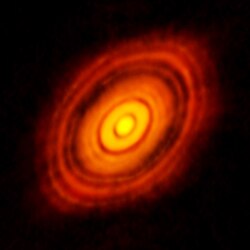
An image of the protoplanetary disk made at submillimeter wavelengths by the Atacama Large Millimeter/submillimeter Array (ALMA) was made public in 2014, showing a series of concentric bright rings separated by gaps. The disk appeared much more evolved than would have been expected from the age of the system, which suggests that the planetary formation process may be faster than previously thought.[14] ALMA's Catherine Vlahakis said, "When we first saw this image we were astounded at the spectacular level of detail. HL Tauri is no more than a million years old, yet already its disk appears to be full of forming planets. This one image alone will revolutionize theories of planet formation."[14]

Stephens et al. (2014) suggest that the faster accretion rate might be due to the complex magnetic field of the protoplanetary disk.[6]

In 2024, water was found within the protoplanetary disk using the Atacama Large Millimeter Array (ALMA), containing 3.7 Earth oceans worth of water vapour.[15][16]

[edit]

References

[edit]
[edit]
Revisions and contributorsEdit on WikipediaRead on Wikipedia
from Grokipedia
HL Tauri is a young of spectral class K7–K9 and mass approximately 1.4 times that of the Sun, located about 450 light-years (140 parsecs) away in the constellation Taurus as part of the . It is less than one million years old and is surrounded by a massive containing about 0.13 solar masses of gas and dust, extending to a radius of roughly 79 AU and inclined at approximately 47° to our line of sight. The disk around HL Tauri gained prominence in 2014 through high-resolution observations by the Atacama Large Millimeter/submillimeter Array (ALMA), which revealed a series of concentric bright rings separated by dark gaps—structures interpreted as evidence of giant planets forming and clearing material in their orbits. These features, resolved at an angular scale of about 0.04 arcseconds (corresponding to ~5 AU), were unexpectedly complex for such a young system, providing a snapshot of early planetary system architecture similar to what our Solar System may have resembled billions of years ago. Subsequent studies have further illuminated the disk's dynamics, including the detection of millimeter-sized dust grains persisting in the gaps, challenging models of rapid dust settling and supporting sustained planet-disk interactions. ALMA observations (published in 2024) confirmed water vapor abundance equivalent to at least three times that of Earth's oceans in the inner disk, linking hydration processes to planet formation environments. HL Tauri's system remains a benchmark for understanding the transition from molecular clouds to structured planetary systems, with its at 15.1 making it a key target for multi-wavelength astronomy.

Discovery and Observations

Initial Discovery

HL Tauri was first noted in 1975 through infrared spectral observations conducted at wavelengths between 2 and 4 microns, which revealed an absorption feature centered at 3.1 microns attributed to by pure water ice particles with a column density of approximately 30 μg/cm². These observations, targeting young stars in the , highlighted HL Tauri as an extremely young object with significant circumstellar material, marking its initial identification as a promising candidate for studies of early . In 1982, HL Tauri was identified as a highly polarized during a survey of stars brighter than about 13th magnitude and north of -30° declination. This survey, which measured polarization in two bands, classified HL Tauri among the most polarized examples known at the time, alongside stars like DG Tauri and V536 Aquilae, suggesting the presence of aligned dust grains in its circumstellar environment. The high polarization levels were interpreted as evidence of scattering by circumstellar dust, consistent with its location in the Taurus star-forming region. Early spectroscopic observations led to the classification of HL Tauri as a with a spectral type of approximately K7, based on photospheric absorption features observed in its optical spectrum. This classification, derived from a comprehensive study of stars in the , positioned HL Tauri as a low-mass, young in a well-known site of active . Initial distance estimates placed it approximately 450 light-years (140 parsecs) from , aligning with contemporaneous measurements of the Taurus cloud complex. A around HL Tauri was suspected from these early and polarization data but was not detailed until interferometric observations of emissions in 1986.

Key Telescopic Observations

In 1986, interferometric observations of (CO) J=1-0 line emission using the Radio Observatory revealed the presence of a around HL Tauri, confirming a gaseous component with a size of approximately 10 arcseconds in diameter and a rotationally supported structure indicative of Keplerian motion. These measurements provided the first direct evidence of extended molecular gas associated with the young star, distinguishing it from more compact emission sources. Subsequent telescopic observations detected a bipolar outflow from HL Tauri, characterized by high-velocity CO emission wings extending to ±20 km/s, suggesting active mass ejection from the accreting protostar. Near-infrared imaging and spectroscopy further identified molecular hydrogen (H₂) emission in a wide-angle morphology and forbidden [Fe II] lines tracing a collimated atomic jet, with the outflow spanning scales from 50 to 200 AU and indicating episodic ejection driven by magnetic processes. This outflow structure highlights the dynamic interplay between accretion and ejection in the system's early evolution. The bipolar outflow is closely associated with the Herbig-Haro object HH 150, identified as a prominent jet of ionized gas extending southeast from HL Tauri, with optical emission-line nebulosity confirming its origin as shocked material from the . measurements yield values of +8.0 ± 6.0 mas/yr in and -21.8 ± 5.8 mas/yr in , consistent with the system's membership in the Taurus-Auriga star-forming region. HL Tauri has an apparent visual magnitude of 15.1, making it undetectable to the and requiring telescopic observation for study. As a K7–K9 spectral type , these features underscore its role as a prototypical example of youth and activity.

Stellar Properties

Physical Characteristics

HL Tauri is a T Tauri star classified as spectral type K7–K9. It has an estimated stellar mass of approximately 0.55 M⊙, consistent with models of pre-main-sequence evolution in the Taurus region. The star is located approximately 450 light-years (140 parsecs) from Earth in the constellation Taurus, within the Taurus molecular cloud, a prominent nearby star-forming region. Due to significant extinction from surrounding material, HL Tauri appears faint with an apparent visual magnitude of 15.1, making it invisible to the naked eye. Its effective temperature is estimated at around 4100 K, with a bolometric luminosity of about 0.6 L⊙. As a young pre-main-sequence object, HL Tauri has an age of less than 1 million years.

Age and Formation Context

HL Tauri is one of the youngest known stars, with an estimated age of less than 100,000 years (∼10⁵ yr). As a , it is actively undergoing gravitational contraction, a key phase in its toward the where the collapses under its own gravity while accreting material from the surrounding envelope. This stage is characterized by high levels of accretion and outflow activity, typical of Class I young stellar objects. Its spectral class of K7–K9 further underscores its youth, reflecting the cool, veiled common in early pre-main-sequence evolution. HL Tauri originated within the , a nearby star-forming region located approximately 450 light-years (140 parsecs) from the Sun. This cloud complex, part of the broader Taurus-Auriga association, hosts numerous young stars and protostars formed from the fragmentation and collapse of dense molecular gas cores triggered by turbulence and . As a member of this cluster of nascent stars, HL Tauri exemplifies the clustered mode of low-mass prevalent in such environments, where multiple systems emerge from shared parental clouds over timescales of a few million years. The remarkably young age of HL Tauri highlights the rapid pace of early for solar-type stars, allowing observations of the immediate aftermath of protostellar ignition and the onset of disk assembly. Compared to more evolved stars, which reach ages of 1–10 million years, HL Tauri's stage reveals accelerated contraction and minimal processing of circumstellar material, offering a snapshot of the transitional period from embedded to optically visible pre-main-sequence object. This provides critical context for understanding the efficiency and timelines of early mass assembly in systems destined to resemble the young Sun.

Protoplanetary Disk

Structure and Extent

The surrounding HL Tauri extends to a radius of approximately 120 AU, as revealed by 2014 ALMA . Its total mass is estimated at 0.03–0.14 M\sun_{\sun}, consistent with a broader range of 0.01–0.5 M\sun_{\sun} from modeling, with a best-fit value around 0.1 M\sun_{\sun}. High-resolution from the Atacama Large Millimeter/submillimeter Array (ALMA) in 2014, conducted at a wavelength of 1.3 mm, uncovered a striking concentric ring-and-gap structure within the . This structure consists of alternating bright rings of dust emission and intervening dark gaps, with the most prominent gaps located at radii of approximately 13 AU, 32 AU, and 64 AU; these gaps represent zones largely cleared of millimeter-sized dust grains. The disk's thermal structure shows brightness temperatures decreasing radially outward, reaching values in the few tens of (e.g., around 24 at 81 AU and 59 at 20 AU), indicative of cooling with distance from the central star.

Composition and Dynamics

The surrounding HL Tauri is primarily composed of molecular gas and , with an estimated initial gas-to- mass ratio of approximately 100, though modeling of Atacama Large Millimeter/submillimeter (ALMA) observations indicates a reduced ratio of about 5 in the midplane layer due to settling. The gas component, traced by molecular line emissions such as HCO⁺ and CO, dominates the disk's and follows Keplerian around the central of approximately 0.5–1.7 M\sun_{\sun}. , observed in continuum emission at millimeter wavelengths, constitutes a smaller fraction, with a total of roughly 0.0005 solar distributed across rings and gaps out to radii of 120 AU. High-resolution ALMA polarization observations from 2023 have detected dust grains within the disk's gaps, revealing aligned, effectively prolate grains that produce azimuthal polarization patterns, with polarization fractions exceeding 10% in these regions despite lower dust densities. These findings indicate that dust persists in the gaps, potentially shaped by dynamical interactions, and constrain grain properties to elongated shapes rather than spherical ones, supporting models of dust evolution in low-density environments. Recent ALMA observations as of 2024 have detected water vapor in the inner disk regions, with abundances equivalent to several Earth oceans, linking hydration processes to the planet formation environment. Dynamical processes in the disk include viscous spreading and accretion onto the star, driven by turbulence with a viscosity parameter α ≈ 3 × 10⁻³, as inferred from gas velocity profiles and dust settling scales. This turbulence facilitates angular momentum transport, allowing material to spiral inward while the outer disk expands, consistent with early evidence of a dynamically accreting gas disk from infrared and radio observations. The disk's temperature exhibits a radial gradient, with midplane dust temperatures decreasing from around 630 K in the inner regions to 16 K in the outer zones, spanning a few tens of Kelvin overall and influencing gas and dust dynamics through thermal stratification. Observations also provide evidence for turbulence and grain growth, with the inferred α value pointing to magnetorotational instability or other mechanisms stirring the disk, while spectral index variations and polarization data suggest mm-sized grains have formed through coagulation, particularly in denser inner areas or via radial migration.

Scientific Significance

Planet Formation Insights

The multiple concentric gaps observed in the protoplanetary disk around HL Tauri are widely interpreted as signatures of embedded actively shaping the disk through gravitational interactions. These structures arise primarily from the clearing of dust and gas by forming , which exert torques that create density waves and deplete material in specific radial zones via mechanisms such as Lindblad resonances or direct dynamical scattering. Hydrodynamical models demonstrate that with masses ranging from super-Earth sizes (several masses) in the inner gaps to - or Jupiter-mass objects in the outer regions can account for the gap positions and contrasts seen in the disk. The system's estimated age of approximately 1 million years underscores the rapidity of planet formation, as these disk substructures must have emerged within this brief timescale following the star's birth. This challenges traditional views of protracted formation processes and highlights the efficiency of early disk evolution in producing planet-carving bodies. Such observations suggest that planetary cores can grow to gap-opening masses in under 1 million years, providing a snapshot of the dynamic early phases where most solid mass accretion occurs. HL Tauri's features offer key tests for theoretical planet formation models, particularly core accretion, in which solid cores build up through collisions before accreting gas envelopes, and pebble accretion, where aerodynamically coupled millimeter- to centimeter-sized particles ("pebbles") enable faster growth by being efficiently captured as they drift radially inward. These paradigms explain how planets achieve the necessary masses to influence the disk so soon, with pebble accretion particularly favored for resolving the short timescales implied by HL Tauri. The system's disk, with a mass of about 0.1 solar masses, supplies the reservoir of solids required for such rapid core assembly. As a prototypical young system, HL Tauri illuminates the transition from a massive, gas-dominated to a mature planetary architecture, akin to the early Solar Nebula that birthed our own planets. Its resolved gaps and rings serve as analogs for the primordial disk structures that likely preceded the formation of the inner rocky planets and outer giants in the Solar System, informing models of how dispersal mechanisms eventually halt accretion and define orbital configurations.

Recent Discoveries and Implications

In 2024, observations with the Atacama Large Millimeter/submillimeter Array (ALMA) detected in the of HL Tauri, revealing a total mass equivalent to at least 3.7 oceans within approximately 100 AU, with the emission confined to the inner regions within ~17 AU. This detection, achieved through three rotational water lines, marks the first resolved imaging of water in such a young disk and highlights its concentration in regions where planet formation is likely active. These findings have significant implications for water delivery to forming , as the vapor resides in the disk's upper layers near the snowline, facilitating the accretion of water-rich planetesimals that could enrich nascent worlds. In the context of , the abundance of in terrestrial planet-forming zones around HL Tauri—a Sun-like star—suggests that similar processes may commonly supply volatiles essential for life on exoplanets. Complementing this, 2023 ALMA polarization observations confirmed the persistence of dust grains within the disk's gaps, showing higher azimuthal polarization there than in the denser rings, which indicates aligned, non-spherical grains despite lower dust densities. This unexpected distribution challenges traditional planet formation models that predict near-complete dust clearing in gaps by embedded planets or other mechanisms, implying more complex grain dynamics such as aerodynamic alignment over magnetic effects. Ongoing studies continue to explore the links between abundance and line dynamics in young disks like HL Tauri's, where radial variations in temperature and turbulence influence volatile release and transport across the snowline, potentially shaping the chemical environments for planet assembly.
Add your contribution
Related Hubs
User Avatar
No comments yet.