Hubbry Logo
HaloTagHaloTagMain
Open search
HaloTag
Community hub
HaloTag
logo
8 pages, 0 posts
0 subscribers
Be the first to start a discussion here.
HaloTag
HaloTag
from Wikipedia
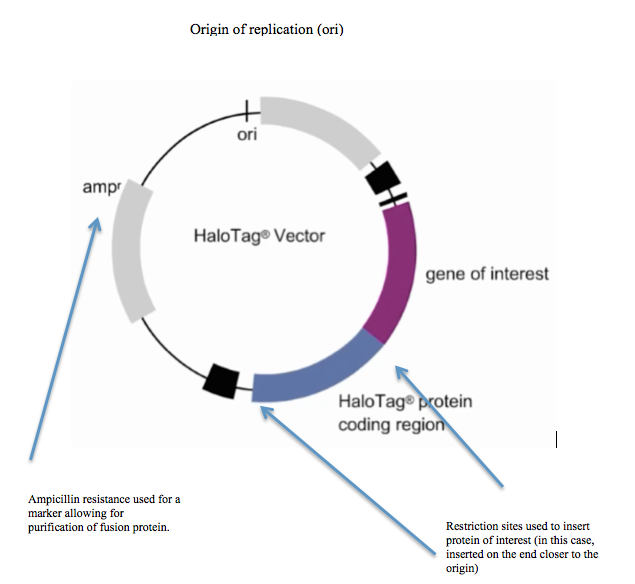
HaloTag protein coding region can be inserted near the gene of interest. An ampicillin resistance gene is also inserted for purification purposes.

HaloTag is a self-labeling protein tag. It is a 297 residue protein (33 kDa) derived from a bacterial enzyme, designed to covalently bind to a synthetic ligand. The bacterial enzyme can be fused to various proteins of interest.[1] The synthetic ligand is chosen from a number of available ligands in accordance with the type of experiments to be performed. This bacterial enzyme is a haloalkane dehalogenase, which acts as a hydrolase and is designed to facilitate visualization of the subcellular localization of a protein of interest, immobilization of a protein of interest, or capture of the binding partners of a protein of interest within its biochemical environment.[2] The HaloTag is composed of two covalently bound segments including a haloalkane dehalogenase and a synthetic ligand of choice. These synthetic ligands consist of a reactive chloroalkane linker bound to a functional group.[3] Functional groups can either be biotin (can be used as an affinity tag) or can be chosen from five available fluorescent dyes including Coumarin, Oregon Green, Alexa Fluor 488, diAcFAM, and TMR. These fluorescent dyes can be used in the visualization of either living or chemically fixed cells.[4]

Mechanism

[edit]
Five available fluorescent dyes that can be bound to the reactive linker. In addition, the terminal chlorine of the reactive chloroalkane can be visualized.

The HaloTag is a hydrolase, which has a genetically modified active site, which specifically binds the reactive chloroalkane linker and has an increased rate of ligand binding.[5] The reaction that forms the bond between the protein tag and chloroalkane linker is fast and essentially irreversible under physiological conditions due to the terminal chlorine of the linker portion.[6] In the aforementioned reaction, nucleophilic attack of the chloroalkane reactive linker causes displacement of the halogen with an amino acid residue, which results in the formation of a covalent alkyl-enzyme intermediate. This intermediate would then be hydrolyzed by an amino acid residue within the wild-type hydrolase.[7] This would lead to regeneration of the enzyme following the reaction. However, in the modified haloalkane dehalogenase (HaloTag), the reaction intermediate cannot proceed through a subsequent reaction because it cannot be hydrolyzed due to the mutation in the enzyme. This causes the intermediate to persist as a stable covalent adduct with which there is no associated back reaction.[8]

Uses

[edit]
Different parts of the fusion protein. As illustrated in the figure, HaloTag protein consists of the synthetic ligand and reactive chloroalkane linker parts. The HaloTag protein is attached to the protein of interest.

HaloTagged fusion proteins can be expressed using standard recombinant protein expression techniques.[9] Furthermore, there are several commercial vectors available that just require insertion of a gene of interest.[10] Since bacterial dehalogenases are relatively small and the reactions described above are foreign to mammalian cells, there is no interference by endogenous mammalian metabolic reactions.[11] Once the fusion protein has been expressed, there is a wide range of potential areas of experimentation including enzymatic assays, cellular imaging, protein arrays, determination of sub-cellular localization, and many additional possibilities.[12]

Recently, HaloTag has been engineered to create hybrid protein + small molecule biosensors of neuronal activity.[13] These sensors undergo a conformational change in response to calcium concentration spikes during neuronal firing; this conformational change modulates the conformation of a HaloTag-bound dye molecule.[13]

See also

[edit]

References

[edit]
Revisions and contributorsEdit on WikipediaRead on Wikipedia
from Grokipedia
HaloTag is a genetically encoded, self-labeling system consisting of a 33 kDa modified dehalogenase that forms a covalent, irreversible bond with synthetic chloroalkane ligands, enabling the attachment of diverse chemical probes such as fluorophores, affinity handles, or radionuclides to fusion proteins for visualization, purification, and functional analysis in biological research. Developed by Corporation based on engineered bacterial dehalogenase variants, HaloTag was first described in as a versatile platform to overcome limitations of traditional affinity tags like His-tags or peptides, which often suffer from non-covalent interactions and . The tag's biochemical mechanism involves a reaction where an aspartate residue (Asp106) in the enzyme's attacks the carbon atom of the chloroalkane linker on the , forming a stable bond that resists due to a key (His272Phe). This process occurs rapidly—typically within minutes under physiological conditions—and with high specificity, allowing the same genetic construct to pair with interchangeable ligands tailored for different experimental needs. Key applications of HaloTag span multiple areas of biomedical research, including where it achieves over 90% purity for many full-length proteins, live-cell imaging for tracking protein localization and dynamics (e.g., in using Janelia Fluor® dyes), and studies of protein-protein or protein-DNA interactions via pull-down assays. It also facilitates in vivo imaging techniques, such as (PET) for tumor detection with >80% sensitivity in models, and supports multiplexed experiments by enabling sequential or simultaneous labeling with spectrally distinct probes. Among its notable advantages, HaloTag offers superior stability under denaturing conditions compared to non-covalent tags, minimal steric hindrance when fused to protein termini, and the flexibility to perform no-wash protocols in cellular imaging, reducing artifacts and improving signal-to-noise ratios. Developments as of 2024 include optimized ligands like Janelia Fluor® and JFX™ variants for enhanced brightness and , as well as biotin-conjugated options for efficient affinity capture in workflows, and split-HaloTag systems for recording cellular . While potential limitations exist, such as the need for ligand optimization to avoid protein inactivation, ongoing advancements position HaloTag as a foundational tool for probing complex biological processes, including genetic disease modeling and therapeutic targeting.

Overview

Definition and Purpose

HaloTag is a self-labeling protein fusion tag comprising 297 amino acid residues and weighing approximately 33 kDa, engineered from a bacterial haloalkane dehalogenase enzyme. It is genetically fused to a protein of interest (POI) to enable site-specific labeling in various experimental contexts, without requiring supplementary enzymes or cofactors for the attachment process. This design allows researchers to track and manipulate POIs directly, leveraging the tag's inherent reactivity. The primary purpose of HaloTag is to facilitate the specific and covalent attachment of synthetic ligands to the fused POI, thereby enabling the visualization, purification, or functional analysis of proteins in live cells or environments. Through this covalent linkage, HaloTag supports the study of protein location, dynamics, and interactions by incorporating diverse reporter groups, such as fluorophores for or affinity moieties for pull-down assays. At its core, the self-labeling mechanism of HaloTag involves an irreversible nucleophilic reaction with chloroalkane-based s, which can be modularly conjugated to fluorescent dyes, , or solid supports for immobilization. This formation provides high specificity and stability, distinguishing HaloTag from non-covalent tags like (GFP), which rely on intrinsic maturation rather than external ligand binding. Developed by Corporation, HaloTag serves as a versatile platform in for applications requiring robust and customizable protein labeling.

History and Development

The HaloTag technology originated from studies on dehalogenases, enzymes that hydrolyze carbon-halogen bonds in , first cloned from rhodochrous in the 1990s. These bacterial enzymes, such as DhaA from R. rhodochrous NCIMB 13064, were initially characterized for their role in degradation, providing a foundation for stable protein-ligand interactions. In the mid-2000s, researchers at Corporation engineered the HaloTag by modifying the DhaA dehalogenase to eliminate its catalytic activity and stabilize a covalent intermediate with synthetic ligands. This involved , notably the His272Phe mutation, which prevents of the intermediate and enables irreversible attachment to chloroalkane derivatives. The modified was patented by Promega in 2007 as a versatile fusion tag for protein labeling. The HaloTag was first publicly described in a 2008 publication by Los et al., introducing the mutated dehalogenase for applications in cell imaging and protein analysis. commercialized the system that year, launching it with initial ligands for and affinity-based techniques. Following this, the ligand library expanded after 2010 to include probes optimized for , enhancing its utility in advanced imaging.

Mechanism

Protein Structure

The HaloTag protein is a 33 kDa monomeric derived from the bacterial haloalkane dehalogenase DhaA of Rhodococcus sp., featuring an α/β fold typical of its family. This structure consists of a central parallel β-sheet of eight strands flanked by α-helices on both sides, forming a compact globular domain with the buried within a catalytic . The has been modified through to facilitate access for synthetic chloroalkane ligands while maintaining the overall fold integrity. Key catalytic residues include Asp106, which serves as the to initiate on the ligand's terminal carbon-chlorine bond, forming a covalent intermediate. To prevent subsequent and trap the ligand irreversibly, the base residue His272 is mutated to Phe272, disrupting the activation of water for the second catalytic step. Additional mutations enhance ligand accommodation without altering the core fold. The protein exhibits high stability under physiological conditions, remaining functional across 5–9 and temperatures up to 37°C, with no bonds that would limit its use in reducing cellular environments like the . The of a HaloTag (M175C) bound to a dansyl-chloroalkane was resolved at 2.27 Å resolution in 2017 (PDB: 5Y2Y), revealing an tunnel to the that enables efficient entry and binding. Further of the halogen-binding pocket via targeted mutations has expanded its capacity to accommodate bulky synthetic ligands, improving versatility for diverse applications.

Ligand Binding Process

The ligand binding process of HaloTag involves a covalent reaction between the and synthetic chloroalkane ligands, enabling specific and stable labeling. HaloTag, derived from a mutated dehalogenase , facilitates a mechanism where the group of Asp106 acts as the , attacking the alpha-carbon of the chloroalkane linker in the . This displaces the and forms a stable linkage between the protein and the , represented simplistically as: Protein-Asp-COOH+Cl-CH2-RProtein-Asp-COO-CH2-R+HCl\text{Protein-Asp-COOH} + \text{Cl-CH}_2\text{-R} \rightarrow \text{Protein-Asp-COO-CH}_2\text{-R} + \text{HCl} where R denotes the functional group attached to the chloroalkane (e.g., a fluorophore). Unlike the wild-type enzyme, which would hydrolyze the ester intermediate to release the alkyl chain, HaloTag includes mutations (notably at the catalytic histidine residue) that prevent this hydrolysis step, rendering the bond irreversible and ensuring long-term stability. The kinetics of this binding are rapid and efficient, with an apparent second-order rate constant of approximately 2.7×10⁶M1s12.7 \times 10^6 \, \text{M}^{-1} \text{s}^{-1} measured for the HaloTag protein with a tetramethylrhodamine (TMR)-conjugated at physiological temperatures. Under typical labeling conditions (e.g., 1-5 μM at 37°C), near-complete covalent attachment occurs within 15 minutes, allowing for quick and quantitative labeling in cellular environments without significant off-target reactivity. This high rate supports applications requiring minimal perturbation to protein function or cellular processes. HaloTag ligands are rationally designed as synthetic chloroalkanes, typically featuring a flexible alkyl chain (e.g., a 6-carbon hexyl linker proximal to the ) conjugated to desired moieties such as fluorophores (e.g., dyes) or for downstream detection. The linker length and composition are optimized to ensure the chloroalkane terminus accesses the enzyme's catalytic pocket while positioning the externally for accessibility, promoting efficient reaction without steric hindrance. The resulting exhibits exceptional stability, persisting for days in live cells under physiological conditions, which contrasts with non-covalent tagging systems and enables prolonged tracking or immobilization.

Applications

Cellular Imaging

HaloTag enables live-cell labeling by fusing the tag to a protein of interest (POI), followed by the addition of a fluorescent chloroalkane , such as HaloTag-TMR, which covalently binds to the tag for visualization via confocal or . This approach leverages the covalent binding mechanism to ensure stable, specific labeling without dissociation, allowing real-time observation of protein localization and movement in living cells. The technique is particularly suited for mammalian cells, where the penetrates the membrane efficiently and binds with high specificity, resulting in low background due to minimal nonspecific interactions. HaloTag supports advanced imaging techniques for studying protein dynamics, including (FRAP) to assess mobility and (FRET) to probe interactions, as the stable covalent attachment prevents label exchange during experiments. Multi-color labeling is achieved through sequential or simultaneous application of ligands with distinct fluorophores, enabling studies without spectral overlap issues common in genetic tags. Labeling efficiency exceeds 90% in mammalian cells, typically occurring within 15-30 minutes at 37°C, which facilitates rapid experimental workflows. Representative applications include tracking membrane proteins, such as G-protein-coupled receptors like EDG1, to monitor trafficking in live cells, revealing insights into signaling pathways. In , HaloTag has been used for organelle localization, such as labeling nuclear proteins in budding yeast to study compartmentalization. These examples highlight HaloTag's role in studies for visualizing dynamic cellular processes with high . Recent advances involve integration with Janelia Fluor dyes, developed post-2015, which provide brighter and more photostable labeling for challenging environments like 3D spheroids and organoids. For instance, Janelia Fluor 549 HaloTag ligands enable clear imaging of nuclear proteins in U2OS cell spheroids after just 15 minutes of incubation, overcoming issues like signal attenuation in thick tissues. This enhancement supports long-term live-cell imaging with reduced phototoxicity. As of 2025, optimized HaloTag protocols have enabled high-fidelity imaging in plant cells, facilitating studies of subcellular dynamics in protoplasts and root tissues. Additionally, photoclickable HaloTag ligands introduced in 2025 allow spatiotemporal control in multiplexed labeling for of protein ensembles.

Protein Purification and Immobilization

HaloTag enables efficient protein purification by fusing the 33 kDa HaloTag domain to the protein of interest (POI), typically at the N- or C-terminus, followed by expression in bacterial or mammalian systems. Cell lysates are incubated with chloroalkane-functionalized agarose or magnetic beads (e.g., HaloLink resin), which covalently capture the fusion protein through the HaloTag's reactive aspartate residue in a specific, one-step affinity pull-down process. Elution is performed either by competitive displacement using excess free chloroalkane ligand or, for tag removal, by incorporating a tobacco etch virus (TEV) protease cleavage site between HaloTag and POI, allowing on-bead digestion and release of the native POI. This approach achieves >90% purity for over 40% of tested full-length proteins, with yields up to 13 μg per mg of resin and minimal non-specific binding attributable to the irreversible covalent linkage. The covalent binding also supports resin reusability, as captured proteins remain attached during stringent washes, enabling multiple purification cycles after . Compared to traditional tags like His6, HaloTag purification often requires no post-purification cleavage if the tag does not hinder downstream applications, streamlining workflows for functional studies. For immobilization, HaloTag fusions are covalently anchored to chloroalkane-modified surfaces, such as hydrogel-coated microarrays, (SPR) chips, or substrates, providing oriented attachment that preserves protein activity for biochemical assays or sensor development. This method facilitates analysis, interaction screening, and single-molecule force by ensuring stable, site-specific orientation without random conjugation artifacts. Practical examples include high-throughput purification of recombinant human kinases from mammalian cells, yielding higher protein amounts and activity than FLAG- or His-tag systems. In 2012 studies, HaloTag was applied to isolate membrane-associated proteins, such as components of Yersinia pestis virulence factors, demonstrating improved solubility and recovery for challenging targets. Additionally, HaloTag has been used for covalent immobilization of the CB2 on SPR surfaces for ligand binding characterization.

Interaction and Functional Studies

HaloTag facilitates the study of protein-protein interactions (PPIs) through affinity-based pulldown assays, where a protein of interest (POI) fused to HaloTag is labeled with a to enable capture on , followed by and (MS) identification of interacting partners. This approach captures both stable and transient complexes in native cellular environments, providing insights into signaling pathways and molecular networks. For instance, HaloTag-based affinity purification MS (HaloMS) has been optimized for high-throughput interactome mapping, as demonstrated in analyses of protein networks where it identified hundreds of novel PPIs with high specificity and low background. Dual HaloTag labeling strategies, using spectrally distinct ligands on fusion partners, support co-localization and proximity-based of PPIs, often integrated with functional readouts like activity assays to distinguish direct from indirect interactions. In , HaloTag reporters have been incorporated into /Cas9 screens to probe gene dependencies affecting protein stability and localization, enabling pooled identification of regulators in pathways such as signaling. A notable application includes 2015 studies leveraging HaloTag for dissecting signaling networks, where immobilization of kinase-POI fusions allowed quantitative assessment of events and downstream effectors in response to stimuli. For functional assays, HaloTag-POI fusions can be covalently immobilized on multi-well plates via specific ligands, facilitating high-throughput enzymatic activity screening and inhibitor profiling without denaturation. This immobilization supports real-time monitoring of post-translational modifications, such as ubiquitination and proteasomal degradation kinetics, particularly in targeted protein degradation studies using PROTACs; for example, HaloTag fusions enable ratiometric bioluminescent tracking of degradation half-lives, typically ranging from 30-60 minutes in live cells. The 1:1 binding of HaloTag to its ligands further permits precise ratiometric quantification of complex formation, such as via fluorescence resonance energy transfer () between labeled partners, providing stoichiometric insights into oligomerization or ternary complex assembly. HaloTag variants adapted for , such as fusions with biotin ligases like TurboID, expand its utility for interactome mapping by selectively ylating proteins within 10 nm of the POI, followed by MS enrichment to reveal spatial networks. These methods support in 96-well formats, where arrayed HaloTag-POI libraries undergo automated functional interrogation, such as activity-based probes for panels, yielding scalable data on pathway dynamics. In 2024, HaloTag has been employed as a substrate-based reporter for macroautophagy, enabling quantitative assessment of autophagic flux in mammalian cells without altering endogenous machinery.

Comparisons and Limitations

Similar Protein Tags

The , introduced in 2003, is a self-labeling derived from the human O^6-alkylguanine-DNA alkyltransferase (AGT), which covalently reacts with O^6-benzylguanine (BG) substrates to enable site-specific labeling of fusion proteins. At approximately 20 kDa, SNAP-tag is smaller than HaloTag (33 kDa), making it advantageous for protein fusions where size may impact function or localization. However, its labeling kinetics are generally slower, with second-order rate constants ranging from 10^4 to 10^6 M^{-1} s^{-1} depending on the substrate, compared to HaloTag's faster rates often exceeding 10^6 M^{-1} s^{-1}. A 2025 advancement, SNAP-tag2, improves these kinetics to approach 10^7 M^{-1} s^{-1} with certain substrates, enhancing its performance for live-cell applications. The CLIP-tag, developed in 2008 as a variant of SNAP-tag, features an engineered that selectively binds O^2-benzylcytosine (BC) derivatives, providing to both (BG) and HaloTag (chloroalkane) ligands. Also around 20 kDa, CLIP-tag facilitates dual- or multi-color imaging when combined with HaloTag or , as their substrates do not cross-react. This has enabled simultaneous labeling of multiple proteins of (POIs) since around 2010, enhancing studies of protein interactions and dynamics. Unlike intrinsically fluorescent tags such as green fluorescent protein (GFP), which rely on non-covalent chromophore formation and genetic encoding without chemical modification, HaloTag and SNAP/CLIP tags allow diverse synthetic probes for customizable labeling in live cells. In contrast to enzymatic tags like sortase, which require co-expression of a separate sortase enzyme for peptide ligation, these self-labeling systems operate independently via covalent bond formation with small-molecule ligands. Overall, while SNAP-tag (introduced 2003) preceded HaloTag (2008) and offers a compact size ideal for fusions, HaloTag provides superior covalent stability for applications like protein purification.

Advantages and Drawbacks

HaloTag offers high specificity in labeling due to its covalent reaction with synthetic chloroalkane ligands, which lack endogenous binders in eukaryotic cells, enabling precise targeting without background interference. This supports versatile applications through hundreds of commercially available or customizable ligands, allowing seamless switching between imaging, purification, and functional probes from a single genetic construct. Furthermore, HaloTag demonstrates excellent live-cell compatibility, exhibiting no and rapid labeling kinetics (up to 2.7 × 10^6 M^{-1} s^{-1}), which facilitate no-wash imaging and long-term protein tracking superior to transient tags like fluorescent proteins. Post-2020 advancements, such as integration with Janelia Fluor dyes and rhodamine-based ligands, have enhanced brightness and reduced , improving signal-to-noise ratios in . Despite these strengths, HaloTag's relatively large size (33 kDa) can potentially disrupt protein-of-interest folding, localization, or function, particularly for small or structurally sensitive proteins. The technology requires dedicated synthesis or procurement, which may increase costs compared to antibody-based methods, although the reusable genetic tag offsets some expenses in repeated experiments. To mitigate size-related issues, engineered variants like HaloTag7 (introduced in 2009 and refined through 2018) improve solubility and expression without significantly altering the core 33 kDa footprint, though smaller alternatives like (19 kDa) remain preferable for minimal perturbation.

References

Add your contribution
Related Hubs
User Avatar
No comments yet.