


Community hub
Recent from talks
Contribute something
Nothing was collected or created yet.
High Standard HDM
View on Wikipedia
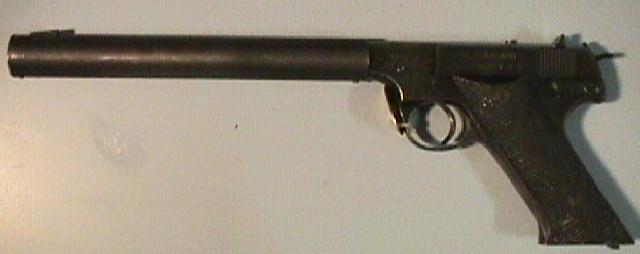
The High Standard HDM is an American semi-automatic pistol equipped with an integral silencer. Based on the High Standard H-D pistol, it was adopted by the Office of Strategic Services (OSS) during World War II. Because of legal concerns during wartime,[citation needed] full-metal-jacketed .22 LR rounds were developed for this pistol.
Key Information


History
[edit]William J. Donovan demonstrated the pistol to President Franklin D. Roosevelt inside the Oval Office. During World War II, the HDM was adopted for use by the OSS.[1] It later was used by CIA agents and US special forces units in the Korean and Vietnam War and supposedly up to the Gulf War.[1]
Francis Gary Powers' HDM is displayed in Moscow after his capture and release at the Central Armed Forces Museum as of 2017.[2][3]
Design
[edit]The High Standard HDM is a conventional blowback-operated semi-automatic pistol fitted with an integral silencer which decreases its report by more than 20 dB.[4] This pistol design was originally delivered on 20 January 1944, and original contract models were blued with a parkerized (phosphate) finish on the silencer. Follow-on models were completely parkerized. Post World War II models produced for the CIA were also blued. The weapon has a frame-mounted safety lever on the left in a similar position to the M1911A1 and Browning Hi-Power. The front sight is a fixed blade with a square notch fixed rear sight.[5]
This weapon uses a heel-mounted magazine release. The weapon is effective at short ranges when the low energy of the round fired is taken into account. The design is simple and typical of the period in which it was designed.[citation needed]
A clone of the HDM is made by Arms Tech Limited.[5]
Users
[edit]Current
[edit] United States: Still used by the Central Intelligence Agency,[6] the United States Marine Corps with 10 HDMs in use with Force Recon,[7] and the United States Army Special Forces,[6][8]

Former
[edit] United Kingdom: Known to be used by the SOE in Nazi-occupied Europe.[3]
- United States: Formerly used by OSS agents.[3] The weapon was also assigned to Lockheed U-2 pilots.[9]

References
[edit]- ^ a b "Hi-Standard HDM silenced". Modern Firearms. 22 October 2010. Retrieved 19 December 2023.
- ^ "Son of US spy pilot views U-2 artifacts at Russian museum". Air Force Times. 7 December 2017. Retrieved 19 December 2023.
- ^ a b c Firearms, Historical. "Historical Firearms - High Standard (Hi-Standard) Suppressed Pistols ..." Historical Firearms. Retrieved 19 December 2023.
- ^ "High Standard (Hi-Standard) HDM OSS silenced pistol (USA)". myweaponplace.com. 16 November 2010. Archived from the original on 11 April 2013.
- ^ a b Kokalis, Peter G. (August 2002). "OSS Silenced Pistol" (PDF). The Small Arms Review. Vol. 5 / 11. Archived from the original (PDF) on 19 April 2009.
- ^ a b Boyd, Bob (21 September 2011). "Arms Tech Limited OSS Hi Standard". Shooting Illustrated. Archived from the original on 13 March 2014. Retrieved 12 March 2014.
- ^ "Strong Men Armed - The Marine Corps 1st Force Reconnaissance Company: Part III - Weapons and Equipment". 22 December 2017. Archived from the original on 22 December 2017. Retrieved 19 December 2023.
- ^ Stejskal, James (December 2017). "Cold War Warriors". American Rifleman. American Rifleman.[page needed]
- ^ Powers, Francis (1960). Operation Overflight: A Memoir of the U-2 Incident. Potomac Books, Inc. p. 31. ISBN 9781574884227.
{{cite book}}: ISBN / Date incompatibility (help)
High Standard HDM
View on GrokipediaHistory
Development and Adoption
The High Standard Manufacturing Company was founded in 1926 in Connecticut as a supplier of deep-hole bore drills and specialty machines to firearms manufacturers in the Connecticut Valley.[3] In 1932, under the leadership of Carl Gustav Swebilius, the company acquired the Hartford Arms and Equipment Company and transitioned into producing its own firearms, beginning with .22 caliber pistols that established its reputation for precision target models.[3] In 1942, following the establishment of the Office of Strategic Services (OSS) earlier that year, OSS director William J. Donovan requested a suppressed .22 Long Rifle (LR) pistol specifically for covert operations, emphasizing the need for a quiet weapon suitable for intelligence agents.[4][5] Development of the pistol began that year, with High Standard basing the design on its existing Model H-D target pistol, which was modified to incorporate an integral suppressor developed in collaboration with Bell Laboratories.[4][2] In 1943, Donovan demonstrated a prototype of the pistol—designated the HDM—to President Franklin D. Roosevelt in the Oval Office, firing multiple rounds into a sandbag without alerting those outside the room, which impressed the president and paved the way for official adoption by the OSS.[4] The pistols were procured under the code name "Impact Testing Machines" to maintain secrecy. An initial production contract was awarded to High Standard in November 1943, with the first models delivered in January 1944 for exclusive OSS use in clandestine activities.[4][2]Production and Variants
The High Standard HDM pistol entered production in late 1943 under a U.S. Office of Strategic Services (OSS) contract, with approximately 2,620 units manufactured between late 1943 and early 1945 by the High Standard Manufacturing Company in New Haven, Connecticut.[2] This output included 1,500 pistols from the first contract awarded in November 1943, with deliveries beginning in January 1944, followed by an additional 1,000 under an August 1944 contract delivered in September and October of that year.[6] A smaller final contract in January 1945 added 120 units.[6] The suppressed pistols, also designated HDMS (HD Military Silenced), featured an integral suppressor and were adapted for clandestine operations.[7] Post-World War II production was limited, consisting of small custom runs in the 1950s for Central Intelligence Agency (CIA) contracts, often in collaboration with firms like X-Ploraco in Texas, which produced legally suppressed versions for $125 each.[6] No mass production occurred after 1951, as the pistols were primarily drawn from existing surplus stocks transferred from the OSS to the CIA.[6] Production ceased due to the dissolution of the OSS in 1945, a strategic shift toward centerfire suppressed weapons like the Welrod for greater stopping power, and the ample availability of wartime surplus that met ongoing agency needs into the Cold War era.[2] Known markings on HDM pistols typically include standard High Standard proofs on the frame, with OSS or CIA designations sometimes hand-applied; serial numbers for wartime models ranged from approximately 114,000 to 117,000, while CIA-issued examples, such as serial number 120,046 recovered from a U-2 pilot, often lacked specific prefix markings but were recorded in agency inventories.[2][6]Design
Specifications
The High Standard HDM pistol is chambered in .22 Long Rifle (LR) caliber, with subsonic ammunition recommended for optimal suppression to avoid the sonic crack associated with supersonic rounds.[8] It employs a simple blowback operation and was historically adopted by the Office of Strategic Services (OSS) for covert operations.[8] Key physical attributes include an unloaded weight of 48 oz (1,360 g), contributing to its stability during suppressed fire.[1] The overall length measures 13.8 in (350 mm), with a barrel length of 6.75 in (171 mm) designed to facilitate gas expansion within the integral suppressor.[1]| Specification | Details |
|---|---|
| Caliber | .22 Long Rifle (LR) |
| Weight (unloaded) | 48 oz (1,360 g) |
| Overall Length | 13.8 in (350 mm) |
| Barrel Length | 6.75 in (171 mm) |
| Magazine Capacity | 10-round detachable box |
| Effective Range | Up to 50 feet (suppressed fire) |
| Muzzle Velocity | ~1,000 fps (with subsonic .22 LR) |
| Materials | Steel frame and slide; brass or bronze suppressor baffles |
| Sights | Fixed front blade and rear notch |