Hubbry Logo
Mk 2 grenadeMk 2 grenadeMain
Open search
Mk 2 grenade
Community hub
Mk 2 grenade
logo
8 pages, 0 posts
0 subscribers
Be the first to start a discussion here.
Mk 2 grenade
Mk 2 grenade
from Wikipedia

Key Information

The Mk 2 grenade (initially known as the Mk II) is a fragmentation-type anti-personnel hand grenade introduced by the United States Armed Forces in 1918.

History

[edit]

The Mk 2 was formally standardized in 1920. It was the standard issue anti-personnel grenade used during World War II, and also saw limited service in later conflicts, including the Korean War and Vietnam War. Replacing the failed Mk 1 grenade of 1917, it was redesignated the Mk 2 on 2 April 1945.

The Mk 2 was gradually phased out of service as the M26-series (M26/M61/M57) grenade was introduced during the Korean War. Due to the tremendous quantity manufactured during World War II the Mk 2 was still in limited issue with the US Army and US Marine Corps throughout the 1950s and 1960s.

The U.S. Navy was one of the last users of the Mk 2 when it was finally withdrawn from U.S. military service in 1969, replaced with the M33 series (M33/M67).

Design

[edit]

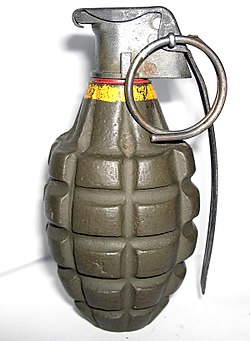
The Mk 2, like the Mk 1, was manufactured of cast iron with a grooved surface divided into 40 knobs in five rows of eight columns.

This was intended to enhance fragmentation (in practice, it was found that the grooves did not enhance fragmentation as much as desired) and provide a better grip when handling and throwing the grenade.

The grooves and knobs gave it the appearance of a pineapple, and are the origin of the nickname. It was also commonly referred to as a "frag" grenade, in contrast to other types of grenades such as the Mk 3 concussion grenade also developed during World War I.

The version of the MK2 in use around 1969, weighed 595 grams, had 57 grams of flaked TNT, and can be thrown at least 30 m (98 feet). A 10 meter "effective causality" distance is listed, but this is likely a typo.[3]

It can be presumed that since it has similar weight and TNT amount to the F1 grenade, it might have very similar throwing and fragmentation distances.

Fuses

[edit]

The Mk 2 used the M5, M6, M10, M11, or M204 series fuses.

The early M5, and the later M6 and M204 series detonating fuses, were used on high explosive-filled grenades. The M10 and M11 series igniting fuses were used on low explosive-filled ones.

The early fuses had many problems. In the M5, moisture could get in under the foil fuse cap, causing the weapon to fail to detonate. The early fuses were not completely silent and made a loud "bang" and produced sparks when activated. They also made a faint "hissing" sound while burning, potentially alerting the enemy of their presence.

The M10, used during the interwar period, and the M10A1, used early in WWII, sometimes prematurely detonated when the flash from the primer hit the explosive charge rather than the delay fuse. They were replaced by the M10A2 and M10A3. A less common type of igniting fuse was the M11.

The M6A4C had a delay of 4 seconds. The M5 and M11, like the M10, M10A1 and M10A2, had a delay of 4 to 5 seconds. The later M10A3 had a delay of 4.5 to 5.3 seconds. In 1944, the M6A4C was replaced by the silent and more reliable 4 to 5-second delay M204 or M204A1 fuse.

Due to the large number of grenades already issued, few grenades with the new fuses were used in combat during WWII.

Fillings

[edit]

The original Mk 2 grenade had a 38-inch (9.5 mm) threaded plug in its base, which covered the opening used to place the explosive filling, either 1.85 oz (52 g) of TNT, 2.33 oz (66 g) of Trojan explosive (a mixture of 40% nitrostarch, ammonium nitrate, and sodium nitrate), 1.85 oz (52 g) of a 50/50 amatol/nitrostarch mixture, or 1.85 oz (52 g) of Grenite (a mixture of 95% nitrostarch and binders). Some early Mk 2 grenades were filled with 0.74 oz (21 g) of smokeless EC powder. The improved "Mk 2A1" introduced in 1942 was filled through the fuse well instead. The Mk 2A1 was initially filled with 0.74 oz (21 g) of EC powder. In 1944, the EC powder filling was replaced with 1.85 oz (52 g) of TNT.[3]

Low explosive-filled Mk 2s had their cast iron bodies painted gray or black to prevent rust. Pre-WWII high explosive-filled Mk 2s were painted bright yellow. During wartime (from about 1943 onwards), grenades were overpainted in olive drab, leaving a narrow yellow ring remaining at the top. Not all were overpainted, however, as D-Day film footage shows.[4] Mk 2 practice grenades were painted red (a practice copied from the French military). M21 practice grenades were painted light blue (a practice copied from the British military) and had blue-painted fuse levers, often with the end painted light brown indicating a "low explosive" marking charge.

Variants

[edit]
Instructional document showing correct throwing technique (1918): "Correct position of thumb when throwing […] is important for otherwise firing lever will not be thrown over when grenade leaves the hand."

Mk 2 grenades came 25 to a wooden crate and were shipped in small fiberboard packing tubes. High explosive-filled Mk 2s were shipped unfused to prevent accidental detonation. Their fuses were shipped separately and came in flat cardboard boxes of 25. EC powder-filled grenades were shipped with their fuses attached.

Variants included:

Grenade, hand, fragmentation, Mk 2

[edit]

EC powder filler, uses M10 series igniting fuse

Grenade, hand, fragmentation, high explosive, Mk 2

[edit]

TNT, Trojan grenade powder, 50/50 amatol/nitrostarch, or Grenite filler, uses M5 series detonating fuse. In 1930, "high explosive" was dropped from the designation.

Grenade, hand, fragmentation, Mk 2A1

[edit]

EC powder or TNT filler, uses M10/M11 series igniting fuse (EC powder) or M6 or M204 series detonating fuse (flaked TNT). Has no baseplug because it is filled through the fuse well.

Grenade, hand, practice, Mk 2

[edit]

Black powder "spotting" charge in a cardboard tube connected to a M10 series igniting fuse. Has a standard body with a wooden or cork baseplug that pops out during detonation, creating a loud report and smoke to indicate ignition. The body could be reused and reloaded as long as it remained intact.

Grenade, hand, practice, M21

[edit]

Black powder "spotting" charge, uses M10 series igniting fuse. Has a heavier body and no baseplug. Its body was embossed with the vertical letters R, D and X on the knobs in a column on one side (because it was originally designed to be for an HE grenade with a more powerful RDX filler). When detonated, it makes a loud report and smoke comes out of the fuse vents.

Users

[edit]

Former users

[edit]

Non-State Actors

[edit]
[edit]

See also

[edit]

Notes and references

[edit]
[edit]
Revisions and contributorsEdit on WikipediaRead on Wikipedia
from Grokipedia
The Mk 2 grenade, commonly known as the "" due to its distinctive serrated cast-iron body, is a fragmentation hand designed for anti-personnel use by throwing it to produce shrapnel upon detonation. Introduced by the military in 1918 as the Mk II and standardized in 1920, it replaced the earlier Mk I model to address reliability issues with its ignition system and became the standard U.S. through , the , and into the era. The consists of a notched, lemon-shaped body weighing 20 ounces (1.25 pounds or 0.57 kg), filled with about 2 ounces (59 grams) of TNT or earlier variants using EC blank fire powder, and equipped with a pyrotechnic delay such as the M10A2 providing a 4- to 5-second delay after the is pulled and released. The serrations on the body, intended to aid in fragmentation into roughly 1,000 lethal pieces with an effective casualty radius of 5 to 15 meters, also improved grip for throwing up to 40 meters by an average soldier. Early models were painted yellow for identification, but wartime production shifted to olive drab for , and it was packed 25 per for transport. Employed primarily as a defensive to supplement small arms fire in close-quarters combat, against personnel in the open or behind light cover, and in urban or environments, the Mk 2's design emphasized reliability and fragment spread over concussion effects. Variants included the Mk IIA1 (, with M10A2 fuze), Mk II HE (using M5 fuze), and practice versions like the Mk II practice grenade for training without live explosives; some were adapted for rifle projection with fins and the M7 launcher. Phased out by the in favor of the M26 and later M67 series for improved safety and performance, the Mk 2 remains iconic in and was supplied to allies including , , and .

History

Development

The development of the Mk 2 grenade drew significant influences from early European designs, particularly the British and the French F1 grenade, which emphasized segmented bodies to enhance fragmentation effects during close-quarters combat. These features addressed the need for reliable shrapnel dispersion in , inspiring U.S. engineers to prioritize similar structural elements for improved lethality against personnel. The initially fielded the in as its primary fragmentation hand grenade, but it suffered from notable limitations, including inadequate fragmentation due to its design and safety concerns stemming from a complex five-step arming process that proved unreliable under combat stress. Additionally, the fuze's chemical delay mechanism and overall design posed safety concerns, prompting a rapid redesign to eliminate these vulnerabilities. Introduced in May 1918 for limited use in , between 1917 and 1920, research and development efforts by the U.S. Ordnance Department focused on refining the grenade's construction, incorporating cast iron serrations to generate more effective shrapnel patterns and adopting TNT as a stable, high-explosive filler superior to the low-order powders used previously. Prototypes underwent testing in 1918, incorporating an innovative 40-segment body design—arranged in five rows of eight knobs—to optimize fragment spread and gripping stability without compromising the thrower's safety. This iteration was standardized as the Mk II in 1920, marking a pivotal advancement in U.S. hand grenade technology just after .

Production and Service

The Mk 2 grenade was formally standardized and entered the US Army inventory in , serving as the primary fragmentation hand grenade for American forces. Production ramped up significantly during , with a wartime surge from 1941 to 1945 to meet demand, as the grenade became the standard issue ; millions of units were produced overall. These were primarily manufactured by various ordnance and manufacturing companies, with explosive fillers produced by firms such as . On April 2, 1945, it was redesignated from the earlier "grenade, hand, fragmentation" nomenclature to Mk 2, reflecting minor updates to the series. The grenade remained in widespread service through the mid-20th century, with its body enabling efficiency. It saw partial replacement beginning in the 1950s during the , when the M26 series was introduced as a more modern alternative, though surplus stocks kept the Mk 2 in limited use. Full phase-out occurred by 1969, when it was completely superseded by the across forces, with the retaining it longest into the era. Post-World War II logistical challenges included storage issues with older explosive fillings, such as early TNT variants and EC powder, which contributed to reduced reliability over time due to potential degradation and sensitivity in fuzes. These factors limited its effectiveness in later conflicts, accelerating the transition to newer designs with improved stability.

Design

Physical Characteristics

The Mk 2 grenade's body is constructed from , featuring a distinctive "" shape with 40 machined grooves arranged in five longitudinal rows of eight segments each, intended to promote controlled fragmentation and provide a notched surface for secure grip during handling and throwing. This serrated enhances the grenade's ergonomic qualities, allowing soldiers to maintain control while preparing to deploy it. The body is typically painted olive drab for in field conditions. In terms of dimensions, the grenade body stands 3.5 inches (89 mm) high with a of 2.3 inches (58 mm), while the total length, including the integrated , measures 4.5 inches (110 mm). The unfuzed body weighs approximately 400 grams, resulting in an overall weight of about 595 grams (1 lb 5 oz), though minor variations occur based on production batches. These compact specifications make the Mk 2 suitable for carry and throwing distances of up to 35 yards. Safety features on the Mk 2 include a pull-ring pin secured by a spring-loaded that must be held in place until release, requiring 20-30 pounds of force to extract the pin and arm the device. The grooved exterior further supports safe manipulation by preventing slippage. Upon detonation, the body is engineered to shatter into 200-300 fragments, each capable of traveling up to 200 yards, establishing a lethal radius of 5-15 yards within which casualties are highly likely from high-velocity shrapnel.

Fuse Mechanism

The Mk 2 grenade primarily employed the M10 series , a mechanical impact and time-fused igniter designed for low-explosive fillings, providing a 4- to 5-second delay before . This consisted of a striker assembly, primer, pyrotechnic delay element, and , allowing the grenade to function reliably upon impact or after the timed delay. Later variants incorporated the M204A1 and M204A2 , which enhanced reliability through improved pyrotechnic components and reduced sensitivity to environmental factors, becoming standard for high-explosive configurations by the mid-1940s. Earlier models of the Mk 2 utilized the M5 and M6 fuzes, which relied on pyrotechnic-based chemical delay mechanisms prone to inconsistencies. These fuzes featured a similar striker-primer-delay-detonator sequence but suffered from ingress, which could degrade the delay element's and lead to premature or failed ignition. The M11 fuze served practice variants, simulating the operational sequence with a non-explosive charge while maintaining the 4- to 5-second delay for training purposes. In operation, the activated upon removal of the and release of the during the throw, allowing the spring-loaded striker to rotate and strike the primer, igniting the delay element that burned through to . The grenade armed within 2 to 5 feet of travel, ensuring the disengaged fully to prevent accidental while providing time for the thrower to take cover. Safety features included a double-safety system with the and to block striker movement, along with impact-resistant construction to withstand drops or minor collisions without exploding. The design evolved significantly in , shifting from the problematic M6 to the more consistent M10 series to address reliability issues in pyrotechnic delays affected by moisture. This change improved performance in varied field conditions, reducing duds and enhancing overall safety without altering the core mechanical principles.

Explosive Fillings

The Mk 2 grenade employed various explosive fillings throughout its service life, evolving from less stable low-explosive powders to more reliable high explosives to improve reliability and lethality. Early production models, dating from the and , were typically filled with approximately 21 g (0.74 oz) of EC (Explosive Composition) blank fire powder, a granulated nitrocellulose-based originally developed for blank . This filling was less powerful than later options and prone to inconsistent ignition, contributing to higher rates in pre-World War II examples due to its low-explosive nature and sensitivity to fuze performance. By the interwar period and into , alternative fillings such as 52 g (1.85 oz) of or nitrostarch-based compositions were used in some variants, often due to material shortages or production needs. Specifically, early high-explosive models incorporated Trojan explosive, a nitrostarch mixture containing about 25% nitrostarch with , , and other sensitizers, at around 66 g (2.33 oz); this was later supplemented or replaced by Grenite, another nitrostarch variant designed for similar sensitivity and fragmentation effects. These powders offered moderate blast but were phased out in the and in favor of more stable high , as the shift addressed stability concerns and reduced dud incidents from powder degradation or incomplete detonation. The standard filling for most World War II and postwar Mk 2 grenades was approximately 54 g (1.9 oz) of TNT (trinitrotoluene), a mixture of 75% flaked and 25% granular forms, which provided enhanced stability, , and fragmentation efficiency over prior options. This high-explosive charge was optimized for maximum fragmentation rather than pure blast, shattering the serrated cast-iron body to produce high-velocity lethal fragments with an effective casualty radius of about 10 yards (9 m). The TNT filling yielded greater destructive potential than EC powder, with total grenade weights varying around 540 g (19 oz) when loaded, compared to lighter configurations of about 500 g (17.6 oz) with EC powder. Manufacturing involved pouring or pressing the explosive through a threaded filling hole in the base plug of the cast-iron body, followed by sealing to prevent moisture ingress, which was critical for TNT's stability. This method allowed for efficient mass production, with over 50 million units filled primarily with TNT by the 1940s, ensuring consistent performance in combat.

Variants

Combat Variants

The Mk 2A1 variant, introduced in 1942 and formally designated on April 2, 1945, featured the improved M10A3 fuze to enhance reliability by eliminating the premature detonation risk present in the earlier M10A2 fuze, where primer flash could bypass the delay element. This update addressed combat feedback from World War II regarding fuze malfunctions, improving overall performance in field conditions. Minor refinements to the grenade's cast iron body included adjustments to the serrated grooves for better fragmentation consistency, and by late 1944–1945, production shifted to a solid base design, eliminating the original 3/8-inch threaded filling plug used in earlier models. Post- updates to the Mk 2A1 incorporated the M204A2 , a pyrotechnic delay-detonating type that differed from predecessors primarily in body construction for greater durability and arming safety, with a 4–5 second delay before detonation. The Mk 2A1 weighed approximately 1 lb 5 oz (595 g), slightly varying with filling. The M6 was used in some Mk 2 s during , including 1944-1945 production, alongside more reliable detonating fuzes like the M10 series. These modifications ensured the Mk 2A1 remained a primary fragmentation through the era.

Training and Practice Variants

The Mk II practice grenade, introduced in the mid-1920s, served as a non-lethal aid for U.S. to simulate the handling and throwing of the standard fragmentation version without risk of explosion or injury. It utilized an inert body identical in shape, size, and weight to the Mk II, weighing approximately 21 ounces (595 g), with dimensions of about 2.25 inches in diameter and 3.6 inches in . The body featured the characteristic serrated "pineapple" surface but lacked any explosive filling; instead, a small charge of black powder, often contained in a paper tube, was inserted into the base filling hole and sealed with a cork plug. After the 4- to 5-second delay, the grenade produces a visible flash or audible report, simulating the of the version. Equipped with the M10A1 igniting —a variant similar to the combat models but designed solely for practice—the Mk II practice grenade allowed recruits to train in safe environments such as boot camps, where it was extensively used during to build proficiency in grenade employment without live ordnance. The body was painted blue for easy identification as a training item, distinguishing it from operational and preventing accidental use in scenarios. This reusable design included provisions for separate replacement fuzes, powder charges, and plugs, enabling cost-effective repeated drills focused on arming, throwing, and impact simulation. A related variant, the M21 practice grenade, adopted during , further refined training by employing a dedicated body matched exactly to the Mk II's specifications, including the same 21-ounce (595 g) weight and grooved exterior for realistic handling. It incorporated a practice such as the M205 or M10A2, which provided a comparable 4- to 5-second delay and initiated a low-explosive flash or report without fragmentation, ensuring safe simulation of detonation effects. Like its predecessor, the M21 was painted and filled with black powder rather than any marking chalk or powder, prioritizing auditory and visual cues over impact tracing. These training variants were unsuitable for live-fire exercises due to their inert construction and lack of shrapnel-producing capability, limiting their role to basic throwing and safety instruction. They remained in service through the era but were gradually phased out in the 1960s alongside the combat Mk II, supplanted by practice versions of the newer that offered improved safety and realism.

Operational Use

World War II

The Mk 2 grenade served as the standard fragmentation hand grenade for the and Marine Corps throughout , employed extensively in both the Pacific and European theaters to support operations in diverse environments ranging from dense jungles to fortified positions. Soldiers typically carried a limited number of grenades into combat, often two per individual, with additional supplies distributed at the level to enable coordinated assaults on enemy positions. The grenade's facilitated its use in close-quarters fighting, where it was thrown from standing, , or prone positions behind cover, integrating with rifle fire to suppress and clear threats. In key engagements, the Mk 2 proved vital for overcoming entrenched defenses. During the in 1942, American forces relied on the grenade for close-quarters combat against Japanese positions, with numerous casings recovered from sites like Gifu Strongpoint and Hell's Point, highlighting its role in . In the European theater, particularly during the Normandy invasion and subsequent hedgerow fighting in 1944, the Mk 2 was employed by U.S. troops to flush out German defenders concealed in terrain and bunkers, contributing to infantry advances amid intense, localized battles. Its fragmentation pattern was particularly effective against Japanese island fortifications in the Pacific, where it helped neutralize nests and pillboxes during amphibious assaults. Production of the Mk 2 surged during the war to meet demand, with tens of millions manufactured between 1941 and 1945, enabling widespread issuance and supporting Allied logistics through programs like , though grenades formed a smaller portion of aid compared to larger equipment. The 1942 Mk IIA1 variant, featuring an improved M10A2 fuse, addressed earlier ignition reliability concerns and became the dominant model, fulfilling the bulk of U.S. hand grenade requirements across fronts. While praised for its fragmentation lethality—producing around 1,000 fragments with a 15-meter effective casualty radius—in urban and confined settings, the Mk 2 exhibited performance challenges in humid Pacific conditions, where moisture could affect fuse function, leading to occasional delays or failures, though specific dud rates varied by environment and were generally managed through training protocols. Overall, tens of millions of Mk 2 were produced and used in WWII, influencing such as pre-assault barrages and room-clearing maneuvers that emphasized .

Korean and Vietnam Wars

During the (1950–1953), the Mk 2 grenade remained a standard-issue fragmentation weapon for U.S. forces, serving alongside the newly introduced M26 series as the primary defensive tool in and close-quarters combat. It proved effective against massed infantry assaults by Chinese and North Korean forces, where its cast-iron body and TNT filling generated dense shrapnel patterns suitable for static defenses. However, many units relied on aging II-era stocks, which occasionally led to reduced reliability in the harsh Korean terrain and climate. In the (1965–1973), the Mk 2's operational role significantly declined, becoming limited to U.S. Navy units, reserve inventories, and specialized forces such as SEAL teams conducting riverine operations. Its heavier weight—approximately 1.3 pounds (0.59 kg) compared to later models—and vulnerability to fuze malfunctions from moisture ingress under the foil seal made it less suitable for the humid jungle environment, where damp conditions often caused premature venting, flashes, or duds during use. By the mid-1960s, it was largely phased out in favor of lighter, more reliable alternatives like the M33 and M67 grenades, which offered improved throwability and fragmentation against dispersed guerrilla tactics. The Mk 2's fragmentation pattern, optimized for clustered targets in World War II-style engagements, was less effective against the mobile, low-density enemy formations prevalent in , contributing to its rapid obsolescence. Surplus stocks were eventually donated to allies, including , marking the end of its frontline service by the late .

References

Add your contribution
Related Hubs
User Avatar
No comments yet.