


Community hub
Recent from talks
Contribute something
Nothing was collected or created yet.
Howick house
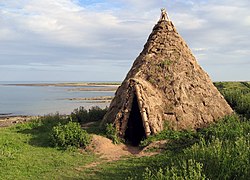
View on WikipediaThe Howick house is a Mesolithic site located in Northumberland, England. It was found when an amateur archaeologist noticed flint tools eroding out of a sandy cliff face near the village of Howick. Investigations found a circle of substantial post holes with charcoal stains in their bases, a number of smaller stake holes, some angled in from outside a hollow, and inside the house a number of shallow hearths filled with charcoal, burnt nutshells and some fragments of bone. Radiocarbon dating of the charred hazelnut shells established that the building was constructed about 7600 BC and occupied for about 100 years, which led to the find being called "Britain's oldest house".[1] This title was disputed in 2010 when the discovery of the even older 'house-structure' at Star Carr in North Yorkshire was announced.
Key Information


Some of the hearths showed signs only of nut roasting, and the numbers of shells suggested that food was cooked here in quantity, perhaps to preserve it for times of scarcity. Together with the very substantial construction shown by the size of post holes, this led to the view that the house was occupied permanently rather than being used on a transient or seasonal basis as expected during the Mesolithic period. Charred hazelnut shells have been found at several other sites from this period, including Cramond, but their smaller stake holes were interpreted as remains of a temporary encampment.
The interpretation that this was a permanent residence for hunter-gatherers is supported by analysis that Howick is a place where natural resources would have allowed all-year-round occupation. Its coastal position provided animals, flint for tools, wood for construction and fuel, fish, seals, sea birds and their eggs, shellfish and a nearby source of fresh water that was available at the time of occupation. Many sites from this time are coastal, but the particular circumstances found here and the evidence of ceremonial ritual from the site at Star Carr in Yorkshire, only 100 miles away, are interpreted as indicating that Mesolithic hunter-gatherers were capable of establishing permanent settlements.
See also
[edit]References
[edit]- ^ Richards, Julian (17 February 2011). "Britain's Oldest House?". bbc.co.uk. Retrieved 5 May 2018.
Howick house
View on GrokipediaLocation and Discovery
Geographical Context
The Howick House site is situated on the Northumberland coast in northeast England, approximately 8 km northeast of Alnwick, between the villages of Longhoughton and Craster, and near the village of Howick. Its precise location corresponds to OS Grid Reference NU 2585 1660.[4] This coastal position places the site within an ecotonal zone, offering ready access to diverse resources including freshwater from the nearby Howick Burn estuary, marine environments rich in fish and shellfish, and terrestrial habitats such as woodlands and flint outcrops along the beaches. The site's environmental setting on the North Sea coast features a sandy cliff overlooking the Howick Burn estuary, about 250 m to the south, which historically provided a mix of estuarine, coastal, and inland resources during the Mesolithic period in Britain. The surrounding landscape includes rocky shores suitable for seals and molluscs, littoral zones for birds and crustaceans, and nearby riverine areas for freshwater fish, all within a few hundred meters of the site. During the Mesolithic occupation around 8000 cal BC, sea levels were approximately 5 m lower, positioning the shoreline about 100 m further seaward and enhancing access to these marine and estuarine resources. Geologically, the Howick site lies on erosion-prone sandy deposits within glacial till and outwash sands, overlain by thin sandy topsoils (0.22–0.4 m thick) and subsoils, above Carboniferous bedrock of interbedded sandstone, limestone, and mudstones. These unconsolidated diamicton cliffs, rising 4–15 m high, are subject to wave undercutting, rotational slumping, and coastal erosion processes that have contributed to the exposure of archaeological materials through ongoing land loss. The broader context is the North Sea Basin, where post-glacial sea-level rise submerged earlier shorelines and land bridges to continental Europe around 7000–5500 cal BC, influencing Mesolithic settlement patterns in the region.Initial Findings
Mesolithic flints were first identified at the Howick House site in 1983 by amateur archaeologist John Davies.[4] In January 2000, amateur archaeologist Jim Hutchinson found additional eroding flint tools exposed by coastal processes while walking along the sandy cliffs near Craster in Northumberland, England.[5][4] Hutchinson promptly notified professional archaeologists, including Dr. Clive Waddington of the Architectural and Archaeological Society of Durham and Northumberland, who conducted a preliminary survey that confirmed the flints as Mesolithic in date.[5][6][4] This initial assessment highlighted the site's potential as an undisturbed Mesolithic settlement, prompting further organized investigations.[4] The revelation of the site through natural coastal erosion was crucial, as it exposed the artifacts without human disturbance, preserving the in situ context of this rare Mesolithic structure in northern Britain.[5][4] Such accidental finds underscore the valuable role of amateur archaeologists in identifying heritage sites.[6]Excavation History
2000 Investigations
Following the amateur discovery of flint artifacts by local enthusiast Jim Hutchinson in January 2000, professional investigations were promptly initiated to assess the site's archaeological potential.[5] The preliminary work was led by Dr. Clive Waddington and Dr. Nicky Milner from the University of York, in collaboration with Archaeological Research Services Ltd.[4] These efforts aimed to confirm the presence of Mesolithic activity through non-invasive and targeted exploratory techniques, marking the first academic engagement with the coastal location near Howick, Northumberland. The 2000 investigations employed a multi-method approach to evaluate the site's integrity and extent. Surface collection focused on recovering scattered flint tools and debitage exposed by coastal erosion, yielding diagnostic Mesolithic artifacts that indicated prolonged occupation.[4] Test pits were excavated to depths of up to 0.5 meters, penetrating the overlying ploughsoil to reveal intact subsoil layers containing lithics and charred organic remains, confirming preservation below modern disturbance.[4] Complementing these, geophysical surveys using magnetometry identified sub-surface anomalies consistent with post holes and potential hearths, providing a preliminary outline of structural features without full exposure.[4] Early findings from these activities substantiated the site's Mesolithic character, with the geophysical data and test pit results confirming the outline of a circular structure approximately 6 meters in diameter.[4] Initial samples of charcoal and other organics were collected from the test pits for subsequent radiocarbon dating, establishing a foundation for chronological analysis.[4] Collaboration with Prof. Geoff Bailey and other specialists in coastal archaeology informed interpretations of the site's environmental context, emphasizing its vulnerability to sea-level changes and erosion.[4] These preliminary results justified further excavation in subsequent years.2002 Full Excavation
The 2002 excavation at Howick House represented the principal phase of fieldwork, building on preliminary investigations from 2000 by fully exposing the Mesolithic settlement features through an open-area approach. A large trench was opened adjacent to the cliff-edge erosion scar, encompassing an area that revealed the complete outline of a circular structure measuring approximately 6 meters in diameter, along with associated post holes and stake holes defining its framework. This phase also uncovered three internal hearths, pits, and scoops within the structure's floor, providing a comprehensive view of the site's layout.[4] Excavation techniques emphasized meticulous recovery and recording, including hand excavation in open areas to delineate stratigraphy, with all deposits subjected to 100% sieving for micro-remains and use of a flotation tank for environmental samples. Geophysical surveys, fieldwalking, and test-pitting preceded and informed the main dig, ensuring targeted exposure of archaeological layers while minimizing disturbance to the coastal context. Documentation involved detailed plans, sections, and photographic records to capture the spatial relationships of features.[1][4] During this season, a nearby Bronze Age cist cemetery comprising five inhumations was identified to the northeast of the Mesolithic structure, though the focus remained on the prehistoric layers. The project was led by Clive Waddington of Archaeological Research Services Ltd in collaboration with the University of Newcastle, with significant contributions from team members including Ian Boomer, Kristian Pedersen, Robert Shiel, and Tony Stevenson in fieldwork and analysis.[4][1]Site Description
Hut Structure
The hut structure at Howick consists of a sub-circular, sunken-floored dwelling with a conical roof, measuring approximately 6 meters in diameter and featuring a floor depression averaging 0.4 to 0.5 meters deep.[7] The design is defined by an inner ring of timber upright posts, typically 0.1 to 0.2 meters in diameter and up to 0.3 meters deep, which supported lintels and a roof plate, surrounded by an outer ring of angled stake holes (0.04 to 0.07 meters in diameter) leaning inward at about 65 degrees toward a central apex.[8] These elements, preserved as biogenic stains in the acidic sand matrix, indicate a robust framework capable of supporting a substantial roof, with evidence of at least two rebuilds on the same footprint using similar post and stake arrangements.[4] Construction materials were primarily timber, including long birch poles for the basic cone-shaped frame and shorter pine logs or hazel uprights for reinforcement and cross-beams, as inferred from the dimensions of the post holes and charred wood fragments recovered during excavation.[2] The walls likely incorporated local turf for insulation, while the roof was probably thatched with reeds or wild grasses from nearby wetlands, secured by additional spars and stakes to ensure stability against coastal winds.[7] No packing material was found around the posts, suggesting they were held in place by the weight of the roof structure itself, with occasional stone pads or clay lumps providing extra support during repairs.[8] The layout includes an external perimeter ring of posts and stakes for wall and roof support, complemented by internal clusters and linear arrangements of stake holes that suggest partitioning for spatial organization or bedding areas within the approximately 30 square meters of floor space.[7] Central post sockets, measuring 0.19 to 0.23 meters in diameter and 0.1 to 0.14 meters deep in later phases, provided additional roof support, creating a focused central space amid the peripheral framework.[4] In the context of British Mesolithic architecture, the Howick hut stands out for its relatively large size and indications of permanence, contrasting with smaller or more ephemeral structures at sites like Mount Sandel or East Barns, both around 5 to 6 meters in diameter but lacking the same depth of sunken flooring and multi-phase reuse.[7] This design implies a semi-permanent residential unit, potentially family-sized, more substantial than temporary windbreaks at sites such as Morton, highlighting Howick's role in demonstrating advanced structural adaptation in coastal settings.[8]Internal Features
The interior of the Howick hut featured three shallow hearths, primarily associated with Phase 2 occupation, each containing deposits of charcoal, burnt hazelnut shells, and fragments of burnt bone. These hearths, identified as contexts , , and , measured approximately 0.5–1.0 m in diameter and 0.1–0.2 m deep, with forming a larger central complex spanning 2.3 m by 1.1 m and up to 0.58 m deep. The presence of over 42,000 charred hazelnut shells in , alongside 2,900 in and more than 5,000 in , indicates intensive nut roasting activities, while the bone fragments suggest food processing near these features.[7] Floor deposits within the hut consisted of trampled sand surfaces and scattered debris layers, reflecting prolonged and repeated use across multiple phases. These included levelling layers such as context , up to 0.1 m thick and containing around 17,500 charred hazelnut shells and 1,280 flints, as well as burnt spreads like and with 15,000 and 11,000 hazelnut shells respectively. Trampling is evident from the fragmented nature of artefacts and uniform sand fills, such as and , which incorporated flint tools, mollusc shells, and additional organic residues, pointing to ongoing domestic activities over time.[7] Activity patterns suggest the central hearth served primarily for cooking and roasting, given its size and concentration of heat-altered materials, while peripheral areas around the hut's 5–6 m diameter interior likely accommodated storage or sleeping, as indicated by smaller pits like with 5,630 charred hazelnuts and post-socket distributions. Preservation of these internal features benefited from localized anaerobic conditions in the sandy pit depressions near the coastal cliff edge, which limited decay of charred organics despite acidic soil challenges elsewhere.[7]Artifacts and Subsistence
Lithic Assemblage
The lithic assemblage from the Howick Mesolithic site comprises over 13,000 pieces recovered primarily from within and around the hut structure, representing a classic example of a narrow-blade industry characteristic of British Mesolithic sites.[7] This collection includes a wide range of tools and debitage, with microliths forming a key component at approximately 2.1% of the total (around 275 pieces), including scalene triangles, crescents, backed blades, and points.[7] Other prominent tool types encompass end and thumbnail scrapers (109 pieces, or 0.8%), retouched blades functioning as knives, awls (10 pieces), burins (4 pieces), and bevel-ended stone tools, alongside elongated pebble tools likely used for hide processing.[7] The raw materials were predominantly sourced from local beach pebbles, accounting for 97.8% to 99% of the provenanced flint, with a minor contribution from glacial till deposits.[7] Technological analysis reveals extensive on-site knapping activities, evidenced by the presence of tool blanks, hammerstones, bipolar flaking techniques, and hard hammer percussion, which facilitated the production of narrow blades and elongated flakes.[7] This narrow-blade techno-complex aligns with broader North Sea Basin Mesolithic traditions, emphasizing efficient bladelet production for composite tools.[7] Spatial distribution of the lithics indicates distinct activity zones, with high concentrations around the central hearth, hut entrances, and occupation floors, as well as in pits and along the nearby Howick Burn.[7] Typologically, the assemblage features oblique points among the microliths, suggestive of their use in hunting implements, while scrapers and retouched pieces point to processing tasks such as butchery and woodworking.[7] The coastal proximity provided ready access to flint pebbles, supporting sustained on-site manufacturing.[7]| Tool Type | Description | Approximate Quantity | Primary Function |
|---|---|---|---|
| Microliths | Scalene triangles, crescents, oblique points, backed blades | 275 (2.1%) | Hunting (e.g., arrowheads) |
| Scrapers | End, thumbnail, and retouched variants | 109 (0.8%) | Processing (e.g., hides, wood) |
| Knives | Retouched blades and flakes | Not quantified separately | Cutting and slicing |
| Awls and Burins | Piercing and grooving tools | 14 total (<0.2%) | Leatherworking and engraving |
| Bevel-Ended Tools | Pebble-based implements | Concentrated in structure | Scraping (e.g., limpets, sealskins) |