Hubbry Logo
search
logo
2240542

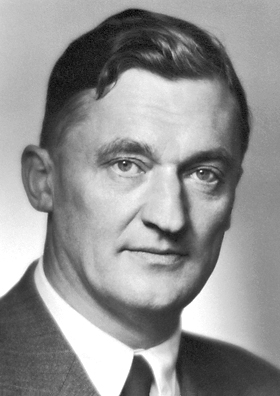
Hugo Theorell

logo
Community Hub0 Subscribers
Read side by side
from Wikipedia

Axel Hugo Theodor Theorell ForMemRS[1] (6 July 1903 – 15 August 1982) was a Swedish scientist and Nobel Prize laureate[2][3][4][5][6][7] in medicine.[8][9]

Key Information

Life

[edit]

He was born in Linköping as the son of Thure Theorell and his wife Armida Bill. Theorell went to Secondary School at Katedralskolan in Linköping and passed his examination there on 23 May 1921. In September, he began to study medicine at the Karolinska Institute and in 1924 he graduated as a Bachelor of Medicine. He then spent three months studying bacteriology at the Pasteur Institute in Paris under Professor Albert Calmette. In 1930 he obtained his M.D. degree with a theory on the lipids of the blood plasma, and was appointed professor in physiological chemistry at the Karolinska Institute.

Theorell, who dedicated his entire career to enzyme research, received the Nobel Prize in Physiology or Medicine in 1955 for discovering oxidoreductase enzymes and their effects. His contribution also consisted of the theory of the toxic effects of sodium fluoride on the cofactors of crucial human enzymes. In 1936 he was appointed Head of the newly established Biochemical Department of the Nobel Medical Institute,[10] the first researcher related to the Institute to be awarded a Nobel Prize. His work had led to pioneering progress on alcohol dehydrogenases, enzymes that break down alcohol in the liver and other tissues. He received honorary degrees at universities in France, Belgium, Brazil and the United States. He was a member of the American Academy of Arts and Sciences and the United States National Academy of Sciences,[11][12] and an International Member of the American Philosophical Society.[13]

Theorell died in Stockholm and is interred in Norra begravningsplatsen (The Northern Cemetery) alongside his wife, Elin Margit Elisabeth (née Alenius) Theorell, a distinguished pianist and harpsichordist who died in 2002.

References

[edit]
[edit]
Revisions and contributorsEdit on WikipediaRead on Wikipedia
from Grokipedia
Axel Hugo Theodor Theorell (6 July 1903 – 15 August 1982) was a Swedish biochemist who received the 1955 Nobel Prize in Physiology or Medicine for his discoveries concerning the nature and mode of action of oxidation enzymes.[1][2] He dedicated his career to enzyme research, notably isolating and characterizing oxidoreductases such as the “yellow ferment” (a flavoprotein), cytochrome c, peroxidases, catalases, and alcohol dehydrogenases, contributing significantly to understanding cellular energy production through oxidative processes.[2][3] Affiliated primarily with the Karolinska Institute and the Nobel Medical Institute in Stockholm, Theorell pioneered techniques like ultracentrifugation and electrophoresis to study enzyme structure and function.[2][4] Born in Linköping, Sweden, as the son of military physician Thure Theorell and musician Armida Bill, Theorell contracted poliomyelitis at age three, resulting in partial disability, yet pursued medicine after initially apprenticing with Swedish Railways.[4] He began medical studies at the Karolinska Institute in 1921, earned a Bachelor of Medicine in 1924, and spent time at the Pasteur Institute in Paris studying bacteriology.[2] He completed his M.D. in 1930 with a thesis on blood plasma lipids and held early positions at the Karolinska Institute’s Medico-Chemical Institution.[2] In 1931–1932, he worked at Uppsala University with Theodor Svedberg on ultracentrifugation, including studies of myoglobin molecular weight and its crystallization in 1932.[2][4] A Rockefeller Fellowship from 1933 to 1935 enabled work with Otto Warburg in Berlin, where Theorell achieved a breakthrough by isolating and reversibly splitting the “yellow enzyme” from yeast into a flavin mononucleotide coenzyme and a colorless protein apoenzyme, demonstrating the enzyme’s two-part structure.[2][3] Returning to Sweden, he headed the Biochemical Department at the Nobel Medical Institute from 1937 (its opening) until 1970, advancing research on oxidation enzymes, including iron’s role in electron transport, the Theorell-Chance mechanism for alcohol dehydrogenase (developed with Britton Chance), and contributions to cytochrome c and peroxidase studies.[2][4] Beyond research, Theorell held leadership roles such as chairman of the Swedish Medical Society and the Association of Swedish Chemists, and received honorary doctorates from several universities along with memberships in international academies.[2] An accomplished violinist who performed chamber music and chaired the Stockholm Symphony Society, he was married to concert pianist Margit Alenius and had three sons.[1][3] He retired in 1970, suffered a stroke in 1974, and died in Stockholm in 1982.[4]

Early life and education

Family background and childhood

Axel Hugo Theodor Theorell was born on 6 July 1903 in Linköping, Sweden.[2] He was the son of Thure Theorell, a surgeon-major to the First Life Grenadiers who practised medicine in Linköping, and Armida Bill.[2] Theorell was the second of three children and had two sisters.[4][5] His mother was a talented musician.[4] He spent his childhood in Linköping, where at the age of three he contracted poliomyelitis, resulting in permanent partial paralysis of his left leg but remaining ambulatory.[4][5]

Secondary and medical education

Theorell completed his secondary education at Katedralskolan (the State Secondary School) in Linköping, passing his matriculation examination on May 23, 1921.[2] He began medical studies at the Karolinska Institute in Stockholm in September 1921 and received his Bachelor of Medicine degree in 1924.[2] That summer, he spent three months studying bacteriology at the Pasteur Institute in Paris.[2] Continuing his studies at the Karolinska Institute, Theorell earned his M.D. degree in 1930 with a thesis on the lipids of the blood plasma.[2] In the same year, he was appointed lecturer in physiological chemistry at the Karolinska Institute.[2]

Postgraduate training

After receiving his Bachelor of Medicine degree from the Karolinska Institute in 1924, Axel Hugo Theodor Theorell spent three months studying bacteriology at the Pasteur Institute in Paris under Professor Albert Calmette.[2][4] This brief international training occurred during the summer of 1924, providing Theorell with early exposure to advanced microbiological research techniques at a leading institution shortly after completing his initial medical studies.[2][4]

Professional career

Appointments at Karolinska Institute

Axel Hugo Theodor Theorell's association with the Karolinska Institute began in September 1921 when he enrolled to study medicine there after completing secondary school. He graduated with a Bachelor of Medicine in 1924 and joined the staff of the Medico-Chemical Institution at the institute as an associate assistant that same year.[2] From 1928 to 1929, he served as a temporary Associate Professor at the Medico-Chemical Institution under Professor Einar Hammarsten. In 1930, after defending his M.D. thesis on the lipids of the blood plasma, Theorell was appointed lecturer in physiological chemistry at the Karolinska Institute.[2] His early work at the institute focused on physiological chemistry, particularly topics related to blood components and their biochemical properties. Following research periods abroad, including at Uppsala University and with Otto Warburg in Berlin, Theorell returned to the Karolinska Institute in 1935.[2]

Leadership at Nobel Medical Institute

In 1936, Axel Hugo Theodor Theorell was appointed Head of the newly established Biochemical Department at the Nobel Medical Institute in Stockholm. The department opened the following year in 1937.[2] The institute was initially housed in temporary premises at the Karolinska Institute for ten years before relocating to its own building in 1947.[2] Theorell served as director of the Biochemical Department from 1937 until 1970.[4][2] As the inaugural leader of the department from its founding, he guided its early development and growth into a key center for biochemical research. His long-term leadership at the institute coincided with his receipt of the 1955 Nobel Prize in Physiology or Medicine, awarded while he was affiliated with the Nobel Medical Institute.[1][2]

Scientific research

Early enzyme studies

After completing his M.D. in 1930 with a thesis on blood plasma lipids, Axel Hugo Theodor Theorell later dedicated his career to enzyme research.[2] His transition to this field began in earnest during a Rockefeller Fellowship from 1933 to 1935, when he worked in Otto Warburg's laboratory at the Kaiser Wilhelm Institute in Berlin-Dahlem. There, he investigated the chemical nature and constitution of oxidation enzymes, marking his entry into the study of this class of biocatalysts.[6] These early investigations opened the field of oxidation-reduction enzymes that utilize non-protein cofactors and established Theorell's lifelong commitment to exploring interactions between enzyme proteins and their cofactors.[6] This foundational period in Berlin laid the groundwork for his subsequent contributions to enzyme biochemistry.[2][6]

Oxidoreductase enzymes and mechanisms

Axel Hugo Theodor Theorell's most celebrated contributions were his discoveries concerning the nature and mode of action of oxidoreductase enzymes, which earned him the 1955 Nobel Prize in Physiology or Medicine.[1][7] These enzymes catalyze oxidation-reduction reactions essential for cellular respiration and metabolism, often involving cofactors such as flavins or heme groups.[8] A pivotal achievement was Theorell's 1935 demonstration that the "yellow enzyme" from yeast, an oxidoreductase, consists of two separable components: a protein apoenzyme and a coenzyme, flavin mononucleotide (FMN), derived from vitamin B2. Neither component alone exhibited activity, but their recombination restored full catalytic function, establishing the protein-coenzyme partnership fundamental to many oxidoreductases.[8][4] This work extended to other flavoproteins using FMN or flavin adenine dinucleotide (FAD) as cofactors in redox processes.[8] Theorell also advanced understanding of heme-containing oxidoreductases. He crystallized peroxidase from horseradish in 1941, revealing it as a glycoprotein with a hemin (iron-porphyrin) prosthetic group that activates hydrogen peroxide for substrate oxidation.[8] His studies on cytochrome c elucidated the linkage between its iron-porphyrin moiety and the protein via sulfur bridges from cysteine residues, with the iron coordinated by a histidine residue, explaining its role in electron transfer without direct oxygen reactivity due to steric hindrance.[8][4] Particularly significant was Theorell's extensive research on alcohol dehydrogenase (ADH), especially the horse liver enzyme. He purified and crystallized the enzyme, which uses nicotinamide adenine dinucleotide (NAD⁺/NADH) as a coenzyme to catalyze the reversible oxidation of alcohols to aldehydes or ketones. Kinetic analyses revealed an ordered mechanism in which the coenzyme binds first, followed by the substrate, leading to product release and then coenzyme dissociation. This framework, known as the Theorell-Chance mechanism, posits a transient ternary complex with rapid reaction steps and low steady-state concentrations for primary alcohols and aldehydes, though deviations occur with secondary alcohols.[8][9] These findings clarified ADH's role in alcohol metabolism and supported practical applications such as blood alcohol quantification.[4]

Other biochemical contributions

Theorell's biochemical research extended beyond his Nobel-recognized studies on oxidoreductases to include early investigations in other areas. His doctoral work culminated in a 1930 M.D. thesis on the lipids of the blood plasma. During his time at the Medico-Chemical Institution under Professor Einar Hammarsten, he also examined the influence of lipids on the sedimentation of blood corpuscles.[2] In 1931, while at Uppsala University under Theodor Svedberg, Theorell used the ultracentrifuge to determine the molecular weight of myoglobin. He later crystallized a pure form of this heme protein and elucidated its role in oxygen transport from the blood to muscle cells.[2][3]

Nobel Prize in Physiology or Medicine

1955 award and citation

Axel Hugo Theodor Theorell was awarded the Nobel Prize in Physiology or Medicine in 1955 for his discoveries concerning the nature and mode of action of oxidation enzymes.[7] He was the sole recipient of the prize that year, with a prize share of 1/1.[1] The official citation from the Nobel Assembly at the Karolinska Institute recognized his pioneering contributions to enzyme biochemistry.[7] On December 12, 1955, Theorell delivered his Nobel Lecture titled "The Nature and Mode of Action of Oxidation Enzymes."[10]

Scientific impact

Theorell's pioneering isolation and characterization of oxidoreductase enzymes significantly advanced the understanding of cellular oxidation processes and their role in energy production. His 1935 breakthrough demonstrated that the "old yellow enzyme" from yeast consists of two essential components—a yellow coenzyme (riboflavin phosphate) and a colorless protein apoenzyme—establishing that enzyme activity depends on this structural partnership.[1][3] This finding provided a key model of how cofactors enable redox reactions in biological systems, clarifying mechanisms previously studied only indirectly. Subsequent work at the Karolinska Institute further illuminated the function of key oxidoreductases, including cytochrome c, peroxidases, and alcohol dehydrogenase. He explained iron's role in electron transport in these and other enzymes, contributing to a deeper understanding of how cells transfer electrons during respiration.[3][11] His studies of alcohol dehydrogenase led to the development of highly sensitive assays for ethanol, which became widely adopted in clinical and forensic applications to measure blood alcohol levels.[11] These discoveries laid foundational principles for enzyme kinetics and redox biochemistry, influencing subsequent research into metabolic pathways, bioenergetics, and cellular metabolism. His innovative purification techniques, such as electrophoresis, facilitated precise enzyme isolation and became standard methods in the field, supporting ongoing investigations into enzyme mechanisms and their applications in medicine and biology.[3][11]

Personal life and death

Marriage and family

Axel Hugo Theodor Theorell married Elin Margit Elisabeth Alenius on June 5, 1931.[2][12] His wife, known professionally as Margit Theorell, was a distinguished pianist, harpsichordist—one of the first in Sweden—and music instructor.[12][13] The couple met through their shared interest in music, as Theorell himself was an accomplished violinist.[13] They had four children: a daughter, Eva Kristina, who died in 1935 at age two, and three sons—Klas Thure Gabriel (born 1935), Henning Hugo (born 1939), and Per Gunnar Töres (born 1942).[2][12] Theorell and his wife are buried together at Norra begravningsplatsen in Solna, Stockholm. She died on February 2, 2002.[12][14]

Later years and passing

In his later years, Theorell retired as director of the Biochemical Department at the Nobel Medical Institute in Stockholm in 1970 after serving in that role since 1937.[4] He continued administrative involvement with the Wenner-Gren Society and Wenner-Gren Foundation during the 1960s and 1970s.[4] His health deteriorated following a stroke in 1974.[4] During the summer of 1982, Theorell visited the island of Ljusterö off the Swedish coast.[4] He died on 15 August 1982 in Stockholm, Sweden, at the age of 79.[2][4] Theorell was interred at Norra begravningsplatsen in Solna, near Stockholm.[14]

Honors and legacy

Major awards and memberships

Theorell was elected a Foreign Member of the Royal Society (ForMemRS) of London and a foreign member of the United States National Academy of Sciences in recognition of his contributions to biochemistry.[2] He was an International Honorary Member of the American Academy of Arts and Sciences, elected in 1950.[15] He received honorary doctorates from the University of Paris (France), the University of Pennsylvania (United States), the University of Louvain and the University of Brussels (Belgium), and the University of Rio de Janeiro (Brazil).[2] Theorell was also a member of learned societies in Sweden, Denmark, Norway, Finland, the United States, France, Italy, Poland, Belgium, and India.[2]

Scientific influence

Theorell's pioneering investigations into oxidative enzymes fundamentally shaped modern enzymology, establishing foundational insights into the structure, function, and mechanisms of oxidoreductases that continue to underpin research in cellular respiration and energy metabolism. His isolation of the "yellow enzyme" (a flavoprotein) in 1935, demonstrating its separation into a flavinmononucleotide coenzyme and a colorless protein component, represented a landmark in recognizing enzymes as composite systems dependent on cofactors and prosthetic groups.[2][1] This breakthrough, achieved during his fellowship with Otto Warburg, set a methodological precedent for dissecting enzyme composition and action, influencing subsequent studies of flavoproteins and vitamin-derived coenzymes.[2] Through detailed characterizations of enzymes such as cytochrome c, peroxidases, catalases, and alcohol dehydrogenases, Theorell elucidated key aspects of electron transport, iron-mediated catalysis, and oxidation-reduction processes central to cellular energy production. His collaborative work on liver alcohol dehydrogenase yielded the Theorell-Chance mechanism, which clarified the kinetics of alcohol oxidation to acetaldehyde and supported advancements in alcohol metabolism research and diagnostic applications.[4][3] These contributions extended beyond immediate discoveries, providing conceptual frameworks that informed broader understanding of oxidative processes in living systems.[4] As director of the Biochemical Department at the Nobel Medical Institute from 1937 to 1970, Theorell established a leading center for enzyme biochemistry in Sweden, where much of his influential work unfolded. His 1955 Nobel Prize marked him as the first Karolinska-affiliated laureate in Physiology or Medicine and highlighted the Nobel Medical Institute's emerging role in cutting-edge research.[3][4] Theorell's legacy endures in biochemistry through the enduring relevance of his enzyme models to studies of metabolic pathways, redox biology, and related medical applications.
User Avatar
No comments yet.