


Community hub
Recent from talks
Contribute something
Nothing was collected or created yet.
Huītzilōpōchtli
View on Wikipedia| Huitzilopochtli | |
|---|---|
| Member of the Tezcatlipocas | |
 Huitzilopochtli as depicted in the Codex Borbonicus | |
| Other names | Blue Tezcatlipoca, Omiteotl, Mextli, Mexi, Huitzitlon, Huitzilton, Tzintzuni, Huitzi |
| Abode |
|
| Symbol | Hummingbird[1] |
| Gender | Male |
| Region | Mesoamerica |
| Ethnic group | Aztec (Mexica) |
| Festivals | Panquetzaliztli |
| Genealogy | |
| Parents |
|
| Siblings |
|
| Children | None |
Huitzilopochtli (Classical Nahuatl: Huītzilōpōchtli, IPA: [wiːt͡siloːˈpoːt͡ʃt͡ɬi] ⓘ) is the solar and war deity of sacrifice in Aztec religion.[3] He was also the patron god of the Aztecs and their capital city, Tenochtitlan. He wielded Xiuhcoatl, the fire serpent, as a weapon, thus also associating Huitzilopochtli with fire.
The Spaniards recorded the deity's name as Huichilobos. During their discovery and conquest of the Aztec Empire, they wrote that human sacrifice was common in worship ceremonies. These took place frequently throughout the region. When performed, typically multiple victims were sacrificed per day at any one of the numerous temples.[4]
Etymology
[edit]There continues to be disagreement about the full significance of Huītzilōpōchtli's name.[5] Generally it is agreed that there are two elements, huītzilin "hummingbird" and ōpōchtli "left hand side." The name is often translated as "Left-Handed Hummingbird" or "Hummingbird of the South" on the basis that Aztec cosmology associated the south with the left hand side of the body.[6][7]
However, Frances Karttunen points out that in Classical Nahuatl compounds are usually head final, implying that a more accurate translation may be "the left (or south) side of the hummingbird".
The hummingbird was spiritually important in Aztec culture. Diego Durán describes what appears to be the hummingbird hibernating in a tree, somewhat like the common poorwill does. He writes, "It appears to be dead, but at the advent of spring, ... the little bird is reborn."[8]
Origin stories
[edit]
There are a handful of origin mythologies describing the deity's beginnings. One story tells of the cosmic creation and Huitzilopochtli's role in it. According to this legend, he was the smallest son of four — his parents being the creator couple of the Ōmeteōtl (Tōnacātēcuhtli and Tōnacācihuātl) while his brothers were Quetzalcōātl ("Precious Serpent" or "Quetzal-Feathered Serpent"), Xīpe Tōtec ("Our Lord Flayed"), and Tezcatlipōca ("Smoking Mirror"). His mother and father instructed him and Quetzalcoatl to bring order to the world. Together, Huitzilopochtli and Quetzalcoatl created fire, the first male and female humans, the Earth, and the Sun.[9]
Another origin story tells of a fierce goddess, Coatlicue, being impregnated as she was sweeping by a ball of feathers on Mount Coatepec ("Serpent Hill"; near Tula, Hidalgo).[10][11][12] Her other children, who were already fully grown, were the four hundred male Centzonuitznaua and the female deity Coyolxauhqui. These children, angered by the manner by which their mother became impregnated, conspired to kill her.[13] Huitzilopochtli burst forth from his mother's womb in full armor and fully grown, or in other versions of the story, burst forth from the womb and immediately put on his gear.[14] He attacked his older brothers and sister, defending his mother by beheading his sister and casting her body from the mountain top. He also chased after his brothers, who fled from him and became scattered all over the sky.[9] This same story exists also with Quetzalcoatl instead. [15]
Huitzilopochtli is seen as the sun in mythology, while his many male siblings are perceived as the stars and his sister as the moon. In the Aztec worldview, this is the reason why the Sun is constantly chasing the Moon and stars. It is also why it was so important to provide tribute for Huitzilopochtli as sustenance for the Sun.[13] If Huitzilopochtli did not have enough strength to battle his siblings, they would destroy their mother and thus the world.
History
[edit]
Huitzilopochtli was the patron god of the Mexica tribe. Originally, he was of little importance to the Nahuas, but after the rise of the Aztecs, Tlacaelel reformed their religion and put Huitzilopochtli at the same level as Quetzalcoatl, Tlaloc, and Tezcatlipoca, making him a solar god. Through this, Huitzilopochtli replaced Nanahuatzin, the solar god from the Nahua legend. Huitzilopochtli was said to be in a constant struggle with the darkness and required nourishment in the form of sacrifices to ensure the sun would survive the cycle of 52 years, which was the basis of many Mesoamerican myths.
There were 18 especially holy festive days, and only one of them was dedicated to Huitzilopochtli. This celebration day, known as Toxcatl,[16] falls within the fifteenth month of the Mexican calendar. During the festival, captives and slaves were brought forth and slain ceremoniously.[17]
In the book El Calendario Mexica y la Cronografia by Rafael Tena and published by the National Institute of Anthropology and History of Mexico, the author gives the last day of the Nahuatl month Panquetzaliztli as the date of the celebration of the rebirth of the Lord Huitzilopochtli on top of Coatepec (Snake Hill); December 9 in the Julian calendar or December 19 in the Gregorian calendar with the variant of December 18 in leap years.
Sacrifice
[edit].png)
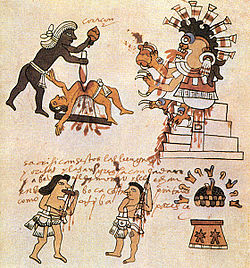
Ritual sacrifice and self bloodletting were key offerings to Huitzilopochtli. The Aztecs performed ritual self-sacrifice (also called autosacrifice or blood-letting) on a daily basis.[18] The Aztecs believed that Huitzilopochtli needed daily nourishment (tlaxcaltiliztli) in the form of human blood and hearts and that they, as “people of the sun,” were required to provide Huitzilopochtli with his sustenance.[19]
When the Aztecs sacrificed people to Huitzilopochtli, the victim would be placed on a sacrificial stone.[20] The priest would then cut through the abdomen with an obsidian or flint blade.[21] The heart would be torn out still beating and held towards the sky in honor to the Sun-God. The body would then be pushed down the pyramid where the Coyolxauhqui stone could be found. The Coyolxauhqui Stone recreates the story of Coyolxauhqui, Huitzilopochtli's sister who was dismembered at the base of a mountain, just as the sacrificial victims were.[22] The body would be carried away and either cremated or given to the warrior responsible for the capture of the victim. He would either cut the body in pieces and send them to important people as an offering, or use the pieces for ritual cannibalism. The warrior would thus ascend one step in the hierarchy of the Aztec social classes, a system that rewarded successful warriors.[23]
During the festival of Panquetzaliztli, of which Huitzilopochtli was the patron, sacrificial victims were adorned in the manner of Huitzilopochtli's costume and blue body paint, before their hearts would be sacrificially removed. Representations of Huitzilopochtli called teixiptla were also worshipped, the most significant being the one at the Templo Mayor which was made of dough mixed with sacrificial blood.[24]

Warriors who died in battle or as sacrifices to Huitzilopochtli were called quauhteca (“the eagle’s people”).[19] War was an important source of both human and material tribute. Human tribute was used for sacrificial purposes because human blood was believed to be extremely important, and thus powerful. According to Aztec mythology, Huitzilopochtli needed blood as sustenance in order to continue to keep his sister and many brothers at bay as he chased them through the sky.[25]
-
 Human sacrifice as shown in the Codex Magliabechiano
 -
.jpg)

The Templo Mayor
[edit]The most important and powerful structure in Tenochtitlan is the Templo Mayor. Its importance as the sacred center is reflected in the fact that it was enlarged frontally eleven times during the two hundred years of its existence.[26] The Great Temple of Tenochtitlan was dedicated to Huitzilopochtli and Tlaloc, the rain god. 16th century Dominican friar Diego Durán wrote, "These two gods were always meant to be together, since they were considered companions of equal power."[27] The Templo Mayor consisted of a pyramidal platform, on top of which were twin temples, one painted with blue stripes and the other painted red. The red shrine, on the south side, was dedicated to Huitzilopochtli, while the blue shrine to the north was dedicated to Tlaloc.[28] That these two deities were on opposite sides of the Great Temple is very representative of the Aztec dichotomy that the deities represent. Tlaloc, as the rain god, represented fertility and growth, while Huitzilopochtli, as the sun god, represented war and sacrifice.[29]
The Coyolxauhqui stone
[edit]The Coyolxauhqui stone was found directly at the base of the stairway leading up to Huitzilopochtli's temple. On both sides of the stairway's base were two large grinning serpent heads. The image is clear. The Templo Mayor is the image of Coatepec or Serpent Mountain where the divine battle took place. Just as Huitzilopochtli triumphed at the top of the mountain, while his sister was dismembered and fell to pieces below, so Huitzilopochtli's temple and icon sat triumphantly at the top of the Templo Mayor while the carving of the dismembered goddess lay far below.[26] This drama of sacrificial dismemberment was vividly repeated in some of the offerings found around the Coyolxauhqui stone in which the decapitated skulls of young women were placed. This would suggest that there was a ritual reenactment of the myth at the dedication of the stone sometime in the latter part of the fifteenth century.[30]
Mythology
[edit]Many gods in the pantheon of deities of the Aztecs were inclined to have a fondness for a particular aspect of warfare. However, Huitzilopochtli was known as the primary god of war in ancient Mexico.[31] Since he was the patron god of the Mexica, he was credited with both the victories and defeats that the Mexica people had on the battlefield. The people had to make sacrifices to him to protect the Aztec from infinite night.[32]
According to Miguel León-Portilla, in this new vision from Tlacaelel, the warriors that died in battle and women who died in childbirth would go to serve Huitzilopochtli in his palace (in the south, or left).[33] From a description in the Florentine Codex, Huitzilopochtli was so bright that the warrior souls had to use their shields to protect their eyes. They could only see the god through the arrow holes in their shields, so it was the bravest warrior who could see him best. Warriors and women who died during childbirth were transformed into hummingbirds upon death and went to join Huitzilopochtli.[34]
As the precise studies of Johanna Broda have shown, the creation myth consisted of “several layers of symbolism, ranging from a purely historical explanation to one in terms of cosmovision and possible astronomical content.”[35] At one level, Huitzilopochtli's birth and victorious battle against the four hundred children represent the character of the solar region of the Aztecs in that the daily sunrise was viewed as a celestial battle against the moon (Coyolxauhqui) and the stars (Centzon Huitznahua).[30] Another version of the myth, found in the historical chronicles of Diego Duran and Alvarado Tezozomoc, tells the story with strong historical allusion and portrays two Aztec factions in ferocious battle. The leader of one group, Huitzilopochtli, defeats the warriors of a woman leader, Coyolxauh, and tears open their breasts and eats their hearts.[36] Both versions tell of the origin of human sacrifice at the sacred place, Coatepec, during the rise of the Aztec nation and at the foundation of Tenochtitlan.[26]
Origins of Tenochtitlan
[edit]
There are several legends and myths of Huitzilopochtli. According to the Aubin Codex, the Aztecs originally came from a place called Aztlán. They lived under the ruling of a powerful elite called the "Azteca Chicomoztoca". Huitzilopochtli ordered them to abandon Aztlán and find a new home. He also ordered them never to call themselves Aztec; instead they should be called "Mexica."[37] Huitzilopochtli guided them through the journey. For a time, Huitzilopochtli left them in the charge of his sister, Malinalxochitl, who, according to legend, founded Malinalco, but the Aztecs resented her ruling and called back Huitzilopochtli. He put his sister to sleep and ordered the Aztecs to leave the place. When she woke up and realized she was alone, she became angry and desired revenge. She gave birth to a son called Copil. When he grew up, he confronted Huitzilopochtli, who had to kill him. Huitzilopochtli then took his heart out and threw it in the middle of Lake Texcoco. Many years later, Huitzilopochtli ordered the Aztecs to search for Copil's heart and build their city over it. The sign would be an eagle perched on a cactus, eating a precious serpent, and the place would become their permanent home.[38] After much traveling, they arrived at the area which would eventually be Tenochtitlan on an island in the Lago Texcoco of the Valley of Mexico.
Iconography
[edit]

In art and iconography, Huitzilopochtli could be represented either as a hummingbird or as an anthropomorphic figure with just the feathers of such on his head and left leg, a black face, and holding a scepter shaped like a snake and a mirror. According to the Florentine Codex, Huitzilopochtli's body was painted blue.[39] In the great temple his statue was decorated with cloth, feathers, gold, and jewels, and was hidden behind a curtain to give it more reverence and veneration. Another variation lists him having a face that was marked with yellow and blue stripes and he carries around the fire serpent Xiuhcoatl with him.[40] According to legend, the statue was supposed to be destroyed by the soldier Gil González de Benavides, but it was rescued by a man called Tlatolatl. The statue appeared some years later during an investigation by Bishop Zummáraga in the 1530s, only to be lost again. There is speculation that the statue still exists in a cave somewhere in the Anahuac Valley.
He always had a blue-green hummingbird helmet in any of the depictions found. In fact, his hummingbird helmet was the one item that consistently defined him as Huitzilopochtli, the sun god, in artistic renderings.[41] He is usually depicted as holding a shield adorned with balls of eagle feathers, a homage to his mother and the story of his birth.[39] He also holds the blue snake, Xiuhcoatl, in his hand in the form of an atlatl.[42]
Calendar
[edit]
Diego Durán described the festivities for Huitzilopochtli. Panquetzaliztli (November 9 to November 28) was the Aztec month dedicated to Huitzilopochtli. People decorated their homes and trees with paper flags; there were ritual races, processions, dances, songs, prayers, and finally human sacrifices. This was one of the more important Aztec festivals, and the people prepared for the whole month. They fasted or ate very little; a statue of the god was made with amaranth (huautli) seeds and honey, and at the end of the month, it was cut into small pieces so everybody could eat a little piece of the god. After the Spanish conquest, cultivation of amaranth was outlawed, while some of the festivities were subsumed into the Christmas celebration.[citation needed]
According to the Ramírez Codex, in Tenochtitlan approximately sixty prisoners were sacrificed at the festivities. Sacrifices were reported to be made in other Aztec cities, including Tlatelolco, Xochimilco, and Texcoco, but the number is unknown, and no currently available archeological findings confirm this.
For the reconsecration of Great Pyramid of Tenochtitlan in 1487, dedicated to Tlaloc and Huitzilopochtli, the Aztecs reported that they sacrificed about 20,400 prisoners over the course of four days. While accepted by some scholars, this claim also has been considered Aztec propaganda. There were 19 altars in the city of Tenochtitlan.
See also
[edit]Citations
[edit]- ^ a b c d e f g h i j Cecilio A. Robelo (1985). Diccionario de Mitología Nahoa (in Spanish). Editorial Porrúa. pp. 193, 194, 1985, 196, 197, 198, 199, 200, 201, 202. ISBN 970-07-3149-9.
- ^ Guilhem Olivier (2015). Cacería, Sacrificio y Poder en Mesoamérica: Tras las Huellas de Mixcóatl, 'Serpiente de Nube' (in Spanish). Fondo de Cultura Económica. ISBN 978-607-16-3216-6.
- ^ "The Teteo". Teochan. Retrieved 2023-06-20.
- ^ Bernal Diaz del Castillo (2012). The True History of The Conquest of New Spain. Hackett Publishing Company, Incorporated. ISBN 978-1-60384-817-6.
- ^ Karttunen, Frances (1992). An Analytical Dictionary of Nahuatl. University of Oklahoma Press. pp. 91. ISBN 978-0-8061-2421-6.
- ^ aunque el término ha sido traducido habitualmente como 'colibrí zurdo' o 'colibrí del sur', existe desacuerdo entorno al significado ya que el ōpōchtli 'parte izquierda' es el modificado y no el modificador por estar a la derecha, por lo que la traducción literal sería 'parte izquierda de colibrí', ver por ejemplo, F. Karttunen (1983), p. 91
- ^ "Huitzilopochtli". Encyclopaedia Britannica. Retrieved 14 May 2018.
- ^ Diego Durán (1971). Book of Gods and Rites. Translated by Fernando Horcasitas and Doris Heyden. University of Oklahoma Press. LCCN 73-88147.
For six months of the year [the huitzitzilin] is dead, and for six it is alive. And, as I have said, when it feels that winter is coming, it goes to a perennial, leafy tree and with its natural instinct seeks out a crack. It stands upon a twig next to that crack, pushes its beak into it as far as possible, and stays there for six months of the year—the entire duration of the winter—nourishing itself with the essence of the tree. It appears to be dead, but at the advent of spring, when the tree acquires new life and gives forth new leaves, the little bird, with the aid of the tree's life, is reborn. It goes from there to breed, and consequently the Indians say that it dies and is reborn.
- ^ a b Read, Kay Almere (2000). Mesoamerican Mythology: A Guide to the Gods, Heroes, Rituals, and Beliefs of Mexico and Central America. Oxford: Oxford University Press. p. 193. ISBN 978-0-19-514909-8.
- ^ Coe, Michael D. (2008). Mexico: From the Olmecs to the Aztecs. London: Thames & Hudson. p. 216.
- ^ Durán, Fray Diego (October 1994) [1581]. The History of the Indies of New Spain. Translated by Heyden, Doris. University of Oklahoma Press. p. 584. ISBN 978-0-8061-2649-4.
- ^ Jordan, David K. (January 23, 2016). "Readings in Classical Nahuatl: The Murders of Coatlicue and Coyolxauhqui". UCSD. Retrieved August 12, 2016.
- ^ a b Coe, Michael D. (2008). Mexico: From the Olmecs to the Aztecs. London: Thames & Hudson. p. 217.
- ^ "The Birth of Huitzilopochtli, Patron God of the Aztecs" (PDF). Porteau High School. Archived (PDF) from the original on 2022-10-09. Retrieved 14 May 2018.
- ^ J. B. Bierlein, Living Myths. How Myth Gives Meaning to Human Experience, Ballantine Books, 1999
- ^ Read, Kay Almere (2000). Mesoamerican Mythology: A Guide to the Gods, Heroes, Rituals, and Beliefs of Mexico and Central America. Oxford: Oxford University Press. p. 194. ISBN 978-0-19-514909-8.
- ^ Brinton, Daniel (1890). Rig Veda Americanus. Philadelphia. pp. 18.
{{cite book}}: CS1 maint: location missing publisher (link) - ^ "Self-sacrifice". www.mexicolore.co.uk. Retrieved 2023-06-20.
- ^ a b "Huitzilopochtli | Aztec God of War & Sun Worship | Britannica". www.britannica.com. Retrieved 2023-06-20.
- ^ Bernardino de Sahagún, Historia General de las Cosas de la Nueva España (op. cit.), p. 76
- ^ Sahagún, Ibid.
- ^ Carrasco, David (1982). Quetzalcoatl and the irony of empire: myths and prophecies in the Aztec tradition. Chicago: University of Chicago Press. ISBN 978-0226094878. OCLC 8626972.
- ^ Duverger, Christian (2005). La flor letal: economía del sacrificio azteca. Fondo de Cultura Económica. pp. 83–93.
- ^ Boone, Elizabeth. "Incarnations of the Aztec Supernatural: The Image of Huitzilopochtli in Mexico and Europe". Transactions of the American Philosophical Society. 79.
- ^ Smith, Michael E. (2011). The Aztecs. John Wiley & Sons.
- ^ a b c Carrasco, David (1982). Quetzalcoatl and the Irony of the Empire. Boulder, Colorado: The University of Chicago Press. p. 167. ISBN 978-0226094878.
- ^ Diego Durán, Book of Gods and Rites
- ^ Cartwright, Mark. "Huitzilopochtli". World History Encyclopedia. Retrieved 14 May 2018.
- ^ Coe, Michael D. (2008). Mexico: From the Olmecs to the Aztecs. London: Thames & Hudson. p. 221.
- ^ a b Carrasco, David (1982). Quetzalcoatl and the Irony of the Empire. Boulder, Colorado: University of Chicago Press. p. 167. ISBN 978-0226094878.
- ^ Diaz de Castillo, Bernal. The True History of the Conquest of New Spain. p. 206. Diaz says that upon hearing of Cortezes’ victory over the Cholullans he immediately ordered a number of Indians to be sacrificed to the warrior god Huitzilopochtli.
- ^ Read, Kay Almere (2000). Mesoamerican Mythology: A Guide to the Gods, Heroes, Rituals, and Beliefs of Mexico and Central America. Oxford: Oxford University Press. p. 193. ISBN 978-0-19-514909-8.
- ^ Coe, Michael D. (2008). Mexico: From the Olmecs to the Aztecs. London: Thames & Hudson. p. 211.
- ^ Coe, Michael D. (2008). Mexico: From the Olmecs to the Aztecs. London: Thames & Hudson. p. 204.
- ^ Broda, Johanna (2001). Cosmovision, Ritual E Identidad de Los Pueblos Indigenas de Mexico. Fondo de Cultura Economica USA. ISBN 9789681661786.
- ^ de San Anton Munon Chimalpahin, Don Domingo (1997). Codex Chimalpahin, Volume 2: Society and Politics in Mexico Tenochtitlan, Tlatelolco, Texcoco, Culhuacan, and Other Nahua Altepetl in Central Mexico. Oklahoma: University of Oklahoma Press. ISBN 9780806129501.
- ^ Coe, Michael D. (2008). Mexico: From the Olmecs to the Aztecs. London: Thames & Hudson. p. 187.
- ^ Read, Kay Almere (2000). Mesoamerican Mythologies: A Guide to the Gods, Heroes, Rituals, and Beliefs of Mexico and Central America. Oxford: Oxford University Press. p. 193.
- ^ a b Sahagún, Bernardino. Florentine Codex. Miguel Leon-Portilla. Book III, Chapter 1.
- ^ "Who Are the Deities of War and Battle?". About.com Religion & Spirituality. Archived from the original on 2011-09-18. Retrieved 2017-02-11.
- ^ Read, Key Almere (2000). Mesoamerican Mythology: A Guide to the Gods, Heroes, Rituals, and Beliefs of Mexico and Central America. Oxford: Oxford University Press. p. 195. ISBN 978-0-19-514909-8.
- ^ "God of the Month: Huitzilopochtli". Mexicolore.
General and cited references
[edit]- Andrews, J. Richard (2003). Introduction to Classical Nahuatl (revised ed.). Norman: University of Oklahoma Press. ISBN 978-0-8061-3452-9. OCLC 50090230.
- Boone, Elizabeth Hill (1989). Incarnations of the Aztec Supernatural: The Image of Huitzilopochtli in Mexico and Europe. Transactions of the American Philosophical Society, vol. 79 part 2. Philadelphia: American Philosophical Society. ISBN 978-0-87169-792-9. OCLC 20141678.
- Brinton, Daniel G., ed. (1890). Rig Veda Americanus. Sacred Songs of the Ancient Mexicans, with a Gloss in Nahuatl (Project Gutenberg EBook #14993, online reproduction). Brinton's Library of Aboriginal American Literature, No. VIII (in English and Nahuatl). Philadelphia: D.G. Brinton. OCLC 6979651.
- de San Anton Munon Chimalpahin, Don Domingo (1997). Codex Chimalpahin, Volume 2: Society and Politics in Mexico Tenochtitlan, Tlatelolco, Texcoco, Culhuacan, and Other Nahua Altepetl in Central Mexico. Oklahoma: University of Oklahoma Press. ISBN 978-0-8061-2950-1.
- Broda, Johanna (2001). Cosmovision, Ritual E Identidad de Los Pueblos Indigenas de Mexico. Fondo de Cultura Economica USA. ISBN 978-968-16-6178-6.
- Carrasco, David (1982). Quetzalcoatl and the Irony of Empire: Myths and Prophecies in the Aztec Tradition. Chicago: University of Chicago Press. ISBN 978-0-226-09487-8. OCLC 0226094871.
- Coe, Michael D.; Rex Koontz (2008). Mexico: From the Olmecs to the Aztecs. London: Thames & Hudson. ISBN 978-0-500-28755-2. OCLC 2008901003.
- Díaz del Castillo, Bernal (1963) [1632]. The Conquest of New Spain. Penguin Classics. Translated by J. M. Cohen (6th printing (1973) ed.). Harmondsworth, England: Penguin Books. ISBN 978-0-14-044123-9. OCLC 162351797.
{{cite book}}: ISBN / Date incompatibility (help) - Diego Durán (1971). Book of Gods and Rites. Translated by Fernando Horcasitas and Doris Heyden. University of Oklahoma Press. LCCN 73-88147.
- Elzey, Wayne (1991). "A Hill on a Land Surrounded by Water: An Aztec Story of Origin and Destiny". History of Religions 31(2): 105–149
- Klein, Cecelia, F. (2008). "A New Interpretation of the Aztec Statue Called Coatlicue, 'Snakes-Her-Skirt'" Ethnohistory 55(2)
- Miller, Mary; Karl Taube (1993). The Gods and Symbols of Ancient Mexico and the Maya: An Illustrated Dictionary of Mesoamerican Religion. London: Thames & Hudson. ISBN 978-0-500-05068-2. OCLC 27667317.
- Quiñones Keber, Eloise (1995). Codex Telleriano-Remensis: Ritual, Divination, and History in a Pictorial Aztec Manuscript. Michel Besson (illus.). Austin: University of Texas Press. ISBN 978-0-292-76901-4. OCLC 29600936.
- Read, Kay Almere (1998). Time and Sacrifice in the Aztec Cosmos. Bloomington: Indiana University Press. ISBN 978-0-253-33400-8. OCLC 37909790.
- Read, Kay Almere; Jason J. González (2002). Handbook of Mesoamerican Mythology: A Guide to the Gods, Heroes, Rituals, and Beliefs of Mexico and Central America. Oxford and New York: Oxford University Press. ISBN 978-0-19-514909-8. OCLC 77857686.
- Sahagún, Bernardino de (1950–82) [ca. 1540–85]. Florentine Codex: General History of the Things of New Spain, 13 vols. in 12. vols. I-XII. Charles E. Dibble and Arthur J. O. Anderson (eds., trans., notes and illus.) (translation of Historia General de las Cosas de la Nueva España ed.). Santa Fe, NM and Salt Lake City: School of American Research and the University of Utah Press. ISBN 978-0-87480-082-1. OCLC 276351.
{{cite book}}: ISBN / Date incompatibility (help) - Spence, Lewis (1913). The Myths of Mexico and Peru (online reproduction ed.). London: G. G. Harrap and Co. OCLC 710093. Retrieved 2008-05-14.
- Taube, Karl A. (1993). Aztec and Maya Myths (4th University of Texas printing ed.). Austin: University of Texas Press. ISBN 978-0-292-78130-6. OCLC 29124568.
- Wimmer, Alexis (2006). "Dictionnaire de la langue nahuatl classique" (online version, incorporating reproductions from Dictionnaire de la langue nahuatl ou mexicaine [1885], by Rémi Siméon) (in French and Nahuatl).
External links
[edit]


Huītzilōpōchtli
View on GrokipediaEtymology and Linguistic Origins
Name Derivation and Variations
The name Huītzilōpōchtli derives from two Classical Nahuatl roots: huītzilin, meaning "hummingbird," and ōpōchtli, denoting "left" or "left-hand side," with the latter often interpreted in directional terms as "south" due to Mesoamerican cosmological conventions where south occupied the left position when facing east.[7][8] This compound yields translations such as "hummingbird of the south" or "left-handed hummingbird," reflecting associations with the deity's solar and martial attributes, as warriors' souls were believed to reincarnate as hummingbirds.[9][10] Early colonial orthographic variations in Spanish transcriptions include Vitzilopuchtlj, Vitzilobuchtli, vitzilopuchtli, and Huitzinlilopochtl, arising from inconsistencies in rendering Nahuatl phonetics using Latin script.[7] The modern standardized form Huītzilōpōchtli incorporates macrons to indicate long vowels, aligning with reconstructed Classical Nahuatl pronunciation.[7] Alternative epithets for the deity encompass Totec ("Our Lord") and Xiuhpilli ("Turquoise Prince"), underscoring his supreme status among the Mexica without altering the core name's derivation.[9]Mythological Foundations
Birth and Familial Conflict
In Aztec mythology, Huītzilōpōchtli's birth occurred miraculously to the goddess Coatlicue at Coatepetl ("Serpent Hill"). While sweeping the temple summit, Coatlicue encountered a ball of iridescent feathers that fell from the sky; tucking it into her belt, she conceived without sexual intercourse or loss of virginity.[11] This event, recorded in post-conquest Nahuatl texts based on indigenous oral traditions, positioned Coatlicue as the mother of Huītzilōpōchtli alongside her other offspring: the moon goddess Coyolxauhqui and the Centzon Huitznahua, a collective of four hundred star deities representing southern constellations.[12][13] Coatlicue concealed her pregnancy due to shame, but Coyolxauhqui discovered it and, viewing it as a grave dishonor, incited her brothers—the Centzon Huitznahua—to assemble weapons and march against their mother to execute her.[12][11] One brother, Cuahuitlicac, defected and warned the divine child in utero of the impending attack, prompting Huītzilōpōchtli to prepare for combat.[12] As Coyolxauhqui and her siblings approached Coatlicue with intent to kill, Huītzilōpōchtli erupted from his mother's womb fully mature, armored in hummingbird feathers, and wielding the xiuhcoatl—a fiery turquoise serpent staff serving as his primary weapon—along with darts and a shield.[12][11] He swiftly decapitated Coyolxauhqui, dismembered her corpse, and hurled the remains down Coatepetl; her severed head ascended to become the moon.[12][13] Huītzilōpōchtli then pursued the fleeing Centzon Huitznahua, slaying most and scattering their bodies across the heavens as stars, while a few escaped southward.[12] This violent resolution of the familial strife established Huītzilōpōchtli's supremacy, symbolizing the sun's eternal conquest over lunar and stellar forces at each dawn.[11][13]Cosmological Role and Attributes
In Aztec cosmology, Huītzilōpōchtli embodied the sun's relentless battle against encroaching darkness, ensuring its daily ascent and traversal to maintain cosmic order. His foundational myth recounts his armored emergence from the goddess Coatlicue on Coatepec, where he decapitated his sister Coyolxauhqui—personifying the moon—and dismembered the Centzon Huitznahua, his 400 stellar siblings, symbolizing the triumph of diurnal light over nocturnal celestial bodies.[14] [1] This narrative established Huītzilōpōchtli as the sustainer of the Fifth Sun, the current era in Mesoamerican cyclic cosmology, where the sun's immobility risked universal cataclysm.[14] To propel the sun's motion, Huītzilōpōchtli required the ritual extraction of human hearts and blood, offered as vital essence to avert the stars' descent and the ensuing apocalypse, a doctrine reinforced through warfare procuring sacrificial victims.[1] [15] As a deity of war intertwined with solar vitality, his attributes included robust martial vigor, described in primary accounts as fearsome and incendiary, akin to "live fire" in conquest.[1] Iconographically, Huītzilōpōchtli appeared as a youthful warrior with blue-green body paint evoking sky or turquoise, a hummingbird-adorned headdress signifying rebirth and the souls of slain combatants, and armament comprising the Xiuhcoatl—a serpentine fire staff—and an eagle-feathered shield.[14] [15] These elements underscored his dominion over southern directions, youth, and transformative powers, such as shapeshifting into avian forms, positioning him as both cosmic guardian and imperial patron.[1]Historical Development and Patronage
Association with Mexica Migration
In Mexica oral and pictorial traditions, documented in pre-colonial codices such as the Tira de la Peregrinación (Codex Boturini), Huitzilopochtli served as the divine patron and guide during the nomadic migration from the mythical homeland of Aztlan, located northward in the region encompassing modern northwestern Mexico or the southwestern United States.[16][17] The journey, spanning approximately two centuries from around 1168 CE to the founding of Tenochtitlan in 1325 CE (corresponding to the Aztec year 2 House or 2 Reed), involved the Mexica—initially known as Azteca—traveling as a warrior band under Huitzilopochtli's directives, often depicted as a portable sacred bundle (tlaxtihuitl or divine image) borne on the backs of priests or leaders to symbolize his constant presence and martial oversight.[18][16] Huitzilopochtli's guidance manifested through prophetic commands and interventions to prevent premature settlement, employing signs, dreams, and occasionally coercive measures like withering crops or inciting unrest to propel the group southward through hostile territories, including stops at Chicomoztoc (the Seven Caves) and various city-states such as Culhuacan.[18] These accounts, preserved in post-conquest Nahuatl chronicles like the Crónica Mexicayotl, portray him as a stern leader who rebuked tendencies toward assimilation or peace, reinforcing the Mexica's identity as destined conquerors rather than sedentary subjects.[18] Archaeological correlations, such as ceramic styles and settlement patterns in the Basin of Mexico, lend partial empirical support to a historical core of migration by Chichimec groups, though the divine agency attributed to Huitzilopochtli reflects ideological retrojection to legitimize imperial expansion.[17] The migration culminated in the fulfillment of Huitzilopochtli's primary omen: the sighting of an eagle perched atop a nopal cactus, devouring a serpent, on a marshy island in Lake Texcoco—an event dated to 1325 CE that signaled the foundation of Tenochtitlan.[18][17] This symbol, tied to Huitzilopochtli's solar and warrior attributes (with the eagle evoking his hummingbird form and the cactus alluding to sacrificial hearts), not only marked territorial claim but also embedded his cult in the city's origin myth, where the god's bundle was enshrined in the nascent Templo Mayor.[16] The legend's emphasis on divine compulsion underscores causal realism in Mexica worldview: migration as a directed ordeal forging martial prowess, with Huitzilopochtli's favor contingent on obedience and ritual reciprocity, evidenced by increased warrior iconography in post-migration artifacts.[18]Elevation in Aztec Imperial Ideology
As the Mexica transitioned from nomadic migrants to imperial rulers following their victory over Azcapotzalco in 1428 and the formation of the Triple Alliance, Huitzilopochtli's cult was systematically elevated to embody the ideological core of Aztec hegemony, transforming the tribal war god into the supreme patron of empire-wide conquest and cosmic order.[19] This promotion aligned the deity's solar and martial attributes with the state's expansionist imperatives, positioning him as the divine guarantor of Tenochtitlan's dominance over Mesoamerica.[20] Central to this ideology were myths such as Huitzilopochtli's miraculous birth and victory over his sister Coyolxauhqui and the Centzon Huitznahua, which symbolized the triumph of order over primordial chaos and mirrored the Aztecs' subjugation of rival polities.[19] These narratives legitimized warfare as a sacred duty to feed the sun god through human sacrifice, ensuring the cosmos's continuity and the empire's vitality, with rulers like Moctezuma I invoking rewritten mythologies to stage mass rituals that reinforced political authority.[20] The deity's temple on the Templo Mayor, dedicated primarily to him and Tlaloc, physically manifested this centrality, serving as the ritual heart of imperial power projection.[19] Conquered subjects were compelled to adopt Huitzilopochtli's worship, supplying tribute in the form of captives for sacrifice, which not only sustained the god's cult but also instilled terror and loyalty through displays of ritual violence, such as the Coyolxauhqui Stone's depiction of dismemberment at the temple base.[20] This integration of religion into statecraft framed Aztec dominion as a universal mission ordained by the god, with tlatoque (rulers) acting as his terrestrial intermediaries to propagate the cult across vassal states, thereby unifying diverse territories under Mexica ideological control.[19]Worship Practices
Rituals and Human Sacrifice
Rituals dedicated to Huītzilōpōchtli centered on sustaining his strength as the sun god and warrior deity through offerings of blood and hearts, believed necessary to propel the sun across the sky and combat nocturnal forces. Priests conducted daily human sacrifices at the Templo Mayor in Tenochtitlan, where victims—typically captured warriors—were stretched over a convex stone altar known as the téchcatl. An obsidian knife was used to excise the still-beating heart, which was then placed in a cuauhxicalli vessel or offered directly to the god's image, with blood smeared on the idol or temple walls to symbolize nourishment.[21] The decapitated body was subsequently rolled down the temple steps, often adorned with paper banners, to represent the defeat of enemies.[22] The most elaborate rituals occurred during the Panquetzaliztli festival, spanning 15 days in the 15th Aztec month (roughly November-December), honoring Huītzilōpōchtli's mythical birth and victory. Captives selected for sacrifice were ritually prepared, painted blue to mimic the god, and adorned with feathers, paper ornaments, and his regalia, including a hummingbird headdress. Processions featured races and mock battles reenacting cosmic triumphs, culminating in the victims' hearts being extracted atop the pyramid, their skulls mounted on tzompantli racks. Indigenous accounts in codices like the Florentine Codex detail these preparations, confirming the practice independent of Spanish reports, though chroniclers such as Diego Durán recorded participant estimates of up to 80,400 sacrifices during the 1487 Templo Mayor dedication—a figure modern scholars view as inflated for rhetorical effect, given logistical constraints.[21] [23] Archaeological excavations at the Templo Mayor have uncovered substantial evidence corroborating the scale and methods of these sacrifices linked to Huītzilōpōchtli's cult. Over 7,000 human remains, including skulls from tzompantli structures, indicate thousands of victims processed annually, with cut marks on vertebrae and ribs consistent with heart extraction. A 2018 dig revealed 603 skulls from one tower, many belonging to women and children alongside warriors, suggesting broader victim profiles than elite captives alone, though war prisoners predominated for solar-war deities like Huītzilōpōchtli. These findings align with native pictorials in codices such as Magliabechiano and Tudela, depicting bound victims and ritual flaying, underscoring the centrality of sacrifice in imperial ideology despite potential biases in ethnohistoric texts compiled post-conquest.[6] [21]Festivals and Calendar Integration
Huītzilōpōchtli's primary festival, Panquetzaliztli ("Raising of Banners"), occupied the fifteenth position in the Aztec xiuhpohualli, the 365-day solar calendar comprising eighteen twenty-day months plus five nemontemi days.[1] This month aligned roughly with late November to mid-December in the Gregorian calendar, coinciding with the sun's southernmost position and symbolizing the god's annual rebirth to sustain cosmic order.[24] The festival integrated into the broader ritual cycle by linking seasonal renewal to military prowess, with participants invoking Huītzilōpōchtli's patronage for warfare and imperial expansion.[25] Rituals commenced with fasting and purification, followed by the construction of a life-sized effigy of the god from amaranth dough mixed with human blood, adorned in feathers and jewels.[26] Priests and nobles then participated in a ceremonial foot race, carrying portable images of Huītzilōpōchtli from symbolic sites like Coatepec—recalling his mythological birthplace—to the Templo Mayor in Tenochtitlan, a distance of several kilometers.[27] The procession featured banners, dances, music from flutes and drums, and theatrical reenactments of the deity's triumph over Coyolxauhqui, culminating in the effigy's placement atop the pyramid for veneration.[24] Human sacrifice formed the festival's climax, with hundreds of war captives—often nobles from subjugated regions—offered atop the Templo Mayor to nourish the sun god, their hearts extracted and bodies dismembered in emulation of Coyolxauhqui's defeat.[25] The effigy was ultimately burned or dismantled, its remains distributed as sacred relics to avert famine and defeat in battle.[26] These practices, documented in colonial chronicles by Franciscan friar Bernardino de Sahagún and Dominican Diego Durán, draw from indigenous informants but reflect European observers' emphasis on ritual violence, potentially amplifying horror to rationalize evangelization efforts.[25] While Panquetzaliztli dominated Huītzilōpōchtli's calendrical observances, his cult permeated the tonalpohualli 260-day divinatory cycle through day-sign associations like 1 Flint, favorable for warfare, and intermittent sacrifices during imperial campaigns tied to solar transits.[1] No other xiuhpohualli month was exclusively dedicated to him, underscoring Panquetzaliztli's role as the apex of his worship, reinforcing Mexica identity through historical reenactment and cosmic renewal.[24]Architectural and Artistic Representations
Iconography and Symbolism
Huitzilopochtli is depicted in Aztec codices such as the Codex Borbonicus and Codex Telleriano-Remensis as an anthropomorphic warrior figure, often youthful and robust, with a black-painted face and blue-painted body evoking jade or celestial hues.[2][1] He wears a prominent blue-green hummingbird headdress (huitzitzilli) and feathers, directly referencing his name, which translates to "hummingbird of the left" or "of the south," linking him to directional cosmology and aggressive avian traits observed in nature.[2][1] His regalia includes the Xiuhcoatl, a serpentine fire staff or spear-thrower gripped in the right hand, symbolizing solar fire and destruction of enemies, akin to the sun's scorching path.[2][1] In the left hand, he carries a tehuehuelli shield adorned with eagle feather balls or down clusters, representing victory and his mythological triumph over familial foes at Coatepec.[2][1] Occasionally, his left leg is portrayed as a serpent or hummingbird, underscoring chthonic origins and transformation motifs from birth legends.[28] The hummingbird symbolizes reincarnated warriors' souls, believed to return from the afterlife to sustain the sun god through nectar-like heart sacrifices, mirroring the bird's flower-feeding behavior and rapid flight akin to solar motion.[2][1] Eagle associations denote his nagual spirit animal, embodying predatory solar dominance over serpentine darkness, as in the eagle-on-nopal icon foundational to Mexica identity.[1] These elements collectively signify martial prowess, imperial expansion, and the cyclical demand for blood to propel cosmic order, with blue accents on limbs in sources like the Florentine Codex emphasizing ritual purity and divine vitality.[1]The Templo Mayor and Dedications
The Templo Mayor, the principal temple of Tenochtitlan, featured a dual-pyramid structure with the southern ascent dedicated to Huitzilopochtli, the Mexica god of war and the sun, while the northern side honored Tlaloc, the rain deity.[29] This arrangement reflected the cosmological balance between solar warfare and agricultural fertility, with Huitzilopochtli's shrine positioned on the right (south) side, symbolizing Coatepec, the Serpent Mountain of his mythic birth and triumph.[30] The temple's construction began around 1325 CE with a modest platform likely devoted solely to Huitzilopochtli upon the city's founding, evolving through seven major phases of enlargement that reached approximately 60 meters in height by the 16th century.[30] [29] Architectural elements specific to Huitzilopochtli included broad western staircases flanked by undulating serpent balustrades and stone cobra heads at the base, evoking the god's association with serpents and militaristic iconography.[31] The summit shrine was painted red to represent blood and warfare, housing the god's cult image and serving as the focal point for offerings.[29] These features underscored Huitzilopochtli's patronage of the Mexica empire, with the temple embodying the recurring cycle of destruction and renewal through layered rebuildings.[30] Dedications of the Templo Mayor involved elaborate rituals centered on human sacrifice to Huitzilopochtli, particularly during inaugurations following each expansion phase, where war captives' hearts were extracted and offered to nourish the sun god and ensure cosmic order.[29] The most documented event was the 1487 CE re-dedication under tlatoani Ahuitzotl, spanning four days and reportedly entailing the sacrifice of 20,000 captives according to some analyses of indigenous and Spanish accounts, though chronicler Diego Durán's figure of 80,400 is widely regarded by scholars as inflated, given logistical impossibilities and absence of archaeological corroboration for such a singular mass event.[32] [33] These ceremonies linked temple enhancements to imperial conquests, as "flower wars" procured victims, reinforcing Huitzilopochtli's centrality in Mexica state ideology and military expansion.[30]