


Community hub
Recent from talks
Contribute something
Nothing was collected or created yet.
Huizen
View on WikipediaHuizen (pronounced [ˈɦœyzə(n)] ⓘ) is a municipality and a village in the province of North Holland, the Netherlands.
Key Information


.svg)
The name "Huizen" is Dutch for "houses" and this usage has been linked to the belief that the first stone houses in the region, instead of the more common sod houses of the time, appeared here. Huizen is part of the metropolitan area of Amsterdam.
History
[edit]Huizen was originally an agricultural village, near the Zuiderzee until 1932. During winter the farmers went fishing, which started the development from an agricultural to a coastal village with a thriving fishing industry, stimulated by building the harbour around 1850. After the damming of the Zuiderzee in 1932, the old sea became a lake, and economic activity shifted towards industry and commerce.
In the 1960s the town was designated to build substantially large residential areas, to overcome the housing shortage in the region. From then on, the village took on an influx of people and grew rapidly.
Where the Phohi-flat now stands in Huizen, before World War II was a large transmitter intended to contact the Dutch East Indies, some 12.000 km away.
A post mill that stood in Huizen was dismantled in 1916. It was re-erected in 1919 at the Netherlands Open Air Museum, Arnhem, Gelderland.
Topography
[edit]Huizen is part of the Gooi area, well known as the home of the rich and famous.

Map of Huizen, March 2014.
Local government
[edit]
The municipal council of Huizen consists of 27 seats, which at the 2022 municipal elections divided as follows:[5]
- VVD - 5 seats
- Leefbaar Huizen - 4 seats
- Dorpsbelangen Huizen - 4 seats
- CDA - 3 seats
- D66 - 3 seats
- PvdA - 2 seats
- GroenLinks - 2 seats
- ChristenUnie - 2 seats
- SGP - 1 seat
- Transparant Huizen - 1 seat
Transport
[edit]With its population of close to 42,000, Huizen is one of the larger Dutch towns without railway connection. On a national level, it's preceded by Drachten and Oosterhout.
Notable people
[edit].jpg)
- Henk Bos (1901–1979) a Dutch painter
- Karel Voous (1920–2002) a Dutch ornithologist and author
- Willem Oltmans (1925–2004) a Dutch investigative journalist and author
- Dorret Boomsma (born 1957 in Huizen) a Dutch biological psychologist specializing in genetics and twin studies
- Arnoud Boot (born 1960) a Dutch economist and academic
- Femke Merel van Kooten (born 1983) a Dutch politician, former member of the Dutch House of Representatives and leader of Splinter
Sport
[edit]- Sofyan Amrabat (born 1996) footballer for Fenerbahçe and the Morocco national team
- Michiel Dudok van Heel (1924–2003) a sailor, competed at the 1952 Summer Olympics
- Nick de Jong (born 1942) a retired sailor, competed at the 1964 Summer Olympics
- Noémi Boekel (born 1984 in Huizen) a Dutch softball player, competed at the 2008 Summer Olympics
- Marlou van der Kulk (born 1993) a Dutch Paralympic swimmer, bronze medallist at the 2012 Summer Paralympics
Gallery
[edit]-
 Huizer Museum Het Schoutenhuis Achterbaan
 -
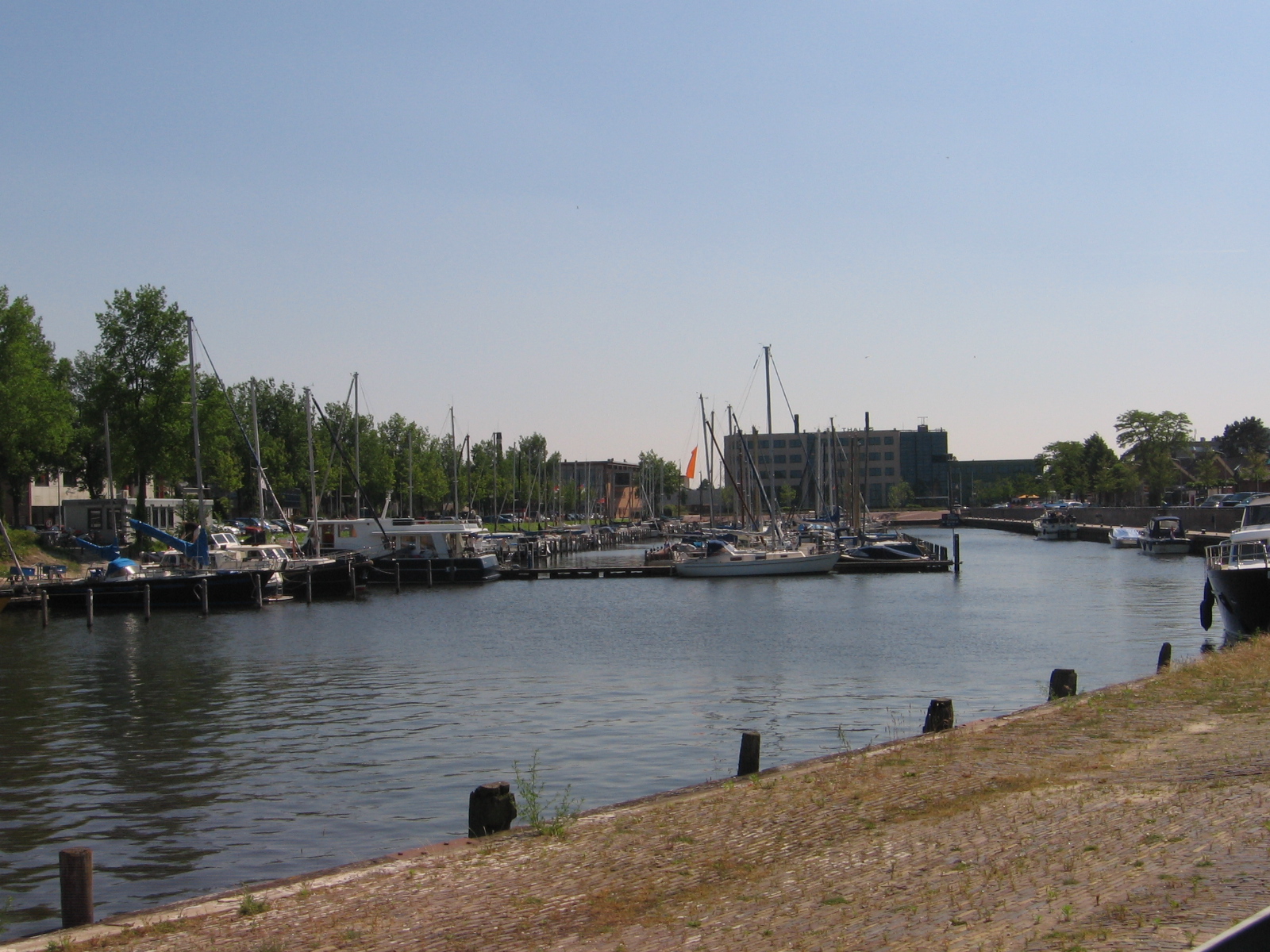
 Huizen harbour
 -
 Huizen Naarderstraat toll house
 -
 Huizen-kalkovens


References
[edit]- ^ "Burgemeester mr. A.Ph. Hertog" (in Dutch). Gemeente Huizen. Archived from the original on 11 March 2014. Retrieved 11 March 2014.
- ^ "Kerncijfers wijken en buurten 2020" [Key figures for neighbourhoods 2020]. StatLine (in Dutch). CBS. 24 July 2020. Retrieved 19 September 2020.
- ^ "Postcodetool for 1276KB". Actueel Hoogtebestand Nederland (in Dutch). Het Waterschapshuis. Archived from the original on 21 September 2013. Retrieved 11 March 2014.
- ^ "Bevolkingsontwikkeling; regio per maand" [Population growth; regions per month]. CBS Statline (in Dutch). CBS. 1 January 2021. Retrieved 2 January 2022.
- ^ "Huizen municipal election 2022". www.verkiezingsuitslagen.nl (in Dutch). 16 March 2022. Retrieved 26 April 2024.
External links
[edit] Media related to Huizen at Wikimedia Commons
- Official website


| International | |
|---|---|
| National | |
| Geographic | |

Huizen
View on GrokipediaGeography
Location and Topography
Huizen is a municipality and town in the province of North Holland, Netherlands, positioned along the southwestern coast of the IJsselmeer, the largest lake in Western Europe. The town center is located at geographic coordinates 52°18′N 5°15′E, placing it approximately 20 kilometers northeast of Amsterdam and within the broader Gooi region.[3][4] This coastal positioning has historically influenced its development as a fishing and maritime community, with the IJsselmeer forming a natural eastern boundary. The topography of Huizen features predominantly flat, low-lying terrain typical of the Dutch coastal plain, with average elevations of about 3 meters above sea level.[5] The landscape includes reclaimed polder areas managed through an extensive network of dikes and drainage systems to prevent flooding from the adjacent IJsselmeer, reflecting the Netherlands' engineering adaptations to its below-sea-level geography.[6] Elevations vary minimally, ranging from near sea level in polder zones to slightly higher ground up to 5 meters in localized areas, with no significant hills or relief within the municipal boundaries of 20.71 square kilometers.[5] The flat expanse supports agricultural and residential land use, bordered by water to the north and east, and connecting via land to neighboring municipalities like Blaricum and Naarden to the south.Climate and Natural Features
Huizen experiences a temperate maritime climate (Köppen classification Cfb), with mild temperatures year-round, moderate rainfall, and frequent overcast skies influenced by its proximity to the North Sea and IJsselmeer. Average annual temperatures hover around 9.9 °C, with January means at 3.0 °C and July peaks at 17.2 °C; highs rarely exceed 25 °C in summer or drop below freezing in winter. Precipitation totals approximately 864 mm annually, distributed fairly evenly across months, though autumn and summer see slightly higher amounts (up to 90 mm in July and October), contributing to lush vegetation but occasional flooding risks in low-lying areas.[7] The municipality's natural landscape reflects the broader Dutch polder system, consisting of flat, reclaimed farmland and water meadows below sea level, bounded by dikes along the IJsselmeer—a vast freshwater body resulting from the 1932 Afsluitdijk closure of the Zuiderzee. Elevation averages near sea level along the coast but rises modestly inland to the Gooi region's sandy moraine ridges, reaching up to 20-30 meters, supporting deciduous forests, heathlands, and recreational trails. Local features include the IJsselmeer's shoreline with shallow bays fostering wetland habitats and bird migration, alongside scattered woodlands like those accessible via nearby hiking paths, which traverse mixed terrain of dunes, ponds, and grasslands.[8][9]History
Early Settlement and Medieval Development
The earliest documented reference to Huizen appears in 1382, recorded as Huussem, indicating an established settlement by the late medieval period.[10] [11] Prior to this, archaeological and historical evidence suggests possible prehistoric or early medieval habitation in the Gooi region, though specific traces for Huizen remain limited; a chapel dedicated to Saint Thomas may have existed on the site of the current Oude Kerk as early as the 10th century.[12] The name Huizen likely derives from the presence of stone houses, distinguishing it from neighboring areas with turf huts, reflecting a relatively advanced building tradition amid agrarian communities.[11] Initial settlement centered on farming, with inhabitants known as boeren who later formed part of the erfgooiers, a medieval collective regulating communal land use in the Gooi area.[10] These erfgooiers held usage rights to meenten—shared commons for grazing and resource extraction—stemming from medieval arrangements under the Abbey of Elten, which owned much of the land since 969 but granted local access.[13] [14] This system fostered a stable rural economy based on agriculture and pastoralism, predating Huizen's later maritime focus. Medieval development coalesced around the Oude Kerk, constructed between approximately 1380 and 1409, with its tower completed in 1509; the structure served as the communal and religious hub, dedicated initially to Saint Thomas or Saint Vitus.[15] [16] [17] Farms clustered nearby, forming the village core, while the erfgooiers' marke organization managed land disputes and resources, enduring as a distinctive feature of Gooi governance into later centuries.[10] The absence of early urban privileges or fortifications underscores Huizen's character as a modest agrarian parish rather than a fortified town during this era.[18]Maritime and Industrial Growth
Huizen's economy shifted toward maritime activities in the late 17th century, as fishing supplanted agriculture and home industries as the principal means of subsistence.[11] Initially lacking a formal harbor, fishermen launched traditional flat-bottomed botter vessels from beaches along the Zuiderzee, targeting herring, flatfish, and other species, with catches unloaded directly onshore.[10] This beach-based operation persisted until harbor infrastructure developed to accommodate growing fleets.[19] The expansion of the fishing sector drove local shipbuilding, with Huizen yards specializing in constructing durable botters suited to Zuiderzee conditions.[20] Production of these vessels continued into the 20th century, with the last new fishing botter completed in 1933 by the Janus Kok yard, reflecting sustained maritime investment amid fluctuating catches and regulatory changes, such as mid-18th-century mandates directing herring deliveries to designated ports.[21][22] Industrial development complemented maritime growth, particularly through lime production via shell lime kilns utilizing oyster shells dredged from the Zuiderzee.[23] Facilities, including four prominent kilns erected between 1918 and 1920, operated as among Europe's final shell lime distilleries, processing materials for construction until the early 20th century.[23] These kilns, situated at the old harbor, underscored Huizen's diversification into resource extraction and processing tied to its coastal position.[1] The old fishing harbor, serving until the Zuiderzeewerk's completion in 1932, facilitated this dual maritime-industrial expansion, enabling Huizen to evolve from a modest village of approximately 150 homes around 1600 into a hub of economic activity.[20][24]Post-War Modernization and Suburbanization
In the immediate post-war period, Huizen experienced modest reconstruction focused on repairing minor war-related damage and addressing national housing shortages, with limited destruction compared to larger Dutch cities. The population stood at approximately 8,000 residents in the late 1940s, reflecting a stable base from pre-war levels around 7,700 in 1939. National policies emphasized rapid housing production, resulting in the construction of over 1.5 million dwellings across the Netherlands between 1945 and 1960 to alleviate shortages exacerbated by halted wartime building and demographic pressures from the baby boom. In Huizen, initial efforts prioritized functional single-family homes and basic infrastructure upgrades, transitioning the town from its fishing-oriented economy toward residential expansion.[25][26] By the 1950s and 1960s, Huizen's growth accelerated amid national suburbanization, as urban dwellers sought affordable, spacious housing outside Amsterdam amid economic prosperity and rising car ownership. The population reached 12,242 by 1958 and surged to 23,728 by 1971, more than tripling from pre-war figures through systematic neighborhood development in areas like the Bovenmaat and Zeeheldenkwartier. This expansion positioned Huizen as a "slaapstad" (bedroom community) for Amsterdam commuters, leveraging its 20-kilometer proximity and scenic IJsselmeer location, with improved bus connections and road networks facilitating daily travel. Residential projects emphasized low-density, garden-style homes, aligning with Dutch planning ideals of functional modernism and green spaces, though often criticized for uniformity.[27][28] Suburbanization reshaped Huizen's social and economic fabric, diminishing the relative importance of traditional fishing and agriculture in favor of service-sector employment and commuting. By the 1970s, over half the workforce commuted to Amsterdam or nearby urban centers, supported by zoning for family-oriented suburbs that attracted middle-class households fleeing city congestion. Modernization included utility expansions and community facilities, such as schools and shopping districts, but also strained local resources, prompting debates on sustainable growth. This period solidified Huizen's identity as an affluent commuter enclave within the Gooi region, with population density rising from under 200 per square kilometer in 1950 to over 800 by 1980.[29][30]Demographics
Population Dynamics
As of September 30, 2025, the municipality of Huizen had 41,162 inhabitants. The population has remained relatively stable over the past three decades, fluctuating modestly around 41,000 residents. From 1995 to 2025, it decreased slightly from 41,611 to 41,196, reflecting limited net growth amid broader suburban trends in North Holland.[31] A peak of 42,230 inhabitants occurred prior to a dip to 40,938 in 2022, followed by partial recovery, consistent with patterns of balanced inflows and outflows in commuter-oriented municipalities.[27] This stability stems from offsetting demographic pressures: natural population change has been negative due to an aging resident base, with an average age of 44.6 years and annual deaths numbering around 470 in recent periods.[32][2] Birth rates, aligned with national lows below replacement levels, contribute minimally to growth, while net migration—immigration of approximately 2,038 persons annually—counters outflows to sustain equilibrium.[2] The low share of foreign-born residents at 3.5% underscores reliance on domestic mobility rather than international influxes.[32] Historical dynamics trace to post-war suburbanization, when Huizen's population expanded as a residential extension of Amsterdam, drawing families to its coastal and wooded setting; growth from earlier fishing-village roots accelerated around 1900 with affluent inflows seeking healthier environs.[10] Between 1975 and 2015, the increase was modest at 1.2%, far below urban centers, highlighting Huizen's role as a steady, family-focused suburb rather than a high-growth hub.[33] Projections for North Holland anticipate provincial expansion to 3.4 million by 2050, but Huizen's trajectory suggests continued stability absent major housing or economic shifts.Ethnic and Social Composition
As of January 1, 2024, Huizen had a population of 41,209 residents.[2] In 2022, approximately 8,933 inhabitants—or about 22% of the population—had a migration background, defined by the Dutch Central Bureau of Statistics (CBS) as individuals with at least one parent born abroad.[34] Of these, 4,126 had a Western migration background (e.g., from other European countries, North America, or Oceania), while the remainder included non-Western origins such as Turkey, Morocco, Suriname, or Indonesia, though non-Western shares remain lower than national averages due to Huizen's suburban character.[34] This results in a predominantly ethnically Dutch composition, with limited ethnic enclaves compared to urban centers like Amsterdam.[35] Socially, Huizen reflects an affluent, middle-class profile typical of commuter towns in the Gooi region. The average income per income recipient stood at €42,600 in 2023, exceeding the national median household income of €34,000.[27] [36] Educational attainment is relatively high: among residents aged 15-75 in 2023, 34% held theoretical qualifications (e.g., university or higher professional education), 41% middle-level (e.g., vocational secondary or mid-level vocational), and 25% practical/basic levels.[27] Unemployment is low, with only 1% of the workforce receiving unemployment benefits (WW) in 2024, and just 6% of households living below the social minimum in 2023, indicating broad economic stability and low reliance on social assistance.[27] Religiously, Huizen maintains a historically Protestant heritage, with multiple Reformed and evangelical congregations active as of 2025, alongside 21 religious buildings hosting 27 faith communities.[37] [38] However, secularization has progressed in line with national trends, resulting in a majority of residents unaffiliated with organized religion, though specific denominational adherence rates for Huizen are not publicly detailed in recent CBS surveys.[39] Social cohesion benefits from this homogeneity, with low crime rates (27 offenses per 1,000 inhabitants in 2024) and community-oriented institutions.[27]Economy
Key Economic Sectors
Huizen's economy is predominantly service-oriented, aligning with the knowledge-intensive profile of the Gooi en Vechtstreek region, where business services, health and social care, and retail trade form the core sectors. In the region, wholesale and retail accounted for 15,837 jobs in 2019, health and welfare services for 10,899 jobs, and business services for 6,302 jobs, comprising a significant portion of total employment.[40] Huizen benefits from this structure, with particular emphasis on health care combined with information and communication technology (ICT) as a focal area for economic activity.[40] Growth in the region has been notable in advisory and research services (up 20% from 2010 to 2019), hospitality (up 19%), education (up 11%), and business services (up 10%), trends that influence Huizen's sectoral development.[40] The municipality's coastal location on the IJsselmeer supports recreational maritime activities, including yachting and boating services, which contribute to tourism and local commerce, evolving from its historical role as a fishing village on the former Zuiderzee.[1] Opportunities exist in sustainable businesses, creative professions, and recreation, leveraging Huizen's high quality of life and green spaces.[40] Employment in Huizen is supported by intensification of existing business sites like 't Plaveen and Huizermaatweg, with no plans for major new developments, focusing instead on mixed-use potential and energy transition initiatives.[40] The region's overall jobs-to-working population ratio stands at 0.9, with ambitions to reach 1.0 through targeted growth in these sectors.[40]Wealth and Employment Patterns
The average disposable income per inhabitant in Huizen stands at €35,200, exceeding the national average, while the average per income recipient reaches €42,600, reflecting a relatively affluent population structure.[27] This positions Huizen above the Dutch median in material wealth indicators, with standardized disposable income estimated at €36,100 per person in 2022 data.[41] Employment participation in Huizen remains higher than the national average, though comparatively lower within the affluent Gooi region, contributing to stable but not top-tier welvaart scores over the past decade.[42] Unemployment is notably low, with only 540 residents receiving unemployment benefits in the latest reported period, equating to under 2% of the estimated labor force in a municipality of approximately 50,000 inhabitants.[43] Local job availability is limited, prompting many residents—particularly professionals—to commute to Amsterdam or nearby hubs for roles in business services, finance, healthcare, and education, sectors aligned with the area's high educational attainment and suburban character. Wealth distribution shows concentration among dual-income households and retirees, bolstered by high property values and homeownership rates typical of North Holland commuter towns, though labor participation gaps slightly temper broader welvaart metrics relative to neighboring municipalities.[44]Government and Politics
Municipal Administration
The municipal administration of Huizen operates under the standard Dutch municipal governance framework, comprising the elected municipal council (gemeenteraad), the executive board (college van burgemeester en wethouders, or B&W), and the mayor (burgemeester). The council, as the legislative body, holds ultimate authority over policy-making, budgeting, and oversight of the executive, with members elected every four years by residents aged 18 and older. [45] The municipal council consists of 27 seats, distributed among 11 political parties following the March 16, 2022, elections. The VVD secured the largest share with 6 seats, followed by parties including CDA (3 seats), D66 (3 seats), Dorpsbelangen Huizen (3 seats), and others such as Leefbaar Huizen, PvdA, GroenLinks, ChristenUnie, SGP, and independent or smaller lists to reach the total. [46] [47] The executive board includes the mayor and four aldermen (wethouders), who handle day-to-day administration and policy implementation. Current aldermen are Roland Boom (VVD, responsible for areas including finance and economic affairs), Fleur van der Kleij (Leefbaar Huizen), Bert Rebel (CDA), and Karin van Werven (D66). [48] Niek Meijer (VVD), appointed as mayor, chairs the council and represents the municipality in ceremonial and public order matters, with his term ongoing as of October 2025. [49] [50] The administration emphasizes regional cooperation, particularly in the Gooi region, for issues like housing and infrastructure. [51]Political Orientation and Elections
In the municipal elections of 16 March 2022, the People's Party for Freedom and Democracy (VVD) received 16% of the votes (2,869 votes), securing 5 seats in the 27-seat Huizen municipal council.[52] Local parties Leefbaar Huizen and Dorpsbelangen Huizen followed closely, each gaining approximately 15% and 13% of the votes (2,646 and 2,309 votes, respectively), translating to 4 seats apiece; Leefbaar Huizen emphasizes anti-establishment and community-focused policies, while Dorpsbelangen prioritizes rural and suburban preservation.[52] [53] This outcome underscores a center-right orientation in local politics, with VVD's liberal-conservative platform dominating alongside robust support for independent localist groups that advocate restrained development and fiscal conservatism, reflecting Huizen's affluent suburban demographic.[52] National election patterns reinforce this, as in the 22 November 2023 Tweede Kamer elections, Huizen voters allocated 22% to the right-wing populist Party for Freedom (PVV) and 21% to VVD, with the conservative-liberal New Social Contract (NSC) at 13%, indicating a broader preference for parties favoring immigration controls, economic liberalism, and skepticism toward progressive centralization.[52] Post-election, the council formed a coalition comprising VVD, Dorpsbelangen Huizen, and other center-right elements, focusing on housing restraint, infrastructure maintenance, and local autonomy amid national pressures for densification.[46] Voter turnout in the 2022 municipal vote stood at around 55%, consistent with suburban patterns where pragmatic, non-ideological voting prevails over urban progressive mobilization.[53] Huizen's electorate, with over 30% aged 65 or older as of 2025, tends toward stability-oriented conservatism, as evidenced by consistent VVD strength since the 2018 elections where it held 6 seats.[54][52]Infrastructure
Transportation
Huizen does not possess a railway station; the closest is Station Naarden-Bussum, situated approximately 6 kilometers southeast.[55] Public transportation relies on bus services operated by Connexxion, with the central Huizen Busstation serving as the primary hub at Huizermaatweg 3.[56] Key routes include frequent connections to Amsterdam Amstelstation, operating every 20 minutes and taking 41 minutes.[57] Local and regional lines link to nearby towns like Blaricum and Laren, integrated into the broader Gooi network.[58] The road network connects Huizen via provincial routes such as the N525 and proximity to the A1 motorway, facilitating access to Amsterdam (about 20 km west) and Utrecht.[59] Infrastructure enhancements include the renewal of the east-west axis from Huizermaatweg to Stroomzijde, replacing roundabouts with priority squares at Fauna and Haar intersections to improve traffic flow.[60] This project also prioritizes high-quality public transport (HOV) with zero-emission buses, three dedicated HOV stops (De Oorsprong, Jol, and De Regentesse), and increased service frequency for greater reliability.[60] Cycling infrastructure supports the Dutch emphasis on non-motorized transport, featuring extensive dedicated paths throughout the municipality.[60] The east-west axis renewal introduces new two-way cycle paths, tunnel connections, and bridges, including one in Regentessepark, alongside continuous pedestrian routes parallel to cycles.[60] Bus stops are being adapted for better accessibility to cyclists, pedestrians, elderly, and disabled users.[60] The Huizen Busstation is undergoing upgrades to a mobility hub with enhanced bike parking, EV charging stations, shared transport options, and potential amenities like parcel points.[61] Huizen's harbor on the IJsselmeer primarily accommodates recreational and fishing vessels, with no scheduled passenger ferry services for inter-municipal transport.[62] Local water access supports leisure boating rather than commercial passenger movement.[63]Housing and Urban Development
Huizen's housing landscape is characterized by a predominance of single-family homes, reflecting its suburban character within the Gooise Meren region and proximity to Amsterdam. With a population of approximately 41,200 residents as of 2025, the municipality maintains a relatively low population density of about 2,600 inhabitants per square kilometer across its 15.8 square kilometers.[64] The housing stock supports this profile, featuring mostly owner-occupied detached and semi-detached dwellings suited for families, though exact figures for total units are not publicly detailed in municipal reports; national trends suggest around 18,000 to 19,000 homes, aligning with an average household size of roughly 2.2 persons.[65] Amid the Netherlands' ongoing housing shortage of approximately 390,000 units in 2025, Huizen's developments emphasize modest expansions to preserve its low-rise, green-oriented urban form while addressing local demand.[66] Urban development in Huizen prioritizes integrated projects that combine residential growth with infrastructure upgrades and recreational preservation, often through public-private partnerships. The municipality's planning focuses on infill and waterfront revitalization rather than large-scale greenfield expansion, constrained by the IJsselmeer coastline and protected landscapes. Key initiatives include the Oude Haven phase 3, which adds 21 single-family row houses (kadewoningen) at 10 meters height and 14 apartments at 16 meters height, plus a commercial plinth, with sales launching in May 2025 at prices ranging from €525,000 to €815,000 v.o.n. for apartments and €699,000 to €799,000 for houses.[67] [68] This project enhances waterfront living while incorporating sustainability features like energy-efficient designs. Similarly, Keuchenius Oost involves constructing 31 homes (reduced from 34 due to national affordable rental regulations), with portions delivered around 2020 and ongoing phases emphasizing central location integration.[69] [70] The De Wolfskamer area development exemplifies efforts to optimize existing land use, repurposing parts of the sports park for housing while upgrading facilities like artificial turf fields. Approved by the municipal council on May 30, 2024, following community participation starting in 2023, it aims to generate space for new residences amid concerns from local sports clubs about field reductions.[71] [72] These projects contribute incrementally to national goals of adding 90,000 homes annually, though Huizen's scale remains small, reflecting local priorities for balanced growth over rapid densification. House prices in such new builds exceed the national average of €489,000 for existing homes in 2025, driven by regional demand from Amsterdam commuters.[73] [74]Culture and Heritage
Historical Sites and Traditions
The Oude Kerk, built between 1380 and 1409 with its tower added in 1509, represents Huizen's medieval ecclesiastical heritage as the village's central church dedicated to Saint Thomas. Originally serving an agricultural community, the structure functioned as the primary burial site until 1828, when interments shifted to a new cemetery.[75] Its Gothic architecture underscores Huizen's transition from wooden to stone construction, aligning with local lore of the town deriving its name from early stone houses in the sod-dominated North Holland region.[76] The Huizer Museum Het Schoutenhuis, located in a replica of the 17th-century Regthuys (sheriff's office) rebuilt after the original's demolition in 1994, preserves artifacts of Huizen's cultural history, emphasizing maritime fishing, cheese trade, and traditional klederdracht costumes from 1850 to 1950.[77] Exhibits highlight the town's Zuiderzee-era fishing fleet, one of the largest in the region, with preserved botters—flat-bottomed sailing boats—displayed at the adjacent Botterwerf museum yard, illustrating 19th- and early 20th-century seafaring techniques.[1] The Naarderstraat toll house, a preserved 19th-century structure, reflects Huizen's role in regional trade routes. Huizen's traditions revolve around its seafaring past, including annual maritime festivals and maintenance of botter restoration practices that sustain community ties to pre-IJsselmeer diking in 1932, when the Zuiderzee became a freshwater lake.[1] Local customs feature distinctive embroidered costumes, once worn daily by fishermen's families, symbolizing social status and now showcased in reenactments and museum collections to educate on pre-industrial rural life.[77] Industrial heritage sites like the 19th-century kalkovens (lime kilns) along the waterfront commemorate lime production for construction, integral to the area's building boom following stone house adoption.[78]Education and Community Life
Huizen maintains a network of primary schools catering to its young population, with 16 basisscholen operating within the municipality as of recent data. Enrollment figures vary across institutions; for example, De Springplank serves 519 pupils, while De Parel enrolls 212.[79] These schools encompass various educational approaches, including Montessori methods at institutions like the Tweede Montessorischool - De Gouden Kraal and Jenaplanschool De Werf.[80] Extracurricular care is supported by organizations such as the Huizen Child Care Foundation, which provides after-school programs featuring sports, theater, arts, and nature activities for children aged 4-12, alongside specialized sports options for ages 6-12.[81] Secondary education centers on the Erfgooiers College, a Protestant-Christian scholengemeenschap located at Graaf Wichman 175, offering programs from mavo through havo, vwo, vwo+, and gymnasium levels.[82] The school emphasizes personalized growth with bridge classes that adapt to students' abilities via core and elective programs, serving pupils in a structured environment focused on academic and character development.[83] Higher education opportunities are limited locally, with residents typically commuting to regional universities in Amsterdam or Utrecht. Community life in Huizen thrives through extensive involvement in sports and social associations, fostering local engagement among its roughly 50,000 inhabitants. The Sport Platform Huizen coordinates over a dozen clubs, including SV Huizen (a football association founded in 1927 with teams across youth and senior levels), Atletiekvereniging Zuidwal for track and field, Badmintonvereniging Huizen'96, and De Zuidvogels for baseball and softball.[84] Other active groups encompass gymnastics at HeJeNa Gym, darts via Dartvereniging Huizen, and pétanque at Jeu de Boules Club Huizen, alongside martial arts at Fight Club Huizen and rowing with Stichting Huizer Botters.[85] Beyond athletics, religious and youth organizations contribute to social cohesion. Celebration Church Netherlands in Huizen operates ministries for children, youth, men, women, and community support, including a food kitchen, clothing bank, and missions outreach.[86] The Knapenvereniging Huizen gathers boys weekly for discussions on faith, life, and personal development, drawing from biblical principles like Proverbs 22:6.[87] The municipal magazine annually compiles directories of local organizations and events, highlighting Huizen's emphasis on volunteerism and neighborhood ties.[88]Notable People
Sports Figures
Sofyan Amrabat, born on August 21, 1996, in Huizen, is a professional footballer who primarily plays as a defensive midfielder. Of Moroccan descent, he opted to represent Morocco internationally, featuring in major tournaments including the 2022 FIFA World Cup, where he contributed to their unprecedented semi-final run, and the 2022 Africa Cup of Nations. Amrabat developed through the youth ranks of FC Utrecht and HSV De Zuidvogels in Huizen before progressing to senior levels with clubs such as Club Brugge, Hellas Verona, Fiorentina, and a loan spell at Manchester United during the 2023–24 season.[89][90] Dolf van der Wal, born on July 21, 1987, in Huizen, is a freestyle snowboarder who competed for the Netherlands at the 2014 Winter Olympics in Sochi, participating in slopestyle events. He began snowboarding in 1998 and turned professional in 2005, earning recognition in international competitions prior to the Olympics.[91][92] Pieter van Ede, born on November 30, 1965, in Huizen, is a former field hockey player who represented the Netherlands in the men's tournament at the 1992 Summer Olympics in Barcelona, appearing in six matches without scoring. He accumulated 19 caps for the national team during his career.Business and Cultural Contributors
Willem Oltmans (1925–2004), born in Huizen on June 10, 1925, was a Dutch journalist, author, and publicist renowned for his provocative interviews with figures like Sukarno and his extensive body of work critiquing Dutch society and politics.[93] [94] His career spanned decades, including studies at Yale University and contributions to international reporting, though often marked by legal disputes and media controversies.[95] Jan Rebel (1885–1961), born in Huizen on August 24, 1885, was a Dutch architect and interior designer who established his firm in Laren in 1911, specializing in luxury villas and country houses in the Gooi region.[96] His designs emphasized traditional Dutch elements blended with modern functionality, influencing residential architecture for affluent clients, and the firm continued operations post his death in 1961.[97] Huizen lacks internationally prominent business magnates among its native inhabitants, with local economic activity historically centered on maritime trade and fisheries rather than large-scale industry or corporate leadership.[10]References
- https://commons.wikimedia.org/wiki/File:Huizen-kalkovens.jpg