Hubbry Logo
Hydrostatic stressHydrostatic stressMain
Open search
Hydrostatic stress
Community hub
Hydrostatic stress
logo
8 pages, 0 posts
0 subscribers
Be the first to start a discussion here.
Hydrostatic stress
Hydrostatic stress
from Wikipedia

In continuum mechanics, hydrostatic stress, also known as isotropic stress or volumetric stress,[1] is a component of stress which contains uniaxial stresses, but not shear stresses.[2] A specialized case of hydrostatic stress contains isotropic compressive stress, which changes only in volume, but not in shape.[1] Pure hydrostatic stress can be experienced by a point in a fluid such as water. It is often used interchangeably with "mechanical pressure" and is also known as confining stress, particularly in the field of geomechanics.[citation needed]

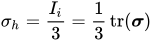
Hydrostatic stress is equivalent to the average of the uniaxial stresses along three orthogonal axes, so it is one third of the first invariant of the stress tensor (i.e. the trace of the stress tensor):[2]

Diagram showing compressive hydrostatic stresses

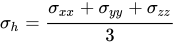
For example in cartesian coordinates (x,y,z) the hydrostatic stress is simply:
Hydrostatic stress and thermodynamic pressure

[edit]

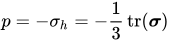
In the particular case of an incompressible fluid, the thermodynamic pressure coincides with the mechanical pressure (i.e. the opposite of the hydrostatic stress):
In the general case of a compressible fluid, the thermodynamic pressure is no more proportional to the isotropic stress term (the mechanical pressure), since there is an additional term dependent on the trace of the strain rate tensor:

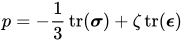
where the coefficient is the bulk viscosity. The trace of the strain rate tensor corresponds to the flow compression (the divergence of the flow velocity):

So the expression for the thermodynamic pressure is usually expressed as:

where the mechanical pressure has been denoted with . In some cases, the second viscosity can be assumed to be constant in which case, the effect of the volume viscosity is that the mechanical pressure is not equivalent to the thermodynamic pressure[3] as stated above. However, this difference is usually neglected most of the time (that is whenever we are not dealing with processes such as sound absorption and attenuation of shock waves,[4] where second viscosity coefficient becomes important) by explicitly assuming . The assumption of setting is called as the Stokes hypothesis.[5] The validity of Stokes hypothesis can be demonstrated for monoatomic gas both experimentally and from the kinetic theory;[6] for other gases and liquids, Stokes hypothesis is generally incorrect.

Potential external field in a fluid

[edit]

Its magnitude in a fluid, , can be given by Stevin's Law:

where

  • i is an index denoting each distinct layer of material above the point of interest;
  • is the density of each layer;
  • is the gravitational acceleration (assumed constant here; this can be substituted with any acceleration that is important in defining weight);
  • is the height (or thickness) of each given layer of material.

For example, the magnitude of the hydrostatic stress felt at a point under ten meters of fresh water would be

where the index w indicates "water".

Because the hydrostatic stress is isotropic, it acts equally in all directions. In tensor form, the hydrostatic stress is equal to

where is the 3-by-3 identity matrix.

Hydrostatic compressive stress is used for the determination of the bulk modulus for materials.

References

[edit]

Notes

[edit]
Revisions and contributorsEdit on WikipediaRead on Wikipedia
from Grokipedia
Hydrostatic stress, also known as hydrostatic in compressive contexts, is the isotropic component of the stress tensor in a , characterized by equal normal stresses in all directions without shear components, leading to uniform volumetric expansion or contraction rather than shape distortion. It is mathematically defined as the negative of the mean normal stress, given by p=13(σxx+σyy+σzz)p = -\frac{1}{3} (\sigma_{xx} + \sigma_{yy} + \sigma_{zz}), where σij\sigma_{ij} are the components of the . In , the total stress tensor σ\sigma is decomposed into a hydrostatic part pI-p \mathbf{I} (where I\mathbf{I} is the identity tensor) and a deviatoric part τ\tau, such that σ=pI+τ\sigma = -p \mathbf{I} + \tau, with the trace of τ\tau being zero to isolate shear-induced deformations. This decomposition is fundamental for analyzing material behavior under load, as hydrostatic stress primarily influences volume changes via dilation or compression, while the deviatoric stress governs and shape alterations. Historically rooted in fluid statics, where it equates to pressure in equilibrium, hydrostatic stress extends to solid mechanics and geomechanics, playing a key role in phenomena like poroelasticity and effective stress principles in porous media, such as soils and rocks, where it interacts with pore fluid pressures to determine overall stability. In materials engineering, its effects are pronounced in high-pressure environments, including deep-earth conditions or manufacturing processes like hot isostatic pressing. Although classical plasticity theories, such as the von Mises criterion, assume hydrostatic stress does not influence yielding—focusing solely on deviatoric components—experimental evidence from metals like 100 demonstrates its significant impact, particularly in notched or cracked geometries, where it can generate internal tensile stresses that lower yield loads by 3-5% and increase strains by 20-35% at failure compared to deviatoric-only predictions. This has led to advanced models like Drucker-Prager, which incorporate hydrostatic dependence for more accurate simulations in and structural applications.

Fundamentals

Definition

Hydrostatic stress, also known as isotropic or volumetric stress, is defined as the average of the three normal stress components acting equally in all directions within a , representing a uniform pressure-like state without any shear components. This scalar quantity arises as a key element of the stress tensor in , capturing the isotropic portion of the overall stress state at a point. In materials subjected to hydrostatic stress, the resulting deformation involves only uniform compression or dilation, leading to changes in volume but no alteration in shape, as opposed to distortions caused by other stress types. This volumetric effect is particularly relevant in analyzing behaviors under multiaxial loading, such as in fluids where it equates to or in solids where it influences bulk properties without inducing shear deformation. The concept originated in the framework of during the early 19th century, with foundational contributions from , who developed the general theory of the stress tensor in 1823 and 1827 to describe stress states in continuous media, including pressure-like isotropic conditions applicable to both fluids and solids. Unlike , which involves tangential forces that cause sliding or angular distortion, hydrostatic stress is characterized exclusively by normal forces perpendicular to surfaces, ensuring no tangential components are present.

Mathematical Formulation

In , the state of stress at a point within a deformable body is represented by the σij\sigma_{ij}, a symmetric second-order tensor whose components include the normal stresses σxx\sigma_{xx}, σyy\sigma_{yy}, and σzz\sigma_{zz} along the principal Cartesian axes. The hydrostatic stress σh\sigma_h is mathematically defined as the arithmetic mean of these normal stress components, given by σh=σxx+σyy+σzz3.\sigma_h = \frac{\sigma_{xx} + \sigma_{yy} + \sigma_{zz}}{3}. This definition extends to the general tensor form as σh=13Tr(σ)\sigma_h = \frac{1}{3} \operatorname{Tr}(\sigma), where Tr(σ)\operatorname{Tr}(\sigma) is the trace of the stress tensor σ\sigma, equivalent to the sum of its diagonal elements. The first invariant of the stress tensor, I1=Tr(σ)I_1 = \operatorname{Tr}(\sigma), directly relates to the hydrostatic stress through I1=3σhI_1 = 3\sigma_h; this invariant governs the volumetric response of the material, as hydrostatic stress induces uniform expansion or contraction without shear distortion. The hydrostatic stress tensor itself is isotropic, expressed as σhI\sigma_h \mathbf{I} in three dimensions, where I\mathbf{I} is the identity tensor; this results in a diagonal matrix (σh000σh000σh),\begin{pmatrix} \sigma_h & 0 & 0 \\ 0 & \sigma_h & 0 \\ 0 & 0 & \sigma_h \end{pmatrix},
Add your contribution
Related Hubs
User Avatar
No comments yet.