Hubbry Logo
Ideal solutionIdeal solutionMain
Open search
Ideal solution
Community hub
Ideal solution
logo
7 pages, 0 posts
0 subscribers
Be the first to start a discussion here.
Ideal solution
Ideal solution
from Wikipedia

An ideal solution or ideal mixture is a solution that exhibits thermodynamic properties analogous to those of a mixture of ideal gases.[1][2] The enthalpy of mixing is zero[3] as is the volume change on mixing.[2] The vapor pressures of all components obey Raoult's law across the entire range of concentrations,[2] and the activity coefficient (which measures deviation from ideality) is equal to one for each component.[4]

The concept of an ideal solution is fundamental to both thermodynamics and chemical thermodynamics and their applications, such as the explanation of colligative properties.

Physical origin

[edit]

Ideality of solutions is analogous to ideality for gases, with the important difference that intermolecular interactions in liquids are strong and cannot simply be neglected as they can for ideal gases. Instead we assume that the mean strength of the interactions are the same between all the molecules of the solution.

More formally, for a mix of molecules of A and B, then the interactions between unlike neighbors (UAB) and like neighbors UAA and UBB must be of the same average strength, i.e., 2 UAB = UAA + UBB and the longer-range interactions must be nil (or at least indistinguishable). If the molecular forces are the same between AA, AB and BB, i.e., UAB = UAA = UBB, then the solution is automatically ideal.

If the molecules are almost identical chemically, e.g., 1-butanol and 2-butanol, then the solution will be almost ideal. Since the interaction energies between A and B are almost equal, it follows that there is only a very small overall energy (enthalpy) change when the substances are mixed. The more dissimilar the nature of A and B, the more strongly the solution is expected to deviate from ideality.

Formal definition

[edit]

Different related definitions of an ideal solution have been proposed. The simplest definition is that an ideal solution is a solution for which each component obeys Raoult's law for all compositions. Here is the vapor pressure of component above the solution, is its mole fraction and is the vapor pressure of the pure substance at the same temperature.[2][5][6]

This definition depends on vapor pressure, which is a directly measurable property, at least for volatile components. The thermodynamic properties may then be obtained from the chemical potential μ (which is the partial molar Gibbs energy g) of each component. If the vapor is an ideal gas,

The reference pressure may be taken as = 1 bar, or as the pressure of the mix, whichever is simpler.

On substituting the value of from Raoult's law,

This equation for the chemical potential can be used as an alternate definition for an ideal solution.

However, the vapor above the solution may not actually behave as a mixture of ideal gases. Some authors therefore define an ideal solution as one for which each component obeys the fugacity analogue of Raoult's law . Here is the fugacity of component in solution and is the fugacity of as a pure substance.[7][8] Since the fugacity is defined by the equation

this definition leads to ideal values of the chemical potential and other thermodynamic properties even when the component vapors above the solution are not ideal gases. An equivalent statement uses thermodynamic activity instead of fugacity.[9]

Thermodynamic properties

[edit]

Volume

[edit]

If we differentiate this last equation with respect to at constant we get:

Since we know from the Gibbs potential equation that:
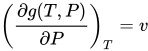
with the molar volume , these last two equations put together give:

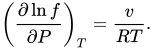
Since all this, done as a pure substance, is valid in an ideal mix just adding the subscript to all the intensive variables and changing to , with optional overbar, standing for partial molar volume:

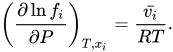
Applying the first equation of this section to this last equation we find:

which means that the partial molar volumes in an ideal mix are independent of composition. Consequently, the total volume is the sum of the volumes of the components in their pure forms:

Enthalpy and heat capacity

[edit]

Proceeding in a similar way but taking the derivative with respect to we get a similar result for molar enthalpies:

Remembering that we get:
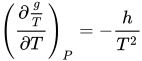
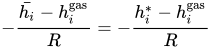
which in turn means that and that the enthalpy of the mix is equal to the sum of its component enthalpies.

Since and , similarly
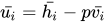
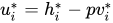
It is also easily verifiable that

Entropy of mixing

[edit]

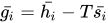
Finally since

we find that

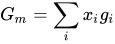
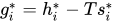
Since the Gibbs free energy per mole of the mixture is then

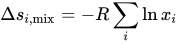
At last we can calculate the molar entropy of mixing since and
Consequences

[edit]

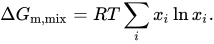
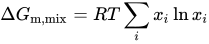
Solvent–solute interactions are the same as solute–solute and solvent–solvent interactions, on average. Consequently, the enthalpy of mixing (solution) is zero and the change in Gibbs free energy on mixing is determined solely by the entropy of mixing. Hence the molar Gibbs free energy of mixing is
or for a two-component ideal solution

where m denotes molar, i.e., change in Gibbs free energy per mole of solution, and is the mole fraction of component . Note that this free energy of mixing is always negative (since each , each or its limit for must be negative (infinite)), i.e., ideal solutions are miscible at any composition and no phase separation will occur.

The equation above can be expressed in terms of chemical potentials of the individual components
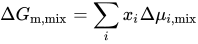
where is the change in chemical potential of on mixing. If the chemical potential of pure liquid is denoted , then the chemical potential of in an ideal solution is

Any component of an ideal solution obeys Raoult's Law over the entire composition range:
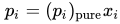
where is the equilibrium vapor pressure of pure component and is the mole fraction of component in solution.

Non-ideality

[edit]

Deviations from ideality can be described by the use of Margules functions or activity coefficients. A single Margules parameter may be sufficient to describe the properties of the solution if the deviations from ideality are modest; such solutions are termed regular.

In contrast to ideal solutions, where volumes are strictly additive and mixing is always complete, the volume of a non-ideal solution is not, in general, the simple sum of the volumes of the component pure liquids and solubility is not guaranteed over the whole composition range. By measurement of densities, thermodynamic activity of components can be determined.

See also

[edit]

References

[edit]
Revisions and contributorsEdit on WikipediaRead on Wikipedia
from Grokipedia
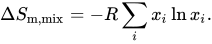
An ideal solution is a theoretical model in describing a homogeneous mixture of two or more components in which the intermolecular interactions between unlike molecules are identical to those between like molecules, resulting in zero (ΔH_mix = 0) and zero volume of mixing (ΔV_mix = 0). In such solutions, the follows the ideal expression for random mixing, ΔS_mix = -R ∑ x_i ln x_i, where R is the and x_i are the mole fractions of the components. This model assumes that the solution behaves as a superposition of the pure components without any excess thermodynamic properties beyond those expected from ideal entropy. The defining characteristic of an ideal solution is its obedience to across the entire composition range, where the partial vapor pressure of each component i is given by P_i = x_i P_i^, with P_i^ being the of the pure component. This leads to such as vapor pressure lowering, , , and that depend solely on the number of solute particles relative to the solvent, independent of their chemical identity. Thermodynamically, the chemical potential of each component in an ideal solution is expressed as μ_i = μ_i^* + RT ln x_i, where μ_i^* is the of the pure component, R is the , and T is the . Partial molar quantities, such as volume and , for each component equal their values in the pure state, simplifying the description of mixture properties. While no real solution is perfectly ideal, certain binary mixtures of similar non-polar liquids, such as benzene and or n-hexane and n-heptane, approximate ideal behavior over wide composition ranges due to comparable molecular sizes and interaction strengths. The ideal solution model serves as a foundational reference for understanding deviations in non-ideal systems, where activity coefficients account for excess Gibbs energy. It is particularly useful in predicting phase equilibria, vapor-liquid behavior, and colligative effects in dilute solutions, providing a baseline for more complex thermodynamic analyses in fields like and .

Origins and Definition

Physical Basis

An ideal solution is defined as a homogeneous of components in which the intermolecular attractive forces between unlike molecules (solute-solvent) are identical in strength to those between like molecules (solute-solute and solvent-solvent). This equivalence ensures that the mixing process occurs randomly at the molecular level without preferential associations or repulsions, resulting in properties that are additive based on the mole fractions of the components. Consequently, no net change accompanies the formation of the solution, as the overall intermolecular interaction energy remains unchanged from that of the pure components. The physical assumptions underlying ideal solutions include zero volume change upon mixing (ΔVmix=0\Delta V_\text{mix} = 0) and zero change upon mixing (ΔHmix=0\Delta H_\text{mix} = 0), reflecting the absence of any expansion, contraction, or heat absorption/release during dissolution. These conditions arise directly from the identical intermolecular forces, which prevent any reorganization of molecular arrangements that would alter volume or energy. The defining thermodynamic behavior of an ideal solution is captured by , which states that the partial vapor pressure of each component ii is equal to its pure-component PiP_i^\circ multiplied by its xix_i in the solution: Pi=xiPiP_i = x_i P_i^\circ. The concept of the ideal solution originated in the late 19th century through Jacobus Henricus van 't Hoff's investigations of dilute solutions, where he analogized in solutions to the pressure exerted by ideal gases, establishing a foundation for treating solutions as behaving ideally at low concentrations. This work, detailed in van 't Hoff's 1887 publication in Zeitschrift für Physikalische Chemie, laid the groundwork for understanding in non-electrolyte solutions. The framework was extended in the early by and Merle Randall, who in their 1923 textbook and the Free Energy of Chemical Substances formalized the ideal solution model within broader thermodynamic principles, emphasizing its applicability to multi-component systems beyond dilution. itself, proposed by François-Marie Raoult in 1887 based on experimental measurements of lowering in various solvent-solute systems, provided the empirical basis for identifying ideal behavior.

Mathematical Formulation

An ideal solution is formally defined as a in which each component obeys over the entire range of compositions. states that the partial vapor pressure PiP_i of component ii above the solution is equal to the product of its xix_i in the phase and its PiP_i^* as a pure at the same : Pi=xiPi.P_i = x_i P_i^*. This relation assumes that the vapor behaves as an and that intermolecular interactions in the solution are identical to those in the pure components. The total vapor pressure PP above an ideal solution is the sum of the partial vapor pressures of all components: P=ixiPi.P = \sum_i x_i P_i^*. For a binary mixture of components A and B, this simplifies to P=xAPA+xBPBP = x_A P_A^* + x_B P_B^*, which predicts a linear variation of total pressure with composition. This equation follows directly from of partial pressures combined with . In thermodynamic terms, the chemical potential μi\mu_i of component ii in an ideal solution is given by μi=μi+RTlnxi,\mu_i = \mu_i^* + RT \ln x_i, where μi\mu_i^* is the chemical potential of the pure component ii at the same temperature and pressure, RR is the gas constant, and TT is the absolute temperature. This expression arises from the statistical mechanics of mixing, where the configurational entropy for indistinguishable particles within each component type leads to a logarithmic dependence on mole fraction, reflecting the probabilistic distribution of molecules in the solution. The of mixing ΔGmix\Delta G_{\text{mix}} for forming an ideal solution from pure components is ΔGmix=RTinilnxi,\Delta G_{\text{mix}} = RT \sum_i n_i \ln x_i, where nin_i is the number of moles of component ii. This quantity is always negative for 0<xi<10 < x_i < 1, driving spontaneous mixing, and consists solely of an ideal entropic contribution with zero (ΔHmix=0\Delta H_{\text{mix}} = 0). The corresponding molar of mixing is ΔGmix,m=RTixilnxi\Delta G_{\text{mix,m}} = RT \sum_i x_i \ln x_i.

Key Thermodynamic Properties

Volumetric Behavior

In ideal solutions, the total volume of the is strictly additive, given by the expression V=iniViV = \sum_i n_i V_i^*, where nin_i is the number of moles of component ii and ViV_i^* is the of the pure component ii. This property stems from the definition of ideality, where intermolecular interactions between unlike molecules mirror those in the pure components, preventing any reorganization that would alter the occupied volume. The additivity manifests through the partial molar volume Vˉi\bar{V}_i, which equals the pure-component molar volume ViV_i^* and remains constant regardless of composition. Consequently, the volume change on mixing is zero, ΔVmix=0\Delta V_\text{mix} = 0, as the contributions from each component simply superimpose without contraction or expansion. This constancy of Vˉi\bar{V}_i reflects the absence of volume-dependent mixing effects in ideal systems. From a thermodynamic perspective, the partial molar volume relates directly to the dependence of the : (μiP)T=Vˉi=Vi\left( \frac{\partial \mu_i}{\partial P} \right)_T = \bar{V}_i = V_i^*. The Gibbs-Duhem , ixidμi=0\sum_i x_i d\mu_i = 0 at constant , further enforces this equality across all components, ensuring that the pressure-induced changes in chemical potentials align with the additive volumes of the pure states. Experimental confirmation comes from density measurements of near-ideal mixtures, such as benzene and toluene at ambient conditions, where the solution density ρ\rho matches the volume-weighted average of the pure densities (ρ_benzene ≈ 0.874 g/cm³ and ρ_toluene ≈ 0.862 g/cm³ at 25°C), yielding ρ = \frac{\sum x_i M_i}{\sum x_i (M_i / \rho_i)} with negligible deviations indicative of ΔVmix0\Delta V_\text{mix} \approx 0. For systems with similar molar masses like benzene (78 g/mol) and toluene (92 g/mol), the approximate formula ρ ≈ \left( \sum_i x_i / \rho_i \right)^{-1} is often used and provides close results.

Energetic Properties

In ideal solutions, the enthalpy of mixing, ΔHmix\Delta H_{\text{mix}}, is zero, indicating that no net heat is absorbed or released during the formation of the solution from its pure components. This arises because the intermolecular interactions between unlike molecules (solute-solvent) are identical in strength to those between like molecules (solute-solute and solvent-solvent), resulting in no energetic change upon mixing. The partial molar of each component ii in an ideal solution, Hˉi\bar{H}_i, equals the molar enthalpy of the pure component, HiH_i^*, and remains constant regardless of composition. This equality reflects the absence of composition-dependent enthalpic contributions, allowing the total of the solution to be simply the mole-fraction-weighted sum of the pure-component enthalpies. Consequently, the heat capacity at constant pressure for an ideal solution, CpC_p, is additive and given by Cp=xiCp,iC_p = \sum x_i C_{p,i}^*, where xix_i is the of component ii and Cp,iC_{p,i}^* is the heat capacity of the pure component. This additivity stems from the independence of molecular interactions, ensuring no excess heat capacity arises from mixing. Thermodynamically, the Gibbs free energy of mixing for an ideal solution follows from ΔGmix=ΔHmixTΔSmix\Delta G_{\text{mix}} = \Delta H_{\text{mix}} - T \Delta S_{\text{mix}}, where ΔHmix=0\Delta H_{\text{mix}} = 0 reduces the expression to ΔGmix=TΔSmix\Delta G_{\text{mix}} = -T \Delta S_{\text{mix}}, making mixing spontaneous solely due to entropic contributions. For incompressible ideal solutions, the of mixing, ΔUmix\Delta U_{\text{mix}}, is also zero, as the partial molar internal energies equal those of the pure components, Uˉi=Ui\bar{U}_i = U_i^*, with no change to contribute a pΔVp\Delta V term.

Entropic Contributions

In ideal solutions, the change upon mixing arises solely from the increased number of ways to arrange the component molecules in the mixture, known as configurational . This , ΔS_mix, is given by the formula ΔS_mix = - ∑ n_i ln x_i, where is the , n_i is the number of moles of component i, and x_i is its . This expression derives from Boltzmann's statistical mechanical formula for , S = k ln W, applied to a lattice model of , where W is the number of microstates calculated as the multinomial coefficient N! / (N_1! N_2! ... N_c!), with yielding the logarithmic form after normalization by mole fractions. The ideal is purely configurational, with no excess contributions from intermolecular interactions, as the model assumes a random distribution of molecules without positional correlations or volume changes. In contrast to energetic properties, where the is zero due to negligible interactions, the entropic term provides the driving force for mixing. The partial molar of component i in an ideal solution is expressed as \bar{S}_i = S_i^* - R \ln x_i, where S_i^* is the molar of pure i. This relation reflects the contribution of the -T ΔS_mix term to the of mixing, capturing how dilution increases the of each component through greater spatial . The is independent of temperature under the ideal model, driving spontaneous mixing at all temperatures, though the ideal assumption is most valid at high temperatures where minimizes the influence of any residual interactions. From a perspective, the ideal emerges in the Flory-Huggins theory when the interaction parameter χ approaches zero and all components have equal segment sizes, reducing the combinatorial entropy term to the standard ideal form without size asymmetry corrections.

Implications and Applications

Phase Equilibrium Effects

In ideal solutions, the assumption of governs vapor-liquid equilibrium (VLE), where the partial pressure of each component equals its in the liquid phase times its pure-component , simplifying predictions of phase behavior across binary and multicomponent systems. This ideal behavior leads to constant between components, enabling straightforward calculations for processes like without complex corrections. Boiling point elevation in ideal solutions arises from the solvent's vapor pressure lowering due to the solute, as described by ; for dilute solutions, this manifests in the van't Hoff limit as ΔT_b = K_b m, where K_b is the molal boiling point elevation constant and m is the of the solute. Similarly, freezing point depression follows an analogous derivation, with ΔT_f = -K_f m, where K_f is the molal freezing point depression constant, reflecting the stabilization of the liquid phase over the solid at lower temperatures in equilibrium with pure solvent. These colligative effects scale linearly with solute concentration in the ideal dilute regime, providing a direct measure of molecular interactions absent in non-ideal cases. For solid-liquid phase diagrams of ideal binary mixtures exhibiting complete solid solubility, the lines are linear, reflecting the symmetric application of to both phases and consistent equality across phases. This linearity simplifies the determination of eutectic points and solidification paths, as the equilibrium compositions follow ideal mixing without segregation driven by excess free energy terms. In VLE for ideal solutions, the equilibrium constant for component distribution simplifies to K_i = y_i / x_i = P_i^* / P_total, where y_i and x_i are vapor and liquid mole fractions, P_i^* is the pure-component , and P_total is the total pressure; for multicomponent systems, this extends to P_total = Σ x_i P_i^, facilitating efficient design with constant relative volatility α_{ij} = P_i^ / P_j^*. Henry's law emerges as the dilute limit of Raoult's law for solutes in ideal solutions, expressed as P_i = k_H x_i with k_H = P_i^*, the pure solute vapor pressure, allowing prediction of gas solubility without deviation from ideality at low concentrations. The osmotic pressure in ideal dilute solutions is given exactly by \pi = -\frac{RT}{V_m} \ln(1 - x_\text{solute}}, where R is the gas constant, T is temperature, V_m is the molar volume of the pure solvent, and x_solute is the solute mole fraction; this expression derives from the equality of chemical potentials across a semipermeable membrane and holds precisely under ideal mixing assumptions. For very dilute conditions, it approximates to π ≈ (RT / V_m) x_solute, emphasizing the entropic driving force behind colligative phenomena.

Practical Examples

One prominent example of an ideal solution is the benzene-toluene mixture, where the components exhibit near-ideal behavior due to their similar molecular sizes and intermolecular interactions, primarily van der Waals forces. This similarity results in vapor pressures that closely follow over the entire composition range, making it a standard case for processes in education and practice. Mixtures of in the liquid state, such as and , also approximate ideal solutions because of the weak dispersion forces between the atoms, leading to an ΔH_mix approximately equal to zero. These systems demonstrate minimal deviations from ideality, as the interactions among the noble gas atoms are nearly negligible, akin to their behavior in the gaseous phase. In dilute aqueous solutions of non-electrolytes, such as in at low concentrations (below 0.01 ), the behavior approximates ideality for like and vapor pressure lowering, where the solute follows a form analogous to as a limiting case of . This approximation holds because the solute-solute interactions are sparse at low concentrations, allowing the solvent to dominate without significant perturbations. Practical applications of ideal solution assumptions are evident in petrochemical blending, where mixtures of similar hydrocarbons (e.g., alkanes or aromatics) are treated as ideal to simplify process simulations for and , reducing while providing accurate predictions for phase behavior. Similarly, in pharmaceutical formulations, ideal solvent mixtures—such as binary cosolvent systems with similar polarity—are used to predict drug , enabling reliable estimates for dissolution rates and without accounting for complex non-ideal effects. In practice, ideality is most applicable to mixtures of chemically similar molecules, where activity coefficients γ_i approach 1 across the composition range, indicating negligible deviations from and zero excess Gibbs energy. This condition simplifies phase equilibrium calculations, such as in vapor-liquid separations, by assuming uniform intermolecular forces.

Deviations and Extensions

Sources of Non-Ideality

Non-ideality in solutions arises primarily from disparities in intermolecular forces between like and unlike molecules, deviating from the case where solute-solvent interactions match the of solute-solute and solvent-solvent forces. Stronger solute-solvent attractions than like-like interactions lead to exothermic mixing and volume contraction, as observed in the ethanol-water where bonding between dissimilar molecules enhances packing efficiency, resulting in a negative excess volume of mixing (ΔV^E < 0). Conversely, weaker solute-solvent forces cause endothermic mixing and positive deviations, expanding the upon blending. These energetic imbalances disrupt the random mixing assumed in ideal solutions, where ΔH_mix = 0 serves as the reference for no net heat change. Size differences between solute and solvent molecules introduce entropic non-ideality by violating the equal-volume assumption of ideal mixing, generating excess free volume that reduces configurational below the ideal value of -R(x_i \ln x_i). In mixtures with significant molecular volume disparities, such as small molecules surrounding larger solutes, the available translational states are constrained, leading to lower than predicted by . This effect is particularly evident in polymer- systems, where the solute's extended structure limits solvent accessibility, amplifying non-ideal entropic contributions without substantial energetic changes. Self-association or dissociation in pure components further contributes to non-ideality by altering the effective number of independent molecules upon mixing, thus modifying the . Carboxylic acids, for example, form hydrogen-bonded dimers in their pure state, reducing the number of free molecules and the ideal configurational ; dilution or mixing disrupts these dimers, releasing in a non-ideal manner that exceeds the simple additive mixing prediction. This association-driven deviation is prominent in short-chain acids like acetic acid, where the transition from dimeric pure liquid to monomeric solution states lowers the overall mixing relative to non-associating ideals. Temperature influences non-ideality by modulating the strength of intermolecular forces relative to ; higher temperatures weaken attractions like bonds and van der Waals forces, diminishing energetic deviations and driving solutions toward ideal behavior as motion dominates. At elevated temperatures, the excess Gibbs approaches zero, aligning properties closer to predictions. Pressure effects, however, exacerbate non-ideality in compressible systems by compressing free volume, intensifying molecular interactions and crowding, which amplifies both entropic and energetic deviations from ideality. Activity coefficients (γ_i) quantify these deviations, with γ_i ≠ 1 signaling non-ideal effective concentrations; values greater than 1 typically reflect endothermic mixing where solute-solvent repulsions dominate, increasing the and causing positive deviations from , while γ_i < 1 indicates exothermic mixing with favorable attractions, leading to negative deviations and reduced vapor pressures.

Models for Real Solutions

Real solutions exhibit deviations from ideal behavior primarily due to intermolecular interactions that affect the excess of mixing. To address these non-idealities, various models have been developed as extensions of the ideal solution framework, enabling accurate predictions of phase equilibria in binary and multicomponent systems. These models typically parameterize the excess Gibbs energy as a function of composition and , with parameters fitted to experimental vapor-liquid equilibrium (VLE) or liquid-liquid equilibrium data. Seminal contributions include expansions, local composition concepts, and theories incorporating molecular size and energy differences, providing tools for applications in , extraction, and predictions. The Margules equations represent an early and simple approach to modeling symmetric and asymmetric deviations using a expansion of the excess . In the one-parameter Margules model for binary mixtures, the activity coefficient for component ii is given by γi=exp[A(1xi)2],\gamma_i = \exp\left[ A (1 - x_i)^2 \right], where AA is an interaction parameter that quantifies the deviation strength and is determined from VLE data; positive AA indicates positive deviations, while negative AA signifies negative deviations. This form assumes symmetry in the activity coefficients (γ1(x)=γ2(1x)\gamma_1(x) = \gamma_2(1-x)) and performs well for mixtures of similar molecules, such as hydrocarbons. For asymmetric systems, the two-parameter Margules equation introduces distinct parameters A12A_{12} and A21A_{21}, allowing independent adjustment for each binary interaction and improving fits for systems with differing component properties, such as alcohol-hydrocarbon mixtures. The van Laar model extends these ideas to handle systems with pronounced solubility differences or azeotropic behavior, using two parameters derived directly from VLE measurements at infinite dilution. It assumes a specific form for the excess Gibbs energy that leads to activity coefficients decreasing monotonically from infinite dilution values, making it suitable for partially miscible liquids or mixtures with large differences, like water-ethanol. Parameters are typically obtained by regressing experimental total pressure data, ensuring consistency with the Gibbs-Duhem equation. The Wilson equation introduces the concept of local composition, positing that a molecule's environment is enriched in similar species due to energetic preferences, which is particularly effective for systems exhibiting partial . For a binary , the activity coefficients are expressed as lnγ1=ln(x1+Λ12x2)+x2[ln(x2+Λ21x1)+Λ12x1+Λ12x2],\ln \gamma_1 = -\ln(x_1 + \Lambda_{12} x_2) + x_2 \left[ -\ln(x_2 + \Lambda_{21} x_1) + \frac{\Lambda_{12}}{x_1 + \Lambda_{12} x_2} \right], lnγ2=ln(x2+Λ21x1)+x1[ln(x1+Λ12x2)+Λ21x2+Λ21x1],\ln \gamma_2 = -\ln(x_2 + \Lambda_{21} x_1) + x_1 \left[ -\ln(x_1 + \Lambda_{12} x_2) + \frac{\Lambda_{21}}{x_2 + \Lambda_{21} x_1} \right], where Λij=vjviexp((λijλii)RT)\Lambda_{ij} = \frac{v_j}{v_i} \exp\left( -\frac{(\lambda_{ij} - \lambda_{ii})}{RT} \right) incorporates molar volumes vi,vjv_i, v_j and energy parameters λij\lambda_{ij}; these are fitted to VLE data and account for both enthalpic and entropic effects. This model excels in representing positive deviations and liquid-liquid equilibria, such as in solutions or alcohol-water systems, and extends naturally to multicomponent mixtures via binary interaction parameters. Advanced models like and NRTL build on local composition ideas while incorporating molecular structure parameters for broader applicability to complex, non-polar and polar mixtures. The (UNIversal QUAsiChemical) model separates the excess Gibbs energy into combinatorial (size and shape) and residual (energetic) contributions, using pure-component structural parameters rkr_k (van der Waals volume) and qkq_k (surface area) alongside binary interaction energies; parameters are regressed from VLE or LLE , enabling predictions for multicomponent systems with geometric irregularities, such as solutions or polymers. Similarly, the NRTL ( accounts for non-random molecular arrangements via a non-randomness factor α\alpha (typically 0.2–0.47) and binary energy parameters, providing flexibility for both VLE and LLE in highly non-ideal mixtures like those involving acids or salts; its parameters are also derived from equilibrium , with the model showing high accuracy for ternary systems. Regular solution theory, extended by Scatchard to binary liquid mixtures, assumes random mixing with only enthalpic non-ideality, leading to the excess of mixing as ΔGmix=ΔHmix+RTxilnxi\Delta G^\text{mix} = \Delta H^\text{mix} + RT \sum x_i \ln x_i, where the ideal entropic term is retained and the enthalpic contribution is ΔHmix=βx1x2\Delta H^\text{mix} = \beta x_1 x_2 for a ; here, β\beta is an interaction parameter related to solubility parameters δi=ΔEi/Vi\delta_i = \sqrt{\Delta E_i / V_i}
Add your contribution
Related Hubs
User Avatar
No comments yet.