Hubbry Logo
Inferior colliculusInferior colliculusMain
Open search
Inferior colliculus
Community hub
Inferior colliculus
logo
8 pages, 0 posts
0 subscribers
Be the first to start a discussion here.
Inferior colliculus
Inferior colliculus
from Wikipedia
Inferior colliculus
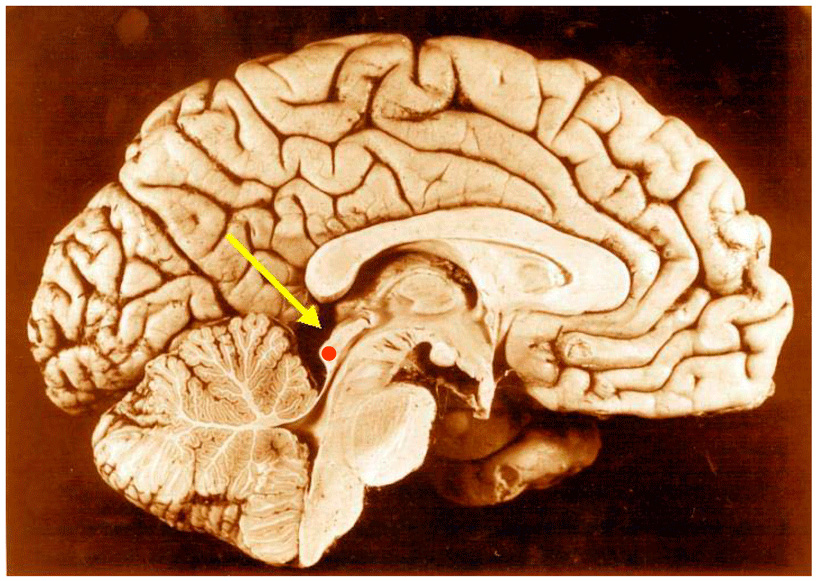
Inferior colliculus (red dot) in human brain, sagittal section.
Transverse section of mid-brain at level of inferior colliculi
Details
Part ofTectum
SystemAuditory system
Identifiers
Latincolliculus inferior
MeSHD007245
NeuroNames476
NeuroLex IDbirnlex_806
TA98A14.1.06.014
TA25916
FMA62404
Anatomical terms of neuroanatomy

The inferior colliculus (IC) (Latin for lower hill) is the principal midbrain nucleus of the auditory pathway and receives input from several peripheral brainstem nuclei in the auditory pathway, as well as inputs from the auditory cortex.[1] The inferior colliculus has three subdivisions: the central nucleus, a dorsal cortex by which it is surrounded, and an external cortex which is located laterally.[1] Its bimodal neurons are implicated in auditory-somatosensory interaction, receiving projections from somatosensory nuclei. This multisensory integration may underlie a filtering of self-effected sounds from vocalization, chewing, or respiration activities.[1]

The inferior colliculi together with the superior colliculi form the eminences of the corpora quadrigemina, and also part of the midbrain tectum. The inferior colliculus lies caudal to its counterpart - the superior colliculus - above the trochlear nerve, and at the base of the projection of the medial geniculate nucleus and the lateral geniculate nucleus.

Relationship to auditory system

[edit]

The inferior colliculi of the midbrain are located just below the visual processing centers known as the superior colliculi. The inferior colliculus has three subdivisions – the central nucleus, the dorsal cortex by which it is surrounded, and an external cortex which is located laterally.[1] The inferior colliculus is the first place where vertically orienting data from the fusiform cells in the dorsal cochlear nucleus can finally synapse with horizontally orienting data. Sound location data thus becomes fully integrated by the inferior colliculus.

IC are large auditory nuclei on the right and left sides of the midbrain. Of the three subdivisions the central nucleus of IC (CNIC) is the principal way station for ascending auditory information in the IC.

Input and output connections

[edit]

The input connections to the inferior colliculus are composed of many brainstem nuclei. All nuclei except the contralateral ventral nucleus of the lateral lemniscus send projections to the central nucleus (CNIC) bilaterally. It has been shown that great majority of auditory fibers ascending in the lateral lemniscus terminate in the CNIC. In addition, the IC receives inputs from the auditory cortex, the medial division of the medial geniculate body, the posterior limitans, suprapeduncular nucleus and subparafascicular intralaminar nuclei of the thalamus, the substantia nigra pars compacta lateralis, the dorsolateral periaqueductal gray, the nucleus of the brachium of the inferior colliculus (or inferior brachium) and deep layers of the superior colliculus. The inferior brachium carries auditory afferent fibers from the inferior colliculus of the mesencephalon to the medial geniculate nucleus.[2]

The inferior colliculus receives input from both the ipsilateral and contralateral cochlear nucleus and respectively the corresponding ears. There is some lateralization, the dorsal projections (containing vertical data) only project to the contralateral inferior colliculus. This inferior colliculus contralateral to the ear it is receiving the most information from, then projects to its ipsilateral medial geniculate nucleus.

The inferior colliculus also receives descending inputs from the auditory cortex and auditory thalamus (or medial geniculate nucleus).[3]

The medial geniculate body (MGB) is the output connection from inferior colliculus and the last subcortical way station. The MGB is composed of ventral, dorsal, and medial divisions, which are relatively similar in humans and other mammals. The ventral division receives auditory signals from the central nucleus of the IC.[4]

Function

[edit]

The majority of the ascending fibers from the lateral lemniscus project to IC, which means major ascending auditory pathways converge here. IC appears as an integrative station and switchboard as well. It is involved in the integration and routing of multi-modal sensory perception, mainly the startle response and vestibulo-ocular reflex. It is also responsive to specific amplitude modulation frequencies and this might be responsible for detection of pitch. In addition, spatial localization by binaural hearing is a related function of IC as well.

The inferior colliculus has a relatively high metabolism in the brain. The Conrad Simon Memorial Research Initiative measured the blood flow of the IC and put a number at 1.80 cc/g/min in the cat brain. For reference, the runner up in the included measurements was the somatosensory cortex at 1.53. This indicates that the inferior colliculus is metabolically more active than many other parts of the brain. The hippocampus, normally considered to use up a disproportionate amount of energy, was not measured or compared.[5]

Skottun et al. measured the interaural time difference sensitivity of single neurons in the inferior colliculus, and used these to predict behavioural performance. The predicted just noticeable difference was comparable to that achieved by humans in behavioral tests.[6] This suggested that by the level of the inferior colliculus, integration of information over multiple neurons is unnecessary (see population code).

Axiomatically determined functional models of spectro-temporal receptive fields in inferior colliculus have been determined by Lindeberg and Friberg [7] in terms of derivatives of Gaussian functions over the log-spectral domain and either Gaussian kernels over time in the case of non-causal time or first-order integrators (truncated exponential kernels) coupled in cascade in the case of truly time-causal operations, optionally in combination with local glissando transformations to account for variations in frequencies over time. The shapes of the receptive field functions in these models can be determined by necessity from structural properties of the environment combined with requirements about the internal structure of the auditory system to enable theoretically well-founded processing of sound signals at different temporal and log-spectral scales. Thereby, the receptive fields in inferior colliculus can be seen as well adapted to handling natural sound transformations.

Additional images

[edit]

See also

[edit]

References

[edit]
[edit]
Revisions and contributorsEdit on WikipediaRead on Wikipedia
from Grokipedia
The (IC) is a paired structure located on the dorsal surface of the rostral , functioning as the primary subcortical relay and integration center for ascending auditory information from the to the and . It receives convergent inputs from lower auditory nuclei, such as the cochlear nuclei and , enabling the processing of , pitch discrimination, and through binaural integration. Anatomically, the IC forms part of the tectum, caudal to the superior colliculi and dorsal to the , and is organized into three main subdivisions: the central nucleus (tonotopically organized for core auditory processing), the dorsal cortex (involved in broader frequency tuning), and the external cortex (which incorporates non-lemniscal inputs). The IC's efferent projections primarily travel via the brachium of the IC to the medial geniculate nucleus of the thalamus, ensuring organized relay of auditory signals, while descending connections from the auditory cortex allow for top-down modulation. Beyond its fundamental role in audition, the IC integrates multisensory signals, including visual cues from the retina and somatosensory inputs from the spinal trigeminal nucleus, to refine spatial hearing and behavioral responses such as head orientation. Emerging evidence also implicates the IC in higher cognitive functions, such as sensory prediction during auditory tasks, reward anticipation, and decision-making correlated with behavioral choices in primates. Clinically, disruptions to the IC—through lesions, tumors, or vascular issues—can result in auditory impairments like tinnitus, hyperacusis, sound localization deficits, and even audiogenic seizures, underscoring its critical position in the auditory pathway.

Anatomy

Location and gross morphology

The inferior colliculus comprises a pair of ovoid nuclei that form the inferior tectal bulges, appearing as symmetrical rounded prominences on the posterior surface of the tectum. These structures are part of the corpora quadrigemina, separated from the superior colliculi by the cruciform sulcus, and contribute to the overall quadrigeminal plate. Positioned in the caudal , the inferior colliculus lies immediately caudal to the and at the level of the trochlear nucleus, with the emerging just inferior to it. It is situated dorsal to the and medial to the , while its lateral boundary is defined by the brachium of the inferior colliculus, which extends laterally toward the medial geniculate body. In humans, the inferior colliculus is a small structure with a maximum dimension of less than 9 mm, typically measuring approximately 5 mm in rostrocaudal length, and is prominently visible as a paired bulge on midsagittal sections of the brainstem. The structure is positioned ventral to the and superior to the , integrating seamlessly with the surrounding architecture.

Subdivisions and cellular organization

The inferior colliculus (IC) is subdivided into three primary regions: the central nucleus (CNIC), dorsal cortex (DCIC), and external cortex (ECIC), each exhibiting distinct structural and cellular features that contribute to auditory processing. The CNIC forms the core of the IC, comprising a disk-shaped structure with layered fibrodendritic laminae that are oriented orthogonally to the tonotopic axis. These laminae organize neurons in a tonotopic manner, with low frequencies represented in the dorsolateral regions and high frequencies in the ventromedial areas. The DCIC, located dorsal to the CNIC, forms a shell-like region with a laminar parallel to the IC surface and broader tuning compared to the core. The ECIC, positioned laterally, serves as a multimodal area with less strict tonotopic and integrates non-auditory inputs alongside auditory signals. Cellular organization within the IC varies across subdivisions, with the highest neuronal density in the CNIC. In , the IC contains approximately 350,000 neurons, with over 200,000 concentrated in the CNIC, yielding densities up to around 10,000 neurons per mm³. Principal cells in the CNIC are predominantly disc-shaped or bushy neurons with flattened somata and dendrites aligned within the fibrodendritic laminae, facilitating precise frequency-specific processing. Stellate cells, characterized by multipolar somata and radiating dendrites, are prevalent throughout the IC but dominate the DCIC and ECIC, where they exhibit more diffuse orientations. , comprising 20-40% of IC neurons, provide local inhibition and are distributed across all subdivisions, with subtypes including small and multipolar cells often associated with perineuronal nets. Histological techniques reveal the IC's internal architecture effectively. Nissl staining highlights the laminar structure and neuronal somata in the CNIC, delineating its fibrodendritic layers, while (AChE) staining emphasizes input zones and accentuates subdivision boundaries. The vascular supply to the IC arises from branches of the , including the collicular artery, and the , ensuring robust perfusion to support its high metabolic demands.

Development

Embryonic formation

The originates from the alar plate of the within prosomere 1 during weeks 4-5 of gestation, as the mesencephalon differentiates from the secondary brain vesicles following closure around embryonic day 21. By embryonic day 24, the mesencephalon is established, setting the stage for dorsal alar plate derivatives including the colliculi. Its initial patterning is governed by signaling centers at the mid-hindbrain boundary, where the isthmic organizer secretes Fgf8 to induce inferior colliculus fate and restrict Otx2 expression to the territory. Complementary transcription factors Otx2 and Gbx2 establish mutual repression to define identity and position the isthmic organizer, ensuring proper segregation of midbrain progenitors from rhombomere 1 cells as early as embryonic day 7.5 in mice (equivalent to early week 4 in humans). Disruption of Fgf8 leads to loss of medial inferior colliculus development after embryonic day 11 in mice, highlighting its role in maintaining the organizer's activity. Early involves evagination of the tectal plate, forming paired swellings that outline the prospective inferior colliculus by embryonic day 35 in humans (corresponding to embryonic day 12 in mice), when the tectal stem zone emerges proximal to the . Neuroepithelial progenitors in this zone undergo proliferative divisions regulated by FGF/ERK signaling to generate projection neurons, with sustained proliferation dependent on to prevent premature cell cycle exit. By gestational week 7, a rudimentary inferior colliculus structure is discernible in human embryos, coinciding with initial axon ingrowth from lower auditory centers such as the cochlear nuclei and . In , these ascending projections begin during late embryonic development, establishing early connectivity patterns.

Postnatal maturation

The postnatal maturation of the (IC) refines its as a key auditory hub through activity-dependent processes that sharpen neural representations and enhance processing precision. Following embryonic formation, the IC undergoes significant structural and functional changes driven by sensory experience, with the central nucleus (CNIC) exhibiting progressive tonotopic organization and the dorsal cortex (DCIC) developing broader integrative capabilities. These adaptations occur during a sensitive developmental window influenced by acoustic input, ensuring alignment with environmental sound landscapes. A sensitive period for IC maturation in early infancy in humans is characterized by synaptic pruning that eliminates excess connections and refines tonotopic maps in the CNIC. This pruning process enhances frequency selectivity by reducing overlapping inputs, allowing neurons to respond more precisely to specific tones. In parallel, tonotopic sharpening occurs postnatally, with initial broad frequency representations narrowing as auditory experience guides circuit refinement. Experience-dependent plasticity plays a pivotal role during this period, modulating IC organization based on acoustic exposure. Auditory deprivation, such as from recurrent , disrupts the CNIC frequency map by altering synaptic strengths and expanding receptive fields, leading to impaired binaural processing. Conversely, enriched auditory environments promote enhanced frequency resolution in the IC, strengthening precise neural tuning through Hebbian mechanisms. At the cellular level, postnatal changes include myelination in the IC and dorsal brainstem pathways, which is largely complete by term birth and supports mature temporal processing by the first few months. inhibition matures progressively, with faster inhibitory postsynaptic potentials reducing initial broad tuning curves and enabling sharper excitatory responses in IC neurons. Growth factors like (BDNF) and (NT-3) further contribute by promoting dendritic arborization in the DCIC, expanding integrative surfaces for multisensory inputs. Maturation timelines vary across species, reflecting differences in developmental pace. In rodents, IC functional organization completes rapidly by postnatal day 21 (P21), aligning with the onset of hearing around P12 and achieving adult-like tonotopy within weeks. In contrast, primates exhibit prolonged postnatal development, extending over months to years, which allows for extended plasticity in response to complex acoustic environments.

Connectivity

Afferent inputs

The inferior colliculus (IC) receives a diverse array of afferent inputs that converge to integrate auditory and non-auditory information. Major brainstem sources include the , which provides direct anteroventral projections primarily to the central nucleus of the IC (CNIC), preserving tonotopic organization. The contributes bilateral inputs, with the lateral superior olive conveying interaural level difference cues and the medial superior olive providing interaural time difference information, targeting the CNIC via the . Additionally, the nuclei of the —specifically the dorsal and ventral nuclei—supply temporal processing signals, with the dorsal nucleus offering inhibitory projections and the ventral nucleus contributing both excitatory and inhibitory inputs. Cortical and thalamic afferents modulate IC activity through descending and ascending pathways. The primary sends descending projections from layer V neurons to the dorsal cortex of the IC (DCIC), influencing higher-order processing. Multimodal afferents expand IC function beyond audition. Somatosensory inputs from the target the DCIC, converging with auditory projections to enable integration of tactile and sound cues. Visual inputs arise from the ipsilateral , projecting to the external nucleus (ICX) to modulate auditory responses with spatial visual information. Pathway details reveal a contralateral bias in auditory inputs, with in low-frequency neurons, approximately 70% receiving their primary excitatory drive from the contralateral side via the commissure of the IC. These inputs are predominantly excitatory and , while inhibitory components are glycinergic from the lateral superior olive and from the dorsal nucleus of the . Topographic organization ensures that inputs maintain frequency-specific , particularly in the CNIC.

Efferent outputs

The central nucleus of the inferior colliculus (CNIC) serves as the primary relay for ascending auditory information, projecting primarily to the ventral division of the (MGNv) through the brachium of the inferior colliculus. These projections are tonotopically organized, preserving the frequency-specific mapping from lower auditory centers to maintain orderly representation in the . These projections to the MGN include both excitatory and inhibitory () components, with GABAergic neurons comprising 20–40% of the projecting cells. Intracollicular efferents include commissural fibers connecting the ipsilateral and contralateral inferior colliculi, primarily mediated by neurons in the external cortex of the inferior colliculus (ECIC), which facilitate bilateral integration of auditory signals. Local circuits within subdivisions, such as recurrent and lateral connections in the CNIC and ECIC, support fine-scale and modulation within the nucleus. Extracollicular projections arise mainly from the dorsal cortex of the inferior colliculus (DCIC), targeting the to contribute to orienting reflexes, the for involvement in the startle pathway, and the for feedback modulation. Additionally, inhibitory outputs from the ECIC to the CNIC provide gain control, regulating the intensity and selectivity of auditory responses.

Physiology

Neuronal properties and tonotopy

The inferior colliculus exhibits a tonotopic organization, where neurons are spatially arranged according to their preference for specific sound frequencies, reflecting the cochlea's topographic mapping. In the central nucleus (CNIC), this organization is strict and cochleotopic, with best frequencies spanning a broad range from approximately 0.2 kHz to 40 kHz across mammalian species, enabling precise representation of the auditory spectrum. In contrast, the dorsal cortex (DCIC) and external cortex (ECIC), often referred to as the shell regions, display broader tonotopy with greater overlap in frequency representations, allowing for more integrative processing of spectral information. Neurons in the inferior colliculus exhibit diverse response patterns to tonal stimuli, classified based on their peristimulus time histograms (PSTHs). Common types include onset neurons, which fire a brief burst at the start of a with minimal sustained activity (comprising about 32% of units); chopper neurons, characterized by regular, periodic firing throughout the stimulus (around 6%); and pauser neurons, featuring an initial burst followed by a short pause and then sustained discharge (approximately 42%). tuning curves of these neurons are typically V-shaped, indicative of excitatory response areas bounded by inhibitory flanks, though shapes can vary from narrow to non-monotonic or tilted forms. Bandwidths of these curves, measured relative to threshold, differ across subdivisions, with narrower tuning (often <1 kHz at higher intensities) in the CNIC due to stronger inhibitory sculpting, and broader bandwidths in the shell regions facilitating multisensory convergence. Response latencies to sound onset are generally short, ranging from 5 to 20 ms, allowing rapid relay of auditory information through the . Many neurons demonstrate or to repeated stimuli, manifesting as stimulus-specific adaptation (SSA) where responses to frequent "standard" sounds diminish while novel "oddball" stimuli elicit stronger activity, developing rapidly and reaching maximum within 20-25 trials, with the largest differences in the onset response component up to 20 ms after stimulus onset and peak response latencies of 14-26 ms. In the DCIC, a subset of bimodal neurons integrates auditory inputs with somatosensory signals, such as pinna movements, enhancing spatial localization; these cells, comprising 5-20% of the population, show modulated firing to combined stimuli via projections from the dorsal column and trigeminal nuclei. The inferior colliculus displays high metabolic activity, particularly during auditory processing, with increased labeling observed using 2-deoxyglucose (2-DG) autoradiography.

Integration in auditory processing

The central nucleus of the inferior colliculus (CNIC) serves as a key site for integrating binaural cues to facilitate , where coincidence detector neurons compute interaural time differences (ITD) and interaural level differences (ILD) by receiving convergent excitatory and inhibitory inputs from the . These neurons exhibit maximal firing rates when inputs from the two ears coincide within narrow temporal windows, enabling the encoding of azimuthal sound positions across frequencies. In mammals, this processing refines brainstem computations, with ITD sensitivity within the physiological range of approximately ±50 μs in mice, supporting precise spatial hearing. Spectral integration in the inferior colliculus combines activity across channels to extract features of complex sounds, such as pitch and , through nonlinear interactions that respond to structures and mistuned tones. Neurons in the CNIC exhibit broader tuning and facilitatory sidebands that enhance responses to multi-component stimuli, contributing to the of musical intervals and vocalizations. This mechanism underpins selective in noisy environments, as seen in the cocktail party effect, where binaural cues in the inferior colliculus aid in segregating target sounds from interferers by enhancing spatial release from masking. The inferior colliculus mediates rapid pathways by relaying processed auditory signals to downstream structures, including projections from the CNIC to the (PAG) that elicit the acoustic startle in response to intense, sudden noises, with latencies as short as 10-15 ms in . Efferent outputs to the drive orienting responses, directing gaze and head movements toward salient auditory cues via an inferior-superior colliculus circuit that modulates attention during spatial tasks. In the dorsal cortex of the inferior colliculus (DCIC), multimodal fusion integrates auditory inputs with visual and somatosensory signals, enhancing spatial awareness through convergent projections that sharpen responses to co-localized stimuli across modalities. DCIC neurons exhibit enhanced firing to pairings, supporting behaviors like prey capture in where auditory cues are aligned with visual or tactile landmarks. Computational models of ITD processing in the inferior colliculus adapt the Jeffress delay-line framework by incorporating coincidence detection with internal delays implemented via axonal branching and synaptic timing, accounting for observed neural transformations beyond the . These models predict broader ITD tuning in neurons, matching empirical data from cats and gerbils where delay lines span up to 1 ms.

Clinical significance

Lesions and deficits

Experimental lesions of the (IC) in animals have demonstrated its critical role in while preserving basic auditory detection. In cats, bilateral of the IC results in profound deficits in azimuthal sound localization, characterized by increased thresholds for interaural time differences (ITDs) and interaural level differences (ILDs), yet thresholds for sound detection and frequency discrimination remain intact. Similarly, in barn owls, electrolytic confined to the IC induce sound-localization errors, including failures to toward the sound source and misdirected turns, with the severity correlating to lesion size. Unilateral IC lesions in ferrets produce milder contralateral deficits in localization but do not significantly impair overall detection performance. Human cases of IC lesions are rare and typically arise from midbrain strokes, tumors, or hemorrhages, often leading to central auditory processing disorder (CAPD) symptoms. A 12-year-old boy with a unilateral right IC lesion exhibited normal peripheral hearing but showed impaired dichotic speech recognition when the target was presented to the left ear, deficits in duration-pattern recognition from the left ear, and contralateral sound-localization errors. In another case, a 36-year-old man with a right IC hemorrhage developed persistent left-ear tinnitus and severe impairment in contralateral sound localization without hearing loss or other major auditory thresholds affected. Bilateral IC infarction following embolization has been associated with tinnitus and reduced word recognition, indicative of disrupted binaural processing. These lesions can also contribute to hyperacusis, where normal sounds elicit discomfort due to altered central gain in auditory pathways. IC lesions disrupt auditory reflexes, particularly (PPI) of the acoustic . In rats, excitotoxic lesions of the IC significantly reduce PPI magnitude compared to controls, with impaired suppression of startle even at optimal interstimulus intervals and prepulse intensities, indicating the IC's role in sensorimotor gating circuits. This deficit arises from interrupted ascending projections that modulate startle via pontine nuclei, potentially leading to vestibular-auditory integration mismatches in more severe cases. Recovery from IC lesions is partial and relies on neural plasticity, particularly in the dorsal cortex of the IC (DCIC), where rerouting of inputs can compensate for core nucleus damage. In barn owls, adaptive plasticity in the IC external nucleus (analogous to mammalian shells) allows partial restoration of maps following lesions, driven by visual-auditory recalibration and strengthened commissural connections. In mammals, deafferentation-induced plasticity in the IC shells promotes synaptic reorganization, enabling some functional recovery in binaural over weeks to months. Diagnosis of IC involvement often includes (ABR) testing, where wave IV amplitude reduction signals IC dysfunction. Ablation of the IC in animals markedly attenuates wave IV, with greater effects from contralateral stimulation, confirming its generation near or within the IC. In humans, diminished wave IV in ABR profiles, alongside preserved earlier waves, indicates selective pathology without peripheral .

Role in auditory disorders

The inferior colliculus (IC) plays a significant role in the pathophysiology of tinnitus, where hyperactivity in its neurons is observed following cochlear damage, often manifesting as central gain enhancement to compensate for reduced peripheral input. This central gain model posits that maladaptive increases in neuronal sensitivity within the IC contribute to the perception of phantom sounds, as evidenced by elevated spontaneous firing rates in animal models of noise-induced hearing loss. In these models, such as rats exposed to acoustic trauma, tonotopic map reorganization occurs in the IC, with expanded representation of low-frequency regions and reduced selectivity for high frequencies, further perpetuating tinnitus symptoms. In age-related hearing loss, or , the IC undergoes alterations in that diminish frequency resolution, leading to blurred neural representations of spectra. Studies in aged demonstrate remapping in the IC, where high-frequency hearing deficits cause shifts in best-frequency tuning, broadening receptive fields and impairing spectral discrimination. Additionally, the IC contributes to temporal processing deficits in , with reduced neural precision for detecting gaps in noise or modulating envelopes, as shown by decreased gap-detection thresholds in neurons from older CBA mice compared to young controls. These changes are linked to downregulated inhibitory neurotransmission, particularly synapses, in the IC. Noise-induced damage triggers in IC neurons, resulting in chronic maladaptive plasticity that sustains auditory dysfunction. Post-exposure, acute increases in lead to and hyperactivity in IC slices from noise-exposed mice, with long-term elevations in spontaneous activity persisting for weeks. This oxidative burden, including , disrupts normal inhibitory-excitatory balance in the IC, contributing to persistent and altered sound processing. In neurodevelopmental disorders like autism spectrum disorder (ASD), the IC exhibits hyperactivity in response to sounds, correlating with and . Rodent models, such as valproic acid-exposed rats mimicking ASD, show sex- and age-dependent disruptions in contextual auditory processing within the IC, with heightened neural responses to novel stimuli and impaired . Similarly, in models ( knockout mice), developing IC neurons display abnormal , characterized by increased excitatory drive and reduced inhibition, which may underlie auditory in ASD. The inferior colliculus is critically involved in audiogenic seizures, a form of reflex triggered by high-intensity sounds, where abnormal hyperactivity and reduced inhibition in IC neurons initiate and propagate seizure activity, particularly in genetically -prone models. Bilateral lesions or pharmacological blockade of transmission in the IC can abolish or attenuate these seizures, highlighting its role in acoustic-motor integration underlying audiogenic . The IC represents a promising therapeutic target for through techniques, including (). In models of , of the IC suppresses behavioral indicators of phantom perception by normalizing hyperactivity and restoring tonotopic organization, with effects lasting beyond stimulation cessation; as of 2025, studies confirm reduces hyperactivity in salicylate-induced models. Electrical or bimodal targeting the IC has also shown potential to reduce central gain and alleviate symptoms, highlighting its role in circuit-level interventions for auditory disorders.

References

Add your contribution
Related Hubs
User Avatar
No comments yet.