Hubbry Logo
InfobaeInfobaeMain
Open search
Infobae
Community hub
Infobae
logo
8 pages, 0 posts
0 subscribers
Be the first to start a discussion here.
Infobae
Infobae
from Wikipedia
Not found
Revisions and contributorsEdit on WikipediaRead on Wikipedia
from Grokipedia

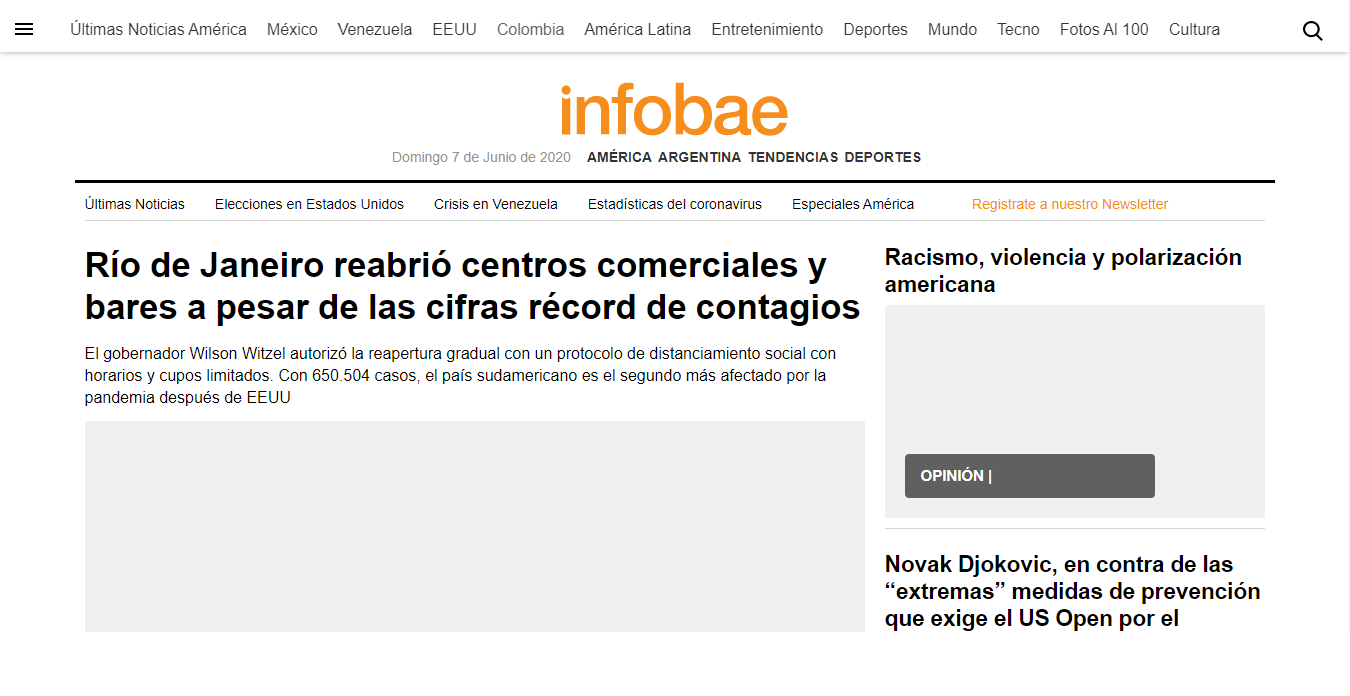
Infobae is an Argentine digital news outlet founded in 2002 by businessman and journalist Daniel Hadad as the online extension of the financial newspaper Buenos Aires Económico. Headquartered in Buenos Aires, it delivers content primarily in Spanish across politics, economy, sports, culture, and international news, employing hundreds of journalists to produce multimedia reporting. The platform has achieved significant growth, ranking as the top news website in Argentina with over 15 million unique monthly visitors in late 2024 and leading digital traffic among Spanish-language media in Latin America. Infobae has garnered recognition for investigative journalism, including an award for its role in the FinCEN Files exposé on global financial scandals, while analyses describe its editorial stance as left-center biased due to story selection favoring progressive sources, though it maintains high factual accuracy. Under Hadad's ownership, the outlet expanded internationally with bureaus in key cities and adapted to digital trends, prioritizing speed and volume in coverage amid Argentina's volatile political landscape.

History

Founding and Early Development (2002–2010)

Infobae was established in 2002 by Argentine media entrepreneur Daniel Hadad as the digital news portal of the financial newspaper Buenos Aires Económico (BAE), which Hadad had acquired in 2000 in partnership with Sergio Szpolski, who exited the venture a year later. Positioned as Argentina's first fully digital newspaper, Infobae launched amid limited household internet penetration, initially targeting office-based users with real-time news updates in a post-2001 economic crisis environment where traditional media faced constraints. The platform emphasized and content, integrating Hadad's existing radio operations to cross-promote stories and build a multimedia ecosystem. Early operations were headquartered in , with a small team led by figures like Valeria Cavallo, focusing on rapid content production to differentiate from print-dominant competitors. Audience growth accelerated steadily from inception, driven by free access and coverage of political and economic developments during Néstor Kirchner's presidency (2003–2007), though specific traffic metrics from this era remain undocumented in . By 2007, divested the struggling print edition of BAE to Szpolski, redirecting resources toward Infobae's online expansion and solidifying its digital-only model amid Argentina's recovering economy and rising broadband adoption. Through the late , Infobae invested in website enhancements and journalist hiring, establishing itself as a key player in Argentine online journalism by 2010, with uninterrupted expansion attributed to its agility in covering crises like the 2008 global financial ripples. This period laid the foundation for Infobae's later dominance, prioritizing speed and volume over in-depth analysis in its editorial approach.

Expansion into Digital Dominance (2011–Present)

In 2011, Infobae released its initial mobile application for Android devices via platforms like the , marking an early pivot toward mobile accessibility amid rising smartphone adoption in . This coincided with broader digital maturation, as the outlet capitalized on Argentina's expanding user base, which reached 30 million unique users by 2016 according to measurements. By prioritizing real-time news delivery and multimedia integration, Infobae positioned itself as a frontrunner in shifting consumer habits from desktop to mobile, where traffic began dominating overall visits. A pivotal advancement occurred in 2017 when Infobae transitioned its mobile site to a (PWA), addressing high bounce rates caused by slow load times on 71% mobile-driven traffic. The PWA implementation, developed in collaboration with technologies, resulted in a 230% increase in session duration, a 20% rise in pages per session, and halved bounce rates, enhancing user engagement without native app downloads. This technological upgrade supported sustained audience expansion, with monthly unique users surpassing 75 million by the end of 2019, establishing Infobae as the leading digital news site in and a top performer in the Spanish-speaking market per data. International growth accelerated post-2017 through localized editions targeting diaspora communities and regional markets, including Infobae US, Infobae México, and Infobae América, which by 2020 ranked among Mexico's top 10 most-read sites with 8.5 million unique users. Mobile apps for these editions further extended reach, enabling real-time notifications and social sharing tailored to users in the Americas and Europe. Content diversification into verticals like gaming and economics in late 2019 fueled exponential traffic surges, with year-over-year increases of 61% in Argentina, 177% in Chile, and 198% elsewhere in Latin America by March 2020. By 2025, Infobae's digital infrastructure had evolved to incorporate AI tools like the ScribNews platform for journalistic efficiency, sustaining dominance with 178 million monthly visits as reported by analytics. This trajectory reflects strategic investments in scalable tech and hyper-localized content, yielding one of the largest Spanish-language audiences globally while maintaining operational agility in a competitive digital landscape.

Ownership and Leadership

Founders and Key Figures

Daniel Hadad founded Infobae in 2002 as one of Argentina's pioneering digital-only news platforms, initially building it from a website previously associated with the Buenos Aires Económico newspaper. A and journalist by training, Hadad graduated from the Universidad Católica Argentina and has a background in media entrepreneurship, including founding radio stations such as Radio 10 and television channels like Mega. Born in 1961 in to a family of Syrian origin, Hadad divested other media assets in 2012 to focus on Infobae, which he owns primarily through THX Medios S.A. and continues to lead as CEO. In 2017, Argentine billionaire Eduardo Eurnekian acquired a 20% stake in Infobae América, the international arm of the company, marking a significant investment from one of Latin America's largest conglomerates, Corporación América, which spans airports, agribusiness, and energy sectors. Eurnekian's nephew, Tomás Eurnekian, serves on the executive board and facilitated the stake's acquisition in 2018, contributing to strategic oversight amid Infobae's expansion. Other notable figures in leadership include Eleonora Zocco and María Laura Fogliatti on the executive board, alongside operational directors like Valeria Cavallo as , supporting Hadad's vision for digital growth and integration.

Corporate Structure and Financials

Infobae is structured as a privately held media company operating under THX Medios S.A., with Daniel Hadad as the primary owner and founder. The organization encompasses Grupo Infobae, which manages its digital news operations, radio stations, and international editions across multiple subsidiaries. Daniel Hadad serves as , overseeing strategic direction, while Tomás Eurnekian, nephew of businessman , acquired a 20% stake in Infobae América in 2018, marking a significant minority . had previously purchased 20% of Infobae América in 2017. The corporate hierarchy includes key executives such as Barrios in a CEO role for operational , alongside directors handling product, , and functions. This structure supports Infobae's expansion into global bureaus and multilingual content, coordinated centrally from . Financially, Infobae relies predominantly on , which accounted for approximately 98.9% of total as of available assessments, supplemented by subscriptions and official advertising contracts. As a private entity, detailed are not ly disclosed, though third-party estimates place annual revenues in the range of $35 million to $55 million, driven by high digital and ad . No external rounds or equity offerings have been reported, reflecting self-sustained growth through operational efficiencies and market dominance in Spanish-language digital news.

Operations and Reach

Global Editions and Bureaus

Infobae maintains newsrooms (redacciones) in several key international cities to facilitate localized reporting and broader coverage of global events. These include facilities in , , Bogotá, and , alongside its primary operations in . This network enables the outlet to produce region-specific content, drawing on on-the-ground journalists to cover political, economic, and cultural developments tailored to audiences in , , and beyond. The platform features dedicated sections for international audiences, such as Infobae América, which aggregates news relevant to the with a focus on cross-border issues like migration, trade, and U.S.-Latin American relations. Separate editorial streams address through content emphasizing policies, local politics, and transatlantic ties. In countries like , , and , Infobae adapts articles to national contexts, incorporating local correspondents' dispatches on domestic elections, security challenges, and economic indicators. Expansion into digital editions has extended Infobae's reach to communities, particularly , where content targets Spanish-speaking readers in cities like and New York with stories on immigration policy, remittances, and cultural events. Brazil receives coverage via Portuguese-translated summaries and São Paulo-focused reporting on regional trade dynamics. These efforts are supported by over 450 staff journalists and more than 1,000 stringers worldwide, allowing real-time aggregation and verification across time zones.

Technological Infrastructure and Innovations

Infobae operates a digital-first infrastructure optimized for high-volume news delivery, leveraging cloud-based content management systems to handle millions of daily page views across its global editions. In June 2016, the outlet adopted The Washington Post's Arc publishing platform, a software-as-a-service solution that integrates video processing, mobile web optimization, app development, and syndication to third-party platforms, enabling scalable content distribution without on-premises servers. This shift supported Infobae's expansion into multimedia and real-time updates, with Arc managing CDN configuration, performance monitoring, and origin stability to reduce latency. To address mobile engagement challenges, Infobae implemented (PWA) technology, which significantly improved load times on mobile devices and more than doubled average session durations while lowering bounce rates. The PWA features offline caching, push notifications, and app-like responsiveness, allowing users to access seamlessly even on slow networks, a critical innovation for its audience in where mobile traffic dominates. Complementing this, Infobae maintains dedicated native apps for and Android, including Infobae Argentina and Infobae América, which provide real-time alerts, interactive commenting, social sharing, and personalized feeds, with over 1,300 ratings averaging 4.7 on the as of recent data. In recent years, Infobae has pioneered AI-driven innovations in Argentine , integrating tools for content generation, , and to enhance efficiency amid competitive digital pressures. As part of broader experiments, it has developed AI applications for automated reporting and audience analytics, positioning it among leaders like Clarín and in the region's AI adoption, though this raises concerns over potential over-reliance on algorithms for editorial decisions. These advancements build on serverless architectures for event-specific coverage, such as real-time election , ensuring during peak traffic spikes.

Editorial Practices

Content Categories and Sourcing

Infobae structures its content into distinct categories reflecting comprehensive coverage, primarily targeting Spanish-speaking audiences with a focus on , , and global events. Key sections include Política (), covering domestic and regional ; Economía (), addressing markets, , and developments; Sociedad (), encompassing , and social issues; Deportes (), featuring local and international competitions; Espectáculos (), reporting on celebrities, media, and cultural events; Mundo (world), providing international ; Tecnología (), discussing innovations and ; and specialized areas like culture and opinion pieces. These categories enable segmented delivery of , investigative reports, and multimedia content, with and often dominating due to regional volatility. Sourcing practices at Infobae rely on a network of over 300 journalists and correspondents across , , and the , supplemented by partnerships with international wire services for global coverage. Original reporting forms the core, with on-the-ground bureaus in major cities enabling direct access to events, officials, and data; for instance, political stories frequently draw from exclusive interviews and official documents. The outlet has integrated since 2023 to automate routine sourcing and drafting for categories like , , and updates, using tools to aggregate public data feeds and generate initial drafts under human editorial review, which accelerates output while reducing costs in a competitive digital landscape. Fact-checking and verification protocols emphasize cross-referencing claims against primary sources, with a dedicated "Fact Check" section addressing in and society, often debunking viral claims from or official statements. Infobae's approach has earned high marks for factual reporting from independent evaluators, though sourcing transparency varies, with articles typically attributing information to named sources or agencies but occasionally relying on anonymous officials in sensitive political contexts. AI aids in initial verification by scanning for inconsistencies in large datasets, enhancing efficiency in high-volume categories like and . Critics note potential over-reliance on algorithmic aggregation could introduce unverified data if oversight lapses, but empirical assessments confirm low rates of failed fact-checks compared to peers.

Journalistic Standards and Fact-Checking

Infobae upholds journalistic standards centered on timely, verified reporting, with human oversight emphasized as a core principle amid the adoption of AI technologies. In coverage of AI's role in , the outlet referenced its code of stipulating that information must be generated and verified by humans, permitting AI to assist in drafting or initial processing only under direct supervision to ensure accuracy. To support fact-checking and production, Infobae deployed ScribNews, an internal AI platform launched to automate fact gathering and streamline workflows for journalists, enabling faster sourcing while requiring manual validation of outputs. This integration reflects a pragmatic to digital demands, prioritizing empirical cross-verification over automated conclusions, though detailed protocols for disputing claims remain internal rather than publicly codified. The organization publishes dedicated fact-checking articles under its "" category, scrutinizing political statements, viral claims, and narratives, often drawing on multiple primary sources for validation. Examples include evaluations of and assertions, aligning with industry norms for evidence-based rebuttals without affiliation to independent verification networks like the International Fact-Checking Network.

Reception and Impact

Readership Metrics and Market Position

Infobae holds a leading position among Spanish-language digital news outlets, particularly in and expanding markets like and the . As of September 2025, infobae.com ranked first in the News & Media Publishers category and 170th globally by website traffic, according to analytics. In , it consolidates dominance as the top digital news site, surpassing competitors like Clarín.com in audience reach, with reporting approximately 178 million monthly visits and a national ranking in the top five overall as of October 2025. In , Infobae has surged to the forefront, leading as the most-read publisher alongside El Cronista according to data released in July 2025, with estimating 24.05 million monthly visits, predominantly from mobile devices. This positions Infobae as a key player in the broader Latin American digital ecosystem, where it leverages international editions to capture a significant share of Spanish-speaking audiences amid a shift toward online consumption, with 55% of regional users favoring digital platforms as of 2023. Audience demographics reflect a young, mobile-oriented readership: data for September 2025 shows 55.27% male users, with the 25-34 age group comprising the largest segment. Average session duration stands at about 3 minutes and 49 seconds, with 2.29 pages viewed per visit, indicating sustained engagement despite a 55.36% . These metrics underscore Infobae's competitive edge in a fragmented market, driven by real-time reporting and content, though it trails global English-language giants in absolute scale.

Achievements, Awards, and Influence on Spanish-Language Media

Infobae has achieved significant readership milestones, positioning it as the most visited Spanish-language digital news site globally, with approximately 120 million unique monthly users and over 1.2 billion page views. In key markets including , , , and , it consistently leads digital audience rankings, surpassing competitors in monthly unique visitors and engagement time, where users average 32 minutes per session. These metrics reflect its expansion since 2010 into international editions, enhancing its reach across and . The outlet has received multiple journalism awards recognizing its digital innovations and content quality. In July 2025, Infobae secured six Martín Fierro de los Portales Web awards from Argentina's APTRA, the most of any medium, including best Argentine news site for infobae.com; founder Daniel Hadad won the inaugural Golden Martín Fierro for portals. In November 2024, it claimed the Martín Fierro for best news portal in the Latino edition. Earlier recognitions include eight ADEPA prizes in 2020 for journalistic excellence and a 2023 national digital journalism award for its Colombia edition in the tourism category. Infobae journalists also contributed to the 2020 FOPEA Top Investigative Journalism Award for the FinCEN Files coverage. Infobae's influence extends to shaping Spanish-language through its emphasis on speed, storytelling, and bureaus in major cities, which have set benchmarks for real-time reporting in regions with limited traditional media infrastructure. By prioritizing and user engagement via mobile-optimized platforms—where 80% of traffic originates—it has driven competitors to adopt similar agile models, elevating the overall pace and of online in Spanish-speaking audiences. This dominance, evidenced by its top global ranking among Spanish outlets since at least 2017, underscores its role in democratizing information flow amid print media declines.

Controversies and Criticisms

Allegations of Political Bias

Infobae has faced allegations of political bias primarily from supporters of Kirchnerism, who claim the outlet maintains an anti-Peronist or anti-Kirchner slant, particularly in its coverage of corruption scandals involving former president Cristina Fernández de Kirchner and her family. Critics, including pro-Kirchner publications, have accused Infobae of selective omissions, obsessive focus on personal wealth, and amplifying judicial narratives in reports on Fernández de Kirchner's assets, framing such coverage as partisan propaganda rather than objective journalism. Fernández de Kirchner has repeatedly categorized Infobae among "medios opositores" (opposition media), asserting that outlets like it contribute to a coordinated campaign of negative reporting against her political movement, as detailed in her public letters and statements following electoral setbacks. These claims align with broader Kirchnerist narratives portraying Infobae, alongside Clarín and La Nación, as part of a hegemonic media bloc hostile to Peronist governments, especially during investigations into cases like the "cuadernos de las coimas" scandal in 2018. Such accusations reflect Argentina's polarized media landscape, where partisan bias claims proliferated in the amid conflicts between successive governments and independent outlets, though Infobae's owner Daniel Hadad has been separately criticized by left-leaning sources for opportunistic shifts from initial alignment with to more critical stances post-2010. Independent evaluators outside the local context, such as , have rated Infobae as left-center overall, citing story selection favoring progressive sources on social issues, but these assessments do not mitigate perceptions of or opposition to populist policies among Argentine leftists.

Government Censorship and Blocks

In , access to Infobae's website has been blocked by the government since October 10, 2014, when the National Commission of Telecommunications (Conatel) restricted the site following the publication of photographs depicting opposition leader in prison. This action was part of broader efforts by the administration to limit independent media coverage critical of the regime, including restrictions on reporting about political detainees and protests. The block persisted as of September 2019, prompting Infobae to publish guides on using virtual private networks (VPNs) to circumvent the for Venezuelan users. The Venezuelan authorities' repeated enforcement of the restriction, including a confirmed re-block in October 2014, aligns with patterns of digital suppression targeting foreign outlets that challenge official narratives on human rights and governance. Independent monitors have documented this as an instance of state-imposed internet filtering to enforce an "information lockdown," affecting Infobae's reach in a country where alternative access methods became essential for disseminating uncensored news. No similar nationwide blocks have been reported in other countries where Infobae operates extensively, such as Argentina or Mexico, where internet freedom reports indicate generally unfettered access to news sites without government-ordered restrictions on political content.

Sensationalism and Ethical Disputes

Infobae has faced accusations of , particularly in its coverage of , scandals, and political events, where critics argue it prioritizes dramatic headlines and emotional appeals over substantive analysis to drive traffic. A 2023 study by the Latin American Journalism Review analyzed Argentine media coverage of femicides and concluded that major outlets, including Infobae, frequently employed a sensationalist style emphasizing emotional impact and graphic details, which 70% of surveyed public respondents viewed as exacerbating rather than informing on violence prevention. This approach aligns with broader critiques of digital-native news prioritizing elements, such as exaggerated claims in headlines about or insecurity, though Infobae maintains its reporting uncovers underreported facts. Political figures have amplified these claims, often in response to adverse coverage. In September 2022, attributed inflated public perceptions of urban insecurity partly to "amarillismo" () by the press, encompassing Infobae's frequent reports on violence and governance failures in . Similarly, in May 2024, the Veracruz state government in denounced Infobae alongside other outlets for "amarillista" articles intended to undermine official efforts on public safety, labeling them as distortions rather than . These rebukes, typically from administrations critical of Infobae's investigative pieces on alleged , highlight potential conflicts where source incentives—such as deflecting accountability—may undermine the accusations' credibility, especially amid Infobae's documented exposés on systemic issues. Ethical disputes have arisen over perceived prioritization of virality, including isolated claims of misleading "exclusives." In , commentators accused Infobae of deceptive promotion in a high-profile "world scoop" that allegedly inflated its novelty to boost engagement, fueling debates on transparency in digital headline practices. No formal sanctions from journalistic bodies have resulted, but such incidents underscore tensions between audience-driven models and standards like those in Argentina's codes, which emphasize accuracy over spectacle; Infobae has not publicly retracted core stories but defends its methods as responsive to public demand for unfiltered revelations. Critics from academia note that while risks eroding trust, Infobae's scale—reaching millions daily—amplifies its influence, prompting calls for self-regulation in Spanish-language .

References

Add your contribution
Related Hubs
User Avatar
No comments yet.